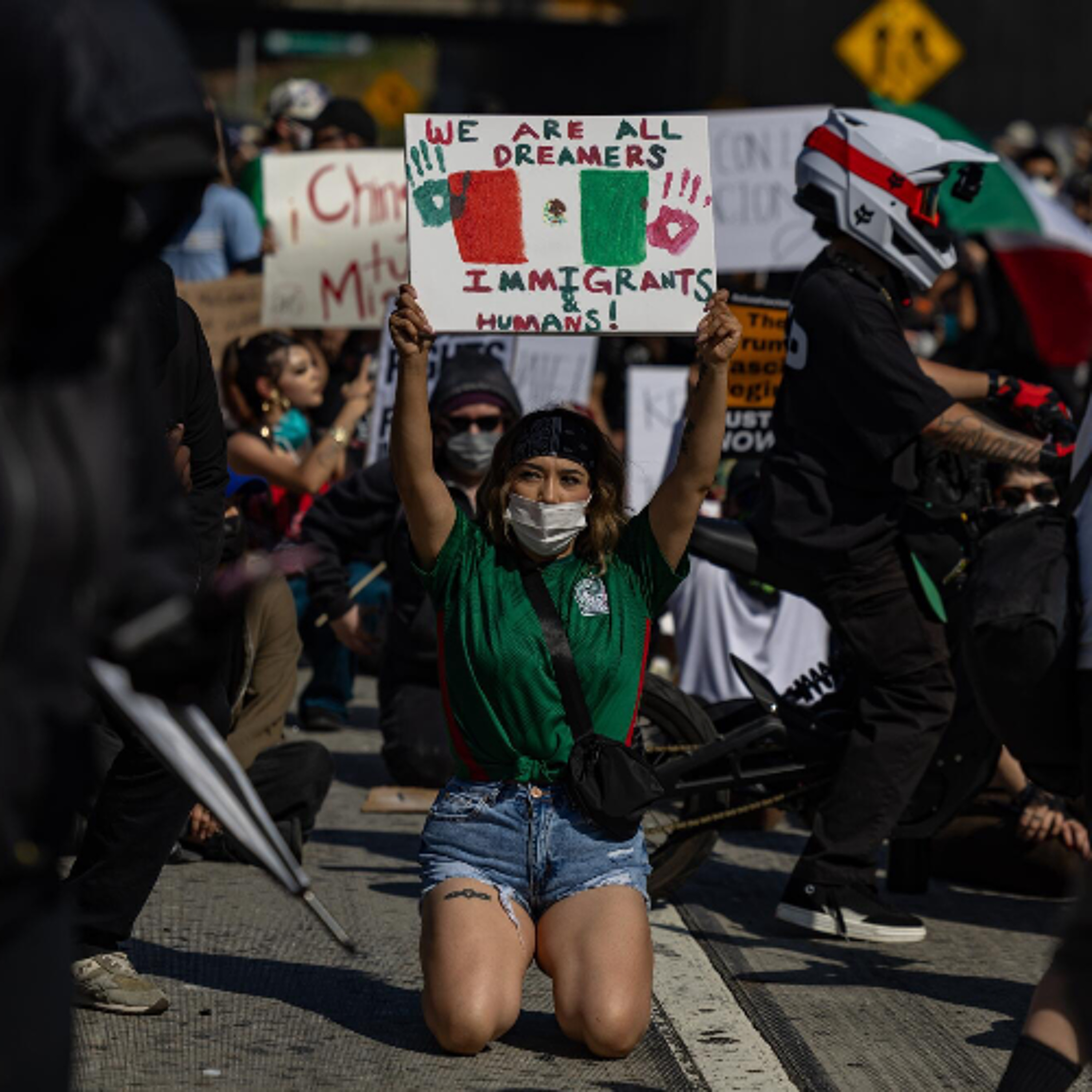
U.S. Immigration: Trump’s Weaponization of an Already Broken System
39m 48s
The speaker emphasizes that addressing contemporary fears requires an internationalist perspective, recognizing global interdependence. They critique U.S. immigration policy as a bipartisan project of border militarization and externalization, highlighting programs like the Southern Border Program initiated under Obama and continued under Trump and Biden. These policies, including detention in sites like Guantanamo Bay and the use of the CBP One app, erode asylum protections and human rights, often with devastating consequences for migrants. The media's focus on Trump's xenophobic rhetoric obscures the longer history of harsh measures across administrations, from Clinton to Biden. The speaker argues that meaningful change demands solidarity with migrants and a rejection of nationalist frameworks, urging collaboration across borders to advocate for universal human dignity rather than citizenship-based rights.
We live in scary times. It's true and we have to say that it's scary and again I have to remind people that the world is bigger than the United States. In this moment of deep fear and unsettling of what being an American citizen is, we have to remember that the key to enduring this is an internationalist mindset. Our lives are always bound to other people who we don't even know outside of the United States. Truly, truly bound because if we even just look around right now in the recording studio we're in, everything in this studio almost was not made in the US. It was made by hands elsewhere. We literally live amongst the remnants of other people and we can then collaborate with them to make different kinds of political claims, then what the US, the normative US politics, allows us to say. I work with migrants because I believe if the US is going to change actually the way to do that is to organize with people outside of the US to make a more internationalist demand to demand the dignity of human life as such, not just the dignity of the citizen. If we can start thinking that way, even though the world is scary, it might be a little less scary. Life is big, the world is big, and there's so many other possibilities besides the ones that are presented to us by Donald Trump or Barack Obama or Joe Biden. Welcome back to season 14 of the Global Inquirer. We are an undergraduate research podcast based out of the University of Virginia and we are sponsored by the International Relations Organization. I'm your executive producer Andrew Chan and I'd like to welcome you to today's episode on one of the most important topics in contemporary American politics, immigration, which we'll discuss through an engaging conversation between special guest professor Levi Vonk and podcast correspondence Abigail Larkin, Anika Shaw, Carolinas on a stone and commutamentary. We're glad you're tuning in and hope you enjoy the episode. [Music] Today we're here with our host, Abigail Larkin, Carolinas on a stone and Anika Shaw. And we'll be discussing recent immigration policy changes under the new presidential administration with our guest Levi Vonk, who is an author and assistant professor of global studies at the University of Virginia. Dr. Vonk's first book, Gordar Hacker, publishing co-written with Axel Kirschner, in 2022 narrates our first-hand account of the migration trail through Central America to the U.S. border and the challenges this entails. You'll also be discussing his recently published article in the Jacobin Political Magazine. The Democrats also want to deport you, where he compares immigration policy and issues of border militarization under different presidential administrations. Would you care to introduce yourself for Professor Levi? Sure, yeah, my name is Levi. I'm an anthropologist by training a medical anthropologist. I work with Central American Migrants Traveling through Mexico. To look at border militarization and externalization. And as you mentioned, I'm also a journalist at least part-time. And I think a lot about how U.S. immigration policies don't just affect Americans, but many other people outside of our borders. Could you expand a little bit on border hacker and your article? Maybe a little synopsis of both. Sure, yeah, so my book, Border Hacker, I co-authored with an undocumented Afro-Latino migrant named Axel, and he's also a computer hacker. So it falls his life. He was born in Guatemala during the Civil War, but he grew up in New York City, and he learned when he was a teenager that he was undocumented. So in order to make money, he started teaching himself how to hack and fix computers. And then he was deported again at about the age of 37 back to Guatemala. And I met him shortly after his deportation on a migrant caravan, actually the country's first migrant caravan back in 2015. And then the story really takes off from there. So it's about our friendship, but also Axel's life. He ends up on the caravan. His hacker skills are noticed by very powerful people in Mexico. He ends up being kidnapped and forced to hack government officials there. So a lot of the book is about that. In relation to my Jack Van Arcole, I was trying to think about the longer history of U.S. immigration policy. So part of what I write about my border hacker is this program called the Southern Border Program. It is a secret border externalization program where the U.S. pays Mexico millions of dollars a year to catch and deport migrants before they can get to the U.S. and ask for asylum. And what's interesting about this program, or maybe horrifying about this program, is that it was an invention of the Obama administration. So not Trump. So and I understand right now, as everyone is very worried about Trump, we should all be very worried about Trump. He's awful, incredibly xenophobic, but part of my article for Jack Van was trying to say how actually between Obama, Biden, and Trump, there's actually a linear progression, a border militarization and externalization. It's not actually something that's particularly new to Trump. It's a bipartisan effort, and we forget that. And when we forget that, we forget about all the people who are basically put in the blender during democratic presidencies. So part of my own politics and my own research is trying to think about how we can work with migrants across the border regardless of who's in power at the moment. Thank you so much. Okay, so in your most recent article with Jack Van, you explained a specific example about detaining migrants in Guantanamo Ve. And you say that in reality, the scenario has already played out before under both George Bush senior and Bill Clinton, who each attained tens of thousands of Haitian migrants at the military base in the 1990s. And we were just wondering how you would say that previous presidential administrations defer or are similar to what President Trump is currently doing. Yeah, there are several differences. One is that with Trump, he is a bit of a wild card. He's incredibly overtly xenophobic, and that is used to create a lot of fear and whip up even more anti-immigrant sentiment that already currently exists. So we're at a moment US history that's one of the most xenophobic ever. I think it's more xenophobic than at least overtly so than under Bush or Clinton. So I don't want to minimize Trump's impact and his horrible rhetoric. And it does have real world consequences for people living in the country who are both documented and undocumented. That being said, part of what I'm trying to say in the article is that the actual infrastructure of border militarization is something that builds upon itself between each presidential administration. So we see over the last at least 40 years our border being militarized and it's usually militarized more and more with every president who's elected regardless supposedly of what they say their politics are. So with someone like George Bush senior using Guantanamo Bay to detain many Haitian migrants for the first time, the idea was kind of we just don't want to deal with these people. We don't want to look at them. So we'll put them in a place that Americans literally can't see right. The whole point of Guantanamo is not being able to know what's going on inside of there. We'll put them there at least for a while so we don't have to really pay attention to them in the national media anymore in the national consciousness anymore. And then you see Clinton basically do the same thing. So this idea of hiding migrants detaining them elsewhere not in the US but outside its borders in a kind of third place becomes more and more important. And again with something like the Southern border program, I see that as like basically a kind of larger scale implementation of these smaller things were entertaining people in Guantanamo Bay. Now we just make sure that everyone or as many people as possible hundreds of thousands if not eventually over a million migrants are just stuck in Mexico stranded indefinitely. And the whole point is to not be in the new cycle to not be in the media. So it looks like each president is doing something quote-unquote about immigration right. But in reality they're just making a ton of people's lives much much worse and they're not solving the root causes of migration to begin with. Thank you. So in your article you compare and contrast the Obama administration with Trump's and we were wondering if you could break down the difference between them focusing on the legality of Trump's different migration policies such as how he's going about deportation getting rid of the CBP one app. ICE raids relocating migrants to the mega prisons in Guantanamo and El Salvador. And we were wondering in your professional opinion how valid and legal are these new forms. Trump's reforms are illegal. But I think what we're starting to realize in the US which has not been part of a kind of normative liberal notion of the world is that I think liberalism often says well whether a rules and everyone just has to follow them. What Trump is showing is that whoever's in power makes the rules. And so even though he's doing things that are quote-unquote illegal so far no one has stopped him from doing that. So there's a real question about moving forward are these things that were previously illegal now just going to become normative and therefore legal right which isn't incredibly scary. But part of what I'm saying is because I think when we only focus on Trump alone we get so scared and we're like oh my god what kind of horror are we living in and it is a horror and we should say that. But it's one that's actually existed for a longer period of time which maybe doesn't feel comforting at first but to me it actually means that there are ways that lots of people including migrants have already been trying to navigate is deeply immoral.
world in humane systems. This is a new iteration of that, but there are ways to push back and resist. So for instance, with Barack Obama and the Southern Board program, the whole point again was in a way it's not it is different don't get me wrong from Trump like basically just kidnapping a bunch of people in the street in the US and then sending them the El Salvador, but also Barack Obama is our deporter in chief. He deported more people than any other president in human history. That is also kidnapping people and just sending them back many of them to prisons or to be murdered by gangs and cartels in their home countries. So these things have kind of already been happening for a long period of time. Also with the Southern Board program, the Obama administration and then the Trump administration and then the Biden administration and other Trump administration again, paying Mexico to basically stop all of these people is another form of kidnapping them and basically imprisoning them. They're just imprisoned in a detention center instead of the squirm quote prison. But generally the conditions are more or less the same. I mean don't get me wrong, these prisons in El Salvador are horrible and despicable, but so are a lot of the detention centers in Mexico. And a lot of people end up dying or going missing on the migrant trail now because of the Southern Board program. It forces them to take increasingly unsafe journeys and they get kidnapped, they get killed. We know that in the last 10 years at least 50,000 migrants have gone missing, which means probably they've been killed and we just don't know where they are and that's at least it could be much, much higher. So that's one issue, the Salvadoran prisons. I'll also just be briefly about CBP1 here. So CBP1 if you don't know, it was basically created under the Biden administration and it's created, they say to help streamline the asylum process. So they say our asylum system is overwhelmed, there's too many people showing up at a reporter. So what we'll do is we'll create this app and then through the app you can apply for asylum. Well that's not true. The app is to apply to apply for asylum, right? So asylum legally, internationally as it's always been constituted since the end of World War II, is that anyone anywhere in the world has a right to leave the country, cross into another country, and through that physical act of crossing a border they can then enter into the asylum process. Always, everyone has a legal right theoretically all over the world. Basically what the Biden administration did was CBP1 to say you don't have that right anymore. In order for you to cross into the United States, first you have to get on this app and you have to apply and then maybe you'll be granted the right to cross into the United States. That's also against international law, that's dismantling international asylum law. So in my article, well I think I have a quote by this really wonderful immigration attorney named John Flanagan who does amazing work with undocumented people in the state of California. He says Democrats seem obsessed with loading the gun that Trump will shoot us with, right? So basically this is what's happened is that Biden and before him Obama and before him Clinton and all the way down, right? We have started dismantling these protections, these human rights protections, under the idea of streamlining or making something more efficient, but really it's not. And then once we've dismantled the system that protects people, when Trump uses it to really hurt people even more, we go, "Oh my god, where is this coming from?" It's like the Democrats did it. And I think that we need to pay more attention to that. So I've read that during the Obama administration, they focused more on deporting migrants who had committed crimes in the United States as opposed to Trump just committing people whose crime is illegally migrating. Would you agree that that's true or? No, I wouldn't. I think that these things get really wishy-washy and I don't have the stats in front of me to truly get into the details, but actually I think a lot of that rhetoric out of the Obama administration was not so dissimilar. And we'll start to ask like, well what was the crime really? Maybe the crime was alleged, first of all, right? And I mean, so a lot of these people aren't even convicted, but then the police picked them up on the side of the road and they say, well, they might be a suspect for this robbery or this whatever, but they don't actually know, but then you get turned over to ICE and then they can just deport you. And part of that process is instead of having you actually go through the legal system and then deciding whether you committed this crime or not, what ICE would do was pressure you to self-deport so they could say, look, we can give you a trial. That trial are also our criminal justice system as backed up, so you might have to wait in prison for sometimes years before you can see a judge and you hear it all out. Instead of doing all that, you can just self-deport. If you sign this piece of paper, we'll just put you on a plane right now. You won't have to go through this whole process. You'll be back in your country tomorrow. And so a lot of people, and I'm talking about hundreds of thousands of people, just sign the paper because the choice was either rotting in jail or going back to their home country. And so the idea for them, at least a lot of people, including Axel who I wrote my book with, it was not such a dissimilar position that he was put in. And he said, well, I have kids. I can't be sitting in jail all this time, not working. So I'll sign the paper. I'll go back to Guatemala, a country that I really didn't know very well at all. But I'll just try to get back to the US as fast as I can. And what ends up happening with border militarization in the Southern border program is a lot of people sign this paper. They think they can get back to the US and then they never can. So that was a strategy of the Obama administration as well. So yeah, Trump is definitely just, he basically sees all and documented people as criminals. But I think that Obama played a large part in creating those conditions, seeing anyone without documents as inherently suspicious and needing to be removed from the country. In our politics class, we've been talking a lot about how previous administrations have deported more people than Trump. But because of the news and media rhetoric around Trump's campaign, it's kind of amplifying it because that's what he's promised. How would you say the media's impacting how he's being perceived and kind of what they're showing and not showing about what he's doing? Yeah, I think that American mainstream media from the New York Times to Fox News, which we see as two polar opposites. One, more liberal and rigorous, one conservative and not rigorous and actively deceitful. Actually, I think that that's a false binary and US media, mainstream media as such is incredibly conservative. So we see a trend over time about what gets reported on. Basically, if there's any kind of progressive policies or an intent to implement something that's more humane and understanding, whether that's immigration or just general social welfare or whatever, the US media's job, it seems, is to just continuously critique those things, whip up hysteria about them and make them less likely to exist. When it comes to someone like Trump, who is no interest at all in helping anyone but himself, because it's so apparent and obvious, the media basically just kind of reports on what he says, but doesn't follow up on the actual concrete things that he's doing. So still today, I have conversations with, quote unquote, well-intentioned liberals all the time, who think that Trump is worse on immigration. And I'm just not really so sure that's true. Again, he creates a more actively more openly hostile conditions for undocumented people in the country, and again, even documented immigrants. That is definitely true. I'm not trying to mitigate that. But under democratic presidencies for at least all of our lifetimes, if not much more, Democrats have been creating incredibly hostile conditions towards immigrants while saying that we love them. And I almost think that sometimes it's better to, if someone's going to lie to you at least, like, let's all just know what's happening, right? Let's know that the lie is being said. And so Democrats can actually be more effective sometimes at mass deportation because people just take them in good faith. At least right now, we know that Trump is not acting in good faith. I'll give you one more example that kind of relates to this too, which is, I do a lot of my work in Mexico. I live in Mexico for part of the year every year. And I work closely with a few people, or I should say now, I have some friends who are working in the Morena government, which is the government and power right now in Mexico. I would describe them as kind of center left social democratic government. They're trying to think very hard about how to alleviate poverty in Mexico and have actually done it very successfully. And something that they tell me, a few, these people told me, who are in lower level positions of power, definitely not higher level. But they say, you know, in some ways, we prefer Trump to be president than a Democrat because Trump is stupid and inefficient. So he says all these horrible things and he says Mexicans are rapists and blah, blah, blah, and that's insulting on one level to us as being Mexican. But on another level, he's not very good about following through his threats, his threats. They're so disorganized, they don't really know what they're doing. They don't have any kind of complex understanding of Mexico. And so like we can actually push back in ways that are helpful to us. Whereas with democratic presidents, they're much more cosmopolitan. They know all the right things to say and they know then how to screw up your country a lot more quickly. So they're like, yeah, we definitely don't like Trump. But there's actually ways that we can maneuver that we can't under democratic presence. I think that's really important if we're thinking about things like international migration, thinking about politics are not just confined to the United States, but global that actually there are opportunities with this horrible Trump presidency for other people who have been historically pressed by the United States. Could the trade war between the US and Mexico lead to further militarization of the US Canada border as a proxy and also then discussing kind of like the declaration of cartels and terrorist organizations, what power and pretext does this give the Trump administration to go into Mexico? Yeah, you know, I don't know about the US Canada border it would be surprising to me if Canada decided to militarize its border more. Maybe the US will install a few more beefed up checkpoints, but it seems to me
that so much of this worry about being invaded by immigrants is racialized in the US, there's not really any real threat of Canadians invading the US, right? This is even this fear, like they have a quote unquote developed economy. And so I don't think that there would be the same way that we'd be erecting a wall against the Canadians. That being said, I have been surprised by just how quickly relations between the US and Canada seem to be inflamed. It doesn't look good, I don't know what that means for the future, I don't know if it's really just all for show or if it's really real and then we need to be worried. But I don't even know what that would look like, I think it would look different than the US-Mexico border. As far as the US invasion in Mexico, I think that something that Mexico has going for it is actually, again, almost that this particular kind of US racism works in Mexico's favor in some ways. There have been other opportunities for the US to invade Mexico, and in fact the US has invaded Mexico at different points. But so far, at least in our history, this idea of ruling over another people that is racially distinct, linguistically distinct, culturally distinct from what we understand as kind of normative American-ness seems to have not been very appealing to a lot of presidents who believe that they're engaging in some sort of manifest destiny, right? And I think Trump, at least from what we understand of him right now, and the people that he's working with, also probably wouldn't want to overtly invade Mexico in that way, because then suddenly you're talking about preserving a white race, well now you've just incorporated 120 million brown people into the American public, right? So I think that that's probably not what will happen overtly, but what we do have to understand is that since, especially World War II, colonialism has taken a different form. We can dominate people without literally owning them on a map, and that's part of what our corporations do. So you have a corporation like Coca-Cola who owns most of the water supply in Mexico. So in some ways, we've already conquered, quote unquote, certain aspects of Mexico, but in other ways, there are ways that, you know, of course Mexico is pushing back, and I think that's why these tariff wars have come to play. Trump is intent on trying to own more of Mexico's economy even if he's not owning overtly its landed people. So as part of your anthropological work, you have locked the migrant chow for, as you documented in OrderHacker, and we are wondering if you could speak on how this could impact individuals who are attempting to take this path and talk about the individual migrant experience, especially with this additional negative rhetoric surrounding migration in the US, and also are there any specific examples of how this is affecting migrants that you know, like Axel from, for example. Yeah, I mean, it's definitely affecting migrants. And again, it's been affecting migrants long before Trump, but for this new Trump presidency, I can just talk about Axel here. Axel is now in the United States and in the asylum process. And part of the worry of the new Trump administration is that asylum as a system is already incredibly dysfunctional. It's been made dysfunctional by a bipartisan effort. But Trump gives even more excuses to make it more dysfunctional more quickly, right? So the process for Axel is going to be long. It's tenuous, incredibly uncertain for him, and you know, things that previously would have maybe taken a couple months are now taking many, many months and might take years. And so we'll just have to see how that goes with him, but also, you know, many thousands, tens of thousands, hundreds of thousands of other people are also stuck basically in this kind of bureaucratic mess that the Trump administration is only inflaming. In terms of border militarization, again, yeah, things are incredibly deadly for people crossing the border. You know, we've made our, we've turned our deserts on the US Mexico border into killing machines, right? So we intentionally don't create infrastructure other than border walls in these areas so that people have to walk through the desert without resources and then they die in the desert, right? And then intentional human choice to turn this thing that we call quote unquote nature into actually a machine that kills. And that's going to continue. I think the big question for us, they're the rest of our lives, they're the rest of the 21st century is we're anticipating the continued collapse of climate change, which means the continued mass migration, right? Now there's over 400 million people in the world who are migrants. That almost certainly will cross a billion in our lifetimes. You know, if there are a billion people, we're migrants, and that's an eighth of the world's population. It'll probably be more like a 10th. But think about that. A 10th of the world's population has no home, has no protections. And it's horrifying and it's scary and all of these Western countries are building walls, both literal and bureaucratic to keep those people out. And also I wonder how you actually do that on such a massive scale. If there's literally a billion people desperate to make a life for themselves, that's also a real political possibility. It's horrible, but it's a real political possibility because politics are born out of desperation and horror actually, right? And the people that I'm most inspired by politically are single mothers carrying their babies across rivers at just the slightest chance of a better life for themselves. To me, that's real politics. For risking your own life at a chance to make your child's life maybe better. If we get to that place, the billion people who are really, truly willing to organize, we might actually be able to also rethink what the world is and how it works. I don't know. I mean, it's incredibly scary and it almost certainly won't work out that way. But the reason I do the work that I do is because I think that migrant caravans and migrants willing to work at risk of their lives are some of the most politically interesting and inspiring people on the planet. And I think that we have a lot to learn from them as we continue to see our own social institutions fall apart and be hollowed out. We don't just have to be scared when we see this. We can start working with people who've already been having to live with this kind of situation for decades and see what they've been doing to survive and the different kind of political claims that they make in the world. We've discussed the hyper militarization and how that impacts the migrant trail. And I know a lot of migrants then end up going through the dairy and gap. And I was wondering if you could talk about that and expand on that. On the dairy gap? Yes. So as borders have become increasingly militarized, they're also increasingly externalized. Right? So maybe I should break that down a little bit, right? So militarization of a border is overt. It's like the walls, the barbed wire, the immigration patrols, the guns, the tanks, today heat sensing drones, motion detectors, all the high tech stuff, right? And that's right on the border, that line on a map that gets imposed on the land. Border externalization is the idea of as we get more and more technology and as wealthy countries have more and more money to spend on this, we'll push that border, which is still fixed on a map out into other countries to make it even harder for people to get to that militarized border in the first place. So in the case of the Southern Border Program, its intent is to turn all of Mexico basically into the US border. So now instead of having to cross a line in the sand and maybe you actually, when you cross the rear ground, you run a mile and then you get into town, now you have to cross at least 1500 miles for that opportunity, right? So what we're seeing now is not even just that two countries are collaborating, the US and Mexico, right? As we keep pushing those borders further and further and further, in our case, south of the US-Mexico border, whole continents can start getting transformed into borders. So the dairy and gap, what's happening now, is that people from other, increasingly from just other countries around the world, not just from Latin America, but from places like China, Tanzania, Cameroon, Haiti, they can't immediately get visas to Mexico. So they have to fly to a place like Chile or Brazil. And from there, travel to the dairy and gap, cross into North America through the dairy and gap, right? And then trek across all of Central America to then arrive in Mexico, to then go to the United States. So we're talking about thousands and thousands of miles they have to traverse. Many of the hardest parts on foot. And so that means that many more people die. And even if they don't die, they get injured and maimed, and that strands them in other countries. So they just can't move anymore, which is also a big part of this. It's not just catching and deporting people back to their home countries. It's literally physically disabling them so they can no longer continue the journey, up and to the point of death. So we just want to stop them at all costs, whatever that means. That could be killing you, that could be cutting off your legs, that could be giving you diabetes or hypertension or whatever, just so that you can't walk anymore. It's just whatever we need to do to stop you from arriving at the U.S. and entering the asylum system, that's what we'll do. So in the United States, there are cities known as sanctuary cities. And just in the future, with new like ice ray practices and new, you know, Trump administration policies, do you think that they'll be eliminated entirely? I don't know. I think, you know, sanctuary cities at this moment still have a certain amount of power to push back. It's going to depend a lot on the political spine of the people running those cities and how willing they are to organize against the Trump administration. I think that what we've seen is that normative liberals and powers.
actually came pretty quickly to chump. They don't actually, they like to have this whole idea of that they resist and bubble, but they don't resist. They hand over the keys to the city very quickly. So it will be up more to local grassers organizers who are willing to break from the normative ideology of American liberalism and think much harder about other social formations, protection of immigrants, and human rights, to protect those sanctuary city policies. I think that there are people out there who are willing to do that. Even in Charlottesville, I think that there are a lot of people who are thinking really hard about this and trying their best. There is a church here under the first Trump administration that got pretty famous in the media for housing an undocumented woman who the Trump administration was trying to deport and they allowed her to be in the church for years and they, whenever she had to leave, they would accompany her outside of the church and make sure that ice wasn't going to show up. And so that is what we need to be doing in part to stop Trump's mass deportation policies. Now I'll say, though, however, that's still relatively reactive, right? And we don't want to just be reactive. We want to be proactive. One of the ways to do that is to demand the end of institutions like ice. They should not exist. Ice is not even that old. I don't exactly know how old you are, but it's more or less as old as you are, right? So it has not existed that long. It definitely just shouldn't exist. The only reason ice exists is to terrorize communities of people, communities who are mostly racialized and ethnicized in one particular way, which is to say, and this claim is a little bit vassic, but I believe it's true, ice exists to conduct ethnic cleansing. That's a job. They're an ethnic cleansing organization. See, only reason they exist. They have no business existing not only in the US, but anywhere in the world. We need to eradicate those kinds of organizations and institutions, but that would mean us really thinking hard about how we organize ourselves to make those demands possible. Ice is not just going to hand over their guns willingly. So how do we create a world where they don't exist anymore? I think that's one of the big questions of my life, actually. Finally, since Trump is attempting to eliminate many of the legal pathways to citizenship, what do you think the future could hold for those trying to attain citizenship in the near future? In the near future, I think things are increasingly complicated, but at least a decent amount of people will be able to continue their legalization proceedings in the short term. If we keep having presidents like Trump back-to-back with no real resistance in any meaningful way from Democrats, I don't know how long our current understanding of citizenship will last, which is again very scary. It also presents an opportunity for us to rethink what citizenship was in the first place, something like the asylum system, which we definitely don't want to see lost necessarily, right? But ultimately, we forget that the asylum system does not accept more people than it rejects. So its ultimate purpose is not to accept people and bring them in, it's to deport them, right? And so actually, it presents an opportunity for us to rethink what asylum is and can we create systems that allow people to stay much more indefinitely than they do currently? What I would hate to see is a kind of move for all of us right now to just protect how citizenship works and just to keep that alone. We should be thinking about how within the nature of the citizenship process itself, it's already deeply conservative and maybe even fascistic that Trump is able to wield this to his own, his own and so easily because it was never that great to begin with. Can we create more policies that are inclusive of everyone in the world? rethink what a nation state and a community actually is? Just in regards to the citizenship question, they're thinking about, you know, they're talking about revoking birthright citizenship, which is obviously in trying to the Constitution would take a constitutional amendment to change. So how likely do you think that is? And also, there are a lot of countries in the world, I know that they don't have birthright citizenship, that their citizenship is through, you know, like your ancestry or your parents, is it like a valid thing to change for the US? I think again in the short term, it feels unlikely to me at the moment that Trump would be able to end birthright citizenship. He might even issue some executive order that says he's doing it, but you can't actually change the Constitution that way. However, I will say we're at an interesting moment in time again where for a long time we saw our Constitution as this holy document that couldn't be changed blah, blah, blah. For better or worse, right? And always it was worse because of that. But we might be entering a period where all of that is up for negotiation again, which is very scary. But I will say that, yeah, the way that we understand who belongs in a society through this idea of birth, that you're just born here and then you get to belong or you're born elsewhere and you don't belong or you have to go through this extensive, sometimes decades-long process in order to then be able to belong. I don't like that either. And I would like us to rethink how we might include people more quickly in our society. I'm not going to pretend for a second that that will just happen naturally and have suddenly everyone will be much more open and inclusive. That takes a lot of work and organizing that maybe probably in fact won't happen in my lifetime. But I think that we should still always keep that in mind and still try. When it comes to other forms of citizenship that aren't birthright, like blood quantum, I mean, I think birthright citizenship is ridiculous, but blood quantum citizenship is like overtly Nazi nonsense. It's like it means that literally if you don't come from a particular quote-unquote race, you can't be a citizen in the same way, right? Of course there are caveats to that and there are some ways that you can legalize yourself. But you get into these weird situations in Europe where these supposedly very progressive countries like the Netherlands or Germany have people living in them for generations talking about people who their grandparents or great grandparents came to the country from Turkey, like in the in the Netherlands is very common, where Turkish immigrant workers in like the 1950s and 60s showed up, they were never allowed to legalize themselves fully as in get citizenship. Then their children are born, they can't be citizens, and their children are born and they can't be citizens. And so now you have whole generations of people who have only lived in one country who are not seen as part of that country even though they're literally building it and making it. So I think ultimately again it should bring into discussion what citizenship is and doesn't actually not work most of the time to exclude. Can we think of creating a society in a country big enough where in order to qualify for social services you don't have to be a citizen? If they're really if social services are for society for everyone then literally anyone should be able to qualify for them. So how do we create a society like that is the big question. Thank you so much. Thank you. Do you have anything else to add that we might not have gone to? No I mean I think when I talk about immigration the only thing I'll add is that it's always very scary. In this moment of deep fear and unsettling of what being an American citizen is we have to remember that the key to enduring this is an internationalist mindset. Our lives are always bound to other people's who we don't even know outside of the United States. Truly truly bound because if we even just look around right now in the recording studio we're in everything in this studio almost was not made in the US. We literally live amongst the remnants of other people and we can then collaborate with them to make different kinds of political claims then what the US, the normative US politics allows us to say. I work with migrants because I believe if the US is going to change actually the way to do that is to organize with people outside of the US to make a more internationalist demand to demand the dignity of human life as such not just the dignity of the citizen. If we can start thinking that way even though the world is scary it might be a little less scary. Life is big the world is big and there's so many other possibilities besides the ones that are presented to us by Donald Trump or Barack Obama or Joe Biden. So leave us with that. Thank you so much. That's our episode for today. As always thank you for listening to the Global Inquirer and thank you to correspondence Abigail, Anika, Carolina and Camina and especially to Professor Levi for helping this story come to life. If you enjoyed this episode please make sure to follow us on Spotify or wherever you get your podcasts. Also please feel free to give us a follow on Instagram @UVA Global Inquirer. [Music]
Podcast Summary
Key Points:
The speaker advocates for an internationalist mindset, arguing that American lives are interconnected with people globally, and political change requires collaboration beyond U.S. borders.
U.S. immigration policies, including border militarization and externalization, have been consistently escalated across both Democratic and Republican administrations, with programs like the Southern Border Program originating under Obama.
Policies such as detention in Guantanamo Bay, the CBP One app, and deportation strategies undermine international asylum law and human rights, often with bipartisan support.
Media coverage tends to amplify Trump's rhetoric while overlooking the structural continuity of harsh immigration measures under previous administrations, masking the deeper systemic issues.
Summary:
The speaker emphasizes that addressing contemporary fears requires an internationalist perspective, recognizing global interdependence. S. immigration policy as a bipartisan project of border militarization and externalization, highlighting programs like the Southern Border Program initiated under Obama and continued under Trump and Biden.
These policies, including detention in sites like Guantanamo Bay and the use of the CBP One app, erode asylum protections and human rights, often with devastating consequences for migrants. The media's focus on Trump's xenophobic rhetoric obscures the longer history of harsh measures across administrations, from Clinton to Biden. The speaker argues that meaningful change demands solidarity with migrants and a rejection of nationalist frameworks, urging collaboration across borders to advocate for universal human dignity rather than citizenship-based rights.
FAQs
An internationalist mindset recognizes that our lives are interconnected with people globally, beyond just U.S. borders. It encourages collaboration across borders to advocate for human dignity and political change, making the world feel less scary.
The Southern Border Program is a U.S. initiative that pays Mexico to intercept and deport migrants before they reach the U.S. border to seek asylum. It was started under the Obama administration and has continued under subsequent presidents.
Border militarization has increased linearly over the past 40 years, with each president, regardless of party, expanding policies like detention and externalization. This bipartisan effort builds upon previous administrations' infrastructure.
Trump's policies are overtly xenophobic and create fear, but the underlying infrastructure of border militarization is similar across administrations. Democrats have also implemented harsh measures, often under the guise of efficiency or reform.
No, the CBP One app undermines international asylum law by requiring migrants to apply for permission to cross the border before seeking asylum. This contradicts the right to seek asylum by physically crossing a border, as established after World War II.
Mainstream U.S. media often amplifies fear around progressive policies while underreporting the concrete impacts of harsh measures. This can mask the continuity of border militarization across administrations and distort public understanding.
Chat with AI
Loading...
Pro features
Go deeper with this episode
Unlock creator-grade tools that turn any transcript into show notes and subtitle files.
 PodcastTranscript AI