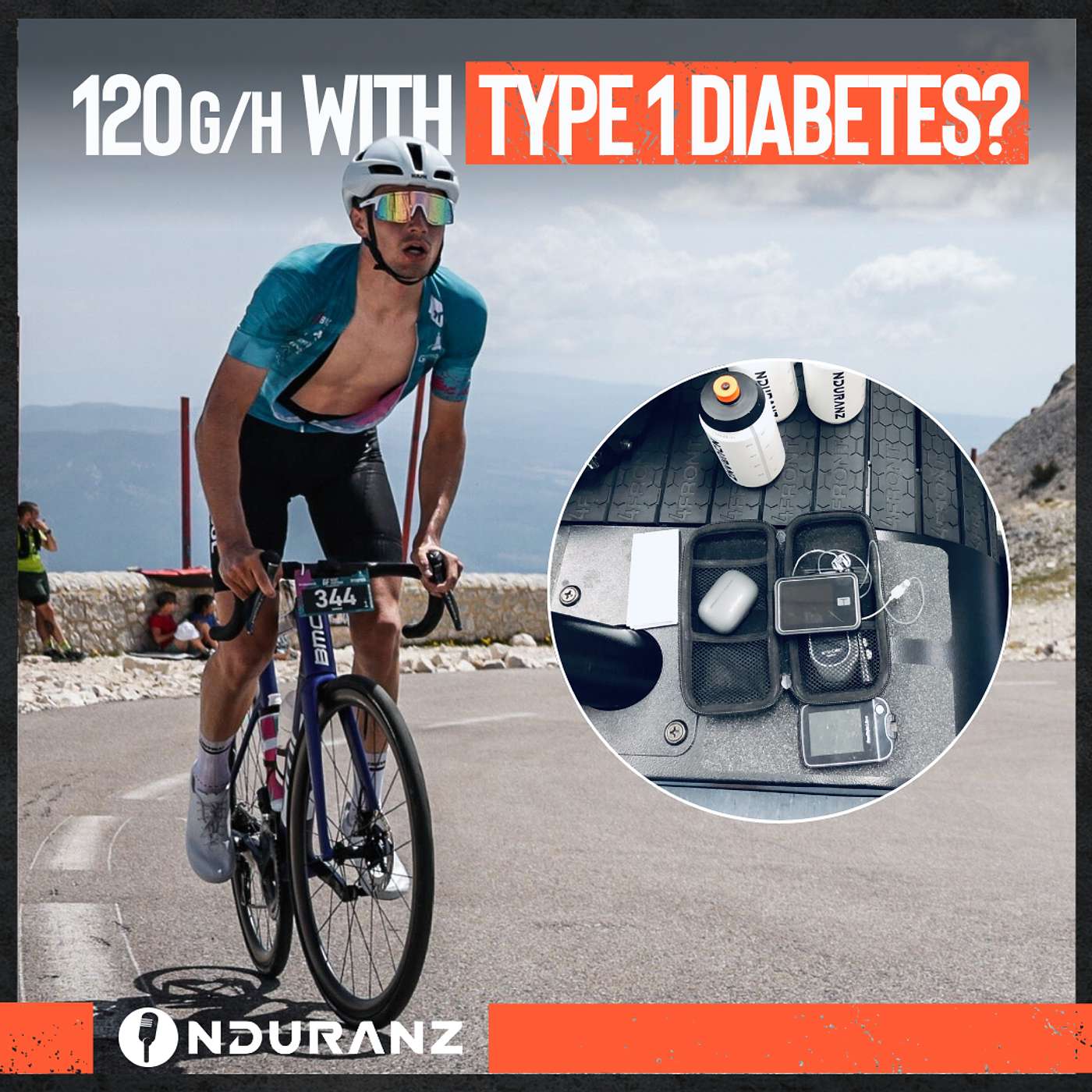
Type 1 Diabetes: Can You Fuel at 90–120g/Hour? (with Simon Helleputte)
62m 25s
In the endurance podcast episode featuring Dr. Simon Hellepo, the focus was on exercise metabolism and type 1 diabetes. The discussion covered the challenges faced by individuals with type 1 diabetes in regulating glucose levels, fueling for endurance activities, and utilizing continuous glucose monitoring tools during exercise. Dr. Hellepo's expertise in exercise metabolism, performance coaching, and his book on exercise and type 1 diabetes provided valuable insights. Athletes with type 1 diabetes encounter difficulties in glycogen storage, insulin administration, and fueling strategies, which require careful planning and monitoring. Technological advancements like continuous glucose monitors and advanced insulin pumps have revolutionized the management of type 1 diabetes, offering improved quality of life and better control over glucose levels during physical activity.
Transcription
9667 Words, 55272 Characters
Welcome to the endurance podcast. In this episode, we discuss exercise metabolism and type 1 diabetes with leading expert Dr. Simon Hellepo.
We deep dive into the regulation of glucose, the challenges that type 1 diabetics face when fueling for endurance events and continuous glucose monitoring during exercise.
There's some great insights and knowledge for all athletes, not just those with type 1 diabetes. We hope you enjoy.
[Music]
Hello and welcome to the endurance podcast, where we dive into the science, the strategies and the stories behind endurance sports, performance and nutrition.
I'm your host, Alex Rhodes, and as always, my glamorous assistant, Dr. Tim Podloga. Good morning, Tim.
Hey, Alex. How are you doing?
I'm not too bad. Thank you. How are you?
Good. I had two rides this weekend outside. Both times I was wet and both times I had to clean the bike, so I'm not doing it again this year.
Well, it is that time of year, isn't it?
But today we've got a super exciting guest and a super exciting topic, and we're going to be talking about something that actually affects thousands of athletes out there and millions worldwide, and that's type 1 diabetes.
And I promise to the listeners out there, even if you don't have type 1 diabetes, there's so much to learn about metabolism, and it seems to be at the forefront of sports science and nutrition at the moment.
So today joining us is Dr. Simon Helliputty. He's a researcher in exercise metabolism, mainly around carbohydrates and their hormonal regulation, but he did his doctoral work on exercising with type 1 diabetics.
In addition to that, he's also a performance coach, so he has the applied insight as well, but I'll let him explain a little bit more when we get into it.
Finally, he even wrote a book, so anyone who wants to read a little bit further or is interested in this subject, he wrote a book called Empowered on the topic of exercise and type 1 diabetes.
So if you're interested in that, you can head to Spotify or Amazon to take a read.
So without further delay, I'd like to welcome you on the show, Simon. Good morning.
Thank you very much. Good morning. Thanks for inviting me. It's an honor to be here, in fact.
And thank you for coming and joining us on what I think is going to be a very interesting and very fascinating discussion.
Just to start with for the listeners out there, if you could just explain a little bit about what your current role is and what you do in the applied field as well, so the listeners can understand a little bit more about yourself.
Yes. Well, currently, as you mentioned, I'm a performance coach, so I guide athletes, cyclists and runners. I train them training, testing and also performance nutrition, sports nutrition.
So that's really nice to have that applied part. And next to that, last year I was enrolled after I did a postdoc project on continuous glucose monitoring, which we'll speak about later.
I was enrolled in a postdoc mentorship. It's called from the European Diabetes Association, in which I was guided and mentored by Tim, by Tim Podlogar.
Brainstorming about research in type 1 diabetes and also what he aimed to get funding eventually for projects about exercise metabolism in type 1 diabetes.
So that's really a fascinating and nice combination.
And next to that, since a few months, I'm also a scientific ambassador for endurance. So all these things come nicely together.
And then mentioning the book last year, we decided me and my co-author, Sam Scott, to bring all these things that we have learned about type 1 diabetes and exercise together in our book, really aiming to bring the science to the patients, to the athletes,
using the physiology and giving them the necessary insights into how better exercise and more effectively exercise.
And as far as I understand, yourself and Tim are looking to try and get funding for projects around exercise metabolism and endurance athletes with type 1 diabetes.
Yeah, both from a fundamental aspect, like the role of insulin and its effects on metabolism, which is not investigated enough, I think.
And secondly, more applied, like using this basic knowledge to let them exercise and do also really high performance exercise, like long endurance races, cycling, running, triathlon,
and learning all these things to feel properly, because it's so challenging for type 1 diabetes.
Yeah, and I can't wait to get in deeper into the science around it, because it's a subject close to myself.
But I suppose for listeners, because this is not, I wouldn't say it's hugely public, it's not huge in the social media space,
and even more so as much as type 2 diabetes in the clinical space.
So just for the listeners, can you just explain what type 1 diabetes is and how that is different not only to someone with regular glucose metabolism, but also type 2 diabetics?
Yeah, I'm happy we start this way, because it's good to put a framework around diabetes.
In fact, in my opinion, and I know that many endocrinologists would agree with me, type 1 and type 2 diabetes are really different diseases,
and in fact they should not have been called diabetes type 1 or type 2. It's completely different.
Type 1 diabetes is an autoimmune disease. It's a chronic disease, it's a metabolic disorder, and there's still no cure today.
Specific cells in the human pancreas are destroyed. Sometimes it already starts in childhood, sometimes it's later.
So it's really, I often say, it's a central defect. It starts in the pancreas, there's destruction of specific cells, the beta cells,
and because of this, insulin cannot be produced anymore. So we have an absolute insulin deficit.
And insulin is a key hormone which regards to glucose metabolism, glucose uptake, and it's further metabolism.
Not only glucose, but also regulation of fat metabolism, also important anabolic effects of insulin on muscle growth and protein synthesis.
So without insulin, people without which type 1 diabetes cannot survive, unfortunately.
They need to administer insulin exogenously, as you may know, via injections or via a pump.
So this is very difficult and this will continue for the rest of their lives. Currently, there's still no cure.
Now we have type 2 diabetes, and type 2 diabetes is not an autoimmune disease. It's, I would say, it's a lifestyle disease.
And initially, there is no problem, no central problem with the pancreas. It's mainly about physical inactivity and increased energy intake,
which will lead to fat storage in places where it should not be. This is called actopic fat deposition in the liver, in the muscles.
And because of that, also the pancreas will start to fail. So in the end, they will also need to administer insulin.
But the cause or the pathogenesis is completely different.
Okay, yeah, interesting. And I think this is like really kind of, yeah, leads into the next question, which I would ask.
Whenever I talk about carbohydrates in this podcast, probably the first most well-used word is carbohydrates.
And then the second one is glycogen, because I keep saying how important glycogen stores are for performance.
How are glycogen stores being in the liver or in the muscle affected by type 1 diabetes?
Can these people get glycogen stores stopped up or not?
Yeah, a very relevant question, especially as you say for athletes, can they carpload?
Can they do a proper glycogen storage protocol, let's say, but it's a bit complex.
I'll try to explain it as easily as possible, with regards to the liver, liver glycogen stores is complex because this relates to the fact how they have their insulin.
In the normal human body, we have insulin produced by the pancreas and this goes to the liver and has its effects.
In type 1 diabetes, we have exogenous insulin administration via another pathway.
It's in the subcutaneous fat tissue, so the insulin ends up in the peripheral circulation and is affecting the liver way less than in a non-diabetic situation.
And there has been some studies on this and it has been shown that liver glycogen storage is often negatively affected in type 1 diabetes,
especially if they are not treated adequately. If we go for an optimized insulin therapy and restore glycemic control,
then we can have the same effects, but often 1/3 to 1/2 of the type 1 diabetes population has a disturbed liver glycogen storage because of this administration pathway.
If we go to the muscle and fact that there is good news, several studies have recently investigated it and showed that carploading is possible,
but of course this requires a lot of planning, planning of your insulin administration,
titration, insulin dosage and monitoring of your blood glucose, but it is possible to have full muscle glycogen.
There is no evidence that shows that the muscles cannot have a proper carpload in type 1 diabetes.
So, pretty much saying muscle can be topped up, liver is a bit of a problematic way and that might affect fueling somehow,
so how the fueling strategies are advised, how is it different?
Perhaps starting from that point that the liver might not be topped up that well,
they might be at an even more increased risk of hypoglycemia, which we'll discuss later of course.
So, I think fueling properly and pre-fueling, carploading, is even more important in type 1 diabetes,
with regards to performance and also with regards to avoiding hypoglycemia because of this liver effects.
So, would they be fueling the same amounts or is it different?
How does it become complicated with insulin because I imagine you would need to still add some insulin during exercise and perhaps the insulin doesn't react immediately.
Well, if we think about having type 1 diabetes affects fueling, the easiest and my first answer would be,
well, it's more difficult and it requires way more planning.
Because in people without type 1 diabetes, why do we fuel?
We fuel because we want to maintain exogenous carpoxidation rates, so total carpoxidation rates and delay fatigue.
So, the answer is performance. We fuel for performance.
In type 1 diabetes, I often say we have a dual goal.
We want to fuel for performance, if we are an athlete, but also for safety, avoiding hypoglycemia but also exaggerated hypoglycemia.
So, I often say to fuel or not to fuel is unfortunately the question in type 1 diabetes.
Sometimes they want to fuel, but they have a glycemia of 20 millimole per liter, so they are not allowed to because of the glycemic disturbances.
Sometimes they are doing a low intensity, let's say phatoxidation right, they don't need to fuel, they don't want to fuel,
but they have a bit too much insulin administered at the pre-exercise meal and they are too low, so they need to fuel.
So, why is it so difficult and why do these glycemic fluctuations happen?
These has like three important reasons in type 1 diabetes.
The first one I already mentioned is that use of exogenous insulin.
We will always have sub-prophysiological levels of insulin.
The normal pancreas, it's like a perfect computer titrating insulin levels in relation to your blood glucose.
And it's almost impossible not to say impossible to mimic that dynamic of a normal pancreas.
Secondly, next to an insulin defect, and this is often not recognized and not known by the general audience,
there are also effects with regards to the counter-regulatory hormones.
So, glucagon, if we have insulin, then we also have glucagon, which is like the most important counter-regulatory hormone.
And also disturbances in this hormone occur in type 1 diabetes.
Not only glucagon, also cortisol, epinephrine, nor epinephrine.
And then the third reason is, and this is also the case in non-diabetic people,
there is a massive increase in insulin sensitivity during exercise and also after exercise,
and there is a massive increase in glucose uptake because an increased blood flow to the muscle.
This is the same in type 1 diabetes as in people without, but because of the aforementioned two reasons,
the exogenous insulin and the disturbed counter-response, this is even more exaggerated.
And that's why they have such an increased risk for glycemic fluctuations during exercise,
and this complicates fueling a lot, requires a lot of practice.
Yeah, I wanted to ask what technological advances we have to basically monitor all these things,
because it's so easy for us, people with doubts type 1, how do they do it?
Yeah, well, working with like over the past five to six years, working with a lot of athletes with type 1,
I can almost, it's almost impossible for me to imagine how athletes with type 1 were fueling 30 years ago,
when there were no continuous glucose monitors.
So these sensors that are measuring every five minutes your interstitial glucose value,
and telling the athlete this is your glucose value,
so knowing should I fuel more or less just to remain in a glycemic balance.
And secondly, if we go to insulin administration nowadays,
we have these crazy technological advancements with regards to insulin pumps.
We have now insulin pumps in which the insulin is administered based on an algorithm
that is communicating via Bluetooth with that continuous glucose monitoring.
So glucose is going up, then the algorithm decides we give a bit more insulin until glucose is stable again.
Glucose is going low, we stop insulin administration completely.
This has tremendously improved the lives of people with type 1 diabetes.
Not with regards to fueling, but the most important example why people say
after they have such an advanced insulin pump that their quality of life has improved is because of sleep.
They can just go to bed and not worry anymore, almost not worry anymore about their glucose levels,
because the insulin pump will give insulin according to the glucose levels.
Then they wake up and they had a good sleep and this is a major improvement.
So I've got a question just before we move on around that fueling
and if I take it back and I try and explain in simple terms
the likes of myself and some of the listeners.
So when we are at rest and we eat something that contains glucose
and we have elevation of blood glucose in the body,
we secrete insulin and that allows glucose transporters to come to the muscle
and allow it into the muscle.
When we're exercising, we have a slightly different way of doing that
that doesn't always require insulin.
In type 1 diabetics, do you still have issues whilst you're exercising in glucose regulation into the muscle?
Yeah, definitely, because we have insulin and we have muscle contractions
and both are responsible for glucose uptake.
So you could say, okay, luckily we have this second phenomenon,
the muscle in the contraction induced glucose uptake.
So this can happen, glucose uptake in type 1 diabetics, luckily.
But because they have that exogenous insulin administration,
I always say once the insulin is in, it's in.
What do I mean with this? When you have administered your insulin in the subcutaneous fat tissue,
it will be released slowly to the interstitial fluid and end up in the bloodstream.
But if you have not reduced your insulin administration at your last meal
and then you want to go exercise, there is relatively way too much insulin
because we have these muscles that will do the work
and they cannot say, oh, I have to reduce my insulin because the insulin is already in.
Now I'm speaking about injections.
Again, if you have an insulin pump, you have way more flexibility.
You have like literally a button which you can turn to say more or less insulin.
So if we have exogenous insulin, we have almost always supraphysiological.
So too high insulin levels during exercise and this complicates fueling a lot to avoid hypoglycemia.
So in the normal population, I mean, we see, I do get this a lot
and I don't know if you get this as well Tim, but people who we speak to,
the general recreational athlete were in a space where it's fueling high carbohydrate, high glucose, high fructose.
We often get the question around the worry of giving themselves diabetes
by this enormous amount or increased amount of carbohydrate and sugar consumption.
Are endurance athletes actually at the risk of developing that?
Is the question for me?
Yes, first.
I thought Tim was interviewing first. No, no, no problem.
Yeah, I get this question a lot as well.
First, I would say let's put the framework around this question
and we are speaking about type 2 diabetes because I really want to stress people with type 1 diabetes
don't like it when there is still sometimes, although it has improved,
but still sometimes there is this belief you will get type 1 diabetes from eating too much sugar.
This is not true at all, as I've explained before.
To come back to your question, we're speaking about type 2 diabetes.
Well, currently science says no, it's all about energy balance.
So calories in, calories out.
So are you consuming the sugars?
And the answer of course is yes for athletes.
If we look at what happens with the carbs, with the sugars that they've taken during exercise,
okay, high intake of carbs, but these are readily oxidized in the muscle
or upon very low intensity, perhaps stored.
But something useful happens, oxidizing or storing low amounts.
After exercise, massive increase in insulin sensitivity.
They need to refuel for the next session.
So again, these carbs are stored in a useful way to use them again for the next session.
And this is very different from the pathogenesis of type 2 diabetes
from a chronic overfeeding situation where you have a high demand on the pancreas,
way too much caloric intake and that ectopic fat storage, as I said before.
And then with regards to after the career, because sometimes this question also is under debate.
Are they at increased risk after their career for developing insulin resistance?
Well, still there is no evidence for that.
For the same energy intake, athletes are not at an increased risk of developing type 3 diabetes.
This would only be the case if the very high caloric intake is not reduced.
But of course, this is generally not the case.
They are not going to fuel that much and eat that much carbohydrates
when they are not a pro cyclist anymore, for example.
I was going to say, I guess if we're not cycling anymore and we're taking gels and drinks
and we're increasing that intake.
Exactly. And this is the same with what I was going to add.
With fructose, there is that debate on possible negative aspects of a high fructose intake
in athletes and professional athletes with negative effects on the liver.
And this question was asked on a podcast I heard lately to Javi Gonzalez
which is an excellent researcher in this field.
And still there is no evidence to show that high fructose intake
will have negative effects on the liver in athletes.
They seem to be protected because of their high activity levels.
So I really would say no to this question.
Yeah, if I may add, I think I've said it many times,
the most important thing to think about is after you eat carbohydrates
they will eventually and for sure end in the bloodstream as glucose or fructose.
So the question now is whether these carbohydrates actually go from the bloodstream
and if you have low muscle glycogen stores because you've just exercised
simply there will be a little bit of insulin coming into the bloodstream
and carbohydrates will simply end up in glycogen storage.
The problem is when you have full glycogen stores
because you've not exercised at all for the last few days
and suddenly there is a lot of floating carbohydrates
that don't really want to go into the muscle because muscle glycogen stores are full.
So what the body does is probably pumps even more insulin
because glucose needs to get out of the way from the bloodstream.
And what happens then is glucose starts to go into the places where it usually would not go
or is converted to, for instance, fatty acids that can start causing problems
and this is when risk of type 1, type 2 diabetes actually becomes present.
So I just want to go a bit more into the practical side of things
and if I was a recreational athlete with type 1 diabetes
and I want to go and say do an hour's ride, do some exercise or a run
how do I go out pulling this?
Because we've discussed some of that regulation of blood glucose
some with insulin pumps or insulin administration around of it.
What are the basic principles about planning some exercise?
Well, in fact, the answer is already a bit in your question, it's about planning.
You need to plan several factors and all the factors related to each other.
We have described the framework as well in our book about this
and according to us there are seven very important factors
and the first one is the timing of day.
You need to plan your exercise.
I'm not saying it's impossible to have spontaneous exercise in people with type 1
but it's just way more easier to plan your exercise.
So first timing of day, we know there are differences in the risk for hypoglycemia,
fasted exercise versus post meal exercise or afternoon or late evening exercise.
In general, fasted exercise in the morning will have a lower risk for hypoglycemia.
We have an increased cortisol levels, very low circulating insulin levels
and a higher contribution of fats to general energy production.
Secondly, maybe the most important question in my opinion is insulin.
When did you last administer insulin?
Because this relates to what is your insulin on board?
IOB or insulin on board is a term that is well known among people with type 1 diabetes
to describe and to think about how much insulin do I have circulating
and this relates to the risk of hypoglycemia, the more insulin, the higher the risk.
The need for fueling, if you have a high insulin level,
so if you have just eaten with a bolus insulin administration,
likely you will need to fuel earlier during exercise.
Then thirdly is your starting blood glucose.
When you want to start exercise, what is my glycemia now?
Am I at 5, at 7 or at 10?
Of course this again relates to when should I start fueling just to have safe exercise
if you're thinking about an hour of exercise.
We know that you can already have a hypoglycemia within 20 or 30 minutes
if your circulating insulin level is too high or your starting blood glucose too low.
A fourth one is of course the type of exercise.
Am I going for continuous exercise or intermittent exercise?
What is the duration and what is the intensity?
If it's a rather high intensity, like one hour with some threshold intervals,
very high use of glucose in general,
of course we will need to fuel to avoid hypoglycemia.
Another one is the duration of course.
If you go for a very long run, let's say two hours,
of course you will need a higher starting blood glucose.
Likely you will want to have low insulin levels to protect you from hypoglycemia and fuel more.
That brings me to the fifth factor, the carb intake.
Which type of cars am I going to use?
What is the total amount and also the distribution?
I'm not going to fuel 60 grams in one bolus,
especially not in type 1 diabetes because of the impact on glycemia.
I want a distribution that aligns with my glucose levels.
Then of course technology.
If I have a pump on these modern insulin pumps,
you can or I would say you need to announce to the pump I'm going to exercise
because the algorithm will then decrease the aggressiveness of insulin administration.
It's called an increased target.
You say to the pump I'm going to exercise and then it will increase the target value.
This means it will be less aggressive.
It will only give insulin when you have a higher target value versus when you're not exercising.
Also CGM, if you have CGM, you have to monitor your glucose values during exercise.
The seventh one is also an important one and often forgotten is previous events.
Do I have a lot of stress this morning or now?
When was the last time that I had hypoglycemia?
Very important one.
We know that if someone with type 1 diabetes has experienced hypoglycemia,
especially if it's severe hypoglycemia, let's say lower than 4 millimoles in the morning,
we know the counter regulatory response to that hypo will be blunted
if he has a second hypoglycemia in the afternoon.
In general, we discourage from going for long duration exercise in the afternoon
if you have experienced severe hypoglycemia in the morning because your protection is blunted.
These are the seven most important factors.
What are the implications?
Are the risk factors much higher for type 1 diabetics versus general population
with normal glucose handling?
Any of us who exercise have experienced a hypoglycemic event where we've either not fueled
or we've gone out at the wrong time and you just have to physically stop
and either go and find a shop and get some sweets or some sugar from there
to then restore those blood sugar levels.
Are the risk factors bigger in type 1 diabetes if that goes wrong?
Yeah, definitely in both directions.
Considering hypoglycemia, athletes without type 1 diabetes, yes, perhaps they can bunk,
they will experience low glucose levels, but then we should say what is low,
perhaps they will go to 4, yes, but type 1 diabetes, it can be lethal.
They can go to 3, to 2 because they have no protection or less effective protection to hypoglycemia
and they can get into coma and die, so hypoglycemia can be lethal in type 1 diabetes
and unfortunately has already happened in the past.
If you have administered way too much insulin, this can be very, very dangerous.
Also on the other side of the spectrum, and this is not happening in non-type 1 diabetes athletes at all,
if you have not administered insulin at all, so zero insulin for a very long time
in people with type 1 diabetes, they will have massive hypoglycemia.
But because there is no insulin, the glucose cannot be taken up in tissues
and then we will start using in an excessive way fats for energy use
and this will lead to more production of ketones and diabetic keto acidosis.
This is a situation that is not occurring.
In people without type 1 diabetes, we have ketosis.
We know the situation, low carb diets, we know ketosis will happen.
But in type 1 diabetes, this can develop to diabetic keto acidosis
and again, this is a lethal situation and we need insulin of course then.
To sum it up, probably I will try to add another example into this.
If you fuel a lot of carbohydrates, which is what we recommend to normal people,
so let's say 90 to 120 grams per hour, but at the same time also add a lot of insulin
to correct or allow the glucose and carbohydrates to flow into the muscle cells to be used.
Can there still be hypoglycemia occurring and what could be the issue with that?
Well, as long as we are not administering insulin exogenously, no, of course not.
I mean in type 1 diabetes.
We are speaking about type 1 diabetes.
Yes, of course this can happen.
Even if we are eating a lot of carbs, let's say we are eating 120 grams of carbs.
So we are fully saturating the transporters for glucose and fructose.
So we cannot protect them anymore by eating more carbs if they have hypoglycemia.
And if we then have administered too much insulin, they will go into hypoglycemia.
And as I said before, we cannot save them by eating more carbs because the gut is full of carbs.
So we need intravenous glucose.
And this is of course again a dangerous situation.
So I would rather fuel high and titrate insulin a little bit less.
So they have like, we allow a bit of hypoglycemia.
We can fuel properly then be too aggressive.
See, it's probably like moderately high glucose levels of between 10 to 15 still are not completely fatal or whatever.
It's the high points way more problematic.
Exactly, exactly.
Between 10 and 15 minimal is not fatal at all acutely.
Although I would not advise to always exercise between 10 and 15 on the long term.
Hypoglycemia is not good, of course, as we know for your cardiovascular system, etc.
But with regards to an acute situation, this will not be lethal at all.
If you have proper insulin, you will not develop diabetic ethyl acidosis.
But some athletes feel from 11, 12, 30 millimoles that their performance will decrease.
In general, what I notice most athletes will feel best.
And I'm speaking about endurance athletes, long duration exercise between 8 and 10 millimoles.
They feel safe, because glycemia is high enough.
They can fuel a lot and they can administer a bit of insulin.
So, and obviously we, you know, if the listeners are not aware, there are high performing type one diabetics.
You know, there's cycling teams that are high performing cycling teams that are specific to the type one diabetics,
which lends itself more to the performance orientated side of things, you know, longer races, you know, fueling strategies.
Going back to my question before, if I was someone who was type one diabetic and we spoke about, you know,
I would say moderate duration an hour, two hours.
What if I was going to something much greater than that, you know, five hours or beyond that?
You know, what would, what would, how would my plan look, you know, how would my fueling be for that?
Because that's obviously a much longer duration to manage.
Yeah, now it's a bit more complex.
We are not only fueling to be safe, to go for an hour of safe running.
We want to fuel for performance, as I said before.
And we are not only thinking about planning, but also about fueling as high as possible in a safe way to boost performance.
That's like the summary. And how do we do it?
First of all, of course, we need to take our exercise into account.
And we need to think just as we do in people without diabetes, what are our fueling needs?
What are our estimated carbohydrate needs?
This relates to intensity and duration.
And for example, as I said, as you said before, we go to four or five hours of exercise with some high intensity period as well.
So we need to fuel rather high, just considering non-diabetic situation, let's say 80 to 90 grams per hour.
What I often do with my athletes then, you use the personal experience, of course, of the athlete first,
and you think about what is your additional insulin need to cover that amount of carbs.
So we are really turning, there needs to be a shift in thinking.
We want fueling to avoid hypo. No, we want to fuel high.
And we think how much insulin do we need to add to cover that amount of carbs?
That's our basic strategy.
And then based on that thinking process with the athlete, we will bolus insulin during exercise between 0.5 to 1 or 2 units every hour.
Not more frequently, because if we give insulin during exercise too frequently, this is called insulin stacking.
Because as I said before, that insulin is administered in the subcutaneous fat tissue,
and you will have very long-lasting effects of all that insulin that is added.
So every hour, half a unit to two units to cover that amount of carbs that we think beforehand.
We do the session, let's say, with 80 grams of carbs and with that bolusing strategy.
And after the session, we observe.
If during this session, we see that the athlete needs to eat even more than 80 grams of carbs per hour for to keep blood glucose stable,
let's say between 8 and 10 millimoles, we know that we overestimated our insulin needs a bit.
So then it's quite easy. After the session, we know next time we need to titrate our insulin a bit lower,
or maybe skip the first bolus that we did and then follow along.
If during the session, we see that the athlete with 80 grams of carbs per hour and that estimated insulin strategy still goes too high,
15 millimoles is feeling bad, muscle cramps because of the hyperglycemia, we know we have to give a bit more insulin next time.
So it's all about learning about your past experiences and doing a lot of trial and error,
like two times, three times, until you know for this intensity and this duration,
I need that amount of carbs for performance and that associated insulin strategy.
So we really want, and that's the ultimate aim of fueling for endurance athletes, we want predictability.
The more insights we have in insulin needs for a given intensity and duration,
the more easy and predictable exercise will be.
And just to, I suppose leapfrog on from that, the thing that you mentioned there is predictability
and the ability to know what, let's say training, I imagine, with some maths is easy to understand,
where you have a duration, you have an intensity, you've got set amounts.
But I think we've had this conversation before Tim, around actually the unpredictable nature, say, of bi-creating.
So cyclists, for example, whether there's a tax out from the start and you have to go with that.
Do you have any experience about how those athletes deal with that unpredictability of sport?
Yeah, a very good question and they need to be able to handle with this.
Indeed, I remember a story that I heard from Sam Scott, who was head of research for Team Nova Nordisk.
So the team that exists exclusively of athletes with that point diabetes, going to Milan San Remo,
they had a wild card and of course they want publicity and as many as possible riders in the breakaway.
I think they were with four riders in the breakaway, Milan San Remo.
And of course, to get in the breakaway, very high intensity, a lot of stress.
You can already predict what will happen. They had hyperglycemia.
And then, of course, they need to think, should I give insulin a bit?
Because now if I do not give insulin on the bike, will I be able to keep fueling, to fuel this breakaway, to stay in the breakaway?
Because if I just follow glucose levels and forget to fuel, I'm not making this four-hour breakaway.
So this is very unpredictable and you need to, let's say, simulate all these kind of protocols on training before
and think about what can happen. Same with stress.
A few weeks ago, I had a triathlete and we had a nice strategy.
But then he had more stress than predicted on the morning of the race, way more stress.
And he gave his insulin bonus for his breakfast and still had hyperglycemia.
And then you need to keep calm and realize this stress is temporary.
What can I do? I can give a bit of insulin, but already think, then I will need to fuel a bit earlier.
And he did. He did amazing. He administered insulin because he had stress.
And normally we say insulin is a bit dangerous to administer before you go into a race, but he did and he started fueling earlier.
So he adapted on the moment. And this is the process that you need to go through with your athletes.
And maybe it's weird to say because I don't have a type when I beat this, but I like this process of thinking with the athlete about predictability.
But also, what do we do if something is not going according to plan?
At least as important as the predictability, as the unpredictability.
And Tim, what your thoughts are? Do you have any reflections working with the athletes that you work with in dealing with that unpredictability?
And whether there's actually any crossover there or any lessons that actually could be applied into those cyclists?
I mean, you want to be really methodological, but like Simon explained really well.
Like you need to document what you've done, learn from your experience from the past, but be prepared for the unpredictable things.
And yeah, the athletes I work with sometimes, yeah, they have issues that are unpredictable.
And then it was basically a result of a result in a bad day in the saddle, which you can't really do much.
Sometimes like the insulin would just not react the way it usually does.
There is something wrong with the technology.
There is something wrong with the glucose sensor, perhaps.
So you just need to do your best and sometimes things happen.
But probably you can minimize the risk of having unpredictable moments by making sure that you try to turn every corner and really think about it through in advance.
And plan and try to expect the most and learn from your past experiences.
And just moving on, I mean, still staying within the fueling realm.
But more about the composition now, because most modern sports drinks and gels are 1 to 0.8 glucose/fructose ratio.
There's two sugars having different glycemic responses.
Are they any different for type 1 diabetics because of the ability to handle things or having to handle things exogenously?
Well, if we think about the mixtures of gels that's at least with type 1 diabetes, for example, can use or are using.
And we have this question of the glucose/fructose ratio.
This is something that intrigues me already since a few years, because in type 1 diabetes, this might be very relevant to think about the type of carbohydrate, even more than fueling performance.
Because first, maybe it's good to mention again, why do we go for that 1 to 0.8 ratio?
We want to maximize total carbohydrate oxidation rates via the exogenous oxidation rates.
Because we know glucose absorption is limited, let's say in general 60 grams per hour via a certain gut transporter.
And then we have fructose, and we add fructose, another gut transporter, and we can maximize exogenous carboxidation rates.
But in type 1 diabetes, there might be an additional rationale to do this, because it has an additional benefit, and that it comes to glycemic impact and to the glycemic index of products.
So what is the glycemic index? As most of the listeners know, perhaps, the glycemic index of a carbohydrate-containing product is what the impact on blood glucose will be after consuming that product.
And the reference standard is pure glucose. If you consume pure glucose, this will have a fast and immediate impact on your blood glucose, and this has a value of 100.
And to glucose, other gels, other mixtures are compared.
Fructose is metabolized way differently than glucose. It has a way slower metabolism via the liver, and it has a glycemic index of 18.
So compared to the 100 of glucose, the impact on blood glucose will be way lower.
So next to increasing exogenous carboxidation rates, it's super interesting for type 1 diabetes, because it will have a low impact on blood glucose, and this has two main benefits.
Of course, if there is a low impact on blood glucose, there is a lower insulin need, which makes fueling way more possible.
You can fuel high by adding fructose and having less risk for hypoglycemia by adding too much insulin.
And secondly, but this needs some more research. If there is a lower insulin need, perhaps adding more fructose can, let's say, provide something that goes against the negative effects of insulin on suppression of fat oxidation rates.
So this is more theoretically, but if you add fructose, more fructose in someone with type 1 diabetes, you have lower insulin needs, and perhaps you can train more effectively by boosting your fat oxidation rates even more.
Also for refueling the liver, we know fructose, adding fructose in your post-exercise recovery will boost liver glycogen repletion rates.
And again, in type 1 diabetes, even more interesting, because we know this liver glycogen storage is a bit disturbed, as we discussed in the beginning of this podcast, and we have a lower insulin need.
So these subtle differences in fueling in type 1 diabetes are really important to research first and then apply.
And are they in the field? Are you changing those ratios at all, or are you currently trying to understand it better?
Yes, in fact, yes. And what do I mean with changing? First, a lot of athletes are just using glucose only, not fructose.
And I have some athletes with whom I'm trying to add more fructose, but always in combination with glucose, because we know fructose alone is not tolerated well.
And I see that Tim is nodding along. We need glucose, so first of all, we do that.
But for example, I have a triathlete with type 1 diabetes, and in the transition zones between swimming and cycling, we add some more fructose,
because often he ends the swim, very high intensity, a lot of stress, he ends it too high, hyperglycemia.
And of course, we want and we need to fuel the cycling, but he has hyperglycemia. If we add a bit more fructose, we can already start fueling
and boosting the exogenous carboxytation rates without high insulin needs. So this can improve the fueling strategy and cycling.
So yes, I'm doing it. And currently I have good results. First, we try it in training because they need to tolerate the higher fructose.
But if you tolerate it, if the answer is yes, then why not increase the fructose?
Of course, never higher than glucose. We know the oxidation will always be lower than glucose.
But sometimes if we are not using fructose at all, it's worth considering.
Yeah, if I may add, one of the things that perhaps the wrong term we use is that fructose is like a slow carbohydrate source.
Similarly, we would compare it to starch on having something complex during exercise. It's not that way because fructose is a simple sugar.
It's going to be transported rapidly into the bloodstream, but it will be taken out by the liver. So it has to be processed there first and foremost.
And the reason why the glucose excursions or the rise in blood glucose are lower is because liver needs to convert fructose to glucose.
And a big chunk of these fructose is actually converted to lactate.
And lactate is then released from the liver and then lactate can be used in the muscle cells or anywhere else and it will not raise blood glucose concentrations.
And only one part, still a big part, is converted to glucose.
So the excursion of or the rise in blood glucose will be lower for fructose because of this conversion to lactate.
And if I may add something also for the other simple sugar, galactose. There is some nice research currently in Denmark.
People with type 1 diabetes in which they are giving galactose pre-exercise and galactose has the same benefits, a very low glycemic impact, but still it can be used as a fuel.
So you can fuel the athlete without having a big impact on glycemia, which makes exercise way more easy again.
And of course, I suppose the fundamental thing of this as well is being able to monitor that glucose response and especially in type 1 diabetics that is going to be a hugely important factor.
And you did your post-doc research on continuous glucose monitoring, which actually not so long back took, I suppose, became really popular, not only from a clinical point of view, but there's lots of athletes using them trying to monitor glucose response during exercise.
So I imagine that is an integral part of exercising and monitoring blood glucose levels in type 1 diabetics.
Just to start off with Tim, just in the cyclist that you work with don't have type 1 diabetics, do you find that they're frequently used?
Less and less because of the UCI's rule that you cannot use it in racing, but before that I think many professional cycling teams were using continuous glucose monitoring devices.
We saw a lot of them riding with them and a lot of them was simply a result of marketing and a result of the company behind that device giving the devices for free to the athletes.
We saw the same way as we get core body temperature sensors and then the result was that most amateurs were or are using these devices for one reason or another without any hope.
Simon really agree a lot of evidence to support their use.
Yeah, if you would ask me is there an application potential, my short answer would be currently evidence says rather not.
The reason why they are not used anymore almost not used anymore by professional cycling teams is not because of the UCI ban.
It's because evidence has shown there is very limited application potential and we need more research.
And recently we wrote a part on CGM for the UCI consensus statement on sports nutrition with them and also a big review paper that is just got accepted will be published soon.
Because there are several claims about CGM, CGM can help with fueling, CGM can tell when an athlete is overtrained and we started from the bottom using the underlying rationality, possible rationality and underlying physiology to try to answer the application potential of CGM.
And we discussed several aspects and we came to the conclusion that for most of the aspects the physiological rationality is really flawed, is really limited.
And for the other ones where there might be a reason to use them, it has not been researched enough, we need more research.
And for the athletes with type 1, is that something that you recommend for all those athletes or do they monitor it in different ways?
100% there's no reason to say, and I'm speaking about endurance athletes who are not restricted.
For example, in football and judo, we have of course is contact sport can be dangerous.
But if you speak about running or cycling, 100% the CGM will tell you, and I'm speaking about athletes with type 1 diabetes will tell you when you're too low or too high, when you can increase the fueling.
And I deliberately say can increase the fuel, not should increase the fueling, and it's 100% reimbursed.
So there is no cost for the athlete himself in most countries, in all developed countries, it's 100% reimbursed diabetes technology.
So yes, and if we're speaking about insulin pumps that communicate, of course we need a sensor to tell the pump this is the glucose value.
So in the last study I did, from the 60 patients that were included, 57 had continued glucose monitoring, only three of them didn't have it because they didn't want the stigma of having a sensor on their arm.
But this was three years ago, so likely by now they will already have realized it's such an advancement in your quality of life to have a sensor that is constantly telling you your glucose and not needing to finger prick 20 times a day.
And do you think there are certain situations where non-diabetics should or could use CGMs?
Yeah, in the paper, and also my gut feeling, there are two situations we described where it could help, we need more research.
And the first one is this phenomenon of rebound hypoglycemia.
So what is rebound hypoglycemia? That is when you consume a rather high amount of carbohydrates, let's say half an hour before exercise.
If you consume carbohydrates, there will be an insulin response in people without diabetes.
And if you start exercise soon after that rising insulin levels, this might coincide with your glucose uptake via the contractions of your muscles and you can feel a bit sluggish.
You can feel declining glucose levels.
If it's really hypoglycemia, I don't know, it's rather the decline.
You can feel the decline and some athletes seem to be susceptible to rebound hypoglycemia.
And then CGM can help us to show if it is the case.
And if it is the case and there are symptoms, then we might consider to increase that window of pre-exercise carbs and say, for you, it's best not to consume carbs.
Let's say in the 90 minutes before exercise to avoid that sluggish feeling.
And that indeed might be relevant for people that want athletes that want to get in the breakaway.
Skip that gel that you take 30 minutes before exercise.
Take it 90 minutes before exercise or take it on the line five minutes before exercise because then the insulin will not kick in as you already started exercising.
And the second scenario where we need more research because there might be some potential is overtraining has been related to Red S.
If CGM can perhaps show lower glucose values during the night, showing a negative energy balance.
There have been one or two studies that suggested that overtraining was related to lower glucose values overnight.
But these were too small sample size studies and we need more research.
But apart from that, I go back to my answer, rather not for fueling, I say 100%.
No, that CGM will tell you when to fuel that that is not true.
I mean, one scenario that you forgot is coffee stops and cake stops during the ride.
Because this is when riders do like four hours without any carbohydrates.
They wait for that coffee stop and they stop.
They have a cake and then they start riding again half an hour later and then you feel sluggish.
Yeah, it has happened on my own rides as well.
I have some friends who say I feel bad half an hour after coffee stop and might be related to that declining glucose.
It is kind of coffee shop legs over here.
It is interesting because we did see such a boom.
I can't remember when it was, but I don't know if they were handed out at free events.
Yeah, 2020, 2021.
Yeah, and it was like, you know, you enhance your fueling and things from there.
So it's interesting to see, you know, you've done a lot of work on there and get that first hand input from that.
But, you know, integral part of those with type one, you know, what are there any surprising insights that you've seen from using those in type one diabetics?
Yeah, the project in general was super valuable because we learned a lot about blood glucose control in people without diabetes.
And for example, we saw that it's not a flat line in people without diabetes.
We have increases upon fueling.
We have decreases upon exercise.
But the question is, are these relevant?
And mostly answer is no, this is normal physiological fluctuation.
What you got to exercise intensity, very interesting to see that also in people without diabetes, if you do a very high intensity effort.
So we have a counter regulatory hormone response, adrenaline.
We see also glucose surges.
We see increases in glucose.
But this go back to baseline really fast.
There's no need to say we have to act upon that.
But it was interesting to see, same with that rebound hypo phenomenon.
And have you worked with Tim, have you had any experience of working with some athletes that have needed it?
Not really, yeah.
So I suppose to recap on some of that and the research that you have been doing.
Is there anything that excites you going forward about the future of type 1 diabetics in endurance research?
We spoke at the start about yourself and Tim are trying to get funding together to do a bit more into that.
Where's your view on where that might be going and where the research might take you?
Well, in general, how we hopefully will be able to further elevate research to help people with type 1 diabetes, athletes with type 1 diabetes,
achieve the same kind of ultra endurance performances, marathons, etc. as people without diabetes.
And I'm 100% convinced that we can, that we need more research, for example, about that insulin strategy,
how to look for a personalized insulin strategy per athlete.
And which relates to that is, of course, this technological advancements.
And very looking forward to the further improvements in these insulin pumps, in these algorithms.
Because although the pumps are already really good, if there is one aspect in the life of a person with type 1 diabetes,
in which the pump is experiencing difficulties, it's exercise.
Exercise is very unpredictable for an algorithm.
And the pump does not know if the intensity is a bit higher or a bit lower, a bit longer, a bit shorter than what's planned.
So these algorithms need to improve.
And to improve the algorithms, we need more fundamental research to personalize the effects of insulin per individual.
And that's what intrigues me a lot and I hope to do research together with Tim in the future.
Do you think on that, just because we are very much in that rapid surge of technological innovation and AI at the moment,
do you think AI is then going to could come into that and very much learn about that individual to then tailor that response?
100%.
AI, in general, if you feed the algorithm with tons, millions of data, it will only improve.
So this is an example in which AI is so nice because it has no negative, let's say there are no downsides of using AI in improving this algorithm.
Every person with type 1 diabetes would like to have an algorithm that can do more and more and more and relieve the burden for him or her.
So if we feed the algorithm with more data on stress, on different kinds of situations of exercise, all types of meals and how did the blood glucose respond to that,
then the algorithm knows, okay, next time we will do improve it, et cetera, et cetera.
So this is already implemented by big companies and it will further improve.
Maybe Tim wants to add something on that.
Yeah, it's kind of like improving the artificial pancreas further.
In the end, we will end up with 100% artificial pancreas with a system that is doing everything, not now, not in 10 years, but it will come.
I mean, it just shows how complex and advanced our bodies actually are when everything is working normally.
Yes.
With all the knowledge we have these days, we still can't regulate blood glucose levels to the same degree as in normal people.
I mean, it's just like in a view like we could take a position that is just like simple blood glucose and it's so simple.
It's regulated by insulin and it's far from being so simple.
Same as like, for example, in women, we know the menstrual cycle has a big impact on blood glucose levels.
And of course, the algorithm can learn this and we know that, for example, in the luteal phase, so after ovulation, we have an increase in insulin resistance.
But what if the cycle is a bit earlier this time, the algorithm doesn't know it.
But if we integrate a lot of data, temperature, et cetera, it will be able to predict, oh, this might be the cycle that started earlier and interact with the user and all these kind of things.
Luckily, still people are needed to do first some research to gain insights in these fundamentals to then help improve the factors that need to be associated with the algorithm.
So that's the reason why we really need to do more and more research and why it actually matters.
That's why we are still useful as researchers.
There's a recruitment drive if I've seen one for a future research.
But unfortunately, that's what we've got time for today.
And we hugely thank you for coming on the podcast and sharing it.
I'm sure we could talk for another hour around this stuff and technological developments and glucose metabolism.
But I hope for the listeners out there that found this really interesting and as informative as we have.
And hopefully they can take some knowledge away, perhaps practical application for those who are living with type 1 diabetes.
And hopefully it might help with their everyday lives and also their sports performance.
So thank you everyone for listening and thanks for joining us Simon.
And until next time.
Thank you.
Bye for now.
Thank you.
Podcast Summary
Key Points:
Discussion on exercise metabolism and type 1 diabetes in the endurance podcast with expert Dr. Simon Hellepo.
Type 1 diabetes impacts glucose regulation, fueling for endurance events, and continuous glucose monitoring during exercise.
Dr. Hellepo's expertise includes research in exercise metabolism, performance coaching, and authoring a book on exercise and type 1 diabetes.
Challenges for athletes with type 1 diabetes include glycogen storage, insulin administration, and fueling strategies during exercise.
Technological advances like continuous glucose monitors and advanced insulin pumps have significantly improved management for individuals with type 1 diabetes.
Summary:
In the endurance podcast episode featuring Dr. Simon Hellepo, the focus was on exercise metabolism and type 1 diabetes. The discussion covered the challenges faced by individuals with type 1 diabetes in regulating glucose levels, fueling for endurance activities, and utilizing continuous glucose monitoring tools during exercise.
Dr. Hellepo's expertise in exercise metabolism, performance coaching, and his book on exercise and type 1 diabetes provided valuable insights. Athletes with type 1 diabetes encounter difficulties in glycogen storage, insulin administration, and fueling strategies, which require careful planning and monitoring.
Technological advancements like continuous glucose monitors and advanced insulin pumps have revolutionized the management of type 1 diabetes, offering improved quality of life and better control over glucose levels during physical activity.
FAQs
Type 1 diabetes is an autoimmune disease that results in the destruction of insulin-producing cells in the pancreas, leading to an absolute insulin deficit. It is distinct from type 2 diabetes, which is more related to lifestyle factors like physical inactivity and increased energy intake.
Liver glycogen storage is often negatively affected in type 1 diabetes due to insulin administration pathways. However, muscle glycogen stores can still be replenished with proper planning and insulin dosage, allowing for glycogen loading in type 1 diabetes.
Type 1 diabetes complicates fueling strategies as athletes need to balance fueling for performance with safety to avoid hypoglycemia. The need for precise planning and monitoring of blood glucose levels is crucial to manage glycemic fluctuations during exercise.
Continuous glucose monitors provide real-time glucose measurements every five minutes, aiding athletes in adjusting their fueling and insulin dosages. Advanced insulin pumps with algorithms based on glucose levels have significantly improved the quality of life for people with type 1 diabetes.
Endurance athletes are not at increased risk of developing type 2 diabetes from high carbohydrate intake during exercise. The energy balance and utilization of carbohydrates for fueling and post-exercise glycogen replenishment differ significantly from the chronic overfeeding patterns that contribute to type 2 diabetes.
Chat with AI
Loading...
Pro features
Go deeper with this episode
Unlock creator-grade tools that turn any transcript into show notes and subtitle files.
 PodcastTranscript AI