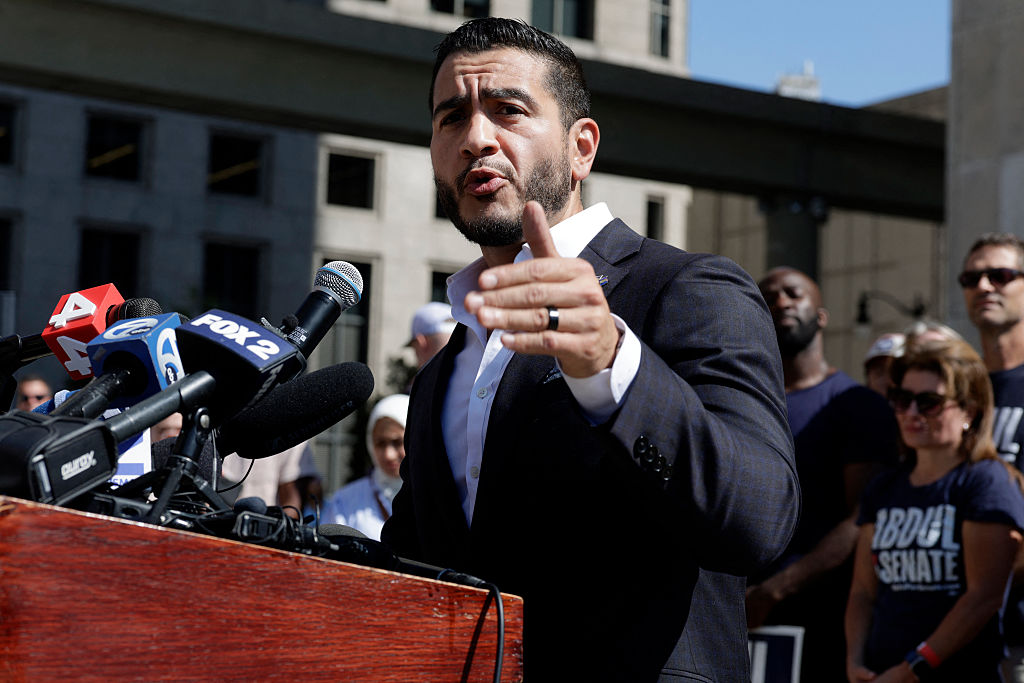
The 2026 U.S. midterm elections are unfolding amid political volatility, with significant uncertainty over vote counts due to state-level election processes and widespread mail-in voting. Central to the analysis is the Michigan Senate race, where Democratic nominee Dr. Abdul Al-Sayed’s evasive response to questions about transgender issues—such as whether boys should compete on girls’ teams—reveals a strategic retreat from moral clarity, raising concerns about ideological extremism. This reflects a broader trend: a small, ideologically committed progressive cadre within the Democratic Party is increasingly shaping national policy, even without majority support, echoing Marxist theory of political influence through bloc voting. Women are emerging as a decisive and increasingly progressive voting bloc, further shifting the party’s ideological center. Meanwhile, a $6.3 billion cryptocurrency theft linked to North Korean hackers exposes systemic flaws in decentralized finance, where centralization undermines security and trust—despite the promise of financial autonomy. From a Christian worldview, these events underscore that moral laws like the Ten Commandments are responses to real human sin, not abstract ideals, and that societal structures evolve from known moral failures. The political and financial crises of 2026 signal not just a shift in governance, but a deeper crisis in values—particularly regarding human life and technological trust—requiring urgent moral and strategic reflection. As election results emerge, the response from both parties will determine the trajectory of American politics into 2028.
It's Tuesday, November 3, 2026. I'm Albert Moller, and this is The Briefing, a daily analysis of news and events from a Christian worldview. Well, it's here election day, 2026, the midterm elections in the United States, and so much is at stake. And you knew that already. And we've been looking at a political season that's beginning hotter and hotter, and frankly, more and more consequential. And that's what really demands our attention as we think about election day today, the results coming in. Now, by the way, a part of the entire setup for election day, 2026, is volatility at open questions as to when we will have answers to the obvious question, how do the vote go? Who won the election? And that's because we have state-by-state, some very interesting electoral processes. And we also have a breakdown in many states of the ability to come up with a quick answer to an obvious question. It should be easier to count votes in 2026 than it was in, say, 1966, but somehow it seems that almost deliberately some states have made it more difficult. Of course, part of this is mail-in balloting and all kinds of things that the Republicans say are evidence of political shenanigans, and the Democrats say are necessary concessions. State-by-state, the argument comes down to the fact that you do have 50 different state governments that constitutionally have the primary responsibility for organizing elections, even elections with national consequences. Okay, so let's just think about what's its stake. You're talking about the majority of governorships in the United States being decided about half of those, and that's somewhere around 20 of those, are actually where you have an incumbent running for a election. That's not a done deal, but it does tell you that it's a more interesting question when you look at the open seats. So we'll be looking at that. And so governorships have a great deal to do with government in the United States. The states in our system of constitutional federalism have so much responsibility. And of course, every governor, and I'll say that just the way it sounds, just about every governor sees himself or herself potentially in the Oval Office. It used to be said that that was true of 100 percent and 100 members of the United States Senate. More recently, it has been governorships, but as we have seen, you are really looking at the fact that everybody's thinking we have to have the data in from 2026 in order to move on virtually immediately in the political class to 2028. The big prize as always is the White House. And something else to think about in terms of how elections work, even in the midterm, is the fact that the president and the party, the president represents is always on the defensive in midterm elections. And that's because a president gets elected by winning the vote, particularly the electoral college vote, in a presidential election year. And then every single president faces the fact that two years, when he takes that Oath of Office, indeed just slightly less than two years, when you think about the November schedule, the president is going to have to face another question when it comes to voters. And even as you have local elections and statewide votes, you also have the fact that there is a verdict rendered on the incumbent president. Of course, the president in his first term is almost always looking to run for the second term. And so in that sense, a president never stops running until the very moment that he leaves office. So this president is looking at his second term, President Trump's looking at the midterm elections. And quite frankly, every president in a second term, regardless of party, reaching the midpoint, is really on the defensive. That's just a political reality. And as a part of what happens when you have a constitutional limitation of two terms, everyone knows that there is no possibility by the constitution of President Trump running for a third term. So that means that at this point, the jockeying on both sides of the partisan equation is what happens next and even more personally, who happens next? But we're going to have to put 2028 off for a few days, even as major newspapers are already running prognostications about how the 2028 race is likely to shape up. If this happens in the elections today, or if that happens in the elections today, let's just stay away from that. The time will come very quickly when those will be live considerations. Right now, we do need to focus on the elections today. And we talked about the fact yesterday that the Senate race in Michigan is demanding a lot of attention, rather unexpectedly, in terms of developments. We saw yesterday, Hayley Stevens, who narrowly lost the democratic nomination for this Senate race to Abdul Asayed. She came out, she had been previously expected to show up with Asayed at a campaign appearance, but things went south. She ended up appearing with the Republican Senatorial candidate, former Congressman Mike Rodgers. And in that context, she endorsed him. So that was a very tumultuous day. Furthermore, you had very odd responses from the democratic nominee. As we have seen in recent days, he is really showing up not only as someone with socialist, very leftist leanings, not only someone who would be the first Muslim elected to the United States Senate, but also someone who, quite frankly, just breaks all the political rules. Because he is quite abrasive. He's quite confrontational. That is something that is unusual in terms of a race for the United States Senate, and at least if the polls are anywhere near accurate, he thinks he's ahead. Okay, so what happened in the last few hours? Well, Sunday night, you had the CBS News program 60 minutes, Ross Dalfa, who had been with the New York Times. Very well-known figure is now one of the more recent conservative hires at 60 minutes. He had an interview about the Michigan Senate race. He had an interview in which he was able to pose a question to Dr. Al Sayed, and this demands our attention. I should make clear that Dalfa had actually interviewed both Abdul Al Sayed and Mike Rogers for the same interview segment, but it is interesting that when he posed a question to Dr. Al Sayed, well, let's just say the answer demands our attention. So Dalfa was talking about the transgender issue, and he asked the democratic senatorial nominee, quote, "What is taught in school? What happens with transgender kids on sport teams and so on?" Like, these are places where rights are in conflict, right? What do you think happens then? The democratic nominee came back and said, "I don't know if that's actually true. I think we manufacture these social issues because here's the thing about it, Ross. You have an iPhone in your pocket, probably, or is it iPhone or Samsung? You have a phone in your pocket, right?" Dalfa, looking a bit puzzled, says, "Yeah." Dr. Al Sayed then says, quote, "You can get access to everything in anything in the whole world, all the world's information in your pocket. The notion somehow that you're going to prevent your child from being exposed to something that you may find disagreeable and that is going to be because of school is so profoundly outdated. Because, of course, you have all the information and they have all the information. So here's the thing about it. I think it's really important for us to recognize that the free flow of information is actually a beautiful thing. It's really important. And the most important thing you can do is not try to protect a person from seeing a thing. It's about trying to make sure you coach your kid through the world that you're engaging with them and saying, "Here's what I believe. Here's what you may see in the world. You get to make your choices about what you're going to be in the world. But that's going to require us to make do with the fact that, like, the internet's a real thing. And this debate about, like, quote, unquote, what's being taught in the classroom, I think it's been made into a cultural flashpoint because a lot of the folks who want to make this a topic of conversation don't want to be talking about the real issues that we face." Well, as has been pointed out, that is a very inarticulate word salad. In political context, that means he's trying not to answer the question. Now, if you watched the 60-minute segment on television, you probably didn't see this. It's in the extended version that was posted in terms of streaming media. You had to see that in order to understand where this exchange comes from and what it represents. What it represents is an intentional effort to shift the issue away from where about 70% of Americans have a very clear moral judgment. So that's what's really interesting. At the very same time, this is running, and, of course, this is now a controversy we're talking about here. And just about the same time, you have just about every major political strategist in both sides, on both sides, the Democratic and Republican sides, who understands that the vast majority of Americans don't believe the biological male adolescents, let's just say boys, should be in girls' intimate spaces. That should be competing on girls' teams. That includes children and especially teenagers. For the most part, this conversation has been centered in, let's just say, middle school and especially high school context. But we all know that morally, the same issues also apply in collegiate sports, and as Christians, we think the same categories apply even to adults. But adults can at least represent themselves. Children put a special responsibility on the society in terms of protecting them from harm. And so that's why the moral clarity when it comes to transgender issues and teenagers, this is why 70% of the American people, and by the way, that's an unusually high percentage on any moral issue. 70% of the American people say, you know, boys don't belong in girls' locker rooms, etc. The point is that the Democratic nominee for the U.S. Senate in Michigan, Dr. Abdul Al-Sayed, he doesn't believe that at all. Just a couple of things I want us to think about here. I think Christians opt to note very carefully when someone is asked an easy, straightforward question and will not answer it in an easy, straightforward way. So this absolute conglomeration of words is what you end up with in kind of a multi-car collision of words when you have a candidate who doesn't want to answer the question. But I think there's far more to it. I think when When you look at this, you have the Democratic Senatorial nominee.
in the state of Michigan, actually coming out and saying, "Look, you're only a parent. "Your teenagers are basically autonomous beings. "You give them a smartphone, "then they're gonna know all this anyway." I want us to just stop for a moment and note, he's saying that if a kid has a smartphone, it's the same thing as putting a biological male adolescent in biological female adolescent spaces. In girls' locker rooms, girls' bathrooms, or for that matter in terms of competition on girls' teams and sports. You're looking at a deliberation. See, that's what's really interesting. And this is true whether the context is medicine or law or arts or culture, entertainment or politics. When someone is asked a direct question and the question is very easy to answer and they do not answer the question clearly. Instead, they try to come up with an obfuscation. That tells you you're facing a big, big problem. And in this case, I think it's very revealing that Dr. Alseid, who, by the way, is a medical doctor and does know the difference between male and female, I think this shows how sold out he is to the leftist agenda. And by the way, it is a word's out. I'm very indebted here to Ed Morrissey at Hot Air because he rightfully gave this attention when others either didn't know about it or were deliberately ignoring it. This is a big story. It's a very big story. When you have a senatorial candidate in the last, say, 24 hours or 48 hours of a campaign, be found making a statement like this. It's not by accident. It's incredibly revealing. And it really shows how radical this candidate is. Now, as of last night, it was pretty clear that a majority of polls show that Dr. Alseid is at least leading in the way the polls are counting. Now, the danger for the Democrats is always that the polls over count Democrats and under count Republicans. And Republicans right now are counting on that big time. But they better turn out. That's a big question in the 2026 midterm elections. And by the way, on both sides, there's the expectation that due to all kinds of political and cultural developments, Republicans might not show up. There's another angle to that. And that's the big question as to whether some of the people who did vote for Donald Trump in the 2024 presidential election, young men, for example, Latino and Hispanic voters, for example, they voted and unprecedented numbers and percentages for President Trump in the 2024 election. Are they backing off? Well, this is a big question that only time will answer. But at this point, we do know that if conservatives don't go vote, something very unconservative is about to happen. On that score, there are a couple of other interesting developments. One of them also points back to the importance of the Michigan Senate race. The New York Times, just yesterday, ran a major article of the headline, "Senate race in Michigan could shape Democrats beyond this election." The subhead Al Sayyed's fate in midterms will test appetite of voters for progressivism. OK, so that's really interesting. You'll notice what's being isolated here. Basically, on the left is an interest about how far left the Democratic party is going to go. Now, the big question, of course, is not just 2028, 2027. It's 2028 in the presidential election. So I want to put that article alongside another one that just ran in recent days, the very same newspaper. This was an article that appeared on Sunday, quote, "Crop of Progressives Could Tilt House Agenda." Now, here's something really interesting. According to the count of this reporter, there are about seven congressional Democrats who, if elected, would significantly move the party in a more DSA, Democratic Socialist of America, direction. And this is where many of the people are now saying, well, you know, that's only seven. And that would add to something like, well, you could add it up. Something less than, say, 2025, 30 Democrats are likely to be that far to the left in terms of identity. Here's something that Christians need to think about. This is something that a lot of people in the Western civilization didn't think about until the Soviet Revolution, the Bolshevik Revolution of 1917, and the continuing developments in terms of the Soviet Union, and efforts by communists to organize in other Western countries. And so here's something that was learned. When you look at communist or Marxist strategy for political organizing, Marxists have never needed a majority to win. And that's because they are outsized in their influence, their outsize in their arguments, their outsize in terms of their political savvy, and they show up. And not only that, they vote as a cadre. They vote as a block, which is something that often you don't have in politics as a matter of, say, party discipline. And this is really about an argument and a direction that would be coming from inside the Democratic Party. And the important thing to recognize is that this doesn't require huge numbers. This has always been true, particularly on the left. It's always been true that a small number-- that's where you get the word cadre in Marxist theory-- a small number of deeply ideologically committed people can move the entire room. So the big issue here is not, say, a lot of mainstream Democrats, who all of a sudden identifies Marxist. The point is that the frame of reference of what's normal and what's democratic shifts significantly to the left. And before you know it, the entire party shifts to the left. And that's one of the issues that has basically driven leftward politics throughout the 20th century now into the 21st century. And that's why you have, even the New York Times, looking at this saying, you know, it's just a fairly small number of people who might be elected as outright identified progressives or democratic socialists. But the fact is, a small number of people can move a giant political party and a lot faster than you might think. OK, there's another big angle here. One of the things we've been talking about for years is the increased gender dynamic, especially when it comes to younger adults in terms of politics. But now, frankly, it's no longer just younger adults. It's basically adults because this pattern has gone on so long that you have men and women in their 50s and 60s who are actually included in this pattern. What are we talking about? We're talking about women being markedly more liberal or progressive than men. That is not something you would have talked about in the 1960s, '70s or '80s. As a matter of fact, many people associated political liberalism largely with men on the left. But that began to change. And I'm going to argue a lot of it began to change, not only because of feminism in general, but because of the abortion rights movement specifically. I think a lot of women, particularly women on the left, were politically activated in terms of the feminist issues, of the effort to try to ratify the equal rights amendment. And then, of course, the abortion rights movement that basically took over feminism in the period of the 1970s and beyond. But now you have a headline, again, in the times, women bring activist energy to campaigns for Democrats, the subheader reliable voting bloc tilts further to the left. OK, so now you have a newspaper that's basically on the left that is recognizing that the movement on the left is not equally male and female. That as a matter of fact, you're talking about a reliable voting bloc that is women for Democrats who are actually tilting further to the left. Now, I want to put that together with the understanding of what happens with electing just a small number of committed leftists or democratic socialists. Their influence is far beyond their numbers. Just think about the amount of press attention and political dynamism that's been directed at Representative Alexandria Ocasio-Cortez. And even though she is, and here's another big story, she's trying to move or least package herself in a slightly less leftist way, at least overtly leftist. The fact is that she's a member of the squad and has been the most famous member of the squad, really. She's the most famous of those in the house really leading in a very liberal direction. And now she wants to lead the entire party that way. And frankly, she has a very uncamouflaged, undisguised presidential ambition lurking in the background. This article, by the way, gives us some numbers. OK, so let's look at the numbers. If you look at voting for the Democratic candidate, the expectation is that the 2026 vote will show an even starker distinction between women and men, with far more women voting for the Democratic candidate than men in almost all of these political contexts. You go back to 2022. 48% of women voted for the Democratic candidate, and 41% for the Republican. And of course, 2022, we're talking about another mid-year election. So we're talking about all Democrats, all Republicans on the ticket. It was a 48, 41 split. Now you have a newspaper saying, you know, there's very good evidence that that reliably left word or more liberal voting block is tilting in an even more liberal direction. Now let's ask the question in worldview terms. Why would that be true? Well, the reason it's true is because over time, human beings work towards more rather than less consistency. This is the way it works. And I think it's a part of being made in the image of God and being reflective analytical creatures as God made us thinking and conscious beings. The fact is that even if we just listen to ourselves talk, even our self-talk moves us in a more consistent direction. And furthermore, if you're ideologically committed, over time you generally become even more ideologically committed. And so I think that's very interesting to note. Women are moving even further to the left. And by the way, their demands, as we've seen, is in what we talked about in the Virginia context on the briefing yesterday, the demands for abortion now is not let's go and put row back into effect. It's let's have abortion available all the way up until the moment of birth. Let's get rid of all restrictions on abortion. And you also have candidates saying, let's require the taxpayer to pay for abortions. Let's make abortions a matter of some kind of national universal health coverage. And furthermore, let's make the woman the only determinator at any point of pregnancy, whether she wants to be pregnant or un-pregnant. Let's completely ignore the status of the unborn human
life within her. And let's just notice that Virginia move would basically allow for legal abortion all the way up through the entire term of a baby's life. And so that's right up until just in all practical terms, the moment of birth. And by the way, don't assume that the moment of birth will be a lasting permanent moral boundary. You already have bioethicists such as Peter Singer at Princeton, who's openly argued for the fact that infants ought to have time to prove, basically, their worthiness for life. Now, as we think about these things, let me point out, the national conversation is going to be about this election for some time. And that's because it's going to take some time, even for all the results to be known and certified. And quite frankly, the big story at that point becomes what's the response to the election? What strategy do the Democrats have now? What strategy do the Republicans have now? And as I have said, the race for the 2028 nomination of the Democratic and the Republican Party basically starts tomorrow morning. Don't doubt that for a moment. All right. Well, as we come to a conclusion for today's edition of the briefing, let me point to you to another piece of bad news. There was a $6 billion theft in terms of cryptocurrency in a hat that is believed to have been launched from agents in North Korea. The Financial Times reports, quote, the cryptocurrency revolution board the promise of the decentralization of finance, taking power from the hands of commercial banks, central banks and governments and putting it in the hands of common people. Single points of failure would be eliminated through a decentralized architecture. The transparency of public digital ledgers with heightened security. Trust would emanate from community oversight rather than through the traditional financial intermediaries that had often betrayed the faith put in them. The massive $6.3 billion hack of finance, the world's largest cryptocurrency exchange, is just the latest example of how those lofty promises have been subverted by centralization. End quote. Well, here the blame is put on the process of centralization. I don't know if that's true or false, but what I can tell you is that there's a huge moral lesson here. And this is where Christians need to understand that people rob banks, whether they are just financial banks, and you think about the old age of the bank robberies in the 1920s and 30s. Or if you're talking about the form of banking that is now disguised as the cryptocurrency industry, in terms of modern finance, the reality is that just to cite a very famous old bank robber, the reason you rob banks is because that's where the money is. And the money is now in cryptocurrency. And by the way, that means that it's digitally exposed. And here you're talking about a theft of $6.3 billion. I just want to repeat that. $6.3 billion. Now, finances said that they are putting their money where their mouth is. They're going to try to protect their investors, those who are account holders. But nonetheless, you can't just see $6.3 billion disappear. And we'll not see this as a, let's just say major problem. The centralization issue is interesting here, because if you're going to diffuse the system into all these separate parts that would make this kind of conspiracy very difficult, you're going to make it very difficult to know how to organize all those separate parts. And that's why the logic is put it together in terms of one centralized source. So as the Financial Times article says, "Exchanges give customers what they seem to be looking for, convenience, a sense of familiarity, and the reassurance that things to go wrong will be fixed. But they also introduce centralization and what is meant to be a decentralized environment. This subverts the promise of eliminating single points of failure. The hack of Binance is the largest so far, but only one of many that have affected this corner of finance." End quote. It's going to be very interesting to see where this goes. Let me point out another issue that's very interesting in terms of the Christian worldview. Laws are generally put in place, rules are put in place when they become necessary. So you don't have a civilization that just starts in terms of the most elemental law and gets to some kind of, let's just say, very convoluted, elaborated law when it comes to finance and banks and all the rest. You get there because it's an achievement that you've built on a previous body of law to get there. Furthermore, in most cases where you have a law that law tells you that someone thought it was necessary at the time. If there's a law that says you cannot do that, one of the things you need to think about is that in human history, someone must have done that in order for society to come back and say, "No, no, no, no, no, you can't do that." In biblical theology, this also points to a very interesting issue of interpretation, just understanding the Bible, so take the Exodus account of God giving the Ten Commandments and then the Ten Commandments being delivered to God's people. Let's just think about some of the Ten Commandments. Let's just take one of them, thou shalt not commit adultery. Okay, Israel was given the law, they received the law, have you thought about the fact that they had to know what adultery was for the law to make sense? So in other words, adultery had happened before the law was given in explicit form, thou shalt not commit adultery. But God named it in order to make very clear that that is a defiance of his law, the moral law, that's a defiance of his authority as creator, that's a defiance of our own moral character. It is also interesting when you look at this kind of crime, we're dealing with cryptocurrencies, so we're dealing with very, very complicated, what are supposed to be very, very secure, high technology dimensions, turn out to be not so secure. The headlines here is about $6.3 billion being basically absconded with, and it turns out there been a $1.5 billion theft before. And yet the industry is going forward, and not only that, investigators, including government investigators believe they know who is behind it, and that's agents on behalf of North Korea, a rogue state, which is a different issue. A rogue state has now apparently, at least it's suspected of being behind the biggest theft in world history. As one news report stated, quote, North Korea's hacking units have for years penetrated banks and companies and capitalized on the rise of crypto, a UN panel in 2024 found the regime cyber attacks had generated about half its foreign currency income, amounting to billions in revenue. Experts agree that the regime is now one of the most capable cyber threats in the world. End quote. So I'll just close with this, we are all paying primary attention to what takes place in the voting today. The results will pay attention to them as they come in. In the meantime, if you just were hacked for $6 billion, that might be one thing that would be of even more pressing concern than the election results from the 2026 midterm elections. Thanks for listening to The Briefing. For more information, go to my website at AlbertMohler.com. You can follow me at xertwitter. We're going to x.com/albertmohler for information on the Southern Baptist Neological Seminary, go to sbs.edu. For information on voice college, just go to voicecollets.com. I'm speaking to you from Asheville, North Carolina, and I'll meet you again tomorrow for The Briefing.
Podcast Summary
Key Points:
The 2026 U.S. midterm elections are marked by significant volatility and uncertainty due to complex state-level voting processes, including mail-in ballots and administrative delays.
The Michigan Senate race is a critical flashpoint, with Democratic nominee Dr. Abdul Al-Sayed making controversial statements that avoid direct answers on transgender issues, suggesting ideological alignment with progressive agendas.
A small number of deeply committed progressive Democrats—such as Alexandria Ocasio-Cortez—can shift the entire party’s direction, reflecting Marxist principles of ideological influence through cadre voting.
Women are increasingly voting for Democrats and are moving further to the left, creating a reliable and expanding progressive voting bloc that challenges traditional political dynamics.
The Democratic Party’s shift toward more radical policies, including universal abortion access and taxpayer-funded abortions, reflects a broader ideological trend undermining the value of unborn life.
A $6.3 billion cryptocurrency theft attributed to North Korean hackers highlights the dangers of centralization in decentralized finance, contradicting claims of financial freedom and transparency.
From a Christian worldview, the existence of laws and moral codes like the Ten Commandments implies that sin and moral failure existed before their formalization, underscoring the need for ethical grounding in human experience.
The political and financial crises of 2026 underscore that ideological shifts and systemic vulnerabilities must be addressed before they lead to irreversible societal realignments.
Summary:
S. midterm elections are unfolding amid political volatility, with significant uncertainty over vote counts due to state-level election processes and widespread mail-in voting. Central to the analysis is the Michigan Senate race, where Democratic nominee Dr.
Abdul Al-Sayed’s evasive response to questions about transgender issues—such as whether boys should compete on girls’ teams—reveals a strategic retreat from moral clarity, raising concerns about ideological extremism. This reflects a broader trend: a small, ideologically committed progressive cadre within the Democratic Party is increasingly shaping national policy, even without majority support, echoing Marxist theory of political influence through bloc voting. Women are emerging as a decisive and increasingly progressive voting bloc, further shifting the party’s ideological center.
3 billion cryptocurrency theft linked to North Korean hackers exposes systemic flaws in decentralized finance, where centralization undermines security and trust—despite the promise of financial autonomy. From a Christian worldview, these events underscore that moral laws like the Ten Commandments are responses to real human sin, not abstract ideals, and that societal structures evolve from known moral failures. The political and financial crises of 2026 signal not just a shift in governance, but a deeper crisis in values—particularly regarding human life and technological trust—requiring urgent moral and strategic reflection.
As election results emerge, the response from both parties will determine the trajectory of American politics into 2028.
FAQs
The Michigan Senate race is a critical indicator of the Democratic Party's direction, with concerns that a progressive nominee like Dr. Abdul Al-Sayed could shift the party's platform significantly, even if only a small number of such candidates are elected.
His response shifted away from a direct answer, suggesting that smartphones provide all information, implying parents can't protect children from exposure—contradicting 70% of Americans' moral beliefs that boys shouldn't be in girls' sports or locker rooms.
Marxist theory shows that a small, deeply committed cadre can shift large political parties dramatically through influence, media attention, and ideological momentum, even without majority support.
Yes, data shows women are significantly more likely to vote for Democrats, and this trend is intensifying, with many women advocating for abortion access and removing moral boundaries around pregnancy and birth.
It highlights the dangers of centralization in decentralized systems, where major exchanges become single points of failure, undermining the promise of financial security and trust.
Laws emerge only after actions have occurred, indicating that societal rules are shaped by real-life experiences—like adultery before the Ten Commandments were given—showing that moral laws reflect human experience and divine order.
Chat with AI
Loading...
Pro features
Go deeper with this episode
Unlock creator-grade tools that turn any transcript into show notes and subtitle files.
 PodcastTranscript AI