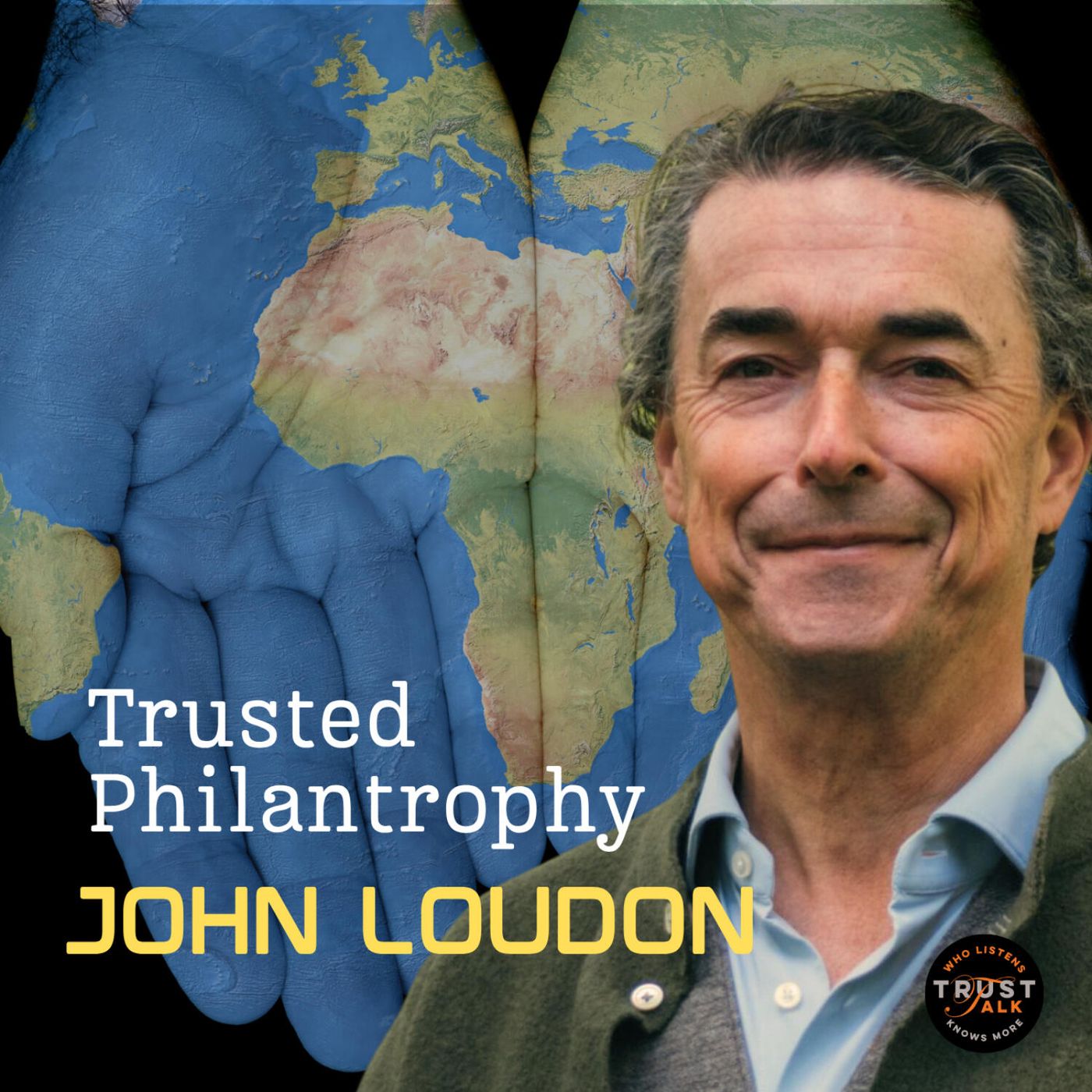
John Lagoong argues that philanthropy is fundamentally about trust, not money. As executive director of Common Foundation, he funds ecological restoration globally, emphasizing long-term core funding over short-term projects. He defines philanthropy as giving for societal benefit, distinct from transactional sponsorship, and notes that giving is harder than fundraising because it requires identifying capable recipients. Trust is critical at all levels: between funders, NGOs, and communities. Building community trust is the most challenging, as demonstrated by a project in Malawi where listening to local needs (water access) transformed poachers into park guardians. In South Africa's Baviaanskloof, overgrazing had turned a million hectares into desert. Common Land used U-shaped conversations to let farmers find their own solutions, leading to a shift from goats to lavender and rosemary, restoring the land and bringing young people back. John prioritizes "opportunity zones" where people and nature intersect, and measures success via "key transformative indicators" (e.g., community collaboration, policy changes) rather than traditional KPIs. When trust breaks—due to internal conflict or dishonesty—he withdraws funding, as happened with a million-euro donation to a dysfunctional organization. His approach shows that long-term landscape restoration requires patience, harmony, and deep trust among all partners.
[Music] Most people think philanthropy is about money. My guest, John Lagoong, thinks it's about trust. He spends decades proving it. John is one of the most connected people in conservation philanthropy in Europe and Africa. As executive director of Comon Foundation, he funds ecological restoration projects around the world. He sits on the boards of Comon Land, Peace Park Foundation, the Charles Darwin Foundation and Wetlands International. But perhaps what sets him apart most is his ability to bring people together, funders, governments, African countries around work that takes not years, but generations to complete. That takes more than money, it takes trust. We met for the first time at a mutual friends reception in Paris. I had just arrived and immediately lost my voice, completely gone. Not the best start. But somehow I managed to tell John a little about trust talk, and he was kind enough to agree to meet again later in the Netherlands. And that meeting led to this conversation, which I have been looking forward to. [Music] John, welcome to Trust Talk. You spent most of your working life either raising money for courses you believe in, or deciding where money goes. Is that something you choose or did it happen to you? So, everyone, first, thank you very much for having me in your podcast, and let me try to answer the first question. I think it's something in between. At an early age, when I was playing at the school yard, and people were fighting, I would always come in between and say, "Peace on earth, there's no reason to quarrel." Usually it would end up with a slap in my face, but, and second, I went fishing with my father in Scotland when I was six. And I think that the vastness of nature has struck me there that I thought, wow, nature is something incredible, and unconsciously I might have decided to spend some time on nature in the future. And because of that, over the years until actually my age of seventeen, I decided that I really wanted to become a paper puncture, and Dutch-Sepapier-Prieker. I always thought that the world I couldn't understand why people would throw away their litter on the streets. So, that was your highest ambition? That was my highest ambition, until my 16th or 17th age. But of course I didn't pursue that, but what I did do is when I ended my high school, I decided not to go study immediately, but I went to an organization called Up With People. And that's an international organization that travels around the world with the musical, but the underlying theme was to create understanding among people of all nations. And that is where I saw, I guess, the light. So when I came back from that year, I did some volunteer work in Alaska first, and then in Africa. And that was the trigger for me to be involved in good causes. And I have to tell you that I was always fascinated about the difference between greed and good, and between destruction and nature. I could not understand those two issues. How can you destroy nature and how can you be so greedy while there's so much good to do? So I guess raising funds for good or spending funds on good is something that just happened to me to answer your question. The title of this episode is Trusted Philanthropy. But is that the same as fundraising? And what does the word "trust" add to it? Well, it's certainly not the same. I define philanthropy as the art of giving, which leads to satisfaction. And fundraising, in my view, is the art of listening, which leads to giving. So those are two different things, but in the end they have something in common. So as well as philanthropy as fundraising, if we cry as knowledge and awareness about the conditions of giving versus how to raise funds. So I can explain that a little bit. Philanthropy, I see as a profession, you need some skills to do this. I actually see there's a job, it doesn't overcome you, you need to get some skills to do this. And philanthropy is not the same as sponsorship. I think that's very important to share. Sponsorship is a transaction. We pay you this amount. And in return we want X billboards in this event. So the return is to the benefit of the payer. But with philanthropy, it's giving to help improve society and the lives of others. So the only return the giver gets is satisfaction. Because if you would ask me what's more difficult giving or fundraising, I would say giving is much more difficult because with giving you need to figure out who is capable of receiving funds to do good and change societies. While fundraising, you preach for yourself and you believe in what you do. But it's more difficult to give than to raise funds in my view. And then the role of trust in your experience. What does philanthropy look like when trust is missing? Before I go there, I think it is important that I share with you that when you give to an organization, you need somehow trust these organizations. And in order to trust an organization, you need to trust, first of all, the cause that the cause is actually doing something that you think betters the world and betters the lives of people and society. But then you need to figure out, are those organizations led by people that you trust? Are they genuine in what they do? Do they really do what they say they do? And are they really passionate about their work? And once you figure that out, then you must figure out whether they are capable of implementing all those projects that they are promising you. So trust is important. So important that if there is no trust, things fail. So if you ask me, indeed, what if there is trust is missing? Well, then philanthropy becomes very static, very data-driven, very distant. Philanthropy then becomes project funding. So you typically see that funders who do not base their giving on trust, they base their giving on data sets, on KPIs, keep performance indicators, all those kinds of things. And therefore, I mean, we at Common Foundation, we spend between 20 to 30 million per year. We do that with a small financial team, one super PA and two executives. But there are similar organizations like ours who have 16 people or 20 people working in the office. And that's because they give small amounts, small ticket sizes, 20,000, 5,000, 80,000, maximum 100,000 to many organizations. Usually, 99% of those are project based. Well, we are convinced that you need to give your funding to organizations that you trust long-term and give them core funding. So you have good people working there. You pay salaries that are very acceptable. You give them the trust that what they do, they do good with all the ups and downs that will follow. So if trust is missing, all of that you do not have. If I'm not mistaken, there are different layers here. A funder trusting an NGO, an NGO trusting a funder, an NGO trusting the communities it works with, and the community trusting an NGO that is trying to help them. Which of those is hardest to build? Well, I would say the hardest to build is the trust with the communities because it's very vulnerable, it's very risky. So even NGO, for example, Peace Parks Foundation, organization we finance, they develop cross-border national parks in Africa. They have are working a lot with communities. So what if you finally have trust with the communities that you come in, that you have listened to what their needs are, and that you are going to raise funds for them, and you do not, I'm not capable to raise the funds, then you have to go back and say, sorry, we didn't succeed. That creates a mistrust between communities and the NGO. So the difficult part is to have all layers in place. So you need exactly like you said. First, actually, you need the trust of a donor that he's willing to put funding in. I can give you an example, which is actually a nice example. There is a place in Malawi called Nika, Nika Plateau, and there's a Nika National Park. And Nika National Park was completely depleted by the people who lived next to it. And. You could say, "Oh, bad people, you should not interfere in this park and you shouldn't have poached the animals." But we didn't say that. We went to these communities and we asked them, "What are your needs?" And they said, "We need water." And the water is up in the plateau. So if the water is up in the plateau, that's why we go there. And of course, if we come across a zebra, we take the green zebra along with us. So instead of punishing the communities, we said, "Okay, we hear you and we'll bring the water to you." So we found donors who were willing to put funding in a project, in this case, to get water from 100 kilometer pipeline all the way adjacent to the park in order for 20,000 people to have portable drinking water less than 20 meters of their living places. And now the communities really trust peace parks and are actually the guardian angels of the adjacent national park. That's a beautiful example of communities trusting an NGO, an NGO trusting its donors, and the donors trusting the NGO and the communities. Which brings me to another story that we talked about in preparation of the interview about a piece of land in South Africa, I believe it was, where years of overgrazing has left everything dead, no green, no income, young people leaving. Can you take me back to that moment? What did it look like when you first arrived? Well, a completely degraded area. It's an area of about a million hectares big, where local farmers have had goats for more than 125 years. So all the farmers have had goats. But the goats have eaten every single piece of grass. So the valley became almost a desert with gullies. So what we did is we donated funds to an organization called Common Length, who are situated here in the Netherlands. And what they did is they brought all these people together in one room for two years of talking. And basically what they said is, do you agree that in this valley things are not right? And that you want to bring it back to another state of how it was, or at least create a top soil that is healthy where you can grow food for your children? So you can all flourish. You can all flourish. So everybody agreed on that fact. So after two years of talking, all the farmers decided to all sell their goats and all become lavender rosemary farmers. And now I'm not saying that all the farmers stick to the rosemary and lavender. But what happened is there is a new vibe in the whole Bavianc clove in this whole area, where people are working together based on trust that they all see, okay, maybe lavender isn't the best thing, the next best thing turned out to be rosemary. Some people went back to goats, but they used the rotational grazing method of grazing so that the goats would actually graze in areas and not be there for another year or half year so that their manure and the rain would eventually create another green area. So it is a complete flourishing area after years of depression. And that is interesting and that is the reason why holistic landscape restoration we actually see it working. In these conversations with the farmers, common land organized what you call "You shaped conversations", right? Yeah, so the U-Terry comes from MIT in Boston and it falls it was developed by a German-American guy called Otto Sharmer and he started the Presencing Institute and it's so the TREU is actually a beautiful theory which brings people together who are insecure, unhappy, not aligned in this case in a landscape. And the TREU basically says, "Let's convene, let's sit together and let's talk about what we can agree upon and what we disagree upon." And then once you observe all those pros and cons, you eventually come to the conclusion that there is actually one spot on the horizon that everybody wants to go to. But to get there you need to go through health basically. You need to go through this bottom of the U. But once you're there, you can reflect and you can say, "All right, if you do this and I do that and if I really listen to you, then maybe we can act together and maybe we can get there." And this is exactly what happened in Baviancloaf. They were first unhappy with the situation. They made a decision, they talked for years and they went and tried things another in the acting phase or actually in the harvesting phase of things. Things are much better in the Baviancloaf that they've been the last 20 years. These are people who had watched their land die, as you said. Why would they trust an outside foundation with a method and money behind it? Enough to really open up? Well, they don't. The only thing that Comalyn does is they put these people in one room and let them talk with each other. So the solutions are not brought up by Comalyn. They're not brought up by a facilitator. It is their own conclusion. Guys, let's try this. And then the other guy says, "Why not?" But the guy is the local farmer. So it's not the outsider. It is creating an atmosphere. That's the only thing that Comalyn does, creating an atmosphere that people open up their heart and open up their mind and open up their willingness. To go into a world of change, in a world of transformation. And if that happens, then people are going to work together and find ways to get there. And it goes with ups and downs. It doesn't mean that the one solution is this solution. There's no silver bullet or any landscape transformation. But there is a way to get there based on only the methodology and not Comalyn telling them what to do. So what does the land look like today? It looks beautiful. The adjacent valley is called the Longcloth. They are now working, not at all with goats, but with honey bush. The interesting thing is that children who left their landscape at the age of 18 because they saw their parents in devastating state. And they said, "Okay, I'm not going to stay here." They are returning. Schools are being reopened. Health cleaners are being reopened. So you call that the return of inspiration. So the four returns that Bavianclov has is the return of inspiration. It's the most important one, happy people. The return of social capital, more jobs in all the things they do. Return of natural capital, re-greening the area, especially the slopes where waterfalls and filters and automatically becomes the irrigation of the lavender. And the fourth one is the financial return. People are actually making more money than they ever did before. Wonderful. So you only work with a small number of partners and you choose them yourself. What makes you decide to trust someone with commons money? It's important to understand, first of all, why we choose the subject of restoration. So close to 40% of the world's terrestrial areas are degraded by humans. And there's a lot of efforts that go into conservation. There will be white-eye funds of this world and the Nature Conservatives and Conservation International. And they're all concentrating on conservation, which is extremely important. But imagine you can restore all those landscapes that have been degraded. A Jason to this conservation areas, then there is no necessity for the people to actually go into this conservation area. So automatically if you restore a landscape indirectly or maybe directly, it adds value to the conservation of areas. So that's important. And then it's important that organizations understand the difference between the zoning where they operate. So for Africa, I look at Africa and I divide Africa every landscape in four zones. So there's an urban area, cities, there's a sub-urban area, little less people, then there's a big area where people either do subsistence farming, low density, and there's the fourth zone, which is the nature zone. And this nature zone is usually, in Dutch, you say, the close, but it means that the nature zone is usually where it's being encrouched by the people who live adjacent to it. So our philosophy is that you need to put your funding in this third zone and you can call it either the forgotten zone or the combined zone, but we call it the opportunity zone. It is the zone where people should be thriving in order to safeguard next door nature and in order to safeguard themselves. So if organizations work in opportunity zones and understand the difference between conservation and restoration, that's the first thing for us that's important. that's important. And then we look at
organizations that we need to trust because we don't like short-term funding, we don't like project funding, we only think in long-term and in core funding. We need good people working in an organization, we need to trust the board, we need to trust the CEO, we need to trust the management, and we need to trust where the whole organization is going to. And once we figure that out, they need to trust us. It goes both ways and NGO also needs to trust us because we don't want to hear all the good stuff. We always say we can read that in the newspaper. We want to hear the difficulties, the challenges, but it takes so long before an NGO gets funding from donors who who they want to please, but we don't want to be pleased. We want to share the hardship, we want to share the difficulties where NGOs are in and funding does do something, but we add value also to be working and thinking with them, along with them, to solve the issues and the challenges they face. John, have you ever decided to stop supporting an organization? Not because the work was bad, but because the trust was gone and if so, what happened? I won't mention names, but we gave a large donation to an organization more than a million euros. And for some reason the board started to fight with each other and then the board started to fight with their management. And therefore the project was failing, so everything collapsed. What they were doing was actually very good, but we couldn't work with them anymore because there was too much non-harmony and we don't like non-harmony. Things must happen in harmony, otherwise things don't work and we withdrew. Which was not nice for the community, of course. It's very difficult. It's a difficult decision, we don't take that overnight. Restoring a landscape takes at least 20 years. Most funders think in much shorter cycles. How do you keep people stressed when there's nothing yet to show? And what do you actually show them? It is very difficult because it did if you are a donor and after two years you're still in the talking phase with the farmers who are still talking while they're depleting the land. The one thing we look at is something which we call KTIs. So generally companies and a lot of philanthropists look at KPIs, key performance indicators. It's very data-driven. We like to look at KTIs and KTIs sends for key transformative indicators. How does the work that the organization does has its effect on transformation in the landscape? Do we see transformation? The fact that after two years 200 farmers are still talking in one room to together decide on the future of the landscape is a key transformative indicator that things are moving forward. And if things are changing policy-wise in a government, if we see children coming back to help their parents in a landscape, that's a key transformative indicator. You could also say, well, how many people exactly came back? Then it becomes a KPI. But it also is we have trust in key transformation indicators because it's an interesting way to measure what's happening in an landscape. Can you think of a time when trust broke down in your work with the funder, a community or a partner? What are the early warning signs? The things you noticed before trust actually breaks? Yeah, it did happen. It's very difficult sometimes as a funder and sometimes as a board member. And I won't mention any names, but I've been in a situation where I've been manipulated by staff of an NGO and I realized later that this person actually told me half the truth and based on half the truth, I made an assumption and confronted the CEO with that, which created a breach of trust between him and me. And once I fully understood the full story, the only thing I could do is apologize and say, I was wrong. I think trust can be broken, but it can also be meant if you show yourself as a vulnerable person and then things can get back online or back straight quite easily actually. After everything you have seen and built, landscapes, the communities, the relationships, what does trust actually mean to you? If you had to put it in your own words, what would you say? Well, I would say trust is the outcome of true empathy and real collaboration. I think that is the key. So trust is the outcome of true empathy and real collaboration. So only start collaborating once you truly have respect and understand the viewpoint or the standpoint of the other. I think that is very important. And it goes both ways in my world. So those who receive our funds should be trusting us and we as donors should be trusting them. And only then the partnership can move mountains, in my view, and we can really change the world for the better. The U-shaped approach you just explained, so the listening before solving, letting the community find its own answer, it takes time. In a world where funders want speed and results, is that a hard thing to defend? Very. It's very hard. Raising funds for holistic landscape restoration is very difficult. It's the most difficult thing I've ever done in my life. But I also think it's the most important thing to do. So now I sit on the giving side. We are fortunate enough to have chosen this theme and we spend a lot of funding on landscape restoration. But I find it hard to leverage on what we do. And it works, but it's difficult because there are so many donors out there that do not yet understand or do not yet have our philosophy that giving is something you need to do in a long term phase and that it takes 20 years to change the landscape. And the most difficult thing to do in life is system change. But if systems don't change, then it becomes. then nothing happens. So transformation in itself is difficult to finance. And it is hard. So the answer to your question is it's very hard, but it's doable. My last question is about fundraising versus grand making. You now sit mostly on the giving side, but you still raise some outside money to bring in a long side what common grants. Does the conversation feel different now that you know what it is like to be on both sides of the table? Very different. Yeah, it's different. I mean, I've always been a fundraiser and now very fortunate to indeed be on the funder's side. But what we give is a lot of money, but it's not enough. So I remain a fundraiser. So I help all these organizations that we truly believe in that based on our leverage, I can now go to funders and say, listen, we already do 5 million, 1 million, 500,000. Why don't you join me? Why don't you join us? So it's different, but it helps that I now sit on the giving side to raise funds. Absolutely. John, you spend decades working in places where trust is not a given, where money alone is not enough, and where the only way to make something last is to listen first. What stays with me after this conversation is something simple, that the land in South Africa came back, not just because someone arrived with a plan, but because someone arrived with questions and the patience to wait for the answers. That I think is what trusted philanthropy looks like in practice. John, thank you very much for this conversation and for the work you do. Thank you for listening to Trustalk. Trust is easy to praise. Much harder to understand. That's what these conversations are for. Hope to see you back for the next conversation. [Music]
Podcast Summary
Key Points:
John Lagoong views philanthropy as based on trust, not just money, and emphasizes long-term, core funding over short-term project funding.
He distinguishes philanthropy (giving for societal benefit) from sponsorship (transactional), and notes that giving is harder than fundraising.
Trust is essential across all levels
Examples include a degraded area in South Africa restored through community-led dialogue (U-shaped conversations), and a water project in Malawi that turned poachers into park guardians.
John focuses on "opportunity zones" (where people and nature intersect) and uses "key transformative indicators" (KTIs) instead of KPIs to measure progress.
Trust can break when organizations have internal conflicts or dishonesty, leading to withdrawal of funding.
Summary:
John Lagoong argues that philanthropy is fundamentally about trust, not money. As executive director of Common Foundation, he funds ecological restoration globally, emphasizing long-term core funding over short-term projects. He defines philanthropy as giving for societal benefit, distinct from transactional sponsorship, and notes that giving is harder than fundraising because it requires identifying capable recipients.
Trust is critical at all levels: between funders, NGOs, and communities. Building community trust is the most challenging, as demonstrated by a project in Malawi where listening to local needs (water access) transformed poachers into park guardians. In South Africa's Baviaanskloof, overgrazing had turned a million hectares into desert.
Common Land used U-shaped conversations to let farmers find their own solutions, leading to a shift from goats to lavender and rosemary, restoring the land and bringing young people back. , community collaboration, policy changes) rather than traditional KPIs. When trust breaks—due to internal conflict or dishonesty—he withdraws funding, as happened with a million-euro donation to a dysfunctional organization.
His approach shows that long-term landscape restoration requires patience, harmony, and deep trust among all partners.
FAQs
John believes philanthropy is about trust, not just money, and focuses on long-term, core funding for ecological restoration.
Philanthropy is the art of giving that leads to satisfaction, while fundraising is the art of listening that leads to giving.
Philanthropy becomes static, data-driven, and distant, often turning into short-term project funding with large teams and small grants.
Trust with communities is hardest because it's vulnerable and risky, especially if an NGO fails to deliver on promises like raising funds for community needs.
They funded Common Land to facilitate U-shaped conversations among farmers, who decided to sell goats and switch to crops like lavender and rosemary, leading to landscape restoration and community revival.
KTIs measure transformation, like farmers talking together or children returning, while KPIs are data-driven metrics. KTIs focus on qualitative change over time.
Chat with AI
Loading...
Pro features
Go deeper with this episode
Unlock creator-grade tools that turn any transcript into show notes and subtitle files.
 PodcastTranscript AI