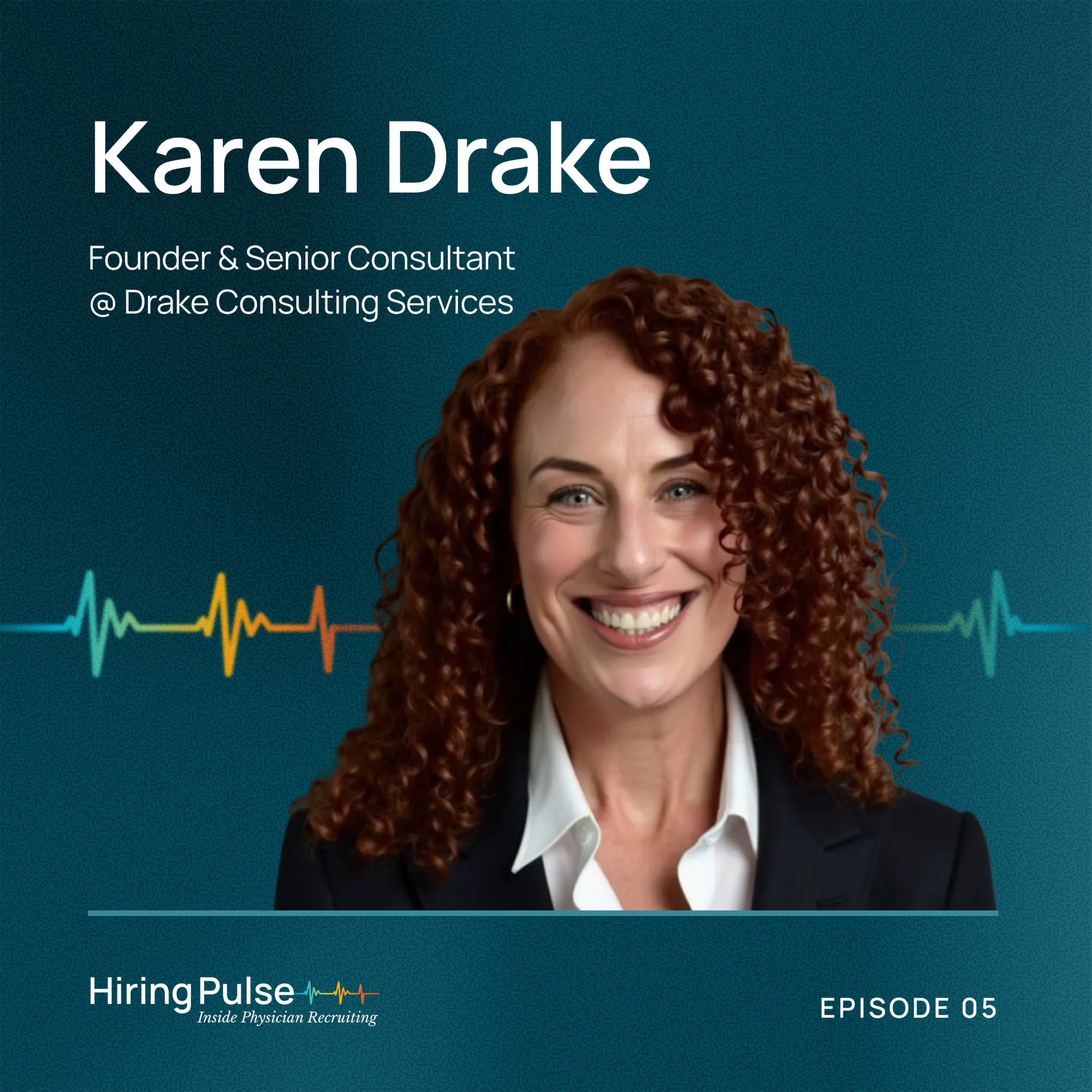
Trust your instincts: Every hire shapes your culture
19m 2s
In this podcast interview, Karen Drake, a veteran physician recruitment consultant, discusses key industry trends and best practices. She highlights that credentialing standards have significantly tightened over her 30-year career, now requiring thorough vetting for patient safety. Locum tenens remains a vital solution for healthcare facilities, despite clients often viewing it as an expense; she emphasizes the importance of demonstrating its return on investment in preventing burnout, covering gaps, and enabling service expansion.
Drake identifies top performers in recruitment as those who work with intention, manage time effectively through daily planning, and prioritize in-person relationship-building over reliance on digital communication. She advises recruiters to trust their instincts and decline candidates when red flags appear. Looking ahead, she sees AI as a tool to expedite credentialing and improve efficiency but stresses it will not replace the human elements of trust and partnership. Finally, she addresses the misconception of locum tenens as merely a cost, advocating for its strategic value, and recommends balancing work with personal life to sustain long-term productivity and focus.
(upbeat music) - Hello everyone and welcome to the Hiring Pulse podcast where we go inside physician recruiting with the industry's best and brightest, all designed to share thoughts, ideas and approaches to make us more effective. My guest today is Karen Drake with Drake Consulting Services. Aaron, welcome to the podcast. - Thank you so much for having me, Jerry. - Of course, of course. You know, I've heard about you actually for many years. I know you've been in the industry for quite some time and I guess the first question with, you know, nearly 30 years in the industry with pretty big companies and different roles, what would you say has changed the most about the physician recruitment industry over your time in the space? - I would say what's changed the most is credentialing. Credentialing has become far more comprehensive as it should be. Patients expect to have providers who are fully vetted, clean, no red flags. Early on in my career, I remember placing providers with just a driver's license and a CV. Today's standards require much more patient safety and organizational procedures. As far as what state constant is, the need for locoms, I think, will never go away. Even when you call clients and they tell you, well, we never use locoms. I really feel like there are circumstances that prove otherwise, whether it's preventing staff burnout or covering an unexpected absence, launching a new service line, managing seasonal surges, locom tenants really continues to be an essential solution to healthcare facilities. - Yeah, everybody you talk to will tell you that they don't want to use locoms. They're looking to get rid of it. I've never seen, and you know, 20 years in, when be able to get rid of it for any period of time. And I think moving forward, it's even more so gonna look like that because again, you've got this supply and demand issue with the shortage. A lot of these younger doctors, you know, they really don't want to commit to the three-year contract. So a lot of them kind of like that, freedom and flexibility of the locoms lifestyle. So I think the best thing is really just figuring out how as an organization you can use locoms, like you just said with some of those ideas and incorporate it into what you're doing versus try to pretend that doesn't exist because it's never gonna go away, right? At least not any time soon. - I think one of the biggest challenges of locoms is that the company or the client perceives it as, this is an expense, and they don't look at it on the return of investment that they received through the locoms. So it's really up to the locom tenants organization to be able to help the client understand what their ROI is. And what are the things that would happen if we don't use locoms? What would we lose, patient loyalty, losing patients to competition, not being able to support the existing staff, which then again is staff burnout? So really painting a picture for a client on ROI is a big opportunity for you to show why locoms is so important. And then additionally, really understanding credentialing. One of the things I hear, we can never get anybody across the finish line. When you're truly understanding the client's credentialing process and setting proper expectations with the timeline of how long it takes for the credentialing and being able to fully provide a completed file. I think that that just builds so much loyalty with the organization and the provider when they understand what is involved in the credentialing process. That either intrigues them and incentivizes them to be able to go forward with the job or they realize right away, I'm not going to have those documents or there's no way I want to do a six month credentialing process. Well, it's interesting too because you talk about where organizations look at locoms as this cost center. But it's the same thing for an employee position, right? They're running a search. They're spending money to do that. If they're paying a search firm, they're paying those fees. They're paying a signing bonus and salary to get that provider there. And then when that provider's there, they can obviously build for that. Well, it's the same thing on locoms. Not that locoms is a substitute for permanent employee, but if the alternative is we're going to lose patience or we're going to lose revenue or we're going to have to cut down cases, it just financially makes sense. If you look at the numbers to bring that locoms in and then obviously build correctly for it. - Excellent point right there is the building. I think so many facilities don't really understand how to build for our locoms. And so they don't. It's amazing how many times I've heard, well, we don't build for the locom services because we don't understand how to do this. So if they can build for the services that the locoms are providing and they are filling a gap in service or in that particular specialty, that's a huge cost savings and they're keeping their patience happy, they're staff happy. So that's an excellent point. - So in your experience looking at recruiting, what do you think separates the top performers from those who just don't seem to really kind of get over that hump and really excel in this industry? - In my opinion, top performers work with intention and discipline, setting your day ahead of time really helps you stick to it working to do list and hitting the ground running. And that was a big part of my production success. Also recognizing that success takes extra effort, starting early, sometimes working later weekends to be able to catch that provider to work and have that conversation on their schedule. And then beyond the hours that you put into work, a differentiator is commitment to relationships. So I think it's important to attend industry events and not just go there and stay in a booth, but utilize that time to take your providers and lunch, dinner, coffee, meeting with them, having discussions one on one, so you can build that rapport. When you take the time to go and visit a provider, they really appreciate that. There's a lot of loyalty that's built when you take time to do that. And then most importantly, being able to say no. I think if your gut tells you that the deal isn't right or isn't a good fit or the provider isn't a good fit, never be afraid to say no. It took me several years to learn that. But an example is I had a pretty rock star candidate and through my vetting process and starting the internal credentialing, there were some warning flags that came off through interpersonal skills and how the provider was unwilling to complete a lot of the paperwork. And so I ended up pulling that provider. My team thought that I was crazy. But in about six months' time, I remember pulling up that provider and seeing license being revoked and hearing about him being removed off several assignments. So I didn't believe this was the best connection, didn't represent the company. And so pulling him initially was kind of caught with, what are you doing, Karen? But in the end, it was the best thing for the company. So never be afraid to say no if your gut tells you so. - You look at how you sort of managed your time. Obviously recruiters have so many different things they have to do, right? I mean, they're in some cases creating job posts, they're sourcing, so they're having to go on to different tools and job boards and reach out and communicate. They're calling, they're emailing, they're interviewing providers, they're presenting the opportunity, then they're assisting with the rest of the process as it gets into credentialing and even offer status and things like that. How does one take all of these different things and tying block it so that you can touch on everything without getting lost down one rabbit hole of, you know, you look up and alive, I've been sourcing for six hours today and there's all these other things I need to get to. - So that is a great question. That goes back to the daily plan. Before you shut down your desk for the day, write up your to-do list. You can write it in a notebook, you can write it in a Word document or one note, but write your daily plan what you wanna do for the next day. And so I encourage recruiters to block time for email, block time for your calls, make sure you know your meeting schedule for the week and then work around that. So as far as blocking my day, I would usually do my emails morning, lunchtime and then after hours, unless it was an emergency. And then I always like to read industry news in the morning. So I had things emailed to me. Like definitive, you can set up searches to have industry for your specialty or your geography mail to you. Always have my pulse on Becker's ASC. So I would utilize that. And then I love your position recruiter network. That right there is a great way for recruiters to be able to share industry knowledge. So reading that information early in the day, always touching my pipeline, making sure that I pull up any new jobs in the system so that I can check those out early on, touching base with credentialing to make sure there's no snags there. So I blocked that in my morning, and of course working around meetings, making sure that if you have any new providers that have started that you flag or set up, time to reach out to them, to make sure you get a pulse on how the assignment is going so that you can catch any issues early on. And then setting up my searches in the CRM for call list so that if I'm working on a specific job that I have a call list set up so I can hit the ground running. And I know exactly what my day is going to look like. In recruiting or anything locum-spaced, you can have your whole day scheduled, sit down and then get an email in the morning to find out that provider Smith is not going to make it to the credentialing committee because of this one missing document. And that just takes your whole day off the rails. So being able to go back to that working to-do list, to see what other priorities you have for the day that you can go back to, I think really helps keep you focused. And that's so important when you're dealing with recruitment because you want to be as efficient and productive as you can be. - What would you say on the other side of that or maybe some of the biggest mistakes that you think a lot of recruiters make that maybe hold them back from being effective as they could be? - Depending too much on email and text to foster or to communicate. I feel like only relying on text and email to get their communication into build rapport, just doesn't allow them to build that rapport. An example, if you have some negative news or need to counsel a provider due to a situation, I had a situation where we needed to tell a provider that something that he had requested he wasn't going to get. And I have a newer recruiter that I was working with who then sent a four-page email and text trying to explain this to the provider. And that provider immediately just gleaned on to the negative information and got very frustrated. So I highly recommend that if you have negative or bad news to share or counsel a provider, try to get them on the phone or screen because that just really allows you being able to show tone, empathy. So it's important for recruiters to utilize text and email when necessary, but I would highly recommend any negative news, share that over teams or a phone call. - So I know you recently launched your own consulting firm, what made you after all these years decide to step out and launch your own thing. - So I've been in the production sales and recruitment for over 30 years, started in technology and then moved over to healthcare. And 24 of those was in Locums, where I was 18 years as a top producer between two companies. And I had done everything from full desk to split desk, marketing, recruiting, my own credentialing, time sheet processing, administration, writing all my job descriptions. I really was looking to do something where I would have an impact on individuals or on a team where I could share my expertise. And I wanted to learn more about what was happening in the Locums industry. By starting Drake consulting, that's really given me the opportunity to work with several firms in the Locums space and staffing space and by sharing my knowledge and learning from them, I've deepened my expertise and reinforced why I started this journey, which is to make a meaningful impact across the industry. That's kind of how Drake consulting came to be. - What would you say given the people you connect with in the industry are the biggest challenges that recruiters are facing right now, is they're trying to fill opportunities and find more candidates? - Well, I can tell you that the Locums industry has expanded significantly since I started in 2001. So the competition is fierce, depending on what specialty you're in. I understand that every specialty has its own obstacles and challenges, but being a recruiter in certain specialties like anesthesia, CRNA. They're still high in demand right now, especially with the pay and bill rates. And GI is a huge specialty. You know, since COVID, there's a big backlog of requirements for GI, whether it be endoscopy, colonoscopy or even call scenarios. Cardiology has multi-specialties within itself from general cardiology up to interventional, structural heart advance. So as a recruiter, you're given a certain specialty or geography, but knowing where to spend your time and where to focus is tough when there's so much out there. So I would say that focus is a big part of being a recruiter and focus is a big part of how you would be able to be successful as a recruiter. - What would you say has been the most surprising thing from launch of the company that you've either run into or heard as you're connecting with people out there? - Well, one of the biggest surprises is how many companies struggle with the same core issues, bringing in direct business, understanding how to effectively vet a provider, how to differentiate themselves in the industry, being able to expedite the credentialing process or adapting to new technology. It's a reminder that even a well-established company has often the same blind spots. Another surprise I would say is how open leadership is to an outside perspective. I mean, when you've been inside one organization for years, you assume that other firms will not want you to come in and critique their processes, but I have actually found the opposite. Companies want fresh insight, they truly value having someone who has been in the trenches and helped them work smarter. - When you look at what's going on with technology, now it's crazy. I mean, literally every day there's some new AI tool out there and more powerful and obviously it's gonna have an impact on recruiting. How do you see AI impacting recruitment landscape looking forward over the next few years? - AI is an interesting topic because depending on who you're talking to, a lot of folks that I communicate with think that AI is going to take away their jobs, but I have to set their mind at ease there because I honestly think that AI is not going to replace recruitment. I think it will allow production to be more strategic. So instead of chasing a bunch of cold leads, AI will surface providers that are already showing interest. It'll speed up credentialing by filtering out unqualified candidates faster, being able to glean information off of CVs and scouring the internet for their background so the applications can be completed faster. And this is going to free up teams on what really drives success, building trust, solving problems and driving long-term partnerships. I see AI as a great way to really be more effective in your productivity of your day. - Yeah, I think I can have one thing that AI does and it's set up to do it. It's just, you know, when will the industry allow it is when we can get credentialing fully on the blockchain where literally here's my key and everything you need is right here, primary source verified, ready to go. Instead of sometimes I've seen six months for longer credentialing, you could literally do these things in a couple days just think of the efficiency and the speed that that's going to create in the market and all those gaps are going to be removed because people aren't going to have to wait so long to start assignments all perm and on the low coincides. So that's definitely something I'm hoping happens here soon. - I think that any way you can effectively expedite credentialing and help with on-time starts go so far and the relationship that you have with your provider and seeing the ability for AI to be able to really bed out providers that haven't necessarily been as honest and up front as they should have been on the internal app so that you haven't spent six, 12 weeks going forward on an application and you find out that goodness this person did not provide all the information up front. It really will save so much time on productivity and that's what we have in this industry is time. - What would you say is the biggest misconception about our industry? - Misconception is that locoms is just cost. So that kind of goes back to our original conversation about the ROI of locoms. What does a locoms bring to the table? The locoms brings solving provider burnout and maybe allowing the client to expand into a service line without hiring a bunch of permanent providers and spending all that money just to find out that it doesn't work in that particular geographic market. Solving the problem of an unexpected absence. So there's so much value in locoms. - Last question here for you. What is something that you would recommend to the audience and why? - This is a twofold question. So I read a lot about sales strategy and one of the books that impacted me was Never Split the Difference by Chris Voss. This book really gave me some practical tools for listening, asking the right questions, guiding conversations towards solutions. I really use basically all the skills I learned in that book every day to build stronger relationships. But I also think that work life balance is a big part of this industry. I am an admitted workhorse. In this industry, you truly can work 24 hours a day and still not get it all done. But understanding work life balance completely changed the way I approached my career and it gave me a healthier perspective that made me more focused at work and allowed me to be more present with my life outside of work too. So I would come back refreshed and really focused and much more productive. - Karen, it's been an honor having you on here. I really love getting into the weeds here about different ways that people should look at and understand not only recruiting but how it impacts the locomotene inside. If somebody out there is wanting to maybe connect with you and learn more, how can they find you? - So Drake Consulting, I have a LinkedIn page and definitely reach out either by email or phone number. That's really the best way. Website is in process. So hopefully I'll have that up and running soon. - Awesome. Well, Karen, it's great having you on. I appreciate your time and that's a luck with everything. - Thank you so much, Terry. I appreciate you having me on today. - Thanks tuning in to the Hiring Poles podcast. Here inside, look at Physician Recruiting. This podcast is brought to you by IA Healthcare. If you've enjoyed this episode, subscribe, leave a review and share it with your network. You can find all episodes wherever you listen to podcasts. Thanks again for listening, until next time. (upbeat music)
Podcast Summary
Key Points:
Credentialing has become more rigorous over time, shifting from basic checks to comprehensive vetting for patient safety.
Locum tenens (temporary physician staffing) remains essential despite client reluctance, addressing needs like staff burnout, unexpected absences, and service expansion.
Top recruiters succeed through disciplined time management, relationship-building, and willingness to decline unsuitable candidates.
AI is expected to enhance recruitment efficiency by streamlining credentialing and sourcing, but not replace human relationship-building.
A common industry misconception is viewing locum tenens as purely a cost rather than an investment with tangible ROI.
Summary:
In this podcast interview, Karen Drake, a veteran physician recruitment consultant, discusses key industry trends and best practices. She highlights that credentialing standards have significantly tightened over her 30-year career, now requiring thorough vetting for patient safety. Locum tenens remains a vital solution for healthcare facilities, despite clients often viewing it as an expense; she emphasizes the importance of demonstrating its return on investment in preventing burnout, covering gaps, and enabling service expansion.
Drake identifies top performers in recruitment as those who work with intention, manage time effectively through daily planning, and prioritize in-person relationship-building over reliance on digital communication. She advises recruiters to trust their instincts and decline candidates when red flags appear. Looking ahead, she sees AI as a tool to expedite credentialing and improve efficiency but stresses it will not replace the human elements of trust and partnership. Finally, she addresses the misconception of locum tenens as merely a cost, advocating for its strategic value, and recommends balancing work with personal life to sustain long-term productivity and focus.
FAQs
Credentialing has become far more comprehensive to ensure patient safety, moving from minimal checks to thorough vetting. This reflects higher standards and organizational procedures.
Locum tenens addresses critical needs like preventing staff burnout, covering unexpected absences, and managing seasonal surges. It offers flexibility that appeals to younger doctors and helps maintain service lines.
By calculating the return on investment, such as retaining patients, avoiding revenue loss, and supporting existing staff. Locum tenens should be viewed as a strategic solution, not just an expense.
Top performers work with intention and discipline, prioritize relationship-building, and aren't afraid to say no to poor fits. They invest extra effort and attend industry events to build rapport.
Create a daily plan, block time for specific activities like emails and calls, and stay flexible to handle unexpected issues. Using tools like CRM call lists and industry news updates helps maintain focus.
Over-relying on email and text for communication, especially for sensitive or negative news. Phone or video calls are better for conveying tone, empathy, and building stronger relationships.
Chat with AI
Loading...
Pro features
Go deeper with this episode
Unlock creator-grade tools that turn any transcript into show notes and subtitle files.
 PodcastTranscript AI