Being an American right now is a wild ride.
The headlines come fast,
but what do they actually mean for people's lives?
I'm Alex Wagner,
and on my new crooked media podcast Runaway Country,
I'm talking to people across the nation
to uncover how political chaos is shaping their everyday realities.
Join me in some of the smartest thinkers and politics
to ask how we take back the reins of a Runaway nation.
Listen to Runaway Country with Alex Wagner every Thursday,
wherever you get our podcasts or watch full episodes on YouTube.
Welcome to another Left, Right, and Center, everybody.
I'm David Green.
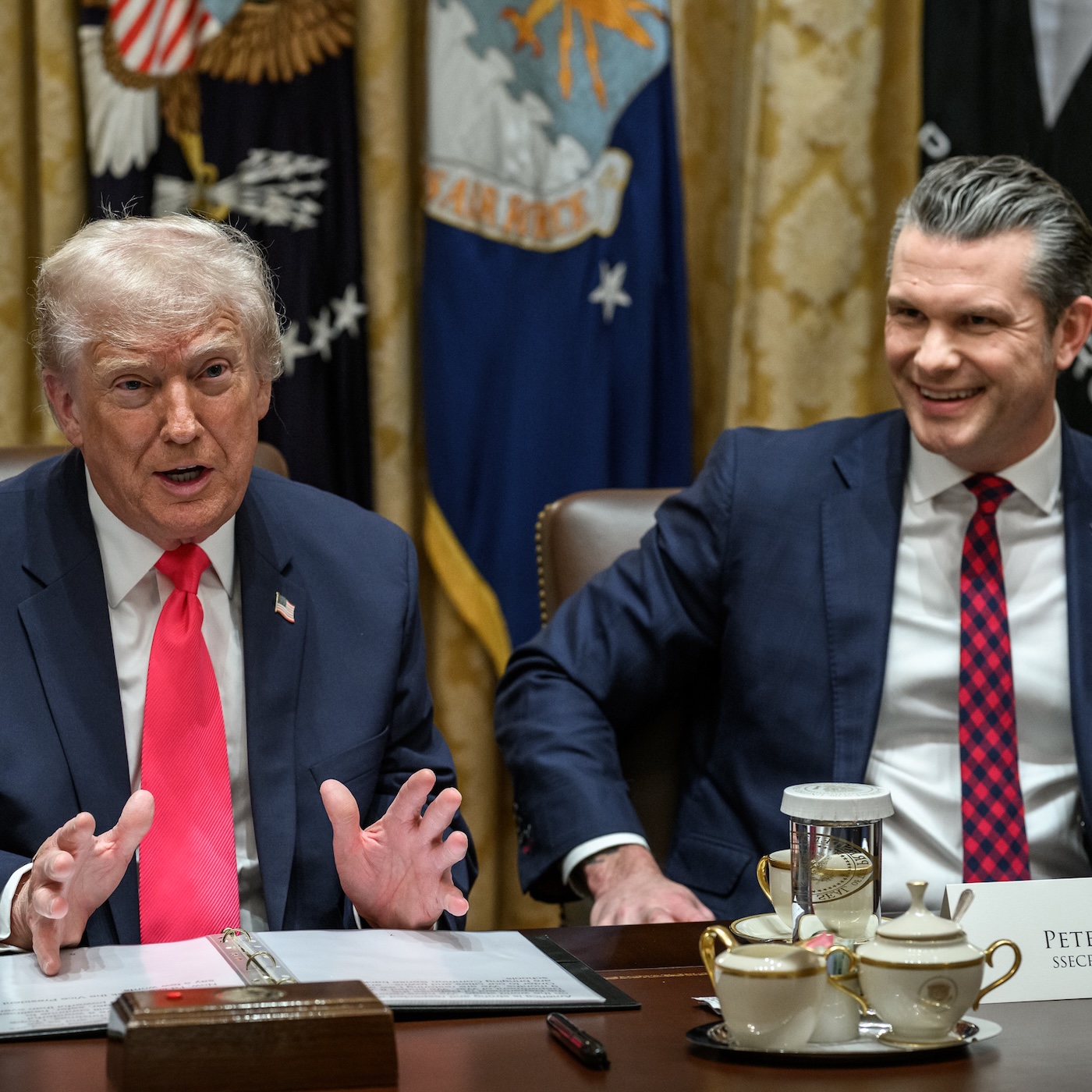
Well, President Trump seemed to be dozing off
throughout a televised cabinet meeting this past week.
Some of the time, he was awake.
He was defending his Pentagon chief
who was facing war crimes allegations,
and we were going to get to Pete Hegseth in a little bit,
but I want to start with Trump's closing statements
at the cabinet meeting.
I hear they ripped off Somalians,
ripped off that state for billions of dollars, billions.
Every year, billions of dollars,
and they contribute nothing.
The welfare is like 88%.
They contribute nothing.
I don't want them in our country, I'll be honest with you.
Somebody said, oh, that's not politically correct.
I don't care.
I don't want them in our country.
Their country is no good for a reason.
The President also said this.
You know, our country is at a tipping point.
We could go bad.
We're at a tipping point.
I don't know.
People mind me saying that, but I'm saying it.
We could go one way or the other,
and we're going to go the wrong way
if we keep taking in garbage into our country.
Ilan Omar is garbage.
She's garbage.
Her friends are garbage.
These are people that work.
These are people that say, let's go.
Come on, let's make this place great.
These are people that do nothing but complain.
All right, the President, they're talking
about Somali Americans.
His rants come as we've been learning more
about fraud schemes in Minnesota.
Federal prosecutors told the New York Times
dozens of people, largely in the state's Somali community,
have been convicted of stealing money
from state social service programs.
The President has decided to take aim
at an entire diaspora, including Representative Omar,
who is Somali American.
Minneapolis's mayor, Jacob Fry,
responded to the President's comments
amid reports that ice raids targeting the Twin Cities Somali
community would begin in the coming days.
Minneapolis is proud to be home to the largest Somali community
in the entire country.
They've been here for decades in many instances.
There are entrepreneurs and fathers.
They benefit both the culture and the economic resilience
of our city.
Targeting Somali people means that due process
will be violated.
Mistakes will be made.
And let's be clear, it means that American citizens
will be detained for no other reason than the fact
that they look like they are Somali.
All right, I'm here in Washington, D.C. with Moelathe
and Sarah Isger in person right here together.
Moelathe, of course, on the left, executive director
at Georgetown University's Institute of Politics
and Public Service.
He was communications director for the Democratic National
Committee and an advisory to Hillary Clinton.
And Sarah Isger on the right.
She's an ABC News legal analyst, host of the advisory
opinions podcast, and author of the forthcoming book,
Last Branch Standing.
She was also spokesperson at the Department
of Justice in President Trump's first term.
It is great to see you both here.
I'm getting used to this doing an in-person thing.
We should do this all the time.
I know it's nice.
Sarah, I want to start with you.
Trisha McLaughlin, the Assistant Secretary
of the Department of Homeland Security,
made a tie between targeted ICE operations this week
to last week's National Guard shooting in Washington, D.C.,
trying a lot of connections here between Afghan National
radicalization here in the United States,
the Somali community in Minnesota,
like taking all together, what is this?
So I think you have to back up as the wrong term.
Go up vertically to like a larger--
Like 50,000 feet.
Look down, OK, let's go.
We're there with you.
OK, so there is this narrative in the United States
for a long time.
Think the Ellis Island narrative, let's call it, right?
The immigrants are the backbone of America,
have always made America vibrant, new.
They're the entrepreneurs.
And then their children become the next thing.
And then eventually everyone's this--
American is apple pie.
I think that that narrative was deeply undermined
by the left and the open borders narrative--
political narrative, I mean.
This idea that we're going to just open the doors,
let everyone in, no matter what, we're not doing anything
merit-based.
And so there was this idea that we're not
looking for future Americans, people
who want to contribute in the big version of that term
by the way.
We're not vetting them at all, right?
So they're not necessarily people
who want to assimilate to our way of life.
They're not people who are looking to contribute to America.
Maybe they just want to turn America into what their country was.
Who knows, right?
Because we don't know.
We're just letting everyone in the door.
And if you criticize that, you're morally bad or racist
or whatever else.
So the open borders from the left undermines the Ellis Island
narrative.
And you end up where we are now, which is, by the way,
also a false narrative, this idea that every immigrant wave
always immediately assimilated.
I mean, ask the German Catholics how much they were treated
like they had instantly assimilated
or the Irish ghettos in Boston.
I mean, Boston in the '70s was still super ghetto-wise
into various ethnicities and fighting
in wars and different Mafias even.
So A, I think the narrative isn't as smooth and Norman Rockwellish
as people would like to look back and think it was.
But I do think it is a problem that we
had so many years of really rampant illegal immigration
coming into the country, because it does undermine
the positive feeling that Americans have generally had
towards immigrants trying to come here.
I think about everything you're saying.
Mo, I want to ask you how this is landing with you,
because I'm feeling this strange disconnect.
Because Sarah is bringing up some really interesting questions
about who we are as a country, the role immigration plays
in our country, the role immigrants play in our country,
how to handle border security, how to vet people coming
from different countries.
And it's hard to have that conversation
when the president's just spewing hate.
And it almost--
I don't know what to do with that.
Like agreeing with or even defending what he's saying.
I'm trying to explain why it's working.
You're trying to frame--
Like why people accept that.
Why his--
Why what he's saying is actually landing in--
Yeah, because it fits with what they already are feeling
that after 15 plus years, 20 years of just sort of like
let anyone into the country that if we were living in 1995
with that Ellis Island narrative,
a president saying that would be really strange to people.
You know, I want to come back to that, too.
What the actual effect is of his language
and the way he's communicating about this on the debate.
But Moe, how are you reacting to what's there saying?
I'm not sure I'm buying it fully, because the reality
is there has always been a sizable anti-immigrant strain
in our national dialogue.
Go back to the beginning of the 20th century.
Go back to the middle of the 19th century.
And you had very strong anti-immigrant strain,
some of which became organized political movements
like the Know Nothings.
It has been most acute during times
of mass economic transformation.
When during the birth of the industrial age,
and suddenly immigrants were coming to take advantage
of the economic opportunities here,
you had a lot of other people--
non-immigrants who got their backs up against a wall
and started lashing out.
You had huge violence in the streets of New York
against the Irish community.
I mean, you had it-- it's always been there.
And yet, we as a nation tried to keep that element in check
because of the value of immigrants to society.
What's different now is the president
of the United States is legitimizing it.
You have had other political leaders
throughout our history who have given voice to this
and tried to legitimize it.
But none of them truly ascended to the Oval Office.
You now have the president of the United States saying,
it's OK to hate immigrants.
All of your unfounded fears are legitimate in my mind.
And that emboldens that feeling.
So you ask, David, what is the effect of his words?
It is to elevate and legitimize this feeling--
this otherization that, again, has always
been there to some extent.
But we as a nation chose to marginalize.
We're no longer marginalizing it.
I'm not disagreeing with editing Moe says.
The one thing I'll note is that the percentage
of foreign-born Americans is higher now
than it was in 1890 or 1910.
Those other waves that Moe is particularly pointing to.
And I do think that's a factual difference
when you have just a higher percentage
of foreign-born Americans than at any time.
But is that necessarily a bad thing?
If we want to be a proud country of immigrants,
like, is that--
It could be a good thing.
It could be, but it's explaining to Moe's point
that, basically, when you have large waves of immigration,
there's always been a backlash to the immigration.
This is the largest wave that we have ever had.
There was always going to be a backlash.
What-- I wonder if there are other people, Sarah,
who you feel are--
I don't know.
Agree with you that there are some larger questions
that are worth asking here.
And if the president's kind of rhetoric just
almost makes it impossible to have a reasoned conversation
about some of those things.
I mean, welcome to the Trump administration.
I think there are often many things that Trump brings up
that are worth a conversation in the way
he brings them up, make it impossible to have that conversation.
What's the conversation you would want to have
if he were not making it impossible
by spewing this kind of hateful stuff?
Yeah, I would love to totally redo our immigration system
from the ground up.
I think it should be much, much easier to come to this country
legally.
And I think we probably should have something
much closer to a merit-based system.
But lots of other countries have a pure merit-based immigration
system.
I'm actually not sure that I want to get rid of family-based
immigration.
I think people building family units here
in the United States is also civic and important
to community building, and that's important to me.
But the fact that we don't have a merit-based immigration
system is kind of insane.
The fact that it could take someone 10 years
to get a visa who has a PhD from another country is nuts.
So I would love to start over on how
we would build an immigration system from scratch,
because I guarantee it's not this one.
And then you do have to shut down the illegal immigration.
This-- I don't even understand how we're still here.
But obviously, if people can cheat the line,
it destroys the line.
Like if anyone's ever sat, we in DC have GW Parkway.
And there's this entrance to 395 from GW Parkway
and the line backs up.
And then the question is, the people
try to cheat the line and get in.
I have long said that if we had one police officer who
prevented people from cutting the line,
the line would actually be very efficient.
Yeah, you're sitting there back there in traffic
as like people who are cheating the line
or sneaking and sneaking and sneaking
and you never move.
That's our immigration system right now.
And so then it incentivizes people
in the back of the line to cheat the line,
get into the other lane and just cut in front.
The whole thing falls apart.
It's chaos.
It's a third world country of traffic.
And that is basically what we have
as an immigration system right now.
Mo, are people on the left willing
to have the kind of conversation that Sarah's talking about?
I think we've been trying to.
Everyone's been trying to have a conversation
about how to fix a broken immigration system.
Sarah and I have talked about this
on the show a number of times.
Nobody likes our current immigration system.
And I think a lot of Democrats agree
that we need a different path to legal immigration
and to citizenship, especially.
There just hasn't been the political will
from either party to truly dive in and figure it out.
And there's important disagreements within that.
A hundred percent.
What do you do with the people who are already here?
A hundred percent.
I don't have a perfect answer to that.
You know, the like kick them out logistically gets hard
as I think we're seeing.
The White House announced just as we're taping the show
that work permits issued to immigrants
who have applied for asylum or a range
of other humanitarian programs are now going
to be valid for 18 months instead of five years.
And so they're going to have to renew work permits more often.
I mean, is that a solution you like?
Sarah, I mean, it feels like that adds bureaucracy.
It adds a burden on people to continually be filling out paperwork.
It's doing, it sounds like it's doing what you didn't want to do.
It's making it's making legal immigration even harder.
Asylum seekers fall into two buckets.
Some are what I would call waiting in the long line
for legal immigration.
Oftentimes they are people who came to the country illegally.
Then when they are apprehended, they apply for asylum.
About 85% of people who come to the country illegally say,
"Actually, I'm seeking asylum."
So not all asylum seekers by any means are in that legal side
where they applied from abroad for asylum.
In fact, very few are in that category.
So asylum seekers more often fall
into that illegal line-cutting side, disincentivizing people
to cut the line and then apply for asylum.
Yeah, probably is helpful to prevent line-cutting.
Mo, I want to ask you, I'm struggling to figure out
what to do with the kind of language that Trump is using.
It is hateful and it is not unexpected.
And I guess there's a world where it's like,
you just look at this guy who's falling asleep
in his own cabinet meeting and saying this kind of stuff
and sounding really tired as he's saying it.
It's almost like, does it get normalized to a point
where you ignore it and move on?
Or should we never allow that to be normalized?
Like literally trashing an entire diaspora in our country,
including a member of Congress.
And I guess the next question I have is,
like, should we be truly worried
that this sort of behavior is going to become more normalized
in our communities?
Or is that not happening?
Or can we count on Americans to see a better version
of themselves and kind of decide whether they like this
from Donald Trump or not, but not actually copy what he's doing?
I think several things can be true at once.
One, we should not allow it to be normalized
for lack of a better word, or at least acceptable
as part of the mainstream.
If you are offended by this kind of language,
if you are offended by the clear racial implications of it,
I mean, to connect the Afghani-born shooter
of the National Guard to the Somali diaspora.
- With a go back to your country,
quote unquote, message around all of these lines.
- Right, I mean, had the shooter been an illegal immigrant
from Sweden?
You wouldn't hear the same words coming out of the president's mouth.
So we should stand up and speak out against it
if we don't like it, and I suspect most Americans don't.
That can be true at the same time that those who are
opposed to this president need to realize showing outrage
over these kind of comments is not enough.
And the past decade has shown us that time and time again.
The best way to defeat Donald Trump is to defeat him
and his allies at the ballot box.
And we need something more than outrage
over his clearly outrageous racist xenophobic sexist.
Whatever it is you want to attribute is appropriate in the moment
because they're all appropriate at some point.
We need to do more than express outrage over that.
We need to speak to people about the issues
that motivate them at the ballot box.
Sadly, this is not one of them or at least not one of the top ones.
The best way to defeat authoritarianism,
the best way to defeat fascism,
the best way to defeat all these things is by reaching out to people,
making them feel like we hear their economic concerns,
their other concerns, and beating it legitimately on the issues.
Because I mean, how many more times are we going to do this dance?
The past decade has shown us this isn't enough.
Hashtag activism is not activism.
I feel like I see these people and they're like,
"Well, I tweeted something."
Or I mean, I ran into these high school girls
who were each wearing, I think they were wearing purple pants or something.
And they were like, "We've done our part of allyship."
And I'm like, "What the hell are we teaching these kids
that wearing pants of a color is somehow contributing to civic society?"
You're not saying not to do that.
You're saying, "Do that, send a message and do our whole love."
Use that for activism.
Don't confuse that for doing something, frankly.
Like, I think you've done nothing.
What do you all think about everything that we are talking about?
Well, if you have thoughts,
you should join the left, right, and center community conversation on Substack.
We'll send you a weekly inbox reminder to hone up on the show
and start debating and start talking to one another.
Join on the latest discussion at kcrwlrc.substack.com.
I will say that one more time a little more slowly.
That is kcrwlrc.substack.com.
And Mohen Serrin, I will be right back to talk about the Secretary of War, Pete Hegseth.
We're back again with left, right, and center.
I'm David Greene with Moelaithy on the left.
He is Executive Director at Georgetown University's Institute of Politics and Public Service
and Sarah Isger on the right.
She is Senior Editor at the Dispatch.
Okay, so the original order came from Secretary of Defense Pete Hegseth,
deliver a lethal strike on a boat with 11 people on board,
a ledge to be part of a drug smuggling operation in the Caribbean.
A first missile hit its target, sinking the boat and killing most of the 11 on board.
And then Navy cameras picked up the image of two survivors in the water hanging on to wreckage.
That is when somebody, not clear yet,
who ordered a second strike on those two people.
This was back on September 2nd.
Three months later, lawmakers won answers about who was responsible.
The Republican chairs of the House and Senate Armed Services Committees are promising an investigation.
Including that first attack we're talking about,
this operation in the Caribbean has hit at least 23 suspected drug boats,
killing as many as 82 people according to the Washington Post.
Democratic lawmakers and some Republicans are questioning the legality of the strikes.
The administration has dismissed these concerns,
claiming that the alleged drug runners are terrorists and by that rationale, a US military adversary.
It is against military law to target an enemy that is no longer able to fight.
And Virginia Democratic Senator Tim Cain on face the nation on CBS voice concerns
that a number of lawmakers have raised.
If that reporting is true, it's a clear violation of the DOD's own laws of war,
as well as international laws about the way you treat people who are in that circumstance.
And so this rises to the level of a war crime, if it's true.
Senator Cain said lawmakers had asked for proof that the targets of many of these boat strikes
were actually narco traffickers.
Now, in the same program, Republican Congressman Mike Turner echoed Senator Cain's concerns
about that second missile strike on the survivors.
There are very serious concerns in Congress about the attacks on the so-called drug boats
down in the Caribbean and the Pacific.
And the legal justification has been provided, but this is completely outside of anything
that has been discussed with Congress.
This is completely outside anything that's been discussed with Congress.
I guess I want to start with how concerned this White House might be that Republicans
on the Hill are taking these questions very seriously and not jumping to the defensive
access here.
How concerned can anyone be of Congress at this point?
Is Congress a scary branch anymore?
But being said, one of the few things that Congress still has been doing is oversight.
There's a limit to that.
Right?
At the end of the day, the oversight that Congress can do can lead to the power of the purse,
right, pulling back money or impeachment.
And at the end of the day, we haven't actually seen them use the power of the purse or impeachment
effectively to do much about their oversight.
So it becomes more of an exercise in transparency, which is not a bad thing.
But again, it's not actually what that branch of government is meant to do.
It's not what their checks actually are.
I think, legally speaking, just to set some of the groundwork here, you have the questionable
legality on striking the boats in the first place.
Which has been a question all along as we've been seeing these strikes, yeah.
Just on this second strike, it's worth noting why we've no quarter orders have been unlawful
for over 100 years in the United States.
I mean, back in the American Revolution, if anyone's been watching the Ken Burns documentary,
one of the loyalist generals gives a no quarter order.
And when they ambush some Colonials, you know, the good guys in our story and some of the
Colonial surrender, they are killed on the spot.
Guess what?
Colonials no longer surrendered in South Carolina after that because they were going to get
killed anyway.
And so it prolongs war.
It makes it impossible for anyone to surrender to end battles that are hopeless because
they no longer believe that there's any reason to surrender.
And so it just leads to a lot more death and casualties and that's led to no quarter orders
to the opposite question.
No quarter orders mean we don't take prisoners.
We just kill everyone.
Those are now unlawful for this reason and it seems like this was a no quarter order in
theory.
I mean, we'll see investigation.
It's possible.
That's right.
It's possible to no quarter order in which case it's clearly unlawful.
Now there's questions over whether, you know, you have to be unable to continue the fighting.
They have argued, at least an initial reporting that they believe these guys could call for
help or something like that that the boat was still functional.
We've also seen reporting that they hit the boat two more times to scuttle the vessel.
Well, under the laws of war, if a boat is no longer, you know, able to continue the fight,
they've taken down their flag, they've raised a white flag, things like that.
You can't attack them anymore.
But of course, this boat doesn't have a flag because it doesn't know it's in a war.
So this brings us back to question number one, which is, were these strikes lawful in the
first place?
It's also relevant.
I think that they stopped doing this after this first strike.
We now know that when there have been survivors in subsequent strikes, they have simply returned
them to their home country, leading at least one senator to note, well, wait, I thought these
guys were narco terrorists, which is it?
If they're narco terrorists, why aren't we trying to believe in this policy?
Why are you not continuing to carry it out?
Why are we returning them home so they can continue to be narco terrorists?
So I am glad that there has now been a spotlight on this because it brings us back to question
number one, were these strikes ever lawful in the first place where they ever had a good
idea in the first place?
What is the evidence for it?
And even if there is evidence for it, is this policy affecting what we want it to affect?
No.
It's not.
You know, this is not accomplishing anything.
No, it's not accomplishing anything in large part because we know for a fact that the rationale
behind this policy to stop the flow of fentanyl coming into America was BS in the first place
because fentanyl doesn't come into the United States through Venezuela.
Comes up the Pacific coast, not through the Caribbean, through Mexico.
These small fishing boats can't traffic the sums of fentanyl that they're being accused
of trafficking into the United States.
So they can't even make it to the United States from Venezuela in these small vessels.
They usually have to stop in a Caribbean country.
So all that's to say, like, I think Sarah raises all good points and agree with most of
them.
I think there is the fundamental question of whether or not these were legal in the first
place.
But talking about this one specific case, the military and the defense department have put
out contradictory statements over and over and over.
The secretary of defense saying that that, you know, it was hard to tell what was going
on that, you know, this was part of the fog of war, but reporting this week from multiple
sources makes it clear very clear that the military commanders knew that there were survivors.
They could see the survivors in the water.
If that's the case, then there's no question in my mind unless they were floating in the
water with AK-47s firing at the naval vessels, they were no longer able to be combatants.
If that's what Pete Hegseth and the defense department wants to call them is combatants,
which again comes back to Sarah's other point, which is if in subsequent strikes, they are
still being deemed as enemy combatants.
Why are you sending them back home?
That's the equivalent of taking a legitimate prisoner of war during a kinetic armed conflict
curious hypocrisy and sending them back to, you know, the front lines.
None of it makes sense.
It just shows the absolute, how absolutely asinine this whole policy is.
It is ineffective because it is targeting the wrong problem in the wrong place, targeting
the wrong people and violating US and international law along the way.
And people are dying as a result.
You're listening to left, right and center from KCRW.
I want to get back to a question that you raised, Sarah, which is something that I think
the two of you have pretty clearly agreed on, which is that Congress seems pretty powerless
and irrelevant these days.
Could this be a moment?
I mean, Americans seem to be, as you said, there's a spotlight on something like our country
deciding to kill in an airstrike two people who are clinging to a vessel in the Caribbean
has caught some attention.
Like, is this a moment for Congress to stand up and say we want to have a voice here?
My hope is that in the next six months or so, or maybe after the midterm elections, maybe
I should say in a year that we might see a more robust Congress, but there's a whole lot
of things that have to kind of happen all at once.
I think we could have that perfect storm happening in the next year, but let me lay out some of
the things that I think need to coalesce.
One, and I know everyone is going to roll their eyes when I'm like, wait, the Supreme Court
has a role in this.
Hey, guess what? The Supreme Court, I think, might have a role in this, so I just rolled
my eyes for the record.
Yeah, yeah.
That's usual.
Yeah.
That's not significant.
Most of the best.
So they've got these two cases.
One on tariffs that was already argued about basically when a president can go back and
find some vague statute and then claim new broad powers based on an old statute.
And then two, the slaughter case, which is being argued on Monday at the Supreme Court
about these so-called independent agencies.
And I think that if you take those two cases together, you can have the court telling both
branches of government, you know, make the president a more politically accountable executive,
but make him a far worse legislator.
So the president will be more powerful over his own branch of government, but have far
less power because Congress is going to have the ball back in their court to actually
need to pass explicit statutes to give the president power.
So a, that needs to happen, I think.
B, leadership in Congress is part of the problem.
This goes back 30 years, Newt Ginkrich started this in the House, Nancy Pelosi took it to
a whole new level where you remember when we used to know the names of like the chairman
of the Ways and Means Committee and stuff?
I do.
Yeah.
Yeah, we don't need more because they have stripped power from everyone, but the majority
and minority leaders of the two parties in both houses, so that committees don't really
have a purpose anymore.
It's why you see things like a gang of 14, a gang of 12, a gang of eight.
That's what's called a committee, y'all, but these senators almost are trying to re-imagine
the committee system because everyone's so desperate to like maybe do something.
But that's my point, couldn't the armed services committee chairs here actually sort of reclaim
some of that power and say we're shooting people who are clinging to boats and killing
them in the ocean like, but not if they don't actually have the power to do anything from
their committee because all power to bring up bills is in the leadership.
So that's that you've got to have some will to do that as well.
And then of course, I think you need to change some of the incentives from voters actually
wanting people to legislate instead of thinking that the president is the most important
election of their lifetime.
When in fact, we should be heralding lobbyists as the keepers of our constitutional republic
at this point because at least they try to do things through Congress and not just have
the whipsaw of government by executive order.
Let me tell you what I saw this week, right?
You saw when this story started to come out, a lot of senators from both parties saying,
whoa, whoa, whoa, Republican senators saying, I don't usually do this, but I'm going to step
out on this one because this seems egregious across the line now.
This may have crossed the line enough of that happened that the president of the United
States and the secretary of defense both started actively looking for a scapegoat, right?
I mean, they they did.
They stood up and they said, oh, oh, yeah, maybe this shouldn't have happened kind of.
We don't know.
It really wasn't our call.
It was the admiral's call.
Mitch Bradley.
They seem to be pointing right in the finger.
Yeah.
There's this great moment where head Seth is like, Mitch Bradley gave the order.
I mean, I totally have his back, but also I had nothing to do with it.
Right.
That's exactly what we saw.
We're not going to be telling Hey, Congress, if you are going to try to flex a little muscle
in this here, and you want a pound of flesh, here it is.
We're going to hand it to you at the same time, saying, but just know we've got his back.
Basically signaling whatever you say or do, there's not going to be any accountability.
The way this Congress has interacted with this president up till now, I think we can see
how this movie ends, the admiral's appearing towards the end of this week.
They're going to listen.
He was going to show them video of the thing.
The admiral's coming before Congress, showing the video, answering their questions, giving
a briefing, some of those Republican senators who wrote strongly worded letters are going
to say, Oh, okay, good enough for me.
Others are going to say this shouldn't have happened, but it's clear the president of
the United States and the secretary of defense had nothing to do with it.
If there is any accountability, it will be laid squarely on the shoulders of the admiral.
So in peaching Higgs set, you think that's off the table?
I did not.
Not even.
Not even a reasonable thing.
I see literally no Republican members of the Senate go that far out on a limb, something,
some sort of blockbuster information is going to have to come out and maybe it will, maybe
it will, but if it validates everything that we already know, and what we know is pretty
damning as it is, I don't see that there are Republicans in the Senate are going to do
anything beyond go after the admiral at worst.
But if there were, if there were some blockbusters, you say that showed that Pete Higgs set directly
knowingly ordered something like this, I mean, how do Republican leaders not talk about
impeachment given some of what they've said already?
I agree with Moe.
It's not going to happen.
You know, there's been rumors that within the administration, for instance, Attorney General
Pambondi is on the outs, Cash Patel, the FBI directors on the outs.
There is the report that has come out from the Pentagon about the signal gate issue where
Pete Higgs set is discussing a future strike on an unclassified signal chat where he accidentally
added a reporter from the Atlantic and that that did, in fact, endanger American lives that
the Houthis could have if they had gotten access to it.
Which was an internal Pentagon report.
This is not like, correct.
You know, a news organization saying that it's, you know, I'm not so sure that Pete Higgs
set last very long in this job.
Agreed.
And if Republican senators believe that there's no need for them to stick their political
necks out and endure the wrath of Trump, it also probably prevents Trump from removing
Hegseth.
So if you actually want Hegseth gone and you're a Republican senator, the worst thing you
can do is say that you would support impeachment at this point.
You want to call the White House and say, get rid of this Joker.
Aren't you sick of being surrounded by incompetence?
You know, he had a Trump faced a million dollar sanctions that has been upheld now by two
of the most conservative judges in the country, including one who's a Trump appointee because
of the incompetence of Alina Haba in her legal services.
On behalf of Donald Trump to sue Hillary Clinton and James Comey and some others, all of these
indictments are getting thrown out because of the incompetence of Lindsey Halligan who had
no clue what she was doing.
You wonder at what point Donald Trump says, ah, okay, maybe in the first term, I veered
too much toward competence.
But in this term, I veered too much toward loyalty.
And now these people are hurting my administration by having this all come back to me.
Does anyone really see a world where Donald Trump suddenly says I veered too much towards
loyalty?
I mean, that is a girl can dream, oh, I think it is likely he is not, you know, give him
a few more months, he's given some sort of whatever the political equivalent is of a golden
parachute and ambassador to Venezuela or that is an amazing way.
That is an amazing notion to contemplate.
But it is to take family vacations to Venezuela in the late 80s and early 90s, it is a beautiful
country.
No, I ve always wanted to go.
It's one.
We would do birding their incredible wildlife.
I ve seen an Andecano orgy that was really something.
I was quite young.
I didn't totally understand what I was witnessing.
All right.
We are going to take another break Sarah and Mo and I will be right back.
We're going to get to social media and digital borders when we come back with more
left right and center.
All right.
We're back again with more left right and center.
I am with Sarah Isger on the right and Moelaithy on the left.
I want to pick up a little bit of the conversation we were having just a moment ago about Pete
Hig Seth.
The issue of competence came up and Sarah, I don't want to put words in your mouth.
But my memory is as we were entering the second Trump term, you said that you did not
think this group was necessarily going to be competent enough to have significant impact
on our country, that the incompetence was actually something that should make Trump's
critics feel more at ease.
Do I have that right and how are we feeling today?
I think to a large extent, I ve been proven right.
I think it is hard to point to what the Trump administration has accomplished in its first
year.
I think that some of the areas I was wrong, National Guard and Immigration, I think they have
gotten a lot more done, that has been a change.
For better or worse, depending on who you are.
That's right.
But they have certainly done the thing.
I think in every other area, it's really hard to find things that have not been pure bully
pulpit.
That does not mean that the bully pulpit has not been powerful, again, for good or for
bad.
What about health?
I mean, trust in vaccines.
Not that that was bully pulpit related.
It's things that the Trump administration is saying, but in terms of changes to the law
or regulations, and again, you look at these trust and vaccines and things like that, like
decisions by parents could be made, even if, like, just be hearing things from the bully
pulpit.
But that was always going to be the case, because that has nothing to do with competence.
That's not whether he's hired competent people.
He and his people can say bonkers things, what they are actually getting done, permanent
or even quasi permanent things, very little, including the Department of Justice, setting
aside this Lister General's office that has had an enormous number of wins at the Supreme
Court, the rest of DOJ, I mean, again, just look at the indictments that are getting thrown
out around the country because you can't stack interim U.S. attorneys on top of each other.
You're not saying things that you say don't have any impact.
I mean, they can't have a lot of impact, but in addition to that, actually, functionally
changing the way our government works, you're saying no, I can't disagree more.
I think yes, they are not getting laws passed.
They are not getting, you know, all the regulatory stuff, sure.
But I think if the metric of their competence is broadened a little bit, and we think about
it, they came into office saying we're going to fundamentally remake the government.
We're going to fundamentally change it.
We're going to blow up certain elements of it.
We're going to concentrate power in the executive.
I mean, these were all things that Project 2025 and Russell Vought said that they wanted
to do.
They have been very competent at doing that, at dismantling whole departments and agencies,
and making Congress toothless and concentrating more power in the executive.
They've been very competent at that.
I agree with you on the, on the hexath point.
I think at a certain point, you know, he will step off.
I'm not sure it's because of competence as much as the political headache that he causes
for the president might eventually be too much.
My problem with his departure on those grounds is it takes away accountability.
And then we will never have anyone who's held accountable for this sad moment, this sad
chapter of our military interest.
I mean, for incompetence, I mean, like being held accountable at all.
Right.
But, you know, was this strike a lack of competence or was it just a blatant disregard for the rules
of engagement for US military code of conduct and for international law?
Well, I actually, Sarah makes me want to like dig into this a little more with you when
when we talk about like what impact means because I hear you on a lot of stuff like, you
know, like laws not being passed, structural changes not being made.
But you know, the reason I bring up health, like if Americans are getting less vaccines
because of what they've heard from the bully pulpit, I would say that's impact.
And I guess also is that incompetence or is that an administration that has an agenda that
has a tremendous impact on our health?
Yeah.
And I'm not putting that in the incompetence bucket at all.
That is the power of persuasion and that's the power that every administration has had.
I mean, the Biden administration, you know, accused Facebook of killing people during
COVID and had this whole like online bullying thing against the tech companies.
That's the bully pulpit.
That's not actually doing something because as soon as they leave office, that's all gone.
And I guess that's my point.
And part of the problem when I say like the whipsaw of government by executive order,
that's what I mean.
If you're someone who cares about immigration, climate change on either side, you're not
going to actually get done what you want in four-year increments.
And yet I hear you people cheering every time you get something you like from the Rose Garden.
It's useless.
Hearing something you like is not government.
It's like hashtag activism, but somehow worse.
Well, speaking of this social media and sort of where people are saying things and feel
like they're being activists, you know, I want to get your thoughts on one.
The last thing today, I mean, political engagement can feel to people like it's just retweeting
or resharing posts from accounts that are aligned with their own beliefs.
But one of the questions has been raised now is what happens when these accounts that
you rely on to give you that the quote unquote truth aren't really who you might think
they were.
I mean, last month X unveiled about this account, which is a feature that tells other
users where accounts on the app originated from and with an hours of this rollout accounts
that had amassed these large followings of conservative supporters were revealed to be posting
from places like Nigeria, Chile, India among other countries.
Some of these accounts that often been reposted by the president himself.
And I just wonder what what we should take from that.
I mean, it seems like there is a, you know, significant mega community on social media
and not in the United States.
Three speech.
I guess people can be in other countries.
If you're not an American, you do not have a first amendment, right?
We've gone over this and over this.
I don't mean on this podcast.
I just mean in American history.
Okay.
And first of all, it's not just mega right.
It's a whole bunch of people who try to influence American policy, elections, culture from
these foreign accounts.
When I was at the Department of Justice in 2018, we indicted 12 GRU officers for illegally
trying to influence the 2016 election through bot farms, paid advertisements on on social media
platforms, etc.
And it's like because the Mueller investigation was going on, everyone ignored it.
But the truth is foreign governments absolutely try to influence our elections.
So let's just remember you were in the Trump Justice Department and you were going after
some of these Russian agents that led to indictments from Mueller, but a lot of people
were focusing on something else.
That's a bigger question of like, what's Trump influence with Trump before?
Yeah, it was so frustrating to be like, look, Russia did this and everyone's like, yeah,
yeah, but Trump.
And I'm like, fuck Trump.
It misses the point, right?
We never found the evidence that Trump was knowingly participating in that even though
he benefited from it.
If you were on one side of it, you were like, no, Trump definitely worked with the Russians.
That was never proven.
And on the other side, it was no, you know, nothing ever went wrong.
And it's like, no, no, the Russians did do this, though.
And I feel very vindicated that people now see that so much of what they think of as influencers,
grassroots, grass tips, or otherwise, were always foreign influence operations, whether
done by the government or by individuals.
But I guess I would warn people they're often done by foreign governments that do not have
our interest at heart and want nothing more than simply to sow chaos, discord, and hate
between Americans toward other Americans.
Okay.
So it sounds like this is a significant thing now that we're being able to see exactly where
these accounts are.
I mean, Mo, what is this?
Does this tell you anything about our politics that you did not already know?
No, nothing that I didn't already know because everybody knew they just refuted just one
party refused to accept it, but that there, and I shouldn't, that's not even fair because
there are.
That's not fair.
That's not fair.
Both parties refused to accept the Mueller report as it was actually written because
it didn't vindicate either narrative perfectly.
My point about the notion that there is a concerted and there has been for quite some time foreign
influence operation that is taking advantage of social media.
And there are, I will say, there are Marco Rubio before he joined the Trump administration
was joining with his Democratic counterpart in the Senate Intelligence Committee, Mark
Warner.
They were raising, ringing the alarm bell over this exact issue.
So to the extent that it's putting more of a spotlight on it is a good thing, will we do
anything about it?
Is the question, can we do anything about it?
Can the government do anything about it?
There's going to be zero political will by the current administration to do anything about
it because they benefit from it in large part.
But is there something necessarily that could be done about it, can be done by the tech platforms
themselves?
They can, they have the capacity to know if these are bots or not.
They can, you know, clean it up and let's have a, hey guys, let's have a basic rule that
if someone is presenting themselves as a human being online, that we check to make sure it's
actually a human being.
Maybe that could be a standard that the tech companies could self impose.
I think we need to return to this topic in the future because this is going to continue
to be shaping our politics for ways that are extraordinary.
All right, I'm going to make an executive decision and say that we're going to skip Ransom
Rays this week because I really want to make time for this thought from a listener.
It's actually in response to something that you said on the show last week, Sarah.
So let's listen.
Hi.
This is Paul Anderson from Interlock in Michigan.
I was wondering with the recent discussions around the idea that what that men are lonely
and therefore turning to more radical positions, I would like to put out the idea that they
have had these positions and therefore are not really easy to like.
The arguments has been presented backwards.
Many people with less empathy and flexibility aren't fun to be around.
Thanks for all of your thoughtful and productive conversations.
Interesting.
Paul's kind of asking a chicken and egg question there for you.
Sarah, is it that lonely people get angry or that people who are radicalized aren't pleasant
to be around?
So that makes them vulnerable?
Well, look, here's what we know is that people who have fringe ideas, as we've said before,
like if you have a one out of 30,000 idea, you were very unlikely to find someone else in
your neighborhood or community that shared your idea.
But now, thanks to the interconnectedness that we all have, a one in 30,000 idea actually
is a pretty large online community.
And what we also know about people who find each other in sort of tight knit online or in
person communities is they become a more distilled, more pure version of themselves.
So if you have a radical idea, you now are able to find groups of other people who share
that idea and as a group, you will become more radical about that idea.
So in some ways, it doesn't matter.
I do think that there is an epidemic of loneliness that is separate from that.
And if you're a radical, you know, or have any radical ideas, you're not really lonely.
You're finding your people and becoming more radical.
And more lonely because you're relying more on like social media to have relationships,
we should say.
Does that make sense, Mo?
Yeah.
It is a chicken or egg thing.
I do think that there are a lot of people out there who struggle to find their place
in the world.
And they go online and they find Sarah said they're people.
It might be their bots, as we were just discussing the last segment.
These influence operations tend to have far more reaching consequences in a lot of ways.
So whether they're finding their people or just they become more susceptible to some sort
of influence, they are to developing these sort of radical ideas or acting on these radical
ideas.
And again, you know, and this problem is only going to get worse as this epidemic of loneliness
is opening up entirely fabricated relationships.
People developing relationships with AI chatbots because they struggle to connect with other
human beings.
And don't forget at the same time, we've also killed off a lot of those civic society organizations
that used to, even if you were a slightly unpleasant person or a weirdo, you would find
your home in the out club or the American Legion or, you know, whatever that civic society
thing would do and they would even embrace, you know, a little bit of the misfits.
With those gone, that is causing that is, you know, part of the accelerating factor pushing
people online as well, yeah, only alone by Robert Putnam.
Yeah, that and we had Vivek Morthy, the former surgeon general on the show with us.
I'm talking about this.
That was a great episode.
That was a great episode and great event.
All right.
Thanks for the question, Paul.
We really appreciate it.
We want more of your questions send them to us, just record a voice memo if you have a question
to ask or a thought to provide us.
Keep it to around 30 seconds or so, send it to us at
[email protected], that's
[email protected].
Just tell us where you're calling from and give us your name.
All right.
We are going to call it a day.
Sarah and Mo, thank you both for coming into the studio with me here in Washington, D.C.
Left Right and Center is produced by Marc K. Green, our executive producers Arnie Cyple.
The show is recorded by Michael Stark and Mixed by Nick Lampone, Todd M. Simon composed
our theme music, Big Shoutout to Adam Rooner and the team here at Clean Cut Studios in Washington
for hosting us this week.
Left Right and Center is a co-production of KCRW and Fearless Media.
We're distributed by PRX.
I'm David Green.
I will be here next week and hope you will be too for more Left Right and Center.
For more information, visit www.kcaw.com/lrc, the KCRW app or wherever you find podcasts.
Left Right and Center is produced and distributed by KCRW.
 PodcastTranscript AI