This transcription discusses a major US-Israeli military operation against Iran, termed Operation Epic Fury, involving strikes on key Iranian cities and infrastructure. Iran retaliated by attacking US bases in Gulf allies like Qatar and Bahrain, raising fears of a wider regional conflict. Analysts suggest the timing may be politically driven for US domestic purposes, akin to a "wag the dog" scenario to shift focus from domestic issues. International responses vary: Australia strongly supports the US, while EU leaders express concern over international law, and the UK remains cautious, not endorsing the action. The discussion highlights significant worries about the legality of the strikes under international law, the potential for escalating proxy warfare, and the risk of Iran accelerating its nuclear program in response. The situation underscores deep geopolitical tensions and the unpredictable consequences of military escalation in the Middle East.
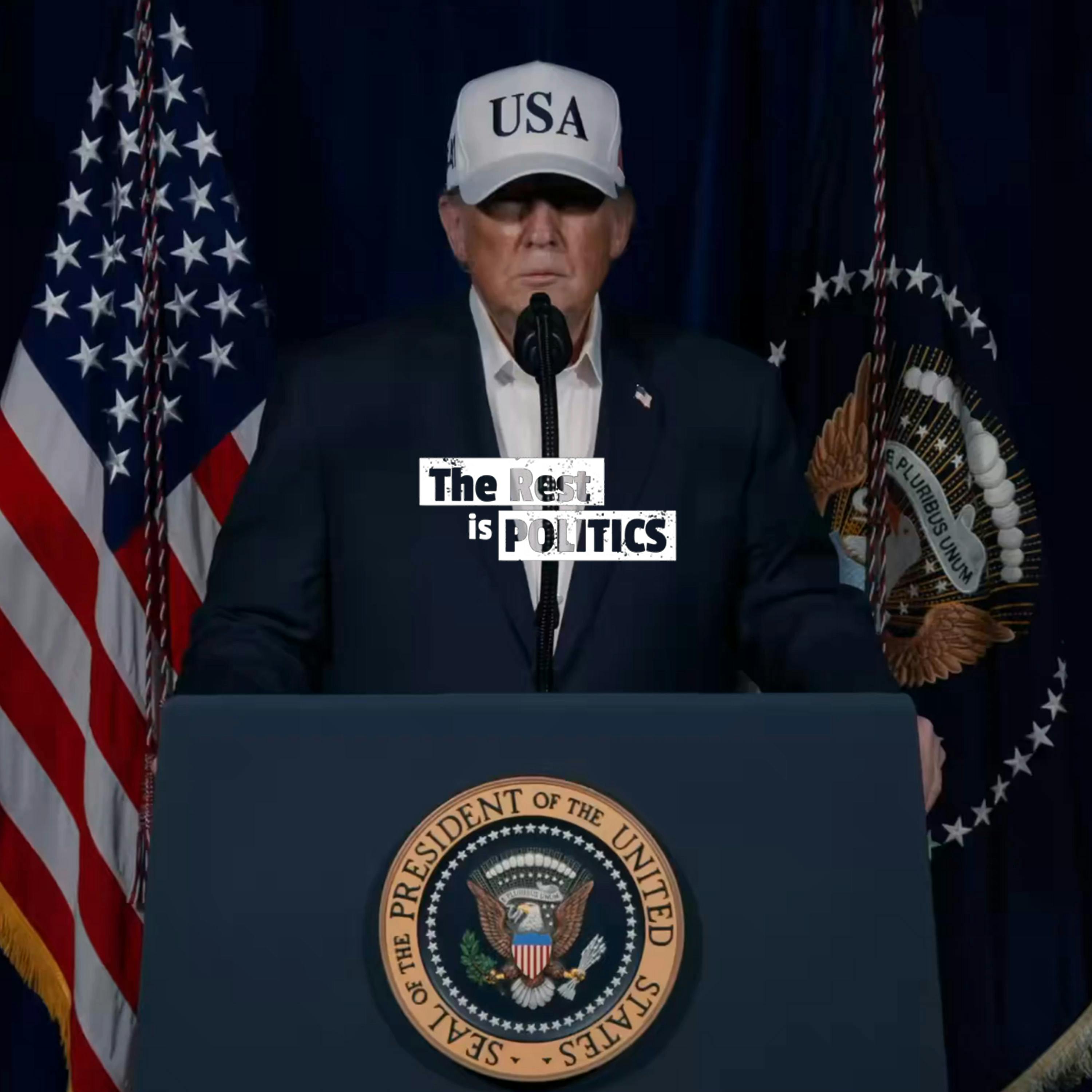
Thanks for listening to The Restisted Politics to support the podcast, listen without the adverts and get early access to episodes and live show tickets, go to TheRestistPolitics.com. That's TheRestistPolitics.com. Welcome to The Restisted Politics special on US-Israeli attacks on Iran. Operation Epic Fury is underway. Sounds like a very much something written by Donald Trump or Hexas. And to think that just two days ago in Geneva, there were talks going on and the Amani media was heading to Washington to report on progress. And now we are with some pretty major bombing underway. Gauri, where do you want to start? Well, I think let's start with for people who are interested in a kind of granular US view. Maybe look back at the recent leading interview that we did with Rob Malley. And just to remind people, the listing Rob Malley was the lead and go show to her on the JCPOA, which was the older run, nuclear deal and was Obama's point man and then Biden's point man on Iran. And we obviously got him on because the US fleet has been gathering around Iran for months now, much in the way that it did in Venezuela. So people remember there was a lot of false alarms around Venezuela. People very concerned that this enormous American military naval and air presence, marine presence had ended up around Venezuela. But for weeks, nothing really happened. And then the strike occurred. And the same pattern roughly has been followed in Iran. So over the last weeks and months, more and more American assets have been moved into the region. And there was a real sense, actually even when the strike happened in Venezuela, of people saying, I'm surprised it's Venezuela, I thought they would be doing Iran first. And when we did a recording, I think, a month ago, we were talking about why it might not have happened yet. So there was a speculation that Israel felt it wasn't quite ready. I'm not getting into the rights of wrongs this yet. We're getting the rights wrong. I'm just talking about the logistics, the tactics. One argument was that Israel wasn't quite ready. It's defenses weren't quite ready. Another argument was that the Gulf countries were holding off and that they didn't really want a war breaking out and that they'd put pressure on Trump to hold off. And by the time you interviewed Rob Malley, there was a rather striking moment, which was rather a good quote, which we've just been reminded of by our team, which is Rob said, "I would not be at all surprised if by the end of this podcast you tell me, 'Oh, we've just had a news bulletin that a deal has been struck, a nuclear deal has been struck, and President Trump has announced that it's the best deal that's ever been negotiated with anyone anywhere for the last 4,000 years. Or if you told me at the end of this, 'Oh, we've just got a news bulletin,' that President Trump has ordered strikes on Iran and strikes against military political targets over the year." Yeah, and he also said there was some method in this madness because, of course, unpredictability was a useful weapon. But I think there's something, I think we have seen this coming recently. I read something just a few days ago when I was in Ukraine, and it was the, some of the kit that has been sent as this build-up, two-thirds of the US's E3 command and control aircraft. Somebody said this would totally not be required just for PR in the way that some of the armada might be. I think the other thing point to make sure is that, you know, one of the things I kept hearing in Ukraine was that these negotiations with Wittkhoff and Kushner are just fake, therefore show. And you sort of feel it's been the same with this. The Iranians turn up, the Americans tell them to capitulate, the Iranians say no, and they go away. And there was a very interesting, there's this guy, I don't know if you follow this guy, Treeter Passy from the Quincy Institute, who seems to be like Rob Malay, something of an expert on Iran. He is adamant that most of the information flow that goes to Trump about Iran comes from Netanyahu, and he's convinced Trump that one that Iran is a lot weaker than it was, which is true. It is weaker than it was on the nuclear front, it's weaker economically, and it's just had the biggest demonstrations, probably the biggest demonstrations that we've seen in recent memory. And so has persuaded him that a few big hits and a few big threats, and Iran will crumble. And Passy tweeted recently, he said this, Trump's fundamental mystery to Iran is that he believed that the Theocratic leadership would fear all the USA aircraft carriers and their firepower, and as a result, opt to surrender. It's the opposite, they fear surrender far more than they fear war. And I think that's an important insight, because the way that Trump operates, I mean, don't forget, when he did do the launch of the nuclear program recently, he came out immediately and said it's been obliterated. I saw JD Vance last week being asked, if he's been obliterated, why do you have to attack it again? Did he really struggle with the answer? But these attacks are far bigger. These attacks are far bigger. We've already seen attacks on the intelligence headquarters, National Security Council, the pastor compound, where he's thought that both the president and the Supreme Leader Hamine, are thought to live. We've seen an attack on the place where the former president is believed to live. And we've also seen the response as well. You know, Qatar says it's a thought of a number of attacks on the American airbase there. We've got bases in Q8, UAE, Bahrain, all being subject to attack. So this could go in any sort of really quite dangerous directions. This episode is powered by fuse energy. Most of us are buying energy in the dark, not knowing what it costs. You wouldn't do that with your weekly food chart, but with energy, you're often charged first and only find out the number later. When you don't have that clarity, you usually end up paying more than you should, which is what fuse energy is working to change about how energy works. The average household switching diffuse can save around £200 on their energy bills. Fuse handles the practical side. The app shows what you're spending day by day and what that actually means for your bills. For listeners to the show, there's an added benefit. Use the code politics when you switch and you'll receive a free trip plus subscription. Switch to fuse energy and save around £200 on your energy bills. Use the code politics for a free trip plus subscription. fuseenergy.com/politics. We'll get on to the really big question I think hanging at the back of this, which is how we judge Trump and Israel's actions. We'll get on to the very different responses that are now coming. Some leaders who aren't really saying anything yet, comments from the EU, comments from Australia, comments from people at Jeremy Corbyn. We can get into all the different ways that you can talk about this. Let's just try to get as far as we can close to the facts at the moment. The first thing is it's extremely interesting how all the news agencies the world have to scrabble to try to put the information together in real time. We're doing this live and some of these strikes are still taking place. We know that these strikes in Iran and we can see this from mostly from social media footage, have hit the major governmental capitals, the major cultural centres of Iran and major religious centres. What do I mean by that? It's hit places like Tehran and Tabariz, which are these huge cities. Tabariz, big city, north-west Iran, hit Esfahan, which is the great kind of ancient Islamic capital, great cultural capital. And they've hit Kham, which is the seat of the religious authorities and religious leadership. But they've also hit slightly more obscure places, Khamansha, which is out towards the west towards Khoridistan. They've hit bits of Louristan and they've hit bits of the border, a place called Ilan and Louristan. And then as you say, there's been these Iranian counter-attacks. So Iran clearly has been expecting this to happen and has had a presumably set the coordinates of the places it wanted to attack so that they could trigger them as soon as the attack happened. They have attacked Israel, but they have also attacked Qatar, Bahrain, Qwait and Jordan. And in most of those cases, as far as we can tell from the information as of 11 minutes past 11 on a Saturday morning in Britain, the attack in Bahrain seems to have been aimed at the US naval base. The attacks in Qatar look as though they were probably aimed, although the Qataris may correct this, at the US air base. Jordan also, there are the US assets on the ground. So it may be that what Iran is trying to do is draw a distinction between attacking US bases in those countries and attacking those countries, but it certainly provoked a massive hostile reaction from the Gulf. Saudi Arabia has put out. And Saudi Arabia, remember, had slightly stepped out of the Iran conflict. China had negotiated a diplomatic alliance between Saudi Arabia and Iran, most of these Gulf states, who had been against the Iran nuclear deal, with the exception of the Emirates UAE Dubai that remained very strongly anti-Iranian, went a bit softer in Iran. It seemed to have concluded that Iran was no longer really a threat. It didn't really have a big nuclear arsenal. A weak regime in Iran was less of a threat than chaos. But those regimes are now very, very angry indeed that Iran, who they felt that they were, taking a gentle attitude towards, has decided to strike their territory, whether or not they're going off the US assets. Now, Ruri, I'm doing this live podcast with you. If I was doing it with our American counterpart, Mr. Skaramucci, and I were to ask him the question, how much do you think Wag the Dog is being brought into the equation? What do you think you would say? You'd say 100% this is all about the Epstein files. That's why Hegseth is going to war with hands, tropic and open AI. This is why they're attacking Iran. Go and tell us about that then. Give us the Wag the Dog. Well, Wag the Dog was a film starring Robert Neneiro, Dustin Hoffman, I think. And basically, the American president was caught up in a big sex scandal. I think just getting up to the election and his kind of Alice Campbell figure, go called Conrad, he somehow constructed a fake war. Would you believe against Albania? So America went to war with Albania to stop this. So Wag the Dog basically means where bad things are happening, you create something far bigger, so that the world stops talking about the bad thing and they start talking about the thing you want to. Now that I don't in that, I don't minimise by the way how awful the Iranian regime is and how Iran has been seen as a threat by all sorts of countries for a long, long time. But it does seem sort of the timing. We've had Trump just on his state of the Union address, longest in history and didn't go down terribly well. His ratings are really poor right now. And there's a couple of historic tweets, Rory. October 9th, 2012, from Donald Trump. Now that President Obama's poll numbers are in tailspin, watch for him to launch a strike on Libya or Iran, he's desperate. Now you can often work, I've said this before, you can often work someone at best by how they attack their opponents. And then this one a year later, November 2013, remember I predicted a long time ago President Obama will attack around because of his inability to negotiate properly, not skilled. So I think given what we know about Trump, what we saw in Venezuela, what we see in some of the other operations is done, there will be a pretty powerful political motivation. And what that leads me to worry, in fact, it puts people like you and me in a tricky spot, we load the Iranian regime, we'd long for it to be gone. But when you are highly suspicious of the motives, unsure whether this is thought through, you do worry that this could go any which way, and it would be hard to work out the truth because Trump's going to declare huge success, whatever happens. Yeah. Well, I think if you look at these statements coming up from those leaders that have already made statements, you can see that fundamental challenge. On the one hand, the Iranian regime is abhorrent, lost profound credibility, has been killing tens of thousands of its own citizens. Yeah. Is weaker than it's ever been, it's in a situation in which for the first time really, you have the middle class and upper middle class Iranians now combining with the Bizarre's and more of the urban poor and even some of the rural poor to rise up against the regime. And a real sense that it's in the end states, we've talked about the fact that how many years, 86 years old, the Supreme Leader. So horrible internal repression. And of course, Iran is a state which has had these proxies, so it's had in Syria, and in Lebanon, and in Yemen, and Iraq, militia groups, guerrilla groups, missiles, destabilizing the region, attacking American bases, attacking Israel, etc. And it had a nuclear program. So that's the Iran is an evil regime that kills its own people and it's the threat to the world. And then you've got the other side of it, which is firstly, where is the international law in this? How do you think this through in terms of a, to be pretentious, a rules-based international order, right? The basic lessons we thought we drew from the Second World War, and even from the First World War, and the whole existence, the United Nations, etc. It was about having rules. Yeah. Royal or even from the American Constitution, because the American Constitution says only Congress can declare war. And he, Trump actually called this war today. Now, before he's been a bit careful on that, he's not taught about war, because that is the American Constitution. But what he's showing yet again is he believes he can do whatever he wants, regardless of the American system and regardless of the United Nations, or indeed his allies. It's not clear to me how many others, I was reading in Der Spiegel this morning. They said, "Mats have been informed. I'm about to use you to go to Washington this week. I don't know whether the Brits were informed. I don't know whether I just don't know." But I don't know. Have you seen anybody outside the kind of really obvious ones like Israel? Have you seen anybody openly endorse this so far? It's interesting. I'll Bernese. Anthony Albanese. Okay. So it's been really interesting. I've just noting down a little bit of this stuff. So you get the full range. On the one hand, you have Jeremy Corbyn coming out saying, as you can imagine, this is illegal, unprovoked, unjustifiable. These are rogue states breaking international law. So that's the classic position of the European left. Then on the other extreme, you've got Anthony Albanese. And Anthony Albanese says, "Australia stands for the brave people that were on in their struggle against oppression." Then it talks about the Iranian regime's ballistic missile and nuclear programs, support for armed proxies, brutal acts of violence and intimidation, attacks on Australian soil, human rights. And it then says, "We support the United States acting to prevent Iran from obtaining a nuclear weapon. We're closely monitoring this situation. We're upgrading travel advice." But it's very, it's the closest, you know, but it's compared to the other world leaders. It's a pretty full-threated condemn Iran. We support the US. And there's no anxiety. Now, Kaya Kallas, who's the EU foreign leader, says, you know, this is an evil regime. Missile's a threat to us all, but calling for a cool head. Vonda Lyon is closer towards the international law position. She says, "Maximum restraint protects the villains, fully respect international law," which is much closer to coded language for, we're really worried that the US and Israel are again acting completely outside international law. And despite the fact that she agrees the Iranian regime is evil and dangerous, she also thinks that we have to think about presence of the whole international system. But at least when I went on, there is a deafening silence from Kaya Starmer's Twitter account and Macross account, neither of you have been tweeting about this at all. The only thing I've seen from the UK is a line from, I'm guessing number 10, the UK did not, or this may be a report, the UK did not participate in the strikes. Kaya Starmer will convene a co-brem meeting this morning. That's the cabin office briefing room A, where they have these sort of national security meetings. UK government statement does not endorse the US operation. That's the report I'm saying now. And the quote was this, "Iran must never be allowed to develop a nuclear weapon." That is why we have continually supported efforts to reach a negotiated solution. Immediate priorities, the safety of UK nationals in the region, we will provide them with constant assistance available 24/7. As part of our longstanding commitments to the security of our allies in the Middle East, we have a range of defensive capabilities in the region, which we are recently bolstered. We stand ready to protect our interests. So there's no mention there of support or otherwise of what of this specific action. And don't forget recently, I mean, I don't know how true this was, but there was quite a sort of cuffuffle with your old leader, Boris Johnson, condemning Kaya Starmer for reports that Britain had not allowed some of his bases to be used for some of the military options that Trump was trying to go off the ground. So that looks to be like it. Yeah, well, that sounds like, let's just on that. I think that's really important because that implies that the UK have been anxious about the legal implications, the US launching attacks on around the middle negotiations and therefore have been reluctant to allow the US to use the UK bases. And if that's been going on for a few days now, not surprisingly, when the US launches those attacks, the UK will still have that position. Can we just step back for one second, just to remind people a little bit of the big picture. I'm here. And the big picture basically is that if you'd been talking about this under Obama or Biden, so let's say we went back four years, eight years, 10 years, 15 years, there would have been three worries. Number one, international law, right? You're going to get Congress, oh, domestically, or as Congress, you get Congress, internationally, you're going to get you into this. And what are your grounds? So you can only do this stuff in international law if it's, if there's an imminent threat to you. Right? I mean, much as I guess I suppose this is stupid analogy, but I suppose you're only really allowed to punch someone on the face in a bar if they're actually picking up a bottle of a swing at actually. You can't say, I think he might in the future pick up a bottle of time, going to smack him in the face. But interestingly, in his state of the union address the other day, Trump said Iran was about to develop ballistic missiles that could hit the United States, whereas the defense intelligence agencies own assessment, the last one, says that's not true. So I wonder whether he was actually trying to sort of generate the sense that we are about to get hit. Trying to set the stuff up. Yeah, well, so there was the legal argument, but I think probably the two stronger arguments why people didn't do it in the past were firstly that they were very worried about Iran's proxies. This very powerful, his beloved force in Lebanon, which had about 100,000 missiles targeted Iran and the Houthis and the Shia militia. And secondly, that they were very worried about the potential response from Iran itself. Its own missiles, the way it would accelerate its own nuclear program, the way in which you would unleash war in the Middle East. And what's changed over the last two years is that Israel began to be much, much more aggressive and take much more risk. So they, we first started covering this when they attacked an Iranian consulate and killed Iranian diplomats in Syria. And which was a change because actually the Iran Israel conflict, really since 2019, was sort of shadow war. There were cyber attacks, there were a few assassinations, there were tax and ships, but there wasn't anything absolutely open. Then there was the Israeli attack which wiped out the whole of the top of his velar. This was, people remember, this was the pages and the radio attacks where 1500 of the top people of these Iranian proxies and Lebanon were killed. Then there has been the change in Syria. So Amad Al-Sharah who we interviewed is very much part of the anti-Iranian force. Iran was backing Bashar al-Assad, the old ruler in Syria. And the whole infrastructure of the Iranian Revolutionary Guard in Syria has collapsed as Amad Al-Sharah has taken it over. So Iran suddenly finds itself without its proxies. And then the next thing that's happened is that the Iranian strike, the Israeli strikes against Iran, of which this is the third major sequence, have revealed a real weakness at the heart of the Iranian system. It turns out that the anti-aircraft, the anti-missile, defences that Iran simply weren't good enough, a huge amount of the satellite and interception infrastructure. In other words, Iran's abilities to scan the skies, see these missiles coming in, has been taken out. The nuclear program has been set back a long way, and Iran did not actually react very powerfully the last two times and the iron dome which protects Israel, held. So the big change to finish this long speech is that Iran, which was seen as a very dangerous power that could cause mayhem if it was attacked, as recently as two years ago, is now perceived at least by US and Israeli policymakers as being a sort of paper tiger, militarily very weak, regime about collapse, and therefore they don't think that they're taking too much risk and attacking Iran. This episode is brought to you by WOOP. And I'm speaking to you, I'm wearing a WOOP device on my wrist at the moment. Politics teaches you fairly quickly that attention is finite. When attention is drawn to the loud and urgent, it's easy to miss the deeper patterns shaping outcomes. And that applies to health as well. You keep going, you meet demands, you get through the day without noticing that the cost is quietly all adding up and taking a toll. Whereas WOOP exists to bring background picture into focus. The thing on your wrist is there showing you how your body responds to everyday life, to sleep, to recovery, to strain, and how those rhythms and trends emerge over time. If you want to better understand how you can feel and live at your best for years to come, head to join.woop.com/tripp and get started with WOOP today. You can sign up for free 30-day trial so you can try WOOP risk-free and see what you learn. Now, just a quick pause in the podcast to mention our sponsor, NordVPN. We're in February and that is the month when the year stops being theoretical. Good intentions turn into systems, accounts, passwords, payments, and life starts running through logins again almost without pause. And it feels completely normal and it's also exhausting so there you are, whacking in all this sensitive information day after day, it's the happiest part of your everyday life. NordVPN works quietly in the background, protects your data as you get on with life online. It adds privacy without asking for constant attention and encrypting what you do and keeping your location private. And we can't begin to tell you how much danger there is if you start having sensitive information on passwords and locations out there. And privacy, as provided by NordVPN, tends to work best when it's built in. One NordVPN account covers up to 10 devices or you can install it on your router and protect your entire home network in one go. To get the best discount on your NordVPN plan, go to nordvpn.com/restispolitics. You'll get four extra months free on the two-year plan, plus a 30-day money-back guarantee. The links in the episode description. [Music] Rory, what do you know about Channel 12 in Israel? Tell me about Channel 12. Well, I don't know anything about Channel 12, so I'm saying, just as somebody has just sent me a social media post, quoting Israel's Channel 12, reporting Israeli officials believe that hemmany, his advisors and those responsible of the nuclear program have been assassinated. I have no idea if that is true or not. But I- Well, let's stop on that for a second. I mean, this is worth doing, given we're doing this live and you've just heard this live. Okay, so let's take that seriously. We don't know whether it's true or not, because in the past we've heard people have been assassinated, turned out not to be in some sort of industry. But let's say it's true. That is an immense change. How many has essentially run Iran since, well, now for decades upon decades. The first phase that you remember of Hormane, really came to an end in '89. And everything we know of Iran, the second Islamic Republic, since 1989, has been under the control of Hamani. And this man, 86 years old, is a true believer. He's not somebody that was likely to flee to Russia or head off of this loot. He's somebody who, to the end, believed strongly in the nation state of Iran, in the sacred resistance, the fight against the US and Israel. And he is the absolute linchpin of that part of the regime. Now, there are other things underneath him. There is a huge revolutionary guard infrastructure. There is a bascheech militia, which is set up throughout all the villages in towns of Iran. And then there's the military. But removing the supreme leader right at the top is essentially like removing Putin or removing Asad Am Hussein or removing Gaddafi. I mean, you're removing the person who has been personally responsible for running this autocratic regime. Now, what does that then mean? Yeah. Yeah. Now, anything I'd say about that, I think that's right. But I think the comparison with Putin is not necessarily accurate. I think Putin is an absolute dictator. I think he came in the supreme leader. But I read somewhere recently, somebody said it's less a pyramid structure, a more a series of pillars that sort of go in in different directions. And I think a lot will depend. Let's assume for the moment that this is true. And as I say, hey, talking like this, because we're talking about sort of hugely consequential global event that we're getting from one person on a trade on his way to a football match telling me has seen on Twitter. But that you've then got the revolutionary guards that is, as we said the last time we talked about this, the RGRC, the last time we talked about them, we talked about they basically control the economy as well as the politics of this. So the question then would be does if he were to get to be wiped out, does that then lead to a power struggle to replace him, which cements those kind of pillars and their power structures, or does it lead to real change? Now, and this is so, this is going to be so complicated. When we were in Munich at the Security Conference, Roy, I was talking to this European diplomat. And we were actually talking about all sorts of different things. And along came our friend, Justin Forsyre, who later introduced my friend to Reza Pachalavi, the son of the Shah. Who else is there, Inspector? Yeah, I mean, yeah, that's why it's very specific to the son of the Shah. Yeah, so we were both chatting to him. And he was saying that he was feeling more confident, they've had these massive rallies around Europe. And he's been out on social media today, saying that the time to return to the streets may be approaching, military there to defend the people, not the regime, pleading with Trump to avoid civilian death, and pleading with people to stay safe, but be ready is essentially saying that the regime is crumbling. May or may not be true. But interestingly, the diplomat, who was just, you know, I think quite pleased to suddenly be immediately in the Shah's son, as we were just having a chat about this and the other. He sent me a message this morning, I'd love to know your reaction to this. He said, "And so it begins, you recall my concern that starting a war is easy, controlling it, ending it much harder if it all possible." The Iranian regime is evil, yet I'm taking a back about the hubris and ease of the decision to attack. The world is becoming unshackled and our most atavistic instincts unleashed, all the while backed by unprecedented technological ability. I feel we're entering an age of impunity and suffering with no one in control. How long will it take to temper the human condition once again, and who is going to do it? And I kind of feel there's a lot in that that, you know, where this happens, Trump, he stands up there with his USA baseball cap and he kind of, you know, just talks as though he literally owns the world and he's carrying it on his own shoulders. And he doesn't really know what's going to happen. But bizarrely, when the news broke this morning, this was happening, I've been in bed wallowing in self-pity with Manflou. And as you do in bed, Roy, I was reading for the latest edition of Foreign Affairs, Pegaside. And I was actually reading a piece by this guy about Iran, he was called Benham Ben-Taleblu and he's the senior director at the foundation for defensive democracies, which I think opposed the JCPOA. So it's probably, you know, very, very anti-Iranian. But he said it was a really interesting thoughtful piece and it was setting out how America, with the support of the Iranian people, could bring down the regime, okay. But as I read through, I thought, God, this is bloody complicated. This could go any which way on the route from A to B. Yeah. So, so let's, let's, I think you, I think this is the key. You are essentially, when you're doing this, you are stepping into a completely black room with no idea whether there's a step underneath you or whether you're going to plummet 100 feet down. You may get away with it. You may not, right? So what's the most optimistic scenario, which is Rayleigh and US planners will have? Their most optimistic scenario will be the Iranian people are completely fed up with this regime, that when Hamani and the top leadership falls, the revolutionary guard and message will be unable to hang on to power. The army will maybe be a more neutral force, more sympathetic to the calls from Reza Palavi. I mean, he himself might even want to feel that the military has some residual loyalty to the old Shah. But in any case, that Iran, this is the optimistic story. Iran has a very strange, strong and long tradition of parliamentary engagement going back to the beginning of the 20th century. And that there are this highly educated progressive population to clean cities. And that what will happen is that it will be like 1989. The old leaders will be kicked out. And this is the very optimistic scenario. Elections follow and sanity returns. Here on the other end is. Well, let's lay out some different scenarios. Number one, a top leadership maybe has taken out. But a new form of top leadership takes over, which could either be a new strong, strong man taking over. Had the Russia of Shigard, or could be just a military coup, a military general taking over. And then the Iranian people are going to be very, very angry because tens of thousands of people have been killed by those figures. And they're not going to be content with a Venezuela situation where you just remove the top person and leave the rest of the regime in place, in which case you have continual coming in the streets. Or you have, let's craft another possibility. You have a anti-regime government takeover. So maybe a tentacratic US-backed government takeover, in which case you might have the former regime elements, right, the people who were lined up with the old regime, starting their own insurgency. That's the Iraq problem, right? The bathists are kicked out and then you have all the former Saddam loyalists mounting a tenure insurgency against the government. As with many of these countries, you could also imagine a scenario of big divisions which are ethnic and sectarian. So the Kurds, West Iran, very, very badly disposed towards the regime, completely different political views, heavily prosecuted now for 40 years, and very, very interested in separatism. The bluch down on the southeast on the Pakistani border again could kick off. Now, somebody listening to this is going to say, oh well, that's this typical, and certainly Boris Johnson, those things, people would be like, oh, this is the normal rubbish that you get from these kind of foreign office arabes. You just, when are you going to just call out the fact the regime is evil fight? I honestly do think that anybody who thinks they can predict which path this is going to go is confusing themselves. We know so little about Iran. We've got so many of these countries wrong. We've got Afghanistan wrong, we've got Iraq wrong, we've got Libya wrong, we've got Yemen wrong repeatedly. So they may be lucky, but even if somehow by some miracle, Trump and Israel triumph and Boris Johnson writes the article, he wants to write saying, yet again, that doom's error liberal bedwetter was wrong and it's all worked out beautifully, it will be in a sense because they were lucky. Anyone who thinks they can predict the directions, they're taking risk, huge risk. Well, on prediction, while we'd be talking about the recovery, our hard-working, dragging the amount of bed early in the morning to set up a live podcast team, we'll be doing a bit of polling of our listeners and viewers. Will Trump be successful in establishing regime change in Iran? Our viewers and listeners think no 80% yes 20% will there be a full blown war? Yes 55, no 45. Will Kierstharma join the US in Iran? No 84, yes 16. Will the Iranian people rise up against the regime in the week of these strides? Yes 41, no 59. On the coup point, Rory, when you were speaking, I was sort of trying to think what would have venous weight in the equivalent B. So venous weight, he goes in and takes out Maduro. And we all think this is going to be the unleashing of sort of great democracy uprising in Venezuela because he's got no interesting democracy, he's actually wants to be a dictator himself. So Delsey Rodriguez does a deal, stays there, carries on. I guess the closest example parallel to that is this too harsh on Delsey Rodriguez might be if actually they take out Khameney and some of the top dudes and then actually a version of the Islamic Revolution regard core just takes over. Yeah, well, I think there would be a, I mean, the one Trump narrative we've seen before which could definitely play well here is a military general takes over who says we made a mistake having a new clip program. We're going to get rid of our ballistic missiles, but I'm going to run a military dictatorship. I'm going to open up oil for American oil exploration companies and Trump will say tick tick. What does Trump care about? He doesn't want, he wants to be able to say no nuclear weapons, no threat to Israel and great commercial opportunities for the US. And as you say, he seems to think that it's easier to deal with old fashioned dictatorships than with democracies that might in an annoying way vote in governments that might be opposed to the United States. So I would have thought it would be a strong temptation from the kind of hard realist edge of the Trump administration to say we don't have any views on whether or not Iran has a democracy or we care about is that it's not threatening our ally Israel and that it gives us commercial opportunities. Now, the problem with that, of course, is that that is not remotely acceptable for the Iranian people who've just seen tens of thousands of their citizens, some machine gunned in the streets over the last few weeks. They are not signing up for a world in which a new military dictator takes over. And so I think the level of rage and antagonism in Iran towards the United States, towards Israel and of course towards their new government is something we're massively underestimating. So I don't think that's an easy thing to pull off. Yeah, yeah. Well, there we are. We're both looking for a quiet weekend. I was looking to get rid of this post-Ukraine, whatever it is. And you've seemed to have a skiing injury. Raise your hand again. What if you're not a very interesting? I was ski touring. And as people know what you have to do, you have to click around the back of your bindings. And I managed to cover the snow in blood to try to flip it around. Now, let's just quickly, let's just quickly just go through some of these comments. Oh, we'll go comments. I didn't know that. Yeah, yeah. So we've got, oh great. I like this. Leftist idiot switching off Kierstarma voters. Stop supporting Ukrainian Nazis. All you two care about is finding a way to smear the motives of Trump. All our friends are out there. So that's yeah. So I think let's just take that on for a second. How would you, if you were, I don't know, Kierstarma, for example, make a speech to the people there who say we're just a bunch of useless lefties who aren't condemning the Iranian regime enough and we just want a smear Trump? I think what you have to say is listen, the Iranian regime is a horrifying horrendous regime that's machine gun tens of thousands of people in the streets. I would say to this person challenging me, I've spent, I guess, much more time in Iran than they have and my experience being detained by the Bastille Jimelish from the Revolution Guard was extremely unpleasant. I got a sense of a totalitarian regime, people living under fear, massive underdevelopment, a very, very angry population. And this is going back even 2025 years. It's a regime that's been in place nearly 50. And it's also true that this is a regime that has destabilized the region, fired missiles around. So I would be incredibly happy if this regime was toppled and a little democratic government emerged in Iran and all the incredible potential of this educated, vibrant, huge civilization was released and stabilized the world. But Trump does not have a good track record on doing these things carefully and responsibly. There is no sense at all that he's answering the question of what happens the day after? What is the nation building? How do you get the government going? How do you get the economy going? And secondly, the risk is here, is not being properly analyzed. Let's talk through the risk. What would it mean if there was civil war? What would it mean if there was some military coup? What would it mean if another Iranian Revolution Guard takes over? What does it mean if Iran starts not just firing ballistic missiles at the Gulf, but starts doing much nastier terrorist attacks around the world in revenge. So somehow we have to find a way of saying, I totally condemn the Iranian regime, but what Trump is doing is reckless, stupid, ill-planned and has a very, very high probability of going wrong. And even if he gets away with it, it'll be through fluke, not judgment. I don't think here's something I can say the last bit of that. I think you can say a lot of the first bit about Iran and what we think about that, but I think maybe the way to phrase it is that look, Iran is an issue and a country that has been devolved, presidents and other world leaders for decades now. And it is probably only if we do have some kind of joint cooperative approach to this that we can make real progress. I mean the truth is that the deal that was done was that it was a pretty good deal. Trump hated it because it was done by Obama. But I just think that that is part of the problem we're dealing with somebody who feels that everything has to be about him. And Rory, I've been, we're getting hundreds of comments in here, but you read out some of the negative ones about the from people who say, I suspect there's quite a lot of bots going on here. But here's one from Fam Giza, Australia. Netanyahu is only interested to stay out of jail, which means he has to continue in the state of the war conflict. Same for Trump, the Epstein scandal continues, distraction helps, somebody else pull, Ingram, Operation Nance Distraction. So there's a lot that it's all very, very mixed. But I think that, look, I think one of the, I was thinking about this when I was thinking about the biolation yesterday and all that sort of all the kind of the relentless commentary that flows from this. You get so many people saying so much stuff about anything that happens in the world. And I think that when something like this happens, it really is important that world leaders can do step back a bit and actually, I think say what they really think. I'd love to hear you mention Albenezio. When you first mention Albenezio, oh God, no, surely he's not going to come out and say, yeah, we totally support this and blank check. And I don't think that's what you're saying. He's done. But I'd really like some kind of honest calling out of this by all of the world leaders really because we're entering the world at the moment. We are, we thought, you know, that friend of mine from the diplomat talked about impunity. We are entering a world where, you know, leaders can do what they want. And then if they have the base and they have the media control that they have, they then just create a new narrative if it goes wrong. Yeah. So, so, I mean, I think this is one of the most worrying things of the whole thing, which is the way in which the engines of the way that populism works, the way that a social media works, the way that this kind of post-truth works, all increases the chance of conflict because if you are Trump or you're Netanyahu and you're effectively running a sort of reality TV show where one should trying to do is uncertainly opponents to everybody off balance by creating a new headline every day. Bombing another country is almost the best headline you could have got. I mean, you've pointed this out when you've said, you know, this, this ends with people dropping nuclear bombs around because the mechanism of politics isn't any more. It's not Cameron against Blair or Gordon Brown, right? This is this is not people talking about, you know, whether we're going with shore start programs for early education or whether we're going to be reducing spending on policing or invest more in devolution. This is a type of politics, which is all about the big radical play, you know, with sending ice sentiment away, dropping bombs on Iran, challenging the constitution. And so, I think that you and the people who are responding who are talking about the fact that you've got to look at wag the dog, you've got to look at distraction, you've got to look at court cases. And the reason why that's problematic is the Iranian people are the victims here, right? Then it's not really about Iran. It's not even really about the threat that Iran poses because in fact actually paradoxically, the reason this is happening is because it turns out Iraq is much weaker and less threatening when people claim two years ago. In fact, the only Iran which you're Iran, sorry, Iran is much weaker and less threatening was to use. In fact, the only way in which Iran is going to damage anybody is going to be in response to these attacks. Right? It's not that Iran was on the verge of launching these attacks, unilaterally. But there's another point, I just just to give you another thing to chew on. Christa Hexand says millions of refugees coming to Europe because of Trump. So, remember, when the Civil War broke out in Syria, smaller, much smaller places than Iran, I guess, probably about a quarter of the size in terms of population. You ended up with three million refugees going to Turkey, a million to Lebanon, a million to Jordan. Are you Korean? I can't remember what the statistic you gave us when you were in Kiev this week, but it wasn't 6-7 million in the European. 4.7 million in Europe, yeah. Okay. Now, Iran is a gigantic population, right? It's a bigger population than Britain. You really could end up if this thing goes wrong with tens of millions of refugees on the move. And this despite the fact, this is in comments from D. Mulcahi. This was Trump in June 2025. I can report to the world that the strikes were a spectacular military success. Iran's nuclear enrichment facilities have been completely and totally obliterated. So, we'll get a version of that tomorrow today or sometime tomorrow. Anyway, we'll be talking about this again on Tuesday, when we do one record the main podcast. We'll probably talk about the bilation as well. But there we are. Bloody hell, what a world, what a day, what a world. Yeah. Yeah. Well, I think we just keep coming back to your point about politics. I mean, there's a guy called Timeload Jenkins, who sort of echoes your anxiety. He's on the other side to you, but this is what you're dealing with. He says, I'm not a fan of Trump, but at least he's someone who's actually doing something rather than sitting in constant conferences, saying a lot and doing nothing. It's this very odd world that you want to say rationally, but what's he doing? I mean, the main fact that you're doing something rather than sitting in a conference is not great if what you're doing is causing chaos. I used to hear this a lot with Boris Johnson. At least he's not sitting around at least he's taking risk doing something. But if the risks are reckless and the actions are profoundly damaging, you know, and someone else has just said, what does it matter if there's a civil war? Well, it matters as a civil war. If you dance up with tens of millions of refugees, apart from the incredible suffering, the Iranian people themselves. There's another thread in the comments, right? CJ Kill, CGKL. I wonder if this is linked to the rumoured executive order to bring in wartime powers on voting. Jim G6458, Trump will use the war as a distraction and there's an excuse to stall halt elections. And there is something odd given that he made such a big thing about the Forever Wars and his constant bleating to get the Nobel Peace Prize. He clearly loves standing up there and saying, I've launched the military. It's very weird. I was looking at the notes that I was taking in October during when he was running against Kamala Harris. And all the number of times he said, these were stupid wars. He was going to stay out of war. He wasn't in launch. He was not. I actually took a note saying, question mark, I'm just looking at these stupid books. I take notes, I'm just going to remember, you know, question mark, will this mean that he won't strike Iran? Because a lot of the language then was very much, I'm not the guy that does that kind of thing. Yeah. We're now in a very different world where this guy's moving flotos and you can see this breaking the mega coalition. You can see Tucker Carlson and people coming out saying, what on earth is going on? I thought you were meant to be this kind of isolationist who didn't want to get into wars. Well, the last time for you picking these fights. The last poll I saw on some cent of this war in the last poll I saw was 20% support for military action against Iran. That's within amongst Americans. Somebody's pointed out that he called it, I should have clocked this, he called it a major combat operation. That's got a ring of the special military operation of Vladimir in Ukraine. Sorry, final final thing, just for let you get back to sick bed. We've talked about how as the old rules and the old order collapses, conflict becomes more likely. But one of the things that's quite difficult to explain to people is that you can't necessarily predict region by region exactly where that conflict is going to break out. What you can say is that the trend is clearly for the last few years, every year you end up with more conflict, more refugees, more internally as a place people. But we are not yet talking about Ethiopian troops massing on the Erotran border. We're not talking about what's happening between Pakistan and Afghanistan. Now, the point is that let's take the Pakistan Afghan border or the Ethiopian Erotran border. These are borders like the Russian Ukraine border. These are contested borders which were created with people drawing lines on maps at different times. And therefore there are populations on either side of those borders that think they should be in a different country. It's true for all Iran's borders. I talked about the Kurds, the Beluge. Make the same comment about people up and as a by-gen in relation to Iran. So what we're seeing in Pakistan, Afghanistan is a huge chunk of the Pakistani population in Khabar-Pakhtunwala where it used to be northwest frontier province are Poshduk who see them call themselves Afghans. And I remember present Kaza used to be kind of greeted by these tribal chiefs people waving Afghan flags when he landed in Pakistan. So the Pakistan is an al-Bomin, Kabul and Kandahar. What's this about? Well, this is about the collapse of a world order where people said, listen, these borders are borders. Doesn't matter how they were created. Doesn't matter who's on the other side of the border. The safest and most peaceful thing for the world is to say we're going to leave these borders in place. And that's why Trump allowing Putin to steal chunks of Ukraine, threatening Greenland, refusing to provide security guarantees for NATO, and now getting involved in these illegal strikes, Venezuela, Iran, is so dangerous because we're just seeing the beginnings from Ethiopia to Pakistan of what could bubble in to almost every continent in the world. Yeah, yeah. Well, there we are. It sort of all fits with the themes that we've been weighing on about for some time, but it's pretty alarming stuff. We'll see where it goes. And I suspect you'll be in a very different place even by Tuesday. Okay, well, speak on Tuesday and hope you get better. Yet your voice sounds much better. Yeah, it's better. I'm getting there yesterday. I talked to a friend of mine who's in the military who has been on that train a lot. And he says he never gets ill, but he does. The sleeper trade there and back is a problem. Anyway, there we are. I'll be fine. I'm going to be very brave. I'm going to be very, very brave. But yeah, yeah. Okay, see you later. And you be brave with your, you be brave with your finger. Yeah, my daughter. What somebody called a post-treat. And listen, somebody also asks what's his picture on the background? The picture on the background is the mother of my father's Chinese teacher. My father studied Chinese in China before the revolution in 1945. And that's his Chinese teacher who was already 18 and 1945. That's his mother. And she was a senior, a wife of senior Manchu official in the like sort of 1860s, 1870s. I've got nothing quite as dramatic as that unless you count, if I just dip down my shoulder this way, you'll be, you'll be able to see there the boots I wore when I played with Maradona. Oh, my lord. Listen, Alice, I didn't want to say this. I just signed by Maradona amtila. Oh, that's amazing. But you've just provoked me there because I saw our mutual friend Damian Lewis two days ago. Oh, did he tell you? He said to me, he said to me, listen, you know, I love Alistair. But I've got to say when he was selected as left back and I was right wing, I felt pretty lucky. Yeah, he was lucky. There's a truly horrible picture of him gliding past me and really looking like, I'm old tired. And anyway, I don't care. I still mention Maradona every day of my life. You've got your dad's Chinese teacher. I've got my Maradona boots, you know. See you soon. Bye, bye. Bye, bye. Bye, bye. To some, he is the revolutionary hero who restored China to its rightful place on the global stage. To others, he's a brutal despot accused of presiding over more civilian deaths than either Stalin or Hitler. Mao Zedong has one of the most recognizable faces in the world yet. He started life in a muddy, provincial village. A rebel son who hated his father survived a 6,000 mile walk across China and rose to become a figure of Titanic proportions. From Empire, the Gohanger World History Show, I'm Anita Arnan. And I'm William Durimple. In this six-part series, we're joined by world renowned expert Rana Mitter to explore the life of the father of communist China, Mao Zedong. We'll track his rise from a bookstore owner to a guerrilla commander and we'll witness his ruthless elimination to secure total power and we'll descend into the dark experiment of the cultural revolution. A time when ancient temples were but children delounced their parents and a nation worshipped a mango as a sacred relic. Subscribe to Empire wherever you get your podcasts to listen now.
Podcast Summary
Key Points:
The US and Israel have launched significant military strikes (Operation Epic Fury) against Iran, targeting major cities, government centers, and religious sites.
Iran had anticipated the attack and responded with counter-strikes on US bases in allied Gulf states like Qatar, Bahrain, and Kuwait, escalating regional tensions.
The timing is viewed by some analysts as politically motivated for US domestic reasons, drawing parallels to past conflicts and the concept of "wag the dog" to divert attention.
International reactions are mixed, ranging from strong support (e.g., Australia) to criticism over legality (e.g., EU figures), with the UK notably cautious and non-endorsing.
Concerns include the violation of international law, the risk of a broader Middle East war, and the potential for Iran to accelerate its nuclear program in response.
Summary:
This transcription discusses a major US-Israeli military operation against Iran, termed Operation Epic Fury, involving strikes on key Iranian cities and infrastructure. Iran retaliated by attacking US bases in Gulf allies like Qatar and Bahrain, raising fears of a wider regional conflict. Analysts suggest the timing may be politically driven for US domestic purposes, akin to a "wag the dog" scenario to shift focus from domestic issues.
International responses vary: Australia strongly supports the US, while EU leaders express concern over international law, and the UK remains cautious, not endorsing the action. The discussion highlights significant worries about the legality of the strikes under international law, the potential for escalating proxy warfare, and the risk of Iran accelerating its nuclear program in response. The situation underscores deep geopolitical tensions and the unpredictable consequences of military escalation in the Middle East.
FAQs
Operation Epic Fury refers to the ongoing US-Israeli military strikes against Iran, targeting major governmental, cultural, and religious centers within the country.
The attacks were motivated by concerns over Iran's nuclear program, support for armed proxies, and regional destabilization, though political timing and strategic unpredictability may also have played roles.
Iran launched counter-attacks targeting US military assets in Qatar, Bahrain, Kuwait, and Jordan, indicating it had prepared coordinates in advance and aimed to retaliate against US bases specifically.
Reactions vary: Australia expressed support for the US, the EU called for restraint and adherence to international law, while the UK has not explicitly endorsed the operation and emphasized diplomatic solutions.
The strikes raise questions about international law, as they may lack a clear imminent threat justification, and domestic US law, since only Congress can declare war, which President Trump bypassed.
Some analysts suggest the timing may serve to divert attention from domestic scandals or boost political ratings, drawing parallels to the 'Wag the Dog' scenario where a foreign conflict overshadows internal issues.
Chat with AI
Loading...
Pro features
Go deeper with this episode
Unlock creator-grade tools that turn any transcript into show notes and subtitle files.
 PodcastTranscript AI