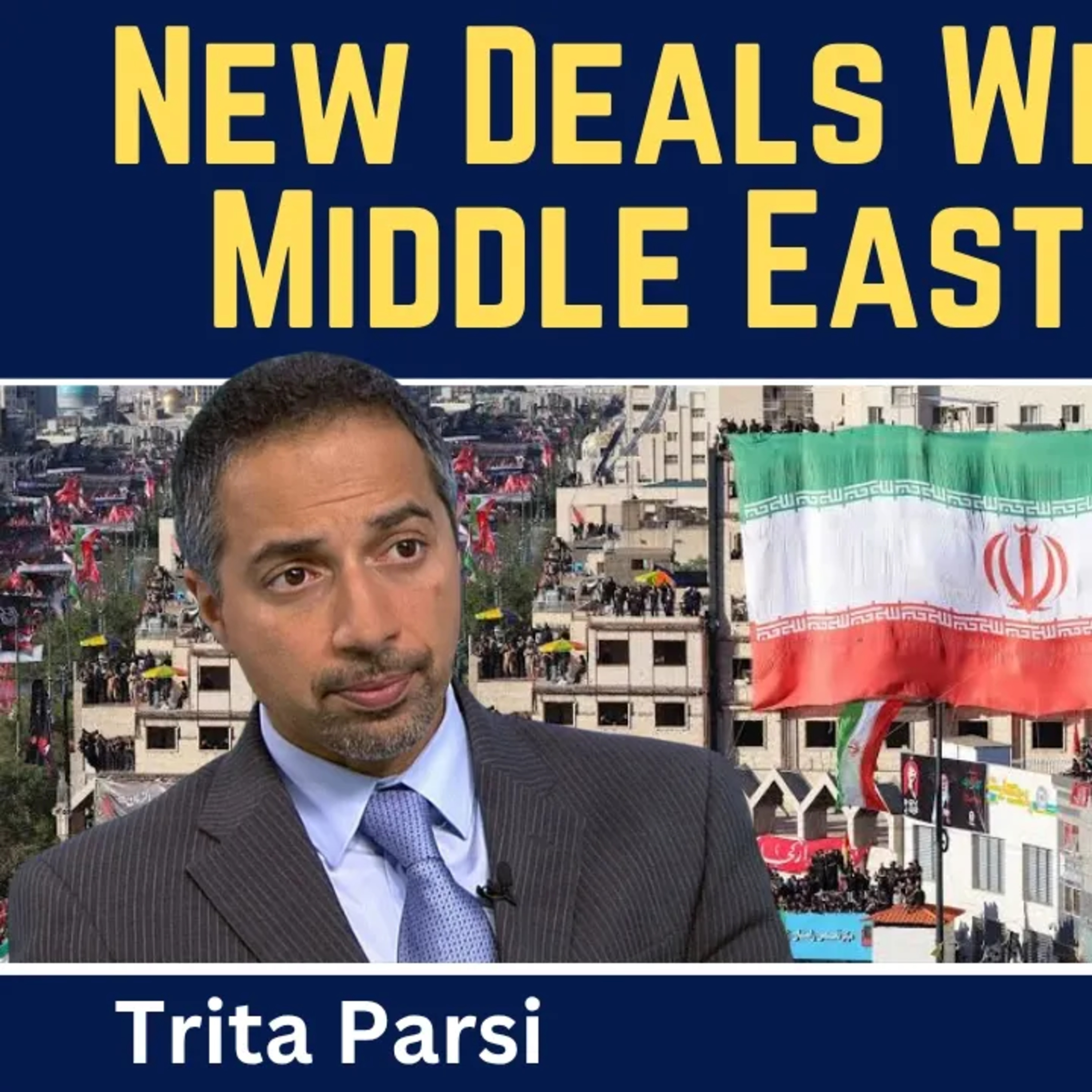
Trita Parsi: New Deals Will Change the Middle East Forever
from Glenn Diesen - Greater Eurasia Podcast
43m 12s
The discussion focuses on the evolving geopolitical situation in the Middle East, particularly the Strait of Hormuz and regional alignments. Treeta Parcy explains that ongoing Oman-Iran negotiations aim to clarify control over the strait, with two competing models: a dual-corridor system (inbound via Iran, outbound via Oman) preferred by Oman and its backers, versus a single shared channel favored by Iran. Oman is effectively negotiating for the US and GCC states, though its own interests align somewhat with Iran to enhance its strategic position, given its lack of oil wealth. The US has pressured Oman to adopt a harder line, but recent talks suggest a drift toward Iran's interpretation, potentially granting Iran notification rights over all traffic. Parcy argues that the US's primary interest is keeping the strait open, not controlling it, citing the 1956 Suez Crisis as precedent where the US sided with Egypt despite its Soviet alignment, as long as free flow was guaranteed. He emphasizes that Iran's ability to close the strait was revealed, not created, by the war, and that the strait's declining significance (oil flow down to ~21-22% of global supply) undermines the case for major military action. Additionally, the US is depleting critical munitions and air defenses, jeopardizing its capacity to address more vital challenges like the South China Sea. Finally, the Saudi-Turkey-Pakistan defense pact reflects divergent motivations: Pakistan offers military capability, Saudi provides funding, and Turkey seeks to counter Iran and hedge against Israeli threats, as Israel increasingly targets Turkey as its next regional rival.
Welcome back here. Treeta Parcy joins us today, the Executive Vice President of the Queen's Institute for Responsible State Craft. And I would again highly advise anyone to follow his sub-stack and I have left a link in the description. And all part of our talk today is actually about some of your articles, which I find very interesting. So, well, we start by thanking you for coming on the program. Thank you so much for having me again, Glenn. Really appreciate it. Well, there seems to be a reorganization of the entire Middle East. A lot of deals being made. And again, what only today we saw a Saudi, Turkey, Pakistani defense back being signed, but first I want to ask about this deal between, what possible deal now between Oman and Iran for some common control over the sphere of our moves. What is it because it seems like this is actually making progress and something will come of this. So, how can we understand this deal? So the details that are out, obliquely, I think are quite corresponding with what I'm hearing privately as well. The issue of course is that for four or five days in a row, we've been hearing that it's very close. I heard it from the US side yesterday as well, a degree of optimism, but it still hasn't been finalized. And I'm not really sure exactly what is holding it up. But bottom line is that they've been going back and forth between a couple of different models. One model is that all of the traffic inbound comes through the Iranian side, the northern side of the straight, with Iran's permission and notification to Iran. And everything that leaves would leave through a southern channel that goes through Omani waters. For some time, that seemed to have been the central proposal, but there was a different proposal as well. And they seem to be going back and forth, at least variations of this. And that is that actually there will be one channel. And that channel goes through both Iran and Oman's water. So it will come in on the Iranian side, it will go through Omani waters, come back onto Iran waters. And the exit is going through that same essential channel or quarter that has been created. This is the Iranian preference. The Omani's who for all practical purposes are not actually negotiating just for themselves, the negotiating for the US and the GCC as well. And that's part of the reason why their position in these negotiations are frankly different from what they were when they were representing themselves. But their preference is one in which there is two corridors minimum. And it would go through, there would be different imbound and outbound traffic. Now, I think at the end of the day, the reason why the US is not formally at the table nor any of the GCC countries is because of the Iranians insisting that the negotiations about this fate of the straight will be done by those who have territorial waters and the straights. That is a way of reinforcing the Iranian interpretation of the straight, which is there are no international waters and the straight is territorial waters of Oman and there's territorial waters of Iran and there's nothing in the middle. And in some ways, at least indirectly, this is at least partially accepted by having the negotiations take place with only Iran and Oman, not even the other GCC are included. The Iranians reject countries such as Kuwait or others who are claiming that because of a lot of traffic in usage of this fate, they have a say in this by essentially saying that, you know, countering by saying that China has even more traffic through the straight than for instance, Bahrain does, does not give the Meseed at the table. That nevertheless is more or less accepted, but the fact of the US and the other countries are about the negotiations are not there's not going to be a deal until unless the US also agrees. Now, what the exact final outcome is we still don't know, but it does appear to be that whatever variation comes through here, there is going to be a clarification of what article five of the memorandum essentially spelled out. It left some ambiguity, those ambiguities are essentially filled out with details in this agreement and it seems to go back to what the Iranians wanted, which is to make sure that there's no ships coming in or out without notification to the Iranians. At least not in this integraint period. When it comes to fees, etc, it's not clear yet whether that will be part of the interim or only something that will be towards the end. There is an aspect that is important to understand, even though the Omani's are negotiated on behalf of the others and even though their own position probably is a bit closer to that of the Iranians, it's because of the fact that this kind of deal actually really strengthens Omans position within the GCC as well because Oman does not have oil and gas like the other GCC states is much poorer than the other ones, but because of its strategic location at the strait will gain leverage, particularly the Emirates, which oftentimes have created problems for Omans. So I think it's important to recognize that Omani is probably quite happy going in some sort of direction that is more close to the Iranian position because they actually give them a lot of benefit as well, but they have to balance that by making sure that they have a continued good relations with the US, which is ultimately very important for Omans as well. Well, that's a fascinating dynamic though. It does make sense. If you're sitting in Iran, you don't want to negotiate with the US, so would the undermine your entire argument that this is about Iran in waters. But it's interesting how the US position is here because I remember back in May, you said that the US has a degree of optimism that a deal will go through, but in the end of May I remember Trump went out on social media and he wrote that as Oman and Iran was having talks about these issues, he wrote that Oman should behave otherwise, or else we'll have to blow them up. Blow them up was a direct Trump court. Again, he's a bit loose with this language, so these things don't shock anymore, but obviously it reflected the US position that he didn't care much for these talks at all. Does this signify the US position as shifting or how do you know? No, no, I think what that interpreted was that back then, the Omans were putting forward compromised proposals that the US was very upset about. So, for instance, the proposal for joint management of the system, which I think is what we're going to end up with now, was an Omani proposal. And the US side was not happy about that. The proposal for environmental service fees instead of tolls was also an Omani proposal, and the US was not happy about that. What you saw there was the US kind of, because at the time the US was trying to create a southern corridor in the strait that would be operational and fortified even if war returned, that would be a way of making sure that the Iranians couldn't close the strait of hormones. And they were putting pressure on the Iran, because you could not have a southern corridor without Omans buying or approval in one way, because it's Omans waters. So, the US was really strong-arming the Omani's to essentially abandon their previous position and take on a position that was closer to that of the US. This is what I was hinting at earlier. I remember when I said that the Omani's were currently negotiating on behalf of everyone else in that group, being rather than themselves, because they themselves are the ones who have put forward. A lot of these compromise proposals that the US earlier have rejected. And so, and on top of that, what was perhaps not reported, at least to the best of my knowledge, was that also when Rubio went to the region, immediately after the MOU, and it was presented as some sort of a trip in which he was going to help explain the MOU or bring the countries on board. No, it was actually there to force the Omans to take the American position, and he threatened them with sanctions if they didn't. Now, after all of that, and another two or three weeks of war, where are we ending up or ending up where somewhere that is pretty close to where we were before, without any significant change in the direction of the US? In fact, if there is a change, it's a clarification in the direction of the interpretation of the Iranians. Yeah, well, I can understand there. Why the US doesn't want to give up the allow Iran to have any administrative control or the ability to impose fees. However, it is a reason, but again, it's, yeah, it limits what, if it limits what you can change, you do have to accept these new realities. But you wrote that it wouldn't be so bad on your sub-stack, which I hear, refer to earlier, had a great piece on how the, yeah, the straight-over moose can be seen through the lens of the Suez Canal, that is, and the developments that took place there in 1956. I, essentially, that US doesn't need to control it as long as it's open. I was wondering if you can explain this argument. And it's comparison, of course. Yeah, because thank you for bringing that up, because I think it's really important, because there's been a conflation of what the actual US interest here is. Is it to make sure that the straight is open, that trade is flowing in a non-discriminatory and predictable way, or is the actual interest control? Because oftentimes, when you see even a restrainer definition of what US interests would be in regions like this, including in the Red Sea, one interest that is accepted by almost all schools is
is that the waterways should be open. But it's very important to understand that them being open and them being on their American control or the American side, depriving a hostile party for having management or are two different things. And those interests have now been completely conflated in this crisis. When you look at it historically, the US interest has been to keep the flow open. If it can be controlled by the US or a friendly power, that's all the more helpful. But even if it's under the administrative control of a hostile power or a non-friendly power, that has nevertheless not been preferred, but it can be something the US lips with as long as their guarantees that the flow will be free. So the second interest in the hierarchy of interest is to make sure to deprive control by someone else. It's there only in order to serve the primary interest, which is to make sure that the flow is free. If you can have an arrangement in which the Iranians are ensuring together with the Omani's, their management is not stopping the flow. They don't have an interesting stopping the flow. They need to get their oil out and they're important through the strain. But if they can guarantee that it is open in the non-discriminatory ways, even if the control or management is not in the hands of the US, it is still acceptable. That has been the historic or case. In 1956, it was a very interesting example because there you actually had two US allies and a country that was becoming a strong ally, which was Israel, France, and the UK, going to war with Egypt when Egypt asserted sovereignty over the Suez Canal. And the US sided with Egypt, even though Egypt at the time was in the communist camp, was closer to the Soviet, not formally aligned, but nevertheless aligned itself with the Soviets. Because the Egyptians guaranteed that free flow, the sovereignty would not jeopardize that. And it was a huge blow to their friendship, to the Brits who prior to that had been managing the Suez even though of course it was not their territory. So I think if we can de-conflate these interests, I think we can see that there's a pathway out of this, a pathway that still is not going to be celebrated in Washington in any way, shape or form, but it's always important to remember, what is the primary interest? What is the secondary interest? And remind ourselves that the secondary interest is there to serve the primary interest. It is not on the same level as the primary interest. - No, I agree. No, no, those are different interests. Again, Mr. Open Waterways is the main interest, but it also, but controlling the straits, also has a strategic advantage though. I mean, throughout history, you also had, well, countries wanted to control maritime corridors for it, for I guess for two reasons, one, security to keep their own ships being able to have the freedom of navigation, but also to limit the security of others. And if you read the work of a big new Brazinski, for example, it makes the point that it's very important to communicate to the Chinese, if they were trying to challenge us, we can shut down the straight Malakka. If they were Russians, they were trying to challenge us, we can shut down, for example, the Baltic Sea. And so wouldn't this undermine the hegemonic position that the US strives for, if it would simply come reach the deal where the straits are open, but outside the US control? - In some ways, yes, but I think it's also very important to understand what did this war do and what did it just reveal? The war did not give Iran control over the straits. The war revealed that Iran all along had the ability to close the strait. So accepting that reality is not to grant Iran something it didn't have before, it had it, it just had not revealed it. So to view it as some sort of a concession or saying, oh, this is granting the Iranians the control, whether the US grants it or not, the Iranians have the ability to close the strait and they did beforehand, we just know it much better now because it was exercised. Now, the Frank which I don't think the Iranians were as confident of that ability that they had either but now it's clear to all. And then that raises the second question. How important is this trade of war moves at the end of the day for US? And how important is the Middle East? We have seen a clear intellectual development in the last 20 years in which increasingly countries are saying that the Middle East is not that crucial. It is not that vital, it does not justify all of these wars, it does not justify 19 military bases in the region. So if we're actually genuine and honest about what is a vital region and what is not, we should not have huge problems. Now of course, if this had happened in a different way and orderly would draw from the United States not on their threat, not as a result of conflict, it would have been much more digestible for Washington. Now it's becoming more difficult because it's happening essentially as a result of losing a war, which creates its own dynamics. But at the core of it, is this something that the US really should go to war for? Well, if it is, why isn't it? At the end of the day, all we're seeing bombing campaigns, we're not seeing a mobilization of 500,000 troops to go in and take over all of Southern Iran. And if the administration really believes that the interests of war and that type of response, then they would put that forward and they would start that mobilization. If they believe they have the capacity, I think what we're seeing is it just clear recognition of the fact that a, they're a combination of them not having the capacity and certainly an incapacity of selling such a war to the American public because no one buys it. No one believes that this is necessary. Take a look at just the importance of the flow through the straight over the course of the last 2025 years. There was a moment in which about 40% of world oil was flowing through the straight of war modes. Today's about 21, 22%. Why is that? It's because Brazil is now pumping 5 million barrels of oil a day, quite a bit above what the Iranians are pumping. You have the shell oil explosion in the United States. You are seeing increased oil production in several other regions and before. And that is going to continue. So even without bypass lanes, et cetera, in which oil would go through the red sea, et cetera, you're still going to see a continued diminishing of this trade. That's not to say that it's unimportant, but you add that process together with the fact that there likely will be investments in pipelines that would bypass this trade that won't be ready for another 10 years fully or so. But nevertheless, you're going to see the significance of this trade go down. And as a result, it just makes it more and more difficult for the United States to justify a major military action. Also, when you think about the alternative cost, what does that do to the US's ability to then address conflicts elsewhere that are far more vital and clear, such as in the South China Sea? We're already seeing now that the US is running out, depleting its air defense systems, patriots, bats. And on top of that, it is also depleting its munitions and projectile such as Tomahawk's. Is the Persian Gulf that important to warrant that type of a war with 500,000 troops and even more munitions and bombings and interceptors being used when there are other regions from Taiwan and elsewhere that also are important, arguably far more important? I just don't think anyone in Washington can make that argument any longer. Yeah, I think this is-- the weapons being depleted is-- can be something that really shifts the American position because by going all in on this war against Iran, and the weapons to use this US are spending now. They actually do need them for-- the US also has security concerns. It doesn't need this for its actual defense. I mean, this is a huge mistake. But if the security of the US itself is challenged by this war, I think that's could be what is required for the US position to shift over. I didn't want to pivot a bit to this other delay reference earlier. That is the defense pact between Saudi Arabia, Turkey, and Pakistan. That is-- again, it's about-- yeah, the attack on one should be considered attack on all. But what is the competing motivations here? I can understand the Saudis. They obviously are under direct attacks. We see Turkey, they have their own rivalry with Iran, but I don't see them wanting to go to war with Iranians. And then they have Pakistan, which-- well, it's hard to see them go attacking Iran unless we've got some corrupt generals. But what is the purpose here? Or they're just three very different actors with different incentives? I think they all have different incentives and different concerns of their own. The Pakistanis don't have the money, but they have the military means. The Saudi don't have the military means, but they have the financing. And they have other ideological factors that are important. And I think the Turks are doing this increasingly, not just because of the balancing against Iran, but also because it does not trust NATO in case the Israelis were to attack Turkey down the road, which the Israelis increasingly are talking openly about Turkey being the new big threat in the Middle East from the Israeli perspective. This is the narrative that started at a moment which the Israelis stopped that they had already defeated Iran, of course the situation is very
very different now. But it is something that I think is noteworthy that as soon as the Israelis think that they have managed to get rid of one geopolitical opponent immediately they start building this narrative about how this next country is the big, big threat to stability in the region, et cetera. And you know, we had Nafdani Bennett, for instance, saying that Erdogan is the most dangerous person in the Middle East. The same thing that we saw happening between Israel and Iran back in 1991 when the Israelis decided that the geopolitical circumstance had shifted and that Iran no longer was a potential friend of Israel, but the main rival. You know, overnight you just started seeing these articles portraying Iran as the big threat whereas just months earlier they were still lobbying Washington to talk to Iran and make up with Iran because they needed Iran as part of the previous geopolitical situation that existed. So I think all of them are coming at it from different directions, but the most overarching thing is you cannot rely on the American security umbrella. So you need to have some alternatives, not just one alternative. This is not a replacement of reliance on the United States. I think this is complimenting it and it will probably not be the only thing and I think you will see more of this in the region, perhaps not as impactful as this one potentially could be, but you will see more of this because everyone in the region understands the American security umbrella turned out to be much more hollow than they expected. Moreover, American decision making is far from rational and predictable and as a result, you would be quite foolish to put all of your security eggs in that basket. Europe should perhaps take some inspiration from the Middle East right now when it comes to this. Europe has had plenty of times to rethink things and have failed to do so, but that's perhaps a different conversation. The question then is, is this really an anti-Iran pact? I think there's different motivations here. I think there's an element of it to at least try to balance against Iran because they're seeing that the other entity that they were hoping was be that balancing element against Iran turn out not to be reliable or effective. So now they have to find their alternatives. The danger here is if we start seeing deeper block formations in the Middle East, that I think would be a huge problem. If however, this is something in the interim, but the real investment will be some sort of a collective security, we talked about it before, indivisible security for the region. I think that's a much better path to go. I find this development potentially a threat to that, but it's not entirely clear yet. Part of it is also because really is this really reliable? Will Pakistan go to war with Iran over Saudi Arabia? Will Turkey go to war with Iran over Saudi Arabia? At the end of the day, these agreements are only as strong as their credibility, and this one's credibility may be stronger than the American security umbrella at this point, but not necessarily fully credible. But if I was sitting in Iran, I would not disvistus. I would recognize that unless there is an effort by the Iranians to also try to move in a direction that relieves some of the concerns of the neighbors, and disincentivizes them from this type of a block formation, they may very well end up in a scenario in which, yes, the region is not relying on the U.S. to balance Iran, but it is still investing heavily only in a formation that does balance Iran, rather than seeking some formulation that could actually bring everyone into a security arrangement, including Iran, of course. Yeah, now that seems reasonable that something has to appear in the vacuum, though, if Iran expects the US to pull out what would replace it, ideally would have some collective security deal that includes Iran, but hopefully down the path. What Europeans, as you've mentioned, they actually had their own path towards a pan-European security architecture, deals with the Russians, as we know in 1990, 1994. I think they went with NATO expansion instead because it was a good way of making sure that the U.S. remained in Europe. But again, now that the U.S. less trust in the U.S. security guarantees, the goal in Europe now is apparently to make a new NATO only with the Europeans. So not go back to the plan of an inclusive security architecture, based on the Helsinki course, but instead reinventing NATO, but without Americans. So it's we're truly led by Madman here, I think. But another deal, though, which is, I guess, reshaping the, could reshape the Middle East, is this the U.S. Saudi deal. I find this peculiar because this nuclear deal would make a nuclear deal with Iran. You know, near impossible, it would seem. If the U.S. would be that blatant about different standards for Saudi Arabia and Iran, indeed they heard a journalist ask about this and the response from the White House was, well, Saudi Arabia is an ally and they get special rules because it's America first. But this is not, you know, if this is the basis of a regional security architecture, then it's going to be very unstable. So what do you make of this deal? Or I see several, I see several dangerous things with this deal, particularly in the context of the U.S. simultaneously trying to get the deal with Iranians. On the one hand, this is less than what the Saudis wanted, but also it's completely cutting out these values. The Saudis also wanted a security guarantee from the U.S. I'm not so sure that they'd completely given up on that. I think in their new approach of having several layers, they would still want it even if it's not as reliable as it could have been, whereas they thought it would have been. It's still something that I think they potentially want. And one of the dangers of doing this new nuclear deal first is that it may put the Saudis in a position in which they will be able to strong arm the U.S. to later on give a defense pact, the security guarantee as well. And part of the reason I would think that would be bad for the U.S. and for the region is because the U.S. should disentangle itself from these regional conflicts, giving a NATO article five type of a security guarantee to Saudi Arabia would be the exact opposite of that. But we have the examples of other countries that once they have the nuclear and rich-than-capability and they have a pathway to a nuclear bomb, they have used that as a way of pressuring the U.S. into giving a security guarantee. Essentially saying, well, if you don't give a security guarantee, we have no option but to go for a nuclear weapon. So the U.S. is now giving the Saudis the same technology. It for the last 40, 50, 60 years have tried to deprive Iran from having and has gone to war to deprive the Iranians from having, but it's granting it to the Saudis. That then creates a significant problem potentially for the negotiations with Iran. Divani has had in earlier discussions agreed to a moratorium on enrichment that could be as long as 10 or 12 years. It's difficult for me to see that Divani would stick to that. If simultaneously the U.S. is granting that same technology to the Iranians, to the Saudis, and on top of that, with far less inspections, in fact no international inspections compared to what Divani's are agreements and that creates a different problem in and of itself. How are you going to get JCPOA or JCPOA plus inspections of Divani program as part of a nuclear deal that Trump says that he wants. If you're simultaneously exempting the Saudis from any such inspection, it's just, you know, it's insanity in my view and it doesn't seem like the administration really calculated how this would be impacting Divani negotiations. That deal incidentally has been ready for some time with the Saudis. It was announced now for other reasons that it has to do with reporting requirements and things of that, making sure that it's all done before Trump leaves office. But I think the two of them together is actually, they're working against each other. It doesn't mean that the U.S. cannot strike other deals with the Saudis, et cetera, but to do it exactly in this manner, if these are the details that stand at the end of it, that once we fully know the details, I think it's going to create a significant problem for any deal with Iranians. Well, yeah, because well, the Iranians want to move away from the U.S. Agamonik system and if you accept that the U.S. gets to write special rules for whoever are obedient and the different set of rules for those who do not obey, you accommodate it, I guess. But yeah, that kind of takes me to another issue I wanted to ask. That is the, what might the Iranian parliament push to as an alternative arrangement for the region? Because I saw in the Iranian media yesterday that the Iranian parliament might present a bill which would then, well, consider a bit of a hard line bill that would limit Israeli ships going through the Australia's remorse or any ships going through Israel or benefiting Israel. Also, they would demand reparations.
again it was yeah I would define there's a hard line proposal and if you see this combined with for example the strikes they did on Jordan which seemed to well be aligned with the wider objective of encouraging them to break their ties with the US so do you think the Iranians would be tempted to go for an all-out victory that is just well humiliated the US kicked them out of the region and such a certain complete dominance over the straddle for most well to various degrees because again there must be a lot of anger there I you know and even from the public and you can't really ignore this either and you know you can I also make the point you can imagine if it was the other way around if Iran had done this to American cities I would would the US not have some vengeance in mind I mean how do you see this again it could just be a political signalling that this is the alternative to proper you know good faith diplomacy if we don't get that we'll hand it over to these hardliners who will just go all out and humiliating the US so I'm not sure how to interpret this to be honest and so I think there's elements of all of that taking place right now there is an element in which I think there is a sense of utility to be able to signal what the alternative is but I think also there's a reality in which the hardliners in the parliament and it's important to note throughout up until what is it a week or so ago the Iranian parliament was not in session because of the war and as a result that was a fact that I was not present in the negotiations now when they are present in the negotiations we do have examples in which the parliament has passed bills that have been meant to strengthen the Iranian position but ultimately has actually ensured that there is no deal similarly to when the Congress is you know imposing new sanctions and it's normally to strengthen the American position but in effect and also to in many cases in intent was designed to undermine the negotiations and I think the Iranians should be very careful about this because yes there's a motivation to or vengeance there's a particular motivation for human creation of Trump because of what has what Trump has done but the counting the the counter effect of that is not necessarily that the US does something the counter effect could and the precisely what we have begun to see the inklings on which is that other players in the region ultimately draw the conclusion that Iran is going to go too far in their view of how it will try to assert its control and position in the region and that that then necessitates that they form block formations to counter Iran's rising position and that will then only change who the Iranians are in a rivalry against rather than allowing the Iranians to exit this very hot rivalry that has been going on for quite some time that is constantly on the verge of war and in the long term perspective of establishing security I think it's quite clear that that type of a situation in which there is this natural reaction not just this deal with the Saudis and the Pakistanis but something much much more than that a full block formation to counter Iran and to balance against the Iran is ultimately not in the Iran's interest so I think the Iranians are going to have to balance whatever desire and need they feel or humiliating Trump or pushing the US out however they want to phrase it with what that actually does for Iran's interest if it generates a counter force that did not exist before that was not driven by the security needs of those countries in the region before but rather driven by American hegemonic incentives or imperatives that that ultimately would be a very bad position for the Iranians to find themselves in. Yeah now that would be a mistake I guess if you replace the US hegemonic alliance system with a new block system for the sole purpose of containing Iran and I guess with the collapse of the US power over the Iran worth I think it's quite remarkable how the Iranians built their power I mean the kind of empathy you have now towards Iran and I guess I have never seen this in my lifetime at least so it would be I think it's a mistake for the Iranians to throw this away by going overboard on the vengeance. I did want to ask the last thing though how the Middle East could the World War now could extend itself it looked for a while like Zelensky had an objective in terms of emerging this wars the Ukraine war with the Iranian war although it seems to have a dialed back a bit since do you still see this possibility because it seems like a recipe for World War III to be honest. Yeah it would be a disastrous outcome if the US were to buy into what I wrote I think was on my sub stack about this as well I did not see a likelihood that Zelensky's visits would generate a positive response from the US side I think the Trump administration would have enough of their guards up to be suspicious of this and it does seem like Zelensky went back relatively empty handed on this specific aspect but my worry was always that the Trump administration would end up making small decisions none of them in and of themselves being seen as an acceptance of this but nevertheless in their totality would move in that direction and then the merging of the wars would happen over time rather by decision by a big decision but rather by a thousand paper cuts that I think was a higher likelihood and that's part of the reason why despite the fact that Trump sorry Zelensky did not seem to be successful in this one visit does not reduce my concern that this may end up being a direction that we go in I don't think Zelensky is going to stop pushing that narrative that is the underlying basis for all of this which is that at the end of the day there's the same enemies in both of these theaters and as a result it is the same war this is something he's been saying for some time now he repeated it even after leaving Washington so I think that fame is going to remain in place and as a result we may be moving towards that even if it's imperceptible day by day that the trend nevertheless will be in that direction and I agree with you fully it would be an absolute disaster and it certainly would not serve you as interest what would be the objective head or because it could you know backfire as well it could pull the Europeans into the Ukraine war and you know spread their resources even more thin what do you think the calculations are the Zelensky given this pushing you this to hard and it's important to also understand from what I've heard there are senior people in the Ukrainian security establishment in the military that are completely opposed to this and they're opposed to it because of a different assessment of the risk the risk is in their view that Ukraine would end up getting overstretched and engaged in the Iran war without generating an American participation in the war with Russia and as a result the return on investment would be a negative one whereas I think the way Zelensky is looking at it the risk is worth it because he thinks that whatever overextension Ukraine may experience it will be compensated by the fact that the Russia the US will be much more directly involved against the Russians it is an insane bet there's some people who tell me that he's doing this more because of it as a distraction from domestic problems he's faced with etc but I think it's difficult to completely buy that mindful of the fact that it has been the Ukrainian position from the very beginning of this war to get the US much much more directly involved in the war and if you're sitting in Ukraine there's an understandable reason as to why you would push for that it's not in logical for them to push for it I think it would be a logical for the US to accept it though well let me yeah just let one last question that where does Israel fit into this there's a lot of deals happening now again the deal between Oman and Iran the Saudi Turkey Pakistani deal the US Saudi deal I mean there's there's a lot of things which could reshape the region here where does Israel stand because I feel they're being awfully quiet at the moment which is much of that's good or bad yeah we'll keep in mind that they're also entering their political season right now so a lot of focuses turning inwards into what will become a very decisive election for Netanyahu of course on the Ukraine thing I think the biggest winners frankly would be the Israelis it would give another lease on life on the Iran war which these Israelis want it would give it would give an opportunity for the Europeans to enter the Iran war in a manner that they have not at least not directly and perhaps most importantly it would reframe the entire
where Iran wore. Because right now it's very centered on Israel's role in it, which is well deserved, mindful of the fact that Israel has had a central role on it. But going forward, it could end up becoming one in which defeating Iran is not there to defend Israel. It's there to defend Ukraine. And that will have a completely different political digestibility in Europe in particular, but also in the United States. Israel's standing has plummeted in the United States. It is a huge drag for the administration that this Iran war is seen by so many in his own base as having been done for Israel. Now they won't make it more happy if it's done for Ukraine, but it will split some of the Democrats who otherwise have been opposed to this war. It will be more difficult for them to take that position because they remain still very committed to support for Ukraine and its war against Russia. So I think these really see a lot of opportunities with this in a manner that I don't think anyone else can see the same level of positives. When it comes to these other things, I think these railings will probably be very worried about this new formulation, particularly if it ends up being one that does not focus solely on countering Iran, but actually ends up in some ways even including Iran. There's been efforts by the Pakistanis in particular to get Iran into that formulation with Turkey and Saudi Arabia. If that ends up happening, I think the Israelis will see this increasingly being a constellation that is there to counter Israel. There's question marks as to whether this deal does eliminate a chance of normalization between Israel and Saudi Arabia. Some in Israel of course are still very much hoping for such normalization doesn't appear to me that Netanyahu cares that much about it, but it's not clear to me that he actually would be a block to that type of normalization with Israel. I just don't see that being in the cards right now and in the foreseeable future or even particularly desired by the Saudis at this moment in which we still have an ongoing genocide and the anger against Israel even amongst Saudis and the region as a whole is still at a level that is much higher than it's been in the last 10-15 years. Well, hopefully something good can come out of all of these deals. I, at least, somehow a little bit optimistic now about the deal between Iran and Iran, especially if I asked a blessing of its neighbors in the US, it could be, if you can resolve the Hormuz issue, I think the other things would be easier to fix. Anyways, thank you so much for your time. Thank you so much. Appreciate it, Glenn. Thanks. Thank you.
Podcast Summary
Key Points:
Negotiations between Oman and Iran over the Strait of Hormuz are ongoing, with two main models proposed: a dual-corridor system (inbound via Iran, outbound via Oman) versus a single shared channel through both nations' waters, with Iran favoring the latter.
Oman is negotiating on behalf of the US and GCC states, though it prefers a solution closer to Iran's position to boost its own strategic leverage, while balancing relations with Washington.
The US previously pressured Oman to abandon compromise proposals (e.g., joint management, environmental fees) and threatened sanctions, but recent talks suggest a shift toward Iran's interpretation, with no final deal yet.
The US primary interest is keeping the strait open for free, non-discriminatory trade, not necessarily controlling it; historical precedent (e.g., Suez Crisis 1956) shows the US accepted hostile powers managing waterways as long as flow was guaranteed.
Iran's ability to close the strait was revealed by the war, not created by it; accepting this reality is not a concession, and the strait's declining importance (oil flow down from 40% to ~21-22% of global oil) reduces the case for major US military action.
The US is depleting munitions and air defenses in the conflict, limiting its ability to address more vital regions like the South China Sea, making a large-scale war over Hormuz unjustifiable.
A new defense pact among Saudi Arabia, Turkey, and Pakistan reflects divergent interests: Pakistan offers military means, Saudi provides financing, and Turkey seeks to counter Iran and hedge against potential Israeli threats, as Israel increasingly frames Turkey as its next major rival.
Summary:
The discussion focuses on the evolving geopolitical situation in the Middle East, particularly the Strait of Hormuz and regional alignments. Treeta Parcy explains that ongoing Oman-Iran negotiations aim to clarify control over the strait, with two competing models: a dual-corridor system (inbound via Iran, outbound via Oman) preferred by Oman and its backers, versus a single shared channel favored by Iran. Oman is effectively negotiating for the US and GCC states, though its own interests align somewhat with Iran to enhance its strategic position, given its lack of oil wealth.
The US has pressured Oman to adopt a harder line, but recent talks suggest a drift toward Iran's interpretation, potentially granting Iran notification rights over all traffic. Parcy argues that the US's primary interest is keeping the strait open, not controlling it, citing the 1956 Suez Crisis as precedent where the US sided with Egypt despite its Soviet alignment, as long as free flow was guaranteed. He emphasizes that Iran's ability to close the strait was revealed, not created, by the war, and that the strait's declining significance (oil flow down to ~21-22% of global supply) undermines the case for major military action.
Additionally, the US is depleting critical munitions and air defenses, jeopardizing its capacity to address more vital challenges like the South China Sea. Finally, the Saudi-Turkey-Pakistan defense pact reflects divergent motivations: Pakistan offers military capability, Saudi provides funding, and Turkey seeks to counter Iran and hedge against Israeli threats, as Israel increasingly targets Turkey as its next regional rival.
FAQs
The deal involves joint management of traffic through the Strait of Hormuz, with models ranging from separate inbound and outbound channels to a single shared channel through both nations' waters. Oman is negotiating on behalf of the US and GCC, though the final details remain unsettled.
Iran insists that negotiations be limited to countries with territorial waters in the strait, reinforcing its claim that there are no international waters there. This excludes the US and other GCC states, though no deal can be finalized without US agreement.
It reflected US frustration with Oman's compromise proposals, such as joint management and environmental fees, which the US rejected. The US pressured Oman to align with American positions, including plans for a fortified southern corridor.
In 1956, the US sided with Egypt's sovereignty over the Suez Canal despite Egypt's Soviet alignment, prioritizing free flow over control. Similarly, the US should focus on keeping the strait open rather than controlling it, as long as non-discriminatory access is guaranteed.
No, the war revealed Iran's pre-existing ability to close the strait, so accepting the deal acknowledges an existing reality rather than granting new capabilities. The US interest should be ensuring open flow, not necessarily maintaining control.
Oil flow through the strait has dropped from 40% to about 22% of world oil due to increased production in Brazil, the US, and elsewhere. This, combined with potential bypass pipelines, makes major military action harder to justify.
Chat with AI
Loading...
Pro features
Go deeper with this episode
Unlock creator-grade tools that turn any transcript into show notes and subtitle files.
 PodcastTranscript AI