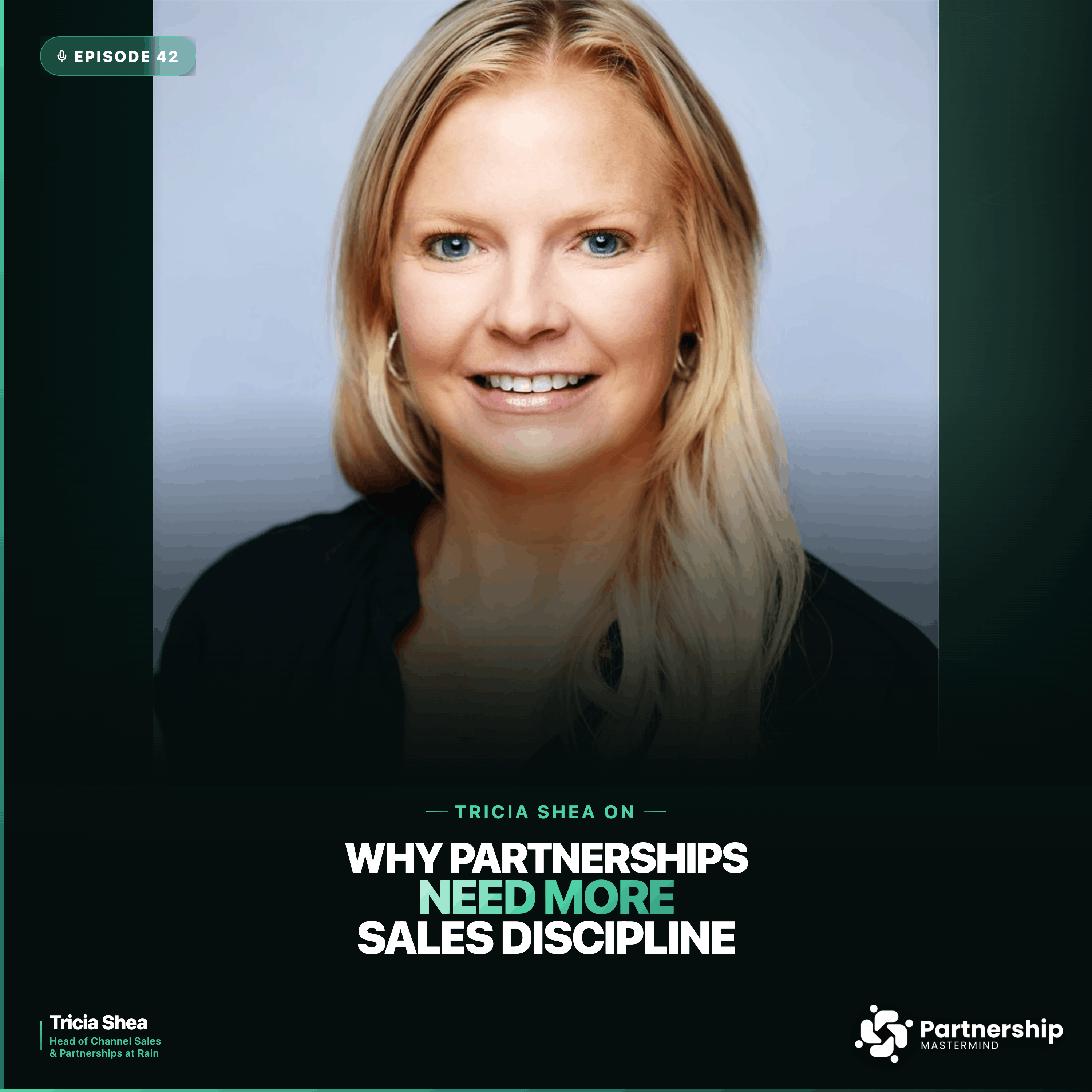
Tricia Shea on Why Partnerships Need More Sales Discipline
from Partnership Mastermind Podcast
51m 24s
In this podcast episode, host Crystal Voie interviews Trisha Shea, who leads Channel Sales and Partnerships at Rain. Trisha shares how her enterprise sales background drives a disciplined, methodical approach to building partner programs. She realized early that one strong partner relationship could open more doors than 100 cold calls, as partners provide borrowed trust and insider intel. She stresses that discovery is critical—partner managers must understand partners' specific goals, such as increasing win rates or knocking out competitors, and be willing to disqualify partners if there's a strategic misalignment. Trisha debunks two common myths: that signing a partnership with revenue share automatically yields referrals, and that more partners equal more pipeline. Instead, she advocates for intentionality, emphasizing that coverage is not activation. She applies direct sales rigor to partnerships, using frameworks like MEDDIC, holding teams accountable for pipeline management, and coaching partner reps to sell the product independently. This approach builds credibility with sales leadership and reduces friction. Finally, Trisha highlights the "no-ask touch point"—reaching out to partners when nothing is needed—as a key habit for building genuine relationships that drive long-term success.
Alright, welcome to another episode of the Partnership Mass Mine podcast, "I'm Your Host, Crystal Voie." Today, I am thrilled to be joined by Trisha Shea, who is currently heading up Channel Sales and Partnerships at Rain. Trisha cut her teeth and enterprise sales and learned early on that one well-placed partner relationship could open 10 doors faster than 100 coal calls. After driving growth at Square, Paylossity, and Daily Pay, she now leads Rain's channel strategy combining sales rigor with ecosystem thinking to build partner programs that actually convert. You can expect raw stories, strong opinions, and tactical gold as we dive into the real work behind building revenue generating channels. Trisha, welcome to the show. Thanks for having me. Amazing. Well, look, I met you not too long ago and I was immediately impressed by just how disciplined you are and you have such a methodical approach to kind of building revenue programs. I was really cool to learn about how your sales background has really served you well in the partnership's landscape, which we're going to talk a lot about today. But before we get into the meat potatoes, we always warm up our guests with five quick kidding questions, just as a way to get you comfortable and help our audience get to know you a bit better. You ready for that? You didn't warn me about this, but I'm ready. All right, let's do it. Let's do it. Okay, so the first question, this is about origin story. When did you realize partnerships were the higher leverage play versus pure coal outreach? So I'd say early on, I definitely recognize that if you had strong partnerships, it could open a lot more doors than I could do with just cold calling and traditional prospecting kind of dialing for dollars. When I first got started in sales, I obviously did the traditional grind prospecting, trying to kick down doors one by one. And I still love a good prospecting session, but there was a time I remembered vividly that I was able to, I was trying to crack into a specific company. And I realized that they kept pushing me off to this consultant every time I called them and emailed them, they'd be like, you need to talk to XYZ consultant. They help us. They'll bring all of this to us. And I started to think like, what could I do to get around this guy? Like, who could I go to? A CEO, there's got to be someone higher that makes a decision other than the consultant that they keep pushing me off to. But then one day it hit me and I realized that if I could get that consultant on my side, I bet they had a lot more than this one client and they can probably open a lot more doors for me. So that's what I started to do and started to position myself in that realm. We're really working through relationships and making sure that I was building trusts within partners. I could get more from one partner in a month than I probably could just cold calling on my own efforts. And it's even more true, I feel like now because a lot of buyers are really overwhelmed by noise and their inboxes are so flooded. So their guard is permanently up. And when you reach out cold, there's no trust whatsoever. But when partner brings you in, you're kind of operating on borrowed trust. So you bypass the gatekeepers, you get the inside intel, you really understand what the executive team cares about and then you can fast track deals. Yeah, totally. I feel like every deal now is brokered somehow some way. You either are talking to someone and they say, "Hey, I'm in the market for such a solution or such a tool." And then that person just says, "Oh, I can introduce you to Rain as an example." So I feel like everything is being brokered more than ever into your point, like outbound, is really struggling channel. I do want to ask you later on, hopefully I don't forget, which is the way you're describing it, it sounds so intuitive as a seller to kind of understand that signal and then lean into it more heavily. But not as many sales reps really do. So I do want to talk about that later and get your take on that. But we'll keep going in the quicketers. So the second one is your favorite cold call memory, right? You just said, you know, you love a good cold call session. What's a sales moment that still makes you smile? Or perhaps one that makes you cringe in your gladets in the past? I have many and we probably don't have enough time to get through all of them. But I do have one that I still think about. It ended up working out in the end. But early in my career, there was this one account that I was so desperate to get into. I tried everything. Snail mail, cold calling. I don't know if LinkedIn was a thing then, but emails, whatever I could do. And then I finally called, found out who the decision maker was. I called them. I got their voice mail and I left really professional, polished message. I mean, I wrote it out. I went through it time after time like this is really thought through. Yep. We're going to hang up on the call. And so I turned to my cold worker who also was prospecting and I said, if this guy doesn't call me back, I'm going to pull my hair out. And then I quickly realized I was still recording. So of course, I freaked and I hung up. About an hour later, he called back and he said, look, I don't want you to pull your hair out. And I need all my vendors to have a full head of hair. So how would I get 15 minutes with you? So obviously I was embarrassed, but it completely broke the ice. And it really taught me that buyers just want someone human. They want to know someone's on the other end that actually cares about winning their business. So I started to become more natural in how I prospected and what my approach was. I mean, I wish we had that recording. That would go on the outbound hall of fame, so to speak. Maybe that's just an intentional sales tactic we can all take. These are like these intentional slip ups. But on the preparation side, that was another key takeaway from my prep and kind of getting prepared for this was just how prepared you are and how you coach your team on preparation account review, going into every call like super prepared. And we'll talk about that in a second. Cool. All right. Next up, what is a sales skill you think every partner or slash channel account manager should have and why? Being really good at discovery. And when I say discovery, I mean discovery really points it at that partner and the partnership. So in sales, you're drilled from day one to go really deep on the end user, understanding what their pain is, what's their budget, who's the economic buyer, what metrics can we really drive. But most partnerships don't give that same attention to the partner ecosystem. So that's why I really feel that discovery is so important. It's not just about talking to a partner, telling them, here's all the cool features we have. This is why you should bring us into your clients. You really have to understand what matters to them and try to align with that. So are they trying to increase win rates? Do they need to knock out a competitor and you have a product that helps them fill that gap? Do they need something more sticky for their clients to stay around? Do they just need to be that trusted advisor and bring more things to their clients? So when you can get that granular and really understand what moves your partner, you can walk into any room and tell them, I know you're focused on XYZ right now and it may change and it actually may be different for each partner manager you're working with at that company. So you have to really go deep, but you can help them reach their goals. And when you start to solve their problems and help them and it becomes mutually beneficial, it really goes from just being a partnership, sign deal to a true relationship building revenue engine. Yeah, I love that. I mean, that's something I preach all the time in our communities and training programs. The importance of discovery because that shows up early, obviously, in the life cycle of a partnership, see a multi-year partnership, it all starts in the discovery phase and you don't, you can continue to rediscover. So to speak is something I always talk about a lot, but just as much as you said, you know, discovery for the sake of, okay, we are going to invest in this partner. What's the best attack plan? I would also argue it's just as important for disqualifying partners, right? Because I think, I think a lot, and I'll get you to react to this in a second, but I think a lot of pams and cams, they assume that like every partner should be good fit because it's like, hey, we're all, we seemingly are working in the same ICP sandbox. We all want to generate revenue, right? So they think it, but as like an x, y curve, it's like, well, we're going in the same direction as businesses. Why can't we partner? But it's like, I would argue, you know, the way companies work is like really in three-dimensional space, right? It's like, sure, we all want to grow revenues as a business, but how we get there is totally different. Maybe one company is going up market, one company is going down market, one company is maybe going deeper in North America, maybe one company is going deeper in and in Europe, maybe one company is becoming more verticalized versus horizontalized. So I would love to get you to react to that. Like, how, just how important is it to not just understand at the rep individual level, like, hey, what's your incentives? Sure, I want to impact there, but like literally as companies, are we even kind of heading in similar directions as a company? Because as you know, if you're not, it's just going to be so hard to like rally the senior stakeholders like yourself around a strategy. Yeah, you're absolutely right. And I'm sure we'll get to this at some point, but that is one of the biggest criteria I have for partnerships, just like sales, qualify in and qualify out. And you have to really uncover what moves that partnership and what's important to them. And you're right, on paper or high level, it may seem like you've got the same ICP, but when you really start to drill down, do you align on all the things that matter and are really going to move the needle? Absolutely. And the essence of the show knows that we talk a ton about disqual qualification discovery, ICP match, which to your point isn't just even company level, like literally who are the users of your product or services? You might sell to the same companies, but wildly different personas. So we'll talk a little bit more of that later. Okay, second last one, and then we'll get into the fun stuff. What's one myth about channel programs that drives you crazy?
something that people keep getting wrong. And don't hold back. Okay, I will. I think you know me that I will. This actually goes in line with what we're talking about. And I have two, but they also go hand in hand. So the first is this misconception that if you sign a partnership and attach a revenue share to it, exactly what you just said, you automatically start getting referrals. People think that money just turns the faucet on that leads right into my second myth, which is the more partners equals more pipeline. It absolutely doesn't. Usually all it means is that you're building this massive, bloated book that you can't actually support. And you end up with a bunch of partners who forget your name the second you leave because you're not being intentional and you're not really understanding what moves them. So at the end of the day coverage is not the same as activation. You have to be really intentional about the partners you bring on and also really intentional about the effort you're going to put into them. Yeah, I love that. We're going to talk a lot about today and you've already kind of highlighted it a bit of just how much work goes into a single partner account to like really be successful. And so unless you want to work a hundred hours a week, which none of us do, you only way you can be so intentional about it per partner is if you actually like lower the surface area, right? You stop spreading yourself so thin. So we'll talk a lot about that today. Cool. Fifth one for you to just wrap up. What's the most underrated personal, this one's a rep but the most underrated personal habit beyond calendar discipline? What do you consistently do that keeps you personally effective? Like what's your what's your cheat sheet? What are the top things that you do in a given week to be so such a high performer? So you can probably do a whole podcast about calendar discipline, but we're thinking outside of that. I say the most underrated habit is what I call the no-ass touch point and it really comes from remembering the little thing. So in sales and partnerships, 90% of the time when someone is reaching out to you via email, via phone, whatever it may be, it's usually for an update, a favor, they need something for you. So I make it a habit and I also instill it in my team to reach out to all of their partners when they need nothing from them. So maybe they were on a conversation and they heard that their son has a baseball tournament or something that weekend. Text them that following Monday. How did it go? Like don't ask me. Just be curious. Also, maybe there's, you know, their favorite sports team. You see an article, you saw something they posted on LinkedIn, whatever it may be, remembering all those little things and really putting the human element to it without a transaction is how you build the relationship. So I try to do that every single day, both internally with the folks I work with and externally with all of the partners, but that's really what I try outside of calendar discipline, which you know is something I'm very passionate about to make sure that I'm constantly doing. Yeah, I love that. I mean, as much as partnerships gets flack for being overly like personal relationships, ee, like hugs and chugs at conferences, at the end of the day, like it is still a critical element of the job and a quote that's been shared many times on this podcast from guest, you know, the famous Myelangel O'Clow, which is, you know, people will forget what you say, what you do, but they won't forget how you make them feel to your point. I think about that a lot and I coach my teams on that as well, which is like, hey, look, we're all competing for mind share and wallets share with our partners. Like the differentiation is the razor thing. Like the, how we win is not, you know, yes, if we can blow blow their quarter over the water by driving them a ton of business, sure, that will stand out, right? But oftentimes it's the little things like being a great personal partner, as much as we are a commercial partner. So I really like that you should that. Cool. All right, let's kick off the training meals now. Let's get into our first of three segments. This one is all about sales discipline meets partnership strategy. So in this segment, we're going to explore how you, how your sales background kind of drives your partner programs. And in our prep, I come to understand that you really believe channel functions must be built like sales works all the way from process, accountability and coaching, not just signing partners and hoping for leads. So the first question for you is around sales DNA and channels. You spent years in direct sales before formalizing a partnership role. What did those years teach you about qualification, urgency, objection, handling that you now bake into partner programs? Yeah, great question. So direct sales really taught me three rules that I never will let go of. And you talked about this earlier, which is qualify hard and early because hope is not a pipeline stage, right? You also have to create urgency with a real closing plan. So you need to have something that's mutually agreed upon. And then finally, surface the objections before the partnership or customer does it. So like, what do we think is going to go wrong? What are the objections that the partner may come across when they're reaching out about your product, bringing that to the forefront earlier so that everybody is paired is super important to me. And the reason our channel partnership program works so well is that I do take those exact same sales rigor and have my team kind of force multiply it through our partners. So we don't find a partnership, hand them a referral link and kind of cross our fingers. You mentioned it earlier, but we run a true sales methodology. We actually leverage medic as our framework. So we'll speak the same verbiage that sales teams do. We go through the same sales training. We do the same type of discipline as far as like game film and reviewing the things we do. We will go through our pipeline of referrals and treat them like sales opportunities. So we would do all the things you would do in a sales process. Just instead, our buyer is the partner. So yeah, so I'd say I think the other parts are done. No, you're good. You're good. You're on fire. I think you didn't ask this question. So I won't answer it, but I had in there. How do I coach my partner reps? Yeah, so that was the next question. Yeah, like going a step further, how do you then coach partners to run deals like AES effectively? Yeah, so I coach the partner reps the exact same way we'd coach an internal AES. So because they are trying to sell our product, we obviously don't need them to know all of the ins and outs. Like the saying goes just enough to be dangerous, but we do manage the relationship very similar to like what we would do in a regular pipeline and making sure that all the same direct sales disciplines follow through within the partnership. Got it. Yeah, I mean, hopefully anyone listening is like, I suspect actually a lot of people who are like pure partnerships folks are listening like, whoa, like this is like hard core sales. And some people listening might even be intimidated right now, but like the proof is in the putting and I didn't come from a like a pure sales background, but I've always worked towards like building up those sales skills because I realized pretty quickly. You're on it's like, yep, like there's a lot of parallels, right? Like we have a pipeline of partners, we have a pipeline of leads and deals that we're responsible for sourcing. So it's it pays to kind of adopt those best practices. And as an aside, and actually, this is an off question, but I'll love you to get your reaction to it. The more you can kind of build your partner and channel program to run like sales, even down to like how you set up your CRM and reporting, etc. and revops, it's going to make it so much easier to align with your actual formal sales team and the VP of sales and the CERO, which is a huge problem. Like honestly, one of the biggest problems right now in partnerships is this like siloed fractured relationships. So in addition to just it being a really productive way to run a channel team, Trisha, talk to me about the benefits in like your internal partnerships with revenue leadership on the sales side. Like how has running it this way kind of, you know, help you kind of get more buy-in and collaboration from your sales counterparts? It helps with credibility. So everybody is kind of rowing in the same direction. The other thing I always tell my sale or my channel sales team and my partnerships team is that we need to be so good at this product that we could sell it on our own. Like that's how you really get people to be bought in. I think to your point, there's a lot of friction. His sales folks will be, well, partnerships doesn't even know how to sell. They sign these partners. They're not the right ICP. They bring all these leads. They're not, they're not ready to buy all those things. Like I need my team to be able to sell this product without anyone else in the room. And that's what I coach them on and to your point. It really does help. And you can listen to any of my team's con calls and you'll be like, wow, we could actually sell this. So the sales team actually will come to us. Like what would you do? So it becomes more of a collaboration instead of a friction. Yeah, I mean, just to be blunt, and I can say that this was me or once upon a time as early I see the average partner person knows far, far less about the product than sales reps. Sales reps should be more confident. Obviously, they're literally diminishing every day. But the gap is so much more than it should be. And so anyone listening, like you really need to know your product, called, especially if you're in like tech and product partnerships, my goodness, like you really need to know your product well. But we'll keep going. One of the things you've been clearly like excited about is just intentional partner qualification. Right. So I'm going to go a little bit deeper here because I think this can be a useful content for our audience. So early on you chase too many partners ended up with a book you couldn't support. So like talk us to it. Like how do you actually qualify it? Like literally what criteria are you using to decide if a partner is worth the bandwidth? Yes, yeah, of course, early on I said yes to everyone. And that was the biggest learning curve for me coming into partnerships, right? You talk a lot about not growing up in the sales world. So having to learn that I had the opposite. So I grew up in the sales world and I needed to learn the partnerships more. So that was really the biggest thing I'd say that I had to
overcome. And maybe it was just a fear that I'd miss out on a referral or whatever it was, but I ended up with a book I couldn't really support. And then partners I wasn't giving any attention to. So I'd sign them, I'd build the relationship, and then off I went to the next one. So it wasn't really a true partnership. So now I qualify on purpose, and I teach my team to do the same thing. And again, it goes beyond just the partnership signature, because we are working with the partnership reps as well. So sometimes you have to qualify out even reps at a certain company. Maybe they're not invested in the partnership. Maybe it doesn't align with their goals. And that's why that discovery piece comes into play. But for me, it's really asking three questions. Does the customer base actually overlap with who we sell to? So industry, employee size, persona, there are large companies we work with that go more down market than we will go. So we need to be able to sus through all of that. Do they have a real motion to sell or refer? Like what is the state of their business today? Are they able to bring in other partners? Are they more worried about other things going on internally, whatever it may be? And then the final thing is there someone senior who will commit to a plan and help us to accelerate this. So fewer partners, more intention, more attention on those partnerships and more pipeline. So I don't know. Again, I always go back to my sales days. So it's just like a sales rep with territories. Right? If you give them a huge territory, they're stretched so thin, they're kind of all over the place. But if you give them a laser, focus, focus territory. And of course, the sales reps will always complain that they don't have enough. But they find a way to make those numbers. And that's the same thing we will do with the partnership side. Totally. Love that. Two key takeaways for me is a, like on the qualification for like, I would always coach my teams, like, and this sounds negative and pessimistic. But like you're going into these discoveries, basically aiming to disqualify because our our bar and standards are so high. And then you're pleasantly surprised if they're like, whoo, they, I put them through the gauntlet, like a decafalon. So to speak in my goodness, like the ICP lined up, they're readiness to buy their incentive alignments, our company strategy, like all of it checked out for the most part. So like we can move forward to the next stage. So I always thought about that. And then on the flip side, I would always teach them like, Hey, look, like the yes is the most expensive word in the English language. Every time we say yes to something, partners that we are going to invest in anything else, it creates debt. Like now we have an obligation to do something. And if it doesn't pan off, it's just so expensive. It's like a bad hire, which perhaps you and I definitely have. But like probably both of us have made some bad hires. Like it's such a costly thing. So those are two things that stood out to me. But let's let's switch gears a little bit and talk about sales methodology as an operating system, which you've already alluded to. So obviously, you know, the playbook you've deployed includes, you know, a cross research discovery, a tailored go-to-market plan, mutual projects, pipeline inspection. So of those, which steps do teams usually skip? And in your view, what's the major downstream cost of skipping such steps? So I'd say the biggest thing that folks skip is usually around the execution piece, which I know that is a broad statement. So I'll dig into that a little bit more. So yes, we've created a playbook. Again, I use the sales methodology or playbook outlines everything from prospecting to discovery, to value creation, all of the normal sales stages. And we run that playbook every single time with every partner and even down to the partner manager level. And it really is doing the research. Like I mentioned, the discovery, but I'd say the big thing that people miss is creating a go-to-market strategy and a mutual action plan that everyone agrees on. So I feel like reason our team succeeds where others may fail is we don't just do a good kickoff call. We actually do the execution and we hold folks accountable for the dates and the things that we want to accomplish. So we build that agreement into everything we do. Like I said, dates, owners, there's accountability to it. And then we're highly disciplined about making sure that everybody does what they say they're going to do. So I think, like, again, when you sign partnerships sometimes or even when you meet with a partner rep, it may be like, yeah, let's do some account mapping. Let's find some top 10 accounts. We're going to go after together. And then weeks pass, you don't follow up whatever it may be. You skip the pieces that really matter. And then you end up in this vicious cycle. So that's what we're really good at is making sure that we're extremely disciplined and inspecting everything that we want to happen. Or pivoting where we don't, you know, if something's not going the way that we have we pivot and figure out how we fix it. So yeah, that definitely jobs. And a lot of pams and cams and certainly I've been there and people in my team have been there where you just fall victim to like the busy work because the surface level work because it makes you feel good. At the end of at five o'clock, you clock going, you're like, I was busy today, but like you weren't productive. Right. So like we naturally psychologically default to busy work because it's a lowest hanging fruit. But like going deep is the hard part, which is why like you really need to minimize how many partner and accounts you're actually responsible for until you've proven that you can handle more capacity, which is a separate topic. So let's let's wrap up this section. The last one is around kind of building a revenue engine versus reporting activity. So I want to talk a little bit about the metrics. So many channel partner teams, you know, incorrectly like celebrate, you know, these fluffy top of funnel things like, you know, partner signings and spiff incentives and rev share payouts, which, you know, doesn't, doesn't retire my quota. So what specific metrics and inspection rhythms distinguish a program that drives pipeline versus one that's just busy making a lot of noise? Yeah. So I love the metrics and the data before I get into this, I do want to just give a little bit of a disclaimer because the metrics and the data are super important, but you also need to story behind them. So for us, it's a difference between, you know, busy team and a revenue engine. It really comes down to what you tolerate as success metrics. So you're right. Busy programs are going to report on the vanity metrics, things like the number of events they did, the contracts, these aren't, how many spiffs they pulled out, how many partners they onboard it, but none of that is actually revenue. So to drive pipeline and measure the results that matter, I look at really the hard numbers. What type of pipeline was and closed one and things like that were sourced and influenced from their partners. How long did it take to get that partnership to a first deal? What percentage of our partners actually did something in the last 90, 100 days, whatever that metric is, and just really digging into that data and answering questions around how much faster do our partner deals close compared to going direct, how much larger are those deals? What deals have partners referred us that we lost and really being methodical about the post mortem as well, like where can we do better? So it's digging into all of that. I think you can really understand what's happening, but the other piece to it is like I said, the story behind it. So you have to also obsess over the leading indicators. So again, a lot of times people think you sign a partnership and all of a sudden it's going to bring in referrals. It does take time. So I also track the behaviors that create the pipeline. So how often are we meeting with the partner rep? What do those conversations look like? We use gongs or able to go back. To analysis. Yeah, exactly. What are we doing in those calls? What does account mapping look like of the accounts that we've talked about? Have they actually lead led to introductions? Do we have a mutual action plan? So all of that. So I'd say it's the leading indicators to prove that the partner is activated and then the lagging indicators to really make sure that we're hitting the mark on the metrics. Yes, super great. And what I love is you didn't just list off a bunch of leading and lagging indicators and said, yeah, good luck, but emphasizing on the story piece. I think in leadership positions, you need to be really strong at that. But even within the IC ranks and early management ranks, like you really need to be able to tell the story. It's not just reading off a bunch of metrics, but like, what does it mean? How does that fit within the context of the broader kind of global KPIs within your company? So to speak. So I think that's really important. As a follow up question before we move on to the next segment, how do you kind of coach your team on it? Because of all the skills, I found that data fluency and just being able to leverage data insights to drive actions, productive actions is one of the lagging skills in terms of, I think there's a lot of skills that just naturally develop organically like public speaking, pipeline hygiene, just understanding your product. If you get enough reps, you're going to get better. But I feel like data is one of those ones where it's like playing a violin. You can't learn how to play a violin without playing a violin. So how do you other than just hiring talented people who are wicked smart, how do you intentionally kind of, in other than leading by example, how do you really drive productive kind of data analysis leveraging within your team? You make it part of the conversation. So in the ones in the team meeting, we're talking about all of that. We're dissecting all of that and we're picking it high. You can't get around it. Yeah. Yeah. Yeah. You don't wait till the end of the quarter and do your, you know, quarterly business review. Yeah. Constantly are talking about it and know where you are and know what you need you to get to the end goal. Amazing. That's great. Just getting the repetitions, I think is key. All right. Well, that was a really fun second. We're getting into our second segment ecosystems within ecosystems, which is a great phrase I picked up from you in our prep. In this segment, we're going to unpack your philosophy that power is part of ecosystems and curated that are curated and
cohesive, not a random collection of logos, which I really love. So you are giving that you don't need a partnership's background. Great AES who love people can be great partner managers, and that too many partners can dilute trust. So there's just some of the things we took away in our early segment. So the first question is around complimentary partners. You have this phrase, ecosystems within ecosystems. So tell the audience, what does that actually mean in practice? And how do you identify partners that reinforce each other as opposed to competing and operating in silos? Yeah. So an ecosystem within an ecosystem basically just means you are so ingrained in your partner's world that you start teaming up with other partners in their networks. So partners are very overwhelmed, especially when you're working with big HCM companies like we are. They can't remember all the hundreds of different vendors they work with. Instead of competing for that mindset, we start to find other complimentary partners and form a cohesive unit and just show up together. So just make it really easy for that mutual partner to digest all of your value. And maybe you even get to the point where you build a partnership with that other ecosystem and you're on their paper. So they're constantly bringing you up and constantly forcing what you do. I say to identify them, it's very similar to what you would use for your partner criteria. That's one major caveat I'd say to that is are they also selling into the same exact folks at the same exact companies? So there may be partners out there within the ecosystem that could potentially align, but maybe they're not going after the same personas. It's going to be really hard for you to align from that perspective. So we're selling the same buyer, but not solving the same problem. We should be in partner's attention. We should really be combining efforts. And that's kind of how I like to think about when we sign a partnership, I'm always thinking about what other partners do they work really well with and how can we double down on that and make sure that we can just accelerate everything we do together. Yeah, I think that's a great framing. To be honest, as long as I've been in partnerships, that's one of the least talked about strategy elements, which is like intentionally curating an ecosystem where that individual partner isn't just a good fit, but it actually starts a former graph where more partners are actually the way you choose partners as it scales is not just, hey, are they a good fit for us in a vacuum? But do they actually fit well within the ecosystem that we've already built, whether you're in zero to one, one, two, two, or three? So honestly, that doesn't get talked about nearly enough. So as a final question, for anyone who's maybe not quite convinced on that just yet, what are the real practical and tangible benefits? Like say, say you do that really well for a couple of years and you find yourself in a pretty scaled state. What are the real benefits you could expect if you are successful in being really careful about how you kind of curate the evolution of your ecosystem within the ecosystem? Yeah, I think the first thing is probably pretty obvious. You're going to multiply your efforts, right? So now, it's like one partner talking about you. You have five, six, ten, also talking about you to that partner. You know, like, hey, I know you guys are in this situation. Have you heard about rain? Whatever it may be, you've got more folks representing you in the room is the biggest thing. And then I think from just a collaboration standpoint, it really helps the partnership and the ecosystem on a whole because you are now invested in them. Not only are you invested at them from a revenue perspective, you're also still invested in their business that you want to get closer. I don't know. What about all of this too, like, dating, and marriage and things like that? It's like when you are going to someone you meet and you want to marry them eventually, you want all their friends to like you, right? Like you want all their friends? Yeah. Without you. This is the same kind of thing that I think about in the partnership world. It's like, I want all of my partner's friends to be talking about us as well and talking about how great of a partner we are and how great our product is. Look, we're big on analogies on the show. So that one definitely lands well. So we appreciate that. Now let's get into another topic you have, which is a slightly controversial, so to speak, in a good way, which is sales talent and partnership roles. So you believe partnerships don't require a traditional partnerships background. But yet, why do you prioritize sales instincts in relationships EQ and hiring partner managers? I will say that there are partnership people out there that don't have any sales experience and can sell better than the best sales rep. So I don't want this to be like such a broad statement that everyone thinks this is my only mindset. But for the most part, traditional partnerships backgrounds often breed relationship managers. And while relationships are great, relationships alone don't close deals. So we prioritize the sales instincts piece of it and then the relationship EQ because it's really just the art and science of revenue. Like you talk a lot about that in sales, we mimic that same type of thing in the partnership world. So the relationship EQ is the art of building those authentic connections rather than just you know, transactional check ins. It's the no-ass touch points I talked about earlier, the thoughtful gestures, the videos that you send, the things, remembering all the little things, the birthdays and anniversaries. And that's really how you elevate the trust piece of it. But the sales instinct is the science. So once you have the trust, you actually have to help support and drive sales. So our partner and sales channel sales managers don't just sit back, they're very proactive. They know how to multi-thread across a partner's organization. They use sales methodologies that I talked about to help progress deals. If a partner rep hits a wall, they know how to jump in and co-sell alongside of them and they're able to support customers, objectives and things like that. So we, I feel that if you can run a really deep discovery, execute on what you say or going to execute on and build mutual go-to-market plans, you have a successful partnership. I can teach anyone the log notes in the CRM to update a pipeline dashboard. But if we're just sitting back being reactive and not using our sales instinct, we're not going to move the needle. So that's really what I look for is that sales acumen to not only build trust and credibility quickly, but to have that instinct to move the deals and help drive the revenue for the company. >> God, it's super helpful. And just two quick follow-ups on this one, just because I think it's important for the audience and then we'll kind of move on. So I've actually hired a few sales, like people who had traditional sales background, zero partnerships experience. Some of them definitely were super-sized and some of them really struggled. And for those who struggled, the biggest thing they struggle with was understanding that it's not a linear kind of sequenced transactional flow. It's not like, deals shows up in your pipeline. A lot of people aren't doing their own hunting these days. They just wake up in a money and they have pipeline. So it's not like, okay, deals in your pipeline and then work it to close one, wipe your hands off, and then go work the next deal and then the next deal. It's very up and down. Partner relationships are complicated. You could be hot in one quarter and then not hot the next quarter. So if you're in, if we have an AE listening right now who is just getting into a partnership role or someone who's just got into a partnership role, it has a pure sales background, how would you advise them on kind of understanding that that is going to be something that they do struggle with and how would you kind of recommend they proactively kind of break that challenge, which is, hey, like it's not linear. Like it is in a lot of cases of sales. I'm not saying sales is a pure linear by the way, but you get what you get my drip. There's a lot more out of your control in this role than there is when you are. Sure. So that's usually the biggest hurdle. So I think the first thing is making sure that you have folks that are really passionate about partnerships. Not everybody understands the value of building that relationship. There are some really great sales people out there that never ever lean into partnerships. They'd rather control everything themselves. So I think the first thing is making sure that you're honest with yourself. Are you really passionate about the partnerships and do you actually see the opportunity for centers of influence to help you if you don't then I wouldn't get into this world. Stay in direct sales. You have a very successful sales career, but you have to help both. For the folks that are getting into it that have both, I'd say to your point, it's a lot like sales and you just have to remember that there are ups and downs, right? You're going to have a good sales week, a good sales day, a bad sales week, a bad sales day. It's the same with partnerships. So you just have to make sure that you're constantly thinking about the discipline and the consistency and it all will come together. But I'd say, yeah, what you learned in sales, put that into your partnerships role and your partnerships hat and you'll be successful. But don't come into this role thinking that partnerships is such an easy role. They just automatically get referrals. All the things that we talked about earlier, you have to put in a lot of work, but you also have to be really passionate about partnerships. Totally, totally. That's great. And just to wrap up this segment, you talked a little bit about it, but we're going to talk just one last time about partner activation beyond kind of spits and revshare. So you've talked a lot about driving real activation. So I'm actually going to focus on the second part of this question, which is maintaining momentum months after the paperwork signed. So we all know that the early days of the honeymoon phase, everything's these. My mom always used to say when I was really in my dating days, she was like, "Chris, why is this relationship so challenging?" It's like three months in, this is your honeymoon phase. Like, if it's not easy now, it's certainly not going to be easy 10 years from now. And it always stuck with me. So how do you kind of coach the team on maintaining momentum?
momentum because it is such a momentum game. Like getting up to 30,000 feet, it's like you, you know, the early days you're going up and up and up and then it just starts to peter off again. So how do you kind of, if it is a promising relationship and you did do good job on discovery, so you're placing really strong bets, how do you really drive that momentum until you get up to that steady state around 30,000 feet? Yeah, the first thing I'd say is you're right, money doesn't build loyalty trust us. So yes, spits and revenue share, they're, they're probably table stakes at this point, but a partner rep is really looking at their book of business and they're very, very protective of it. They are not going to bring you into a deal if they don't think you're credible, if they don't trust you and you aren't top of mine. So that's really where the relationship EQ comes in and what I was talking about earlier. So our team drives that long term activation through consistency. So it's that meaningful communication, it's not just the pipeline interrogation check ins, it's understanding them, what moves them, what's important to them, the why behind everything they do, remembering all of those little things and not being flavor of the month. So it's constantly showing up, even when you don't want to, right, even in sales when you don't want to make that cold call or send that email or do the prospecting, those are the things that we are constantly doing, saying consistent and getting on those calls where we don't get the referrals, but no, there's a lot of opportunity building the trust, showing that we're credible, and then all of it just kind of falls into place. But you have to be really intentional and you have to be really consistent, which is to your point earlier, why you can't have so many partners, because then it just becomes watered down and you can't do that. Totally. Yeah, that's all great content. And one thing I always kind of say on that front is, you got to get to your first win. And it doesn't, you know, that's why like setting like an initial goal is so key, like a very well-defined objective and key results approved that you were in fact successful. And it's not the end-to-end all be all like you're going to have, you know, bigger, more grandiose goals, long term, but like you need stage gates. And so I always coach my team like, look, if you really believe this partner is worth investing in and it seems like all the signals would suggest that case, then what is the low, like how can you set the bar low enough, not high enough in fact, where it's like if we achieve this within say, you know, 60 days, it substantiates like continued in further investment and don't stop working until you get that. It's not like you take your foot off the gas once you do. You actually the opposite. You can go faster, but at least you have confidence that both sides were able to meet because if you can't, you know, do what it takes to get that win. And the partner doesn't show up. It's like, well, what the hell are they going to do, you know, when the stakes get really high? Like again, it's like the dating analogy. Like if they can't be on time for your second date, right? Like what are they going to do when, you know, you got diapers to change in six years, right? So like weird analogy, but I think you catch my drift. Cool. Cool. All right. We're going to finish off with a fun smaller segment, which is around the human impact and mission driven partnership. So one of the things I really kind of appreciated and joy just digging into your background is just, you know, not just a high performing operator, which is evident from the first 40 minutes of this interview, but you also have like worked at companies and enrolls in industries that are like a really mission driven, right? So at Rain, championing a mission that gives employees financial breathing room. And I enjoy reading a blog post on the human impact of Earn, Weage, Access, or EWA, the emphasizes the difference between kind of survival and stability. So this first question in this segment is around, you know, from sales to financial wellness advocate. So when you're a Rain blog post, which was, you know, a vulnerable share on your part, you share personal experience of financial strain, single parent aid, so to speak. So how does that lived experience shape how you talk to partners about Rain's mission? Yeah. So I think it's easy for us to call someone just manage their money better, you know, but until you actually live it, you can't relate. I hear it all the time. It's probably one of the biggest objections we get. People will stand on the sidelines and say, well, employees just need to manage their money better. It's very easy to give that advice when you're comfortable, but until those shoes, you can't relate. So for me, I've always been about the mission. Every single place I've worked, I've believed in the product in some way, shape, or form. But here, obviously, it just hits home a little bit more. So I know what it's like to be a single parent. I know what it's like to stare at that bank account and do the mental math. Like, how am I going to survive until payday? So when I talk to partners about Rain, I'm not pitching this, you know, theoretical HR perk or shiny new software feature. I'm pitching a lifeline that I really wish that I had when I was raising my boys and partners feel that. So it really changes the energy in the room because they realize that I'm not just reciting, you know, some corporate mission or some vision statement or whatever it may be that I believe in that mission in my bones and they can feel what their partners and the customers that they work with in their employees would feel as well. Yeah, I love that. I think it's so powerful to truly be inspired and believe in the mission of a company which sounds kind of like table stakes, but so few of us candidly actually like really are excited with the mission and would love to be a user, like would love to have had that solution. And look, some people, whatever circumstance you have in life, like you got to take a job, you got to need that paycheck. So like you can't be so picky. But for a lot of people listening, who might be successful in half, these unique opportunities, like the big lesson is like, you know, choose wisely. Like I've personally made decisions on employers where it's like, I didn't really align with the mission and ensure you can still be productive, but like not as productive as you probably could be and not as fulfilled as you probably could be. So if you have the privilege of choice, like really slow down and ask the right questions to make sure that it aligns to your core principles. So appreciate you sharing that, Trisha. And as a follow up, how do you integrate reins deeper purpose, you know, helping employees avoid predatory loans and gains stability into your partner conversations without sounding like marketing fluff? Like you kind of just talk to us about how, hey, like you're telling them, hey, like this isn't just some shiny perk, like this is real life. So to speak, but how do you actually, you know, take that a step further to, you know, coach partners or enable partners on like, hey, here's what we can actually do together and here's why it rains a good fit. Yeah. So you really have to be grounded in the mission and the absolute reality as well as the business metrics that it's going to drive. So for us, it's not just about, you know, using fluffy buzzwords, right, like holistic financial wellness or anything like that. It's talking about the hard facts. So because I've lived through that financial strain, I can look partners in the eye and ask the hard uncomfortable questions. Do your clients actually know what percentage of their workforce is forced to take out a 400% interest payday loan just to buy groceries on a Tuesday because they have no food in the house? Do they know how many of their workforce is putting their child's medicine on a credit card with a 25% interest rate because they can't pay the out of pocket? Whatever it may be, just really getting deep into what those actual stories are, we actually just did a survey with some of our customers and some of the things that they told us, you know, rain helped me from staying a night in my car because I was homeless. I was able to get a whole teller in like really relating to those stories and talking about them with your partners is super, super important. So I just take that raw reality and tie it into what's going on in the clients world. So a lot of times the biggest operational headache is the turnover. So you talk about how an employee gets trapped in this predatory payday cycle. They don't have enough for an emergency they're often just quitting their job and going down the street to get maybe, you know, a $500 sign on bonus, but that's going to help their family survive for the week or maybe even now they call out sick to pick up a shift with lift or Uber and now that's strain on the company. So that again, that direct sales methodology, we talk about it not being a nice to have benefit and getting really, really deep with what's actually happening and then tie it back to the business impacts and you start to talk about what it's going to do for the business and the ROI that you can have on a no cost benefit. So I love that. I mean, look, it's super refreshing to hear someone like so genuinely passionate about what they do. I think a lot of the folks we have on the show are certainly excited about the company that they work with him, but like you certainly like are kind of next level, which is really cool to see. I was going to ask you about like what type of partners resonate with Reigns mission, but I think you did a good job kind of articulating that. So I'm just going to ask the final question for you on the show, which is lessons just from your career. Like you've spent a lot of your career obviously in payroll, HR tech, etc, you know, pay loss of the daily pay, etc. So just final question for you. Like what's it all of these experiences teach you about trust and reliability that now informs your work at Reigns? Yeah. So I work and historically have worked a lot with tech companies or payroll companies. And I think you realize really quickly that payroll and HR tech operate in a zero mistake environment. If a marketing software glitches, if you know your Zoom goes down for an hour, it's annoying. Yeah, but it's not detrimental to your business and the front-line workers. So those experience have really taught me that in this specific industry, all the things that I talked about earlier are super crucial, right? The trust, making sure that you're building strong relationships, that you're credible. All of that is really important. But when you sit down and you kind of strip back all of the benefits, you also have to have a reliable product and you also have to have a really good reputation. So if we drop the ball, they lose a car. Obviously they've spent years trying to win. And then we're. you know, they're obviously not going to bring us into any more opportunities. So for us, it's using that strict sales methodology, building the mutual action plans, doing the dealer reviews, but also taking what I learned in my past life that you need a product that actually stands behind what you're doing and what you're saying. I mean, I can tell like how much of a responsibility you personally feel, like you can feel it through the conversation, for sure, audience is picking up and there's, well, I'm sure that like is a big part of how you and rain approaches hiring, right? Like people who will take that level of ownership, not just for their KPIs, but like for their client outcomes, like the end user outcomes, which is really cool to see. Cool. Well, look, Chris Trisha, this was absolutely phenomenal conversation. Last question for you. We just spent 50 minutes digging deep into your career and how you operate. What's one thing you hope the audience takes away from this conversation? I think that the one thing I hope everyone takes away is that partnerships is not just a relationship job. It's a sales job that happens to require great relationship skills. So I feel passionate that most programs would perform better if they were more disciplined, had more of that sales and business acumen and brought that into everything they did within the partnership's ecosystem. Amazing. Well, certainly you give us a blueprint for that. Thank you so much, Trisha. And thank you all for listening. Until next time, signing off. Cheers.
Podcast Summary
Key Points:
Trisha Shea, head of Channel Sales and Partnerships at Rain, emphasizes that a well-placed partner relationship can open more doors than cold calling, leveraging borrowed trust to bypass gatekeepers.
A key sales skill for partner managers is deep discovery, focusing on partners' goals (e.g., win rates, competitor gaps) rather than just pitching features, and qualifying out mismatches early.
Two myths about channel programs
Trisha applies direct sales rigor to partnerships, using frameworks like MEDDIC, treating partner pipelines like sales opportunities, and coaching partner reps to sell independently.
An underrated personal habit is the "no-ask touch point"—reaching out to partners when nothing is needed to build human relationships, which differentiates in a crowded market.
Summary:
In this podcast episode, host Crystal Voie interviews Trisha Shea, who leads Channel Sales and Partnerships at Rain. Trisha shares how her enterprise sales background drives a disciplined, methodical approach to building partner programs. She realized early that one strong partner relationship could open more doors than 100 cold calls, as partners provide borrowed trust and insider intel.
She stresses that discovery is critical—partner managers must understand partners' specific goals, such as increasing win rates or knocking out competitors, and be willing to disqualify partners if there's a strategic misalignment. Trisha debunks two common myths: that signing a partnership with revenue share automatically yields referrals, and that more partners equal more pipeline. Instead, she advocates for intentionality, emphasizing that coverage is not activation.
She applies direct sales rigor to partnerships, using frameworks like MEDDIC, holding teams accountable for pipeline management, and coaching partner reps to sell the product independently. This approach builds credibility with sales leadership and reduces friction. Finally, Trisha highlights the "no-ask touch point"—reaching out to partners when nothing is needed—as a key habit for building genuine relationships that drive long-term success.
FAQs
Early in her sales career, she realized that building trust with a consultant who blocked her from a target account could open many more doors than cold calling alone, as partners provide borrowed trust and bypass gatekeepers.
She left a desperate voicemail saying she'd pull her hair out if a prospect didn't call back, accidentally still recording. The prospect called back, joking he needed vendors with full hair, which broke the ice and taught her to be more human.
Discovery skills focused on the partner's needs, such as their goals for win rates, competitive gaps, or client stickiness, to align mutually and build a revenue engine.
The myth that signing a partnership with revenue share automatically generates referrals and that more partners equal more pipeline. In reality, coverage doesn't equal activation, and bloated books without intentional support lead to forgotten partnerships.
The 'no-ask touch point'—reaching out to partners when she needs nothing from them, like checking on a personal event or sharing a relevant article, to build human relationships without a transaction.
She applies sales rigor like early qualification, urgency with closing plans, and surfacing objections, using frameworks like MEDDIC and treating partner referrals as sales opportunities with the same discipline.
Chat with AI
Loading...
Pro features
Go deeper with this episode
Unlock creator-grade tools that turn any transcript into show notes and subtitle files.
 PodcastTranscript AI