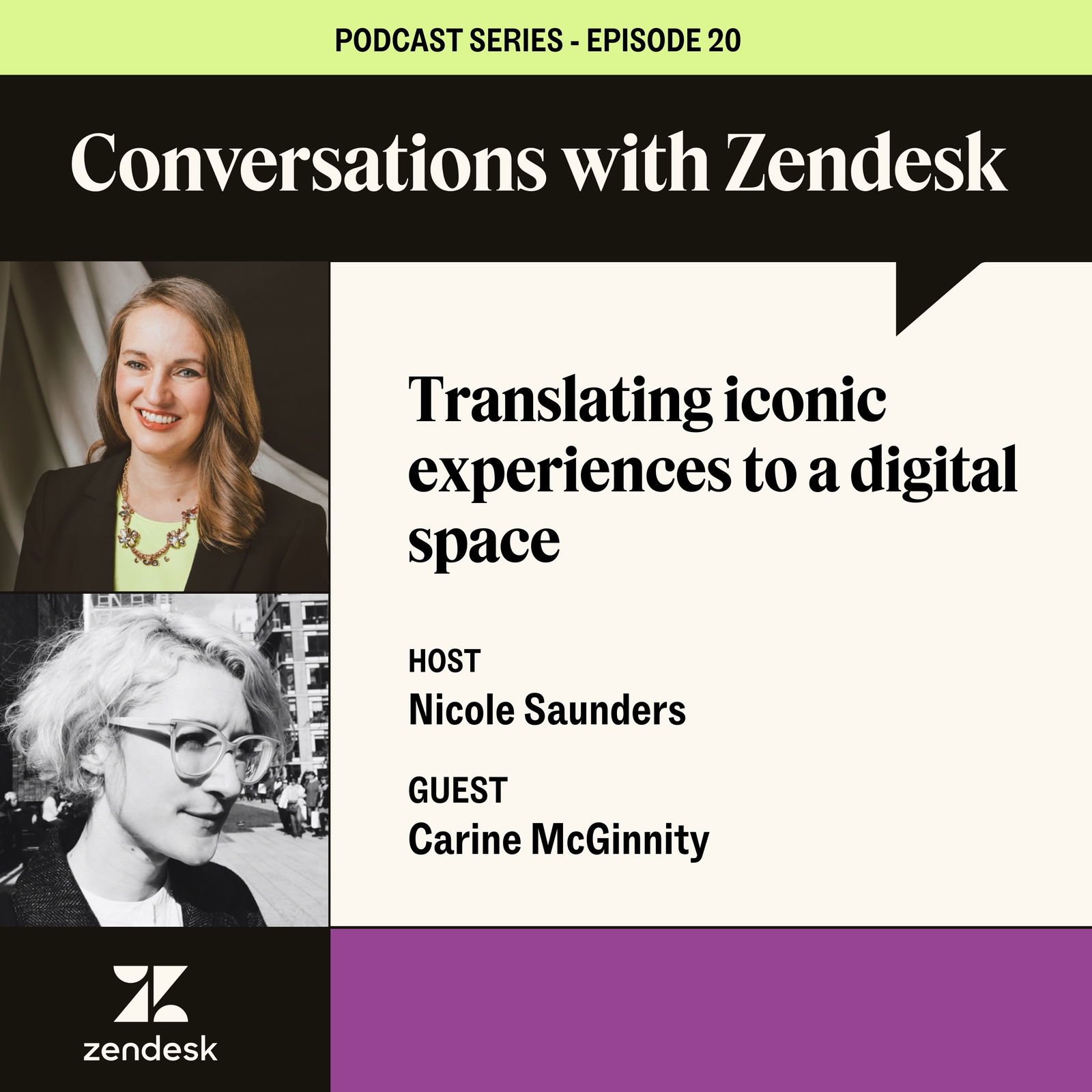
Translating iconic experiences to a digital space with Aesop’s Carine McGinnity
18m 57s
On the Conversations with Zendesk podcast, host Nicole Saunders interviews Carine McGinity, Global Head of Customer Communications and e-commerce at Aesop, about translating the luxury brand’s renowned in-store experiences into the digital realm. Aesop’s physical stores engage all five senses with personalized consultations, a challenge when moving online. The COVID-19 pandemic accelerated Aesop’s digital transformation, expanding from a single email channel to over 50 multilingual agents across live chat, social media, and platforms like WeChat and Line. Many agents are former retail staff, ensuring deep product knowledge. Aesop integrated Zendesk with a custom 360-degree app that exposes customer transaction history, loyalty status, and local store info, allowing agents to offer personalized service without toggling systems. Training combines standard retail education with digital selling techniques, supported by an internal knowledge base and quality assurance via Playvox. A US pilot for messaging bots focuses on deflecting simple inquiries while always offering a human handoff to avoid friction. McGinity emphasizes that technology should empower people, not replace them. Future goals include conversational commerce, deeper CRM integration, and aligning retail and digital teams for a seamless omni-channel experience. Her key advice: invest in agent experience to drive customer experience, and ensure digital channels mirror the high-touch, personalized service of physical stores. She shares a personal story of exceptional service from Ugg, where a consultant proactively called to resolve a lost package, highlighting the lasting impact of human connection.
One of our main principles when designing it was always to not create friction. And we definitely didn't take it. We wanted to deflect customer approach. Actually, we want to engage more with customers. Hello and welcome to the Conversations with ZenDesk podcast. I'm your host Nicole Saunders. Today, we're going to be talking about building best in class digital retail experiences and how one iconic brand known for their in-store experience translated that to the digital space. We'll discuss why it's important for the whole thing to look and feel seamless and representative of your brand, no matter how or where your customers are engaging with you. We'll hear that story and more from my guest, Carine McGinity, Global Head of Customer Communications and e-commerce at ASAP. Now, in case you're unfamiliar with the brand, ASAP makes luxury skin, body, and hair care products, as well as fragrances and accessories for the self-in-home. They have a cult following and they are known for their truly memorable in-store experiences. The stores have a unique design language, but it's personalized to their location, and there's a wonderful sound scape that all really enhances what you see and feel when you go into the store. When you walk in, you're greeted by a consultant who hosts you and offers incredibly personalized service. Now, as their customer base continues to grow, so has the need to bring these rich in-store experiences to life in a digital space. Carine has led ASAP's digital transformation across 28 markets globally, so I'm really excited to dive into what that process has been like. Before we do so, just a quick reminder that our biggest customer event of the year, Zendus Gridley, is coming up April 16th through 18th in Las Vegas. We've got some amazing sessions lined up and we would love to have you join us. The schedule is now available online, so you can see who's coming and what will be happening. Visit zendusgrillate.com to reserve your spot today. Also, please go ahead and head over to LinkedIn and follow Zendusk. That's going to be where we share all of our most interesting content, upcoming episodes of our podcast, and we would love to connect with you there. All right, without further ado, welcome to Conversations with Zendus, Carine. I'd like it to be here. Thank you. So in the introduction, I was talking a little bit about the iconic in-store experiences that you offer. And of course, a lot of what we're talking about today is the digital transformation you've undergone and how you've needed to work on translating that highly personalized, highly sensory, very intentional in-store experience to the online world. Tell us a little bit about what was driving that transformation and how you've approached it. Absolutely. I'm casting everybody's mind back to 2020, if it were, it was in a very different place. That was probably a huge catalyst for us in terms of ESOP and its digital transformation. And very much then, I suppose, our customer service offering through our digital channels. So as you mentioned, we're very well established, retail business, operating globally and have a very distinct and recognizable customer experience within our stores. So bringing that to life online has not been without its challenges due to the absence of those sensory elements you touched on as well. We very much lean across the five senses when you're in-store to be able to stimulate and engage you through the product and through conversation as well. So pre-2020, we had a very lean operation only operating at simple email in terms of our customer service channel. So from 2020, we went on a huge transformation in terms of our global organization. So we now have over 50 consultants or agents operating across multi-languages globally and we operate a number of different channels globally as well. From live chat across all of our websites, web form, email, phone, and then social media and some of the Asia-specific channels like WeChat and online. So a lot of our consultants that we actually brought on board are from our retail teams. So they have that expertise and experience with our product and with our store experience. So we've got a highly skilled and highly engaged customer service team and we've got an amazing cohesion amongst that team as well in terms of the experience that we do offer the customers. And so from the training of the teams coupled with the technology. So we've used Zendesk then to integrate all of those channels into one place for the consultants. We took on a body of work that our CBP equivalent system into Zendesk as well to give visibility that relationship with the customer. So that was at hand and visible to the consultant at the point of conversation. So there's been a lot going on. It's been a huge journey across the last four years. Sounds like it. You were talking a little bit about how you've used Zendesk to integrate everything and make sure the consultants have information at their fingertips. Can you tell us about the experience of putting that together? Absolutely. So we engaged with Zendesk professional services team for that. And they custom built at 360 app. We basically exposed within Zendesk as much information that we have in our internal systems about a customer based off the unique identifier being an email or phone number when the customer contacts us via any of our channels and that ticket is created within Zendesk. That makes a call to our internal systems which therefore exposes a number of pieces of information about the customer. So from their local store, all of their transactional history, whether that's in store or online, products that purchased samples that they've received and then loyalty information as well. So things like lifetime value and tenure. And then we did a phase two which just loaded more information so based off feedback from our customer service teams. We added more information so things like tracking number and a lot of easy to access information for those support like inquiries. And then we also included functionality like being able to on-subscribe a customer marketing for example so that the customer service team can issue that action from the app as well. Being able to really avoid having to dance across multiple systems, multiple screens, really have an active voice of youth. And then secondly, really being able to fuel that personalized experience as well. So really being able to equip the consultant with as much information about the customer to be able to have as personalized and informed conversation as possible. It sounds like that would be incredibly helpful and it sounds like you've really seen it drive some great efficiencies. Now of course once your consultants have that information at their fingertips, the next thing is what to do with it. You mentioned earlier that you had to do a lot of training with everybody to onboard them to the whole experience. And I imagine help them through that process of what it means to go from being an in-store consultant to a digital agent. Tell us a little bit about that training and how you approached it and what that was like. Absolutely. We use Zendes Guide both for our external help center and our internal knowledge base. We have a global capability and quality manager who manages all of that training and onboarding and continuous engagement and capability of the team so she partners really closely with all of our customer service managers in region to support them onboarding and then also upscaling then as well. So in terms of the training and that global team and from a non-bording perspective all consultants in our network globally will follow the same training as a retail consultant. We'll follow so that covers off everything about the brand, everything about the product, who we are, and what we stand for and the type of customer experience we want to offer. And then what's sits on top of that is a spill training onboarding to bring you into that virtual world. So everything you need from a systems capability but also then how to sell online. So obviously selling in person and in a physical environment is very different than selling within that virtual environment. So for Doreen our quality and capability manager she really specializes in this was curiots training that helps translate how do you sell a product and how do you engage with the customer in those online channels and she also runs our quality assurance program then as well. So we use playboxes, our quality assurance program and that's integrated with Zendesk and that's very much a total again for the customer service managers to really instill that coaching and feedback and performance culture. Amazing, it's also you put a ton of thought into it. I know that the word intentionality came up a lot as we were talking about our preparation for this conversation and it's clear that is just a common thread through everything that you're putting together. So in thinking about the website I did go ahead and take a visit to check it out and obviously like you said you can't use the five senses for website but I loved how there was detailed pictures and slow motion videos. You know you could get a sense of the texture or the viscosity of something the aesthetic really permeated the digital space which was cool. I also noticed I was able to ask some questions of a bot there and get some product recommendations and that kind of thing. Tell me a little bit about how you implemented and designed your bot flows. We introduced Zendesk as our customer service platform in 2016 and it was set up as one brand one instance across all of our markets so limitation with that has been we haven't been able to tailor it by market and that goes for our help centers as well. So we haven't been able to curate FAQs by market and we do see a lot of variance. So as a foundational piece to be able to launch messaging we've been and splitting out our instance into multi-brand. It really plays to our advantage to be able to do a more piloted trial approach on a by market basis and then being also able to tailor and curate that content by local and as well for our help centers so that we kicked off that body of work with Zendesk support last year as a pre-car service for launching messaging and then we started all of the design work for
launching messaging in our US market. So our US market is one of our biggest, a commerce markets. It's also one of our biggest volume markets and for customer service as well. So we just looked at all of our top contact reasons, the idea of stuff of what we know and started to design those flows, the idea of stuff that. And also coupling that with looking at internal process and kind of how we usually respond to customers, the idea of stuff, a certain type of inquiry and layering that process or the types of questions that a consultant will always ask for a certain question, being able to volunteer that upfront and within that flow experience. But one of our main principles when designing it was always to not create friction. And we definitely didn't take, we wanted to deflect customer approach. Actually, we wanted to engage more with customers. And so we would always then have a consultant available. We've all probably had that experience where it feels like you end up in a bit of a vortex with these bots and you just get those points of frustration and you don't know how to put on, I'm like, you don't know how to do it. You're like, oh, I just want to speak to somebody. So we definitely did not want to assume you're new to any of that type of feeling. So that was very close to mine. What we're hoping to see is that some of the efficiency gains will be able to do is being able to support the customer to self serve from that support perspective and then being able to leverage the internal team. And as I spoke to earlier, that highly trained, highly capable team to actually speak to product and selling. So we'll be looking very much around that containment piece. And then also if it is handed over to a consultant, the efficiency of them having as much information at the point of contact as possible. So the customer will have volunteered their intent or what their problem is or what they need support with. So that'll be hand straight to the consultant with that contact. So hopefully, quicker resolution and being able to offer that better customer experience. Those are probably the main things we're hoping to see. As I said, it's a US trial. It's a pilot. We're really very much going into it, thinking, OK, we've designed it with this hypothesis. So let's test that and let's iterate and improve as we go as well and be a staff feedback. We're going to really leverage our customer service team with the front line, as opposed in terms of their interacting with the customer and they'll be able to sense those points of friction or what's not working or what could be improved. So we'll very much take a test and learn approach and really implement any change as quickly as possible and as well to just keep building on that experience for the customer. Implementing a pilot and doing that iterative process is such a smart way to approach it. And I think it's so important to always look at the different ways and the different steps as you're implementing something. Now, Karina, I know that you aren't known as a leader who is always ahead of the curve and always thinking about the future. And we've talked a lot about your plans. Looking a little further out, we've got AI on the horizon. You're going to be implementing messaging. What are some of the things that you are seeing a little further down the road for your customer service operations? A big focus has been probably the technology piece for us. Once we get messaging set up, we'll very much be looking at how we optimize and continue to build into that tool. So what we'll be looking to in the future is how we build in more selling tools for the customer service team. So exploring conversational commerce and how we bring that to life for our teams as well with the technology tools that we have available. And then probably from the 360 pieces, while just really continuing to build on that visibility piece for the customer service team and connect that in with the other experiences that the customer is having across various other touch points with the business. So that's probably been something we've been working towards in terms of trying to really integrate into that CRM piece and being much more holistically involved. And then there's also great opportunity for us from a more client-hailing perspective as well. So again, thinking of that, selling experience and that high-conflictive experience that we offer, high-can-we-espist support store teams and become really that kind of omnateam across retail and customer service that supports the customer. So a lot of opportunity for us in our guard. - So thinking about lessons learned, what recommendations would you have for other brands that are offering luxury or bespoke experiences as they start to think about any kind of a digital transformation or moving from brick and mortar to online? Any big learnings or lessons that you would share? - Oh, that's a great question. Many, many lessons, many, many learnings along the way, as always. My probably biggest advice is how you're investing in people and technologies, your agent experience, obviously, reflects very heavily in your customer experience, definitely really nurturing that whole piece and we continue to learn in that space as well as to what our consultants need to be driving their capability and growth. And then I suppose really thinking about high technology supports those people and supports the customer then as well. That's very much been something that we, as a very mature retail business, have been really trying to bring our customer service. I have three our digital channels in line and with that experience that we offer in stores. So really connecting those two pieces as well on those teams in the back end as well as incredibly important. - Those are great recommendations. So I wanna end with a question that we ask every guest that comes on the podcast. We are big fans of great customer service experiences here. And so we always like to ask, have you had a particularly memorable or favorite customer experience digital or in the real world that you would wanna share and maybe give a shout out to you? - Yeah, absolutely. It's awful like you always remember that you're really bad. (laughs) - I had to go into, and we see that in customers ever since that. Obviously customers haven't tell us and we haven't done a good job. But actually I had a really lovely experience just over Christmas. So I'm obviously Irish as the accent is properly quite evident. So I was organizing most of my family or back in Europe and in Ireland and Spain. So I was organizing a presence to be central and as a bit of a nod to Australia, I thought I would get in a pair of Ugg slippers still for anybody doesn't know Uggs. Or I'm sure most of you will know Uggs incredibly comfortable synonymous with Australia. So I'm very cold in Ireland. So I thought it was a very place for myself with the product choice. I was very ahead in terms of how the order that in November so felt like I ticked all the boxes. - You were on top of it. - I was really proud of myself on the back. And I was following the track in "Datials". I don't know what to keep getting stole. And ultimately I think I got lost somewhere. So I contacted their customer service team. I was connected by the wonderful consultant there. He actually just called me straight away and was like, "Oh, I'm so sorry." And all this was probably a present. Let me do everything I can to sort this out for you. So she was fantastic and kept across the wake. He was keeping me up to date. It was continuity of service. I'm very much appreciated. I'm very kind of high touch, very personalized. To pick up the phone. And we actually see that a lot in some of our CSAT for Beatom that we get through of how much a customer values. They're like, "Oh, I'm so surprised and pleasantly surprised that I was talking to somebody." I wasn't pet dined this rate of, "I've speak into a bot." I said, "Yeah, good learning is for me." In terms of just the importance of how that makes a customer fail as well. - That's a wonderful story. And I'm so glad that it had a happy ending and that you were able to give those thoughtful gifts this year. That's great. And every time we have these conversation the thing that comes up again again is that human touch and that personalization. And I think it's why it's so important that we have these conversations about, how can you leverage these new technologies to give you the information so that you can have that meaningful human interaction and be able to do that in an efficient and effective way? I think that brings us to the end of the conversation. But thank you so much, Karin. I've really enjoyed this. And I can't wait to visit an ASAP store. I've identified the nearest one to me. I can't wait until I get there. - Oh, where's the nearest one, Nicole? Where are you? - I'm based in Madison's Katz and so I'll be headed down to Chicago. - Oh, beautiful, gorgeous. - All right, I have absolutely got to get myself some of those ASAP products. I can't wait to try them out. All right, listeners, please be sure to join us for our next episode. We will be discussing the power of experimentation and how to build the support organization that your customers actually want with Bitly's director of global customer support, Brad Harris. Subscribe and follow us on your favorite podcast platform to make sure that episode lands in your feed. And as always, we would love it if you would leave us a review on Apple podcasts or share this podcast episode with a colleague. Until next time, I'm Nicole Saunders for Zendesk, the intelligent heart of customer experience. (upbeat music)
Podcast Summary
Key Points:
Aesop prioritized frictionless digital experiences that enhance, rather than replace, personalized customer engagement.
The brand translated its iconic in-store sensory experience (sight, sound, touch) to digital channels using integrated technology and trained retail staff as digital consultants.
A custom 360-degree app in Zendesk provides agents with customer history, loyalty data, and transaction details, enabling informed, personalized conversations.
Training blends standard retail knowledge with specialized digital selling skills, supported by a knowledge base and quality assurance program.
A US pilot for messaging bots was designed to avoid customer frustration, always offering a seamless handoff to human agents for complex or sales-oriented queries.
Future plans include conversational commerce, deeper CRM integration, and collaboration between retail and digital teams to create a unified omni-channel experience.
Key advice
Summary:
On the Conversations with Zendesk podcast, host Nicole Saunders interviews Carine McGinity, Global Head of Customer Communications and e-commerce at Aesop, about translating the luxury brand’s renowned in-store experiences into the digital realm. Aesop’s physical stores engage all five senses with personalized consultations, a challenge when moving online. The COVID-19 pandemic accelerated Aesop’s digital transformation, expanding from a single email channel to over 50 multilingual agents across live chat, social media, and platforms like WeChat and Line.
Many agents are former retail staff, ensuring deep product knowledge. Aesop integrated Zendesk with a custom 360-degree app that exposes customer transaction history, loyalty status, and local store info, allowing agents to offer personalized service without toggling systems. Training combines standard retail education with digital selling techniques, supported by an internal knowledge base and quality assurance via Playvox.
A US pilot for messaging bots focuses on deflecting simple inquiries while always offering a human handoff to avoid friction. McGinity emphasizes that technology should empower people, not replace them. Future goals include conversational commerce, deeper CRM integration, and aligning retail and digital teams for a seamless omni-channel experience.
Her key advice: invest in agent experience to drive customer experience, and ensure digital channels mirror the high-touch, personalized service of physical stores. She shares a personal story of exceptional service from Ugg, where a consultant proactively called to resolve a lost package, highlighting the lasting impact of human connection.
FAQs
The COVID-19 pandemic in 2020 was the main catalyst, pushing ASAP to bring its in-store luxury experience online and expand customer service channels beyond simple email.
ASAP used Zendesk Professional Services to build a custom 360 app that exposes customer data—like store, transaction history, loyalty info, and tracking numbers—based on email or phone number when a ticket is created.
Consultants first complete standard retail training on brand and products, then receive specialized training on systems and how to sell and engage customers in a virtual environment, led by a global capability and quality manager.
ASAP focuses on avoiding friction and ensuring customers can easily reach a human consultant. They design flows based on top contact reasons and internal processes, aiming to support self-service while keeping a consultant available to maintain engagement.
After messaging is set up, ASAP plans to optimize with conversational commerce tools, enhance the 360-degree customer view, integrate with CRM, and enable retail and service teams to work as one omnichannel team.
Invest in people and technology, as agent experience directly impacts customer experience. Focus on how technology supports staff and customers, and work to align digital channels with the in-store experience.
Chat with AI
Loading...
Pro features
Go deeper with this episode
Unlock creator-grade tools that turn any transcript into show notes and subtitle files.
 PodcastTranscript AI