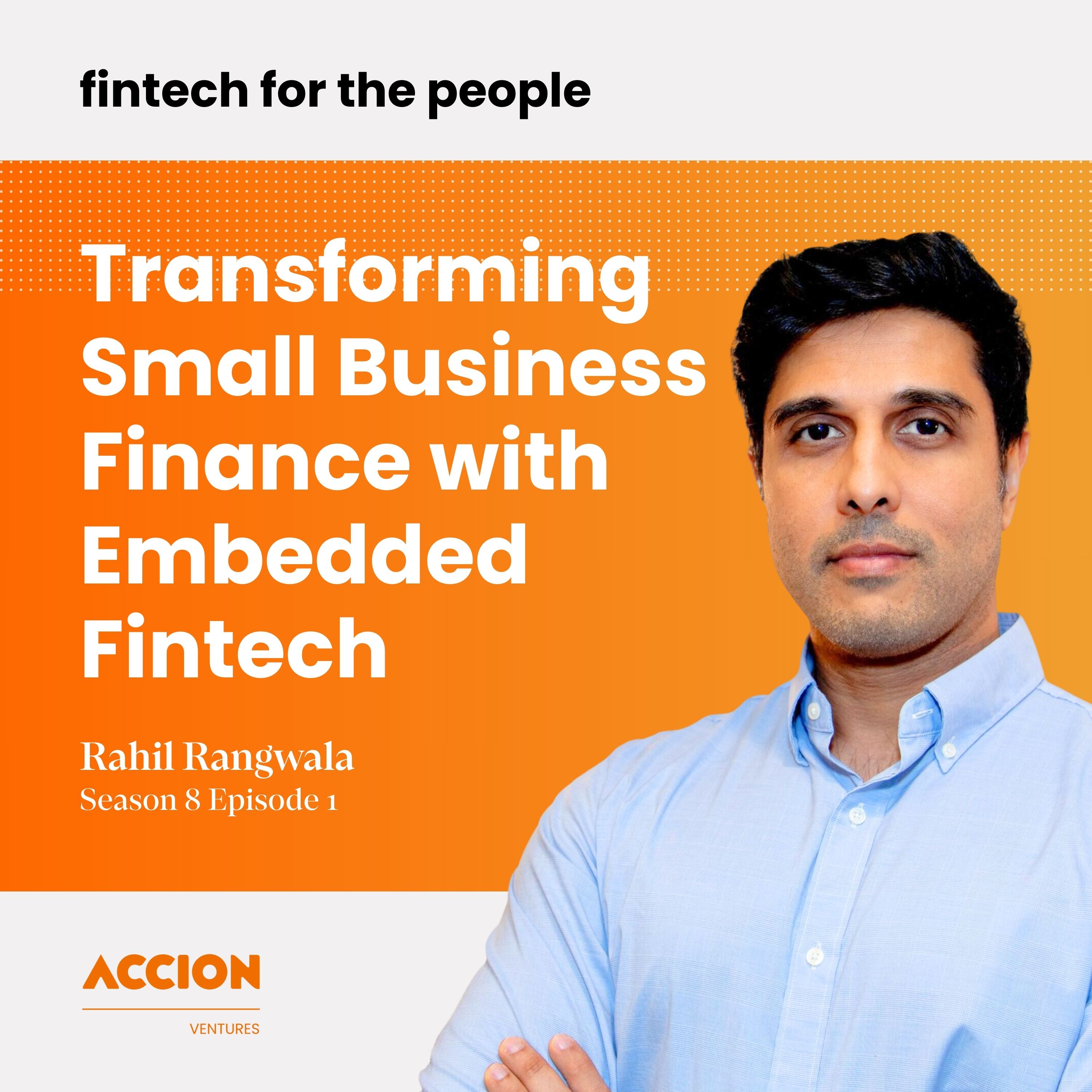
Transforming Small Business Finance with Embedded Fintech
14m 8s
The transcription introduces the new season of "Fintech for the People," hosted by Ami Barbou of Xeon Ventures. The firm has rebranded from Xeon Ventralab and closed a second fund to invest in fintech startups promoting financial inclusion, particularly in emerging markets. The season's focus is on "verticalized embedded finance," which integrates financial services like payments and lending into the specific operational contexts of industries such as construction, agriculture, and logistics. This approach addresses the unique needs of small businesses in these sectors, moving beyond generic solutions. The discussion highlights the importance of founders with deep industry knowledge and a realistic grasp of the regulatory and operational challenges in fintech. Looking ahead, embedded finance is viewed as a transformative, context-driven opportunity with significant growth potential, driven by technological advancements and increasing smartphone accessibility globally.
(upbeat music) - Hi, everyone. I'm Ami Barbou, managing partner of Xeon Ventralab, and welcome back to Fintech for the People. I'm thrilled to be back and to learn from Fintech innovators reaching and transforming the lives of people and small businesses around the world. Xeon works to build a more inclusive world, with access to financial and economic opportunity for everyone. And at Xeon Ventralab, we believe in the power of Fintech to reach those that have been left behind. As an early stage investor in Fintech startups, we've invested in more than 70 companies across Africa, Latin America, Asia, and the United States. We are kicking off this season of Fintech for the People with an exciting announcement. We have closed our second fund at Xeon Ventralab to continue to support the next generation of Fintech innovators. We are also changing our name to Xeon Ventures. So I'm excited to have my co-managing partner, Rahel Rangwala here with us to talk about Xeon Ventures and about our newest fund, as well as to kick off the topic of the season, which is a deeper dive into how embedded finance is helping to increase access to financial services for small businesses in what we think of as traditionally overlooked industries. Great to have you, Rahel. Thanks, I'm so excited to be here with you. It's really exciting to be embarking on this next phase of Xeon Ventures with you. We should talk more about this. When you think about this new name and this new fund, what's on your mind? What's exciting for you? So much. I mean, I think let's start with a new name, right? I love the new name. It suits us so well. We've been more than a decade plus at this. It's about time we drop the lab. We're not an experiment anymore. I'm so excited to how well this name reflects what we do. It builds on the legacy of what we've been doing for so long. It doubles down on the same thesis, Fintech for an inclusion and our strong belief that Fintech is the big opportunity in emerging markets. And at the same time, it doesn't feel a new name because we've always been venture. So it's familiar. It reflects our identity. It's just us. So I'm really excited to talk about this transition. I couldn't agree more. When we got started in 2012, 2013, it was unclear if what we were doing was going to work. Fintech wasn't even a word. People weren't investing in this. People definitely weren't investing in the markets that we were looking at across Kenya and Mexico and Brazil and Indonesia and India. And so the lab was like a bit of a cover. I was like, who knows? We'll see. Let's test. Let's learn. But you're right. Now a couple of funds later and many, many investments, 70 plus investments, it feels like we can drop it. 70 plus investments, exits, the kind of impact that we've had demonstrating to people that you can have impact. You can have financial returns. And you don't have to sacrifice one for the other. That was a question as well. So we should be proud. I'm proud. Definitely. And what would excite you about this next fund? What's thrilling you about investing in Fintech at this moment? Fintech's had a decade, almost, right? But it feels like Fintech's going through a bit of a reinvention with AI, machine learning, green finance, open finance, embedded finance. It's basically, I think, one of the driving forces for ecosystems and industry and all the geographies we operate in emerging markets. We're seeing regulators take a very progressive view how important financial services are for the industry and for the economy. And it's opening up lots of opportunities across the board. Super exciting opportunities exist. And we know how important it is for the underserved communities because they don't have access to these services. It's a massive opportunity and that's super exciting. For me, what really brought me into Fintech in the first place was, you remember this? It was like 15 years ago. Everyone was talking about the proliferation of mobile phones, simple dummy phones and how that was going to transform everything. Now, I mean, if you look at the latest Fintech data, it's what, 86% of adults now own a mobile phone and smartphone ownership is continuing to expand. And for me, that was the crux of getting started in Fintech but now it's so much more, right? There's so many different ways. Technology is impacting populations previously overlooked. Like you said, AI, we're just touching stablecoin, infrastructure, digital lending. There's just so much. It's really exciting to think about also just how small of the grand spectrum Fintech has penetrated into financial services. It's still tiny compared to what the full opportunity is. So there's so much more to grow into. Yep, agreed. We're, of course, investing globally in many markets and it's across, as we just said, I mean, lots of different thematic areas, payments and share tech lending. Today, we're talking about embedded finance and this season, in particular, we're talking about this very jargon-y phrase, verticalized embedded finance. So I was kind of hoping you could break it down for us. What's a simple definition of verticalized embedded finance? What does that mean? The desk sound jogging me, desk sound complex. But at the end of the day, I think verticalized embedded finance, let's start with embedded finance. It's fairly simple. The me embedded means you contextualizing the financial transaction. We are big in B2B transactions. And B2B transactions are typically three components. There's usually an exchange-- To business to business, you mean? Business to business. Stop using-- Stop using business to business. Three components. One is exchange of goods and services. That's fairly standard. Most people recognize it. Then the second is a payment for that transaction. And then the third-- and this is very important for businesses-- is the information interchange to confirm the transaction. And these are typically data-heavy. It has invoice details, the details of what was exchanged, the tax information, the payment terms, the time for delivery. There's a whole bunch of things you would bank guarantee, you're alone associated with it. That's the context. And businesses have been doing that in the nanologway forever. And now it's moving online. And the thing is, while it's been moving online, the financial services component continues to stay outside of it. So how do you embed that financial transaction with the context of the B2B transaction? And that to me is embedded finance. It's making it contextual to how businesses operate. And to your point on verticalized, for me, the first generation was around horizontal place. It looked at the entire ecosystem, and it treated everything the same. What we've discovered is that context for different sectors is different. So when you embed it, you have to operate in a separate-- in a unique context. So you talked about construction. You talk about agriculture. You talk about logistics. So many different sectors, health care, such different contexts. These are big markets. And I think only now people are recognizing that they're big markets. And it's not just big markets in the US and in Europe. It's huge in India. It's huge in Nigeria. It's huge in Brazil. Founders have recognized this. Investors have recognized this. It's a massive opportunity. And that's how I think about verticalized embedded finance. I really like the way you break down the contextualization, both in terms of financial services, the embedded finance, but also the sectors. I mean, over the last decade, plus we've seen how small businesses in financial inclusion, financial services are treated like monoliths. They all kind of get framed as a small business, needs working capital. Here's a term alone, six months, but that's not really meeting the needs of what a small business might be facing. That's a big part of how I think about verticalized embedded finances, like meeting the small business where it is with the context of its day-to-day operations. The season is going to be great to dig into each of these different sectors. There's a lot that, whether you're talking construction, agriculture, logistics, and you factoring, there's a lot that's similar. Like they are all massive industries that you could talk about in terms of the size by GDP in a country. There's a long tail of small businesses that operate in them. There's largely very manual processes that go behind the different elements, the three components you've talked about, the exchange of goods, the payments, the data. But they're all very different. Like a construction contractor needs capital well before they're repaid 60 days after completing a job. A farmer needs capital before a harvest, and that could be full season. Manufacturing me have effects needs about cross-border payments. You can't kind of give the same solution. And I think for me, that's the power of these verticalized solutions. Farming's a great example, because in farming now, we're seeing people want to, and farming is, and maybe even manufacturing, is that they want to go all the way to the source. They want to see who's worked on it, like from an ESG perspective. What's the supply chain look like? That's increasingly also being now embedded in the transaction. When we think about ESG and climate, people want to know. That's also part of the transaction. This is what completes a verticalized solution. It's not just thinking discreetly like, hey, I bought so much of corn, but what's the information behind it? Was it organic? How has it grown? Then you can think about pricing and underwriting in so many more intelligent ways. Yeah, there's a lot more information behind that. So we're going to talk to the founders of four of our portfolio companies working in these different industries over the course of the season, leasing fine construction, magma, manufacturing, vertical and agriculture, trucker and logistics. What is their secret sauce? Tell us what you think convinced us at Axion Ventures, each of these were worth backing. Look, you're asking us to now give away our secrets. But it's actually not that complex. For me, it starts with the founder. We don't know these sectors. We will never claim to be experts in construction or trucking in Pakistan or agriculture. We are not those experts. So we want to see the founders who understand the problem are they close to the ground? Do they understand the customer, that perspective? Do they know that pain point? Have they lived that pain point in a way that they can relate to it? Because we come in so early. To me, that's everything. And understanding that is probably most of it. And then the readiness for financial services and the capacity and the capability for them to understand that, which I think comes later. But that to me is one of the most important things. The stories from the season are pretty exciting of Sharia's trucking business and Fernando being a subcontractor. I mean, yeah, that deep, deep knowledge of these sectors, I think is so important. Every sector has its own rules too. And all of these founders began with some combination of they're doing lending and payments or they were doing a software tool and they added financial services later. How do you think about that right starting point? Is it financial services? Is it not non-financial services? And then if it is not, what are the steps for a non-banking platform? They need to handle before it can lend. This is actually very difficult. This is the toughest, I think one of the toughest questions for founders, right? Like when you think of lending, lending, any kind of financial services business, but let's start with lending 'cause that's one of the most common. It's the hardest of them to do, right? I've seen founders often underestimate that. And I think that to me then tends to be a red flag. Is that do founders really understand the complexity of what it means of running a core business and then talking about lending? That's another business. Do they understand that? Do they understand that it's regulated? They have a whole bunch of different responsibilities. It tends to be a balance sheet business. Like a lot of our startups have more P&L driven 'cause they're more tech first, right? They don't have to think about keeping risk on their balance sheets and never thought about risk. Do they approach it with the appropriate amount of respect that it needs, I think is important? And then also knowing what they don't know and knowing when they have to do it in-house, when they have to get external people to help them with it or just work with a partner? Like all of those three things, the maturity to evaluate that and to have that discussion in a very real way in recognizing the gaps that they have, to me that's where at least it's important that founders recognize that and want to see that they recognize that when I think about working with a founder. Looking ahead five years, where do you think verticalized embedded finance will make the biggest difference? I think we're scatching the surface. So I'm a VC, VC's have to be optimistic. I'm super optimistic about embedded finance and the future of what this is. I truly believe the future will be contextual. It is all about context and I think embedded finance and verticalized finance is going to be that type of solution that's going to be the future. So I'm super excited by what the five year journey looks like for embedded finance. A huge part of our fun theme and thesis couldn't agree more. It's exciting to think about the future. Thank you, Rahel, so much for joining us. Thank you for having me. Excited again to be embarking on this journey with you for exeone ventures and-- Likewise. Thanks for sharing your thoughts here. Thank you. [MUSIC PLAYING] Well, I hope that was a good introduction to the topic for this season of Fintech for the People. Tune in next week when we head to Columbia to speak with Fernando Ouyoki, co-founder and CEO of Lucify. We'll learn how digitized procurement and embedded finance are speeding up construction projects in supporting small business contractors across Latin America. [MUSIC PLAYING]
Podcast Summary
Key Points:
Xeon Ventures (formerly Xeon Ventralab) has closed its second fund to support fintech innovators, emphasizing financial inclusion in emerging markets.
The season focuses on "verticalized embedded finance," which contextualizes financial services within specific industries like construction, agriculture, and logistics.
Founders with deep sector expertise and an understanding of regulatory complexities are key to success in embedded finance.
Embedded finance is seen as a growing opportunity, leveraging technology like AI and mobile phones to serve underserved small businesses globally.
Summary:
The transcription introduces the new season of "Fintech for the People," hosted by Ami Barbou of Xeon Ventures. The firm has rebranded from Xeon Ventralab and closed a second fund to invest in fintech startups promoting financial inclusion, particularly in emerging markets. The season's focus is on "verticalized embedded finance," which integrates financial services like payments and lending into the specific operational contexts of industries such as construction, agriculture, and logistics.
This approach addresses the unique needs of small businesses in these sectors, moving beyond generic solutions. The discussion highlights the importance of founders with deep industry knowledge and a realistic grasp of the regulatory and operational challenges in fintech. Looking ahead, embedded finance is viewed as a transformative, context-driven opportunity with significant growth potential, driven by technological advancements and increasing smartphone accessibility globally.
FAQs
Xeon Ventures, formerly Xeon Ventralab, is an early-stage investor in fintech startups focused on building a more inclusive world with access to financial and economic opportunity for everyone. They invest in fintech companies that reach underserved populations globally.
Verticalized embedded finance involves embedding financial services like payments or lending into the specific context of a business transaction within a particular industry, such as construction or agriculture. It tailors solutions to the unique needs and processes of each sector, rather than treating all businesses the same.
The name change reflects the firm's evolution from an experimental 'lab' phase to an established venture capital entity. After over a decade, multiple funds, and 70+ investments, the new name better aligns with their identity and legacy as venture investors in fintech.
Xeon Ventures invests globally in emerging markets, including Africa, Latin America, Asia, and the United States. They focus on regions where fintech can drive financial inclusion and economic opportunity.
They are excited by fintech's reinvention through trends like AI, machine learning, green finance, open finance, and embedded finance. These innovations offer significant opportunities to serve underserved communities in emerging markets, with regulators increasingly supporting progressive financial services.
Founders should understand the complexity and regulatory responsibilities of lending, including managing risk on their balance sheet. They need to assess whether to build in-house capabilities, partner externally, or seek help, approaching it with respect and awareness of gaps in their expertise.
Chat with AI
Loading...
Pro features
Go deeper with this episode
Unlock creator-grade tools that turn any transcript into show notes and subtitle files.
 PodcastTranscript AI