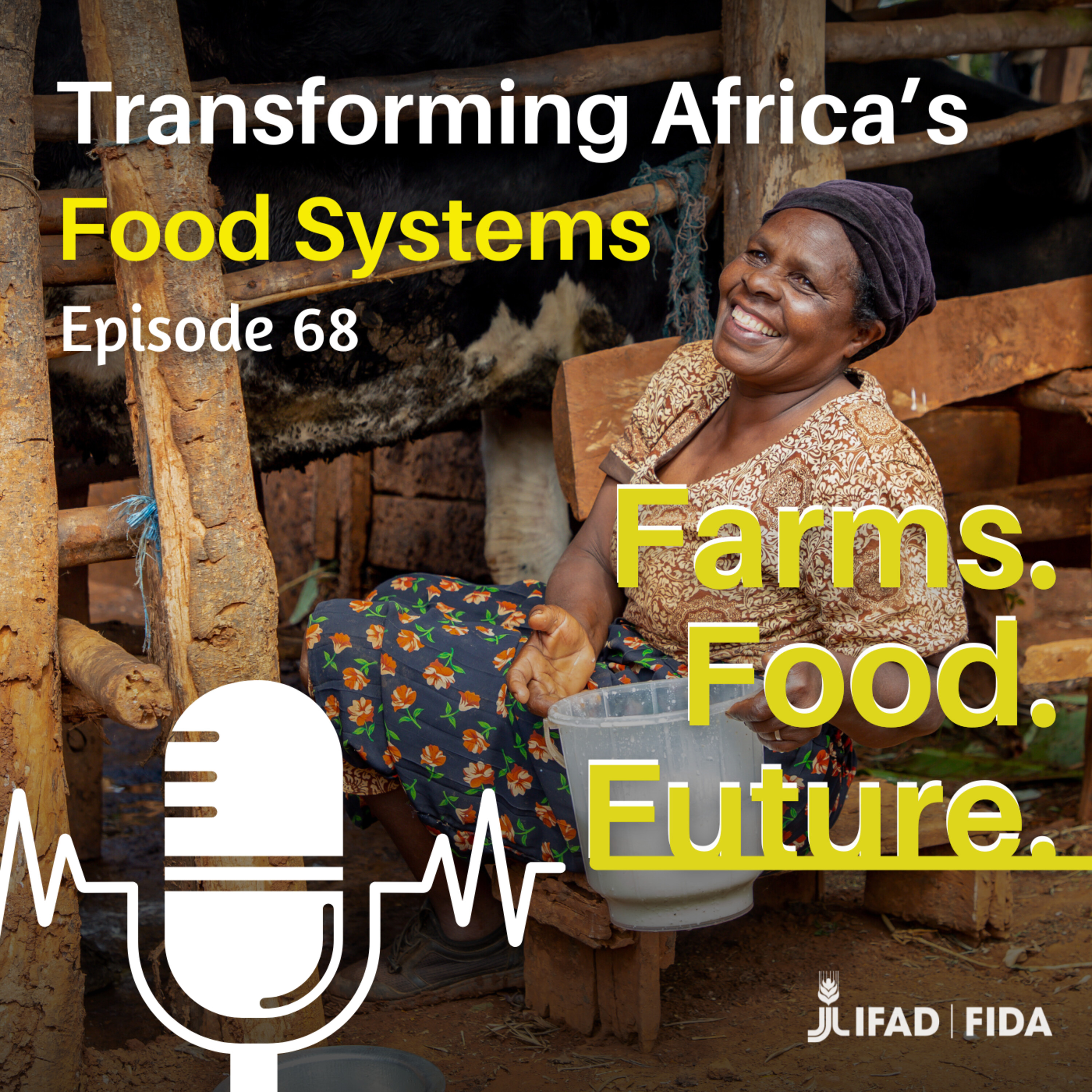
(upbeat music)
This is Farms Food Future,
a podcast that's good for you,
good for the planet and good for farmers,
brought to you by the International Fund
for Agricultural Development.
You ready?
I'm ready.
Shall we start?
- Super ready.
- Super ready.
- Let's go for it.
- Okay.
A big three, a huge two and an amazing number one.
Welcome to Episode 68.
I'm Brian Thompson.
- And co-presenting this edition, I'm Michelle Tang.
- In this episode, we'll be traveling around
eastern Southern Africa to get the inside scoop
on innovations to improve food security,
healthy diets and sustainable agriculture.
And talking about nutrition,
we can't forget to mention this year's Sophie Report.
- That's right.
Released this July,
the state of food security and nutrition in the world,
better known as the Sophie Report,
is an annual report jointly produced by FAO, UNICEF,
WFP, WHO and EFAT.
- According to the 2024 Sophie Report,
hunger is driven by conflict, climate change
and economic fluctuations, not a lack of food.
The 733 million people who were hungry in 2023
need more than just food.
They need a systemic change.
We have the means to end hunger by 2030,
but we lack the necessary funding and political will.
- Small scale farmers who produce a third
of the world's food need more investment.
It's high time to put our money where our mouth is
and invest in achieving zero hunger.
- Moving on to our stories.
Today, we talk about the innovative behavior change
communication techniques that are improving
climate resilient crop production
and making a real difference in Zimbabwe.
- Then we take a look at ways in which we can tackle
rural poverty and food insecurity among small holders
in Kenya's arid and semi arid lands.
And in Malawi, we hear about the vital role
of indigenous crops in supporting
household economic development.
- We'll also be talking about nutrition, education
for small holder farmers in Lesotho.
Don't forget, we want to hear from you.
What do you think about our stories
and who you want us to be talking to?
So please get in touch with us at
[email protected].
You can also subscribe to this podcast
via your favorite podcast platform.
And please don't forget to rate us.
- Coming up, we take a trip to Zimbabwe.
(upbeat music)
You're listening to Farm's Food Future
with me, Brian Thompson and Michelle Tang.
In Zimbabwe, food security depends heavily on maize,
grown by over 90% of households.
Recurrent droughts and worm infestations impact production
and even good harvest can lead to low prices
and post harvest losses,
creating cycles of surplus and scarcity.
The AFAD funded small holder irrigation revitalization
program aims to improve productivity
and climate resilient crop production in the country.
Our reporter, Federica Giordani,
spoke to Fungai Kuchiaripo,
nutrition specialist for the project.
- Thank you very much for being here today
to attend this knowledge and experience sharing workshop
on nutrition sensitive agriculture, rural development
and food transformation in Nairobi, Kenya.
Would you mind to introduce yourself, madam?
- My name is Fungai Kuchiaripo from Zimbabwe.
I work for the small holder irrigation revitalization
program as the nutrition specialist.
- Thank you very much.
Let's start now with the first question.
What specific nutritional challenges do you aim to address,
particularly concerning underutilized species
and dietary diversity?
- So in Zimbabwe, we have the challenge
of chronic malnutrition in the form of stunting.
And this is mostly affecting children under fives
and the current rate is at 27.4%.
And we also have the challenge of hidden hunger
or micronutrient deficiencies,
which is also affecting the children
as well as women of childbearing age,
especially issues of anemia and vitamin A deficiency.
So with these underutilized species,
normally rich in micronutrients.
- Thank you very much.
Now, could you tell us about the strategies
you're using to enhance nutrition,
including home garden initiatives
to promote dietary diversity and food security?
- So mostly the strategies that we employ as a program,
they are there to improve availability of food
and also dietary diversity at household level.
So we formed an SBCC strategy,
which is there to create demand
for uptake of a diverse and nutritious food.
So some of the things that we do
under social behavior change communication,
we have cooking demos,
we distribute labor-saving technologies to women
to address issues of labor
and then also raise awareness through trainings.
And we also promote biofortified crops
in the neglected and underutilized species
and also the home gardens through QO gardens,
which are micro gardens,
which do not need much water for survival.
We use our gray water or water
that have used for other activities
like washing, bathing and so forth.
- So Anna, the strategy that we're employing as a project
is to contribute to food security policy formulation.
And we are doing this through policy dialogues,
documenting what we are doing
and sharing with other partners.
These we are doing to create an enabling environment
for adoption of good nutrition practices.
And lastly, what we are doing as a program,
we are participating in the multi-sector coordination
platforms at all levels.
This way, we meet with different players
along the nutrition sensitive value chain
and we share lessons and also new approaches
to doing things that way.
We coordinate efforts towards improving nutrition
and also availability of nutritious foods along the markets.
Thank you.
- Thank you very much.
What tangible outcomes or success have you achieved
in terms of improving nutrition,
especially concerning behavior change
towards healthier diets?
- Okay, so what we have noted as a program,
when we started off, we carried out a baseline survey
where we measured the nutrition indicators
assessing where they were.
And these were the minimum dietary diversity
for women to assess diet quality,
the household dietary diversity score and so forth.
And notable changes have been seen,
like the number of households with acceptable diets
is at 98 point percent now
and women of childbearing age consuming
by four more food groups is at 76.8 percent.
And with the school program that we've been carrying out
to complement the school feeding program,
school attendance was reported to have improved
and even school performance among learners.
And through the youth vocational trainings
that we've conducted about 20% of the youth
that we trained have managed to open businesses
to improve their income.
- Thank you, fungi.
Next up, we're traveling on to Kenya.
You're listening to Farms Food Future
with me, Michelle Tang and Brian Thompson.
In Kenya, crop production is heavily reliant on rainfall
and nearly half of animal production takes place
in arid and semi-arid regions.
Drought and unpredictable rainfall patterns
are severely impacting agricultural productivity
among small holders in Kenya's arid and semi-arid lands.
- Our reporter, Federica Giordani,
spoke to nutrition focal point
for IFAD's Serial Enhancement Program, Justin Murioki,
about the multi-stakeholder approach they're using.
- Good afternoon.
What specific nutritional challenges do you aim to address,
particularly concerning underutilised species
and dietary diversity?
- Thank you.
K-Sepcrawl is implemented in eight counties in Kenya
where we address nutrition challenges.
And the greatest nutrition challenge
faced in the eight counties is wasting,
stunting and underweight.
And all these challenges could be addressed easily
by using underutilised species
and broadening the dietary diversity
of the beneficiary farmers.
- Thank you very much.
Now, could you tell us about the strategies
you are using to enhance nutrition,
including home garden initiatives
to promote dietary diversity and food security?
- Thank you.
These strategies are adopted by K-Sepcrawl several
and the most important of them
is a multi-stakeholder approach
to developing training modules
where stakeholders from each county
carried out an analysis of nutrition challenges,
building concurrence on the pathways
to address the specific challenges
so that the interventions
would be county context specific.
The second approach was the multi-stakeholder training
of trainers who include lead farmers.
And again, it is county specific
integrating local knowledge
and the local food sources in the module,
especially locally underutilised species
that are nutrient dense.
Then the team developed training materials,
posters in different languages
and now carried out training demonstrations
including integrated home gardens
where different stakeholders
brought different approaches to the home garden,
some more corn gardens, vertical gardens,
braced bed gardens and so on.
And K-Sepcrawl invested in water harvesting
to support the home gardens using farm bonds.
- Thank you very much.
Let's move now to the last question.
What tangible outcomes or successes have you achieved
in terms of improving nutrition,
especially concerning behaviour change
towards healthier diets?
- One of the key achievements for K-Sepcrawl
and the multi-stakeholder partnership
that has been working together
is acceptance of traditional nutrients,
dense vegetables in the diets.
Presently in our country,
you get these vegetables like a jute plant,
black nightshade, amaranthus, pumpkin leaves
and spiderweeds in supermarkets being sold
and they are available in the local vegetable markets.
They have also been accepted in the diets in most hotels,
including roots and tuber crops,
which are currently being offered
even in five-star hotels.
The second tangible achievement
is improvement in the key indicators of our nutrition
in the counties I've mentioned.
For instance, in Machakos County,
wasting reduced from 7% to 4%
and the weight reduced from 11% to 8%
and starting from 27% to 16%
through the Kenya Demographic Household Survey
carried out in 2014 and 2022, respectively.
- Thank you, Mr. Maruyoki.
Our next stop is Malawi.
- You're listening to Farm's Food Future
with me, Brian Thompson and Michelle Tang.
Malawi faces significant challenges
with over 70% of its population
living below the poverty line.
Climate change poses a significant threat to Malawi,
causing droughts and floods,
which further impact agricultural productivity
and food security.
IFAD's financial access for rural markets,
smallholders and enterprise program
aims to support household economic development
through access to financial services.
Our reporter, Federica, spoke to nutrition specialist
Joseph Maulana about the importance of indigenous crops.
- In Malawi, one of the main causes of malnutrition
is basically the low accessibility
but also availability of high nutrient-dense crops.
So in the program, we are trying to address
the issues of availability but also accessibility,
which we've done through the provision of improved seeds.
And basically the ones that are already traditionally accepted
are the ones that are locally available,
but that we've just engaged a local university
to make sure that we are distributing the seeds
that are now improved in terms of making sure
that the production is more so that people
can have more available indigenous vegetables
within their home state.
At the same time, we are doing this through the demonstrations
because we cannot distribute the seeds
to all the project beneficiaries at once.
So what I'm trying to do is to do the demonstrations
so that to do the demonstrations
that the people could see the importance
of growing these indigenous crops.
We're also promoting the multiplication of the same rockery
because some of these seeds are also available
within their garden.
So we're also supporting them to source the rockery
as part of sustainability.
- Thank you very much.
Now, could you tell us about the strategies
you are using to announce nutrition,
including home garden initiatives
to promote dietary diversity and food security?
- Thank you.
So for the, in terms of the home gardening,
we are doing this under what we call
integrated home state farming.
So basically, we are encouraging the project participants
to establish a home garden which are within their homes
so that they can access the fresh vegetables.
But what we've done as innovative now
is to develop what we say a communal home garden
where a number of women having a common garden
where they take care of it in rotation.
At the same time, it's bigger than having a smaller garden
for individual households.
They're also using these as part of, yes,
improving the utilization part of the nutrition aspect,
but also using these as part of our economic empowerment.
So they even sell the surplus of vegetables.
And this is kind of a motivation.
They are motivated to grow these vegetables
because they are setting the surplus,
but they're also using part of the vegetables
to improve their nutrition needs.
- Thank you very much.
Let's now move to the last question.
What tangible outcomes or successes have you achieved
in terms of improving nutrition,
especially concerning behavior change
towards healthier diets?
- Thank you so much.
So this program in Manawi,
we are working with the Attrapua women.
Basically, these are the women
who are under the social care transfer.
So they are getting some small aspect from the government
to support their consumption needs.
Unfortunately, the consumption hasn't been concerned
about what they eat.
So it has been more like buying and eating foods.
So what we've done so far is really to train them,
educate them on what healthy foods are
and how they can combine them
and how they can prepare such foods.
So it has been so helpful,
including their diversity,
most specifically for the women as improved.
At the beginning, we had around 23% women
meeting their minimum daily diversity,
but at the follow on study that we've just done in April,
we have had up to 40% of the women now
that their minimum diversity has been achieved.
But at the same time, this is also encouraging us
because what we are seeing now is the women on themselves,
they are actually now using part of the money
which they get from the government
even to buy the nutritious foods.
Previously, they were not concerned about what they buy.
So they're actually using the money
to buy nutrition foods from the market.
- Thanks, Joseph and Federica.
To find out more about Malawi,
check out episode 59 of this podcast.
Rural Malawians share how they're building back
after Cyclone Freddy hit the country last year.
- And don't forget to check out our latest episodes.
In episode 65,
we celebrated the world's indigenous peoples day
joined by indigenous leaders from across the globe.
Then in episode 66,
we spoke to EFAT 2024 gender award-winning projects
about their transformative initiatives.
- And in episode 67,
it was all about food systems
featuring Irish youth activist
and global citizen award winner Sophie Healey Fow.
Stay tuned as we move on to Lizoto.
You're listening to Farm's Food Future
with me, Brian Thompson and Michelle Tang.
In Lizoto, the agricultural sector,
especially livestock plays a crucial role
involving about 71% of the rural population.
EFAT's Small Holder Agricultural Development Project Program
aims to support smallholder farmers
to exploit opportunities to increase their productivity
and diversify into market-orientated agriculture in Lizoto.
Our reporter, Federica Giordani,
spoke to LeBang Nataki
about the importance of nutrition education.
- What specific nutritional challenges do you aim to address,
particularly concerning underutilised species
and dietary diversity?
- In our country, the challenges that we want to address
in regard to nutrition, first of all,
we want to address dietary diversity for the households.
And then also, we want to promote biofortified foods
and then also diversified household food production.
- Thank you very much.
Now, could you tell us about the strategies
you're using to enhance nutrition?
- The strategies that we are using in the country,
as first of all, we are using nutrition education
and awareness in other people to know about nutrition
and nutrition-related issues.
The consequences of not eating well
and the other thing is that we conduct trainings
on household food production,
where we are training them on constructing
climate smart plots, also the production of fruit trees.
And the other thing is that we train them
on post-harvest loss technologies
so that they can have foodie all year round.
Also, introduce income-generating activities
so that they can earn money.
Also, to empower women to make their own work
so that they can have money for the households.
- Thank you very much.
What tangible outcomes or successes have you achieved
in terms of improving nutrition,
especially concerning behavior change
towards healthier diets?
- Thank you.
The tangible outcomes or the success stories
that we have in the countries are not that much,
but we have because we are still facing
the challenge of malnutrition.
But now, after making the trainings
in some parts of the country,
some people know how to eat well,
know how to prepare food.
Also, they know how to practice,
hygienic practices.
And also, they know how to use
the safe and nutritious foods very well
so that they cannot lose the nutrients
when preparing food.
I think we are trying to reduce the impact of malnutrition
that is why we said we are training them on those.
In other areas, we have nutrition clubs.
Those nutrition clubs are the groups of people.
We are targeting every person, woman, men, youth
to be part of the nutrition clubs
so that they gain experience
or the skills on nutrition issues.
And then, we are trying, encouraging them
to have vegetable plots in every household
of each member, to have preserved foods,
to have fruit trees, to have short cycle animals.
Also, to have tippy taps for washing hands
every time when they are from,
because we don't have enough water in our area.
So, also to have the environment clean every time,
to maintain hygiene and sanitation
everywhere in the house, for the body, everything.
So, that is, I think now, our community
and some of them adopted these skills.
Thanks to Ms Nataki and thanks to our reporter, Federica.
You can find out more about IFAD's work on nutrition
visiting www.ifad.org/nutrition.
And that brings us to the end of this episode.
Thanks as always to our producers here in Rome,
Francesco Manetti and Joe Matteo Pacchi,
and to our reporter, Federica Giordani.
But most of all, thanks to you for listening
to this episode of "Farm's Food Future,"
brought to you by the International Fund
for Agricultural Development.
We'll be back again in just two weeks
with an episode on the world's smallest
and sometimes forgotten climate warriors.
An episode of "70" drops on the last Monday in October,
bringing you discoveries of a new bamboo species in Colombia
and stories from our forests.
[MUSIC PLAYING]
This is "Farm's Food Future," a podcast that's good for you,
good for the planet, and good for farmers,
brought to you by the International Fund
for Agricultural Development.
You can find out more about all of our stories
at www.ifad.org/podcasts.
Remember, we want to hear from you what you think about our stories
and who you want us to be talking to.
So please get in touch at
[email protected].
Send us your voice or text messages to this address,
and we'll be happy to play you out in the next show.
Also, don't forget to subscribe to this podcast
via your favorite podcast platform, and please rate us.
And once again, we'll be trying to be good for you,
good for the planet, and good for the farmers.
Until then, from me, Brian Thompson,
and the team here at IFAD, thanks for listening.
 PodcastTranscript AI