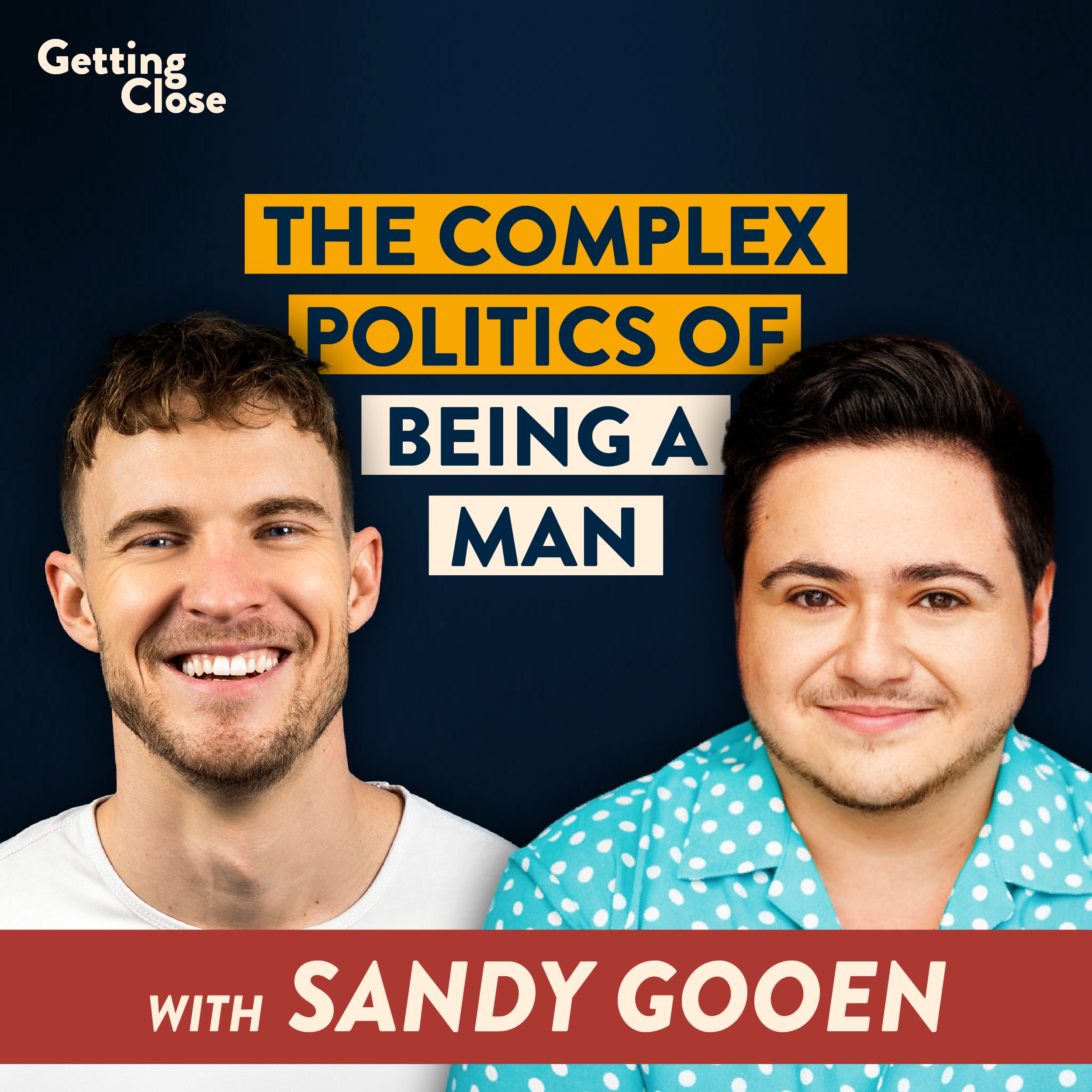
Trans Thought Leader: The Complex Politics of Being a Man
54m 21s
In this episode of *Getting Close*, host Aiden Morton engages in a candid and vulnerable discussion with Sandy Goon, a queer man of trans experience, about masculinity, inclusion, and connection within the gay community. Sandy describes his gender journey, noting that he always felt masculine and was often mistaken for a boy as a child, with his family eventually supporting him despite initial struggles. The conversation delves into how anti-trans rhetoric is rooted in misogyny, disproportionately targeting trans women, and how transitioning brought Sandy safety from misogyny but exposed him to transphobia. A key theme is the social pressure on trans men to suppress vulnerability, which Sandy contrasts with the grace he received before transitioning. Both discuss how fear of saying the wrong thing often prevents gay men from building meaningful relationships with trans men, and they emphasize the need for intentional inclusion rather than keeping trans men on the periphery. They also explore childhood gender expression through media like theater and video games, highlighting how these shaped their identities. Ultimately, the episode calls for stronger queer community bonds through honest, imperfect conversations that foster understanding and belonging, despite the challenges of navigating differing experiences and fears.
Hi friends, welcome back to Getting Close, a podcast about connection. My name is Aiden Morton and today I'm connecting with Sandy Goon. One of the biggest hurdles I've had with gay men is constantly feeling like I'm on like a periphery. The thing that makes my day is not like the over-browing but that you're considering me as part of the in-group. This definition of manhood matters as much as yours. We're doing it a little differently from each other but we're still all men. Getting close to someone is not always an easy thing to do. I think this is the most clear I have been with the goal of this show. So thank you. Before we dive in, if you're one of the 25% of people who is listening without subscribing, go back to that show page and hit subscribe for me. Subscribing means that our metrics go up and we can continue to bring you incredible conversations like this one with Sandy. Sandy is a published and produced writer who's currently developing a musical called Twink Peace. He also runs Tempo, which is an organization for trans music professionals. His professional and academic background is mostly music and theater but in his free time he focuses a lot on gender and LGBTQ topics. At the root of Sandy's work is the desire to cultivate belonging and understanding. This episode is a little different. I wanted to have Sandy on to have a vulnerable and honest conversation about these cis and trans experience and what gay men can learn from trans men. It is definitely the most vulnerable I have ever been on an episode so far. In it, we unpack why many conversations about trans people focus on the wrong questions, how to talk to people even if you don't want anything from them, how fear of saying the wrong thing can prevent meaningful conversation, the small yet impactful ways that gay men can include trans men and how to build stronger queer community with people who we might not fully understand yet. You ready? Must get vulnerable with Sandy, Gua. Hi Sandy. Hi Aiden. Welcome to Getting Close. This is very fun. Thank you. Of course, I am so happy that you have joined me for this episode. Before I do any sorts of introductions, I think we're going to start with our questions. Who in your life inspires you to be better? Oh, this is a really fun question to start out with. Just getting it out of the way very first thing. I'm a huge mama's boy. I love my mother. And so I will just say that my mom inspires me to do better, be better, all the things. I will flat. It's upside down. Yes. What bed habit do you wish you could stop? Oh. Okay. These are good questions. Like, does like overthinking an anxiety count as a habit? Oh, oh, wait. No, I know the answer. I wish that I could stop multitasking. I have found that I have a really hard time waiting for things. And so as soon as I have to wait for something to upload to whatever and all these edits I'm doing, then I start working on the next task. And then I feel insane. So that one. I, and this will be like an intro to the listeners as well. Um, wanted to have you on because I wanted to have a cisgender, transgender conversation about masculinity. I think you and I have encountered so many gay male-centric spaces and in both our friendship and your writing have, you've really made me reconsider a lot of the innate beliefs that I had around about masculinity and how we sort of engage with each other in a way that is in a way that is like accepting and tolerant. And honestly, like, this is not a conversation that needs to be listened to by transparent, I would say, but it is very much a conversation that needs to be listened to by gay men. So with that, can you give a little introduction to our listeners and your gender journey? And I brought you to the chair today. Absolutely. Um, so a little context, I am a, this is how I phrase it. I am a queer man of trans experience. That would be like the way that I would phrase it. Um, queer because of how I like my sexuality and then man as in my gender and then trans experiences, how I came to this gender. Um, I started like a social and medical transition in college. And I've spent most of my adult life as a man. And so I never really had the whole like woman experience, but I did have like a fairly interesting childhood of like being raised in like girl mode. Okay. But like, and we'll talk about this probably, but like I feel like there is more allowance in society to be a masculine girl than there is to be an feminine boy. And so I. Like 100% there was more permission for me to be a little bit weird and quirky in that way than I think some people are afforded. And so I'm like, I want to jump on that. Yeah. I feel like that's a great starting point because I have never thought about that in many things that you bring up and completely agree. I got hypothesized about whether or not I was gay when I was really young because I was so I wouldn't even say flamboyant. I was just energetic and spent more time with girls. Is there any similar conversation for you being a yes. I first of all, so many people before there was really the gender box put on kids, so many people assumed I was a little boy. My name has always been sandy. I had short hair. I was always like roughening up on the playground and all my friends were boys. And so they just there were people that just assumed I was a boy, which I loved. And so that led to speculations of like, is this going to be a tomboy, a lesbian? Is this like a phase that you outgrow or like what to do with this? There was a lot of that, but it wasn't as, you know, stop doing that in those early years as it sometimes is for people in the other shoe of being an effeminate boy. Was there like acceptance from your family or like, would it have been different if you had like been a lesbian or like, was that? I think that my family has grown with me and doesn't really care what my deal is. I love that. I'm like very lucky for that. Like, there have been a million learning curves and mistakes, but like we've all whatever I was going to be, I was going to be and they were going to be cool with it. We just had to go on that trip together. Of course. Which I'm so blessed with. Meanwhile, they're, I'll talk a little bit more about my family. It's a point, but I was going to first say that at school, girls were very distressed by me being masculine and boys on the other hand, until I got a little bit older, loved it. Right. We're cool with it. We're very uncomfortable because in the same way that like now you have people talking about like not wanting to have trans people in like bathrooms or whatever. By assuming that I was masculine, knowing that I was masculine and assuming that I was a gay woman, I was like discouraged from using the girls locker, which was accidentally very gender affirming. Right. Oh, that's so interesting. And again, like I think, which is why I'm so excited about conversation is like there's so much wrapped into both the gender privilege that comes out in the trans conversation. Because even that, like if we're thinking about all of the bills that are being passed, it is rarely, we don't want girls playing boys sports. It is sort of always, we don't want boys playing girls sports, which again, like comes back to this protection safety and it's like all wrong and a misconception anyway. There's a lot of assumption put into that and also that like generally a lot of the anti-trans rhetoric is rooted in misogyny, which means that trans women are on the front lines of it. Because they just hate the idea that anyone could possibly, you know, aspire to be or experience being a woman. So that bothers people. People tell me all the time they're like, oh, I get it. You just want more privilege so you became a man, which is not true. But that is something that I've heard a lot. Do you feel like you have gained more privilege since you transitioned? Sometimes. The answer is definitely sometimes I'm like the amount of cat calling and other shit immediately went away the second I had top surgery. Yeah. I feel safer generally in most contexts, not all, but many. So materially, I feel less like I deal with misogyny, however, transphobia and other things are a new thing. Sure. Sure, sure, sure. And I feel like there is a lot of opportunity for transphobia within the gay community. And I also just want to say like for the people listening, you talk about your family going on the journey with you. And I think a lot of gay men and I'm going to give them the benefit of the doubt are sort of scared to go on the journey with our trans siblings in a meaningful way. And we talked about this beforehand.
I recognize that even like I misstep it, I say the wrong thing. So I'm just like blanketing this conversation as like there might be missteps. And I think just like I wanna be able to like come to all of this with like so much love and admiration for you which I have and to like bring people together. I think that the queer community is so disparate and we need to come together. And I think fear is a big part of why we don't. I think that's absolutely true. I also think that like it's harder to have these conversations with people you literally don't know. So I'm grateful that we're talking because it's not like you're just meeting me. Correct. That would be much harder. I mean maybe or maybe not. Like I found that a lot of times I hold myself back from asking questions because I feel like I should know them. Like again, like we haven't talked, we have talked a lot about like critical theory but we haven't talked about like you are lived experience. A ton. You know, that's a fair point. Part of me is like, well let's treat this as a brand new conversation. What was the most surprising thing you learned after you transitioned? This is a little dicey but I'm gonna try to say it's see we're all making mistakes and learning. I think that there's a sense of like I've had a learning curve with like softness. Okay. I think that like the resistance to be vulnerable that like immediately comes up when you are a masculine presenting person, it's given me a lot more compassion for people who that's been ingrained in them their whole lives. Versus like now I feel like I have to kind of walk a thin line emotionally that I didn't always have to and there was more grace given before I transitioned. What does that line look like? I'll give one example that like people on the internet like to say that testosterone makes it so that you can't cry. I think that is bullshit. I don't think that there's enough science behind that. I think that that is dubious at best. Sure. I think that part of it is like beyond science. I think that a part of it is more about social things rather than about physical things. But like that's a that people talk about HRT in either direction as being like you cry more, you cry less and I'm like that is reinforcing a thing. Versus like I feel like things change obviously but like there's this sense of like fear around vulnerability maybe more than just like, oh, I can't cry because I'm on testosterone. I'm like, I don't believe that. Sure. And it comes back to what beliefs we have about masculinity anyway which are so many. Like I was doing this survey for this conversation and I'm even just sitting down to try to think about the adjectives that come to mind when you say man or masculine or you know what like it's so complicated and it's so complex. What were your first beliefs or thoughts about masculinity? Sure. Small question. It's a little question just a tiny warm up. I had the privilege of growing up in a household where neither of my parents are like cookie cutter people and also like my other extended relatives. I wouldn't say that any of them are like, you're run of the mill like, we're New York adjacent Jews. We're not like, we're not like. Where did you grow up again? I grew up in New Jersey. There's a little bit less rigidity in gender stereotypes I feel like. And so my first introductions to masculine people weren't maybe as like, there are some ways in which they adhere in some ways in which they don't. But for me masculinity wasn't presented in some of the typical ways that other people may have had them of like, you got to be like a tough guy. Right. I also have written about this a few times about how I feel like I through media, especially experienced socialization not just as a girl. I feel like I got, I absorbed a lot of rules through media. Okay. I am on the cusp between millennial and Gen Z. Me too. Yes, we are about the same age despite maybe not looking. (laughs) Cousin age. But I feel like I learned that there's a few different ways to be a man from the beginning. I never believed that there was one way, but I did believe that a lot of it looked like, oh God, I got really obsessed in middle school with like, shivalry. Interesting. Okay. And like the idea of like having to be a protector and like being like, like Galant and all that bullshit. And I'm like, it's so funny to me. But I, what I glombed on to from like books and movies and TV. Right. What kind of books did you read as a kid? So I read like a lot of like Charles Dickens and like-- Shivalry. Yeah, and also my favorite book for a long time was Don Quixote after seeing the musical man of La Mancha. I got really into, Perks of Being a Wallflower and like that type of boy as well. I also, you know, saw 500 days of summer, a million times when I was in high school. Which is so funny. Those kinds of boys are like very like the soft boy version of that. And I'm like, did you always feel like you like were a man on the inside? Kind of. I mean, I was always following, I was always tracking the guy in those stories more than the girl and like, when I came out to my mother, which first of all, she asked. I didn't tell. She asked. How old are you? When I came out to her 19. OK. But I had been doing something. But yeah, but yes, when we had that conversation, she asked point blank, which is so funny. But it's because like for my whole life, like there's been this thing that has been noticed of like, I would openly talk about like relating more to every time I watch something, the boy or like playing the boy in video games or like, this is one of my earliest childhood memories is that I had an imaginary twin brother named Eddie that I blamed all the bad shit I did. I was like typical little brother. Pranked on my sister kind of person. So like, I feel like I've been the same person this whole time on the inside. And I have better language for it now. Right. One thing, you know, because that question also gets asked of like queer people is like, did you always know? And it's like on one hand, yes, on one hand, no. It's like, we didn't have the language. We didn't talk about trans people that much from this growing up. I feel like I didn't talk about trans people until college maybe, maybe a little earlier, but especially in like small town Hawaii, not a conversation that was had often, except like Mahu was thrown around often, but Mahu is like also a slur, but also sort of like two spirits. So it does hold both of these worlds in a way that like, it's very fascinating to me. But what also is fascinating to me is now I'm like curious, I would love to do a study about like what people's video game characters say about them. I know it's like a strong pivot backwards, but no, it's very fair though. But I'm like, I uphold my own beliefs about masculinity through the video game characters that I choose. And I know a lot of gay men like choose like women so that they can tap into that. I'm like, I always choose like Bowser essentially. When we're playing Mario or like the like rip dude, because like, especially as a kid, that's what I wanted to look like in a way that is probably not super healthy. It definitely like, didn't make my life as a kid any easier. - No, I mean, and it's really funny to tell you this for the first time sitting here with you and also talk about this, but like on the playground as a child, when I did make a few like friends who were girls, we would literally act out wicked on the playground and I would be fierre on. - Oh my god, yes. I'm obsessed with that. - So I'm like, this is important information. - I like also like, again, growing up in Hawaii, like Broadway wasn't huge, but like sort of misunderstand like the zeitgeist that wicked sort of held. It's, I'm reading this book right now. Remina Boss has major questions and the author's gonna be on the podcast in a few weeks and a month or so. But like wicked is a huge part of that book as well. And I'm just like theater saves people. Like there's, like theater is such a lifeboat to queer people in a way that I know is like understood but like isn't really understood, I feel like. - My very first crush and also like first like thing I identified with as a little, little person was like Peter Pan was kind of like, that was like the gender envy crush of it all that I had that I was like, oh my gosh. Like I see myself in this experience. - And also like Peter Pan is very like gender fluid as like always, not always, but often played by a woman and was made famous by May Martin, Mary Martin. - Mary Martin, yeah. - Mary, so queer. - Right. And it is just like such a fascinating way that again, like we don't have language for this when we're kids and yet it doesn't feel at all unnatural, just like is the process. So as you got older, What was your family's response, your mom's response when you came out?
There were a lot of really strong and mixed emotions in my family that have, we've really evolved. I grew up in a family that had such strong and intelligent and wonderful women that kind of felt very uncomfortable with the idea that I was kind of opting out of womanhood. Like there was less of a hesitance about my queerness. Like that was kind of always kind of a given because I was just an eccentric weird little kid. But the idea that to them a little bit, and they've really changed on this, but there was this feeling almost like a little bit hurt that we've had to unpack together. And that was about sort of not the history pre-coming out, but like the future of you not having to deal with womanhood. Yeah. That is so interesting. That's just my experience. I know other people, it's all kinds of things. And there was also like specifically also like testosterone was a big drama, not just for my family, but also my schooling. Because I had a voice major. And so like I had to wait to take testosterone till I finished my undergrad. And then I day after. Yeah. Which it's so interesting. My friend Becca, who I grew up with, they are a voice practitioner voice teacher in the UK specializing in authentic voice for trans and non binary folk because they also like we all did theater together. And they did fun, home and white with my friend. Oh my god. Yes. Oh, okay. Wait. Small world. Yes. I love that. Hi Becca. Okay. So now fast forwarding sort of like through family to New York. When did you move to New York? So I actually moved to New York when I was like into the city for college when I was 17. Okay. Which yeah same exposed to all the things very quickly. And the first time because I had been exploring different labels and things on the internet for years is like a youngster. But like the first time I said different pronouns out loud or like even shared pronouns ever. Right. Was in a circle at orientation. And I was like, Oh, we're doing this. I guess we're doing this. Yeah. And that was very scary. I sort of split my time between like queer spaces and religious spaces and theater spaces. And then they kind of sort of throughout my freshman year started to blend together. And I figured it out within the first year. It's just that when I first got there, I was like, come part metalizing code switching because I didn't know what was okay and what wasn't going to be okay. And I found places eventually that were like, no, you can just be you. You don't have to do this whole like literally change clothes. Yeah. For the first year. Yeah. So I had like essentially two whole more troops. Damn. That must have been so exhausting. Yes. And taxing emotionally. A little bit. So then like, how did you? Because what? So we met on fire Island. We did meet on fire Island. And like you and I have encountered in so many gay male spaces, which I also think is like one of the reasons why I think you the shit my love you so much. Because like that that has to be home to a host of other challenges. So like what has it been like sort of carving out your own space in the city? Um, it's come with like a lot of mixed bag stuff. So like I've famously like I said, I've been out for a long time. I've been transitioning for a long time. And so like I've had good days and bad days, good years of ad years. I've made friend groups that were like very accepting and then on a dime. Not even always because of the trans thing, but like it doesn't help. There's a lot of distance. And then there are other times where it's like people willing, like I said to go on the ride and like make mistakes and then be cool with it. But there's been a lot of like headbutting I guess. And even fire Island, like I ended up there initially because I advocated for in this friend group getting to go. It didn't even occur to them that I might want to. A group of cis men. Okay. And then I just kind of just never stopped going after that. Even after like the I'm still friends with some of those the house and some not. But like I just I decided I was staying. Right. One then last year we were both out there for invasion doll invasion. Yes. And that also brought up a really interesting conversation that I had never thought about about like even the subdivision within the trans community. Yes. I felt very strange at the doll invasion because it was very much for the dolls. Right. And I've been in my writing and in general lately thinking about there is like the trans community as a whole but like I live in a different world in a different experience than trans women. Right. And so being mindful of that and then also just escaping it and being in the pines where I'm just also living a very different journey than my like non-trans gay counterparts. And like I will just add because I was having a conversation with the one of the organizers of doll invasion. And she made very clear because I said the same thing where I was like doll invasion is not like a space for me. I didn't want to intrude. And she was like no, no, no, no. Doll invasion is a space for everyone because we're not going to come together as a queer community unless we do start having these spaces for all people wherein we can uplift one subset of the population. There I will say there were some really sweet and cool gay guys at doll invasion as well. But like they also like were involved in friends with the organizers and so they knew that they could. So I think that getting out of the echo chambers and having these conversations will help it move forward as it grows. And I think just how we show up for each other with respect. And how we again like take the time and the discomfort to wade through these conversations that might be uncomfortable where we might say the wrong thing. So in the the light of that conversation before we move into the conversations that you think do need to be have what conversations around transness do you think we've got covered? I think at least like in between like gay guys and trans guys like that we've had with each other the ones that I've heard most commonly and we should still have like privately but maybe don't need to do as much in this capacity are like going over identity terminology about our medical history and sex lives. Like there's plenty of people more experienced more professional to talk about that. Similarly like attraction like is it gay to be attracted to us? Is it transphobic to not be attracted to it? Like I've heard every take under the sun and I think it's really important to just chat it out but not like this. It's fine. Because also sorry now I'm interrupting again. It's fine. Do you find that those conversations aren't even with the people who those conversations are about? I can sort of see like you know a well intentioned or not gay being like well am I transphobic if XYZ even though that's not a thought that they're like seriously considering. It sort of feels like let me off the hook. It's looking for it's looking for reassurance and it's also like I've had people who have come out to me with good intentions but maybe not necessarily great understanding who regularly will be like will I be canceled if I say or do XYZ? Like that's what they lead with and I'm like I don't know I'm only one person and I have my opinions but I don't have you like absolved for everybody and also like if you're a fear if your biggest fear is getting cancelled I'm sorry like that's not that big it like I think you'll be okay actually. We're just a funny guess okay we're here's we don't like the vulnerability no but like that is like a big thought that I had as I was making these questions and it and it wasn't necessarily am I going to get canceled but it was like am I going to say something that I don't realize is ignorant or am I going to draw attention to something that doesn't need to or am I overthinking it and I'm not just like having a conversation with my friend. I think the answer is like knowing and this is also yeah knowing that there will always be I mean you've you've encountered haters on other subjects where I don't know that this is any different that there'll be people that disagree with you and like knowing that you did your best and that you can always keep trying is something that I would say to the the piece of Aiden that's a little bit scared. Well and like I think it comes back to the name of the show you know like getting close to someone is not always an easy thing to do. No and I have caught myself many times like pulling back if I say or do a wrong thing rather than like leaning in chatting about it. My like biggest I hate the word trigger. What trigger is feeling like I've done something wrong and I think that frequently holds me back from doing anything not anything. We're very similar in that way. I hate not being right but it happens to everyone. Here's here's a question. Here's like honestly a question that I've been thinking about for a very long time but have never talked about. Sure. And yes I think that you'll have a different answer than another trans person or another and Casey gave me a position to ask this as well. What he does really well is he uses very gendered language when talking to a trans person affirmatively. Like what's up man what's up bro in a way that I'm
and like is that maybe going too far or is that like, lovely and affirming? - I think it really depends on the person. - Sure. - I will say that in a pinch, it makes my day. - Great. - And like, even you just saying that in reference like that it was Casey, I'm just like, I can't not smile. Like, great human. - Yeah. - And again, I'm like, I'd so agree. And yet every time I'm like, oh, I'm so trapped in my own head and my own worry that I have not done that and not made your day, you know? - Well, I think it's a little bit more complicated than that. I think it's, and I have to give him a shout out 'cause he's another brilliant trans guy out there. James Tom, comedian, actor, friend of mine. He made a post about how like a lot of gay guys were referred to people as girl. And he's like, and if you don't include me in that, then you're freaking out for no reason. And that, I hear where he's going. And it's like a completely, the thing that makes my day is not like the overt growing, but that you're considering me as part of the in-group. - Interesting. - That's the thing that matters to me. And I think that's the thing that matters to him. I'll ask him, like that the idea that we're not being like put over there. And I think that one of the biggest hurdles I've had with gay men is constantly feeling like I'm on like the periphery. - Yeah. - So just to clarify, he is saying that he wishes to be in that like girl cis thing in the context. - In context. - In context. - Well, because that's again, like I frequently find myself doing like what up girl and in my head will stop myself from doing that in the way because I'm like, well, I don't want to like misgender, but it is like colloquial and it's ironically because I think of you as such a man that I would then go to do that. - I call people of every gender, Diva. - Regular. - Diva is a good one. - Diva actually does feel like we're a remarkably gender neutral and affirming at the same time. - Yes, I call people of every gender, Diva. - Okay, so Diva, bro, cis, girl, we're tall. - Yeah, I think about context. - I think it is about context and it's also about like, again, like if you are thinking about it in a way of like, things said within deerment are going to land better than like if somebody's like you want to fight, bro, I'm not going to like that. You're gonna be like, ah, you don't need to call anything. I'm just gonna go. - I'm actually just gonna go. - Okay, well, so now that we've had this conversation and we've touched on the things that have already been talked about enough in the ways that we have, what are the conversations that you wish would happen more between trans men and cis gay men? - I would say that we need to talk about like how we move through space together or don't. The idea of like, are we nice to people that we're not attracted to is like a thing. And rather than like, hashing out, it's like how do you treat people that maybe aren't your type? Just as friends or as like, not even friends, but like, colleagues or like, just people in the world. - Right. - And so like, those conversations then include trans men and like, how we move about space. On places like Fire Island, on places where like, maybe it's like a given and a default for some people that like, this is my space, but it's other people's spaces too. What I've always found particularly interesting about Fire Island and I will use this just as an example, T and some other spaces is that there are, you know, often in some houses, they'll be like, one cis woman friend in the group sometimes. And I find that like, they, I can't pretend to know what's in their head, but I've found that like, they have their people, so they feel a little bit more insularly protected, but it's always feel, felt a little tricky to then not have that same patience afforded. - Sure. - For example, do you feel like there is a double standard with how gay men treat? I'm gonna say in this context, cis women and trans women and trans men. - Yes and no. I think that there's a lot of discourse that's like, very valid about like, cis women and gay bars and whatnot and just like women and gay bars and people then make assumptions. And like, I think that we need to allow for queer women, including trans women to be in spaces. But like, there's sometimes a more sense of, well, they're over there and the reason why I'm uncomfortable, I in this case, me cis gay man, like the sense that like, I'm uncomfortable because there's this person that has an experience I don't quite understand. It's a little bit closer and proximity to me right now than I'm used to. And so there's a different kind of thing happening there. Like, there's a removal sometimes, like there's a little bit of distance, I think, from trans women and cis women that feels more comfortable. I went through this with a lot of my gay male friends when I was transitioning that like, I was the same person, but we needed a little bit of space apart to process that we were just indifferent. It was gonna be different. - Right. And it really does, I think, come back to how we interact with people we don't want to have sex with. And I would say even like, don't want anything from, I think this, we did touch on it last week with Andrew, which I love that we're now, just like a podcast that references itself. - Sorry, it's not for the whole thing. - Are you kidding? No, that's great, because if you haven't listened to it, go listen to it. But again, and I weighed into this hesitantly because I think there's a lot of room for misunderstanding. But it is, it's like, I think there's an element of the internet that has really broadened the divide between, I'm gonna go with like class. I feel like class is sort of like the best way because we in queer culture, everybody has different amounts of class, depending on a ton of different things. Even when I did my survey, like the number one physical quality that people associated with manliness was hair, either facial or body. And so again, it's like that, but like height. I win, I win. - Bam, like high race, monetary wealth, like all of this stuff contributes to like the really intense ways that we quantify each other, right? And I know personally speaking from my own experience, the times when I have been less accepting of somebody who wants to talk to me is when I'm worried that they want something for me that I am unable to give them in a way that inhibits me from talking to them in the first place, which is not something I'm proud of. And so I don't really have an answer, but I'm like, how do we then sort of like put our guards down and just talk to each other again? - That's so real. And I feel like I, I, in this is me owning my side of the street is that if I perceive somebody to be like quote, unquote, a chaser, which is the polar opposite, the people that like seek out, I immediately am like block. - Sure. - No, like I tend to-- - Clarifying for listener a trans chaser. - Yeah. - Okay. - Somebody who is specifically chasing trans people, some of them are even very confused and are looking for trans women, but then they reach out to me. And I'm like, beyond the wrong tree. - Right, sorry. - I'm like, no. - Yeah, and it's again like the fine line between fetishization and attraction and I mean, I think again, like we have so such malleable boundaries as queer people that the internet is making us more comfortable exploiting, right? Like we have so many people who talk to me differently on the internet than they ever would in person. And that influences how I interact with people in person. And I also say that with like an acknowledgement of privilege and visibility on the internet, like I'm not crying about it. But again, I do think we have to look at this issue, as sort of like the issue de jour of queer people from like a really honest standpoint. I don't know, am I being like really cringey and-- - No, you're being very real. I mean, I've been on, I'm gonna be so, I'm gonna be vulnerable and real with you, but I've been on both sides of that. - Right. - There are people who I look up to, who I admire, and I even said this to like in a comment that like, sometimes I will shoot my shot. I will do it once and move on. But like the fact that I'll be like, I really respect you and I think you're hot. Like I will say something like that. We're not even hot. Sometimes it'll be about art or about something else, but I'll be very forward. And then I'll just leave it and I will not bug them again if they don't respond. But I'm also just like, ooh, I feel a little bit-- - Do you find that you on either side of it? Like, 'cause if somebody says that to me, I'll respond like with a thank you that is not encouraging. - Yeah. - Right? But then a lot of people like will confuse kindness with consent. - Yeah, I mean, I'm somebody who--
who I've started on Sniffy's, sending it back a thing about once I've said no, I have like a little, and I can share it with you like an infographic. - Yeah. - I'm not explaining what consent is. - Oh my God, that's good. - I literally, that's my response to all these unsolicited infographics. - I will literally, so here's how consent works. If I've said no, I'm gonna need you to stop. - Which, you are a king of infographics. You've sent me some really, really good ones. - Yes. - I think this is the most vulnerable conversation I've had on here. Which again, I think is, shows like where the most growth needs to happen, especially as summer is about to hit, and we are about to be in like much more mixed spaces. So what would you wish gay men listening to have an awareness of in their spaces this summer? - Again, I don't wanna be language police because there's like a million words that can like feel different for different people, but I think it's just like, not even just about what you say, but like how you say it. If you're trying to like talk to people, consider your own feelings. Again, like in the consent conversation, we all have a different learning curve where we're starting from. But if the like baseline is like, I'm thinking about my like intentions, we're already on a better starting place than like the disinhibited internet. Like I'm just gonna say whatever. There's a little bit more leaning in. And also like you said, you brought a vulnerability. I think that men of all kinds are walking around with a lot of unsaid, like some repressed shit. - All of us. - For sure. - And I think remembering that, this is also even to trans men about cis men. I know, I'm calling us. And it's like we need to remember that if we are walking around with that, probably someone else is too. And like that might break down some of this stuff. I think if we remember that. - Yeah. But again, like again, big podcast episode for vulnerability. And like I feel closer to you. You don't have to see you feel closer to me. But like again, it is vulnerability is only constructive. I think. - It scares me. - It scares me. - It's terrifying. - And we're like, again, getting worse at it. Maybe I think this will be the way to end before we go into the question bananza is like, how do we have the right conversations about the ways in which masculinity and manhood is the same to us and like respectfully different, right? - I think the answer to that is really simply put, like when people talk about like gender being, like they're being a variation or they're being multiple masculinities or gender being a spectrum, it's not saying like, oh, we can pinpoint everyone's, like we're all on the line. There's somebody who's the most man. - Right. - And somebody who's the most woman. It's just that we each, and that's again, why I say that I'm a man of trans experience is that like these are the words that we currently have to describe my journey. - Right. - That fit the best. But there's these people in this general area that are men. We're doing it a little differently from each other. - But we're still all men. - And nobody's definition of manhood matters as much as yours. - For me, yes. I can't go up. - Sorry, yes, yeah, yeah. - Yeah, I'm like, I can't go up. I can't go up and be like this guy. You're not a real man. - Wait, and that's so big because of my head. I was like, that was a really good quote. And then I was, I didn't finish it. - Yeah, no, I'm like, I cannot be the arbiter of who isn't isn't I? - Right, and that is terrible. - Nobody's definition of masculinity matters as much as your own about yourself. - Yes. - And I think it is a thing that we will all be struggling with until we die, you know? - Yes. And I think that also like masculinity is enforced differently than femininity. And so like recognizing that, I also hope this for gay men because they experience masculinity different than I do and other trans men experience masculine differently than I do, but like all of us, what I wish for us to be set free a little bit from that, what you just said about like it being an individual experience rather than like enforced by other people, is I hope that takes some of the pressure off them. - Yeah. - Because like who you are day in day out, even though you sometimes have to like perform and present in a different way, that is still the same person and you don't have to be beholden. Like the less we can be beholden to other peoples. - Right. And like again, it's about how you feel internally I meant to say this is the ending, but like I have always felt like my emotional processes are much more in line with women's than men's. Like I will read, I read burnout by Emily Negoski and it's very much written by a woman for women, but I was like, this all applies to me. Like this language feels so in line with me and I have never questioned my gender in that way, but I love the fact that I can embrace that femininity and yet have a really hard time accepting femininity in my physical existence. - Right. I think that also in our discussion also about like presentation and identity is that like most people are not like 100% one thing, but that the closest best descriptor would be one usually. But then like we have feminine things. Like I still do some very stereotypically feminine activities like baking. - I'm not giving that up. - I love baking. - I'm not saying that men can't bake in fact I encourage it, but I'm just like in my family, none of the other men learned how to cook or cook. And I do it a lot. - Yeah, I guess baking was the thing I did with my sister. - But. - Not just an exit, but I'm like as a trans person, I've not out here being like do gender stereotypes. I'm actually more like figure out what is the best vessel for you, but let your inner life be whatever it wants to be. Don't be limited. - And I just like wish. I wish peace for people with that. - Yes, everyone. - Yeah, it's hard. - Or the straight men. I mean, I literally confession time got my testosterone levels tested when I was on tour because I was convinced that they were low and that like, I guess it was, I was also really anxious, but I had like thought of that for years because like I don't have a lot of body hair at that point like my muscles weren't like growing quickly. And so I was like, well, I must have, like that must be the reason. And it wasn't. And then I was like, that's just me. Like I say that too, like normalize this like doubt in this process. - Everyone, everyone is coming to terms with where they're at and I think that that is actually very helpful. I, it's not, it's not like when people come up to me and they're like, I'm also on testosterone for low T. I'm like, great. - Very different. - Like that's not, but that's, I'm like. - And again, sharing that we are in a journey of like accepting where we are at is something I resonate with versus people being like, I had X medical, I'm like, I guess we're now just swapping medical histories. Which again, like isn't something that you should feel entitled to ask a trans person, gay people. But like, why don't you instead talk about the ways in which we have trouble intersecting with masculinity? Like that's a much more interesting kind of. - I would like to talk about that more often with gay men than rattle off things. Even though I will say in my personal world and also in some of my writing, I do speak very candidly about those other topics and I'm comfortable with it. But I don't necessarily feel like it's fair to ask me to do that for the whole community. - And just because you write about it does not mean people can talk to you about it. - Yes, not all the time. And I think you and I can relate on that. - Yes, just because I write about sex does not mean that people can talk to me about it. How they want to. - And not all the time. - What a guy. - Yeah, my god. Give him a break. - All right, now we're gonna get into like more a lighthearted angle. Although, I don't know, who knows? Who knows? Fuck Mary Kill. The Pines, P-town or Palm Springs? - I've never been to Palm Springs. So I am going to, I'm gonna marry P-town and I'm gonna kill the Pines and I'm gonna fuck. I'm gonna fuck Palm Springs. - Why? - The only reason that I'm gonna kill the Pines is because I will never fully outgrow my first time out there. Being regularly asked, are you sure you don't mean to be in the Grove? And I know that we're all growing and I do love Fire Island. But like that, are you sure thing kind of just lives in the back of my head a little bit? - I'm really sorry that that happened. That sucks. This next question feels weird after that moment. - That's okay. - But I think also like helpful. Do you feel more comfortable in a gay men's space or a queer space? - It depends on the day. I've had really rough goes of it in all spaces. I've even been in some all-trans spaces lately that I felt a little wonky. I feel comfortable in a space where I know I'm there to do something. I need a task. I need an activity. [BLANK_AUDIO]
makes me happy. And if that happens to be a mixed company, love it. If it happens to be gay men, love it. What is the most affirming thing you do in a day? Oh man, it depends on the day, but today, I swear I was like getting all-emotion-y shaving to come in today, like doing my little lineup. I I remember being a very small child and there's photo evidence. I will try to go quickly. My dad used to have a beard and I used to touch it and then touch my face and wish for one. So it just blows my mind. I love that. I just like, I lost myself in that memory of yours. It's fine. Okay, we're going to move into our final three. What is something you're feeling curious about these days? I'm feeling really curious about goal setting. I'm somebody who gets really overwhelmed when things are just like big and looming and I want to get better at identifying ways to break things down and just get them done. Show you my checklist. I made this morning for podcast editing. Living! But yeah, that's when you're feeling down. How do you seek out connection? I feel like a big challenge for me that I'm going through right now is wanting to reach out, not just when I'm down, but when I'm like just around. Yeah. I want to keep people close all the time. But when I'm especially down, I've got my core people. I do a lot of meme texting back and forth, but I don't think that fully means connection. So I'm trying to stay connected beyond just the little. Right, right, right. I love that. And what is a recent example of community that makes you smile? I do a lot of dropping classes of different things and I mentioned baking, but I've lately been going a lot to a baking dropping class. And the people that go to these classes are hilarious. And we all end up team building together by making little treats together. It's very fun. Wait, I love that. That's so cute. You want to come sometime? Yes. I love baking. I've recently started baking on a whim, which is crazy without a recipe, but yes. Okay. Where can people find you? Sure. So my Instagram is at silent. What? It's a reference to the musical spelling bee. That's my Instagram. And I also do some sub stacking under T-boy topics, which is you gotta go subscribe. I truly have learned so much through your writing, especially because I think we find that we write about similar things. And I just every time I'm like, Oh, like that is my privilege that I have never had to think about this thing in this context. And you do it with such wisdom and grace. And it is, it's really appreciated. Thank you. And lastly, and this is like, I just want to, as we've had a vulnerable conversation, I feel like I was going to do this off the air, but I feel like it's important to also model like how to like end a conversation like this, which I don't really know like perfectly how, but like, did that feel conversation feel okay? It felt really good. I feel like there's always going to be more to talk about, but I feel like we covered a lot of stuff. And I don't feel like you put me on the spot in any way. So like, that was nice. Thank you. Like truly. Thank you for coming on the show and being vulnerable and letting me be vulnerable and maybe say the wrong thing of just learning and grow together. I definitely said some interesting things. So it's okay. Yeah. I think this was the closest, I think this is the most clear I have been with the goal of the show. So thank you. Thank you. Well, folks, if you learned something today, please send it to another gay man who might want to hear it too. Then tune in next Tuesday as I sit down with Keanu Jackson of Homebody Psychotherapy. And remember, when connection feels far away, we start by getting close.
Podcast Summary
Key Points:
The episode features host Aiden Morton in a vulnerable conversation with Sandy Goon, a queer man of trans experience, focusing on cis and trans male experiences within the gay community.
Sandy shares his gender journey, emphasizing that he was always masculine-leaning and that his family evolved with him, though his mother initially struggled with him "opting out" of womanhood.
Key topics include
Sandy notes that transitioning brought increased safety from misogyny but introduced transphobia, and he highlights the need for gay men to actively include trans men rather than keep them on the periphery.
The conversation explores childhood gender expression, media influences on masculinity (e.g., video games, theater), and the importance of building queer community through honest, imperfect dialogue.
Summary:
In this episode of *Getting Close*, host Aiden Morton engages in a candid and vulnerable discussion with Sandy Goon, a queer man of trans experience, about masculinity, inclusion, and connection within the gay community. Sandy describes his gender journey, noting that he always felt masculine and was often mistaken for a boy as a child, with his family eventually supporting him despite initial struggles. The conversation delves into how anti-trans rhetoric is rooted in misogyny, disproportionately targeting trans women, and how transitioning brought Sandy safety from misogyny but exposed him to transphobia.
A key theme is the social pressure on trans men to suppress vulnerability, which Sandy contrasts with the grace he received before transitioning. Both discuss how fear of saying the wrong thing often prevents gay men from building meaningful relationships with trans men, and they emphasize the need for intentional inclusion rather than keeping trans men on the periphery. They also explore childhood gender expression through media like theater and video games, highlighting how these shaped their identities.
Ultimately, the episode calls for stronger queer community bonds through honest, imperfect conversations that foster understanding and belonging, despite the challenges of navigating differing experiences and fears.
FAQs
Sandy Goon is a published writer developing a musical called Twink Peace and runs Tempo, an organization for trans music professionals. His background is in music and theater, and he focuses on gender and LGBTQ topics to cultivate belonging and understanding.
It means he is queer in sexuality, a man in gender, and his path to this gender involved a social and medical transition that started in college.
He learned there’s a social pressure to resist vulnerability as a masculine person, which gave him more compassion for those raised with that expectation. He also challenges the idea that testosterone prevents crying, attributing it more to social norms.
His family had mixed emotions, especially some strong women who felt he was opting out of womanhood, but they evolved over time. There was also drama around starting testosterone due to his voice major.
Gay men can learn to include trans men by considering them part of the in-group, moving past fear of saying the wrong thing, and having vulnerable conversations to build stronger queer community.
He believes it targets trans women because society hates the idea of anyone aspiring to be a woman, which reflects deeper misogyny. This is why trans women face the brunt of such rhetoric.
Chat with AI
Loading...
Pro features
Go deeper with this episode
Unlock creator-grade tools that turn any transcript into show notes and subtitle files.
 PodcastTranscript AI