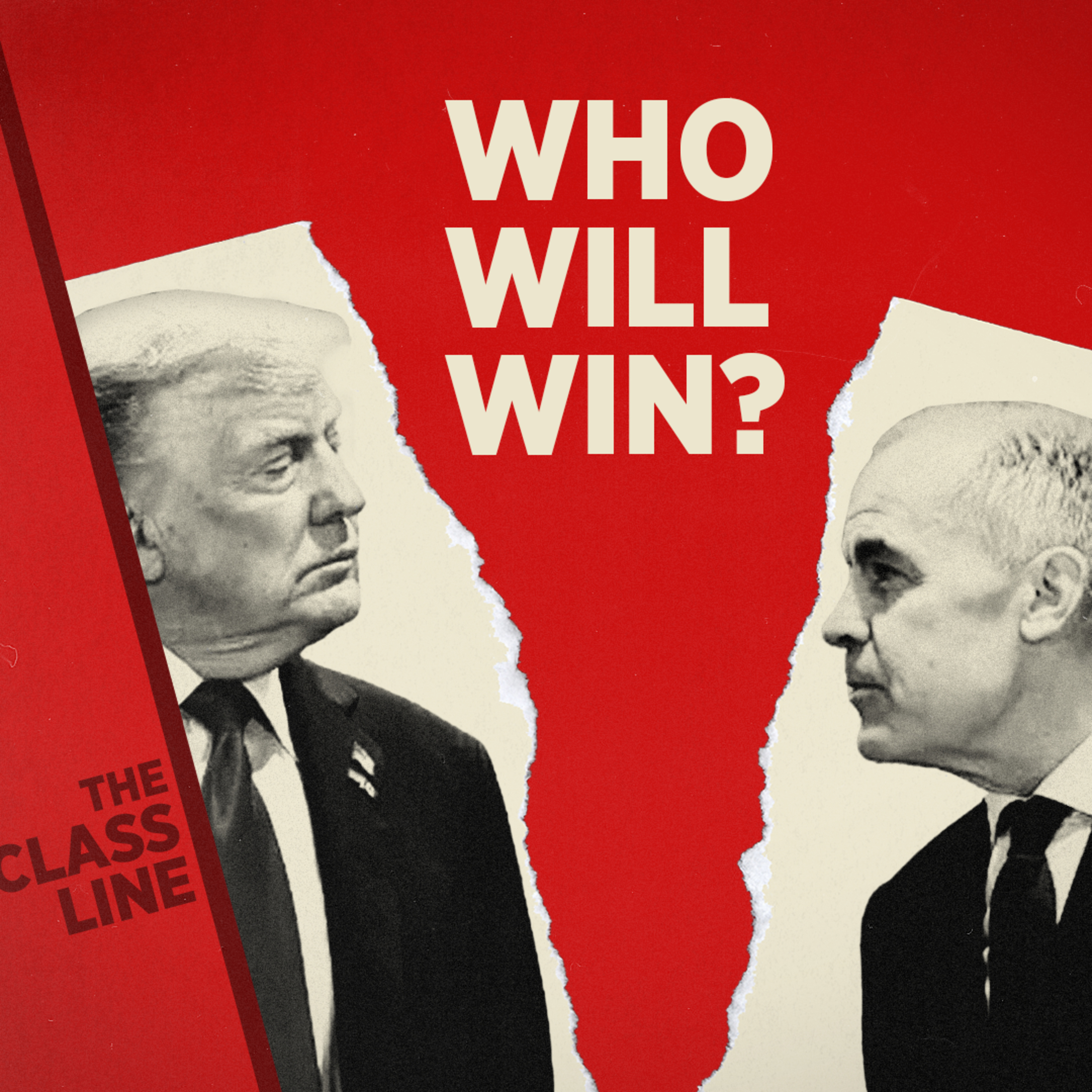
The trade war between the US and Canada has intensified after negotiations broke down, with both sides imposing tariffs on billions of dollars of goods. The US, under Trump, has hardened its demands, seeking to dominate the Americas, secure critical minerals, and eliminate Canadian auto and steel manufacturing, reflecting a broader imperialist strategy amid US decline. Canada, as a junior partner, has made numerous concessions—like increased military spending and repealing taxes—but faced political backlash from provinces and a public opposed to capitulation. Carney's nationalist rhetoric, however, masks that the Canadian ruling class largely aligns with US aims, seeking a seat at the table rather than genuine resistance. Canada's weak economic position, with an economy 12 times smaller and 75% of exports going to the US, makes victory unlikely, and key leverage like oil and potash remains unused due to provincial opposition. The costs will fall on working-class Canadians, who face layoffs and inflation, while banks and corporations profit, exposing the myth of national unity. Communists propose nationalizing threatened industries under workers' control to protect jobs, rather than subsidizing corporations. The situation is set to worsen, with economic decline and political instability looming, potentially sparking greater class consciousness and struggle as the ruling class's promises fail to materialize.
Trade talks between the United States and Canada
have broken down and there is now a full-fledged
trade war with tariffs and counter-tariffs.
Politicians across the political spectrum
are rallying around Karni.
They're saying we're on the same team,
but Mark Karni is not fighting for us.
He's not fighting for working-class Canadians
and working-class people will be made to pay
for this trade war one way or another.
This is the class line.
Well, hello, my name is Joel Bergman.
Welcome back to the class line after about a month break.
We have been very busy.
We had the World School of Communism, which I attended.
Also, I'm here with Marco Lagrata.
He also attended that.
There's a whole bunch of us from Canada there.
We will provide a link.
You can see all of the talks.
This was a fantastic event with 500 people in attendance.
And I think upwards of 10,000 viewing it online,
the biggest communist educational meeting of its type.
So we'll include a link.
You can view the talks online.
But that's part of the reason why we took an extended break.
We are back now.
And yes, like I said, I'm joined by Marco
from the executive committee of the RCP. Welcome, Marco.
And we're going to discuss the trade war.
This is the latest news.
This is the latest political development in Canada.
We're going to discuss that.
Discuss what the communist approach or position
is on this trade war.
So maybe we can just start from the top.
So yeah, they were negotiating last week, down to the wire,
and then at the last minute, the Canadian negotiators
pulled out.
And now the talks have broken down where we have a trade war.
So why did things go awry, I guess?
Yeah, I think maybe walking it back a bit
just to give our viewers some context, I think.
Because we've been in a trade war for over the past year
and a half with the United States.
I think it goes back to early last year.
I think it was February of last year
when Trump first introduced the tariffs
on both Canada and Mexico.
In April of that year, we had the famous liberation day
where Trump introduced tariffs on virtually every country
in the world.
In response to that, most countries
were pressured into signing a deal with Trump.
You signed a deal, Japan signed a deal, South Korea signed
a deal.
UK.
UK.
There's only two countries in the world
that actually retaliated with counter tariffs
to the United States, one of those was China, which some people
would say won that battle and came out on top.
The other was Canada.
Now, what we said at the time is that Canada is not China.
It's a much weaker economy.
It's much more dependent on the United States than China
that this was not the most sensible move
by the Canadian ruling class.
And essentially, at a certain point, they'd
be forced to climb back down to Earth,
make concessions to the United States.
And I think in the past year and a half,
we've been proven right on that point.
That up until now, Carney has been forced
to make a concession after concession to the United States.
I mean, you could go down the list.
They increased military spending, border security.
They repealed the digital service tax on foreign streamers.
They repealed most of the counter tariffs
against the United States.
Most recently, we had the climb down on the Gordi-Hau bridge,
which connects Detroit and Windsor, the Canadian government,
paid for the whole thing.
But now they have to split the revenues with the United States.
So anyway, what we've seen is one concession after the other,
despite all of this elbows up rhetoric.
They went into negotiations a few months ago.
This is in the lead up to the re-negotiation
of the USMCA, which is the free trade agreement
encompassing Canada, the US, and Mexico.
Yeah, the one that replaced NAFTA.
The one that replaced NAFTA.
And in these negotiations, too, by all accounts,
the Canadians were prepared again to make massive concessions.
They were, by all accounts, willing to accept tariffs,
although Lord tariffs on steel, on aluminum, on autos.
There's been a lot of talk from the Canadian side
about how Orwell French wanted to violate
the rights of Francophones in Canada,
and the Francophone media content in Canada.
The one thing I would say about this is that--
and this wasn't featured very heavily in the news cycle--
but a few months ago, the CRTC, which
is the agency that oversees communications in Canada,
they had a 5% tax on foreign streamers.
The purpose of that tax is that it would create a pool of money,
which would then be used to fund the production
of Canadian content, Canadian media,
which includes Francophone media.
That was supposed to go up from 5% to 15%
so they were going to increase the tax.
But then I think it was in July.
They actually-- the government actually
ordered the CRTC to review its increase.
Not only did they stop the increase to that tax,
the government tried to ax the tax altogether.
So in other words, foreign streamers
would be paying no money to produce Canadian content
in the country.
These companies like Netflix, Paramount,
and Disney, whatever. Exactly.
So it's a bit rich now to hear Karni saying, oh, well,
they wanted to-- whatever-- destroy Canadian content,
destroy Francophone content.
Because this was a concession that Karni made just
a few months ago.
I think he made it in the lead up to the Cosmo.
He was trying to-- the Gordie was right.
The Howbridge thing.
This thing, he was trying to say, we'll
give you some concessions on this stuff.
That's right.
And then they just turfed it anyway, exactly.
So it shows they were prepared to concede on this point, too,
despite making a big fuss about it.
But nonetheless, the talks broke down.
I would say they broke down for two main reasons.
Now, we don't have all of the details.
There's been conflicting things said by the US side
versus what the Canadian side is saying.
So we don't have a full picture.
There's been lots of articles written about it.
They all say different things.
But I would say there's two main things here.
One is that the US-- I think we can say--
has hardened its position in relation to Canada.
I think Trump was very pissed off
by the fact that Canada retaliated initially,
that it didn't sign a deal like Britain, like Japan, like the EU.
I think Trump was not happy with that.
They've hardened their position.
By all accounts, the things that the Americans asking for
went well beyond what a typical trade agreement would entail.
These include things like Canada had to maintain its purchase
of the F-35 fighter jet, which is manufactured
by Lockheed Martin, an American company.
The Americans were asking for the right of first refusal
for critical minerals in Canada.
In other words, we get the first opportunity to buy it
before any other country in the world.
There was a request that Canada aligns its tariff policies
with that of the United States.
So if the US puts tariffs on China or on India or in Russia,
then the Canadians would be compelled to essentially do
the same thing to mirror the trade policy of the United States.
And a whole bunch of other things.
They wanted access to the dairy market.
They wanted tariffs on a whole number of industries.
So just a long, long list of demands, which became unpolitable.
This is one side to it.
The other side is the mood in the country
that going into the negotiations.
There was a poll that showed that I think it was 67% of Canadians
who said that they believe there should be counter tariffs
introduced against the United States.
And only 7% of people said that the government should make
concessions as part of these trade agreements.
That what you have right now in the country
is a massive animosity towards the United States,
a massive animosity towards the Trump government in particular.
And essentially it created a situation for Karni
where to accept the deal that was being proposed
by the United States politically--
- It would have been suicide.
- It would have been suicide for him.
It would have been impossible for him.
He spent the past year or more talking up
this whole elbows up rhetoric whipping up
the fires of Canadian nationalism.
And I think he created a situation
where if he had accepted this deal,
that could have been the end of the Karni government
because that whole illusion that he built up
would have essentially fallen back down to Earth.
- He's got a slim majority.
It's very tight.
- Yeah.
And I think you got a taste of this
with the Gordy Howbridge--
- People were upset about that.
- People were upset about that.
And I think it was--
The first time where people realized, okay, maybe this elbows up stuff isn't what he's
making it out to be.
It was such an embarrassing climb down.
And I think that acted as a warning to the Carnegie government.
It's like, can we have to tread very, very carefully here?
Otherwise we're going to be thrown out of power.
So I think it was the combination of these two factors that led to the breakdown in negotiations
and now we've had an intensification, you could say, of the trade war.
That's where we are now.
A couple of things before, so the U.S. decided not to renew the U.S.
MCA, the Kuzma trade deal on July 1st for 16 years, because that was what was on the table.
They were going to renew it to 16 years, or they were going to have to renegotiate it
or every year they would have a renegotiation and whatnot.
So they decided not to do that.
And then just three weeks later, on July 20th, Donald Trump announced a whole bunch of tariffs
on Canada.
So basically, you can see what they're trying to do.
They're trying to squeeze the Canadian Canada basically.
50% tariffs on, it was mostly manufactured goods, $28 billion in Canadian dollars and
Canadian goods.
4% of Canadian exports to America were being tariffed in addition to the other tariffs.
And actually, I'd say one interesting element here, which you may talk a bit about later,
but these are targeted.
The targeted on manufactured, like I said, but also regionally.
So Quebec, the tariffs on Ontario were upwards of 9%, of exports, Quebec 11%, BC 14, Saskatchewan
and Alberta 1%.
So this was before they started negotiating.
And then, in the negotiation, another thing that I think was important is that they said
they had a deal of some sort.
And then what did Mark Kernie do?
He told the premieres to put that US alcohol back on the shelves.
Everybody knew about that.
And then there was all these rumors of some things that you were saying that he was prepared
to make a series of whole bunch of concessions to the Americans.
And so yeah, the mood inside the country was amongst the large sector of the population
was like, no, we don't want that.
That's bad.
Yeah, and he's sticked his whole political career.
I also think the degeneration, like it's not like last year, last year, Donald Trump was
riding high, he was had a certain amount of popularity.
This year, it's like just totally degenerated.
His support has collapsed, inflations up, the Iran War debacle, piss everyone off.
What do you do with Venezuela?
The Epstein scandal has just totally blown up and even caused divisions within the Trump
mega camp.
So I think a lot of the anger towards the Trump government is a lot more palatable, a lot
more intense amongst the population.
So the demand to not give in to this bully pedophile billionaire imperialist asshole
is a lot stronger in the population.
Yeah.
And I would just say, yeah, just to add to that, yeah, I think the provinces also played
a role in why the negotiations broke down.
Yeah.
There was one report, I think it was in the New York Times, which said that Karni had called
Ford shortly after they signed the draft agreement.
Yeah.
And Ford was, was, was, was, was living it.
And he said, you cannot sign this agreement.
Karni asked that they restock U.S. alcohol in places like the LCBO.
At Ford said we're not going to do that.
It was similar comments from people like Wab Kenu.
So I think there's also, and of course, the reason for that is that Ontario was going
to be one of the most affected provinces.
It's the home of Canada's auto industry, a lot of the big steel plants are in Ontario.
So there's huge political costs for Ford in particular, which I think helps explain
why he's taken a more antagonistic approach.
He went on the radio a day after the, the deals broke down, saying, yeah, Ford, sorry,
that Trump can, that can kiss my ass and I've got a big ass, so there's a lot to kiss.
And he since tone that down, it's worth pointing out.
But I think it makes sense why in Ontario in particular, he's taken a more antagonistic
approach.
And that had an effect on, on Karni leaving the negotiations.
Now, if you are a listener to this podcast and you live in Ontario, you must come to
the Toronto School of Communism.
This is an event that's occurring this fall on the weekend of October 17th to 18th.
In Toronto, there's going to be hundreds and hundreds of people from Toronto and all over
Ontario that will be gathering for this educational event to train people in the ideas of
Marxism to build communist activists for the revolutionary struggles to come.
The topics we have that are going to be discussed at this weekend, the Russian Revolution, Socialism,
Utopian Scientific, Marxism versus Stalinism, the German Revolution, lessons from the Arab
Spring and what is to be done.
So yes, I encourage you to register and come to the Toronto School of Communism in October
17th, 18th.
This fall will include the link in the description of the episode.
Yeah, so I think maybe we can get into like, what does Trump want?
Like kind of like more broadly, like, why is this all happening?
I've seen a lot of comments about senseless trade war, pointless.
It's kind of just down to Trump's ego and his narcissism.
Yeah, what do they want and why is this happening?
Well, I think, yeah, it's not madness.
I think actually Trump has been actually remarkably consistent on what he wants and he has
a few things.
One is the domination of the Americas and the retrenchment of American power in the western
hemisphere, which he's laid out time and time again.
And specifically in relation to Canada, they want free access to oil gas, critical minerals.
They don't want auto manufacturing Canada.
They don't want steel and aluminum manufacturing in Canada.
He said time and time again that those are jobs that should be in the United States.
We don't need anything that Canada produces or we need very little that Canada produces
in terms of manufacturing.
And they want to shore up their position on the continent.
There's also a military dynamic to it.
The Arctic is becoming an area of increasing importance geopolitically.
They're quite exposed in the Arctic.
If you compare Canada's military footprint in the Arctic to, for example, a country like
Russia's, there's just no comparison.
And when, yeah, when Trump makes a comment like, you know, Canada doesn't have a military
up there.
There's an element of truth to that.
There's a very weak footprint, there's some radar stations, there's the Canadian rangers,
things like that.
Or using guns from, I think, the Second World War.
But there's an element of truth to the things that he's saying.
From the standpoint of U.S. imperialism, you know, you saw this in Venezuela, right?
They wanted to shore up American position, shore up American control over oil production
in Venezuela.
He's even floated the idea of, oh, well, maybe Venezuela can be the 51st state in Canada.
But it's a similar idea here that, you know, they want to secure American imperialist control
over the continent.
And they don't care whether that means, you know, kicking, you know, countries that were
formerly allies around it.
I think that's the thing that shocks them.
When they do it to a country like Venezuela, Karna has very little to say.
When they start aiming the fire at, you know, Canada or at Europe, suddenly it's, oh,
my God, it's, you know, they lose their minds.
But this is essentially, it all flows from the same thing, you know, the same reason that
motivated Trump to do what he did in Venezuela is the same thing motivating him in this trade
war with, with Canada.
So I think it's not madness.
I think it's, you know, quite logical.
But what's behind this fortress America, you're describing this thing.
He wants to, like, they said it in that national security strategy document last fall, this,
they want to re-assert U.S. dominance in the Western hemisphere.
Sure.
But is that just a crazy idea of Trump?
Why would he want to do that?
And why do they need to re-assert U.S. dominance, you know, aren't they already dominant?
I think this is related to what's going on in the world, you know, I don't know if you
want to speak to them.
Well, I think it's, you know, it's, I think, if you look at the U.S. over the past few
years, it's been one humiliating defeat after another.
He found the proxy war in Ukraine, which essentially Russia has, has won, it's been a massive embarrassment
for the West.
Yeah.
Russia has emerged as a, as a, not just a regional power, but a world power with a, with a,
they trained and equipped military, they've been delta bloody nose in Iran.
Trump went into that thinking it would be an easy win.
He said it will last just a few weeks.
It's now going, I think, what, into its sixth or seventh month with no end in sight.
Yeah.
They're in, so they're going to keep going until they, it
Administration's gone. Yeah, exactly. They're not in a rush. Exactly. And it looks like that will likely be the case
So they're being pushed out of one area after the other
The one area where the US can secure easy wins and really entrenched its position is in its own hemisphere
And in that sense Canada's or Venezuela is a much easier adversary than in Iran in a Russia than a China
So in some ways it's oh Cuba as well. Oh, so they have more economic leverage and they have more economic leverage
So it's an easy win for the United States. It's it's it's its home turf
Yeah, you know Canada you could say is the kind of soft underbelly of the American Empire and the Western Hemisphere
And so they want to secure their position
But I think that oh, there's a lot there's a big hope for people that like even karni said this will
We will use counter-terrorism will support our businesses
Beyond the life of this administration. He said and there's this hope that Trump won't be gone won't like less forever
He'll be gone someone else to be in and we'll go back to normal
And I think people think that with a trade deal and I think this is important as Marxist that we have a broad view of
What's happening that this isn't just one mad president although he is kind of crazy. We have to admit that
He's kind of sporadic and you know, he has his whole art of the deal way negotiates and stuff
And yeah, he has his own narcissistic personality ego
But yeah, he's a product of the situation himself and the situation is such that America
And this is related to the role that Canada has played is the most powerful capitalist country that has ever existed
It's been the unipolar power in the world since the Soviet Union collapsed and
He can it and you know when America rose it couldn't just counter the USSR on its own. It had doing list allies
And Canada was one of those allies and they gave the Canadian ruling class
some
Benefits from that relationship, although generally speaking American imperialism was like very dominant and like controlling everything
And Canada would kind of mostly do what America wanted, you know the Canadian ruling class would but now you have that's not the case
America isn't unchallenged you have Russia as you mentioned, which has been given America bloody nose
And you also have most importantly, I think it's China and I think this actually goes a long way to describe what happened in the trade negotiations is
You know, there's one thing that they asked they said can't sign trade deals with other partners
This is something was in the Kuzma trade deal
That they can't sign a trade deal with a non-market competitor, which is China basically what they think that is
And look if you look at it, why would they do that? I thought America liked free trade
Well America used to like free trade when they were the ones that were winning
But now they've been losing in some regards and China's been stealing trade partners all over South America and even Chinese trade with
Canada has been increasing
Mark Carney went to China signed that trade deal for let allowing 49,000 Chinese electric vehicles in
They're more efficient. They're more cheaply produced than the ones in North America
The North American auto industry is being threatened by the better to be honest the more productive
Chinese one and that was
If you look at it that seems to be the main thing in the trade deal
Was the auto stuff Trump has made it extremely clear. He doesn't want autos to be cars to be our vehicles to be produced in Canada
He wants to move. He says you stole those jobs are gonna bring them back
And so yeah, this is Trump just more clearly represents this desire of American imperialism cannot
Give benefits to their allies anymore. That's why he's not just he's not just fighting against Russia or China or whatever
He's attacking he's he doesn't even understand. He's like oh we given
Canada a free ride, you know, they can't do this same thing with Europe. It seems like
American imperialism as a whole
Trump's the most clear representative it is trying to
resure back to the Americas and reassure dominance and they're not able to give the same benefits the same military protection the same trade
Agreements that they were in the past and they have to try to bring jobs back and have economic security at home
So this is more breaking down into a classic imperialist conflict in a sense where American imperialism is like no
Where you're our competitor?
If you want to if you want to do a deal with us, we need more favorable terms. So I think
Yeah, this helps explain it obviously Trump has his own personality in his own kind of way. He do does these things
but US imperialism does have certain needs in the current situation
Yeah, competition with China auto manufacturing. I think even the critical minerals first
Why why are they doing that? Well because they're in a massive competition with China over critical minerals and this part of the reason why we talked about this
Previously why China essentially won the trade war say Taco Trump always chickens out
He chickens out with China because China had leverage. So they drastically need their own critical minerals
Mining and refining
And if Canada is going to be a part of that they can't be trading with everyone else in trading with China
Yeah, they have to be trading with America if they want to play ball in fortress America
So all those things kind of flow from that same idea
Yeah, they want Canada. They don't want to just destroy everything in Canada. They need Canada
They need Canada for certain things
You know, there's the things that are not tariffed or any oil and gas
Natural resources critical minerals potash. They essentially if you look at it
They want to turn Canada into some sort of resource colony for them. Yeah
Yeah, that's what it looks like they don't they're like why would you produce vehicles up there?
You're not going to allow Chinese vehicles in there. I mean competitor, you know
So yeah, I think that helps kind of explain the big picture of why
Trump's doing that and also why it's unlikely even if Trump's gone even if you get a Democrat in that they will remove
All these tariffs and all of a sudden go back to quote-unquote normal trade relations with Canada
Even Biden didn't do that. He put in place a bunch of things that were damaging to you to Canadian industry
And I think it was Biden who said on a he had visited the Canadian parliament. Oh, yeah, right
And he said well listen our relationship is this you guys dig the stuff up and we build it. Yeah, I was Biden who said that
We we greatly need Canada in terms of the minerals that are needed
Well, you guys
We don't have the minerals to mine. You can mine them. You don't want to produce. I mean
Yeah, turn them into product. We do
I mean and it goes to show what you said is that how American imperialism views Canada
It's not as this, you know, friend and ally. It's, you know
You know, we've said sometimes the relationship between a master and his butler. Yeah, right a junior partner of American imperialism
And the role that Canada serves is you know one part mine and one part military base
Yeah, right and what Trump is saying is, you know accept your role
Yeah, right. We've paid so much for you now accept your role
And yeah, but Trump is you know, it's just an expression of a deeper phenomenon like you said of US imperialism
Trump is just the purest expression. Yeah, of that move. It's actually an expression of weakness
They're declining relatively and they're struggling. They're massively indebted. They're losing these wars all over
I mean you mentioned Ukraine and Iran, but we got Iraq, Afghanistan massive debacles. They spent yeah hundreds of billions of dollars
And what did they get out of that? So yeah, it's a declining empire
And Canada actually has been a part of that empire as a junior partner
And now the empire is no longer able to continue as it was in the past
So I guess the question here is a lot. Does the title of this podcast? Who's going to win this trade war
Can Canada win? I've seen mixed things in the news about that. I've seen some hopeful things from a lot of the Canadian news
Yeah, I don't know you have thoughts on that. I think it's very
Very unlikely that Canada could come out on top of this and again, we have to come back to
The actual facts and figures
You know, we've said this time and again
But at the end of the day it comes back down to geography and it comes back down to math
Canada is a much smaller economy. The US economy is about 12 times the size of the Canadian economy
Something like 75% of Canada's exports go to the United States. So it's heavily reliant
On the United States. Even if you look at yeah this
These these current tariffs and counter tariffs. They're each tariffing about
27 28 billion dollars worth of goods
For Canada that represents something like 1% of its GDP
For the United States. It's something like 0.1% of its GDP
And like one of the things they're counter-tariff in the Canadians is aluminum
Which Canada sends a lot of aluminum to the United States
but there's
Relatively little that goes from the United States to Canada
So these counter tariffs only have a limited effect
They also have the effect of driving up the cost of imports in Canada
So that has knock-on effects on inflation and other things like that
So there's a limit to what they can do
also
The most powerful bargaining chip that they have is not in play and those are things like oil
gas, poultry, and gas.
Potash, Potash is a big one.
It's used as a fertilizer.
Something like 90% of the United States imports
of Potash comes from Canada.
It's only a few countries in the world
that produce it at a large scale.
I think others are countries like Russia and Belarus.
Obviously, there's problems getting it from there.
So, but Daniel Smith and Scott Moe
were the premiers of Albert and Saskatchewan.
Actually, there was an article in the paper today
saying, "Listen, you are not going to touch oil.
You're not going to touch Potash.
They've floated the idea of an export tax.
Doug Ford has talked about this.
People like a Nahid Nenshi in Alberta.
- There's an unholy alliance around this.
Even Avi Lewis supports that.
- Avi Lewis is supporting an export tax.
- Jason Kenney, Rachel Nelley, Nahid Nenshi.
Left the right everyone coming together
and Daniel Smith's got more like resisting it.
- Yeah, and they're the ones
who ultimately have to make the decision
and they've been categorically opposed
to it from the beginning.
And actually, I would say,
well, the argument that Smith has said is that,
well, listen, if we cut off oil to the United States
or if we cut off Potash,
the thing we need to understand is that
a lot of the oil that goes to Eastern Canada
does not transit through Canada,
but transit through pipelines
go through the United States into the Eastern Canada.
She said, "Well, listen, if we cut off the oil,
"they can also cut off the oil going to the East."
- Yeah.
- She also made the point, which I actually didn't know about,
but the US has strategic oil reserves.
Canada does not.
So in a situation where the flow of oil is cut off,
Canada would actually or Eastern Canada
would be in a much more desperate position
than the United States would be.
And she's right in making that point.
Obviously, she has her own narrow interests in mind here.
But she has a point when she says
that there are real consequences that would flow
from putting something like an export tax on oil,
on Potash, just a case in point,
Doug Ford, who's taken a very antagonistic approach,
and he's been, I think, the loudest proponent
of things like an export tax.
Early on in the trade war,
he introduced a surcharge on electricity exports
from Ontario into the United States.
And he backed off within 24 hours,
because of the response from the United States.
So it shows that it's easy to come out,
with all this bluster, and we're gonna do this,
and we're gonna go to war,
actually putting that into practice
when you're a small economy.
This is an entirely different thing.
- Well, it's easy for him to say that
Alberta and Saskatchewan should do something.
- Yeah, of course.
- It's not gonna have any impact on him,
and he can look tough,
but then they're like, no, damn way, we're doing that.
And he has more to lose than Alberta or Saskatchewan.
- Yeah, exactly.
- So you can see Trump's trying to play
the provinces off against each other,
which is related to the provincial makeup of Canada.
It's very divided and kind of weak, therefore.
We've talked about that in the past.
We did a podcast on Alberta separatism for example,
and why the force is driving that.
That's another topic.
But yeah, on the topic of Canada win,
a couple days ago, or was he yesterday,
or the day before, the White House put out a statement
from Trump, it was titled, "President Trump
is finally ending Canada's free ride."
And it says some of these points,
which some of it's kind of nonsense,
but there are some facts in there that are just true.
It said, "Without the United States,
Canada could not survive.
Canada sends roughly three quarters of all goods
to export to America,
and the US market is where Canada gets
overwhelmed in the majority of money and economic oxygen."
Then it goes on, "US economy is approximately 13 times
larger than Canadian economy, and home to over eight times as many people."
You know, the United States is clear, leverage.
And Donald Trump has said this immediately after he's like,
"You think you're going to win a war against Donald Trump?
You're no way, you know, not going to happen."
So they kind of see it in very stark terms.
We're big, we're powerful.
You rely on us.
What are you doing?
Don't go to wars.
You can see kind of Mark Carney stuck
between a rock and a hard place here.
So yeah, very unlikely that they'll win.
Also, because they're not using their main leverage as you said.
And they can't.
And they can't.
So, and the effects on Canada
are going to be far worse than the effects in America.
There's another thing they said, it's actually true
that the OECD predicts that the Canadian economy
will react last 38th out of 38 in terms of economic growth
in the coming period.
They're already quite low.
There's been a problem of labor productivity.
There's the Canadian economy has massive problems.
So this is the absolute last thing
that the Canadian ruling class, the Canadian economy, needs.
So yeah, I think there's a lot of wishful thinking.
We can win for United.
Mark Carney said this stuff about small acts of solidarity,
like not buying an American product,
but buying a Canadian one.
I'm like, that's not going to win the trade war.
No.
I think that's a bunch of political opportunism, yeah.
And I think to use past history, because you also had
was it in 2018 or 2019, there was a trade war at that time
as well, when Trudeau was in power, Christie of Freeland,
they had steel or the tariffs on steel and aluminum.
Canada introduced counter tariffs.
But then the end result of that was the signing
of the USMCA, which replaced the NAFTA trade deal,
which led to massive concessions being
made to the United States.
The US raised the level of required content,
a US content in cars.
That was also how you mentioned it already,
but the requirement that Canada and Mexico
do not sign trade agreements was non-market in countries,
meaning China.
So the outcome of that trade war was not a win for Canada.
It was a win for the United States.
Yeah, they personally opened up the supply management.
The part to allow US Darien.
Exactly.
So what we have now is Trump 2.0.
It was far worse since they've taken a hardened position.
And you're going to see a similar result.
I would say something even more humiliating
than what Canada signed with the USMCA with Kuzma,
whatever you call it.
So yeah, it would be very, very difficult for them to win.
The September issue of communist revolution
is hot off the press, and you must get your copy.
This issue is focused on the question of should Canada
go communist?
Instead of just criticizing capitalism,
which everyone knows is a nightmare,
we lay out concretely what would be possible under communism
from housing to jobs to oil and gas to you name it.
This issue goes through all of the basic fundamentals
of the Canadian economy and life.
And what would be possible if we overthrew the capitalist system?
So get your copy of communist revolution.
This issue also contains an article on the trade war,
which you can read, which we've talked about here,
but you can read about in the paper.
So yes, get your copy of communist revolution.
Become a subscriber.
You can go to Marxist.ca/Subscribe and help us
spread the word of communist revolution.
I think everyone's a bit shocked.
You know, I think there was a bit of hope
that there was going to be a trade deal,
but then people were concerned
'cause they thought Carney's given more concessions.
But now we have no deal.
And they're a trade war, right?
So it's going to be, it could be a tit for tat trade war
with tens or hundreds of thousands of jobs on the line.
But yeah, one question before we get into that
and what do we do about it?
Is I think this, I think a lot of people,
I've seen a lot of people on the left
almost celebrating Carney talking,
"Well, I don't normally agree with them,
but I totally agree with them here.
This is very good, very good."
And people almost act acting like he's, you know,
with all these threats from America,
which is sort of like we're going to,
people think, "Oh, they're trying to make us a colony.
We need to be united and fight back."
And look at Mark Carney, he's some sort of anti-imperialist.
What do we think about that, is that true?
- Yeah, just on that point 'cause there was actually,
it's not even just the left, but the bourgeois are now
making these arguments, they've become, you know,
essentially, you know, proponents of multi-polarity theory.
There was an article in The Globe the other day,
which was it's called, whether it's Iran or Canada
for Trump, the result is the same.
- Okay.
- And it actually-- - So Canada's Iran, okay.
- Yeah, it essentially tries to compare Canada
to what Iran's been doing to the U.S.
in the straight-of-form was just to read a quote
'cause the whole article's pretty funny, to be honest.
But it says, "Primonister Mark Carney
was no more willing to conform to the American president's demands
than was Iranian supreme leader Mojtaba Kamini,
both refused to fall in line."
Clearly, the expectation of the White House,
the way members of the Republican Party have.
And then anywhere, there's this other interesting quotes.
But essentially, what it's saying is that, yeah.
Canada is like Iran.
I saw other articles comparing Canada to China.
But I would say, yeah, this is a completely faulty comparison
for a few reasons.
One is that on a very basic level, countries like Iran,
China, Russia actually have the ability to score a victory
against the United States.
China has, you know, it's an economic superpower.
Russia has a very powerful military.
It's a military superpower.
Iran has the straight-of-form was.
Canada has none of these things.
It's in a much weaker position than any of these other countries.
So that's the first point that they can actually
beat the United States in any meaningful way.
The other point is that Canada for almost this entire history.
has been a loyal lapdog of the United States.
It's been, you know, we've described it as a junior partner
of American imperialism.
They've gone along with almost every coup d'état,
almost every war that's been carried out
by the United States.
They were mum when Trump kidnapped Maduro in Venezuela.
They were mum on the question of the war with Iran.
They were supporting the United States all throughout this.
They've-- -Cuba, yeah, same thing. -Cuba, that's not a thing.
The fact is that this is not a rising anti-imperialist force
which is going to deal this significant, you know,
crushing blow to the United States.
This is a junior partner who essentially wants a seat
at the table in this situation.
It wants, you know, a sphere to itself
in this whole fortress North America.
Actually, just on this point,
'cause there was an article in The New York Times
which was kind of an in-depth look
on how the negotiations broke down.
But it explains the position of the Canadian negotiators
going into the talks.
And it makes the position very clear.
It says Canadian negotiators had gone into the talks
suggesting the ultimate goal should be to create
a quote fortress North America, as they called it,
with ultra-lower non-existent tariffs inside its walls,
namely between Canada and the United States
and a line tariff for outsiders.
So what they're saying here is, you know,
far from wanting to stand up to the United States.
No, no, they want to be working with the United States.
They just want a bigger share of the pie
than Trump is proposing to give to them.
This is what this is about.
It's, you know, if you want, it's a falling out between thieves.
Except one thief is like the big mafia Don
and one is like a little petty criminal that he employs.
So there's really no comparison with a country like Iran
or Russia or China.
These are two entirely different things, I would say.
- Yeah, I think that sums it up right there.
The Canadian ruling class is not.
I think they oppose, it is true that the Canadian government
and the large sector of the Canadian ruling class
opposes what Trump is doing, but not,
they oppose it when it's directed against them.
They don't oppose it in general.
So it's important.
And they don't necessarily also another point.
They don't disagree with a lot of his general program.
They don't disagree with that.
They don't disagree necessarily
that the main enemy is China.
They don't disagree with a lot of what he does
in the world as you said.
They also don't disagree with domestic policy.
You know, they had the whole doge thing,
but what's Karni been doing?
They're doing also laying off public sector workers,
privatizations, cutting all sorts of programs,
cutting environmental regulation, state financing
for all sorts of oil pipelines
and critical mineral projects and things like this,
government handouts to big business.
They're fine with this, they're doing it.
And actually, I think there are a lot of things
that the Canadian ruling class has wanted to do,
but politically could not do.
And now, the threat of Trump, they're like,
yes, never let a good crisis go to waste.
We can use the crisis.
Well, we have to privatize the airports
and we have to redo the labor code
and stop a whole bunch of workers
from being able to strike because it's a crisis.
So essentially, we have to implement Trump's program
in Canada, some very similar program because of Trump.
It's a very funny argument.
So I think they're not opposing him essentially.
They're opposing him in some senses
because like you said, they want to see it at the table,
they don't want to be on the menu.
As Karni said, they want to be,
they'd continue to be the junior partner
with a bigger piece of the pie.
But yeah, they do agree with a lot of his main thrust
of his program.
And actually even Vance acknowledges this.
Yeah, yeah, yeah.
What's this?
There was this leaked interview or a speech of Vance
where he said the whole point of this
is to change Canada's behavior.
And then he says they've certainly shifted
in a Trumpian direction.
What does that tell you?
Part of the point of the trade war
has been to shift Canada's behavior
on a whole bunch of things you already mentioned
at military spending, border security,
environmental trade, the relationship
with the labor unions, taxes, other things like this.
So yeah, I think that's very clear.
Now, maybe this flows directly
into this other point that I think we can end on here is,
yeah, they said at the top,
there was all this, every time Trump says anything,
there's all this stuff about how we're all in it together,
we're all on the same team.
We all need to be united.
What do we think about that?
Are we all in this together?
Not at all.
And I think there's two Canada's if you look at the country
because on the one hand, you've got layoffs
and manufacturing, unemployment, particularly youth
unemployment.
You've got an increase in the number of Canadians
using things like food banks.
In other words, working people are suffering.
Partly as a result of the trade war.
But it's a very different picture on Bay Street.
It's a very different picture in the offices
of the oil companies in Calgary.
They've been making off like bandits, right?
They've actually been making increased profits.
There was the windfall from the war in Iran,
which has led to a massive increase in profits
for the oil executives.
There was a report the other day,
and I think it was yesterday's global mail.
And it was interviews with all of the CEOs
of the big banks.
And they were, you know, they said they were shrugging off
the Canada U.S. trade war.
They don't care.
They don't affect them.
Yeah, their profits have been doing better than ever.
And I'd also add, a lot of their investments
are also in the United States, these banks.
Actually, I read an analysis of the Canadian banks
over the past year have made, I think it's over 60% increase
in profits, which is insane, insane, 60% return.
And I was trying to figure out why?
And yes, it is partially because they have a lot of investment
in the U.S. and things like AI and all these things.
But then it's also because when there's a trade war,
banks actually end up making a lot of money
because there's big shifts in money.
People pulling money out of one thing
and putting it into the other
and the banks make a little cut.
And so they make, when there's a lot of money changing hands,
they make 'cause they're parasites.
The banks are parasites.
The big Canadian banks are particularly parasitical.
They make a lot of money.
And they make a lot of money at our expense.
Interest rate payments, mortgage payments,
credit cards, all this stuff.
So, yeah, that's one.
There's actually this, so yeah,
we're not all in this together.
This is kind of vacuous statements.
I know the president of the CLC,
the Canadian labor congress came up with a statement
that says, "This is the moment to stand together.
"Governments, workers, unions, businesses,
"and communities, nice, big, happy family,
"to defend Canadian jobs
"and build a stronger, more independent economy.
"This is a appeal for what we describe as a popular front.
"It's a unity of the bourgeois and the proletariat.
"The main union is arguing that.
"We think this is Marxism 101.
"Nothing good will come of that.
"You're disarming the workers
"from the threat of their main enemy,
"which is, everyone hates Trump, of course.
"And workers don't like Trump for good reason,
"but they have an enemy at home,
"which is the Canadian ruling class,
"which is not the friend of the Canadian worker."
So yeah, I think, yeah, that's clear.
So Abby Lewis, initially, the new leader of the NDP,
we've done a podcast, a couple of podcasts about this,
who's calls himself a socialist, he's criticized capitalism.
He's definitely a step to the left
in the leadership of the NDP.
His initial statement was pretty not that different
than what Karni was saying,
a little bit somewhat disagreeing saying at the end,
we need to do strength in Canadian sovereignty
through investment in social services
and sustainable energy.
But subsequently, he's now, and he said,
yeah, we need to be united, we're all united, you know?
And then, you know, subsequently he went on democracy now,
which are left wing news in the US,
and he said this, he said, he said,
we're not all on this together.
And he said, some things that are true.
And so, you know, credit or credits, do he said?
You know, there are corporate players
who will make out fine, but it is the working class people
of our continent who are going to be hurt.
We are not all in this together
when the six big Canadian banks made $70 billion last year.
They are not directly affected by tariffs,
and they continue to make higher and higher profits
every single year.
We are not all in this together
when the oil and gas sector in Canada,
which is majority owned by US corporations,
made on track to make up to $150 billion
in wartime profits this year alone,
because of the immoral, senseless, illegal attack
on around by the United States and Israel.
- That's all true, yeah.
That's all true stuff.
We can get in a little bit more to what Lewis says.
But yeah, I guess connected to what I said before,
no, there's a clear difference.
Working class people would be made to suffer.
Corporations are fine mostly, the big ones.
anyway. And the Carnegie government is implementing a Trump type program internally. So I'm not sure,
you know, advance is admitting that they're forcing them in that direction. So we're not all in this
together. And I think it's very important that we point this out because it's the most dangerous
thing is this national unity that the Canadian ruling class has been constant. And Carnegie is the
captain of that, fomenting, you know. But what end of the day, what that
means is you need to lower your guard as we defend corporate interest, basically. But yeah, I guess
this is all true that we're not all in this together. So then what are we supposed to do about
this? I guess you move on to like what is to be done about the trade war? Do we just complain
about it and say, oh well, we're not going to be united with you. Everything sucks. What do
communists propose to do, I guess? Or maybe we start with what is Carney doing? What are the
governments doing in response to the trade war? Well, I would say yeah, because what they're doing,
like this question of counter tariffs, this question of loans to businesses and so on,
which pretty much the whole spectrum from the trade union leaders to liberal politicians,
to conservative politicians, NDP, they pretty much all support this whole idea of, yeah, we need to
provide subsidies to these corporations. We need to provide loans to these corporations. Otherwise,
there's going to be mass layoffs. But we've seen this story before, right? We saw it in COVID,
where you had big companies that took massive loans, massive subsidies, you had the wage subsidy
program. And in many cases, they just pocketed that money, right? While laying off workers,
they gave themselves huge bonuses. And what we say now is similar to what we said then,
is that we do not trust these big companies who have never been the friends of the Canadian worker
to use this money to actually help retain jobs, help increase pay. But pretty much the whole
political class and the trade union leadership have been advocating this approach. We disagree,
we think it's inefficient, we think it's wasteful. It doesn't help workers so much as it helps
the executives, so much as it helps the shareholders. What we've said consistently is that obviously,
first of all, yeah, the trade war is a threat to Canadian workers. There have been layoffs,
particularly in steel, particularly in auto manufacturing. That's a very real and legitimate
concern. So yeah, a worker in this industry has every right to be upset at Trump, you know, anxious
about what this trade war will mean for their job. But what we say is that loans and subsidies
are not the way to protect those jobs. What we say is that if any company threatens to layoff workers
shut down production, it should be taken over, nationalized, placed under the control of those
workers. And then if necessary, retooled so that it's, you know, for example, steel.
Steel is used in many things, right? It's used in many infrastructure projects.
What we say is, okay, we'll take over companies like Acceler, Metal, companies like Stelco,
companies like Algoma, most of which by the way are not even majority Canadian owned.
It's not that it would make a fundamental difference, but they're not even majority Canadian owned.
Take them into public hands, put them into Canadian hands, under workers control,
and then we'll use, we'll retool if necessary, and use those products for actual things that
are necessary for Canadians, that are necessary for Canadian workers. That's the only way,
and yeah, it's a more serious measure, but I would argue it's the only measure that can actually
work. Otherwise, we're just continuing to drip feed money to these corporations with no guarantees
whatsoever that those jobs will remain. Another thing about the subsidies, the corporate subsidies
is where is the money going to come from? The government's already ramping up the debt at basically
carnies deficit is higher than anything in history of Canada outside of COVID. So the more is the
money going to come? It's got to come from somewhere. Guaranteed, they're not going to say, oh,
because we have to support businesses because of the trade where we're not going to fund that,
we're not going to buy that pipeline, or we're not going to spend all that money on military
spending. They're not going to say that. They're going to say, now we don't have money,
we have to cut healthcare and education, we have to lay off more public sector employees.
So one way or another, they're trying to frame it as we're not going to let any worker get laid
off or hurt by this, but workers are going to get laid off and hurt one way or another.
Then the other thing is, Mark Carney said, we're going to keep these supports for the foreseeable
future for whenever. He didn't put a limit on it, but they can't continue to prop up the private
sector forever. They've been propping up the private sector in one way, shape, or form, since
2008 and beyond massive corporate welfare schemes. This is just, you had the massive corporate
welfare in COVID, like you said, and now you have more of this. They can't keep doing that forever.
So yeah, that won't work, that won't last forever. I think there's already this thing where
42% of companies said they've even started to move or they're considering to move to the US.
I think because of this trade war, this will just increase, and they can do that if they want.
That's capitalism. They have control over their industries. We do not control the economy.
It is in the hands of these private millionaires and billionaire companies. A lot of which, as you
mentioned, are actually American. So yeah, I think this is it. This trade war is going to be bad.
There's projections of 90,000 or more jobs lost. You already had d'installant to say they're
closing down, brampton plant, or they're moving towards doing that. That was even before this.
And then the counter tariffs, the counter tariffs don't really, I can see a lot of people
rally around that. We need to do counter tariffs because they're terrifing us. What do you think
about that? It just makes everything worse. It's the increased costs. We make more inflation.
Doesn't protect any job in and of itself. So yeah, we say the labor movement instead of
joining hands with the business community and trying to argue for the government to shower them
with money and put counter tariffs in place should work on protecting fur and protecting jobs
and protecting workers and their benefits. So that means any factory being shut down,
occupy it. The workers organize an occupation, demand it be nationalized. That would be the
socialist response to this. And I haven't seen anyone say that. No, I haven't seen Abby Lewis say it.
I haven't seen anyone. Abby Lewis actually said we need emergency assistance for the sectors that
are worst hit by this. Again, manufacturing, wood products, apparel and furniture and others.
So he's completely if you look at it, he's it's very difficult to see where exactly he disagrees
with Karnion. I guess there's certain things internally, but he's very focused on showing how he
agrees with a lot of the main things. But that's because if you support the private ownership
of the means of production, if you support capitalism, do you have to support this? Yeah,
there's no other way. And what he's saying, what it means in plain languages, we need to subsidize
foreign multinationals and American owned companies in Canada. And trust that they'll do
right by their workers. That's what it amounts to. When you strip all of this beautiful language away,
they want to subsidize foreign and American owned companies. That is not what's going to work.
Yeah, of course. Demonstrably, it's been proven false. I think that's most of the stuff we wanted to
talk today. Talk about today. I don't know if you have anything else you want to add. That's the
trade war. I guess just to say that we're just at the beginning of this process in that there's
a fighting mood right now. There's been very defiant words uttered by Doug Ford by Mark Carney.
Yeah. But again, we keep coming back to this point that Canada cannot extricate itself from the
American market. Geography and math, they're real things which have real consequences. And I think
it would only be a matter of time before there's some kind of climb down. And when that climb down
eventually happens, whenever it happens, this is going to have major economic and political consequences
inside of the country. One thing I'll say is that politically this has been very good for Carney.
That's it. And Ford as well. They've been able to present themselves as Canadian patriots,
you know, Captain Canuck. Canada is not for sale. So it's very good
for them politically. But the problem with making all of these beautiful promises about how Canada's
this great country that's going to stand up to the United States is that if you don't deliver
on those grand promises, you know, what do they say? The bigger they are, the harder they fall.
And I think a big, big collapse is being prepared, both economically and politically.
Right now, I think it's being papered over by this wave of Canadian nationalism. But that will change.
That will, the US has locked and loaded. I think the US is not going to change course
in any significant way. They know what they want. You know, you've read the White House,
statement. They know that they have the leverage. Yeah. This is not going to change in any significant way.
And big explosions are coming in Canada. A big change in consciousness is coming in Canada.
And that's ultimately what we're preparing for as communism. Yeah. And so the nationalism that we see,
that Karni has really fomented. And it's pretty much just so easy. Anytime Trump says anything about
Canada, like they said, they want to rename Lake Ontario to Lake America. The picture that they
posted with that statement on social media was a bold eagle attacking Canada goose. So obviously,
this thing's shocked the mind and shocked Canadians. So it's very easy for Karni and other politicians
to say we all get a rally behind that can only go so far. That can only go so far if the Canadian
economy is inevitably going down to have a worse and worse. There's less good jobs. There's
increased inflation. The housing market's not fixed. That's where he promised to fix. He hasn't
really taken hardly any steps in that direction. Hadn't really done anything. He's bailing out condo
developers. There's, yeah, the military spending. There's no money. He's cutting social services.
This can only go on for so long. Before that unity, people start to realize, wait a minute. We're
not on everything we said here. We're not on the same team that people start to see the fall
through the fog of it. I think they were starting to this year. The polls certainly showed a little
bit of a shift. And now it's cut across by the trade war, of course. But look, we got to think
long term here. We can't be just, we're not like one of these politicians who's just thinking about
their political career for a year or two and do an opportunistic stance in any given moment.
But yeah, it's communist. We got to think of, we got to have foresight over the process that's happening.
Yeah, Mark Carney has no solution to the crisis facing working class people. And it's not going to
go be easy. And therefore this, and I think every single year, this is little actually. If you
look at it, what we said, the tariffs, they're significant, but they are not like, he's not
harrassing 50% of all things coming from Canada. It's a fairly small amount. Like you said, it's
1% of Canadian GDP is going to have an effect. But I think there'll be more every year. There'll be
more. We should be prepared for that. And they'll try to use the Canadian nationalism to rally workers
behind the ruling class, while the ruling class attacks those very workers. They'll be strikes.
They'll be demos of workers just can't take it anymore. They need to fight for their better wages,
pensions. They'll be fight against privatization or attacks on the right to strike. And yeah,
that's really what's coming our way. So this doesn't really change anything about the general
perspective, capitalism's in crisis. The bourgeoisie have no solutions to this. And working class people
are going to need to fight back. And the people they fight back against are actually not in America.
They're here. Well, they might be American companies in Canada. But also Canadian companies
that will always try to make the workers shoulder the burden for any of the negative effects
from this crisis as they have done. And so, yeah, this is what we're here to explain
on this podcast. And I guess that's it. That's more or less the, we've run the whole gamut of that.
So yeah, if you like this podcast, appeal to you to get involved with a revolutionary
communist party. The class line is a podcast put on by the revolutionary communist party.
Please help us spread this podcast for and wide. Please like and subscribe. You can rate the
podcast on Spotify. And yeah, leave comments or questions. You can DM us at class line pod on
Instagram or leave a comment on the YouTube or the Spotify. That's all for the show today.
My name is Joel Bergman. I've been joined by Marco Lagrada. This is the class line.
Podcast Summary
Key Points:
Trade talks between the US and Canada have collapsed, escalating into a full trade war with tariffs and counter-tariffs.
Canada's ruling class, led by Prime Minister Mark Carney, has made repeated concessions to the US but faced political pressure from provinces and public opinion.
The US aims to dominate the Western hemisphere, secure resources like critical minerals, and reduce Canadian manufacturing, reflecting a broader imperialist strategy.
Canada is in a weak position due to its smaller economy, heavy reliance on US exports, and inability to use key leverage like oil or potash.
Carney's "elbows up" nationalism is seen as a facade, as the Canadian ruling class largely agrees with US policies and seeks a junior partnership role.
Working-class Canadians will bear the brunt of the trade war, while banks and corporations profit, undermining claims of national unity.
Communists advocate for nationalizing threatened industries under workers' control, rather than corporate subsidies, as the only real solution.
The trade war is expected to worsen, leading to economic decline, political fallout, and potential for increased class struggle.
Summary:
The trade war between the US and Canada has intensified after negotiations broke down, with both sides imposing tariffs on billions of dollars of goods. The US, under Trump, has hardened its demands, seeking to dominate the Americas, secure critical minerals, and eliminate Canadian auto and steel manufacturing, reflecting a broader imperialist strategy amid US decline. Canada, as a junior partner, has made numerous concessions—like increased military spending and repealing taxes—but faced political backlash from provinces and a public opposed to capitulation.
Carney's nationalist rhetoric, however, masks that the Canadian ruling class largely aligns with US aims, seeking a seat at the table rather than genuine resistance. Canada's weak economic position, with an economy 12 times smaller and 75% of exports going to the US, makes victory unlikely, and key leverage like oil and potash remains unused due to provincial opposition. The costs will fall on working-class Canadians, who face layoffs and inflation, while banks and corporations profit, exposing the myth of national unity.
Communists propose nationalizing threatened industries under workers' control to protect jobs, rather than subsidizing corporations. The situation is set to worsen, with economic decline and political instability looming, potentially sparking greater class consciousness and struggle as the ruling class's promises fail to materialize.
FAQs
The talks collapsed due to two main factors: the US hardened its position with demands far beyond typical trade agreements, and Canadian domestic politics made it politically impossible for Mark Carney to accept the deal, as 67% of Canadians supported counter-tariffs and provincial premiers opposed the terms.
The US demanded Canada maintain F-35 fighter jet purchases, give the US right of first refusal on critical minerals, align its tariff policies with the US, and provide access to Canada's dairy market, among other far-reaching concessions.
Ontario Premier Doug Ford opposed any deal that would devastate the province's auto and steel industries, and he refused to restock US alcohol in the LCBO after Carney requested it, contributing to the collapse of negotiations.
Canada's economy is 12 times smaller than the US, it relies on the US for 75% of its exports, and its most powerful leverage—oil, gas, and potash—is off the table due to provincial opposition and strategic vulnerabilities, making a victory highly unlikely.
Canadian negotiators proposed creating a 'fortress North America' with ultra-low tariffs between Canada and the US and high tariffs for outsiders, showing they wanted a seat at the table in US-led trade bloc rather than true independence.
Communists argue that corporate subsidies and counter-tariffs only line the pockets of executives and shareholders while failing to protect jobs, and they advocate instead for nationalizing threatened industries under workers' control to truly safeguard workers' interests.
Chat with AI
Loading...
Pro features
Go deeper with this episode
Unlock creator-grade tools that turn any transcript into show notes and subtitle files.
 PodcastTranscript AI