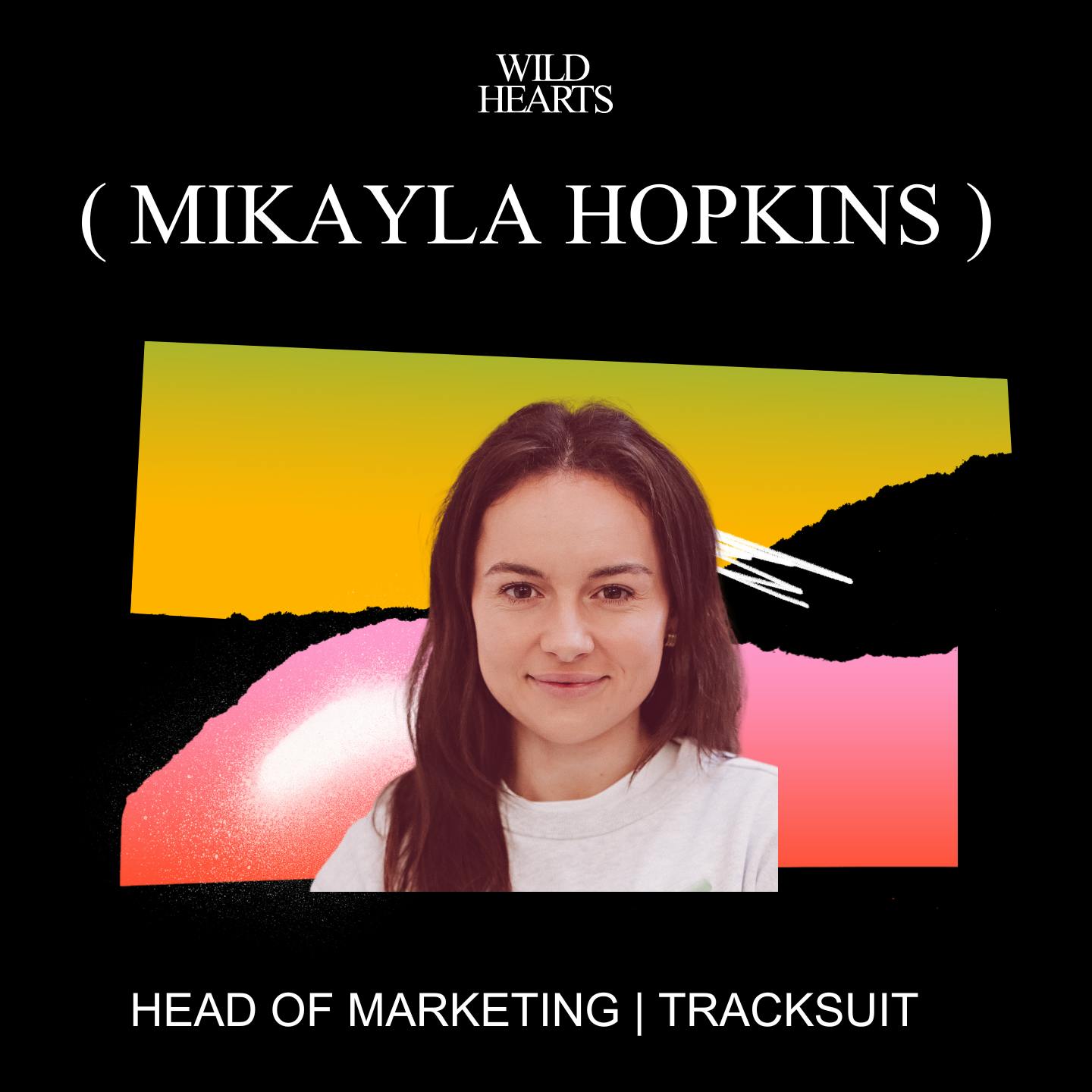
Tracksuit’s Head of Marketing, Mikayla Hopkins on Building a High-Performing Marketing Team and Scaling with Growth
52m 25s
In the transcribed conversation, Michaela Hopkins shares her views on hiring individuals who challenge and inspire, emphasizing the importance of hiring those who are smarter and capable of driving growth. The discussion also delves into marketing strategies and branding at Tracksuit, highlighting the significance of understanding customer problems to develop impactful solutions. Michaela discusses the company's global expansion goals and the challenges faced in scaling internationally, such as staying relevant and building credibility quickly in new markets. Additionally, insights are shared on adapting marketing strategies for different regions, like the US, and the importance of tailoring product offerings and enabling sales teams accordingly. Michaela's journey at Tracksuit showcases the role of customer-centric approaches and innovative marketing tactics in driving business growth and success.
Transcription
10254 Words, 56426 Characters
(upbeat music)
- Sometimes a good hire shouldn't be easy.
My view in the last few years
is I'm only gonna hire somebody
that does freak me out a little bit.
(laughing)
And I'm like a little bit scared on
because I want them to challenge me
and I want them to challenge the team
and like all of my best hires
are people who are genuinely so much smarter than me.
And they're just, yeah, incredible.
Like I am in awe of them every single day.
And if you're not in awe of your team,
you've hired the wrong people.
Welcome back to our Wildtard Operator Series.
This series is dedicated to surfacing the lessons
from verified world-class operators.
The Australians and New Zealanders
are the forefront of building generational companies.
From product to marketing to manufacturing to engineering,
each of these conversations is a masterclass
in how someone at the top of the game gets it done.
In this episode,
we learn about Michaela Hopkins rise
from the first individual contributing marketing hire
to leading the marketing team of the company
whose sole focus is about empowering brand ambassadors
to have a seat at the boardroom table.
Truck suit is one of the Kiwi startup darlings
who is growing at wild paces globally.
And so in today's episode,
we cover everything from truck suits marketing philosophy
what makes a great marketing team,
the metrics that Michaela tracks as the head of marketing,
the principles and tools the team leans on every day
and how the heck Michaela reinvented herself
to grow at the same rate of the company.
If you enjoyed this episode
and want to listen to the other gems
we've got planned for this season,
we'd be so grateful if you'd subscribe.
It'll also help other wild hearts find the podcast too.
And finally, if you're a founder right at the beginning
booking for investment or just have any questions
my LinkedIn DMs are waiting for you to say hi.
And with that, let's say hi to Michaela.
Well, we have a lot to get through.
I want to start at the highest of levels
and ask you what is marketing a truck suit?
- Great question to kick us off with.
The marketing at tracks suit is everything for us.
If we just put marketing and brand into the same view
it is how people think and hear about you.
And it's how people talk about you
when you're not in the room.
So for us, we want to make sure that we are eliciting
a specific feeling at every single touch point
across the user journey.
And for us, that's joy.
Like we feel brand building is one of the most creative
fun parts of building businesses
and building great businesses for the long term.
And we want to do that in a way that our market
is out inside professionals and our entire audience
connect with other deep people.
And so for us, it's showing up in a way
that it's different, differentiated
and gives people that feeling of joy
so that they know that what they're doing
is actually driving impact.
But that's a whole lot of fun at the same time.
- Damn, it sounds deep.
I love it.
- Oh, deep.
I'm a deep person.
I'm gonna get a bunch for that in this conversation.
- That kind of sets us up well,
just to understand the difference
between marketing for B2B and marketing for B2C.
I know that your prior role was consumer facing.
And how does that differ across the two?
- Another great question.
I never had any desire to work in a B2B SaaS company.
In my mind, it's dodgy, it's boring.
They don't prioritize brand
and it's just not a sexy thing to be a part of.
And so with that view,
I wouldn't have been in this seat.
But then I thought about it
and I was like, at the end of the day,
it's still humans buying product or service.
Buying decisions are made with emotion every single time.
It doesn't matter if it's a B2B product
or a B2C product.
And so my thinking there is like,
why wouldn't we just apply the exact same view
that we have on brand in a B2C setting
into a B2B setting?
And like, I think the proof's in the pudding, right?
Like, we are B2B SaaS,
but we walk and talk with the consumer brands
because we want to be different
and we want our buyers to be able to connect with us in a way
that isn't being done out of market.
So if there's any marketer listening
who's trying to weigh up that conversation,
apply the same framework.
We always come back to that term,
coin future demand,
and that is that 95% of your buyers are not in market,
they're ready to buy just yet.
And the goal for the marketer is to build up that familiarity
and emotional positivity in the long run
so that when they do come in market,
they gravitate and connect
towards your product or your service.
The same thing.
You can apply that on B2C,
you apply it to B2B, same, same.
- You said the word dodgy,
but I'd love to give us like,
hear about an example maybe where
B2B goes wrong in marketing.
- 100%, I think the moment,
I'm not gonna call out any--
- Not name and shame.
No, I'm kidding.
- I'm not naming and shaming.
I've done it too many times
and I've gotten into trouble too many times,
but I think like the moment Tracksuit
is saturated in corporate blue
with corporate drone tone of voice
is the moment I'm in a leap of sleep.
- Damn, we don't want that.
- We don't want that.
I don't want that.
- Fortunately, you're the head of marketing
who gets to control that.
- Yes, exactly.
But that's the thing, right?
Like the amount of sameness out there
in a B2B setting blows my mind.
It is the same stuff.
Everybody looks and talks the exact same way.
Apart from a few who actually understand
that being brand-centric
will drive the most insane growth for your company.
But yeah, I do not understand to this day
why more B2B companies don't apply the same framework
as how you do it if you're a marketer
within a consumer business.
- It's confusing.
- It is.
- And many of the product principles too.
- Exactly.
- So let's go back to the beginning
of your journey at Tracksuit.
I believe you were the first hire.
Is that right?
- Technically the third, but--
- Okay.
And so as an individual contributor at the time,
can you just share like first few weeks,
what was your mindset?
What were the responsibilities that you had?
- Yeah, absolutely.
I mean, I was never actually meant to work at Tracksuit.
I walked into a coffee meeting with a group of marketers
and had a girlfriend who's head of marketing
an authentic company to talk about this piece of software.
And it was not what she was talking about
but how she was explaining it.
And she was so jazzed up on this piece of software
and like you tell me the last time you've heard anybody
that excited about a piece of technology.
Like it just doesn't come along that often.
I mean, maybe different for you working in a VC,
but I think for me it was really new
to hear that kind of tone.
And so I had a conversation with Matt
because I was struggling with all the same things
she was struggling with,
which is how do we prove what we're doing is actually working?
How do we continue to keep our seat at the boardroom table
and drive investment into marketing
and make sure that the wider company sees it
as a profit center and not a cost center.
And so I jumped on a call.
I saw the dashboard.
I had an aha moment like the second that I saw that product
and was like, holy shit,
this is going to answer all of my questions
and make sure that my team is really supported
with the right investment they need to grow.
And as those conversations were happening,
there was a bunch of other things.
I was about to sign on the dotted line
for another company, Dream Fintech Role.
- No.
- Yeah, I had the contract in my hand, ready to go.
They gave me everything that I could have asked for.
And Conor and Matt brought me back on a call
and sold the dream and sold the problem,
which I connect with so deeply
because I felt at all and experienced the full gamut of that.
And so long story short, made the call then and there.
I was like, yeah, this feels right.
I want to help solve this problem at a global level.
And my first few weeks,
I came in as the customer and marketing lead.
And so first priority is just speak
and meet every single customer that we had,
which will end that many of that stage.
And a bunch of these people had been sold tracksuit
on a couple of wireframes, right?
And the product wasn't even fully built at that stage.
And so for me, it was just about understanding
what are their pains, their fears, their dreams
and then building a business around that.
- Apparently you delivered tracksuits
like actual tracksuits to the first cohort of customers.
Can you tell us about that?
- Absolutely, I mean, an amazing brand moment, right?
Like if we call tracksuit and the reason we call tracksuit
is because traditional brand tracking is usually done,
how do I say this tactfully?
It's usually a group of older.
In a PDF, it's slow moving, it's ugly, it's boring
and it's usually delivered to you by a group full of people
in suits at a boardroom table.
It's not fresh, it's slow.
And so for us, we just wanted to change it all up,
call it tracksuit, which is agile, fast-moving, comfortable.
Like we think you can do your best work
whilst being comfortable and you're comfortable
by getting great data that allows you
to make good decisions.
And so first few weeks, yeah, I packed tracksuits
into recyclable bags and we all hand delivered those
to our customers and our stakeholders.
It was a lot of fun.
- Did you see any of their reactions?
- Yeah, that was amazing.
It was so good, I loved it.
We had Matt, our CEO, running around in his Rev4
hand delivering them to people's homes as well
before the Christmas card off.
So we are still to get those out.
- Did it do anything in particular with the love
and word of mouth in that cohort?
- Yeah, absolutely.
Just the advocacy from that first group of people,
I would still say some of the strongest today.
And we often speak about that T should affect
with somebody so proud to associate with your brand
that they wanna wear a piece of your clothing
down the street.
And I mean, every company does merch, right?
But to do it right, what you need to do
is you need to sell an identity.
And we're selling that aspirational state of somebody
who believes in building brands
for the long-term sustainable success.
And so the moment somebody sees another person,
another marketer, another agency leader in our tracksuit,
they know that one, they are like,
I can't above the rest because we don't, they know.
- We don't have a good tracksuit.
They just get it exactly, exactly.
But like that's the whole goal, right?
It's like we're building this community
of the best market as an agency leaders.
And like, you see somebody else in a tracksuit
and it's just that shared alignment there of,
we're doing great things and we're doing it right.
- You got promoted pretty quickly.
I think it was around the seed ending like 2022.
What do you think you got right?
- Good question.
Yeah, so I think it was probably year into the journey
that I was being promoted into head of marketing.
And like keeping in mind,
I sort of took a motion on the title coming from CMO
and to customer and marketing lead.
And I had to do a bunch of parking my ego
to like make sure that that felt okay.
Some great inner work there to just figure out.
But that promotion came, I think from my dedication
to understanding the customer's problems
and building a solution to support those.
I also think like, I'm ambitious.
I'm hungry to do good work.
I'm a real team player and I want everybody
in the company to win.
And I think that was seen.
- Love that.
In marketing in general,
why do you think it's important to understand
customer's problems?
- I think for me, like that is everything.
And the moment that you lose contact with the customer
is the moment you shouldn't be in the seat.
Like how do you know how to build a solution
that genuinely makes it impact
as you're not having those conversations
with them every single day.
And I think if you're the loudest advocate
for their pain, when they experience that moment
of pain or that problem,
they're gonna directly associate it with your solution.
And so it's a really fast short track
to being out there, stay top of mind or the customer.
- I think at the beginning of 2023,
you and Trax sort of just raised the seed round.
They started heavily investing in brand.
Maybe just define what brand actually is for us.
I got a few follow-ups.
- Yeah, absolutely.
I would love to.
And I can give examples at a tactical level as well for us
and how we view brand at Trax suit,
like beyond just good merch and showing up
with a fun friendly place or tone of voice.
I think it's an idea, right?
Like a brand platform when done well is an idea
that you then use marketing tactics
as a vehicle to drive that idea.
And for us, it's champions of brand.
And so that's champions of the people who are building brand.
And so we actually over-invested, let me always say that,
we didn't over-invest, we correctly invested
in long-term strategy when it comes to branded marketing
and that's content.
And that is something that you know takes a long time
to actually be able to reap the rewards from
instead of over-investing in your short-term conversion
activity like paid as a core channel.
And so from the very get go, we understood the pain points
across all the different personas
and the verticals that we were serving.
And then we built content to solve those pains
even for people who didn't enter the product.
So for us, like we've got content,
so good people can't believe it's free.
And that was a really driving principle
for how we want to build this engine
that will allow us to then apply paid channels
on the top of that for distribution.
- And talk about maybe some examples.
- Yeah, absolutely.
I'll give you one actually campaign level example,
which was Barbie.
And so we obviously saw the Barbie movie coming out
and we knew that they were going to invest deeply
in the collaboration and strategic partnerships.
And so we started tracking them early
in our brand tracking platform.
And that was a risk, right?
Because that's a cost to track suit.
But by tracking them early, it then opened up
so many opportunities across paid owned and earned
to be able to be a thought leader on the conversation.
And why you can actually reinvent yourself
as a legacy brand and move into this new age of conversation.
And what that allowed us to do by actually understanding
how the wider market was thinking about Barbie.
I mean, that we were the first people
that people were coming to speak to
and they wanted to hear more about the movie marketing.
And like, obviously when you have a billion dollar budget,
you're going to be able to create an insane campaign
and insane conversation.
But we became culturally relevant
by becoming a part of that conversation.
And it drove pipeline, it drove advocacy,
it built us as thought leaders.
It just, yeah, they bottom line aside
at how it built our brand.
- Keeping in touch with, I guess,
the cultural heartbeat.
Is that something that is constantly top of mind for you?
- Yes, absolutely.
So PR is like a core go-to-market channel for us.
And I mean, data isn't that sexy.
It's fairly boring unless you package it up
with a narrative that is interesting.
And what's interesting is cultural relevance.
And so that's things like pop culture.
And so we know what's coming through
because we have enough range within the team
to understand what people are talking about
in the smallest corners of the internet.
And we make sure that we use our data
to tell stories about those.
So we're launching all sorts of data
dependent on the culture that's happening
in our different markets
or those even supporting events, right?
So for Olympics, we were launching things prior
because we knew that we'd text them to stage at the global level.
And if we want to enter mainstream conversation,
that's how we do it.
- Teach us more about what it means to go global.
When did that start happening in sidetrack suit?
- We wanted to become, for us,
like our core vision is we want to be
the world's best brand tracker.
And what that means to us is we want brand data,
track suit brand data,
and every single boardroom around the world.
And so straight away,
that vision sets the tone for how we want to show up
and how we want to distribute that.
I feel very confident to say that
we've really cracked the ANZ market.
We've got deep brand maturity
and we're really benefiting from that stage of the growth.
But for us to genuinely be in every boardroom,
like we have to have a global view.
And so that really kicked off last year.
And that changed the way that we positioned ourselves.
It changed everything.
Like our brand remains the same.
We still operate under that brand idea
of being champions of brand.
But the way that we're showing up
in the different markets and communities
is vastly different.
In communities where we have zero credibility and influence,
we need to lean on the people that do have that.
The scale that's fast.
What is hard about scaling internationally?
- So many things.
There are so many things.
And I'd be jumping up here lying
if I said there weren't challenges that are a part of that.
And I think for me,
the hardest thing is about understanding
how to stay relevant,
how to build credibility really, really fast,
especially when you're in markets
that you're not in the ground on.
And yes, we've got go-to-market people
in each of those markets,
but as the marketer, when you're not there,
hearing the conversation, hearing the different pains,
hearing the different things
that are keeping marketers up at night,
there's definitely challenges there.
And so it's like figuring out,
do you operate from a decentralized
or a centralized viewpoint?
And that tension, I guess,
between creating a global marketing strategy
that regional marketers can activate from.
- Like bring us to New York.
I know you've got an office there.
Like what are some things
that you did to help the sales team?
- Yeah.
I mean, even while I was just talking about things
we did to help the wider business,
like as a company,
we learned very quickly
that we actually didn't have product market fit
in the US and we thought we did.
And we took the same product to the US
that we have in ANZ.
But because it's essentially,
it's a few different countries,
that was the view that we needed to think about it from.
And so instead of having this national tracker,
we actually completely changed the product
to make sure there was a regional tracker
and that in itself saw incredible change
in our velocity within that market.
Because you're no longer speaking to one marketer in Sydney
who's just looking after Australia.
You've got people who are only focused on New Jersey
or New York or California.
And so it's, yeah, there was product complexity.
So there's actually needed to be thought about harder.
And so then you have to re-change all of your enablements.
You need to look at how you're highlighting
different aspirational marketers
that operate with that lens,
not just at a national level,
which is what we were doing in New Zealand and Australia.
- What else?
- What else?
I think for us that the time to trust
is vastly different in the US.
It's a lot more transactional as well.
And so the buyer's journey is different.
And so you've got people coming in a lot earlier,
planning for next year.
Whereas our deal cycles in ANZ,
you know, 25 to 30 days from the moment they hear about us
to being able to close that out.
And so aligning to people who've had that credibility already
instead of having to take a view
of it's going to take us 10 years to get there
is incredibly important.
And so that's aligning with people like Mark Ritson
in the UK or Systems One in the UK
or these people who already have those audiences
who have a position on thought leadership within the US,
giving them our data to make sure
that they sound smarter to their audiences
has been a really big unlock for us.
- Hmm.
I read that in 2023, you wanted to quote unquote
"bite off more than you can chew."
- Mm-hmm.
- And maybe as a step one,
I just want to understand perhaps what you meant by
I want to bite off more than I can chew.
- For context, we were walking up a hill riding
as this old man, he was probably 75 plus
and he was walking a lot faster.
And we were like, how is this person
better than all of us?
And we asked him, what's your story?
Tell us a bit more.
We're fascinated by you.
And he had retired at 40.
He'd done all this incredible work in business.
And that was his life motto.
He was like, bite off more than you can chew
and then chew like hell.
And so it's about setting that vision
and doing everything that you can do
to make sure that everybody in the team
understands what that North Star is,
what it is exactly that you're wanting to do.
Otherwise the competing priorities piece
just breaks at an operational level.
And so for us, like even that shift in the vision
of we wanted to be the common language
for marketers to measure, understand
and communicate the value of brand.
Now it's very much about we want that brand data
to be in every boardroom.
And I think that created a shift in itself
because it gives us a tangible way
of actually being out of measure, right?
Like it's hard to measure, are we the common language
even though we feel like we're making it and rose to that?
But for us, we need to be in every boardroom.
And that is a true way to get the entire team
around the shared vision.
- How do you win more budget
either in your own role or to be in the boardroom?
How does that conversation happen?
And how do you think about negotiating
we are deserving of more money
so that we can spend it on brand?
- I mean, that's the million dollar question.
And that's what we want track suit
to help every market around the world's soul.
And I think it comes down to what I see
sets the best marketers apart from good
is their ability to communicate marketing
to non-marketing stakeholders.
And the way you do that is you wrap that around
a very easy concept.
And that's what I spoke to before around future demand.
And that is that marketing has two jobs.
That's the harvest existing demand in the short term
with conversion activity and those future demand
for the brand amongst a much wider group of people.
And both jobs are equally important.
But if you want to be around in two, three, four, five, six
years and above, like you have to build it at future demand.
And that concept is a concept that CFOs and CEOs
can rapidly get around.
And so if you can prove that you know how to build that,
which means if I take a step back,
like we had that massive boom across the 2000s
where people were putting a dollar in getting $1.50 out
through all of their performance marketing channels.
And then the cost of acquiring the customer skyrocketed
because all of those channels were saturated.
So that $1 and $1.30 out became $1 and $1.10 out
and then $1.80 out.
And the floor there is they weren't doing a critical job
of building to each demand.
So that when a wider group of people came into market
and we're ready to buy,
they naturally gravitated towards your product.
And so it's just about demonstrating that as a concept
and that is how you build sustainable success.
And then you use a platform like TrackSuit
to actually measure how you're building brand
and how that correlation then actually drives
better and more efficient sales.
- What do you think people get wrong
when they ask for more money?
- I don't think they use data to back up that conversation.
I mean, it's so easy just to jump into the board room
and say, "We need more investment."
But like the CFO doesn't give a shit about that POV.
Like you need to use data to be able to storytell
and get them on that journey
and make sure that they see marketing
as a real growth engine, not that cost center.
Because they do, right?
Like if you're reading a P&R
and you see marketing has the largest byline
when it comes to the budget,
that's the easiest thing to pull,
especially when sales metrics aren't being hit.
You've got to reframe it.
It's not just about driving sales.
It's about driving future sales.
And that's the job of building brand.
- How do you align goals between marketing teams
and the sales team without in mind?
- Yeah, it's a really good question for us at TrackSuit.
Like we all have, the whole company
has three North Star metrics.
It's ARR, it's in ARR or GRR.
And then it's also ARR per employee.
And so we need to go three core North metric,
North Star metrics that you know you're all going for.
That means everybody feels like the guardian of those.
It's the same with marketing.
Like I tell you for a new person that comes into TrackSuit,
you are all the guardian of this brand.
Marketing is just one function,
but it's all of our responsibility.
And it's the same with sales and marketing.
So we all do have the same shared metrics,
which is pipeline, ARR, deal velocity,
and all of the core pieces that you need
to make this engine fly.
But the moment everybody has different metrics,
different competing metrics,
like even if you look at pipeline for one example,
if you look at pipeline and you break it down by channel
and bound partnerships outbound and upsell,
if people are competing across at a channel level,
it just creates so much tension and like operational mess
that it just falls over.
Whereas you collaborate by saying,
we're all responsible for the total sum of pipeline.
- What would be an example?
Like how could two channels be competing with each other?
- I mean attribution, like we def by attribution,
but if we were to actually have a look
and bound and outbound and you have these DRs going
after the same context that I've seen all of your ads
engage with your audience, engage with the community.
And then our class in that is theirs.
It's this us first to them,
which is like that creates the competing mindset, right?
As opposed to we've both brought that in,
we know it's multi-touch and that is a shared impact.
- How did you think about designing the marketing team?
- I'm a big follower of Emily Crammer's work,
which I think is one of the best beta B marketers
in the world at this stage.
And she takes it with the philosophy
that there's really sort of three core can.
So you want to build a marketing org around
and that is your product marketing.
It's your brand and contents
and what your traditional marketing.
And then finally, it's the mind genie growth or digital.
And so those three pillars are really how I set up tracks
with it and the marketing team here.
So we've got in the set 15 people now
and I deeply follow her lens
on how to build good org structures.
- What else have you learned?
- That people are like, it's just everything.
I think you come into one of these roles
where you see this opportunity
and you're really bullish
in building the biggest marketing team that you can
because you think the more horsepower you have
is the fastest way to spin and win.
When in reality, you can have the best people in the sea,
but if your process is not set up
to support and empower those people, it still breaks.
And so like my goal is not to build
the world's biggest marketing team,
but to have the most efficient, collaborative
and empower team working together
to be able to smash at our goals.
And I've seen that like it doesn't get easier
with the more headcount that you bring in.
And if you don't focus on those processes
and that collaboration piece and prioritization,
more people just makes it break easier and faster.
- What's the balance or composition of the team?
- We are heavily skewed toward brand content comms,
coming back to my earlier comment
but we've really invested in that.
And in product marketing as well.
We also, I mean, yeah, the digital team is phenomenal
and you've got everything from life cycle to ops
to a media buying, everything that you would want.
But I have incredible senior leaders
that sit at the top of those three pillars
who we talk a lot about letting go of our Lego,
but all three of them are much better at their jobs
than what I would be at an individual level.
And so they really are the ones
that are making all of this fly and making it happen.
- What do you think heads of marketing should avoid?
Or put another way, what have been some lessons
just from scaling from third hire to 150 people?
- I think honestly, one of the biggest things
is letting go of your ego
and getting people who are better than you in the seat.
I think it's really easy at the start as well
when you don't have massive budgets to just fill a role.
But I think we hire so slowly for a very good reason.
We want the 1% of talent in the ecosystem.
And I think you've got to park your ego.
And I've seen it in myself as well,
where I've hired somebody who maybe doesn't scare me.
And now my view in the last few years
is I'm only gonna hire somebody
that does freak me out a little bit.
(laughing)
That I'm a little bit scared on
because I want them to challenge me
and I want them to challenge the team.
And sometimes a good hire shouldn't be easy,
but all of my best hires are people
who are genuinely so much smarter than me.
And they're just incredible.
I am in awe of them every single day.
And if you're not in awe of your team,
you've hired the wrong people.
- Conor basically summed up the purpose
of this operator series when describing you.
He said, "Incredible drive and ambition, wildly talented
"and has an ability to reinvent herself continually
"and grow very quickly."
You touched on it a little bit there,
but maybe you can tell more about the journey
of reinventing yourself.
- Yeah, so many different versions, so many different versions.
And I think like that's a really important skill
is like being open to feedback.
And there's definitely been hard conversations.
Like it's not this absolute seamless ride, right?
And I think the thing I really like about Conor
is he's able to give feedback
that genuinely makes an impact
on how you grow as a person within a workforce.
And so like I could even take you back specifically.
I'm sure I regret sharing this so honestly,
but here we go.
Back in December last year,
and there were things like I was not focusing
on the right things.
I probably wasn't hiring at the seniority
that I should have been.
And even just at a culture perspective,
showing up in office as much as I could have been
and so many different things.
And he listed that feedback out.
And that can be really brutal
when you think you're a good star, strong performer
and you get this 20-year bullet pointed list
of all the things you need to be doing better
and your first reaction is to defend yourself
and to justify why you've done XYZ.
But I think Conor and Matt have created this space
where we feel psychologically safe
to be able to take on that feedback,
respond well and do better.
And like that then flows on through to my team.
And so we can't shy away from those hard conversations.
And I think that to his point around reinventing ourselves,
things move so quick at tracksuit.
And if you're not willing to reinvent yourself
and to take on that feedback to do better,
then it's not the place for you.
- Thank you for sharing.
It's powerful.
And it goes to show just one of the most important principles
of reinventing yourself
and just looking at yourself in the mirror.
So I appreciate it.
Thank you.
- Right over there.
- Host series A around December, January.
What did you take from that experience?
Is now an injection of a lot of money.
How did you then action or get right
what you were getting slightly wrong?
- I think for me, like a just intangible level,
like I viewed that email every single day
and I made sure to prioritize how I showed up
off the back of that.
And also like just defining success metrics for that.
So if this was true, what would that look like?
And so they were to step into that as frequently
as they possibly can.
And I don't expect another one of those emails
not to come through
or another conversation around
you need to be doing this better.
But I love it.
Like I'm so thankful for that kind of feedback.
And people don't give you feedback
if they don't care about you, right?
Like you only deliver that kind of feedback
because you care about somebody's growth.
And so that's the view.
And then I think the other piece of that
when you go and raise something like $20 million,
like things do change
in terms of what your capabilities are.
But again, if you don't have the people
in the process to set up $20 million means nothing.
But for us, it was like changing the view
and how we show up.
Instead of being the super, super scrappy startup,
it was like go and think about that campaign
if there was no restrictions.
There's no limitations on people,
process, technology, spend.
Go and rethink about
how we would deliver something like this.
And yes, we can strip it back,
but I think it just gave people the authority
to think so much bigger.
And I think that's the power
of sort of raising something like that.
- Can you show an example?
- I think for us, like a really cool example,
and this doesn't even, it's like money aside,
but like core strategic partnerships
for some of the world's best technology partners
and co-creating content with the likes of TikTok or Google,
like we never thought that was within our reach.
And yet we're having all of those conversations
and building out a really beautiful partnership ecosystem
with the world's best technology partners.
Again, I don't think that change is based on like the revenue
or the money that you've got coming in,
but I think it gave people,
I guess, yeah, that authority to be brave
and like go and ask for what you want
and see what happens.
So it was a change in mindset massively,
because you can no longer use money as a cross
for why something wasn't done.
Like you just take the lid or the cap or the ceiling
of anything you wanted to do.
And so even if that doesn't directly contribute
to how you make something come to life,
it changes the way you think massively.
- It's like this fascinating like injection of confidence
at a team-wide level.
- Yes.
- My theory is that after a big financing,
there's like a saying that, I think it's like a poem.
Hard times create strong people,
strong people create good times,
good times create complacent people, complacent people.
And you see this like create weak times again
in this virtuous cycle.
Have you seen the trade-offs
of what that ambition has led to?
- I think the biggest trade-off there is
when you have everything coming inbound
and everything being handed to you on a platter
is you've got to get even better at saying no.
Like that's the trade-off.
And so for us, we have to say no
and continue to say no to 99% of things
because it'll break, right?
And that's really hard.
When you're the tech darling of an ecosystem
and everybody wants to work with you
and everybody wants to do all of these incredible things,
the reality is that you can't do everything.
And then you have that cash injection
and it comes to you in like the tsunami.
And so again, it's like what I look for in people
is their ability to prioritize and say no.
I want them to say no to me.
I want them to say no to Conor and Matt.
Like we have to be able to do that time and time again
across every function with interact suit.
Otherwise we're always gonna be running
in a zillion different directions
and not rowing their boat in the same.
- Can you teach us about the marketing equation today?
Like what is the flywheel
that underpins track suits approach to marketing?
- Yeah, absolutely.
And it's changed as well, right?
Like initially we went out to market
to go to market was a shop for marketers.
Whereas like we're really excited
by our agency partnerships flywheel.
Because you move from one to one to one to many.
And remember earlier I said you need to find those people
who can build your influence and that community
off the back of theirs instead of trying
to build that organically solely through our own channels.
And so our agency flywheel is one
of the most exciting things about track suit.
Because if you take an agency,
let's say independent agency in the US goodness shift,
you may have heard of them.
They're absolutely cleaning up at the FES.
They're doing the most incredible creative work
in the world.
If they are bought in and not advocates of track suit,
they then won.
It allows them to prove the work that they're doing,
which creates so many opportunities for their books.
But that means that they're selling track suit to 10, 20,
30 people and that flywheel or that channel
is genuinely driving incredible growth for us at all levels.
And again, like coming back to building that common language
with all of the agencies, with all of the CSOs
are speaking about track suit and brand
and fundamentals of brand tracking.
We have permanently submitting ourselves
at the level that we need to be.
- Is that funny?
I think it's the first time it's occurred to me
that it's the same playbook as zero.
- Yes, yes, accountants, right?
- Yeah, well, like partnerships that work
is where the core user is like,
their specific role is amplified
because of the product that you have.
And they went, I think, to accounting.
- That's exactly it.
- Little accounting firms, SMBs.
- Yeah, that's it.
And so we have, we've looked around like,
what has gone really well and how do we replicate that?
And so you've got agency as a core channel,
that sort of starts that flyer well,
but then you also look at inbound and HubSpot.
You know, HubSpot created that category, essentially.
And they did that by building brilliant content
that then sees and nurtures people through right
across the user journey into your biggest advocates.
And we applied the same.
Like we're not looking after one channel.
We're trying to find all the different ways
that we can drive this across a range of different
go-to-market motions and channels.
But the best thing about us is like,
what I see is when somebody comes through the journey,
they love TrackSuit, like we're not actually selling software,
we're selling career currency.
And so when they can use TrackSuit to prove
that what they're doing is working,
not only does it make, if it's an agency,
it makes the agency famous.
If it's an individual market or any team,
it makes the marketing function look really strong
and proves their impact, which leads to promotions,
at least new job opportunities.
And so you're always going to be bonded
with a piece of software or a brand or a company
that's allowed you to go from A to B
and make you a better person
in terms of your career development at the same time.
- I think I need TrackSuit for Wild Hearts.
- Yes.
- Don't think I could afford it though.
- I mean, of course you could.
- Can we strike a deal?
- Yeah, pretty strike, let's talk offline after this.
That's the thing though.
I like I need TrackSuit for TrackSuit.
That's the irony right now.
- Yeah.
- It is, and it's so difficult,
like I need to go and see you go out.
And then you should see our inbox
with the amount of people who want
B to B brand tracking.
And again, that's coming back to saying no.
Like we could go and build it
and that would open a massively revenue stream.
But again, if we want to be the world's best brand tracker
for consumer brands, we have to stay focused on that.
That has to be the priority.
But yes, we all need brand tracking.
- When you get into the podcast game.
- Yes.
- Let me know.
- Absolutely, it'll come.
It'll come, Mason, I promise.
- Oh, there we go.
There's the focus.
Can you teach us about how the creative engine
works inside TrackSuit?
- Yeah, absolutely.
I mean, there's actually a couple of people
that I can call out around this.
I think even earlier this year,
what I started noticing is that we were,
we fell into the spot of just pushing out pieces
across the full user journey
that we knew were going to work
without actually making them different.
And so like you've got the B2B playbook, right?
Like every B2B market and knows about it
and knows what to do to make that survive.
But I think you can so easily fall into the trap
of quantity over quality and you lose that creative lens.
And so we've actually completely overhauled
the creative lens and how we actually operate
because I started noticing that we were losing that
and we were just shipping a million and one different things
and it wasn't differentiated.
And so for us, whenever there's a core idea
or a problem that we want to solve,
it actually starts with creative first.
And an example as well is like,
you've just got to get the team into the right mindset
of again, no limitations.
If you could go hire any freelancer in the world,
work with any agency in the world,
if you could come up with any kind of idea, limits aside,
what would that look like?
And I never put that on one person to actually build.
Like how best ideas and our best work
come in this three or four or five people
sitting around a table having that conversation.
And like sometimes what I'll do is I won't even have,
I won't even put my input into those conversations,
I'll just sit in the room like there to offer support
where needed, but the ideas they come up with
when I'm just hanging about like a little fly on the wall,
a 10X better than when I'm in there
trying to drive that conversation.
And so it's about spotting people
who naturally think creatively
and giving them space to be creative as well.
Like if that means taking the afternoon off,
go paint a picture, do some art,
do something that makes you feel creative,
run a marathon, whatever that looks like.
Like it's making sure that the team has space as well
so they're not operating at 100%
to lose all of that creative spark and essence
that they all clearly had.
- What's the frequency of these brainstorming sessions?
- Good question.
It changes depending on the quarter.
Like I think we are a team full of plants,
we have a gazillion ideas,
but like ideas without execution are not ideasable.
And so for us, I would say at a quarterly level,
we're really getting creative and collaborating
around what all of that looks like.
And then if there's a core campaign
that somebody's leading, whether that's a three week campaign,
whether it's a biannual campaign,
they're actually leading a charge on that themselves.
- And what sort of numerical feedback loops
do you use to measure whether you're doing a good job?
Like you shared the three core like business level metrics
that guide the team's success.
And then if we step underneath that,
what are the inputs that drive those?
- Yeah, yeah, great question.
And for us, there's several within the marketing function
that we're looking at,
but I think like in terms of creativity,
and if somebody is actually aligning
with what we're putting out,
that's whether they're then using their voice
to re-share something that we've done,
but we cover a bunch of different metrics
across the funnel.
So branded search, I mean, the thing above that
would be brand tracking if we had it,
but branded search, pipeline, deal velocity,
conversion across the funnel,
high intent actions in the actual product,
and then how many people are actually upselling and expanding?
Like is our product genuinely sticky?
And then like this thing that I love the most
is user-generated content.
So if somebody taking something that tracks what's done
or said or put out in the world
and re-sharing it with their own view,
like that to me feels so, so good.
And coming back as well, so like the creativity piece.
As we still do things that don't scale,
but I think that is a way that you can actually understand
how to drive true creativity.
Like an example of that is we had a Mark Ritzen event
where we partnered with them
and we had all of our sort of biggest advocates
and the community come into that room.
And there were 10 people who said that they couldn't make it.
And so, I mean, I didn't notice it was happening.
Like this is just the brilliance of my team.
Our events lead Emi.
She went and printed each of those 10 people's excuses
on the texture and said,
"I'm sorry I couldn't come to Mark Ritzen's spicy breakfast.
"A couple of other curse words in there.
"I was too busy doing XYZ."
And then she will then send those out
to those 10 different people.
Those 10 different people would then post it on LinkedIn
and say, "Ha, this is great.
"Couldn't make it to the breakfast.
"Couldn't be in the room.
"But look, I was invited.
"And also look at this great amazing piece
"that they sent out."
So we always do things that don't scale as well.
And that to me is a core measure of success.
And that's talking about it and then the efforts.
- How do you know when or if spending is getting bloated
when it's getting out of hand?
Has that happened yet?
Maybe it hasn't.
What do you sort of do to keep track of the efficiency
of the marketing team?
- It's a really good question.
And I have, I'm fine to put my hand up there.
I think I've got the world's like best budget efficiency
mechanism spreadsheet in the world.
So they haven't actually tracked that.
But we're also looking at all those poor metrics, right?
Like you pay a big period,
it has to stay under 12 months.
And if we can make that even smaller,
then we get to increase our investment.
But it is really easy for their marketing budget to bloat.
And so that's been to bloat.
Everybody's accountable for what they drive
across the different bylines and how they're spending.
We're not in a position yet where we are at risk of bloat,
but I think it happens often.
And a bunch of the, you know, the marketing teams
that I speak to and have conversations with,
I think it's a very real problem.
So I think it's one of those unit economics
that you know have to be true.
So you feel confident that you're not bloating
your marketing budget.
And then it's making sure that you're measuring that
and managing that like at a monthly basis as well.
- I'm quite literally analysing a funnel at the moment
for another company.
- Yeah, what are you seeing?
- I'm seeing a very, very, very big spreadsheet.
Many, many, many different tabs.
They also have like specific paid channels,
attribution of marketing qualified leads
from different channels, blah, blah, blah, blah, blah.
But you're zooming back out.
How would you advise me to understand
whether this is a good or bad performing funnel?
- Right, Christian.
I mean, it's really hard to view that in isolation as well.
Right, like if you're just looking at a funnel
at one period of time, it doesn't tell you anything.
And so having a look and like understanding
as they're growing is that decreasing
that conversion across the full funnel.
I think it's the very first place to start.
'Cause I think these numbers in isolation,
they just don't mean anything.
I think it's really important to understand
if the goal is payback period of 12 months
and an LTV to catch a one to three, maybe it's not,
maybe it's different.
Like you can bend and change marketing investment
depending on what needs to be done
at the high level business requirements.
I think it's a good thing
that you're looking at it at channel level as well,
like we do.
And so we're able to pull and change
and like saturate channels that we know are hyper efficient.
But then that comes back to the brand piece.
Like if you're seeing decreasing returns
from specific channels,
like it's not always the channel that's the problem
because brand drives efficiency at all layers
and at all different channels.
And so for me, it's about understanding
what are those poor unit economics
that you guys need to achieve.
And then looking back from there.
- Imagine I'm that marketer based in New Zealand
who was trying to acquire customers in New York
or Texas, Austin.
And I'm like, am I doing a good job?
What does that look like?
- To understand if you're doing a good job,
I think it's about looking at all of those metrics
and cohesion and a holistic view,
like payback period with our Yalzi Vedicac is irrelevant.
And I think like you need to think about all of those
in conjunction with each other.
And also the appetite for risk.
Because if you know, like our Yalzi Vedicac is irrelevant.
If you know that you can pay back that spend on a customer
within six months, nine months, 10 months, two years.
Like it's all relevant to the business model
and the appetite for risk in the runway that you've got.
- Keep it below 12 months, please.
- That's the goal stat, isn't it?
For me, like it tracks, I want us to be doing nine months
and we've had periods of that.
And then we go through explosive growth
and it expands a bit.
But it's like at a monthly level and at a board level,
like those are the metrics that we're looking at.
And that gives us more permission.
So if we're staying under 12 months,
we have more permission to increase our investment.
We go over that.
We need to think as things are.
We need to improve GRR for a sustained period of time
before we can reinvest in acquisition level.
- What's your advice to founders
hiring their first marketing hire?
- I think look for a T-shaped marketer.
So referring back to those three sort of sub-disciplines
that I spoke to across your branding content,
your digital or your product marketing,
find a marketer who can do two of those three really well.
And I think as well,
I look for a leader who can communicate.
I think communication is the single most important thing
when it comes to marketing leadership
and their ability to be understand the job
that needs to be done today versus in three years.
But that's really important.
And again, comes back to like,
how do you want to grow the brand?
Like, are you interested in just using digital platforms
to saturate every little bit of existing demand?
Go for a digital marketer.
I mean, I'll stay straight away from that
because that's the fast way to fail.
But I think look for somebody who's good
and either one of those three,
but primarily you want somebody who's confident
and confident across two.
- What's your advice to operators
following in your footsteps?
Who want to follow?
- My advice,
I've actually thought about this question before.
I think it comes back to that,
that Mayor Angelo quote around like,
people will forget what you do or what you say,
but people won't forget how you make them feel.
And I think if you operate with that lens all the time,
it means you show up in a very specific way.
And that's how I live my life is they like,
I know people will always remember how I make them feel.
And I'm very deliberate in making sure that people still,
the way that I want them to feel and feel good
about our conversations, even if they're challenging.
And so I think, yeah,
they would be my advice is like,
look after people, treat people well,
shop with kindness, you can still be ambitious,
but be a good person.
And I think everything kind of falls into place.
- That's great advice.
How do you feel about being the head of marketing
and a company whose sole purpose is to give
brand building a seat at the board table?
Is there an additional layer of pressure
or is it the inverse?
- I think it's the inverse.
Like I think it's the greatest privilege of my life
being able to do something that my friends
and my network and my community are going to benefit from.
And like selfishly, I want this profession
to be around for either because I see the impact it makes.
And so yeah, the inverse for me, it's such a privilege.
And I feel so lucky because I've had so many marketers
crying on my lap, talking about how hard and challenging
it is to be a marketer or to be an agency leader
because it's a different role, right?
Like it's not like sales where it is so transactional
and you can see directly your impact.
So you've got to fight and you've got to communicate
every single day why what you're doing is valuable
and not everybody can do that.
And so for me, like if I can change the world's view,
the business's field of view on marketing,
that feels like my greatest work today.
And we've got a long way to go,
but yeah, it's such a privilege.
Speaking of long way to go in six months time,
what are you hoping to learn from the role?
- What am I hoping to learn from the role?
I think we've done a very good job in ANZ.
And what I want to do is I want to be able to see us
and make a genuine impact in the lives of all of our customers
in new markets that I don't have experience in.
Not just that, but I think like when you move from IC
to a team player or your player track,
sorry, your coaching track and you're leading a great team,
like I want to see all of them do their best work.
And I think like in six months time,
there's going to be even more opportunities
for us to be able to do that
and for them to show off their incredible world class skills.
And that's what I hope to learn is I want to know
how to exactly motivate and empower each of the individuals
on my team and wider to do their best work.
- By the time this episode comes out,
you're going to be living the high life in New York,
which I'm very jealous about.
But I'm curious how you have planned
on keeping the high bar of communication up
with the rest of the team that are based down under.
- Yeah, I mean, it's that for me
is like the thing that keeps me up at night, right?
Like that's the thing that we need to figure out
and figure out really quickly
and we can hypothesize around the different ways
that we're going to make that work.
And the way that we've currently done our doing that
is I've got a senior level of marketing layer
within the function
and that's giving them the opportunity to step up
and over communicate and play that role that I play.
I just sort of conduct a role,
but we're going to make it work in different time zones.
And I think like leaning on technology to allow for that
is going to be the single biggest priority for us.
So we need to be better at prioritization.
We need to be better at collaboration
and we need to be better at execution.
And I think like regardless of where I am,
like if I'm leading my team correctly, it'll work.
- Here, here.
Taylor, thank you so much.
That was just amazing.
We really appreciate it.
- Thank you, Meester.
Appreciate the tip.
- Thank you so much for joining us
on this latest episode of "Wild Hearts."
If you want to learn from other ambitious people
that are building, designing
and creating the world that we want to live in,
then please hit the follow or subscribe button.
It would mean the world to us here on the "Wild Hearts" team.
We have an insane producer, Melia Rayner,
an incredible editor, Annie Jones from Welcome to Day One,
and our marketing and content support
is provided by Jonathan Bleakly
and we couldn't do it without them.
If you're searching for investment, please,
my DMs are open, find me on LinkedIn, I'd love to help.
And so with that, we'll see you next week, "Wild Hearts."
(upbeat music)
Podcast Summary
Key Points:
The importance of hiring employees who challenge and inspire.
Insights on marketing strategies and branding from Michaela Hopkins at Tracksuit.
Emphasis on understanding customer problems and building solutions.
Focus on global expansion and challenges faced in scaling internationally.
Summary:
In the transcribed conversation, Michaela Hopkins shares her views on hiring individuals who challenge and inspire, emphasizing the importance of hiring those who are smarter and capable of driving growth. The discussion also delves into marketing strategies and branding at Tracksuit, highlighting the significance of understanding customer problems to develop impactful solutions. Michaela discusses the company's global expansion goals and the challenges faced in scaling internationally, such as staying relevant and building credibility quickly in new markets.
Additionally, insights are shared on adapting marketing strategies for different regions, like the US, and the importance of tailoring product offerings and enabling sales teams accordingly. Michaela's journey at Tracksuit showcases the role of customer-centric approaches and innovative marketing tactics in driving business growth and success.
FAQs
Hiring people who challenge you can bring fresh perspectives, drive innovation, and lead to growth by pushing boundaries.
Marketing at Tracksuit focuses on eliciting a feeling of joy at every touchpoint, connecting with the audience on a deep level, and driving impact while having fun.
Marketing for B2B and B2C both rely on emotional buying decisions, but B2B marketing often faces challenges in prioritizing brand and differentiation.
Tracksuit reinvented brand tracking by being agile, fast-moving, and comfortable, focusing on creating an identity and selling an aspirational state to build a community of brand champions.
Understanding customer problems is essential in building impactful solutions, staying top of mind with customers, and creating strong associations between customer pain points and your solutions.
Chat with AI
Loading...
Pro features
Go deeper with this episode
Unlock creator-grade tools that turn any transcript into show notes and subtitle files.
 PodcastTranscript AI