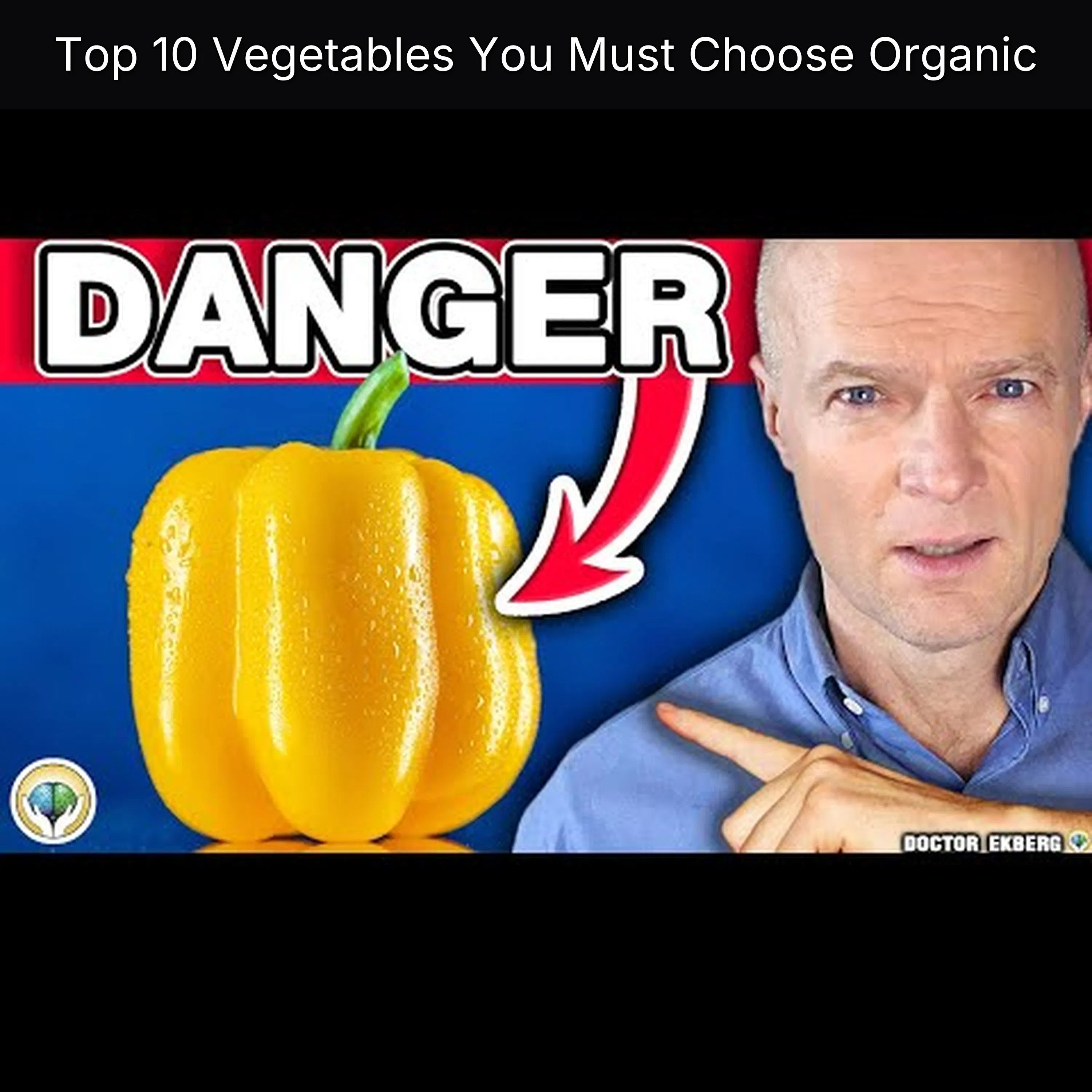
This transcription emphasizes the importance of buying organic for certain vegetables due to high pesticide contamination. The speaker lists the top 10 "dirtiest" vegetables—spinach, kale/collard/mustard greens, bell peppers, green beans, tomatoes, celery, lettuce, cucumbers, and broccoli—citing reasons like thin skins, porous surfaces, or wax coatings that trap chemicals. They highlight a global crisis: 3.7 billion kilos of pesticides used yearly lead to soil depletion, weaker plants, and a cycle requiring more chemicals. The speaker criticizes safety testing, which examines single compounds in short-term studies, ignoring the synergistic effects of chronic, multi-chemical exposure. Many pesticides are fat-soluble, accumulating in body tissues and resisting water washing. This exposure is linked to rising health issues like neurological disorders, hormonal imbalances, infertility, and cancers. The "Clean 15" (e.g., avocado, sweet corn, onion, asparagus) offer lower-risk alternatives. Beyond food choices, the speaker advocates for a whole-food diet (80-100% real food), limited processed foods, and lifestyle practices (sleep, exercise, sauna, meditation) to enhance detoxification. They urge consumers to "vote with their wallet" for sustainable, organic farming to break the toxic cycle and improve personal and planetary health.
Hello, health champions. Today, we're going to talk about the top 10 vegetables you must eat organic. And some of the dirtiest vegetables in terms of how much pesticides they use. Number one is spinach, because very often, they will find high levels of pesticides and they even find multiple different types of chemicals on the same plant. Number two is another leafy green that's kale, collared, and mustard greens, where they also find frequently high levels, but also you can find in the US, you can find pesticides that have been banned in some other countries. And why is it so important that we start paying more attention to the amount of pesticides and getting clean food? Well, we're using more pesticides, more chemicals, more poison than we ever have. In fact, 3.7 billion kilos per year. And if you divide that out, it's a little over one pound of poison per person. And that may not seem like a whole lot. But if you keep in mind that these are poisons, and these are things that can harm you in very, very small amounts. And a lot of this has to do with soil depletion, the aggressive farming practices, where we take dozens of minerals out of the soil, and we only put three synthetic minerals back. And therefore, the soil gets more and more depleted over time, and the crops growing there get weaker and weaker. They can't defend themselves against the pests. And now as a result, we need even more chemicals, which makes the soil even worse, with fewer microbial species in it, and the plants get even weaker. So now we create this vicious cycle. And I want to talk about these things so that you understand it's more than just getting a few chemicals on your food. It's really more of the tip of the iceberg that we're really talking about saving the planet and saving your health. As a society, we need to start paying attention to how our food is produced, and where we're spending our dollars. What are we voting for with our wallet? Are we voting for long-term sustainable production of food? Or are we voting for cheap stuff that may not be sustainable, and where the quality is going to decline year after year? And I know a lot of people now are gonna say, well, it can't be all that bad. If it was this bad, then wouldn't everyone be sick? Well, you know, everyone kinda is sick. We're having things that we didn't use to have. We used to die from infections and starvation, but now we're suffering from completely different conditions. Like we have an abundance of headaches and memory loss. We have neuropathy with numbness and tingling. We have exomos and rashes. We have Parkinson's and other neurological problems. We have hormonal imbalances, and we have an abundance of infertility. So the most basic function of humans to procreate, it is now so difficult for people that we have infertility clinics popping up everywhere. And we also have a lot of cancers that can be traced to pollution and pesticides and chemical toxicity, such as lung cancer, breast cancer, and lymphomas. And I'm not saying that all of these conditions are exclusively caused by pesticide, but pesticides play a big role, and they're starting to play a bigger and bigger role the more polluted we get. And a lot of people think that most of the chemicals used have been tested and therefore they are safe. But it turns out that there are tens of thousands of different chemicals and only a very, very small number, a very small fraction of those have been tested. But even so, that doesn't really help us all that much. And let me tell you why. Because they use single compound testing when they check out these things. They test them one at a time. And there's this concept called LD1 or LD50, which means lethal dose one, which means that you give a test animal a dose of a poison and you give it to 100 different animals. And then you see what dose of this poison is going to kill 1% of the population if we're looking for LD1, or which will cause 50% of the rats to die, which would be LD50. And then let's say that they find this dose of milligrams per kilogram of body weight, where 1% of the test subjects die. They call it an LD1. And then they divide that by some number that they feel is safe. And now they allow manufacturers to use these chemicals as pesticides and preservatives and food additives and things like that. But here's the problem with that. And I'll talk you through this in a way that you can start thinking about it differently. Let's say that we have LD1. There's a certain dose that kills 1% of the rats. Now what if you have another compound and we'll call this lethal dose of-- let's call this compound A, and this is compound B. Now if this had 1% of the rats die, now if you add another one, do you think it's going to be 1% more? Does it going to be 2% of the rats that die? Well, I don't think so, because if you give 100 rats a certain poison and 1% of them die, that does not mean that the other 99 rats are unaffected. They have to have some serious burden, some serious challenge to their immune system, to their physiology if 1% of them die from a short term exposure. They give them a poison for a short time and 1% of them die. Then the other 99 are not healthy. So now if those 99 rats that survive, if they're giving another poison, which would kill 1% in another population. But now they get two different poisons when one of them has already made them weak. I don't know what that number would be, but I can tell you it's going to be a whole lot more than 2%. Maybe 20, maybe 50%. Because these rats would already be very weakened. And now what if we add another one? And we add another one. We're not talking 1, 2, 3, 4%. I don't think you have to go very far down the line here before you're going to kill most of the rats. And also like I mentioned, these experiments, these tests are performed for a very short time. They don't have years and years. They can't take most of the lifespan of the rats to figure these things out. It has to happen within a day or a few days. So we're also talking about acute exposure versus chronic exposure that when you live life on planet Earth and humans live a fairly long time, now you get an accumulation of exposure. You get a little bit every day. And we have, like I said, tens of thousands of different chemicals. And we don't have any data on what thousands of different chemicals would do to a person over a period of decades. And even if we wanted to figure it out, the complexity of such a study and to control all the variables is basically impossible. And part of this cumulative exposure is that most of these pesticides are fat soluble, meaning they don't dissolve. In water, they dissolve in fat. So in the tissues of the body, like fat, where we have a lot of that in the brain, and we have a lot of that in storage, where there's a very, very slow turnover. That means that these chemicals and these heavy metals and all these pollutants have a chance to start really accumulating over the years and the decades. And now the body does have a detoxification system. The liver can break down and neutralize a lot of these toxins, but there's a limited capacity to that. So if we keep adding more, then the body knows how to get rid of. And some of that gets sort of sequestered or accumulating in the fat tissue. Now the liver is not going to be able to catch up. And what this also means that these toxins are fat soluble means that they're going to be pretty hard to wash off. If you just rinse your vegetables, you get some dirt off, but any kind of fat soluble substance is going to be very difficult to remove. So absolutely, it helps to wash your produce, but there's still going to be things that have gone inside of the plant and there's going to be things that don't wash off with just water. So here are some more of the dirtiest vegetables. We have bell peppers and hot peppers, and they often have very high levels of pesticide residue. We have green beans, which again, often we can find multiple different types of residue on there. And then number five, tomatoes is something we want to watch out for because they have a very thin skin that allows for easy penetration. And also, the skin is something that we typically eat on tomatoes. In contrast, different types of food.
different types of squashes have a skin that's quite thick, but even so, these pesticides need fat-soluble substances can still leech inside into the flesh, into the substance of this plant. Next on the list of dirty vegetables that you have to buy organic are celery, because it has that irregular surface that allows for a very large surface area, and it also quite porous, that tends to absorb things. Number 8 is lettuce, which also has a very large surface area, and number 9 cucumbers, that makes matters worse when they put wax on top of them, because cucumbers are almost entirely made of water, so they would evaporate very quickly, and therefore they cover them with wax, but that traps these poisons inside under the wax. And then number 10 is broccoli that you also want to get organic, because it can trap some pesticides in these dense flurites, and the tight convolutions of that plant. It's very hard to get the pesticides out. So these are the 10 dirtiest vegetables, but also keep in mind that there's a big difference between the number 1 and the number 10 on the list. So everything on the top half of the list, one through five, I would absolutely make sure that I get organic, and on this I would try to get organic when you can, but sometimes I'll buy broccoli for example, if there's nothing else available, or if the organic doesn't look so fresh, then I'll tend to go with whichever one looks the best on that day. But overall, these are the 10 vegetables that you want to get organic. I'm sure you've heard about the dirty dozen, which are the 12 fruits and vegetables, where you most often find pesticides. In this video, I focused on the vegetables, but I still want to mention the dirty dozen and give you some resources here. So they call it the dirty dozen and the clean 15, where the dirty dozen obviously are the ones where you use the most pesticides, and the clean 15 would be where you have the least. And this is based on regular testing by the USDA and the FDA. And then there's an organization called the Environmental Working Group, or EWG, that looks at the data and they analyze it and they come up with these lists and recommendations. And this EWG, they're supported by donations, but they're a great resource, they are a force to be reckoned with, to kind of keep the playing field fair for the consumer. So go there and check them out and if you feel like you're getting some value, then I would suggest maybe donating a little bit to them. So when we look at these numbers and this data, what we have to keep in mind is that there are different farming practices and different parts of the world. So the list that I gave you are for the United States in 2024. And there will be large regional variations. There will also be some changes on the list from year to year. But even if you're not in the U.S., you can still take a lot of value from these lists because there's a lot of overlap. Farming practices are probably not that different and the clean vegetables are usually clean because they have natural resistance for whatever reason. Whereas the ones that use the most pesticides are usually the most vulnerable. So there's not like one country's list is going to be completely useless and not applied to anything in another country. And then there's something called a PLU code or price lookup code that can help you identify certain produce. So if it's an organic produce, then it's going to have usually a five digit number starting with a nine. And most of them are going to have four digits and then typically they're not organic. So if it starts with an eight, now you know that it's going to be a genetically modified, a GMO. And you're probably not going to find very many of those because most people know to watch for GMOs and nobody wants to advertise that they're selling that garbage. And then I want to mention one of my pet peeves and that is the word conventional. So anything in the U.S. that's made without pesticides and certified in certain ways is called organic. In some other countries they call it biodynamic or something like that. But they call it conventional when in fact they mean that it's poisoned. And the word conventional, that sounds like that's the usual way we do things. That's how it's always been. That's the normal way of doing it. And then organic is this other abnormal, rare way to do it. When in fact it should be that organic is the normal natural way. That's how it's always worked for the history of the planet, things have grown on their own until we started with this harsh farming and we started depleting the soil and we had these aggressive practices where we had weak plants. And now we have to start poisoning them and we do it to such a degree that that becomes the convention. That is very, very tragic. Another pet peeve of mine is when you're in a grocery store and you come up to this small little section where they usually sell the healthy stuff, the organic stuff and the things that have been less altered. And now they call that the section for natural foods. Now always stand there and I look at this little section with natural food and then I ask myself if this is the natural food, then what is the rest of the store? That must mean that the other 98% of the store is unnatural and we should start thinking about these things. That what are we feeding ourselves? So we talked a lot about the dirtiest foods. I also want to give you the cleanest foods and the vegetables and the plants that you find the least pesticides on are number one avocado. That's the cleanest of all of them. Number two is sweet corn but you want to keep in mind that there is a chance that that is also going to be a GMO, a genetically modified corn. So if you buy the corn organic, then you know for sure that it's not genetically modified. The cleanest is onion and then number four is sweet peas followed by asparagus. And a lot of these are going to have a natural resistance to pests like onions, have sulfur in it and asparagus has something else that the pests don't like and others are going to have a thick layer of protection like the avocado and the onion. Number six is cabbage and then we have mushrooms, sweet potato, carrots and cauliflower. So these are some foods that you wouldn't necessarily have to get organic if you're in a pinch. But again, the first half of the list is going to be significantly better than the second half of the list. And also remember what we talked about before that when you buy things, you're voting with your wallet, you are sending a message to the food producers on what sort of stuff you would like. And if you want something sustainable, if you want this whole system to change, then you probably want to get organic on all of these anyway. So what can you do about this? Well unfortunately, we live in a world that has been severely polluted and they're adding millions of tons every year to that. There's tens of thousands, different things in the air, in the food and the water. So you're not going to get completely rid of it. But you can make some smart choices and you can probably limit your exposure by 80, 90%. So educate yourself and follow the stuff that we talked about in this video. You get organic, the dirty dozen, you always get organic. And then if you can't get organic, then you make sure that they're on the clean 15 list. And I'm also going to give you a PDF, check out the link down below. The 46 different fruits and vegetables that they tested and that was the foundation, the basis for the dirty dozen and the clean 15. And while you can't eliminate 100% of the pesticides, realize that your lifestyle makes the biggest difference in how your body deals with these things, how well your body can give rid of it. And also realize that detox uses up resources, that your liver, whenever it neutralizes a compound, it's like an engine. It needs to put some energy, it needs to put some resources into it. And the more these resources you put in, the better the liver can do its job. And if you watch this channel and seen some of my videos, then you know what's going to come next, that if you eat real whole food, natural food, unprocessed food, then it's going to contain these resources that your liver and your body needs. So I would suggest that 80 to 100% of what you eat should be real whole food. And if you can do 100 more power to you, if you feel like you need to have a little bit of a leeway and you need to enjoy an exception here and there.
a weekend or a party then you figure out what percentage you can handle. But you avoid processed foods because that's depleted food. It doesn't have these resources that your body needs to detoxify plus. It probably has a lot of the chemicals and the garbage in it that you were trying to get rid of in the first place. So I think your processed food intake should be hopefully zero, ideally zero, but no more than 20 percent, which is far, far cry from the 60, 70 percent that most people eat. And then realize that your body has a natural rhythm to it. It has a need for sleep and exercise. And if you do a sauna, you can help speed up certain detoxification processes. If you meditate, you put your body in a healing state. So stress will interfere with these detox processes. So the more of these pieces that you can put in to your lifestyle, the better off you're going to be. If you enjoyed this video, you're going to love that one. And if you truly want to master health by understanding how the body really works, make sure you subscribe, hit that bell, and turn on all the notifications so you never miss a life-saving video.
Podcast Summary
Key Points:
Spinach, kale/collard/mustard greens, bell peppers, green beans, and tomatoes are among the top "dirtiest" vegetables with high pesticide residues.
Globally, 3.7 billion kilos of pesticides are used annually, creating a vicious cycle of soil depletion, weaker crops, and increased chemical reliance.
Pesticide testing is flawed
Many pesticides are fat-soluble, accumulating in body tissues (e.g., brain, fat) and are hard to wash off produce.
The "Clean 15" (e.g., avocado, sweet corn, onion, asparagus) have least pesticide residue; organic choices support sustainable farming and reduce personal exposure.
This transcription emphasizes the importance of buying organic for certain vegetables due to high pesticide contamination. The speaker lists the top 10 "dirtiest" vegetables—spinach, kale/collard/mustard greens, bell peppers, green beans, tomatoes, celery, lettuce, cucumbers, and broccoli—citing reasons like thin skins, porous surfaces, or wax coatings that trap chemicals. 7 billion kilos of pesticides used yearly lead to soil depletion, weaker plants, and a cycle requiring more chemicals.
The speaker criticizes safety testing, which examines single compounds in short-term studies, ignoring the synergistic effects of chronic, multi-chemical exposure. Many pesticides are fat-soluble, accumulating in body tissues and resisting water washing. This exposure is linked to rising health issues like neurological disorders, hormonal imbalances, infertility, and cancers.
, avocado, sweet corn, onion, asparagus) offer lower-risk alternatives. Beyond food choices, the speaker advocates for a whole-food diet (80-100% real food), limited processed foods, and lifestyle practices (sleep, exercise, sauna, meditation) to enhance detoxification. They urge consumers to "vote with their wallet" for sustainable, organic farming to break the toxic cycle and improve personal and planetary health.
FAQs
The top 10 dirtiest vegetables are spinach, kale/collard/mustard greens, bell peppers/hot peppers, green beans, tomatoes, celery, lettuce, cucumbers, broccoli, and green beans (listed as number 4). These have high pesticide residues due to factors like thin skins, large surface areas, or dense structures.
Pesticide use contributes to soil depletion and a vicious cycle where weaker plants require more chemicals, harming both the environment and human health. Choosing organic supports sustainable farming and reduces your exposure to toxins that can accumulate in the body over time.
The cleanest vegetables are avocado, sweet corn (preferably organic to avoid GMOs), onion, sweet peas, asparagus, cabbage, mushrooms, sweet potato, carrots, and cauliflower. These have natural pest resistance or thick protective layers.
Organic produce typically has a five-digit PLU code starting with 9, while conventional produce has four digits. A code starting with 8 indicates GMO produce, which is rare.
Pesticides are tested individually for acute toxicity (like LD50), but real-world exposure involves multiple chemicals over decades. This cumulative, chronic exposure can weaken the body and lead to health issues not captured in short-term tests.
Pesticides are linked to headaches, memory loss, neuropathy, hormonal imbalances, infertility, and cancers like lung, breast, and lymphoma. They accumulate in fat tissues, including the brain, and overwhelm the body's detoxification system.
Chat with AI
Loading...
Pro features
Go deeper with this episode
Unlock creator-grade tools that turn any transcript into show notes and subtitle files.
 PodcastTranscript AI