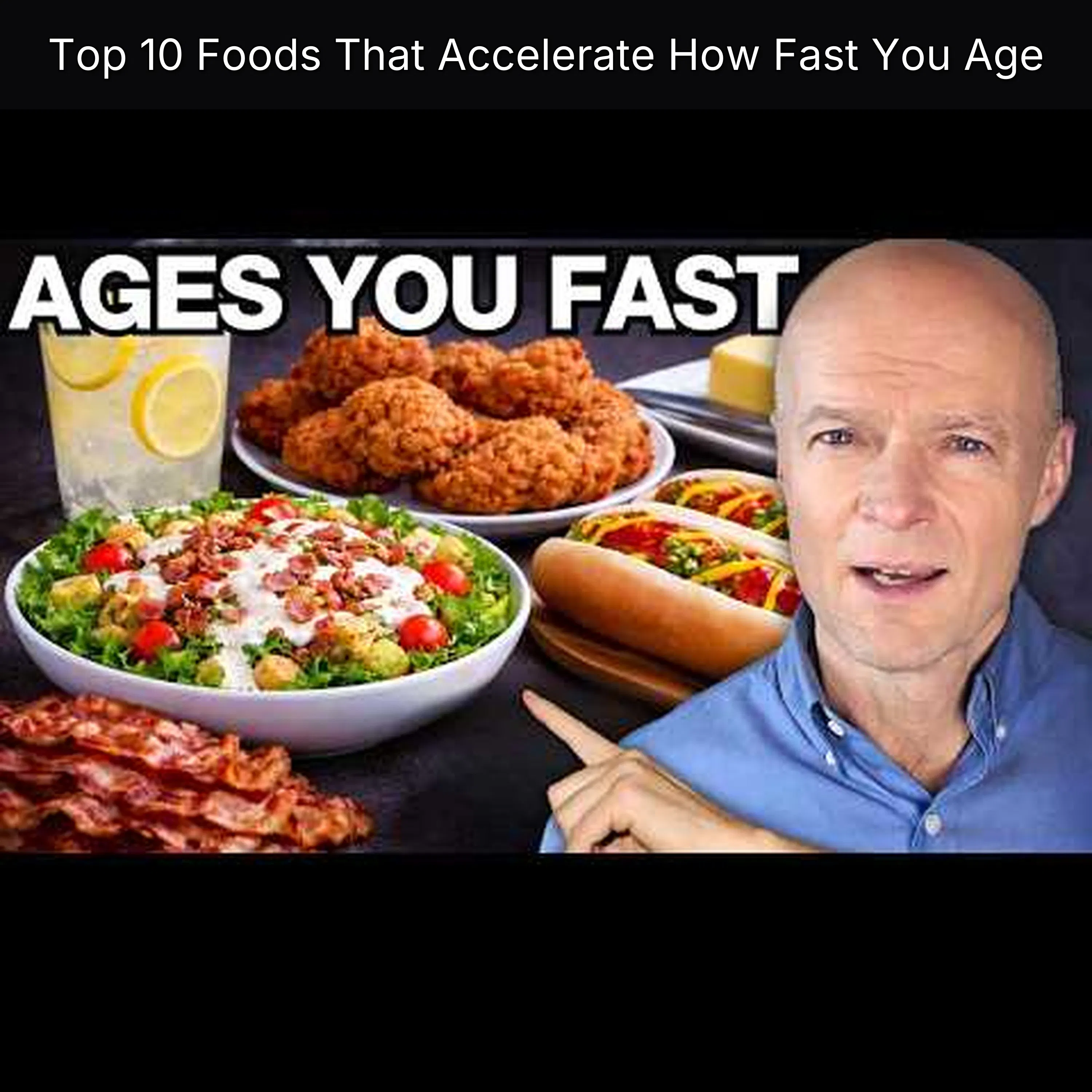
The transcription identifies ten major dietary "aging accelerators" that cause cellular damage and inflammation. It begins with margarine, which contains trans fats from hydrogenated oils that distort cell membranes and promote systemic inflammation, recommending natural fats like butter or olive oil instead. Fruit juice is highlighted as a hidden source of concentrated sugar without fiber, leading to blood sugar spikes, glycation, and fatty liver disease; whole fruits or green juices are better choices. Salad dressings often use processed vegetable oils and added sugar, contributing to inflammation, while homemade dressings with olive oil and vinegar are healthier. Breakfast cereals are refined grains with high glycemic index and minimal nutrients, often fortified artificially; alternatives include eggs or yogurt. Processed meats contain nitrates that can form carcinogens when cooked, along with high sodium and unhealthy omega-6 ratios; fresh meats are preferred. Deep-fried foods generate toxic compounds like acrylamide from reused oils, while air frying or pan frying with stable fats reduces risks. Baked goods combine sugar, white flour, and unhealthy oils, creating advanced glycation end products. Sugary drinks offer rapid sugar absorption with no satiety, depleting nutrients. High fructose corn syrup is slightly worse than regular sugar due to higher fructose content, but both are harmful. Finally, alcohol is a toxin that damages all organs and produces carcinogenic byproducts. Overall, the speaker advocates for minimally processed, natural foods to slow aging.
You've been told that age is just a number and food is all about calories. But here's what they don't tell you. Aging is actually cellular damage and certain foods create that damage every single time you eat them. Your skin, your brain, your joints, they're all aging faster because of foods you think are normal or maybe even healthy. Hello, I'll champion today when I talk about the top 10 aging accelerators from bad to absolutely devastating. Number 10 is margarine and margarine is made from liquid oils, from vegetable oils like soybean and canola and so forth. And in order to turn it from liquid to solid, there's a very harsh processing involved. And that processing develops trans fats. Anything that is hydrogenated, meaning that they bombard them with hydrogen. And in that process, they create trans fats from oils that are already high in omega-6s. And they are already highly processed with high heat and high pressure. So when you buy these products, they are already highly oxidized, even on the shelf already. When you buy them, they are oxidized. And the trans fats in themselves, that's an unnatural molecule. It's man-made, it's completely foreign to biology. It's something that doesn't exist. It's closer to plastic than food. And when we eat that type of fat, then these fats, to some degree, become incorporated into your cell membranes. And your cell membrane is one of the most important structures in your body. If you think about the word cell membrane, that is how your brain actually processes signals, is through that membrane. And with these trans fats in the cell membrane now, the membrane gets rigid. And we get a distortion of the signals and of the information processing. Furthermore, this promotes systemic inflammation. And it interferes with the omega-3 metabolism. And they also interfere with the mitochondria and the way that they make energy and turn it into ATP. So instead of these margarine and these fake fats, what you want to use are real fats, natural fats, like butter and ghee and tallow, and extra virgin olive oil. Things that have been minimally processed, with a molecular structure of the fat, is still the way nature made it. And the really sad thing is that we already had all these healthy fats that I just mentioned, but margarine has been promoted as the healthier alternative because we believe that saturated fats were bad when in fact saturated fats are really good because they're stable. And these vegetable oils that margarine is made from are very unstable, highly oxidized, etc. And it used to be that in the movie theaters, you got popcorn with coconut oil, which is again, a natural fat, very stable. But once everyone got scared enough of saturated fats, they replaced that coconut oil with soybean oil and canola oil. And on top of that now, because there's no flavor at all to these, they add artificial butter flavor. And French fries, it McDonald's, for example, used to be fried in tallow, in beef fat, which again, if you're going to fry something, you want to use a saturated fat, which is stable. But now instead what they use is again, soybean oil, canola oil, and synthetic beef flavoring with a bunch of artificial chemicals in it. So in reality, they switched from something that was natural and stable and relatively good to something that was very high in Omega 6, that's pro-inflammatory, that is highly oxidized and full of chemicals. And I saw a slogan one time that said something like "better health through engineering", but unfortunately, it turns out to be more disease through engineering. And we want to think about this for a little bit, that I'm all in favor of science. I'm so impressed, I'm so happy with science and engineering and the convenient, comfortable, interesting lifestyle that we have as a result. But think about this. We can put a man on the moon, we can land on other planets, we can create artificial intelligence, we can make these incredible things, but we cannot make a cell from scratch. When they create life, so to speak, when they clone people, they're not actually creating a single cell. They're just rearranging molecules that are made by nature. We cannot make a single blade of grass. We don't know how to do it, but nature can make them by the trillions. So if we can't make a cell or a blade of grass, what makes us think that we can create food? I think that we should lead food making to mother nature. And number nine is fruit juice, which is very often promoted as very healthy. They tell you to have your orange juice for breakfast to get your vitamin C, but it's actually just concentrated sugar without the fiber. And very often fruit juice, orange juice, apple juice will often have more or equal amount of sugar per cup than soda than soft drinks. And there's so much confusion about this thing called sugar. When you look at the nutrition label, then we have to understand that sugar, whether it's added or not, is glucose and fructose. And this glucose and fructose, those molecules are identical to the table sugar that we know we're not supposed to have. And yet, we think that fruit juice is a good thing. And just because they put on the label that it has zero added sugar, it means nothing because the sugar, like I said, it's still as much or more than soda, and it's identical to the sugar in there. And what happens when we drink juice that is concentrated without fiber is we create blood glucose spikes, blood sugar spikes, which leads to insulin spikes. And that's the glucose portion. The other half is the fructose, and we're going to get a massive amount of fructose from this juice, which contributes very heavily. It's the number one contributor to non-alcoholic fatty liver disease. And in addition to that, the high blood glucose leads to glycation. The glucose is kind of sticky and it sticks to proteins in the bloodstreams and creates advanced glycation and products. And these are very much an accelerator of aging, and these tend to accumulate throughout life. So instead of the mass-produced fruit juice, what you want to do is you want to eat the occasional whole fruit, not like six to day, but now and then in moderation. And if you want to do some juice, then stick to the green juice, which is much, much lower in sugar and packed with nutrients. Number eight is salad dressing. And again, this is made from these highly processed, so-called vegetable oils from soybean and canola. And very often, they contain also high fructose corn syrup and sugar. Some of them can have as much as a third of the dressing be sugar. And these oils also are very oxidized, and they give us an inflammatory omega-6 ratio, because the omega-6 is so much higher than the omega-3s, and that pushes the body toward inflammation. And because these fats are oxidized, they will create free radicals, which accelerate aging. And a big problem is that the whole idea of a salad with salad dressing, it's so healthy. We have this idea that salads are so awesome, which they are, which they can be before we add the sugar and these processed oils. And then very often, because people have fat fobias, they create these chemical concoctions that are low-fat or non-fat dressings. And now what they're going to do always is they're going to increase the sugar and the chemicals. Because if they take out the fat, they have to make it taste good somehow, and they have to replace that fat with something else. So now we get way more sugar and chemicals in there. So instead, what you want to do, if you buy something in the store, then you want to look for something that is avocado oil-based. Or even better yet, you make your own dressing. You just sprinkle extra virgin olive oil and some vinegar, and then you put salt and pepper, or whatever spices you like, and you've essentially made your own dressing. And it's been years actually since I had anything else than extra virgin olive oil and vinegar on my salads. But there's nothing wrong with making your own dressing, and then you want to base it off of avocado, and olive oil, and vinegar. And now you can put in garlic, and spices, and anything that you want, that you know what it is that goes and you're dressing. Number seven is breakfast cereals. And again, here,
advertising has created this misconception that this is a normal and healthy breakfast. But they're made from refined grain, from corn and wheat, typically sometimes a little bit of oats. And because they're so heavily processed, they're basically white flour. Now the glycemic index is very high and that processing has stripped them of all their nutrients. So as part of the marketing now, they say that, look, these are so nutritious because we have fortified them. We have enriched them. And what does that mean? Well, basically, if I'm going to enrich you, then I'll take away a dollar, which was the original nutrients in the food, and I give you back a penny. And now I have enriched you. And this is basically how it works with processed foods. And then in the marketing, they say, look how nutritious we've made it, which is really not the case. And in addition to that, they often have tons of added sugar, of artificial colors, and of artificial chemical flavors. And very often, they tell you to have these breakfast cereals because breakfast is the most important meal of the day. But I would rather say that breakfast, if you have cereal, is the most important insulin spike of the day, and it will set the tone for your daily rollercoaster of blood glucose swings and mood swings. Or what you can do is you could eat something with fat and protein that would actually be good for you, such as an omelet with ham, with a healthy version of ham, and some vegetables. Or you could do something like a yogurt, and if you do a homemade yogurt, it's actually very easy, and it's even better. Then you can use full fat, and you can make it really tart. So you have lots of bacteria, and not so much lactose left in there. And then what I like to do is put some ground up chia seeds that I keep in the freezer, and some pumpkin seeds. And now you have a super delicious, super healthy. You get some bacteria to feed your gut, and you get tons of fiber and omega-3s and minerals from that breakfast. Or you could try intermittent fasting, which means you eat fewer meals in a shorter time period during the day, and you could actually skip breakfast altogether. And for some people, that's a radical idea, but I promise you probably won't miss it, and you live. Number six is processed meats. And here it just depends on how processed they are, how much chemicals do they have in there. And one of the things they put in is called nitrates. And they're not too terrible in themselves. They're naturally occurring substances, but when they add them into meat, and then you heat them, now they can create what's called nitrosamines, and that's if you grill them. So with ham, for example, it wouldn't be such a big deal, but if you do bacon or hot dogs, and you cook it in a frying pan or on the grill, now those nitrates can actually combine with the protein. So I wouldn't do that like every day or all the time, because these nitrosamines are known to create some DNA damage. Another problem is that these are typically very, very salty, and salt is not a problem in itself when you get it from whole foods, or when you get plenty of potassium in your diet, then you can freely salt your food, and it's not going to be an issue. But if you were to eat like a lot of people, you never have vegetables, you never get much potassium, and you eat tons of processed meats and processed foods, now you're going to get tons of sodium without any potassium to balance, and that becomes a problem. And most of these meats are going to come from feed-lought animals, from commercially raised animals. And now you're going to get that very, very high omega-6. So if you have a grass-fed animal, now you're going to get about a one-to-one ratio of omega-3 to omega-6, whereas with these commercially raised, where they raise them on corn and grain, now you could get a 20 to one omega-6, which will push us toward inflammation. Also, these processed meats, a lot of them, not all, will contain a lot of preservatives, and these preservatives, they will disrupt and damage your gut biome, which is super important for your health. So instead, what you want to do is most of the meats should be fresh meats, fresh fish, fresh poultry. And then, if you do a careful search, and you spend just a little bit more, now there are plenty of good daily meats, without chemicals, without sugar, without preservatives. And those, I wouldn't eat them like all the time. I wouldn't eat them as much as I eat fresh meats and fish and chicken. But if you get the good kind, you don't really have to worry too much about it. Number five is deep-fried foods. And here we have these same vegetable oils, primarily, it's a soybean and the canola and sometimes corn oil. And now, we heat these oils to extremes. They have already been heated during manufacture, but now, we heat them over and over in the presence of oxygen. And this heat creates something called acrylamide and aldehydes. And these are known to be neurotoxic and carcinogenic. And the oxidized fat will create free radicals, which again, speed up aging. And this high heat also creates some trans fats that we talked about earlier. And all this harsh treatment of these fatty acids will create byproducts that overwhelm the liver pathways. It creates much more work for the liver. And another problem is that most people will eat their deep-fried food from restaurants, from fast food restaurants. And there, they will reuse their oils multiple times. They might stay there all day and you reuse it and you cook those fries like dozens or hundreds of times. And what happens now is this oil gets worse and worse all day. So you're creating more acrylamide, you're creating more free radicals, and you're creating more trans fats. So what you want to do instead is you want to use air frying. You can oven roast things and you can pan fry. And if you pan fry, now you just use some good fats like butter, ghee, coconut oil, avocado oil, and extra virgin olive oil. Just keep in mind that these are natural and you don't want to use extremely high heat. You want to watch the smoke point and be aware of which oils are best suited. Number four is baked goods. And here you're really getting a hit from all directions. You're getting sugar, white sugar, you're getting white flour, and you're getting white oil. Has no nutrients whatsoever in it. So it's like you're getting a triple hit of white trash. And you always want to remember that friends don't let friends bring home white trash. On top of that, the baking heat and the browning will create some advanced glycation and products. You're going to get trans fats from the margarine and oftentimes shortening in these products. And you want to check the list. If anything that says hydrogenated or partially hydrogenated anything, it's going to have some trans fats in there. And then you're actually getting additional trans fats from frosting. If there's a cake or a cupcake, something that has frosting, then you're going to be sure to have some trans fats in there. And it's really scary when you're out traveling and you see how common it is. How every hotel buffet, every breakfast buffet, you see, have muffins and pastries on the menu. And people just think of this as normal. It's just something that everybody eats. So why not? And number three is sugary drinks. So here we're talking soda, energy drinks, coffee drinks that are becoming so common that you've loaded with sugar. And you're getting a maximum sugar concentration because it's really just sugar and water. And it provides no satiety. You don't get full at all from this stuff. And these drinks have the fastest possible absorption. There's nothing. There's zero buffering mechanisms. The sugars just floating around in a liquid ready to be absorbed. And these drinks also have zero nutrients. But people don't realize this, they require nutrients. You need be vitamins to convert all this sugar into energy. So what happens is you're drinking something that has zero nutrients. So you're going to borrow from the existing stores in the body and you're going to deplete your nutrient stores. And because sugar is very addictive and because it provides no satiety, no fullness at all, then it's going to invite. It's going to have a very strong tendency for constant consumption. And so many people will get their drink, their little tumbler, their coffee drink, and they'll sip it for hours or throughout the day. And And then once they're done, they'll get another one.
So we want to think of these drinks as liquid sugar as a very potent aging accelerator. And number two is high fructose corn syrup and all the products that contain it, which includes soda that we just talked about. But I want to talk about this to give a little bit of perspective because it's very, very misunderstood. So high fructose corn syrup has a little bit higher level of fructose, just like the name says. So normal sugar has 50% fructose, 50% glucose. It's two molecules linked together, so there's always exactly 50% of each. High fructose corn syrup has about 55% fructose and 45% glucose. And the high fructose corn syrup is almost entirely a US thing. As of politics and corn subsidies, etc., the United States uses almost entirely high fructose corn syrup for sweeteners. And it's in tens of thousands of different products. Virtually everything processed is going to have high fructose corn syrup. And in the rest of the world globally, they use pretty much sugar either from sugar beats or from sugar cane. But if you're not from the US, I still want you to listen carefully and will make this totally clear. Now, fructose is a little bit worse. High fructose corn syrup is a little worse because it has more fructose. And fructose goes straight to the liver. Glucose can be metabolized by your entire body. Every cell can use glucose. Fructose can only be processed through the liver, so the potential overwhelm is much, much higher. Fructose promotes uric acid, which can be inflammatory and contribute to gout. And it also forms ages, advanced glycation and products 10 times faster than glucose. Fructose also does not raise blood sugar. It does not trigger insulin and it does not trigger leptin, which is a satiety hormone. And that means that fructose does not give you any signal of fullness or any signal of satiety, of satisfaction. So when people hear this, they hear that high fructose corn syrup is terrible, but we have to understand that they're still pretty close. High fructose corn syrup and sugar are not that different. Yes, high fructose corn syrup is worse, but just because it's worse, it does not make sugar something good. So in the United States, a lot of people say that, "Oh, high fructose corn syrup, it's so bad, I never drink coke or soda or soft drinks from the United States, I get the soft drinks with sugar." Well, that is a huge mistake because they're very, very similar. High fructose corn syrup has 55%, but sugar still has 50%. It's not that different. So it's kind of like you're hitting your thumb with a hammer, right? That's a very unpleasant. The thumb doesn't like that at all. So sure, it's better to hit your thumb with a 2.25 pound hammer rather than a 2.5 hammer, but neither hammer is good for the thumb. So don't fall for the idea that just because something is worse makes something else a good thing. They're both terrible. And the number one aging accelerator is alcohol. And there's several reasons here. So first of all, it's a toxin that directly damages every organ system in the body. When we break it down, a byproduct is called acetaldehyde, which is toxic and carcinogenic. Alcohol will dehydrate you because it blocks a hormone called ADH, anti-diuretic hormone. So a lot of people may have noticed that you tend to pee out about twice as much as the liquid volume that you're actually drinking if it has alcohol in it. And here's the reason. And when the liver breaks it down, it uses up B vitamins. It uses up magnesium and antioxidants. Alcohol damages your gut lining. It increases the intestinal permeability. It is a stress on the liver and it damages brain cells. And it also interferes with sleep. It will reduce your sleep quality, especially during the phases of deep sleep and REM sleep, which are the most important ones because deep sleep is when your brain slows down the most. And the brain cells actually shrink a little bit to allow the flow of three-brospinal fluid. And that's part of the cleanup process that happens primarily during deep sleep. And REM sleep, or rapid eye movement, is where your body processes memory and events and it integrates long-term memory. Now that's all the bad stuff about alcohol. And if you don't drink, then don't start. I commend you on that. But for other people, it is kind of a tradition. It's a habit that if they drink in moderation, it does add some benefit. And there's something called alcohol dehydrogenase in the body, which is an enzyme. It's a specific enzyme that helps break down alcohol. And if we have a specific enzyme for it, that means that we have had exposure to alcohol for a very, very long time. It is a natural substance. And on the positive side, alcohol can provide some relaxation. And it's not necessary, but it's very common for social well-being and social settings. And for some people, if it can help with relaxation and social well-being, then it can actually reduce some stress. Now that's not an excuse to start drinking, but it is there nevertheless. The key becomes moderation. And anytime that you have too much, it really becomes a burden. You're using up resources. But if you can keep it to one to two drinks per time, three to four days a week or less, then in my opinion, I believe it to be very safe. So when you watch a video like this, I don't want you to look at every single item and just totally freak out because there are people who live a fairly long time eating very little butt these things. And I don't think that's a great idea, but it's not what you eat once in a while. Create a situation where you know what's good for you, and that's what you eat most of the time, and then the exceptions are going to be well-tolerated. If you enjoyed this video, you're going to love that one. And if you truly want to master health by understanding how the body really works, make sure you subscribe, hit that bell, and turn on all the notifications so you never miss a life-saving video.
Podcast Summary
Key Points:
Margarine and hydrogenated oils contain trans fats that incorporate into cell membranes, causing rigidity, inflammation, and mitochondrial dysfunction; natural fats like butter and olive oil are better alternatives.
Fruit juice is concentrated sugar without fiber, causing blood sugar spikes, insulin spikes, glycation, and fatty liver disease; whole fruits or low-sugar green juices are preferable.
Salad dressings often use processed vegetable oils and added sugar, promoting inflammation and free radicals; homemade dressings with olive oil and vinegar are healthier.
Breakfast cereals are refined grains with high glycemic index, stripped of nutrients, and often fortified with minimal vitamins; better options include eggs, yogurt, or intermittent fasting.
Processed meats contain nitrates that can form carcinogenic nitrosamines when heated, high sodium, and unhealthy omega-6 ratios; fresh meats and carefully sourced deli meats are recommended.
Deep-fried foods create neurotoxic and carcinogenic compounds like acrylamide and aldehydes from reused oils; air frying or pan frying with stable fats is safer.
Baked goods combine sugar, white flour, and unhealthy oils, leading to advanced glycation end products and trans fats; they are nutrient-poor and common in buffets.
Sugary drinks provide rapid sugar absorption without satiety, depleting nutrient stores and promoting addiction; they are potent aging accelerators.
High fructose corn syrup is slightly worse than regular sugar due to higher fructose content, which overloads the liver and doesn't trigger fullness signals; both are harmful.
Alcohol is a toxin that damages all organs, produces carcinogenic acetaldehyde, and accelerates aging through dehydration and oxidative stress.
Summary:
The transcription identifies ten major dietary "aging accelerators" that cause cellular damage and inflammation. It begins with margarine, which contains trans fats from hydrogenated oils that distort cell membranes and promote systemic inflammation, recommending natural fats like butter or olive oil instead. Fruit juice is highlighted as a hidden source of concentrated sugar without fiber, leading to blood sugar spikes, glycation, and fatty liver disease; whole fruits or green juices are better choices.
Salad dressings often use processed vegetable oils and added sugar, contributing to inflammation, while homemade dressings with olive oil and vinegar are healthier. Breakfast cereals are refined grains with high glycemic index and minimal nutrients, often fortified artificially; alternatives include eggs or yogurt. Processed meats contain nitrates that can form carcinogens when cooked, along with high sodium and unhealthy omega-6 ratios; fresh meats are preferred.
Deep-fried foods generate toxic compounds like acrylamide from reused oils, while air frying or pan frying with stable fats reduces risks. Baked goods combine sugar, white flour, and unhealthy oils, creating advanced glycation end products. Sugary drinks offer rapid sugar absorption with no satiety, depleting nutrients.
High fructose corn syrup is slightly worse than regular sugar due to higher fructose content, but both are harmful. Finally, alcohol is a toxin that damages all organs and produces carcinogenic byproducts. Overall, the speaker advocates for minimally processed, natural foods to slow aging.
FAQs
Margarine is made from highly processed vegetable oils that create trans fats, which are unnatural molecules that incorporate into cell membranes, causing rigidity, inflammation, and interference with omega-3 metabolism and mitochondria function.
Fruit juice is concentrated sugar without fiber, causing blood glucose spikes that lead to insulin spikes and glycation, which accelerates aging and contributes to fatty liver disease.
They are made from highly processed oils like soybean and canola, which are oxidized and promote inflammation, and often contain added sugar and chemicals, especially in low-fat versions.
They are made from refined grains with a high glycemic index, stripped of nutrients, and often fortified with minimal vitamins, while containing added sugar, artificial colors, and flavors that spike insulin.
They can contain nitrates that form carcinogenic nitrosamines when heated, are high in sodium without balancing potassium, and come from grain-fed animals with high omega-6 levels that promote inflammation.
The reused oils heated to extremes create neurotoxic and carcinogenic compounds like acrylamide and aldehydes, along with free radicals and trans fats that damage the liver and speed up aging.
Chat with AI
Loading...
Pro features
Go deeper with this episode
Unlock creator-grade tools that turn any transcript into show notes and subtitle files.
 PodcastTranscript AI