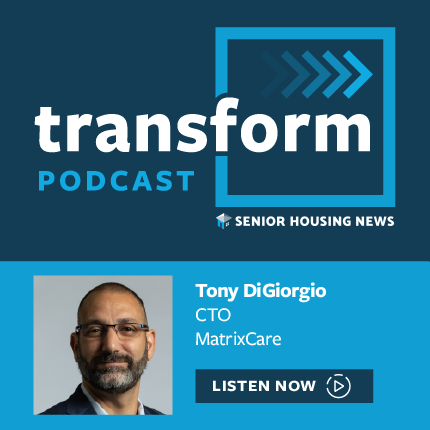
Tony DiGiorgio, Chief Technology Officer, MatrixCare
29m 20s
Tony DeGiorgio, Chief Technology Officer at Matrix Care, shares insights on how technology can transform senior living by prioritizing human-centered design over complexity. His career in healthcare was deeply shaped by a pivotal moment where his software detected early cancer in a long-term patient, reinforcing his belief that technology can save lives. He emphasizes that success in senior living tech does not come from adding more tools, but from simplifying systems to create seamless, continuous care across different settings. Fragmented technology environments lead to inefficiencies and data silos, which break care continuity and increase staff workload. True interoperability is defined by a unified data platform that maintains a longitudinal patient record through transitions in care. AI must be implemented with strong governance, security, and transparency to build trust and ensure it enhances, rather than complicates, operations. Real-time data dashboards enable leaders to monitor performance and respond to issues proactively. Modernization should begin with identifying core business problems, not with new features. Ultimately, the future of senior living technology will be defined by systems that free staff from administrative tasks, allowing them to focus on meaningful, human-centered care. This vision aligns with Matrix Care’s mission to create a connected, intelligent, and efficient care ecosystem that improves both outcomes and experiences.
Welcome back to Transform, a podcast highlighting the people and ideas shaping the future of
senior living.
I'm Austin Montgomery for Senior Housing News.
On today's episode, I spoke with Majority Care, Chief Technology Officer Tony DeGiorgio.
Majority Care helped senior living organizations connect care, operations and insights through
one platform designed to support the entire continuum.
By bringing together a more complete view of the resident with AI-powered intelligence,
Matrix Care helps teams work more efficiently, support better experiences across levels of
care, and operate as one connected community.
My goal has always been around how do we build systems that make the users efficiency
as productive as possible?
How do we move them through the system in a very efficient manner so they can do what's
important, which is to get back in front of the customer?
Now here's my interview with Matrix Care, Chief Technology Officer Tony DeGiorgio.
Thanks for having me here.
And we know that so many Americans have personal experiences with healthcare and aging.
Do you have any big experiences that led you into this profession?
I want to really understand this because I think there's an important distinction because
healthcare is such a passion-driven industry and a mission-driven industry that a lot of
folks have some stories to share.
So would you mind sharing anything that really drove you to be where you are today?
Absolutely.
I think one of the most important aspects of my journey here was very personal for me.
I actually have been an engineering for quite some time and consulting.
I actually had the honor of working for a company where we did population health and we worked
on evaluating and helping customers, maintaining their health and evaluating their diagnostics
and everything else.
And I remember one story a long time ago where it really kept me in the healthcare world
because we wrote software that found patients that were in dire need of care that might not
have been seeing their doctors on a regular basis with comorbidities or high tolerance
for certain medications that they should be taking that maybe they're not and so forth.
And I recall one day that I actually got a letter in the mail from one of our providers
who had told us that, "Hey, your software actually found a patient that we hadn't seen
in over 10 years.
You brought them back into our industry or back into our office and that meeting we had
diagnosed them with cancer."
Finding out that they had cancer that early, it caught it early enough where they were
actually able to say their life.
That letter, I know we're not doctors, I'm not a doctor, but getting that letter and
actually seeing that our software made a difference, that basically put me over to where
I told myself, "Look, I'm in healthcare.
This is the industry I'm in because I want to do whatever it takes to help people."
And that story alone for me was so inspiring to know that, "Okay, what we're actually doing,
we're writing code.
We're building platforms to make users live easier, but we realized that, "Hey, we actually
make patients live easier."
And for me, that was such a touching thing that it kept me in healthcare for all these
years.
I've been doing healthcare now for 25 plus years.
And that's one of those primary reasons why is things like that.
Really appreciate you sharing that.
We know that things are moving quickly in a time like now for the industry.
Not just in senior living, but beyond and in healthcare more generally.
And we know Matrix Care is getting more involved on the senior side.
So we're really seeing a lot of change, and especially in your new role, I really want
to dive into this because I think we're seeing an evolution from the senior living perspective
that operators are thinking a lot about having these chief technology officer positions.
So obviously you recently joined Matrix Care as chief technology officer, and you spent
much of your career working in healthcare and enterprise technology, specifically you've
held leadership roles at Simpler, Track Manager, IBM Watson Health, FITEL and Elation Health.
What did your experiences teach you about the differences between organizations that successfully
modernize and those that simply accumulate more technology because I think there's a
fine line there.
Yeah, I think the one thing that's taught me over the years is that building a foundation
and building additional stacks of technologies and products is not necessarily the most effective
way of doing it.
I've learned that over the years, the most important thing for us to do is actually get
our users away from the computer.
The focus is should be on the patient, so my goal has always been around how do we build
systems that make the users efficiency as productive as possible?
How do we move them through the system in a very efficient manner so they can do what's
important, which is get back in front of the patient for our customers?
So over the time, it's not about just accumulating more technology, more products, it's about
simplifying, it's about being able to create that continuity of care through the system
so you have from day one to day X, they're in one system, they know the system, the system
is making things easier, so they're spending less time in front of that and more time in
front of the patients.
And we know that that's critical, giving that time back to really make those impactful
moments and not just be filling out paperwork or filling out any sort of forms that really
take you away from that.
So very interesting to hear your perspective there and I know you've probably seen it
done a lot of different ways, having been involved in the sector for so long.
Now I want to move on to the next question here, senior living providers now rely on technology
across nearly every part of the organization.
At what point can adding more tools actually create more complexity?
And what are the signs that an organization's technology environment has become too fragmented?
Are there any things you've seen, any similarities, any trade-in?
As someone who's had to deal with that for so long, I think one of the pain points that
you see, especially in health care, you're seeing CTOs, CIOs and other organizations, we're
dealing with, you know, not just a couple of tools, we're dealing with hundreds and hundreds
of tools.
You know, you see these companies and CIOs and CTOs, we're dealing with 400, 500, 600 different
vendors and different tools.
It's very hard to manage.
It's what I call the swivel chair effect, right?
And what you're seeing is that you're seeing those users and those systems having to constantly
swivel chair between systems, double entry and having to, and that causes all kinds of
mistakes, right?
You have data entry and system A, you've got to go over data entry and system B. And it
just becomes that continuity and that flow of data is just decoupling.
You don't have that longitudinal record across a patient because you have so many different
systems.
And one of the key things that is on my mind is, how do we minimize that?
How do we create that longitudinal record?
It's what we're going to focus on here at MatrixCare is, how do we build that longitudinal
record?
So you have that continuity.
So you're not having to do the swivel chair.
Data flows from system to system to ease the user's workload and minimize the workload.
Again, it's all about how I get you away from the computer screen in front of the patient.
And having less systems is actually better in some cases.
Now obviously you want to make sure you have the right system for the job.
But too many tools become such a headache and it's very hard to maintain as well, right?
You're having to keep up with compliance, security controls and so forth that you run
into those bottlenecks.
And now what you're doing is you're spending most of your time dealing with contract negotiations
to renew software versus just getting that continuity in place.
So minimizing the tools is very, very, very important for us.
Yeah, and it's interesting because I think there's a really fine line there, especially
in terms of practical rollout and adoption by staff for what those tools can do and really
understanding all the features because sometimes features will get left out or worked around
because staff really have either found in a more efficient way of doing something or they
neglect a tool just on its face.
But just add to that, one of the things that you also see is that the more tools that
you have, now you've got to take training into account.
You're having to train everyone and you do have people that might get frustrated with
a tool that find other ways of doing it.
And again, once you do that, now you've broken that continuity because now you have different
processes for different people based on the tools.
You're spending an awful lot of time having to make sure you train them.
If you bring in another tool, that's just more time that you're training them.
So it's a weight on the staff.
It's a weight on the management that happens that a lot of people might think of it because
they look at the tools, "Oh, this is just going to make us better."
Well, you have to think about, "Is it really going to make you better or is it going
to make you more efficient?"
We want to drive on, "Is it going to make you more efficient to do your job?"
And we often hear about, especially in healthcare and in senior living, we hear a lot about
connected technology, the importance of integration and the importance of having interoperability
between systems.
But from your perspective, what does a truly connected technology environment look like?
Not necessarily technically, but in the day-to-day experience of a staff member and residents.
If you have any anecdotes,
I'd love to hear your thoughts because I think this is interesting.
>> Yeah, interoperability to so many, it's such an open word, right?
It's easy to say, you have integration, I have interoperability, and so forth.
To me, it's all about kind of where that data, the data platform lives,
the way that how data flows within systems, right?
It's not just necessarily, do I have connectivity between system A and system B?
That's great, I can make a call.
It's about the flow of the data throughout the system.
So for me, when I think about interoperability, I think about that continuity of care within our systems,
it's about building that data foundation under, so you're building that longitudinal record for the patient.
So regardless of the system that you're using, that data is flowing both ways in a centralized manner.
So that way, regardless of the system that you're in, you're seeing up to the data,
you're seeing the necessary data, especially in senior living where you have patients moving from maybe facility A to facility B,
then maybe coming into home hospice, and so forth.
If you don't have that continuity of care, you don't have that data flow that interop between these systems.
Now what you're doing is, again, back to the school chair.
Now you're having to re-enter all this data, and that just breaks that continuity of care.
It means you're going to miss something, we're human, right? You're going to miss entering the piece of data,
getting that family history, getting that full view of that patient.
Having the interoperability between the systems is critical, but it starts with understanding and laying out that data framework.
So you have that across all your systems.
Right, and we know one of the things that I think is invoked and has been for the last couple of years,
are all the new AI tools and AI-supported systems that are coming online for folks as they look at what their tech stack really looks like and how it can function as operators choose to grow.
We know that it can be sometimes challenging to add in new technology, but all the time we're hearing from operators saying that these AI-assisted tools are really starting to shape what it looks like around,
how their platforms work, parts of the platform that are automated, that may be weren't in the past, and so it's been interesting there.
What foundation needs to be in place around data systems and workflows for artificial intelligence to move from an interesting capability to something that creates meaningful value,
and what role do operators have in creating that foundation?
So the first thing for me is security, that's number one, especially we're dealing with health care, right, we're dealing with patient data, we're dealing with a lot of those controls.
So security is the kind of the foundation of how are you going to make sure you're securing this data appropriately?
How are you making sure that there's no bias in the models that you're looking at when you start talking about AI and you start looking at the core competency of the AI.
So you're looking at your security models, you're looking at the how are you managing bias, whether those controls around it, and then once you have what you're beyond that, you start looking at the efficiency.
So it's not just about how can I just apply AI for the sake of AI, it's more about how can I how can I use AI in a way that is going to make my customers, make my users more efficient at what they're doing?
How can I get them the right data and be very responsible with that data to to them in an efficient manner, helping them make decisions, being that assisted, that that would drive workflows, direction, goals, decision making, and so forth, with them, understanding that that flow, being able to show them how we secured it, the compliance behind it, where's the bias, where's it being trained from, and kind of understanding that.
So it's a big, big model around how you build that out, but again, back to your original question, it all starts from a security perspective, that security lens, because I think what I'm, what I've seen in the healthcare industry over the years is that the nurses and patients, they're always questioning it, well, how are you making sure that this data is right, how are you making decisions on my behalf, you know, are you letting it make decisions, how are you training it, so there's a lot of skepticism.
So I think if you can, you have to be able to prove how you're building these things out, how are you governing the way you're introducing AI, AI can be an extremely efficient tool to help everyone move faster, but you have to do it under the lens of governance compliance and security.
I think those are all three important things, and we're also hearing that in today's environment, data around real time data around operations has really shifted to being more immediate and not so much on a trailing basis, and so I think there's also another element there that that talks about how operators can really track their quality of how they're doing, they can take their metrics of what they need and really.
I've heard from one operator we reported on earlier this year that was head overhauled their their tech platform, but basically to put in their own data model that could send out these summarized AI generated updates to executive directors and the regional leaders with daily insights from the night before the previous 24 hours, so I think it is all about getting getting to be more efficient and leveraging that in a way that is, I think narrow and accurate.
So, you're not going to be able to do that in a way that is not a good way to do that. So, I think that's a good way to do that. When you start looking at it from the operations side, from the executive lens, everything else, we are now looking at things in real time. I'm not looking at a report that's getting sent to me on a daily basis or weekly basis or so forth. I'm looking at a real live dashboard at all times where I'm getting signals being updated to me in that real time.
So, I'm keeping very close attention to how our systems behaving, how our customers using our systems are they having issues. I'm able to start looking at trends and catching potential problems in our system, whether it be just operations wise or whether it be security perspective, I'm looking at all of those things in real time.
So, I can make decisions and act upon those right then and there versus waiting for the next day versus waiting for the next week and having a monthly recap of how did we do.
I can look at those and we can make the decisions based on real time data and looking at those trends. AI is there to help you with that right. So, it's helping you identify what step false flag versus what's actually trending. And you apply those into into your own operational workflow so you can trigger certain alerts at the right time.
So, AI is helping operations side on the internal piece of it in that same bank. Right. I think there are two important elements of it and you touched on both of them, I think in good detail.
Now, we also know that senior living organizations often span multiple departments, various functions and obviously have a continuum of care most often times across a community or a portfolio.
So, what opportunities really emerge when technology and information can follow the resident and support teams more consistently across those different areas of continuum because I think you brought it up earlier, but I really want to go back to that point on how you really do that and why it's so important to have all this data, but all the information that can follow a resident throughout their journey.
Yeah, I think that's one of the most important things and you look at it from that data perspective is that continuity of care, that longitudinal record from a patient.
It's about having that master data management model within your data platform so you can tie that patient together across multiple systems in a way.
So, you have that continuity, right. That's where that school that was talking about earlier happens when you had that break and you have, you know, you have patient Tony to Georgia in system A with I be fine.
You have Tony to Georgia in system B with a completely different if you're not able to utilize your data platform and utilize a data management platform that can identify those and map those together properly.
You lose that continuity of care. You lose that longitudinal record. We're focused on building out that longitudinal record.
So, when I hand over and I can provide the data of a patient, I know that that data is as far back as everything that we can possibly have without that break.
That's where that data platform becomes so important of how you do it collecting all that data and mastering it into a single model.
And that's where then you can start building your AI models because now you know you have a full longitudinal record.
You have insight and you're not broken up so the AI is not making any kind of guesses. It's looking at the entire picture.
So, starting at that data platform layer is one of the most critical things is having the data, understanding the data, organizing that data in a way so you can build that longitudinal record.
Great, thank you. And we know that obviously most providers can't just start over with their technology environment.
They really have to build off of something. How should leaders think about what to connect, consolidate, replace or preserve as they modernize?
And what can they do most immediately? Maybe something small that will have a big impact while they get started on this journey of transforming what their technology foot.
print looks like.
Yeah.
Technology is moving so fast right now that identifying where you're improving, where
you focus is kind of picking up the low hanging fruit of how can you improve your foundation.
I look at it in the model of leveraging AI tools, leveraging those code banks that will
let us evaluate our architecture, look at security vulnerabilities and identify the complex
city of the code that can break things out.
So one of the first things that we look at is, you know, in the old days, model, it used
to be a bad term.
Model is not necessarily a bad term if you have that kind of service oriented model around
it.
So what we do is we look at the opportunities of how can we break functionality out?
How can we build that services model and we can streamline it in those chunks?
So it's not about trying to eat that elephant in one big bite.
You have to identify where, where am I going to get the biggest bank from my book from
an efficiency level?
How am I going to improve something that's going to make my customer's lives better by
being more efficient?
I'm going to pick those pieces first.
I'm going to look at my overall architecture and then again, I'm going to leverage AI capabilities
to help me identify and kind of streamline those services out as I'm building.
Yeah.
And I have a following question that I wanted to get your perspective on, especially with
your new role at Matrix Care, are you start in terms of when you work with a senior living
provider and they are needing to make a change in technology?
Do you start where the crisis is?
Do you start where the problems are?
Or do you start by mentioning what some of the additional add-on or layered-in features
could be available?
I want to get your thoughts maybe on just kind of where you start first.
Yeah.
You guys, in my opinion, you always have to start with where the core problem is.
You have to understand what the core problem is.
If you start with a solution, you're never actually going to get to the proper resolution
of what it is.
So you've got to take a step back and you've got to look at where is the core problem?
What is the use case?
What is the problem statement that you're trying to solve?
And then you work backwards into understanding what it is?
Is it a core functionality that we're missing?
Is it an architectural issue that we're missing?
Is there an interrupt?
Okay, possibly.
We can look at things like build first-by.
Is that something we should go build onto our current stack?
Is it something that we can go build and leverage a partner to go to go add-on to?
So I think it's critical to understand where the problem is.
What's the business case for what we're trying to solve first?
Right?
If you don't understand that, you're not going to come out with a solution that is going
to address anyone's needs.
You're just going to come out with a technical solution that everyone loves to go build.
But at the end of the day, your customer is going to look at it and say, "That's not what
I wanted."
Right.
Thanks for that distinction, because I think that's an important understanding where the
starting line is.
It's always important.
Yeah.
You have to.
Right?
And that's where, for me, it's extremely important to partner with my chief product officer.
And for us to sit down and understand what is the business value that we're bringing?
Is this something that, what's the market need?
What is the drive that's moving us towards solving this problem in the first place?
Is it a pain point?
What's that value that we're going to bring to the market?
Let's go do that.
Right.
And how can senior leaders really balance the push for greater automation and intelligence
with the need to keep technology really human-centered and make work more simple for staff rather
than adding another layer of complexity?
Because I think I often hear that from folks when they're talking to me about technology
is that they're really weighing a lot of new additions that could come at a cost of
either low staff adoption or just push back in general.
So really, how do you keep that human-centered piece to it all as you're talking about these
things, like automation and artificial intelligence?
So want to get your thoughts there.
I think with the way technology has moved so fast, you know, in the old days you used
to have to spend months of building a prototype and then you put it in front of people and
you get their thoughts and you go back and you cycle through that.
In today's day and age, with AI and core concepts, you can get ideas out the door in a very,
very fast fashion, right?
You can build an idea.
You can build a concept.
You can put it in front of a customer in a model that lets them see something and give
you direct feedback on the spot.
So one of the things that we look at is, you know, things as simple as feature flagging,
right?
We'll build something.
We'll do fast prototypes.
You look at feature flagging and those you'll be able to turn those on, you let people
use them, provide direct feedback and then you iterate on that very, very quickly.
It's not about pulling teams away and building these big prototypes anymore.
It's about building incremental functionality and capabilities and getting real-time feedback,
taking that feedback, working it through the whole process and then iterating on that.
I think it's a lot about how do you quickly iterate in a matter of days and it's no longer
about weeks and months and quarters anymore.
It's about how can I iterate using AI and other feedback mechanisms so I can quickly
get something out there to a customer who can validate something and then you test it
with the market, right?
And then you can expand from there and you get that.
But again, it goes all the way back to the business case.
What are you trying to solve first and understanding your core customer concerns and needs?
And Tony, last question here and it's a forward-looking one.
Looking three to five years ahead, what do you think will distinguish senior living organizations
that are best positioned to take advantage of the next generation of technology?
What are you seeing right now and what are your thoughts for just down the road and your
outlook?
I think for me, the way I look at it now is kind of helping.
Again, it goes back to the core really at the very beginning, which was really just opening
up the innovation landscape of where you're looking and thinking of it in that longitudinal.
How do I create that continuity of care across the base?
From our perspective, I think when it comes to the outlook of where we hear folks talking
about technology and where they see it heading, I think a lot of it just comes back to that
human element, which is I think an interesting comparison.
We're talking about all these things like automation and artificial intelligence, but what operators
really want from their platforms is to be able to give back their time to staff to really
have to build those connections.
Yeah.
I think that's kind of the way you frame it and the way I think about it, as I kind of
go back in my head, is it's more about how am I building tech so my users don't have
to use my tech, right?
It's all about how do I build the efficiency into my software that allows my users to execute
workflows, communicate across departments, communicate that longitudinal continuity path
for my customers.
So they are not having to sit in front of the computer doing this work.
So it kind of all revolves around that.
The most important thing for any technology organization in healthcare, I look at it as
the most important thing you can do is build software that your users don't use.
And I know that sounds counterintuitive because everyone wants to be.
But I look at it like if I'm building software and I'm building workflows and I'm building
efficiency gains into the products that we provide, the more time that I can get them away
from my software is more time that they are focusing on the most important thing, which
is their patience.
I would tell any CTO in my seat in a healthcare world, I would think about how are when you're
building software, when you're collaborating with your product teams and everything else.
You should be thinking about how are you building and designing your software so that your
users aren't using it.
How are you making it more efficient for them?
How are you streamlining those back-end processes?
How are you leveraging the newest technology that's coming out literally every day to take
advantage of that goal, which is get the nurses, get the clinical staff and everyone back
in front of the most critical thing, which is your patience.
I think it's a wonderful spot to end it on.
Tony, thanks so much for joining us here on Transform.
Yeah, thank you very much.
I appreciate your time.
That does it for this episode of Transform.
Thanks for listening.
Podcast Summary
Key Points:
Tony DeGiorgio’s journey into healthcare was inspired by a story where his software helped detect cancer in a long-term patient, emphasizing the life-saving potential of technology.
Success in senior living technology lies not in accumulating tools, but in simplifying systems to create a seamless, continuous flow of data and care across the patient journey.
Fragmented technology environments lead to inefficiencies like the "swivel chair effect," where staff constantly switch systems, causing data entry errors and breaking continuity of care.
True interoperability means more than system connectivity—it requires a unified data foundation that enables longitudinal patient records, regardless of care setting or transition.
AI must be built on strong security, bias oversight, and compliance to gain trust, with its value measured by improving staff efficiency and decision-making, not just technical novelty.
Real-time operational dashboards allow leaders to monitor performance, detect trends, and respond to issues immediately, shifting from reactive to proactive management.
Technology modernization should start by identifying core problems and business needs before adding features, ensuring solutions address real user pain points.
The future of senior living tech will be defined by human-centered design that minimizes staff workload, freeing them to spend more time with residents and deliver meaningful, personalized care.
Summary:
Tony DeGiorgio, Chief Technology Officer at Matrix Care, shares insights on how technology can transform senior living by prioritizing human-centered design over complexity. His career in healthcare was deeply shaped by a pivotal moment where his software detected early cancer in a long-term patient, reinforcing his belief that technology can save lives. He emphasizes that success in senior living tech does not come from adding more tools, but from simplifying systems to create seamless, continuous care across different settings.
Fragmented technology environments lead to inefficiencies and data silos, which break care continuity and increase staff workload. True interoperability is defined by a unified data platform that maintains a longitudinal patient record through transitions in care. AI must be implemented with strong governance, security, and transparency to build trust and ensure it enhances, rather than complicates, operations.
Real-time data dashboards enable leaders to monitor performance and respond to issues proactively. Modernization should begin with identifying core business problems, not with new features. Ultimately, the future of senior living technology will be defined by systems that free staff from administrative tasks, allowing them to focus on meaningful, human-centered care.
This vision aligns with Matrix Care’s mission to create a connected, intelligent, and efficient care ecosystem that improves both outcomes and experiences.
FAQs
A personal story where his software helped identify a patient with undiagnosed cancer, allowing early treatment and saving their life, deeply influenced his commitment to healthcare technology.
A truly connected environment ensures continuous data flow and longitudinal patient records across systems, enabling seamless care continuity regardless of where a resident moves in their journey.
Too many tools lead to fragmented workflows, data duplication, and increased staff workload—causing errors, missed data, and reduced efficiency, which undermines care quality.
Strong data security, governance, and transparency around AI models are critical to build trust, ensure compliance, and prevent bias in decision-making.
By establishing a master data platform that ties a patient’s journey together across facilities and care stages, ensuring consistent, real-time access to a complete medical history.
Start with identifying core operational pain points and improving efficiency, using AI to analyze architecture and streamline services in manageable, impactful steps.
Chat with AI
Loading...
Pro features
Go deeper with this episode
Unlock creator-grade tools that turn any transcript into show notes and subtitle files.
 PodcastTranscript AI