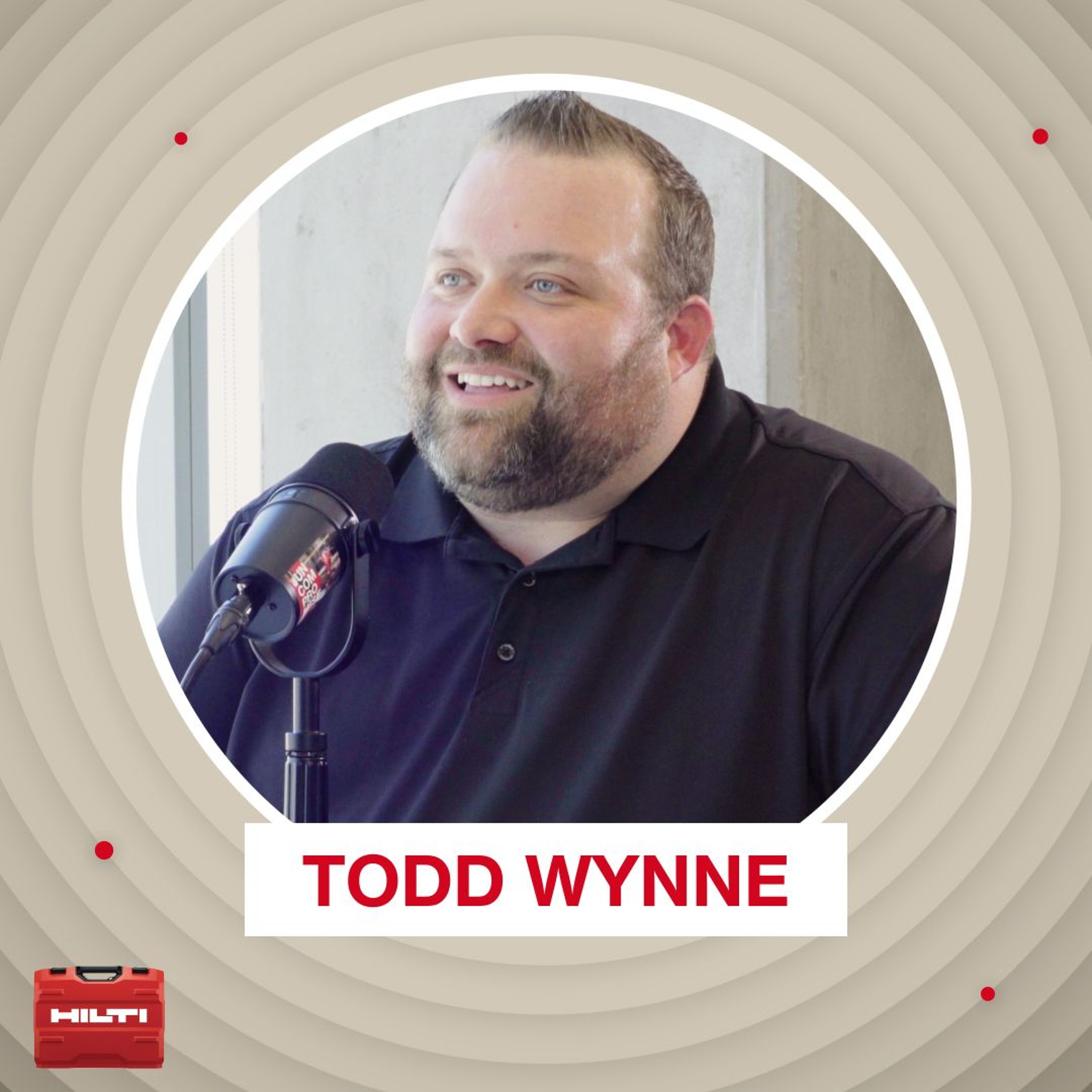
Todd Wynne on construction's role in shaping our world
55m 13s
In this podcast interview, Todd Winn shares his journey from a hands-on builder to a construction technology innovator. He began in operations but was naturally drawn to leveraging technology for a competitive edge, becoming the informal "shadow IT" on sites. A key realization came when he saw the disconnect between detailed digital models and the workers in the field, prompting his mission to bridge that gap. This led him to a role focused on construction technology and co-founding a company later acquired by Bluebeam. Reflecting on his favorite project, a fast-tracked hospital, Winn attributes its success less to the tools and more to the exceptional team collaboration and shared learning mindset. He now passionately argues that team health, alignment, and communication are the foundational elements that most significantly impact schedule, cost, quality, and safety. He concludes that fostering a strong culture starts with the language a team uses, which creates the clarity and focus needed to overcome the inherent complexities of construction.
Welcome back. I'm Ali Hernandez, and you are listening to In This Case, a podcast from Hilty North America. This season, we are hearing stories from builders. We're hearing about their favorite projects, to how they got into construction, and now what they're doing to make the industry, they love even better. To bring us these stories, we have our special guest host this season, Tyler Campbell. Welcome back, Tyler. What's up, Ali? How's it going? Okay, we've another story from a builder this week. I'm super excited. Who are we hearing from? This week, we get to talk to Todd Winn. I've heard him described as a vibe. Todd is a vibe, and it is so accurate. He's so awesome. We get in a room, and it is loud, and it is so much fun because we have these really deep conversations about the industry and all of these, you know, it just makes you think. So when we talked about who do we want to have on the show, Todd was right there. And I think you actually recommended him first, but I started geeking out. Yes, yes, yes, perfect. Awesome. Todd's perfect for this. Exactly. I met Todd at World of Concrete in January of this year, and I thought, I love this guy. I got to talk to him. No, he's so great. I cannot wait to hear what he says to you and the insight to give us about the industry. Oh, yeah, he's awesome. So you want to hop into it? Let's do it. All right. Let's get this thing. Let's get this party started. Who are you? What do you do? All right. What do I do? Well, how big of a backstory? What do you want? We don't need to go all the way back to eighth grade, but like, you know, we could jump forward just a touch. Yeah. Yeah. Yeah. Yeah. Okay. Cool. Well, I'll try to, I can get a little wordy. So I'll try to give me a look of like wrap it up, Todd. You're in good company. Thanks, buddy. Now you're good. Cool. So Todd, when Chief Innovation Officer Rodgers of Brown Construction, I started in the industry, Tyler, as a builder. Okay. A lot of people see me as a technologist and an innovator, but I'm a builder at heart. Yeah. So I started in operations, worked for Balfour Bede and Ops for just under three years. Built a couple buildings, but man, my story really goes to the end of the right place at the right time. Okay. I mean, that's the truest, truest beginnings of my story. Yeah. Again. How was the guy in college who was modding his Xbox to meet his friends at Halo? Yes. Trying to find that competitive advantage to win, right? Because I'm very competitive. I want to win. Want to find that better way, better outcome. And so yeah, I became kind of that shadow IT on the job site. Yeah. I was the guy, Todd, the printer's broken. Can you fix it? Yeah, I can fix it. But it got to a point where I was like, you know, there's a lot of other things we could be leveraging right now, like the cloud. So this was like, when I came out of school, it was 0809 recession. And yeah, it was really just being able to start to, luckily, I had a team that was supportive of trying new things. So I had a great general superintendent, a great senior project manager that were like, you know what? Let's see what Todd can come up with some new ways. So I was building my first project was a mega church. And that one was all paper based. I mean, we were in the process of moving into the blue beam world of digital at the time. Yeah, yeah, yeah. And if you look at Blue Beams trajectory, it was really around 2010 when things started to click in and play. So right, yeah. Right place, right time. Yeah, yeah. Then it was, but we were still, we were doing all this cool stuff with Navis and the model. And then we would have blue beam. We started digitizing workflows. Yeah. But we were still putting it through the model through the deli slicer. We were printing that out on these papers, right? Yeah. And I gave this while I was building my next project was this hospital up in Frisco, the north of here, not far from here at all. And on that job, that's when the iPad came out. Nice. Well, it was April 3, 2010 when the iPad came out. I can remember it like it was yesterday. And if you remember, the first iPad didn't even have a camera. And there was no app store. We had to actually get the documents through iTunes. And it was really the iPad too. And that came out in 2011 into 2011. And you know, while the whole media news was like, oh, it's just a giant iPhone. Yeah, yeah, yeah. I saw it as no way. This is the first multi gesture driven device that could actually service the deskless worker with. Yeah. And then you can just go to the computer and you can just go to the computer and you can just go to the computer and you can just go to the computer and you can just go to the computer. And then you can just go to the computer and you can just go to the computer and you can just go to the computer. Forrest Harrison, my general superintendent, we're standing on a slab. We're about to pour some concrete. And I said, Forrest, check this out. I have one of those motion tablets before the iPad. And I said, I have the plant table on the pole in my hand right now, man. Yeah. Like no more walking back to the trailer down those gang ladders. Just to go look up, you know, the sleeping drawing that went around here checking the electrical or so. And I'm getting a question from another trade and he said, well, that's great Todd. Pull up S302 because we were in that structural. Yeah. Yeah. Yeah. Well, I'm sitting there with the stylist trying to pull it up and it was terrible. Terrible experience and he's sitting there tapping his foot. And I can tell he's getting antsy and he's already got the drawing open. Right. Yeah. Yeah. And finally, when I get it open, I'm open it up in blue beam and I'm like, look, here you go. And he said, well, that's great Todd, but it's got to be this fast. Yeah. Or it'll never work. Yeah. And what was there was a it was a crazy moment that occurred with me there and it was this. This realization that he was right. I was right too. Yeah. Like this is the way where it's headed because there should not be that separation from the documentation in the worker putting work in place. Yeah. So then that's when it became kind of my my mission to bridge that gap. And I was given this talk at a BIMS symposium and Joe Williams was sitting in the audience. He was the first BIM VDC guy at R.O. And he was sitting in the audience and I was speaking all these BIM guys and I was kind of metaphorically trying to punch him in the face a little bit. I was trying to say, hey guys, we're investing in all this coordination, all this upfront planning, which is great. But then we're putting it through a deli slicer and really it's the worker with the wrench and hand that stands between the successful execution of that coordinated model. And we're always we're not thinking about that person, that craftman, that craftsman that's actually putting the work in place. So that was really where I was trying to put a focus and Joe came up to me and said, help me come bridge that gap. Yeah. And that's when I left operations and I came to R.O. And we invented our first title. We invented a few over the years, but it was operations technology specialist. And I think a year later we changed it to construction technology manager. So it just was starting to evolve. By the way, I don't know if it's true, but the contact crew gives us credit for construction technologists. Really? Yeah, and I don't know if we deserve that. But because there were a lot of people thinking the same time. Yeah, yeah. James Benham and Josh Bone and Jeff Sample, they still give us that credit. But I appreciate it guys, but I don't know if I deserve that. And so then it was really trying to find ways to bridge the bridge operations to the BIM Topium future that we all imagined. I yeah. And then over the years, you know, was experimenting, learning and trying new things. We had this one idea called Atlas project Atlas. Yeah. And to be honest, a lot of people come up to me and go, so how do you think of starting that company? It was never intended to be a company. Right. It was just an idea that we presented at the BIM forum. And we were we knew ProCore, Bluebeam, Trimble, all these companies are there in the audience. Auto does. Right. And we were showing the idea to say, go build this. Like reimagine the way we access information. Yeah. And the audience's reaction was incredible. So Joe and I decided, let's try to do it ourselves. So we injured an app. Yeah. It got acquired by Bluebeam in 2018. Went over worked for Bluebeam and got to see the inner workings of a multinational technology company. Yeah. And then came back to RO in January of 2021. Gotcha. Okay. Thanks for the back story. Sorry for the long wind. It's all good. It's all good. All right. So we're here for a minute. Glazed over this. I'm going to bring you back just to touch. Let's go where I am. I'm going to bring you back just a minute. Yeah. What was your favorite project that you ever worked on? Because you mentioned two. I'm not sure if those were your favorites. Well, the hospital was my favorite. And I'll tell you why. Yeah. I'll tell you why. Because we achieved something that hadn't been achieved before. What's that? Peers the carpet. 12 months. It was a four-story hospital on a radius. Five-story parking garage. Three-story medical office building. All linked together with a sky bridge. And I mean, we flew. Yeah. And.
That's where Balfour was like, how did you all do this so effectively? Yeah. And that's where they had me start going around and training other projects. And it wasn't just me. There were other great thought leaders at Balfour. But we were really bonding together on trying to find ways to take what we had kind of learned on that project and then apply elsewhere. So Fort Hood was one we implemented these processes on the Perot Museum downtown, the beautiful Morphusist design with the first exterior escalator in the world. Yeah. DFW Airport. Yes. Yeah, that's some of those terminal rebuilds. The Omni Hotel downtown Dallas. So these were all projects that started to get to reap some of those benefits and those learnings. Yeah, yeah. But yeah, I think it was, and actually the reason why it was my favorite, it wasn't because of the, really the technology process or tools. It was the people that I was working with. It was that team that was, it was like, it was like magic. We all had each other's back. Yeah. And we all had this conviction that we were going to discover a better way. Yeah. And we knew that those better ways were only obscured by our lack of understanding at that time. Yeah. Yeah. So we were searching for it, peeling back the layers to discover. Okay, okay, Allie. I'm from Millageville, Georgia. I'm not familiar with DFW. So can you enlighten me? What are these projects that he is talking about? What is this? I am glad you asked because if you're from Dallas, you know the names of these projects. The Perot Museum. It's incredible. It's a staple of downtown. I didn't realize that the exterior escalator was the first of its kind. And just to give you some context, you ride this escalator. It's by floors the Perot Museum. On your left, you're seeing these giant T-rexes. You're seeing saber-to-tigers. You're seeing all the stuff that's inside the museum. And then on your right, you're just seeing the skyland of Dallas as you go up. I mean, it's so incredible. You know, I mentioned DFW Airport. Obviously, if you're from the area, you know that's the hub. I think it's the hub for the entire country. But again, I'm from Dallas, so I'm biased. So I think he's just, we need his context of things he's talking about. Our huge staples in DFW. It's incredible he's worked on these projects. Well, thanks for filling me in on that, because I'm completely clueless being from a small town. So let's hop back into it. But let's hear what he has to say about those projects. What does it mean to you? Like, I mean, just like, I know you've made me glaze over there, but like, what is the project like that mean to you? What it means to me, and you know, it's funny, Tyler. I'm learning now more than ever. This industry, it's so complex, right? And you know this. Everything we build as a prototype. We've talked, we've all talked about those. And we always measure the things that we think matter, which is schedule, cost, quality, safety. And by all means, those things matter. The thing that I'm starting to fall in love with again is this understanding of team health, team dynamic, team collaboration. Because and that's one thing I learned on that project, but I didn't really, I didn't put enough weight in it throughout my career until now. The last few years, I've now been, I'll be bullish enough to say that based on the way the project team is working together, will be the largest factor that influences the impact of your schedule, cost, quality, and safety. And what's that? What's crazy to me, Tyler, is the only industry metric we have around team health is a safety metric. It's EMR rating. Like, yeah, we don't have industry processes or metrics around measuring how well, what's the sentiment in a team? How well are they collaborating? How well are they each pulling their weight? How well do they, are they keeping that level of vulnerability and transparency to leave pride and ego at the door and really bond together to overcome the complexities in the build? Because every single project comes with just such a new level of complexity and that's why the greatest attribute a project team can have is their speed of learning. How well can they learn together to overcome and adapt to that situation and environment to achieve their desired outcome? So that was something that I now have perspective on what really was so special about that project for me. I thought it was the tools, the technologies, but you know what, those wouldn't even been effective without the foundation of that team health. Yeah. Man, all right. This gets a fire in my belly for one thing. Okay. Talking about like I'm six generation. Kind of crazy that we can try to get back that far. Yeah, it's awesome. This was preaching that I've had six births, which is like if you're building something you have to have friends, yes, teams, yes, have to build that community and when you do that, oh gosh. Well, anything's not right. Yeah. Anything. What's crazy about it is I've now, I'm now in my career where I can walk on a project, even if it's not an RO job, I can go walk on another project. And if I can spend a couple hours with the team, yeah, I get a good sense of how well they're collaborating, how well they're, to be honest, it's their language. Language defines culture in a team or department or a company. Yeah. And the way that they're talking, I can tell, oh, this is an aligned team. And by knowing that, I've seen a line teams that are set up with a not not so great plan, not a great estimate, not a great schedule, and they overcome it and make it successful. And I've also seen the inverse. I've seen a really good plan, great schedule, great, great estimate, become a project right down. Yeah. The team, the people, they, they siloed in their own swim lines and they didn't come together and realize that to go, if you want to, it's the old, I love this old African proverb, but it's if you want to go fast, go along. Yeah. If you want to go far, go together and that's the epitome of our industry, Tyler. Yeah. There is not one person on the planet that can build one of these buildings by themselves. Yeah. And I don't just mean they physically can't do it. What I mean is they can't do it with the knowledge or skill they have. And it's because, I mean, we've made the designs more complex. We've made the schedule time ones, just more unachievable. Yeah. The new types of materials that are being used. Yeah. And that's why the more we can recognize that it's not individuals that build buildings, it's teams that do. I think it will bring us one step closer to truly instrumenting the right level of measurement of what matters. And then everything else is actually a lagging indicator. Yeah. Yeah. What's the language that you're talking about? Yeah. Dig into that. Yeah. Like when you're going out on site and you hear, I say a language, we can drive some lines there, but like what sorts of things do you talk about? French? Yeah. Yeah. Yeah. Yeah. Yeah. What I mean by that is it's really. So think of it this way. You know, there's a there's a very simple mathematical formula for results. Okay. Clarity plus focus times time. If you and I Tyler say, hey, we're going to go do something. Say it's start a company, start an app, build a building. Yeah. We got to paint the canvas of what we're trying to do. Yeah. That's the clarity. Yeah. Then we got to go dedicate our attention, our focus to it. And if we can have when you add clarity plus focus together, you have alignment. And when you have alignment over a period of time, you achieve results. So the way that I can check for alignment is when I hear this person and I say, what's critical path today? What's most important? What's what's your biggest risk? And if I get a different answer from this person, this person, I know there's not alignment. I know they're not communicating. I know that they're not focused on the MIT, the most important thing. They probably haven't even discovered the MIT. Yeah. And there's a very simple question you can use. I stole this from the four disciplines of execution, 40x. Great book. Great book. I really highly recommend. Definitely. And what it is, it's a modified version of the question, but it's one that I've used and I preach internally at RO. And yeah, the question is if everything remains the same, what's the one thing that we get achieved today that would have the largest impact? That becomes your MIT. That's your most, you can call that, that's your critical path. Yeah. So even just starting there with getting the awareness of what are we rowing towards and are we rowing together? Yeah. The way that you do that is you use language. It's in language, what precedes the language we say, what's mindset? But what's interesting is mindset precedes language, language influences, hopefully behavior. And behavior influences mindset. So it becomes this.
cyclical wheel and guess what sits right in the middle? Culture. If you want to change the culture of your business or your department, it starts with what you're saying, because what you're saying is shaping the mindset of what people are thinking. And then depending on if you're not just naming it, you got to live it. Yeah, that's where we have, and it's really easy to see when someone is in to grow it. It's they're saying one thing, but they're doing something. Right. Right. Yeah. We want to be congruent with we say it, we name it, we live it. And then if we do that enough, we're shaping the mindset and we're thus shaping the culture. We create a level of alignment that then we can achieve anything together. Oh, love that. I mean, would you say communication side of things, you know, the team building thing, would that be the biggest challenge that we face in the industry right now? Do you think that's the biggest one? Yeah. I mean, I, you know, I definitely think that what I think we're reaping what we so on the skilled craftsmen ships side, the art, the art of the business. I have a lot of concern for and I know you do and we're all on there. But yeah, I think that the way that we can overcome that, if you go back to like, what are ways we can fix it, I think it even starts with, we have to communicate better. And, and it's funny when you look at construction, you know, I always, where I'm explaining to a friend, it's like I use the Lego analogy, right? We all do. Yeah. Yeah. Yeah. Yeah. This is what we're trying to do. Make sure we get the right legos, put them in the right place. But yeah. It really is a combination of documentation and communication that makes that effective. Yeah. And we put way too much focus on just the documentation side and we, we don't, we don't take the time to use questions to calibrate understanding. Like what we'll do is we'll say, go do this. Yes. And then, and then we assume that the way that we were delivering that message, it was received in the same way. Yeah. But we all know that as human beings were complex, we even perceive words and their definitions differently. And that's why it's so important. I mean, you get to say it 11 times. And then you got to have them ask questions and yeah, and I even challenge my own teammates like, okay, we're aligned, right? Well, you now you get up and paint what done looks like. Yeah. What does it look like to win at this? Yeah. And we calibrate to make sure that we have alignment. And I think that's one of the, that's one of the things we don't do well enough in this business. But but I understand why. And it's because our time to decision making is just a compression, an environmental impression that doesn't give us that afford us that time. Yeah. I love technology. Okay. Two, man. It's going to change things. We know it's all right. We're like, you know, back to using that motion tablet. Yeah. Like, you know, like you could see it. Like this is, this is going to enhance things. We're getting to this place now where we as an industry, sometimes we think that technology is going to solve all of the problems. And especially like the communication problem that we're talking about, like, oh, if we could just communicate in one place, yeah, not saying that that's a bad thing. No, that's not what I'm advocating. I think that is wise. But we over look at and we think that tech is going to fix every single bout of our industry. But the reality is is that people influence every part of our industry. 100% influence technology that we use. Yes. Right. And speaking from a detailers perspective here, we had, we had new people come in. We have this amazing software that we use. It's very capable and like world class, right? Yeah. Put them in the seat. Yeah. They've never built anything in their lives. The technology isn't going to take them there. It's the training. It's the invest. Yes. It's the, it's the mindset. It's where it's where you're showing them what's important, where focus needs to be. And then the process that's used to achieve that desired outcome and the tool, those are just subsets. Yeah. And that, you know, the reason I think we do that though, Tyler is because it's the path of least resistance. It's easy. It's easy to, it's easy to assume that AI is going to fix everything. Yeah. And you're talking to a guy who I'm excited about. It's, yeah. No, we're leveraging it right now. Very bullish on it. Absolutely. But I know at the end of the day that it's not a process or tool problem that we have in this industry, it's a mindset problem. It's, it's, it's, that's the problem. It's, and here's the thing. You know, our industry has always been, I think very under, I think unfairly represented as an industry that's slow to adopt. And I mean, what I always like to say is, who can adopt anything when they're firefighting? Like that's, that's great, man. You know what I meant? Solid. Yes. Yes. I mean, that, that's what, so you know what I used to say though, Tyler, I used to think that the reason we were slow to adopt is because the, the technology companies weren't building us the right, the right tools for our environment, which I do think they're still waiting that. Like for instance, until we had the iPad, we didn't even have a way to take the plan table effectively. Right. To the field. Right. And I say the iPad, I know there's surface tablets and all these other things, but that one was really the first kind of platform that gave us had a long battery life, it had rugged nature. We could, when you put a case on it. Yeah. And we were able to start bridging that gap and, and making our people in the actual trenches in the field where the work gets placed more effective without having to travel time. Yeah. So I used to think that, yeah, this is why we've been slow to adopt. So we just haven't had the right tools to surround our people with the right environmental factors to leverage them. Yeah. But where I was so wrong, that's, that's just a piece of it. That is a piece of it. But the biggest piece is that we're always in a state of reaction. And if you ever want to practice doing something a potentially better way, there is a really learning curve that comes with that. And it's really hard to learn something or practice something new whenever you have an enormous amount of pressure on you. Yeah. Why would I change things? Well, why would I change things because I am under pressure right now. And I know if I just do the thing that I've always done, I know I can get it done and I can deliver this because the client's on my butt. Right. And that's why you'll even see people start to use that new way and then right when the deadline starts creeping up, it's like, you know what? I grab the thing. Yeah. And by the way, I'm not immune to that. You're not immune to that. That's a human nature. If there's an emergency and we got to get it done to deliver, we go back to what we know on how to deliver. So I think that is probably been the largest contributing factor to why we get this reputation of slow to adopt. It's because we don't have capacity for proper change management to occur. You know, I keep pushing back against that mindset that the construction industry is slow to adopt. Me too, man. I just don't think that's true. I don't either. And I don't think anyone wants that to be true. You know, in the last 15 years. I mean, I was given a talk yesterday to our VDC group and I remember when that team was three people and now it's like 25 and seeing these young faces and seeing the way that we do things now compared to just over a decade ago. It's night and day. So I would agree with you that if you really zoom out to the forest, we've been very quick to adopt and change, especially when you consider how we built these projects. If you go back a decade ago and then go within that last hundred years, I mean, it was very, very similar. I mean, I even joke sometimes and say we went from the pyramids we were using papyrus to paper, right? Like it wasn't that big of a, yeah, but it's still a change. But, but, but no, I really think it comes back to, because there's still things that we have opportunities to capitalize on today. And, and it's like we're getting inches. And, but I, and I'm not saying that I'm not advocating saying we're slow to adopt what I'm saying is give the industry some grace because we are doing things that no other industry has to figure out. In other words, manufacturing retail, they all, they're not, they're able to optimize, they're able to optimize because they have controlled environments, they have repeatable patterns, they have staging systems that do not change. That's why I even joke with our people and I say, you know, we go and we tell a client that pick us to build your project because look at this, look at these projects that we've done that should give you the confidence that we can do yours. And the whole industry does that. But I honestly think that's not the most accurate message we should be delivering. And the reason why is because if you really look at how these projects come together. That new project that we're proposing on, it's a new schedule. It's a different design, it's a different team, it's different materials, it's different location.
different environmental conditions. It literally is a prototype. So even though you've done projects like this, you are going to have to adapt and overcome the novel uniqueness of this project. And that's why our speed of learning as a project team or as a company, that's our greatest competitor, the niche. But what we should be saying to a client is not pick us because we've built these. What we should be saying is pick us because we understand how to obsess over a problem and how to adapt and overcome quickly to address your needs. All right, Tyler, this point about technology and adoption and construction is super interesting to me. I don't know if you know this, but a healthy we have a job site to office solution called fieldware. And this is how you get the plug in there. Didn't you? You had to get the plug in. It's a healthy podcast. Let me tell you about fieldware. So the solution is designed. The solution is designed for builders by builders. For this reason that Todd mentions, right? We at Healthy wanted to make sure we were offering our customers the right solution that actually met their needs. That's how we approach all of our offering solutions. But I think my question to you is all of this is still dependent upon individual competency and team health and performance, right? So how do we improve those things if we're always in this firefighting mode that's described? Honestly, if you're in firefighting mode, it is very difficult to improve those things. All right. And my brother, Eddie, and I, while we were working as retailers in the industry, we had this thing that we used to talk about where have you been? Have you kids played T-ball yet? Or like, so like when you watch a kid play T-ball, right? The ball gets, it comes to you, you field it, and you see one of these kids scramble and freak out and they try to throw it over to first base. But what they do is they throw it over the fence instead. That's the type of stuff that happens in firefighting mode. It's just stupid errors that nobody really intends to happen. So it's really, really hard to address some of these challenges when you're in firefighting mode. So that's why I'm excited that some of these new technologies are going to help us be a little more calm, be a little more collected, make sure that we're doing the next right thing. Right. Because there is no way to grow if you're in firefighting mode, just full stop. But let's talk about what Todd is doing to address some more of these challenges. What are you doing to fix this? Like your day to day? Yeah. What does that look like? Yeah. All right. So like we say, all this, this tough, it fires me up. And we could talk about that for three hours for the sure. Yeah. What are you doing now to address some of these challenges? What's your day to day? Yeah. So my role, so luckily I get to work with some incredible people and they deserve the credit Tyler. I mean, I'm kind of a big believer that in life, there's dreamers and engineers. And that's what moves society forward. Yeah. And I definitely fall into the dreamer category. I'm a practicing futurist. I can't help it. I live in tomorrow. Yeah. So I try to, I try to paint that canvas best as I can and then get out in front of people and remove roadblocks so that we can recognize those intersections of opportunity. What does that mean specifically? Yeah. So I oversee six departments at R.O. IT, VDC, field engineering, quality, R&D, and operational excellence. Okay. So three of these departments didn't exist three years ago. Okay. So one thing I've been doing Tyler and I really challenge anyone that's watching or listening. What got you here is not going to get you there. And if you're just looking for the new shiny hammer, you're selling yourself short. We need to innovate at the org structure because the org structure of where people are sitting on the bus is what is going to give you scalability with introducing right processes, new processes, better processes, and then of course better tools to achieve whatever those new desired outcomes are. And you shouldn't just start creating new positions and overhead. But what you should do is first take the time to really determine what you're trying to achieve and ask yourself that question. That I said earlier, if it my company, company acts, if everything remains the same, what's the one thing that we could get better at and it would have the largest impact? And then you need to look to the lens of do we even have people position to achieve moving the needle on that outcome? A lot of times we don't. A lot of times that's why we've seen these roles pop up within these existing departments and these operations technology and it's, oh, it's under the pre-con department or under the IT department. And it's because what's happening is it's trying to burst out. These new, this new way of building is trying to say, let me out. But instead we're trapping it in analog work structures. So I'm not saying we need to add a bunch of new departments. What I'm saying is you need to look at even evolving the ones you have. So for instance, for us, we created a digital RO playbook with all of our process manual SOP back in 2015. And we had this great ambitious idea that we're going to pull some people off their, their current responsibilities. We're going to do a little tiger team put this together. And then the way it's going to maintain and manage itself is through this beautiful crowdsourcing model of people in the company. And it was a total failure. It was a total failure. And the reason why it was a failure was because everyone's firefighting. Everyone's too busy. So everything that we put in it became obsolete in a year. It was good for the first year, but then there was no one grooming it, maintaining it, updating. So one of the first things I did when I came back to RO was establish an op-ex department. And I took one of the best superintendents and two of the best project managers in the company. And we made an investment to put them in an overhead department that all they do is they own the RO playbook. And it's funny because people say to me, "But Todd, if you overstandardize, well, that's going to conflict with being innovative." What I really say is, think of the way we build a building, the more solid your foundation, the higher the more vertical you can go. The whole reason we want a certain level of consistency is because it provides predictability. And if we have predictability, we can plan. So now, building that baseline of predictability then allows us to introduce new experiments, new learnings to then uncover those better ways to generate those outcomes. So that was one new department. Another one was R&D. It's really just two guys. They're amazing that I have. I have James and Hagen, Dr. Hagen Fritz, and these are kind of SEAL Team 6 of the company. We test them on challenges and problems that are existing departments in old structure do not currently have a process to fix that challenge or problem. So they're kind of being constantly moved to where to solve something that is out in the fog. They are the ones who step into the fog and start uncovering it and working with our SMEs across the company. The last one, the most recent department we created was field engineering. So traditionally field engineering at RO and many other companies lives within operations. And this was a huge wake up for me. As a BIM guy, I totally, totally screwed up Tyler. That's the beauty of innovation, right? There's license to screw up all the time. That's where learning lives. Amazing. I loved what, I think it was Nelson Mandela who said we never lose. We either win or we learn. Yeah. And that's what failure is. It's just learning. So, so where I really learned a lot was I had this say, it wasn't just me, Joe Williams, to my co-founder of Atlas and and former boss at RO, brought me to RO. It was this belief of creating a BIM enabled workforce, which I still do believe in. I believe in bridging that BIM toopia to operations. And so we were we were a training department. We were training everyone on how to model and rev it. We had superintendents creating their own lift drawings in the company. And what would happen is they would have such success on their project, they'd all get promoted. And then we're like, now we got to start over. So that became a challenge. But, but the thing that I was missing, Tyler, was what connects the model to reality, coordinates. That's the interstitial layer of bringing the digital world to the physical world. And I missed it, man, but I'm not missing it now. So we actually pulled all of our, we've about 26 field engineers across the state of Texas. Yeah. We pulled them out of operations, put them in their own support department and have bridged it between VDC and operations. And these will become the future robot was birds. Interesting. I love
I love, hmm, I love the mindset of failing. Yes. Like fail often, fail often. It's like all of these things. And you don't have to like it. That's what the room said. But I understand that the price of entry to discovering a better way is sometimes failing. I think often, and it's easy to do this man. Like I mean, I run businesses, you run businesses. It's like, it's easy to get into that comfort zone. Oh yeah. Things are run it smooth. Yeah. I don't really want to mess with it, right? Status quo. Everything's just rolling. I mean, checks coming in. Stuff like, it's easy to get there. As a business owner, as a project manager, as a VDC. It does not matter. And that's why it's so important to invest in your people. Yes. And focus back on them and encourage them to fail. Yes. And applaud them when they do. Yes. Absolutely. I remember when I screwed up. I, that hospital I told you I loved. That I built. Yeah. I caused a $50,000 mistake by myself. And I was like, I'm gonna get fired. Was it? Is it? And you know what? My superintendent said to me, it's sad. We just invested 50 grand in your learning. Yeah, I loved that. And I loved it. I loved it. What? Now, I still felt like a goofball, but he said, you ever gonna do that again? I was like, no. And it was a whole measure once. Cut once. Yeah. But yeah, so failure, it's one of those things where I, I don't glorify it in the sense of like loving it. I don't want to lose. I want to, I'm a competitive person. But I understand this. If you're someone who says, I want to be innovative, I want to find a better way. Well then you also have to swallow the medicine and acceptance of knowing that failure is in front of you. And it's up to you to choose. You can't have your cake and eat it too. You can't discover a better way and not ever fail. That's not how the game works. So that's also, you know, it's funny to, I have so many people come to me and go, how do I make my company more innovative? Innovation is an outcome. It's an output. You can't make yourself more innovative. You can't make your company more innovative. But if it's an outcome, and by the way, I can prove it to you. Because it's. Yeah, I can give us some examples. Yeah, I give us some. What's something that you've seen in the industry that you're like, man, that was innovative? It could be anything, doesn't mean. I'm not sure, man. How about drones? How about lasers? How about lasers? Laser scanning. There's so many. Right. So pick one. So let's say drones. Okay. So drones have given us a flying super-intinent eye in the sky, visual intelligence. I mean, it's almost like the old sci-fi movies where you have like, we're not even sci-fi, but like the old battle planning movies like A Harrison Ford or Tom Cruise is like, put the satellite imagery, the tank mobilizations. We have that intelligence on our jobs now. But I remember whenever I flew my first drone and it was inside one of our boardrooms at R.O. It wasn't even a quadricopter. This was. By the way, that's a cool fact. Did you fail at flying it? That's the question. This is one of those. Oh, Crashy McGee. This was like a sharper image like helicopter. This was before DJI came out with the first quadricopter. Oh, yeah. I remember, man. I had one. We still have the original. We were actually the first company in Texas to get drone insurance. Really? This was way before FAA had done any reforms. We had to get a custom policy because we were in the Wild West of using these. Yes. But so back to innovation. I remember. Here, let me tell you why we tried to even get a drone. It was really just. I needed a flying camera. And there was a project that we were building out in Fort Worth called One City Place. And it had these precast panels. We had already finished it. And some of the panels started cracking. Yeah. And the structural engineer was like, "Go get some photos, some video. Let us see it." Right. And it was occurring. And there was another construction project happening right beside it, right below. So we couldn't get a lift or anything. We actually had to rent a swing stage and come down from the top. And it was a two-day process, $5,000 just for some photos. And that's when I. You know, necessities, the mother of inventions. And we were sitting there going, "Can we not just attach a camera to a helicopter, like a little. And just fly it up there to get these photos?" Yeah. And then we started by a little sharper image. This was before DJI and this was 2011. And. Yeah. And the first Phantom One came out, I think, at the end of 11. Yeah. So I'm flying this little sharper image, Compton. And I remember our CEO at the time, he opens the door and he sees it. And I'm like, "He thinks I'm just playing during the workday in this boredom." Because he gave me kind of a look and was like, "I don't know what he's doing." And walked away. But at that time, it seemed. You know, innovation, it's always something where it seems a little crazy, it seems different, it seems silly. Yeah. Sometimes seems stupid. Yeah. And then, now, when we look back at what drones have been doing for our industry, I think it was the JB Knowledge Report in 2018 that showed more than 50% of GCs in North America were leveraging some form of drone technology. Yeah. So we reached a level of that tipping point of over, of starting the C saturation. And the way that we classify drones as being innovative is in our rear view mirror. We say, "Wow, yeah, that was innovative." We do that with everything. So that's why innovation is an outcome, it's an output. And usually we can't even evaluate and determine if it created a better way until it's done. But if innovation is an outcome and it's an output, then what are the inputs? That's the exciting part because that's where we can put investment and practice and mindset and communication. So I've been trying to document what the inputs are throughout my journey in my career. And by no means do I think I have it all figured out. Of course, yeah. But the ones that I absolutely, I mean, they've proven results for me. The first one is curiosity. If you're not curious that there could potentially be a better way, then I promise you'll never discover it. You got to at first just say, "I bet there's a better way to do this." It literally starts there. Yeah. And that's why the first thing I'll even tell people is just, you got to stay curious. You got to be curious at all times. Any flow and learner just curious of what could be, what assumptions are constraining our thinking today because we're wise to a world that no longer exists. There's new technologies, new ways to accomplish something. If we just think a little differently, that's that curiosity. The second is courage. Sometimes you got to be the first one dancing when no one else is. Right? Yeah. It's amazing when you do start that learning and discovery through that curiosity and courage of experimentation. Yeah. I mean, it takes a lot of guts to say, "I'm going to try something different." Yeah. Like, "Whoa, you just put yourself out there." It feels very much like you're exposing yourself to a high level of risk, which in some ways you are, but our brains overblow it. Because you can also build in capacity for failure to occur intentionally for learning to occur. And treat it like safety. So safety at RO, our definition of safety is not the absence of accidents. We know accidents will occur. That's why it's the definition of an accident was an intentionally meant to happen. Our definition of safety is building in the capacity for failure to occur safely. We're predicting that an accident is going to occur. Why are we putting netting around a building? We know stuff's going to fall off, but we're going to catch it. We're going to let that failure fail safely. I always love using the rumble strips on the highway. When you're going out of the lane and you hit those rumble strips, you're failing safely, get you back in the middle of the road. So you can do the same thing with innovation. You can try and experiment with things that aren't compromising the critical path, aren't compromising safety, aren't compromising. It's the pillars of the build quality. Already said schedule, schedule, oh, cost you. That's a big one. But it takes practice to be able to learn how to do that well. And we're still learning at RO on how to build in capacity for some of those learnings to occur without compromising those pillars. And that's the courage side. The next ingredient or input is diversity of perspective. It's amazing how many people are trying to figure something out by themselves. And I just pity them. Yeah, I pity them. Because every great idea I've ever had was not solely my idea. It was put in this washing machine of perspective and then spit out. And every time we threw it in, someone else's washing machine, it's spit out even better. And so that's huge. And then the--
The next input is your speed of learning. You have to, you gotta treat everything as a hypothesis that's gonna be validated or invalidated. And this is where I say, don't fall in love with your solutions. Don't fall in love with your ideas. By the way, I messed this up. Oh yeah. I used to. Pride enters the equation very quickly. Well, pride in being like a technology nerd. I'm like, I see something. I'm like, oh, I want to do this. I'm excited about this. And I fall so much in love with the solution and the idea that I forget the problem I was trying to solve. And that's why what I preach at RO is we're not in love and obsessed with our solutions, ideas were obsessed and in love with the problems and the outcomes we're trying to create. And the more that we can practice that with language and mindset, the more that you'll be successful and be able to take an agile approach at trying new things and experiment with new things because you're trying something. You're trying that new shiny hammer, but you're not looking to the lens of like, I want this hammer to work. Yeah. What you're saying is you're looking to the lens of, did that move the needle on our problem? Did that move the needle on our outcome? No. Is there a different way to approach it? No. Let's try something else. And obsessed with the problem. Obsessed with the outcome. And then the last ingredient that I've discovered is keep it fun and light. That's what I encourage to everyone is, you know what I, so I have two little girls. And hopefully there'll be builders one day too. They want to be able to. Yeah. I want to be a builder like Daddy. They still think I'm like a super intended putting the work in place. Daddy, yeah. Daddy is a different kind of builder. Let him believe that for a while. Yeah, yeah, totally. I just lean into it. Oh, yeah. So Kennedy is eight and little Tuddy Lee's four. And before they go to school, I say to him every day, what are we going to do today, girls? And they repeat back simultaneous, be kind and learn something. And I just, I wish that we could all practice that mindset in this industry. And we have amazing people in this industry. Amazing people that are just, just really purpose and pride of what we're putting in place. I mean, we're literally shaping the geometry for everyone. Yeah. And I mean, I don't know if I've ever told you this. There's a cool quote I always love to use. It's, you know, in November, I think it was November of last year when we crossed eight billion people on the planet. And if you really add up how many people out of that eight billion are in the AEC industry, it equates to about four percent. Four percent, Tyler. Four percent have the moral responsibility to shape the geometry for the other 96 percent. Teachers, doctors, lawyers, scientists, the athletes we admire on TV, they all live in the geometry of our creation. And to me, there's no greater purposeful industry or career than that of a builder. Do you, we're going to close up shop? I think that's a slam dunk ending right there. Thanks for being here, man. Yeah. No, thank you for the opportunity. Yeah. And man, seriously, thank you for everything you're doing. And I, from the bottom of my heart, man, thank you. I mean, appreciate that, man. Totally. Wow, Tyler, what a ride. Todd is basically a motivational speaker. Yeah, he is. He's a bad. I'm telling you, he's great. I love him to death. Every time we get in the same room, it is loud. It is very loud. I mean, you guys covered so much to his background in the industry is super impressive. From, you know, we talked about technology and failure and innovation. In this last point, about only four percent of the world's population in the architecture, engineering, and construction. So the AEC industry are responsible for building the spaces for the other 96% of people to live and work and play in. What a staggering stat. Yeah, it's absolutely insane. Take a second, go back and relisten to that and just let it sit. Just think about this for a second. Four percent of the world's population helping build all of our hospitals, all of our roads, all of our bridges, all of these things, holy smokes. Well, we need more people in the industry. Let's go back and listen to Angie's episode again. Get those young people in the trades. I mean, it's super impressive. Everybody should be super proud who's able to contribute to this purpose because what a great one to have. Thank you so much for this story. I love that we got to hear this story from another builder and we have another one next week, don't we? Oh, we do. We got more. Thank you, Tyler. And thank you to everyone listening to this case this season. We will be back next week with another episode. See you then. [BLANK_AUDIO]
Podcast Summary
Key Points:
Todd Winn is a builder at heart who transitioned into a technology and innovation role in construction, driven by a desire to find better, more efficient ways to work.
A pivotal moment in his career was realizing the critical gap between digital planning (like BIM models) and the on-site workers executing the plans, leading him to focus on bridging that divide with technology like early iPads.
His favorite project was a hospital build, not primarily for its technology use, but for the exceptional team health, collaboration, and shared mission that enabled rapid, successful execution.
He strongly advocates that team dynamics, alignment, and effective communication are the most crucial factors for project success, even more than plans, schedules, or estimates.
He emphasizes that changing culture starts with language, which shapes mindset and behavior, and that alignment is achieved when a team has clarity on and focuses collectively on the "most important thing."
Summary:
In this podcast interview, Todd Winn shares his journey from a hands-on builder to a construction technology innovator. He began in operations but was naturally drawn to leveraging technology for a competitive edge, becoming the informal "shadow IT" on sites. A key realization came when he saw the disconnect between detailed digital models and the workers in the field, prompting his mission to bridge that gap.
This led him to a role focused on construction technology and co-founding a company later acquired by Bluebeam. Reflecting on his favorite project, a fast-tracked hospital, Winn attributes its success less to the tools and more to the exceptional team collaboration and shared learning mindset. He now passionately argues that team health, alignment, and communication are the foundational elements that most significantly impact schedule, cost, quality, and safety.
He concludes that fostering a strong culture starts with the language a team uses, which creates the clarity and focus needed to overcome the inherent complexities of construction.
FAQs
It's a podcast from Hilti North America featuring stories from builders, covering their favorite projects, career paths, and efforts to improve the construction industry.
Todd Winn is the Chief Innovation Officer at Rodgers of Brown Construction, a builder at heart who started in operations and now focuses on technology and innovation in construction.
He started as 'shadow IT' on job sites, fixing issues like printers, and later leveraged cloud technology and digital tools like Bluebeam and iPads to streamline workflows.
His favorite was a hospital project in Frisco because the team achieved a fast pace (12-month schedule) and demonstrated exceptional collaboration, which he now sees as key to project success.
He emphasizes team health, collaboration, and alignment, stating that these factors significantly influence schedule, cost, quality, and safety more than plans or tools alone.
He listens to the team's language and asks about critical priorities; if answers vary, it indicates a lack of alignment and communication.
Chat with AI
Loading...
Pro features
Go deeper with this episode
Unlock creator-grade tools that turn any transcript into show notes and subtitle files.
 PodcastTranscript AI