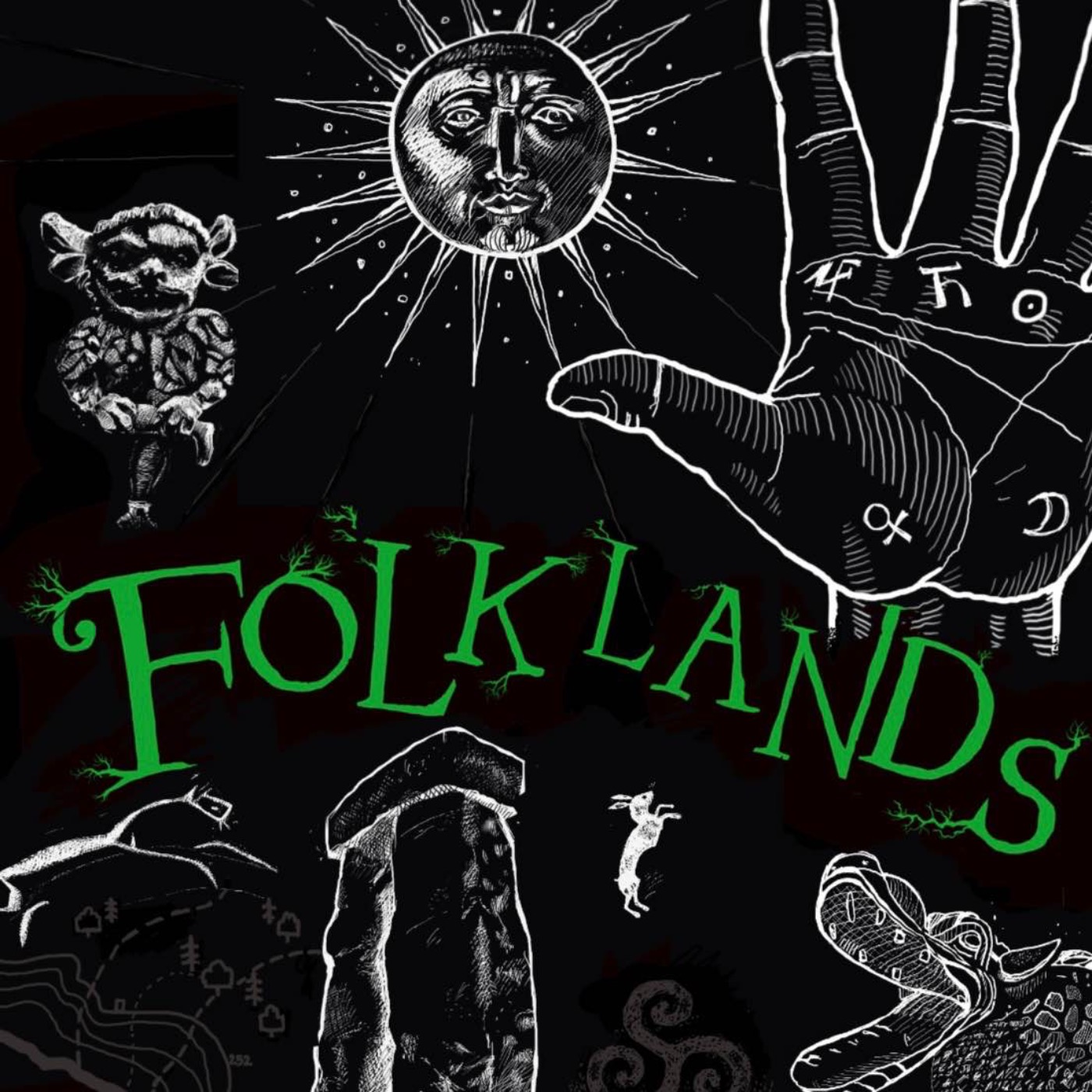
Folklands, created by Tim Downey and Justin Chubb, explores Britain’s enduring myths, legends, and folk traditions through real-life investigation and storytelling. The podcast draws on personal childhood memories of eerie children’s television shows like *Children of the Stones* and *The Shadows*, which instilled a lifelong fascination with the mysterious. Through vivid personal anecdotes—including a sealed wardrobe containing a perfectly hung suit and unexplained footsteps—the creators highlight how ordinary places can hold deep, unsettling significance rooted in family superstitions and local history. A central theme is the layered atmosphere of places, such as hill forts or areas like Center Point in London, which retain a sense of mystery and spiritual energy despite modern development. The show also references historical erasure, such as the Roman abandonment of certain sites, suggesting that these places were deliberately forgotten, leading to haunting legacies. The team’s mission is to explore the interplay between place, time, and story, seeking to capture the tangible atmosphere of folklore through on-location exploration and authentic human encounters. Their journey blends personal history with cultural myth, aiming to uncover what makes certain places feel uniquely alive with the past.
[Music]
Folklands created, written and presented by Tim Downey and Justin Chubb.
Many episode, Times, Past and Present.
My name is Justin Chubb and together with my friend and fellow actor writer Tim Downey,
we're setting out to explore some of Britain's most intriguing myths and legends out on location
using our trusty Zoom H6 handy recorder.
Before we started our investigations, we met up earlier in the year at my house
a 200-year-old farmer's cottage in North London where we had a chat about some of our influences
and inspirations from childhood and also discussed our ambitions for the coming series.
So come back with us to a cold night in February over a bottle of fine ale
for today's mini episode, Times, Past and Present.
So Tim, what's your first spooky memory?
As a kid, I remember the Dracula ladybird horror series that they had.
There were like the horror classics that they had Frankenstein and the mummy and they had Dracula.
I was terrified of just the cover.
And it was a regular ladybird book.
Regular ladybird book, I bought it in the post office, in our local village post office.
I was like, "Oh, I'll get this."
Secretly, I don't think my parents were sort of, "Oh, I don't know, this is right for you."
I said, "Okay, this ladybird, exactly, I mean, they teach you what an apple is, surely I can look at this."
I remember having it, but it absolutely terrified me.
Just the cover of this kind of bloodless face pulling himself out of a coffin with red eyes.
I used to hide it at the bottom of the book cupboard, but it was the thrill of kind of knowing it was there.
I don't want to look at it, but I know it's there.
And then you would sneakily kind of just have a little look,
and it's still, yes, it's absolutely horrible.
What about you?
Because I'm slightly old and new.
I was a child when things like children of the stones were first on.
The changes, the idea is lovedites, takeover and everybody stops trusting technology and cars that scrapped
and no one will go near any machines.
I remember my brother and I playing games afterwards of the changes, you know?
Yes.
Yes.
Not wanting to go near Pylons, because in the show, it's, "Nikki, don't go near the Pylons!"
You know?
So, Pylons became quite a scary game.
And, yeah, there was this golden age of children's spooky tea time television,
that I think tapped into a lot of people like ourselves and grown up into this sort of fascination
with sinister, mysterious, oldy things.
Yes.
But there were three women pioneers of television, I suppose they were, really,
who kind of control a lot of that spooky programming and a home,
Ruth Boswell and Dorothea Booking, and they produced or directed lots of these spooky things,
time slip, the moon stallion, raven was the sort of follow-up to children of the stones.
There were just so many of these things and shadows, I think you remember the shadows,
which was basically really scary programs for children at tea time,
half an hour ghost story, and some of them were genuinely quite unnerving.
And also written by people like Fay Weldon, like extraordinary writers,
writing episodic.
But at first, version of The Darker's Rising is an episode of the Shadow series.
Easy, yeah.
I didn't know that I'm going to have to go back and rewatch that most definitely.
And similarly to you, there were definitely books that sort of were scary,
or had scary pages, or scary things, but were sort of fascinating.
Mysteries of the world, or the unexplained world, you know?
Yes, I remember like a crystal skull with lights kind of emanating.
Yes, that would have been Arthur C's car.
Arthur C's too clever.
Yes.
And the friend of mine worked on that series actually was so jealous of him going off and researching all these things.
Oh, he wasn't interested in it at all.
Now I think that's the best job he could possibly have.
Why would you love on this?
To go to Spain and find the miraculous blood that returns every year in this festival.
Anyway, I'm fat.
I'm still terrified of spontaneous human combustion because of that.
That was absolutely terrifying.
That was in this very book.
Actually, he's tapped into a real memory.
Yeah.
There was one really horrible black-and-white photo of. I think I know the one.
It was a leg.
It was a leg.
It was a woman's neck in a not-too-attractive shoe.
It was in that book.
And that is exactly what I remember.
And it was the terrifying thing.
I think they write about the fire doesn't spread.
It is so contained.
And that photo with the leg on the floor.
And it's just almost like the shadow of her.
It is burned into the upholstery of her.
Absolutely.
Delightful recipes.
It's just horrible.
My family have got quite a lot of superstitious things attached to my mum's side of the family.
Really?
No, grandmother and my mother both read playing cards like tarot cards.
We had to keep cards away from my mum because she would ask the cards questions,
you know, and then be tormented by their answers.
And we also had a family Christian ball that was given to my great grandfather, I think, in Africa.
Yeah, we had the same.
I grew up in a village.
We were a very old house.
We called the cottage.
It used to sit and still does.
We were almost right in the centre of the village.
And the village dips down.
So there's that big hill and there's the old church called the Cathedral of the Chiltsons.
It's right at the end of the Chiltsons.
And it's quite big and dominating and we're all very proud of it.
But our little house was in the middle and it was very, very old.
We used to have problems with things like wasps nest.
So there'd be a sort of a drone in the house that you kind of be slightly unsettling.
But the story I remember is when my parents first moved in,
they were looking somewhere to redevelop and just kind of knock through a few bits.
And in their bedroom, there was a stud wall at the end of their bed.
And by knocking on it, you could tell it was hollow.
So they thought, "Okay, well if we're going to renovate, that's going to be the place we do it."
So they just stopped doing little bits and piecemeal here and there.
And then one day they decided, "Okay, we're going to take down that wall."
Assuming it would just be an empty space,
they could probably make something out of it.
So they'd take the wall down.
And it is a bank of wardrobes.
Inside this room.
Oh, okay.
Interesting.
Why would you have sealed this up?
You're reducing the space.
Anyway, they're looking through the wardrobes and there's nothing in them.
And yet there's one at the end sort of as it were facing their bed and they open it.
And there's a suit hung perfectly neatly.
The only thing there, one suit and you can't take it out and look at anything.
Okay, well, we'll get rid of that.
We'll put that away somewhere.
And then, like a couple of nights later, my mother tells this story of hearing footsteps in the distance,
walking up to the door.
And then you will hear,
"Oh my God, I should have gone on earth, earth is now."
And then she just wouldn't say anything.
And then you'd hear a. That's the feet went away.
I think, "Okay, nothing, I think."
Was this inside the house?
This was inside the house.
So it was walking towards the wardrobed door.
So it was behind the wardrobe.
Whether or not there were stairs there.
In a bygone time, no idea.
So it keeps happening and happening.
My mother keeps ignoring it.
And this one particular evening,
I think I was very young and keeping her up.
And she was very tired.
And it happens again.
Knock on the door.
And she just says, "No milk today, thank you."
And with that, she heard this.
Oh my God.
And the padding away.
And that was the last they ever heard of it.
Do you know why she said that specific thing?
I have absolutely no idea.
She said she was so tired.
And so kind of just exhausted by children.
And just that I think we were just the first thing.
The first thing that she said.
And it just happened to be somehow the right.
The suit was still in the house.
It was still there.
I think they just hadn't got around.
We'll just put it, we'll deal with that.
Again, that was obvious.
obviously the centre that was obviously where what he was after all this
person had this suit or left it who who knows such a strange thing well it's a
little bit like this sort of idea of things being left for deliberate purposes
as you know magical protection or charms something that's sort of been
deliberately disguised or hidden in that way you know uncovering a suit
hanging just to being actually quite eerie I would have thought very
eerie it's almost like a body yeah isn't it yeah and a suit on its own in a
sealed room yeah or a sealed wardrobe is a very strange yeah you're not gonna
think good things have you spoken to your mum kind of about that
subsequently and has she sort of said she was frightened or she wasn't
frightened at all she wasn't frightened at all she that initial time she was
very spooked yeah as just trying to work out what this what this could be is
someone walking past the house is it because we used to have a neighbor that
was behind could have been Gerald who knows but yeah on that particular evening
it wasn't frightened at all I've heard other stories about friends who have
seen things or felt things is that there isn't a sense of fear necessarily
no there is that sense of a presence but it's not necessarily a frightening
thing as you would imagine if you watched TV or something you see a ghost and
you are terrified you run away screaming and it's a thing of horror but it is
not necessarily like that no there are there are others that have a definite
sense of foreboding or fear about them it bring an energy but no not on
that occasion he was just there to deliver milk obviously
you do have a really interesting map of lots of spooky places interesting
things and as our absolute Bible to all of this is of course the reader's
digest folklore myths and legends of Britain because actually the connection
between us doing this podcast is really this book is this book is one of
those that I remember as a kid and I think my parents must have
subscribed to readers digest as I think most people did and this catalog
grand catalog readers digest and it would just sit on a shelf and then I
remember just one day just plucking it off and just looking at it and at first
glance it's very thick it's very dense quite tightly written
gathered here really of just places and things and you could be just kind of
blinded by it but then when you start reading it it is like the font of all
folklore myth and legend of this country it is just and there's lots of
lavish illustrations maps pictures as soon as you started talking about it on
the podcast I was listening to I thought I have to have this yet instantly put
in a bit on eBay but no I think it is extraordinary and in fact the
introduction tells this very very eerie story that I made the hairs on back in
my neck stand up
this is something that is tapping into kind of folk horror and fascinating ideas
of Peter Acroid like it is an extraordinary thing I mean just looking at it
just now and it is just so rich and so layered and I don't think it's ever been
bettered is the copy you've got now the one that your parents had no it's not I
was at a village fate on the Isle of White just wandering and there it was in
the middle I think I did an audible it's the book it's the book it's the
book my father's names and the brothers but yeah so I just snatched it up
immediately so here here's a start from a tale of two heads there is for
instance the story of Dr. Anne Ross the eminent Celtic scholar and archaeologist
and a major contributor to this book Dr. Ross does research work for a
number of museums and late in 1971 she was asked to examine two car stone
heads which had been discovered near Hadrian's wall what happened next is best
told in her own words I won't do the accent I was going to say there was
nothing unpleasant a very appearance of the ads there was nothing unpleasant
about the appearance of the heads I took an immediate instinctive dislike to
them I left them in the box they had been sent in and put them in my study I
planned to have them geologically analyzed and then to return them as soon as
possible to the north a night or two after they arrived didn't connect this
experience with the heads until later I woke up suddenly at about 2 am deeply
frightened and very cold I looked towards the door by the corridor light
glimpse to tall figure slipping out of my room my impression was that the
figure was dark like a shadow and it was part animal part man I felt compelled
to follow as if by some irresistible force I suppose the next question is
with our podcast what exciting adventures we might plan and where we might go
well what's our ambition I think it's exploring the sense of place the sense
of time and the layering of story and history and legend yeah kind of what
makes what makes a place a place what makes what makes the place unique to the
person that lives there as well as to the visitor what sometimes brings
someone to that place yeah like what what is it like to live in Woolerton where
the green children are as in we will go and you expect oh well this is where
the green children of Woolerton are but what is it like to actually live in
Woolerton like certain areas are supposed to be UFO hotspot and there's a lot
of other things that come from that so is it something that just emanates from
the land is it something that is just kind of imbued in the landscape there's
areas of a city that are always no matter how much regeneration you do the
classic one is the area around center point in London is that's the area of
Fagans den so even in Dickensian London that area has always been an area
where the sort of the homeless or the poor flock and no matter how much they
seem to push those people out with regeneration and cross rail and all of these
things the seven dials part of that I think seven dials was yeah yeah
totally the sort of den of vice yes but no matter what you do there is an
energy although there's a something yeah that draws certain people back to
certain places and certain and center point is on the crossroads and center point
is on the crossroads and maybe you know but lots of gallows obviously will
situated on crossroads and yeah that's where you'll meet the devil that's
where the devil will be absolutely so it's going to be anyway
reading about Aifbury or seeing children the stones and thinking how I want
to go there I want to you know see if the atmosphere that these people have
conjuring in either these spooky books or on spooky television shows the
fascinations to go there and feel if there wasn't atmosphere and try and as you
say tap into what those layers are or what's going on to make these places have
that kind of special lure clearly they do I think there's something very special
about lots of hill fort sites not just that they're elevated and there's chalk
figures or whatever but there's a sort of sense of peace and something about
seeing for so many miles from a vantage point that just gives an atmosphere
to something yeah absolutely and somewhere like I think it's Chantonbury rings
that's said to have a very strange other atmosphere to it as it is
a place that has just been built on and built on and built on and built on so
we'll be an iron age for and then it'll be a Roman for and then it will be a
Therian or some whatever else is kind of added on top and on top yeah so it's a
focal point and these places are focal points
maybe that sense has been forgotten yeah which gives it that then the element of
mystery why has this place been forgotten so many towns were Romanized and the
Romans were here for five hundred years which amazed me when I first read that
because it seems like Julius Caesar was maybe here for I don't know 25 50 years
you know being the Romans just thought well there's not much here it's not very
nice weather it probably should go home but then you realize
500 years, it seems incredible, there's not more traces to me, you know, buildings were presumably ransacked, and stone was reused to build other things, and people maybe didn't want traces of the Romans around, because they were invaders and not people belonged here.
And the surest way to get any haunting you like is whenever they say, "Well, we just, we got rid of this druid, a place of worship, and we use this to build your house."
Yes!
Ah, right, I think this is going to have possible repercussions.
So, I think your right, it will be lovely to have adventures where we try to go and experience atmosphere, try and meet people who know about histories and layers of specific places, and try and just see what we can capture on microphone.
Absolutely.
Get hopelessly lost in a dark lane. That will happen. Without a doubt, are we supposed to be crossing this river? Well, that's what it says.
Folklands was created, written, and presented by Tim Downey and Justin Chop, with original music by Justin.
Thanks for listening.
Podcast Summary
Key Points:
Childhood memories of spooky children's television shows like *Children of the Stones* and *The Shadows* sparked a lasting fascination with myths, legends, and mysterious phenomena.
Personal anecdotes, such as a suit found in a sealed wardrobe and footsteps heard in an old house, illustrate how real-life experiences can evoke a sense of supernatural presence, often rooted in family superstitions and local folklore.
The book *Reader's Digest Folklore and Myths of Britain* serves as a foundational source of inspiration, revealing rich historical narratives, such as Dr. Anne Ross’s unsettling encounter with carved stone heads, that blend folklore, horror, and cultural memory.
Summary:
Folklands, created by Tim Downey and Justin Chubb, explores Britain’s enduring myths, legends, and folk traditions through real-life investigation and storytelling. The podcast draws on personal childhood memories of eerie children’s television shows like *Children of the Stones* and *The Shadows*, which instilled a lifelong fascination with the mysterious. Through vivid personal anecdotes—including a sealed wardrobe containing a perfectly hung suit and unexplained footsteps—the creators highlight how ordinary places can hold deep, unsettling significance rooted in family superstitions and local history.
A central theme is the layered atmosphere of places, such as hill forts or areas like Center Point in London, which retain a sense of mystery and spiritual energy despite modern development. The show also references historical erasure, such as the Roman abandonment of certain sites, suggesting that these places were deliberately forgotten, leading to haunting legacies. The team’s mission is to explore the interplay between place, time, and story, seeking to capture the tangible atmosphere of folklore through on-location exploration and authentic human encounters.
Their journey blends personal history with cultural myth, aiming to uncover what makes certain places feel uniquely alive with the past.
FAQs
Justin recalls being terrified of a ladybird book with a blood-red, zombie-like cover of Dracula. Tim remembers playing games inspired by 'Children of the Stones,' such as avoiding pylons, which became a frightening ritual as a child.
Ruth Boswell and Dorothea Booking were three pioneering women who produced and directed many spooky children's TV programs, including 'The Moon Stallion' and 'Raven,' which were inspired by the 'Children of the Stones' phenomenon.
The book is described as a foundational source of British myths and legends, with a haunting story about Dr. Anne Ross and two stone heads that caused her to experience a terrifying apparition, deeply influencing the podcast's thematic focus.
After moving into an old cottage, the family found a suit hanging in a wardrobe. On a later night, the mother heard footsteps approaching the wardrobe, which she initially dismissed, but the incident repeated and left a lingering sense of unease.
These places often have layered histories—such as Roman, Iron Age, or Druidic sites—where original structures were dismantled and reused, creating a sense of forgotten presence and spectral energy that continues to resonate.
Folklands investigates how specific locations carry unique histories and atmospheres, drawing on local legends and stories to understand what makes a place feel special or mysterious to those who live there or visit.
Chat with AI
Loading...
Pro features
Go deeper with this episode
Unlock creator-grade tools that turn any transcript into show notes and subtitle files.
 PodcastTranscript AI