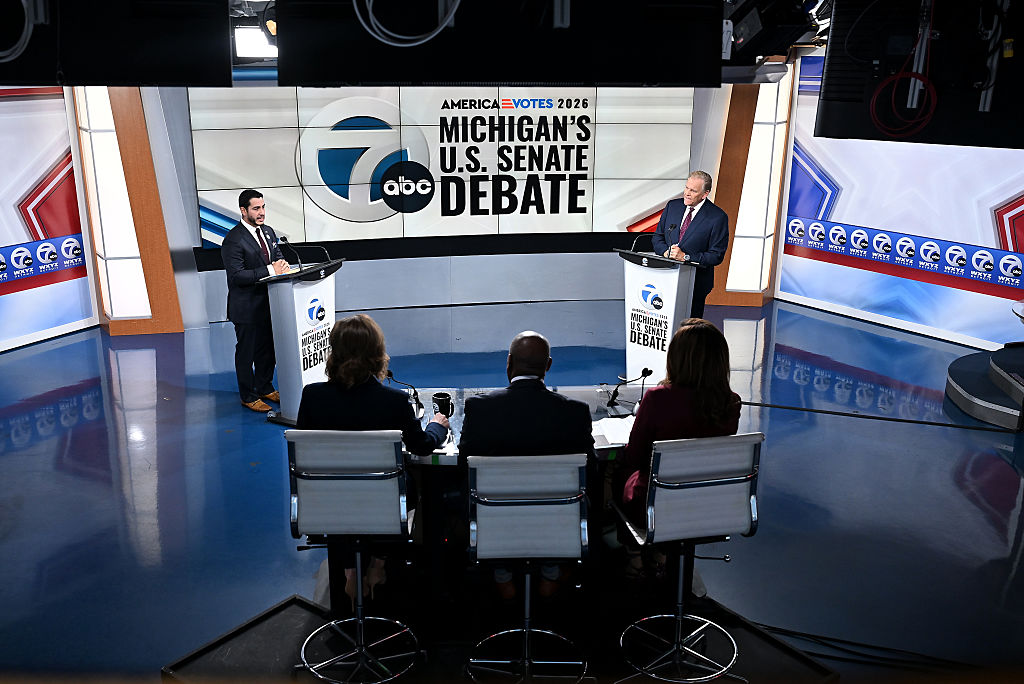
The upcoming Michigan Senate race features a unique and controversial political dynamic as Dr. Abdul Al-Sayed, a Democratic nominee with family ties to the Muslim Brotherhood, faces off against Republican Mike Rogers. This encounter marks a rare moment where mainstream media, including the New York Times, has seriously engaged the issue of religious affiliations and ties to extremist organizations. A direct question about loyalty to America versus terrorist groups in the debate underscores a significant shift in political discourse, where such questions are unprecedented in U.S. Senate elections. Simultaneously, broader political trends show the Democratic Party increasingly embracing left-wing ideologies, including candidates with ties to the Democratic Socialists of America and Muslim identities. This ideological shift is mirrored in cultural movements, particularly the rise of polyamory. Prominent liberal Christian publications like The Christian Century are now openly discussing polyamory, framing it as a mainstream alternative to monogamy and challenging traditional Christian teachings on marriage. The article notes that mainline Protestantism, already rejecting biblical norms on gender and marriage, is most likely to accept polyamorous relationships. However, this shift raises serious concerns, as it implies a rejection not only of Scripture but also of natural law and creation order. The use of terms like “polytheology” and “relational anarchy” signals a deeper philosophical abandonment of moral foundations, with the “plus sign” being interpreted as a symbol of expanding moral chaos. These developments collectively suggest a fundamental transformation in American values, where traditional boundaries on marriage, sexuality, and political identity are being systematically dismantled, reflecting a broader cultural decline in moral and theological consistency.
It's Thursday, October 22, 2026. I'm Albert Moeller, and this is The Briefing, a daily
analysis of news and events from a Christian worldview. Of course, the midterm elections
are just about on every mind as we're headed into the final stretch here, and some interesting
things are happening. It's not to say it hasn't been interesting already, but last night there
was a face-off between the main Senate candidates there in the state of Michigan. So that means
former Representative Mike Rogers, who's the Republican nominee, was in a debate against
Dr. Abdul Al-Sayed, and as you might expect, it got interesting. Now, this is where the story
turns, because over the course of the last several months, the mainstream media has been basically
saying there's nothing strange here. There's nothing to observe here. This is just a normal
Senate campaign.
But the presence of Dr. Abdul Al-Sayed as the Democratic nominee makes this a very different
case and a very different story. And one of the big questions I had watching this is whether
or not the mainstream media nationally and there in Michigan would kind of zero in on
exactly what is taking place and what Dr. Al-Sayed actually represents.
And, for instance, the Muslim Brotherhood and other organizations, and we know exactly
what these things mean, and members of his family have been contributors. This is a really
interesting thing.
This is a really interesting story, because as the days are running out, the sand is more
or less running out of the hourglass in terms of midterm election. All of a sudden, some
people are paying more attention. This came up in the debate last night, and it came up
in a big way, because for one thing, the Republican candidate asked the Democratic candidate a
pointed question, are you for America or are you for these terrorist groups overseas? And
the astounding thing is that the Republican candidate asked the question and the Democratic
candidate basically didn't answer.
Now, you think about a U.S. Senate race. Let's just be very clear about what we're talking
about. We're talking about a race for one of 100 seats in the United States Senate. We're
talking about a statewide election in the state of Michigan. In the state of Michigan,
it's been rather predictably blue in terms of partisan color for many recent election
cycles. But when it comes to something like this, this is, well, it's very blue, but it's
also out of the blue. We're talking about something that wouldn't have been expected
even recently in American politics. And thus, we're looking at something that also is
coming with other news reports. So, for example, the New York Times runs a piece, and it's
by three reporters. Okay, so when the New York Times runs a piece like this, this close
to an election, that's a big thing. When it is really by a team of reporters, this means
a lot of people have been working on this. Here's the headline. Abdul Asaid confronts
attacks on his faith and family ties. And the fact that this runs, and of course, it
is not what you would call a hit piece. It's not coming from some kind of conservative news source. This is the
nation's most influential newspaper of record raising the question. But one of the things the
New York Times points out is that there is now evidence that the candidate's mother contributed
to a fund that is very much associated with the Muslim Brotherhood and other terrorist organizations.
And you even have someone saying in this report of the charity to which she contributed, a counterterrorism
consultant who's an expert witness in one case cited here, Evan Coleman, the New York Times quotes him as saying,
that the charity was so small that all of its employees most likely knew about its activities.
He added that the group was part of a global network whose leaders have been found to have
previously sent money to Osama bin Laden. Quote, it was no secret that they were doing this, end quote.
So it is going to be very interesting to see where this goes. But even as there have been
statements made and you've had Republicans and others asking some big questions, the fact is
that the Democratic candidate has now been asked a blunt question right out loud. Are you for America?
Or are you for these terrorist groups overseas? And I don't know of any context in American politics
where a candidate for the United States Senate has been asked that kind of question or anyone
thought of asking that kind of question. But it just points to the fact we're in a very different
moment in American politics. And this underlines the seriousness of this moment. And as we're
looking at this, it's going to be very interesting in the next few days to see where this goes.
But some people who were watching the debate last night, no doubt,
were surprised and I think troubled by what they saw in the debate. And that's
another very interesting thing is that the Detroit News, which is the newspaper of record
there in Detroit, Michigan, has endorsed Mike Rogers, the Republican candidate for this U.S.
Senate seat. That is no small thing. Interesting developments. We're going to watch them.
Speaking of that, when it goes to the 2028 presidential election, I just want to tell
you one thing we always want to think about when we're in a conversation about a midterm
election like this. Everybody's concentrating on it and everyone with an eye for the White House
is paying very close attention. And there's going to be a lot of attention to the presidential
nomination race in both parties as soon as the midterm elections are over. But because there's
an incumbent Republican president, Republican President Donald J. Trump, the fact is that the
very fact that President Trump is in office and will be in office for two more years puts a damper
on the Republican side. That's like putting a putting a little firewall up for now. So the
interesting activity is not going to be on the Republican Party side for some time. It's going
to be on the Democratic Party side. And that's going to be on the Republican Party side for some
time. And
Susan Page, who's the Washington bureau chief for USA Today, she writes that the potential 2028
field is now now just brace for this evolving on the left. So as we're thinking about Abdul
al-Sayed and you're thinking about several other major candidates identified either with the
Democratic Socialists of America or receiving support from the Democratic Socialists of
America, as you're looking at some of these other candidates and they're all going to be
there are some who actually have a combination of a Muslim identity and the DSA affiliation or
support. It really is a very interesting new development. Now, Susan Page is making the
argument that even when you look at some of the candidates who have been either in previous
Democratic cycles or talked about in anticipation of the coming Democratic nomination cycle,
it turns out that some of those people are now sounding more left than they sounded just a matter
of, say, an election cycle ago.
So one of the big things to watch in politics and worldview terms is not just where people are,
but where they are going. And as you're looking at human beings, you are looking at people who,
well, they're not always absolutely consistent. And not only that, when it's in a political
context and they're looking at the need for developing political support, well, they're
going to have to go where that support is or they're not going to be viable candidates. That
tells you that the Democratic candidates and the ones who may have the most interest in the 2028
Democratic presidential nomination,
at least a good number of them, understand they're going to have to shift left because
the Democratic Party is shifting left. That's a big thing for us to know. It's not so much because
I think most listeners to the briefing are going to be actively involved in the Democratic
presidential race, because I think we need to understand that when you look at our cultural,
political worldview landscape, the fact that one of the two major parties is likely now to be
shifting considerably to the left and fast. I think that's very interesting. The fact that USA Today
is noticing this.
And as Susan Page here observes, you're talking about prominent
Democrats having to watch these developments and take them very seriously. Now, I will make one
other statement here, and that means that many of them are not going to make any statement. They're
not going to make any clear move until the midterm elections are over. One of the big questions is,
what in the world is going to happen in a race like the Senate race in Michigan?
That will determine at least a lot of how the prospective Democratic presidential candidates on the
other side of the midterm elections decide to start positioning themselves. At the very least,
we know in advance, it's going to be interesting. All right, I want to shift gears because we need
to talk about something that isn't particularly easy to talk about, but it's necessary to talk
about. The word is polyamory. And the reason we're talking about it is because there is big news
when it comes to polyamory and some who claim Christian identity. And what we're looking at
here is the fact that the predictions that many of us made at the time, that for example,
the sexual revolution would lead to other things. And one thing leads to another. All you have to
think about is LGBTQ plus sign. There are things to come. And this is not just about sex, however,
and marriage and human relationships. We'll talk about what's more in just a moment. But it is
about that. So even when you look at the Obergefell decision, legalizing same-sex marriage, that's a
huge deal. And it was handed down in 2015. It was a big deal because many of us said at the time,
if you can redefine marriage in terms of gender or sex, then you can certainly redefine it in terms
of number. I mean, the number is less significant, certainly in historical terms, than the definition
of marriage as a union of a man and a woman, a resolutely heterosexual institution. But when
you had the Supreme Court say, and of course, remember, the majority opinion was written by
former Associate Justice Anthony Kennedy. Remember, he expressed this in terms of an
internal knowledge and the fact that fairness needs to prevail. And if someone who has a
heterosexual attraction can marry someone and receive the benefits of marriage, then it will
be unfair. And then he actually made the jump astoundingly to unconstitutional to forbid a man
and a man to marry or a woman and a woman to marry. Many of us at the time said this is something that
will destabilize the entire society. And there were those at the time who said no. But it is
interesting that even in very recent times, books have appeared from people on the cultural left
and by the way, I don't mean the radical left. I'm not talking about the DSA, the Democratic Socialists of America or Maoists or
avowed Marxist. No, I'm talking about people who are part of the liberal political establishment
in the United States. Some of them are now openly acknowledging, as one said, there is no teleology.
Now, we talk about the fact that they are denying ontology, which means reality, as in male and
female. They're now also saying there's no teleology. There is no defined end point. There
is nothing that is the last thing in this series. That's why LGBTQ is followed in so many cases by a
plus sign. And one of the pluses we've known for a long time, in fact, we could see this even in
2015, is what is now called polyamory. And the reason I say it's called that now is because
the traditional word that was used in most legal contexts in the Western world was polygamy,
because the main model was one man with plural wives. And of course, this is a part of not only
what we see in the Old Testament, a part of many civilizations around the world. It was also a part
of American controversy. And it came into the U.S. Constitution,
because of the looming question of the entry of the state of Utah as a state in the Union.
And in order for Utah to become a state, you know, founded by and so shaped by Mormonism committed to
plural marriage or polygamy, the Constitution was changed so as to make polygamy unconstitutional
in the United States. So that is when all of a sudden a miraculous vision came to Mormon leaders,
and it was completely a coincidence. But nonetheless, the timing was such that then Utah could enter into
the Union. But ever since then, you have had very few references to polygamy or what is now called
polyamory in much of American society. Some of the radicals in the 1960s, some of the hippies were
arguing for destabilizing marriage and a sexual revolution in which basically all the relics of
limitation in the past would be done away with and everything would be permitted. But the fact is,
it was noted even at the time that, well, at least on the part of most
women, they really didn't want to share a man. And so even in the sexual revolution, even the
hippies ended up being, first of all, overwhelmingly heterosexual and then overwhelmingly also, well,
here's the word for it, married pretty conventionally. And so that's a television sitcom staple
for several of the last decades. But what we have now is in worldview terms, the unraveling of an
entire civilization. It's an unraveling to the point that you now have arguments for polyamory and polygamy.
Okay, that would be interesting if it's true in the culture. The reason we're talking about it
today is because of a major article that has appeared in the Christian Century in the October
2026 issue, an article by David Congdon, who is a modern ethicist in terms of liberal Christianity.
And that's what the Christian Century represents. The Christian Century is the flagship magazine
historically of Protestant liberalism. And back in the day when the Protestant liberals were the
mainline Protestants, the Christian Century was one of the most influential religious magazines
in the United States. But it, in its October 2026 issue, has run an article entitled "Understanding
Polyamory: Alternatives to Monogamous Marriage Are Going Mainstream: How Will Christians Respond?"
Okay, I also want to suggest to you that it's a very interesting worldview indication
when people openly ask a question. Because it's a different thing to ask a question and to answer it,
but there is an inevitability to certain answers
if a question gets asked. So in other words, in the Christian Century, if you're asking how should
Christians respond, it's not going to be with a flat "no." That would make no sense. The editors
would not choose an article in which they're going to answer "no" to polyamory. Instead,
it just shows up here in a very different form. So it's interesting because we're told here that
by this author in this article, which has such prominence in the Christian Century, we are told
that the world is changing when it comes to polyamory and at least some
Christians. In 2023, he says, "Christopher M. Gleason published American Poly: The First
Scholarly History of American Explorations in Polyamory and Non-Monogamy." There's the other term,
non-monogamy. How do you like that? "A few months later, Molly Roden Winter's bestselling book,
A Memoir of Open Marriage, presented a brutally honest picture of the ups and downs
of an open relationship, what was once more commonly referred to as free love." There are
the hippies again. That's where they come in. "Around the same time, NBC began airing a new reality show called
Couple to Thruple on Peacock. TLC got in the action, he says, in 2025 with the reality show
Polyfamory. Right on cue, he writes, a number of think pieces came out reflecting on what polyamory
might mean for the state of Western society." He goes on saying the conversation now has to include
a new vocabulary, polyamory, he says, "has an image problem given that many on first encounter conflate
it with polygamy." So yeah, that's why we're troubled because it sounds like polygamy. No, just think of what's going
on here. Polyamory means multiple loves. And by the way, that does refer to romance and relationships
and sexual activity. He writes, "As anyone who has tried to define one's relationship knows,
using the right terminology is very important. And when it comes to the subject of polyamory,
most people need a glossary." End quote. So get ready for a glossary. Here's the vocabulary.
He writes, quote, "While polygamy means many spouses, polyamory, which literally means many loves, was coined in 1935
and 1992 to refer to the increasingly common practice of consensually having more than one
romantic partner. Romantic partner often means sexual partner as well, but these are not strictly
identical. Those within the broad polyamorous, often abbreviated as poly or polyam community,
have varying degrees of fastidiousness regarding language use. Some insist that the word polyamory
should be restricted to loving romantic relationships. Those who remain romantically
monogamous but allow for other sexual partners typically fall under the umbrella terms of
consensual or ethical non-monogamy." Okay, I'm going to stop there for a moment. When you take a word like
monogamy and you put a non in front of it, you are turning the world upside down. There's a reason why
mono, as in one, as in monotheism, one god, and monogamy, meaning one spouse,
you put non in front of that and you end up with, as I say, the entire world turned
upside down. Other terms in here, we are told that one activist popped
the word monogamish, you know, like large-ish, in order to say, kind of sort of monogamy,
but not exactly monogamy, "to refer to variations on monogamy that allow for some level of sexual
intimacy with others." You also have a language of coupledom instead, of course, of marriage.
Okay, so as we look at this, we come to understand that if the Christian Century
is writing an article like this, in which the argument is coming right out that the
church is going to need to come to terms with this, and this is just the way the world's going,
and by the way, it's a matter of liberation, it's a matter of affirmation, it's a matter of
understanding that there are rights involved here, and the church, this is their argument,
is going to have to come to terms with this and come up with the right response,
which presumably would mean polyamorous or polygamist relationships just being welcomed
in the church. Okay, now this writer understands that there are some
likely obstacles to that. One of them would be the Roman Catholic Church. And for instance,
the Roman Catholic Church sees the marriage of a man and a woman within the church not only as an
institution of marriage, but as a sacrament. And so you would think the Roman Catholic Church would
be real clear on this, and the Roman Catholic Church is. As a matter of fact, even more recently,
the Vatican has released a document called "Una Caro," "One Flesh," on polygamy.
But the point about this article in the Christian Century is that here is a writer who's
saying, "You know, I know the Vatican looks tough on this, but I think there are ways around even
the Vatican. I think there are even Catholic arguments that can be made." And the reason why
we mention this is because that's exactly what happens on the abortion issue, where the Roman
Catholic Church is abundantly clear about the moral status of abortion, but you have liberal
Catholics that go out and say, "Well, you know, there's a precedent here, there's a quotation there,"
and they misrepresent Catholicism. But nonetheless, it's interesting that this writer goes there. And then furthermore,
he sees mainline Protestants, liberal Protestants, as the most likely place
where the pro-polyamory position is likely to emerge. And I will say that's exactly right.
And so he writes this, quote, "Mainline Protestants who already embrace same-sex
relationships within the Church don't necessarily see Adam and Eve in Genesis or the marital analogy
in Ephesians as normative templates for marriage in the first place," end quote.
Okay, that's what we really need to know. That line in this article is gold because of what it reveals.
And so here you'll notice that this author is saying, "You know, if you're looking for a group
that's likely in religious terms to move towards polyamory and the affirmation and embrace of
polyamory, mainline Protestants are the good place to go because they have already decided that Adam
and Eve and Genesis aren't normative, authoritative, and they've already decided that the
marital analogy in Ephesians from the apostle Paul isn't normative for our understanding of marriage here
on earth." And so, in other words, you don't have to have a bride and a bridegroom. You can have a
bride and a bride, you can have a bridegroom and a bridegroom, and presumably this also means you
can have a bride and a bride and a bridegroom or any permutation thereof. It is interesting,
of course, that in an article like this published in the Christian Century,
the writer does recognize there is likely to be a lot of opposition. It's interesting that he has a
book coming out in a matter of months, the title of which is "Polytheology in Praise of Unnatural Love."
Okay, so you get
gotta love candor. You know, even when someone just says out loud, this is what I'm doing,
he even names it unnatural love. And you know where he's going when the title of the book is
polytheology. Okay, so just looking at this, it's important for us to see not so much that this is
likely to be an issue of discussion among evangelical Christians. Let me be clear. I don't
think there's any immediate concern about evangelicals failing to do the math on marriage,
male and female, one male, one female, monogamy as the complete expectation.
But we just need to note how the entire society changes in two ways.
Number one, the society is losing its ability to say no to anything. And so when you have the
emergence of polyamory here, well, why not? And that plus sign won't end with polyamory.
There are already other things that, don't worry, I'm not even going to mention today on the
briefing, but there are other things that will have to follow because if sexual liberation is
your worldview and your attitude, then you're going to have to follow it. And if you're not
absolutely determined that any restriction on human romantic and sexual relationships or
imagination or activities is a form of oppression, if you buy into that, then you can't stop with
anything. You can't stop with same-sex marriage. You can't stop with a sexual revolution.
You can't stop with redefining marriage in terms of male and female. Now it's got to be marriage
in terms of number. And furthermore, this is something we already see. We already see where
some municipalities in the United States are moving to de-center marriage and to recognize
in legal terms multiple partners within a domestic setting. And so this is already happening in terms
of some locales, and not by surprise. Many of these are taking place in communities very close
to major college campuses, very close to major metropolitan areas that are by definition
generally more liberal. And it's going to be interesting to see where this goes. And here's
another thing to note. When it comes to a lot of these definitional issues, our political system
assigns those issues to the United States. And so it's going to be interesting to see where this
goes. And so it's going to be very interesting to see where in state governments you start to see
the initiative towards this. But I wanted to deal with this article because it doesn't appear
in Time magazine. It doesn't appear even in the Los Angeles Times. It appears in the Christian
Century. So let's just mark for a moment the fact that this is an absolute theological disaster.
It's an absolute biblical disaster. But we should not be surprised because liberal Protestantism
has been denying biblicalism for a long time. And so it's going to be interesting to see where this
authority and openly denying the clear teachings of Scripture for a very long time. But there's
another big thing here, and that is the fact that even beyond Scripture, behind Scripture,
God has implanted a moral knowledge of these things within the universe itself, within the cosmos.
And so even in terms of a natural knowledge, even the natural law, there's a very clear
understanding of these things.
So the people making these proposals have to come out not only against the clear teachings
of Scripture, they also increasingly have to come out and acknowledge we're going to
have to reject every natural law teaching as well.
Now, I don't want to let that pass, even in the stack of articles I have here right now,
without understanding what a concession that is.
What a concession that is.
Already we're at the point where the liberals are more or less conceding, you know, when
you look at the New Testament in particular, and then you look at Jesus defining marriage,
do you not know that from the beginning, this is what Moses said marriage is? God's intention was
that it be the union of a man and a woman for a lifetime. It was very clear. And so now you have
the open statement, we're just rejecting biblical authority because we don't believe that's binding
on us. That's kind of the story of liberal Protestantism and liberal theology. But now
they're even at the point of saying, you know, when it comes to polyamory or polygamy or any
go. And so it's going to be interesting to see where this
All right, another major article on this and also pushing it and pushing it in terms of ethical
acceptability. It offers a vocabulary of types of non-monogamy. So I'm just going to list them. I'm
not even going to go through the definitions. Just listen to the terms. Polyamory, a quad, a V,
solo polyamory, polyfidelity, open relationships, monogamous, swinging, polygamy, and relational
anarchy. I'm ending on that because I think that's the only honest statement in all of this
relationship, anarchy. Because at the end of the day, the rebellion against God, the rebellion
against the Creator, the rebellion against creation order, the rebellion against the gospel,
and the rebellion against God's Word basically comes down to the word anarchy. And this is where
it all leads. So if you're thinking about LGBTQ and other issues of moral dissent as well, you
look at that plus sign, that plus sign just might be rightly identified as an A for anarchy. And here
we've been told it right out loud. Thanks for listening to The Briefing. For more information,
go to my website at albertmohler.com. You can follow me on X or Twitter by going to x.com
forward slash albertmohler. For information on the Southern Baptist Theological Seminary,
go to sbts.edu. For information on Boyce College, just go to boycecollege.com. I'm speaking to you
for a live audience here on the campus of Boyce College and the Southern Baptist Theological
Seminary. And I'll meet you again tomorrow for the briefing.
Podcast Summary
Key Points:
The Senate race in Michigan features a rare political clash involving Dr. Abdul Al-Sayed, a Democratic candidate with familial ties to the Muslim Brotherhood, raising concerns about religious and ideological alignment.
Mainstream media, including the New York Times and Detroit News, have spotlighted the issue, with the Times reporting on evidence linking Al-Sayed’s mother to a charity with known ties to terrorist organizations.
A direct debate question—“Are you for America or for terrorist groups overseas?”—highlights a significant shift in American political discourse, as such a question has never been formally posed in a U.S. Senate race.
The Democratic Party is increasingly shifting left, with several candidates affiliated with the Democratic Socialists of America or combining Muslim identity with left-wing politics, signaling a broader ideological transformation.
The rise of polyamory as a mainstream cultural and religious discussion is being explored in prominent liberal Christian publications like The Christian Century, which acknowledges its growing acceptance and challenges traditional Christian views on marriage.
Mainline Protestantism, already liberal on same-sex relationships, is seen as most likely to embrace polyamory by redefining marriage as non-normative, undermining biblical and natural law foundations.
The article suggests that liberal theology is moving toward rejecting both Scripture and natural law, with terms like “polytheology” and “relational anarchy” indicating a philosophical collapse of traditional morality.
The “plus sign” in LGBTQ+ movements is being interpreted as a symbol of expanding moral boundaries, with polyamory seen as a logical progression toward societal anarchy and the dismantling of conventional relationships.
Summary:
The upcoming Michigan Senate race features a unique and controversial political dynamic as Dr. Abdul Al-Sayed, a Democratic nominee with family ties to the Muslim Brotherhood, faces off against Republican Mike Rogers. This encounter marks a rare moment where mainstream media, including the New York Times, has seriously engaged the issue of religious affiliations and ties to extremist organizations.
S. Senate elections. Simultaneously, broader political trends show the Democratic Party increasingly embracing left-wing ideologies, including candidates with ties to the Democratic Socialists of America and Muslim identities.
This ideological shift is mirrored in cultural movements, particularly the rise of polyamory. Prominent liberal Christian publications like The Christian Century are now openly discussing polyamory, framing it as a mainstream alternative to monogamy and challenging traditional Christian teachings on marriage. The article notes that mainline Protestantism, already rejecting biblical norms on gender and marriage, is most likely to accept polyamorous relationships.
However, this shift raises serious concerns, as it implies a rejection not only of Scripture but also of natural law and creation order. The use of terms like “polytheology” and “relational anarchy” signals a deeper philosophical abandonment of moral foundations, with the “plus sign” being interpreted as a symbol of expanding moral chaos. These developments collectively suggest a fundamental transformation in American values, where traditional boundaries on marriage, sexuality, and political identity are being systematically dismantled, reflecting a broader cultural decline in moral and theological consistency.
FAQs
Dr. Al-Sayed's candidacy is significant because he is the first Muslim nominee for U.S. Senate in Michigan, raising questions about religious affiliations and the influence of groups like the Muslim Brotherhood, which have ties to international terrorist organizations.
Yes, the New York Times reported that Dr. Al-Sayed's mother contributed to a charity linked to the Muslim Brotherhood and previously associated with funding for Osama bin Laden, highlighting the media's growing attention to the issue.
The Republican candidate asked, 'Are you for America or are you for these terrorist groups overseas?' This question underscored a major shift in political discourse around religious identity and foreign ties.
It is significant because the Detroit News, as the city's leading newspaper, endorsing a Republican candidate in a blue-leaning state signals a notable shift in local political and media sentiment regarding the issue of faith and identity.
The Democratic Party is shifting left, with several candidates, especially those affiliated with the Democratic Socialists of America, adopting more progressive stances, indicating a broader ideological realignment within the party.
Polyamory refers to consensually having multiple romantic partners. It is gaining attention due to cultural shifts, media coverage, and legal developments, including new reality shows and books that normalize non-monogamous relationships.
Chat with AI
Loading...
Pro features
Go deeper with this episode
Unlock creator-grade tools that turn any transcript into show notes and subtitle files.
 PodcastTranscript AI