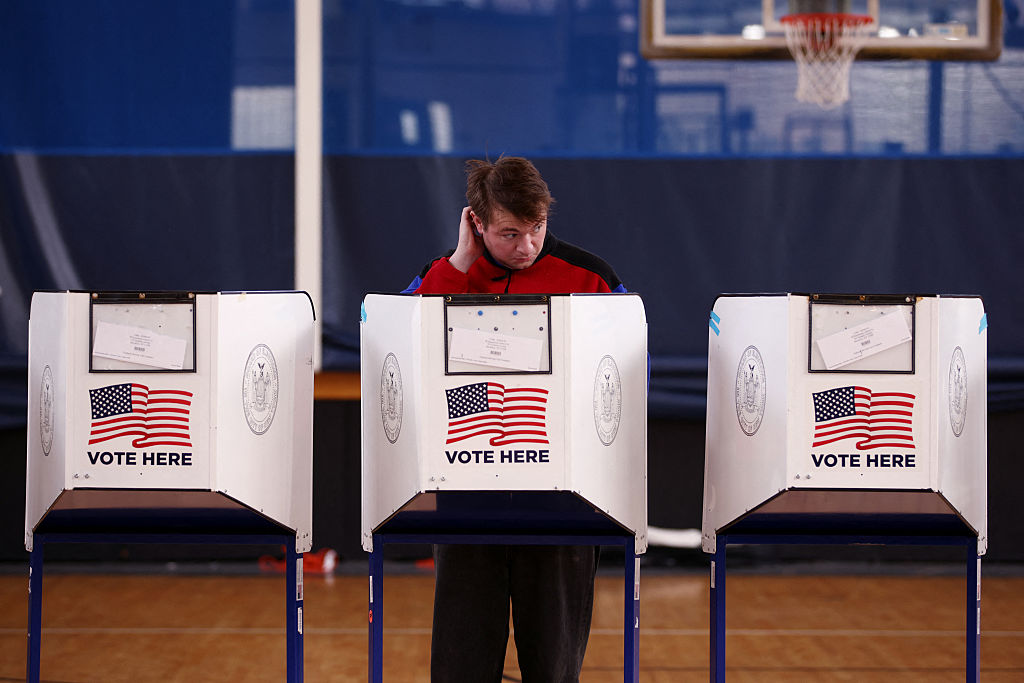
The 2026 U.S. election marked a historic and dramatic realignment in American politics, with Governor Ron DeSantis calling the Republican losses an "extinction-level event." Data shows every major demographic group shifted left, with young men experiencing a 40-point swing toward the Democrats, driven by frustration with both the Biden administration and Republican policies, particularly regarding the Iran war. This shift has resulted in a decisive Democratic majority in Congress, effectively ending Republican control of the House and Speaker position, and forcing the party into a minority role with severely limited legislative power. Within the Democratic Party, a notable rise of liberal Protestant candidates—such as Senator-elect James Tallarico and Adam Hamilton—signals a resurgence of the "religious left," challenging long-standing patterns where conservative Christians dominated politics. These candidates won not despite their theological liberalism, but because of their likability, relatability, and strong public personas, highlighting that voter appeal transcends ideology. The Republican Party now faces a crisis of identity, pressured to reevaluate its moral positions on key issues like abortion and LGBTQ+ rights, potentially shifting toward the center to regain electoral viability. Meanwhile, a major AI-driven cyberattack on grocery systems—triggered by the default password "12345"—exposes deeper vulnerabilities in modern infrastructure, reminding society that even basic security measures are critical in a fallen world. From a Christian worldview, these events reflect a broader cultural and ontological crisis, where political, technological, and moral systems are under strain, signaling a fundamental realignment in American values and faith.
It's Thursday, November 5, 2026. I'm Albert Moeller, and this is The Briefing, a daily
analysis of news and events from a Christian worldview. An extinction-level event. That
was the term used by Florida Republican Governor Ron DeSantis about the results of Tuesday's
election. And as Governor DeSantis, let's just say one of the most important Republicans
in the country, said, quote, let's be clear about what happened last night, speaking of
Tuesday night, quote, this is as close to an extinction-level event for Republicans
in many parts of the country as we've seen probably in the last 100 years, end quote.
Now, Governor DeSantis, whose second term is ending and the Constitution in Florida
does not allow him to run for a third term, there was a Republican candidate who is now
going to succeed him as governor. But the big point here is that Governor DeSantis is
not exaggerating when he speaks of the scale of the Republican loss. And, you know, from
a world view, he's not exaggerating. He's not exaggerating. The big issue is when you have a titanic shift in terms of the worldview of the culture.
Now, one of the reasons why I put it that way is because it is of importance to us to
recognize, as the New York Times reported yesterday, quote, every major demographic
group swung left amid the Trump backlash. That's the headline of the New York Times,
a little bit of editorializing there. But nonetheless, the most important part of that
headline are the first words, every major demographic group swung left. Now, the left-right
dichotomy, let's just remind ourselves of that. The left-right dichotomy, let's just remind
us of that. The left-right dichotomy, let's just remind ourselves of that. The left-right dichotomy,
let's just remind ourselves, goes back to the French Revolution, where the left is the far
more liberal progressivist, more radical progressivist direction, and the right is the
more conservative direction. So when we are told that every major demographic group swung to the
left, will every major demographic group, what would that include? Well, all voters, 15-point
shift. So you just take voters as a whole with 15-point shift. You look at the white voters who
are identified just that way, 13-point shift. To the left, Hispanic voters, 28-point shift.
To the left, Asian voters, 17-point shift. To the left, black voters, already very loyal to the
Democratic Party, shifted by nine points to the Democrats. Now, when you talk about right-left
here, I'm just reading to you the headline from the New York Times. So in other words, I'm not
editorializing on the right-left issue here. The headline says, every major demographic group swung
left. Now, as you look further in terms of this data, one thing that becomes clear is there's
that will come to us. But we already know that some voters shifted to the left in greater
percentages, and maybe even you might say at a greater velocity when you consider the shift from
the electoral results just two years ago. Just listen to this, quote,
young voters shifted to the left this November by more than 30 percentage points, the largest
shift of any age group. Young men in particular shifted nearly 40 points toward Democrats
after a 23-point shift toward Republicans in the 2024 election, end quote. Okay, we're going to be
looking further at this because it's important. When you look at young men and young women,
young men are markedly more conservative than young women. Or to put it another way,
young women are markedly more liberal than young men. So the big shift here in terms of just the
numbers, the bigger shift just by the dynamic here is the shift among young men. Now, when you talk
about young men, age, let's just say 15 to 29, you're talking about a 40-point shift towards the
Democrats. Now, one of the big stories coming out of the 2024 election is that the Democrats are
going to be more conservative than young women. So young men are still more conservative than
young women, but it does point to the fact that ideological commitment here is not really clear.
This is not a new thing when it comes to younger voters. It's a long-standing pattern. First of
all, younger voters are less likely to vote than older voters, that's in the first place.
But when you have younger voters who vote, young men and young women over the course of the last
several years have gone in two different directions, with young women going to the left,
young men at least compared to the young women moving to the right. But as we now see, it wasn't
necessarily a very clear move to the political right. It probably has a great deal to do with
an agenda for change. Because one of the things that becomes very much associated with young male
voters when you look at this data already available, we saw it heading into the midterm elections,
see it affirmed in just the raw numbers. It is clear that a lot of young men think that the
world as they know it, the employment world, the educational world, you could just come up with an
entire list here, it's not working as they think it should work. And thus they are expressing
frustration. And when the vote for Donald Trump came in 2024, it was a clear statement on the
part of many of those young men, a clear statement of frustration about the Biden administration and
the Democratic Party. Now that has shifted to very great frustration with the Republicans. And it has
to do, of course, with the Iran war. It has to do with economic situations, many other things. But
when we look at this, it's just really important. The headline tells us every major demographic
group swung to the left. That was unexpected. So just to be clear, as people were looking at this
election and saw the pattern coming, the pattern was not clear in this particular contrast, in this
particular shocking nature. This is something that goes beyond even what most observers concerned
with the 2026 elections, part of what they feared. This is beyond what they feared. And I'll just
simply say, it's shocking to just about everyone who's honest. Now, going back to the statement by
Governor DeSantis saying this is an extinction level event, he just stressed the fact that this
is a very big event. It is going to require a reshaping of the Republican Party and a reshaping
of Republican strategy. And quite frankly, it's already leading to a resorting of the entire
political map. There is going to be
a very clear Democratic majority in the House of Representatives. It could be a matter of an even
larger gap than we know today, simply because so many of the elections still out are congressional
elections. But the Democrats already have a commanding majority. So we're not going to have
a Republican majority. We're not going to have a Republican Speaker of the House. Mike Johnson
has said that as the current Speaker, he is not even going to be in the race for Republican
leadership in the new Congress. We are looking at massive shifts, and there are all kinds of
decisions that are going to have to be made. Republicans in the House of Representatives,
accustomed to being in the majority, although not a really clear commanding majority in terms
of the last two years. Nonetheless, Republicans are now going to have to figure out how to be
politically effective in the position of the minority, which in both houses of Congress,
by the way, is a spectacularly disadvantaged position. The party with the majority in the
House, the party able to elect the Speaker, is able to decide what issues come up for a vote,
what issues don't.
What gets assigned to what committee? You just go down the list. This is not to say that Republicans
will have no political options. It is to say their political options are going to be reduced
very, very fast. It's already clear, by the way, that the current Democratic leader in the Senate,
so right now, the minority leader in the Senate, Senator Chuck Schumer of New York, it's really
clear he's going to have competition. And so it's not really clear, frankly, who's going to be the
Speaker of the House, although Hakeem Jeffries is expected to move into the position of Speaker of
the House. But when it comes to Chuck Schumer, it is interesting. Some of the Democratic candidates
who are now senators-elect said that they would not support Chuck Schumer as the majority leader
of the party if they were elected. So that's going to be very interesting. And of course,
there are things that politicians say, that candidates say on the stump, so to speak,
that will have to bend to some kind of reality when they get into a room in the Senate.
But we are looking at a massively reshaped political landscape. I want to go back to
Governor DeSantis.
And his extinction-level event language again. It's going to be a very clear challenge for
Republicans to figure out how to move forward. And this means a rebranding of the party. It
also means that the party is going to ask basic questions about its political commitments.
Now, as a Christian, I want to say one of my concerns is that there are going to be
some who are going to see the possibility of shifting the Republican Party to the left on
some moral issues. And they're going to say, look at the voter landscape and understand the
profile of the American public. We're not going to be able to put together an electoral college
victory for a presidential run or a majority in either House of Congress unless we move on some
of these issues more towards what some would say is the center. Let me just remind you that when
you're looking at the transgender issue, you're looking at the LGBTQ issue, you're looking at the
abortion issue. And those are a prime commitment to Christians. You understand there really isn't
any middle ground, not when it comes to the morality of what's in question. It's going to be
to see who comes out as the new leadership for the Republican Party. Now, there are a couple of
people that come immediately to mind. I mentioned Florida Governor Ron DeSantis, whose term as
governor is coming to an end. But just remember that it was former Governor Ronald Reagan who won
the Republican nomination for president and eventually was elected president in 1980 in a
landslide election. So having former before your title as governor is not a real political lie
in many ways. And for one thing, Governor DeSantis will be free to campaign basically
on behalf of Republicans and on behalf of what might be a potential DeSantis presidential run in
2028. Obviously, in the Trump administration, Vice President J.D. Vance and Secretary of State Marco
Rubio are at the top of the list. And it is also clear that the vice president is ready already to
speak to the issue. And yesterday in social media, the vice president of the United States, J.D. Vance,
making the argument that it was the war,
the war in Iran that was the big political issue that cost the Republicans in such a landslide way,
in such a radical wipeout way in the 2026 midterm elections. It was a long statement. It's very
interesting when you consider the fact that the vice president of the United States made this
statement. And he made the statement when it was already known that inside the Trump administration,
he was far less keen to follow the advice of some who were saying that the United States and Israel
should go to active war against Iran. It was clear the vice president had concerns there.
Now he says in public that the war is the reason that Republicans were wiped out in this election
cycle. And it's very interesting that President Trump, when confronted with that, said basically
that might be right. President Trump went on to say that he would not reconsider the rightness
of what he had done in terms of joining Israel in this military action. He said it's worth it
if it prevents Iran from gaining a nuclear weapon. And by the way,
there are new headlines. There are new headlines. And the international press saying that there is now political pressure inside Iran to develop
that nuclear weapon and to even stop saying that they will commit not to develop a nuclear weapon.
And so that situation is getting more and more intense almost by the hour. But we are looking
at the fact that there is now an open discussion among Republicans. And this means even involving
the president and the vice president of the United States on some of these issues. If nothing else,
that is likely to open the door for a very energetic Republican conversation on so many
of these issues. It's going to be a very interesting few weeks ahead. All right. So one of the big
issues here is that headline, every major demographic group swung left. Well, did that
swing to the left involve Christian theology as well? Here are other headlines. On election night,
the religious left is back. That's religion news service. The same writer for religion news service
just a matter of days earlier, mainline Protestant.
Having a political moment. Can they move from protest to power? Commonweal magazine. That is a
Catholic magazine. The rise of the Christian left. And there's so much here. You also have
the rise of the Christian left in terms of the magazine, The Week. So something's going on here.
By some counts, either seven or nine candidates for major office as Democrats were elected with
a very clear identity as a liberal Protestant or a member of a mainline Protestant church or
a major office as a Democrat. And so that's going to be a very interesting few weeks ahead.
of a mainline Protestant church. The founding pastor of one and a seminarian in another
denomination. Now, the two most important here, at least the two that come most immediately to mind
are James Tallarico and Adam Hamilton. And now let's just be clear. That means Senator-elect
James Tallarico of Texas and Senator-elect Adam Hamilton of Kansas. Understand that it had been
just about 90 years since Kansans had elected a Democrat to the United States Senate. It has now
happened. It has been a generation of Democrats who have been elected to the United States Senate.
It has been a generation since Texans have elected a Democrat to the United States Senate. It has now
happened. And in both cases, they're clearly identified with liberal Protestantism. When it
comes to Adam Hamilton, we've already mentioned the fact that he's the founding pastor of the
church, which is now known as Resurrection, the Church of the Resurrection, a United Methodist
church there in the suburbs of Kansas City, Kansas. It is a massive church, multiple thousands of
members. And Adam Hamilton has been an active figure in the United Methodist Church, I would argue,
not only in shifting that denomination more or less to the left, but in pushing the conservatives
out of the denomination. And that's just over the course of the last several years.
When it comes to James Tallarico, of course, you're talking about a much younger candidate,
an unmarried candidate. He is not a pastor, but he is constantly identified as a product of a
mainline Protestant, in this case, liberal Presbyterian church, with a liberal pastor who
influenced him when he was just a boy and as a teenager. And now he is a seminarian at Austin
Presbyterian Theological
Seminary, which, again, is a liberal theological institution. Or you could just say this,
it's one of the main institutions of the mainline Protestant denomination known as the Presbyterian
Church USA. Okay, so why did they win? And by the way, both of them won convincingly,
and both of them, along with several others, they were elected not in spite of the fact that
they were theological liberals, but precisely because they had identified themselves that way.
You think of the headline, again, at Religion News Service, the
religious left is back. Well, it is very interesting. I mean, this is a significant
development. As you look at politically active people who have been religiously identified over
the course of the last several decades, the big story has been conservative Christians,
conservative evangelicals being newly involved in politics. Now, if you go back a generation
before that, the mainline Protestants basically were in charge of everything. You look at the
United States Senate, and there was even an outsized representation of the most elite of
those mainline Protestant denominations. And so, you know, it's a very interesting
the Episcopal Church. But now you're looking at a reshaped political landscape. And for years,
religious liberals have been pretty much on the defensive. Now you have a significant number of
religious liberals who are deciding to run for office. And at least by the count of many observers,
almost every single one of them has won, every single one of them running as a Democrat. Two of
them, as we said, for very crucial U.S. Senate seats, both of them in states that haven't elected
a Democrat, much less, let's say, a theological liberal in a very, very long time. Now, as you're
looking at the Religion News Service, there's a celebration, basically, of the fact that the
mainline Protestant left is back. I want to speak as an evangelical Christian. I don't want to speak
in terms of a Christian worldview analysis here. It's very significant that liberal theology is now
going to show up, even more so than already. You already had Dr. Raphael Warnock as Senator Warnock
from the state of Georgia, and he is. He's not only well-identified as a pastor, he's still functioning as a pastor of an historic
black church there in Atlanta, Georgia. And he holds even a doctorate from Union Theological
Seminary, a bastion of liberal theology. So this isn't the first time this has happened,
but something is happening in the Democratic Party. More and more of these very significant
political positions are being occupied by people who are more religious than the Democratic Party
have been moving. So, okay, let's just look at the political landscape for a moment. In worldview
terms, this is massive. If you make a division in the United States, you're going to have a
in the voting public. If you take the voting public, the electorate, and you say,
who's going to vote Republican? Overwhelmingly, it's the religiously identified. If you say,
who is going to vote in a more liberal direction, even a more democratic direction?
For decades, it has been those who are more secular and more publicly identified as secular.
So how is all of this happening now with Tallarico and Hamilton and all the rest?
I'm going to say a part of it is that you have to understand liberal theology
as a way,
basically, of making peace between a secular worldview and historic Christianity. That's
basically a part of the liberal experiment from the beginning in terms of liberal theology. It's
to update the faith in such a way that it is, as the liberals said, credible and useful for a new
age. Now, this is where conservatives, conservative evangelicals said that is not possible. Our
responsibility is to contend for the faith once for all delivered to the saints. The Christian
faith is not given to us for remodeling in our continual world.
It is instead given to us as that faith once for all delivered to the saints. And, of course,
this gets back to the war between the liberals and the conservatives in these mainline Protestant
denominations throughout much of the 20th century, going all the way back to the period right after
the turn of the century, white-hot heat by the time you get to the 1920s and the fundamentalist
modernist controversy as it was known. You had the liberals denying the virgin birth,
the liberals denying the bodily resurrection of Christ, the liberals denying the exclusivity of
the gospel.
Certainly, the authority and inspiration and inerrancy of scripture. But the interesting
thing is that when you look at, say, now-Senator-elect Tallarico and Senator-elect
Hamilton, they don't sound like that, except sometimes they do. When it comes to Tallarico,
the sound bites are out there. But evidently, an awful lot of Texans decided that wasn't so
important. When it comes to Adam Hamilton, he is one who's been very cagey in the way he speaks
theologically. But as you can see, he's been very cagey in the way he speaks theologically.
But as you read his books, as you listen to his sermons, and I have done a good deal of
investigation here, I've written about it before, and when you look at how he has exerted leadership
in the United Methodist Church, let's just say he's very solidly liberal. Okay, so how do they
get elected? If indeed the Republican Party is energized by those who are more explicitly
Christian, just in terms of a general electoral profile, and if the Democrats are generally
mobilized by those who are liberal, then they're going to get elected. And if they're going to get
less explicitly theological, how in the world do you end up with two mainline Protestant,
you know, one a seminarian and another megachurch pastor, you know, who are actually making history
by being elected to the United States Senate as Democrats from these states? I will tell you
point blank, I think a lot of it has to do with their public persona. And this is a good thing
for Christians to think about. When you are looking at an electoral situation, you're looking at not
only a choice between two profiles, you're looking at a choice between two personalities. And let's
just say when you look at the Texas race, and you consider Ken Paxton, the attorney general who was
running as the Republican candidate, I have already mentioned and have come back to the fact
that a good many evangelical pastors who could never support a liberal Democrat, they also could
not give any energy to support Ken Paxton in the 2026 Texas Senate race. He was just so out of
bounds in so many different ways. And I'm here talking about moral issues that are very well
attested. But I want to say something else. And even President Trump, in his own eccentric way,
made very clear the fact that he didn't think Ken Paxton was very likable. When it comes to James
Tallarico, he's. looks like the kid who grew up next door. He is mild-mannered. He smiles a lot. He's quick
and quick-witted. And so you look at this and you say, you know, likability evidently
is a far more significant issue than many Republicans have wanted to think.
Okay, so here's a signal to the Republican Party. The Republicans had better find candidates who
are committed to the right positions on the issues and they have the right political profile and they
have the right experience and all the rest. That also was missing in the case of some Republican
candidates in this particular cycle. But they also have to be likable. Voters have to like them.
The bottom line of at least one lesson from the 2026 midterm elections is that voters do not want
to go out to vote for candidates they do not find as likable. Now, I'm going to be the first to say
likability is not enough. I hope I've made that point as clearly as possible.
Likability on its own is not enough, but the absence of likability
is downright fatal. And especially in the age in which you have smartphones and you have TikTok
and you have all these things, that's playing into the Mississippi Senate race, which is not
yet even concluded. It's really clear that a candidate can just blow it or come very close
to blowing it with just appearing with the wrong attitude or with the wrong quip or the wrong
comment at the wrong time. Likability enables you to get over a lot of things. That's one of the
things that was very central to the Trump campaign. When you think of his repeated campaigns for
president, he was willing to make people dislike him, but he also had a very strong likability and
a concerted core in the Republican Party. And that was very, very important. When you run without
likability in any of these contexts, guess what? Voters don't like you. All right, going back to
the question, is the religious left back? Well, I think that remains to be seen, but at least in
terms of electoral politics, the answer is yes. And this is unexpected. It's one of the most
interesting and unexpected developments of recent years. This does not mean that the membership is
back in those churches. It doesn't mean that the attendance is back in those churches, but there's
another dimension to this, and that is that liberal Protestantism, as of the early 20th
century to the forward, has been more explicitly political than conservative Christianity.
And so, in one sense, for the liberal Protestants, this is kind of a reversion to the norm.
And they've reduced so much of the gospel to their version of love your neighbor, and they've
transformed and redefined the gospel, basically, in terms of social justice and social action. The
fact is that it is going to be very interesting to see the issues as they are framed in upcoming
debates in Washington, now in the United States Senate, of all places, in which you might have a
face-off not only between Republicans and Democrats, you might have a face-off not only between
conservatives and liberals, you might have a face-off between conservative Christians
and those who represent very liberal Protestant denominations. That is going to be interesting.
Finally, you have probably seen the big news about what has happened mostly in Europe, in which you've
had someone hack into the system using artificial intelligence, the systems controlling the
temperatures in the frozen food department of grocery stores, turning it up in some cases to
an ambient temperature of what would be in Fahrenheit, 120 degrees, and basically ruining
millions upon millions of dollars of food. And then it turns out,
of course, that this is part of the threat of artificial intelligence, it's part of the threat
of criminal hackers, and it's random, but somehow there were people who figured out, and by one
estimation, it only used about six dollars of energy to create multi-million dollars of losses.
Okay, here's the other angle. It turns out that at least a part of the reason why the hackers were
able to get so quickly using artificial intelligence into this system to create, again,
spoilage on a mass level in grocery stores, one of the ways they were able to do it was by using
the default password, which was 12345. And it turns out that it doesn't take an awful lot of
intelligence, as in artificial intelligence, to crack the code 12345. I guess it's just one of
those reminders to us that passwords actually matter. In a fallen world, we have to think
about things our ancestors never knew to worry about. Passwords evidently turn out to be one of
them. Thanks for listening to The Briefing. Daily on The Briefing, we talk about news and events,
but these don't occur in a vacuum.
Every story comes from somewhere. I have dedicated so much of my life to showing how every news story,
every election, every political change, every cultural issue is the fruit of a worldview.
That's why I'm thrilled to present to you my new book, available just starting today for pre-order.
Western civilization is a precious inheritance, but now it's tearing apart at the seams.
The family has been undermined, redefined, even abandoned. Many churches have compromised
doctrine and morality.
Even rejected the Christian faith altogether.
I don this vestment of makeup to craft a work of art for God, for neighbor, and for myself.
Society and its rulers have given themselves to totalitarianism, anarchy, globalism. Each of
these blights has intellectual and ontological roots. What we have experienced is nothing short
of an ontological revolution, a rejection of reality itself. Our situation is what the former
leftist Malcolm Muggeridge called the great liberalism.
The world's death wish.
Meanwhile, for more information, go to my website at albertmohler.com. You can follow me on X or
Twitter by going to x.com forward slash albertmohler. For information on the Southern Baptist Theological
Seminary, go to sbts.edu. For information on Boyce College, just go to boycecollege.com.
I'll meet you again tomorrow for The Briefing.
you
Podcast Summary
Key Points:
Governor Ron DeSantis described the 2026 election results as an "extinction-level event" for Republicans, highlighting a profound and unprecedented shift in political power and public sentiment.
Every major demographic group—white, Hispanic, Black, and Asian voters—shifted significantly to the left, with young men showing a 40-point shift toward Democrats, reflecting deep ideological frustration.
The Democratic Party now holds a commanding majority in Congress, with Republicans facing a minority position that severely limits their ability to control legislative agendas or committee assignments.
Key Republican figures like Vice President J.D. Vance have publicly blamed the Iran war for Republican losses, sparking internal debate and raising questions about the party’s foreign policy and moral commitments.
The rise of liberal Protestant candidates like James Tallarico and Adam Hamilton in key Senate races signals a major shift in political power, marking the return of the "religious left" in electoral politics.
Voter likability has emerged as a critical factor in electoral success, with voters rejecting candidates who appear unapproachable or out of touch, especially in the age of social media.
The Republican Party faces a crisis of identity, forced to reconsider its moral stance on issues like abortion and LGBTQ+ rights, possibly moving toward the political center to regain electoral viability.
A major AI-driven hack targeting grocery store temperature systems revealed that weak passwords like "12345" are dangerously vulnerable, underscoring how technological failures can amplify societal risks in a fallen world.
Summary:
S. " Data shows every major demographic group shifted left, with young men experiencing a 40-point swing toward the Democrats, driven by frustration with both the Biden administration and Republican policies, particularly regarding the Iran war. This shift has resulted in a decisive Democratic majority in Congress, effectively ending Republican control of the House and Speaker position, and forcing the party into a minority role with severely limited legislative power.
Within the Democratic Party, a notable rise of liberal Protestant candidates—such as Senator-elect James Tallarico and Adam Hamilton—signals a resurgence of the "religious left," challenging long-standing patterns where conservative Christians dominated politics. These candidates won not despite their theological liberalism, but because of their likability, relatability, and strong public personas, highlighting that voter appeal transcends ideology. The Republican Party now faces a crisis of identity, pressured to reevaluate its moral positions on key issues like abortion and LGBTQ+ rights, potentially shifting toward the center to regain electoral viability.
Meanwhile, a major AI-driven cyberattack on grocery systems—triggered by the default password "12345"—exposes deeper vulnerabilities in modern infrastructure, reminding society that even basic security measures are critical in a fallen world. From a Christian worldview, these events reflect a broader cultural and ontological crisis, where political, technological, and moral systems are under strain, signaling a fundamental realignment in American values and faith.
FAQs
DeSantis uses the term to emphasize the unprecedented scale of Republican losses, suggesting a fundamental shift in the political landscape that could require a complete reevaluation of the party's strategy and identity.
Yes, according to the New York Times, every major demographic group—white, Hispanic, Asian, and Black voters—shifted toward the Democratic Party, with the largest shift among young men, who moved nearly 40 points to the left.
The shift reflects widespread frustration over economic conditions, the Iran war, and perceived failures of both the Biden administration and Republican policies, especially among young men who are more politically engaged in these issues.
Their victory marks a significant shift in political power, as they are the first Democrats elected to the U.S. Senate from Texas and Kansas in decades, signaling a resurgence of the religious left in American politics.
Liberal Protestantism has increasingly aligned with social justice and political activism, redefining Christianity in ways that emphasize compassion and societal reform, especially in contrast to conservative evangelical Christianity.
Likability is crucial—voters often reject candidates they find unappealing, even if they agree with their policies. Candidates like James Tallarico were successful partly because of their approachable and personable presence.
Chat with AI
Loading...
Pro features
Go deeper with this episode
Unlock creator-grade tools that turn any transcript into show notes and subtitle files.
 PodcastTranscript AI