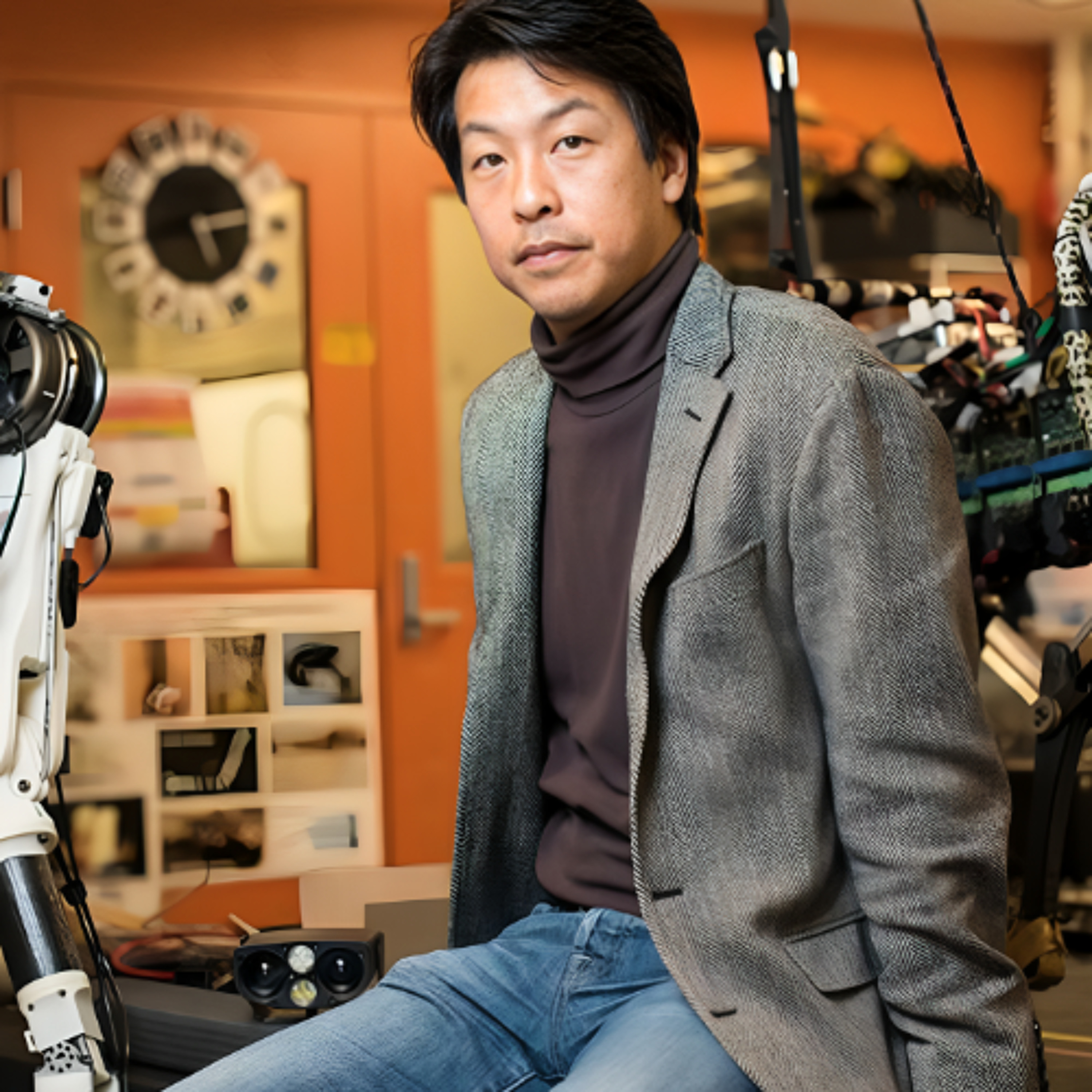
Throwback: Sang-bae Kim on Humanoids and Legged Robots (2021)
from Soft Robotics Podcast
50m 16s
Sangbaek Kim, a professor at MIT, discusses his journey into robotics, starting from childhood interests in building and RC cars to developing the MIT Cheetah series. He emphasizes that legged robots are still in an evolutionary phase, with significant challenges in both hardware and software. Hardware limitations include the complexity of replicating animal joints and actuators, while software challenges involve creating algorithms for locomotion and decision-making that go beyond traditional gradient-based optimization. Kim highlights that the design of the MIT Cheetah focused on minimizing leg mass and mechanical compliance to enhance force control bandwidth, which serendipitously led to high efficiency. He argues for a shift toward heuristic, event-based algorithms to better mimic animal intelligence and stresses the need for fundamental innovations in actuation technology to advance the field beyond current electromagnetic and electrostatic methods.
Hi, my name is Sangbaek Kim. I'm a professor in mechanical engineering MIT. I'm a robot assistant. I love design. I for love with the control of the leg robot and I built many robots including sticky bar ice bra, spine bar, mesh warm and four cheetah series like for cheetah and cheetah two, cheetah three, me, cheetah, so I love to talk about leg robot. I love to talk about mobile robot and application in the real world. Wonderful. So thank you once again for joining. But we are curious to go for your childhood. How was your childhood? Well, this is science which technology has a kid. Do you have any members of all that? Well, I always love building, you know, as many many engineering students or most of kids like love Lego. That's how I started, but I think that quickly evolved to like building something more. How can I say active? Like a love electric motor, building my own stuff. Lego, you know, is limiting. Lego is very convenient, but there's a quite limitation, a lot of limitations. So I start building, you know, cars by myself and I realized so hard. And then that's where I thought of love with the RC cars. RC car at the time was such a big source of learning experience because it is usually like all kinds of vehicle dynamics and the design of the suspensions and shock ups over like I learned a lot of like a sort of like a physical sense through RC car before even learning simple mechanics. So RC car was such a big learning experience for me and yeah, of course, like, you know, the gliders, then rubber power, the gliders, I went to competition every year when I was a military school student and I loved physics. I had a Korean version of thinking physics as a book you can find Amazon. It's fantastic. A way to physics for, you know, middle school student to the adult. It teaches you intuition instead of, you know, falling, you know, the loss in the equation. So I always love physics. That's how I think, yeah, that's pretty much it. I always caught things with the knife because I didn't have a tool and then when I first got my electric drill when I was 13, that just changed my world. Yeah, this is really, really interesting. You're very smart, Ken. So, but I'm curious, but what's the actual first robot you built? First robot I built, I probably is something I can call robot is the ice brawl when I was a stand for it. They had a cockroach inspired robotics project. They tried to learn how to simplify the model of the insect running and then replicate in the robot and they had a called the robot called the spural leader, which is a pneumatic powered machine. But they, you know, because it's a pneumatic power, the robot cannot be completely powered autonomous. So, I joined the Marco Koskis group and the start building independent power independent machine and then it turns out the desires for all at the time was the fastest running robot in terms of the body length per second now, not really. But yeah, that was my first robot. But I'm here so skew, I think you are now one of the pioneers in the Liga Droppe design and how this was installed for you. When you get an inspiration for this designing, you mentioned you were interested about physics. But we have a question what kind of me be abstraction you can get from, for example, MIT sheet or robot that's three version now and the many one. So what kind of an instrumentation look for for replicating the motion? Or you go for something beyond what we have already in nature? How you can make this happen to make a useful design? So the legged machine is still, how can I say, is in the middle of the evolution, in my opinion, wheeled vehicle didn't exist in nature, human somehow invented it, you know, like thousands of years ago and then it became a thing, became proven to be very, very useful. And engineers, you know, from Roman era, even before, always wondering about why not we have a legged machine, they can, like, because we had an example in nature, humans are good example and other animals are example and then they do perform excellent job in moving around the world of training and so on. Yet replicating animals are not easy. And as you can see, even just Chira series by itself, let alone all kinds of examples in robotic community, it start with the more animal looking design and then it get quickly simplified to be more practical. And in my opinion, I think it's still too complex to be practical. And we're still in the middle of the evolution. What can we learn from nature is still also, you know, in the middle of the evolution, we're still not sure what inspiration is good, what inspiration is not useful. One thing I can say is the animals biological systems are just way to complex to replicate anything. So we've been always focusing on the simplification, simplification of design and focusing on the principle. One example I can tell you that was useful is the animals legs, if you look at the animals leg, especially the fast ones, they have a very little mass in the leg, especially going to the distal end that minimized, required torque on the shoulder and so on. So we focus on that for last 10 years, how to minimize and eliminate that really allows us to build a robot that can be very powerful in that dynamic and efficient. But I'm just curious to see, it is really interesting experiences about what kind of elements you have to get inspiration from nature, for example, in MIT, shit robot. But I'm curious to ask you what could be the missing pieces here. If you can have a step back and look what's really missing since we are still the middle of the evolution for that. What are the missing pieces do you think that we have to focus on? So there's two aspects, like a hardware aspect and software aspect. In hardware aspect, we cannot afford to have as many joints in actuator like animals, for example, dogs have 700 muscles and our cheetah has a 12. It's not even close and we always talk about how nice it will be to have ankle joints and then it's practically impossible because our actuation technology is not quite there yet. There are a lot of complexity plus weight and robustness issue. And the fabrication challenge, I guess, like if you think about how to fabricate a paw, like a robotic paw, is very, very difficult to replicate what animal has. But I think bigger challenge is in software, much, much bigger challenge. We just are talking about the biology itself. We just don't even scratch the surface of how animal balance and then perform what they do, like combining with the vision and planning everything. And even though we don't understand, completely understand how animal do, you know, in our algorithmic world where optimization or machine learning is just the beginning to do a fraction of what animal is doing. So I think this is not we're not even talking about high-level intelligence, like, you know, competing with the human. We're talking about things animal like doing a second or two very easily. So low-level, medium-level intelligence were not even close there. So I think there's some challenge in hardware, but I think bigger challenge is missing part is actually the algorithm. I think this is a really interesting part here about when you mention about what kind of intelligence because we have mechanical intelligence and we have this kind of brain. So do you think in animals you are focusing more in the mechanical intelligence? Do you think which one you have to maybe give more focus or maybe both of them as just out of curiosity? To be honest, if you look how MIT Cheetahs evolved, we try to minimize the mechanical functions in the entire machine. So meaning that we just don't we try, it tries as hard as possible to minimize compliance between the actuator to the foot. We have to have some compliance because you don't want hard metal leg shaft hitting the ground.
So at the end of the vector, you need to have some compliance. But besides that, we try to minimize compliance in any mechanical play because we lose a bandwidth. That's something very often overlooked by many mechanical genres. If you don't want to a vector trader, yes, like a undergraduate system, some passive compliance mechanical intelligence, do the job, that's fine. But if you want to achieve something versatile, you know, cheat out robot is not just running straight. If you cheat us running a straight on single speed, there's a many thing we can do without even involving many actuators. But this robot, many mobile robot, we want to do acceleration, disseration, turning the spot like jumping and landing. Just all kinds of behavior. We need to be able to control in every millisecond what force you want to achieve. And then the bandwidth is critical. So, yeah, to be honest, there's almost no mechanical intelligence in our robot. And it can be useful when you really try to minimize degree freedom. But that minimizing degree freedom also lead to very limited application. You can make a versatile machine. Good example is a gripper. If you make a gripper with a bunch of under-air actuators, the hand cannot do many things. Yeah, great. So maybe there's a question about what I think you are really interested about designing. What could be the techniques you use for dynamic model for your robot? Because we know that modeling sometimes is super challenging and especially when we have the kind of dynamic environment as well. But for the robot itself, the designing process, what technology you use to create this dynamic model? So we use very carefully designed dynamic simulation software to verify some ideas. And we do model our actuator. And we actually even use the dynamometer to test our actuator. To be-- it's all this effort to try to really model and then be accurate about what we're building. And when it comes to actually designing and making decisions, all these tens of thousands of parameters, there's no particular method we can use here. Yeah, we basically have many, many, many hours of meetings and discussions and comparison with other machines and were design processes are pretty much done by human discussion. And again, you can just build a great machine by having great meetings. You need to have an IA central designer, which played the biggest role in-- and his experience and then a concept of understanding really hugely impact how the machine is designed. So designing such a complex systems are still up in there. We don't have a formal way to do it. What is area or direction of research? You think it's very promising for a legate robot. But still, maybe as a community of research, we don't agree or we don't give much attention to it. I think the still the locomotion algorithm or navigation algorithm, there are many. There are thousands of papers, hundreds of papers on working on navigation algorithm. But when it comes to legate robot that move around with the in 3D space where you have to exert forces and to choose a full placement, this is still quite a challenging area where the typical optimization scheme gradient based of the machine learning type of a stochastic gradient descent doesn't really work because you can't really create a cost function perfectly in every single time. And in many cases, you're optimizing through multiple discrete events, which makes it very difficult to use any gradient based approach. So often people fall into this like a mixed integer optimization. And it's very inefficient and quite challenging. So we still need to take a look at a little bit high level intelligence, like literally algorithm. Humans are performing not in a way like we quantify everything all the time. If you just grasp something on your table, we're not maximizing or minimizing value. We have a much more crude discreet decision making process. And if you do the same task a hundred times, your grasping position or force applied to the object, it's all of the place. They're not always consistent because we're not really-- we don't really care about those quantities. We care more about how level decision, which finger I'm going to use, and where I'm going to grab, and what I'm going to do if slips. There's a lot of discreet decision. We just don't know how to properly do. Our tools are all based on some quantity and then gradient based, like the minimizing value or maximizing value. Somebody might argue that if you throw every possible case and then make into gigantic optimization process, it's possible, and that will require on almost infinite amount of data or infinite amount of time. So we don't think that's actually quite practical way. So we have to really think about how to program a concept. We know how to program a quantity based approach, gradient based approach, but we don't know how to do a concept. We don't know how to program a concept. That's basically basic challenge in everywhere in robotics, in my opinion. That's really interesting aspect. I may be a peer-staff skill. What should take from us so that we can consider that and what we do. Why do you think we still don't grasp this idea or at this point? What's contributing to it? I think just a legacy, you know, how we do engineering is always a mathematics in which it has a long history, 500 or more history, longer history. And I think we need to really start thinking about different format of intelligence, which is not easy, of course. But several people in the leadership really thought about those two. Leslie Kebling in our institute also agreed with that. We really need to think about intelligence that not necessarily rely on just a quantity. At least it's not just-- we can't really program anything without quantity. But making decision doesn't need to be always finding maximum value or minimum value. The algorithm development should more focus on an event-based reaction based algorithm, which is a lot more close to typical classical algorithm, like yes and no if or else. A lot of people call that a heuristic. I think we need to go back to heuristic and then think about how to generalize all this heuristic, which actually usually help our robot to be more smart. That's a good point. Maybe it goes just to you. What's something, I think you think, you say that? You highly depend on intuition, a factor, since you were in early ages. What's something you sort would work out very well in the version for MIT sheet of robot? And the empirical result proved something wasn't expected. Only he was surprising to you. Counter-intuitive to you. Well, so the biggest surprise actually was the efficiency. We even have a paper how we make our robot efficient. But it wasn't quite planned. It's more like aftermath. We analyze after and it turns out that it's actually very good. Because when we first design the MIT sheet, our goal is really run as fast as possible. We need to design a machine like a F1 formula, a type of like concept. If your robot run out of battery one minute, that's still OK. Because if you can run really fast, you can do so much in one minute. Test of fastest machine doesn't take more than a minute, even a battery. So we just completely ignore efficiency when you design the machine. We focus on force bandwidth and then the high torque density and then minimum weight and so on, like the literally like a airplane design or a formula car. And then it came out like efficiency of animal. And then it was the best in this class. I think still the best in the class. And work quite a sharp.
And then it took me for at least a week to evaluate and re-verify multiple ways to check our measurements correct. We checked like two to three different ways and then they're all matched within like a 1% error. And it turns out that we lose so much through the transmission, which we take it as the gospel like our monoclonal drive or high-gear ratio system to conventional transmission system was horribly inefficient not only just the transmitting power and also that so inefficient not through the just transmission actually the inefficient happens when it collide with the object. If you look at the most robotics applications or even research topic, most robots are not having any impact with the object work environment. They're very, very careful in contact because it's very hard to control. When it comes to impact, by the way, if you look any human behavior, if you watch anybody is doing any work in one minute, they're going to have you're going to go through like hundreds of collisions. And we don't even notice because our bodies are so well built and we have a nice cushions and controls so we don't really realize we have a very we're using high-speed collision all the time. If you run, if you walk, you can do it without any collision. That's why actually most conventional robots are so slow. When it comes to collision, if your actuation have a high IMF, which is the impact mitigation factor, if you don't know what it is, the Google please because it's a very important concept in actuation. They represent workspace mass matrix, relative mass matrix quantity. Low IMF means your machines are very rigid and then awkward to touch anything. If high IMF means you're very flexible, you can touch something and then you can control for it very well. So those conventional actuation system, which is a low IMF, high gear ratio, high inertia, have a horribly inefficient in terms of the collision because it's not you're losing energy through the transmission, you're losing by colliding with the high mass, so you've lose by the impact that eventually cause all this vibration, heat and eventually damage or all kinds of machines. So the design of a minute, the Chira robot, it turns out that we were focusing on high force control bandwidth, which is correct thing to do. It has a side byproduct like efficiency and byproduct like the power generation and power regeneration. We didn't quite plan to have a regeneration, but realize you can have a proper force control without energy generation. So that was the spy product. Yeah, that's really excellent point. But Mimicers here, do you think in having that, do you think in soft robotics or maybe artificial muscle could really contribute in designing these muscles for MIT, or ligand robot in general? You know, the artificial muscle has always been holy grail for many engineers. But people really need to understand that we need a different way to generate force. If you look at the physics, there's only two kinds of way to generate force. One is electro-megaletic way, which include electrostatic or electro-megaletic, which is a pretty much dominant. And then the other way is doing chemical reactions like boiling waters or combustion or using compressed air type of thing. But if you don't change, if you don't have any new way to generate force, just converting that kind of energy source into a different form doesn't really change anything fundamentally. So basically, for example, you can generate a thousand different actuators with a new medic source. And if you cannot change how the pneumatic power conversion happened, it doesn't really help because there's a fundamental limitation on the pneumatic power resource. And combustion in the same region, and combustion has a fundamental limitation. That's why most actuators are either electrostatic or electro-megaletic. And same argument here, if you don't change how we fundamentally change our generate electro-megaletic or electro-static. They're associated with the fundamental limitation. Electrostatic has a very different fundamental limitation compared to electro-megaletic. But you have to basically attack the base basic principle. And otherwise, it's going to be all ended up being same or cannot improve too much. And there's a question from the audience. What kind of maybe limitation or upgrading for MIT-SITA robot version 3? What kind of advancement you're looking for or tackling limitation? You had an early version. Minichira-chira 3 is differentiated from Chira 2. You know, way that it's more simplified. It has a more range of motion. It's designed to be much more robust. And then we also design developed our own software package that has a very good model. Chira 2 was much more difficult to model. So we move the direction, moving to the much more practical or problematic direction. So Minichira is pretty much like a combination of the design. And especially the scales also small. It's as extremely robust. We drop from like a meter height. Multiple times doesn't even have any mechanical issue. Our first Minichira, we were running for like a year and a half in our lab doing more than, you know, several hundreds of experiments. We didn't have a single mechanical failure. So the simple design is really, really important. I really wish the community understand that part. Like if you build a machine, sophisticated, beautiful machine, if you fail, and 10 times experiment, it's not very useful. So the Minichira is sort of like hallmark of like the robust machine. That can be also versatile. If you look at the military applications, the robots are extremely simple. They don't want to have put more than one motor because it becomes fragile and break. And Minichira can be the first robot that actually can have a diversity and then mechanical robots at the same time. That's going to be one of the critical design aspects in the future robot application. If robot just break, we can make a product. We can really help human humanity. That's a great point, Anne. Now, here's also a question about what's your source about wheels and look, the commotion. So yeah, I actually thought about this a lot. And, you know, there's so inspiration from this Japanese manga, Japanese animation like Ghost in the Shell, for example. There's a fantastic concept and so on. And I think there's going to be very, how can I say, the certain area where wheels can really perform out from everything else. But if you're, if somebody asks like, what is going to be the winner of, if you consider everything, I'm still not sure. Because if you have a wheeled machine, which means you have to have another actuation at the end effector. You have to move the wheel as well. And then can you sacrifice, can you get rid of some extra degree of freedom due to the wheel when it comes to Rob train, not really. You know, to generate XYZ force properly, and you need to have all the actuator that leg robot has, and then you need to have another actuator for the wheel. It's just to make it a lump or complex. So if you want to build a robot, like primarily running on the Rob train, I don't think the wheeled machine wheeled leg robot will have any benefit. Wheeled leg robot is obviously more beneficial and the more primarily like flat train. Let's say the machine is mostly running on the flat train, maybe slightly slope, maybe a few steps upstairs. I think there's a advantage. But if the robot has to go through the rough train a lot of times, or you have to do both the world very, very well, I still think the leg robot without wheel is going to win. Because due to the complexity, it's at less complex. Not having wheel. Yeah, that's interesting. As we'll hear. And also we have a question about hominolid robots, for example, why does post-ondonomics Atlas, if robot have needs like human, bend forward, while other designs sometimes bend backward? And do you think there's maybe advantage, or this advantage is for designing leg robot vs like human robots? Yes, actually we had a long history of a discussion about this because we have an example like bird. They're ostrich and many like a land, like a bird that doesn't fly have a different morphology from seemingly human. But if you look at
This is a biology story. If you look at every single runner, their first proximal joint is actually pointing forward, which is kind of like a human knee. Like, oh, somebody might say the birds are not. Actually, if you look at the first joint, which is a femur, it's hidden in the body. And then, the knee, cubula, and it's actually ankle. And same thing for the dogs. And if you look at the dogs, the cheetahs, the fillins, and the kainines, if you look at front leg, front leg looks like an opposite of the real leg, but opposite of the human knee. It's actually not. There's a spatula, the scapula is actually moving quite a lot. Human scapula doesn't have as much range of those animals use scapula a lot. And then that act as a first joint sticking forward. So there's such clear dynamic advantage being having a knee forward, the first joint from the body is sticking forward. But if your robot is not moving fast, if you really don't care about dynamic advantage, it's a debatable. It's a depends on what you're the task is. If you want to climb upstairs a lot, head forward, sticking knee forward is not gonna be very useful. So knee backward, robot will be much more convenient climbing upstairs all the time. And but you have to think about climbing down. It's easier probably not. So when it comes to just the configuration spaces geometry of your environment matters, but dynamically the knee forward is always beneficial. That's why I believe humans and all these animals have a first joint from the body is sticking forward. - And I also have a question here. What are the short and long term technological world books for year research and also for leg droplet in general? - I think the challenge I talk about in the beginning is still gonna be the roadblock. How can we write an algorithm they can handle so many discrete event? There's no longer continuous dynamics where gradients and a stochastic gradient works really well. It's gonna be a lot of mixture of a hybrid dynamics. It's not just like hybrid dynamics between two phases. You have to they would like 20 different phases and then we have to choose from. And each phase has its own continuous dynamics and we don't even know when to terminate that phase and so on. So the worst possible example is the grasping or any hand-de-manipulation. Think about how many contact points we don't even know how many contact points we're gonna do given hand and given object. And when to make that contact and how to transition, it's gonna just explode in your optimization space. So that's why I think we need to really think about high level decision making algorithm rather than just gradient based or met the quantity base. And I guess it's more like a state based algorithm or phase based algorithm. Yeah, I have to formulate that how to generalize those approaches is going to be the biggest roadblock in my opinion. Either you use a machine reinforcement learning or optimize your base doesn't really matter. So yeah, that's sort of like my thinking. Yeah, that's what we're going to do. So we are closing the end and have a few questions. The first one, why we don't have, don't we have yet useful autonomous robots in real world? And how we can ensure what we develop is beneficial to humanity for designing world. - Very, very important question. Again, I thought about this a lot. I attempt to start a company multiple times and I closely watch over many other robot companies and I review all this history of the robotics. I think there's a fine balance between the versatility of the and the complexity. Simplicity, I guess. And then good example is actually Rumba. Very good example is the vacuum machine and it's extremely simple. And it's not just the company because the company is design simple. The task is actually very simple. So that's where actually robot autonomous system can really shine. Many people ask like when we're going to have a robot that can do laundry and cleaning dishes and cleaning the house and everything. And I ask, imagine somebody actually built that. How much is that going to be? And how complex is it going to be? And how about service fee and so on? And then I said, probably is at least like $50,000. But if you think about all this vacuum cleaner, autonomous vacuum cleaner, laundry machine, dishwashers, of course it's not as good as those multiple versus robot. But all that combined to be at least like at most like $3,000 compared to $50,000, maybe $100,000 robot, then maybe it can do a little better than what we have. So you've got to be very careful of the all multipurpose versatile machine that can do everything. Our cell phone did really well, but our cell phone doesn't have a single actuator. It's all digital, all IT technology. So my cell phone can be camera, recording device, like audio, web browser, like everything. Yes, this versatile great. But we carry around. We do all this physical behavior. When it comes to physical service, I'm still doubtful about having fully versatile multipurpose machine. Our product successful machines are all one purpose. Our laundry machine has a one motor. Instead of having 12 degree freedom hand with the six degree freedom arm to rub your laundry using soap, it does everything with one motor. Our dishwasher has a two motor, one motor. It's very simple and can do one thing really well. So going back to the Rumba example, Rumba has a few motors, but its task is very simple, limited and is a very fault tolerant, which is actually very, very important aspect. Complexity goes hand in hand with the false sensitivity except the autonomous driving. When robot task is more complex, typically, the task is a fault sensitive. You cannot make a mistake. If you drop a glass of cup of glass every day, your robot is useless. When it comes to Rumba, it's just always stick in the ground and then maybe bump into the wall a couple of times. It's fine. Nobody really care that vacuum machine make 100 mistakes in an hour. That's not even a mistake because it doesn't really affect much. But if your robot is doing something more complex, that typically lead to the false sensitive task. So this complexity and simplicity and versatility and specialized machine, we have to navigate in this space very carefully while focusing on what value we provide as customers. So this is something the whole community need to really think about and it's gonna evolve to something interesting. You have to really think about why Rumba is invented. Like Rumba is not even the first vacuum machine, autonomous vacuum machine, an electrolyte looks as even older, more than 20 years of history. And yet there's no another autonomous robot that help us in our life. If you ignore like Roma or machine and like swing and pull machine, those are kind of similar version of Rumba. There's a, those issues are now quite resolved yet. That's why there's still very few autonomous machines. - That's very excellent answer. And thank you for the celebration. I think this really insightful as well. Yeah. And he's also questioned about how we can enable more intellectually inclusive culture for competitive ideas. I don't know if we were sort about being intellectually inclusive in field of robotics in general. We think we have the scan of intellectual inclusiveness and all we have to work in that when it's a little idea. - That's also kind of tricky question and then a big great question. Even in this world we have a distinction between countries and how much can we share? And then, and the countries are like, doesn't respect like IP for example. And we had to also work for the inclusion. Yeah, this is a lot more complex than I can personally think of. But I am a believer of, you know, I believe that like we should openly share everything to as much as possible to really move forward and make a progress. And because innovation not necessarily just happened because we're not going to be able to do that.
you're hiding something and you secretly develop something. If you look at Apple and if you look at Tesla, who actually benchmarked Apple a lot, there's no like a secret like thing they do. They just work really well hard, well to really focus on human value, not necessarily invent something completely out of rule. So I think the sharing idea is always, I believe it's always good. - Yeah, thanks for the honesty. And do you think ego is important for the researcher? - I think so. Everybody has to have a piece, have a make a piece with their ego, right? And but many cases the ego actually is a counterproductive. Somebody is care too much about their name values or like authorship. And so I think it's a fine balance. In academia, you cannot really work without acknowledging somebody's help, but there's always a challenge between working with somebody at the same time make a piece with your ego and your colleagues is a challenge. So this is another fine balance you have to deal with is academic person. - Yeah, and also have a question about what's your thoughts about publish or parish culture? Since you're doing very innovative research, how you manage between being innovative and taking risky ideas and also the culture of publish and parish? I don't know if you have thoughts. I think about that all the time. And I feel actually bad about myself and our group. In a way that we care, we don't care publication as not as much as others. We care about what is really useful. We're extremely programmatic. There can be bad for some of my grad students when they get a job, their publication is not as good as others and we don't publish as much as others. We in our group, our conviction is we decide to care programmatic solution rather than high citation or is it worth publishing? We have a lot of ideas that this could be good paper but I don't think it's useful, like we just don't do it. And I think it's very important to have, I wouldn't suggest to everybody because as you said, if you don't publish as parish, you have to balance. But if you everybody just search for the way to get published, I think community can go on a wrong direction. I can pinpoint certain community but some of the community happen to lock into that trajectory and then it's more or less, less relevant as the technology change to the world to change because they culture lock into that published or parish and then their publication is based on other publication is getting far away from real application. So that's something you gotta be very, very careful. - Yeah, I think we need more like you. That's actually what we need. We need more meaningful research and less publications. So I think you have to feel very good about that. - Yeah, I mean, the meaningful is a very multifaceted thing and it's difficult to even quantify, academic, in my opinion academic contribution is like, as long as it's helpful for other people, the research is useful. But if entire community is working on something not very practical, you gotta think about it. But if you do or working on something that shows something new and interesting but your published doesn't really give them enough ideas so that other people can replicate or help. That's another challenge. So yeah, I think this is something you have to balance. It's not necessary, one idea is better than the other. - Yeah, and here's a question. What are the most important qualities you have gained while working in academia? What are you doing? What are the most important qualities you have gained and you have to maintain? - I think the most important thing is still passion. I think, you know, passion also have many different stages, many different type of passion. For example, when we first designed a Cheater Robot, our passion was very extremely naive and pure. You didn't care about anything else. We just wanted to make a machine that can do things like they never done before. It's not wrong, but that kind of passion has an expiration date. People like trying to design a car that can go 1000 mile per hour. It's a diminable challenge, but has a short shelf life. Eventually you had to guru and foster your passion into something more sustainable. That's where you're the other question like, how can we make our research more useful to the humanity? That's actually a proper way to redirect your passion to really help the community and society. Because eventually that's gonna be the final source of motivation and final end route of your research. So it's not easy to develop something or work on something that's meaningful because it takes a long time. So maybe one KG student five, six years, which is okay, but if you want to something really, really meaningful, it takes sometimes 10 years or 15 years. It's not easy to maintain your passion without having that really meaningful goal. So managing those passions and you cannot give up what you like. You're intrinsically like something moving fast. I'm a big fan of moving fast and dynamic machines. So cannot give up that, but that kind of pure passion by itself is not quite sustainable in my opinion. So you have to latch into the ideas or you have to evolve your dream to really, really help a real society, real people help elderly care for example. Then you can maintain your passion and then you can really feel your research effort. - And lastly, what was the best advice was giving to you and was a life of changing? Life changing, that's very difficult. - Be very good advice. You keep in your mind just too. I guess, again, it is balance issue, but I think I still remember my brothers that like, somebody who worked the hardest, I mean, somebody who enjoy what they do, it's gonna eventually prevail because even though you're most talented in that area, if you're not really enjoying what you're doing, you can't really do that for a long time. Again, the sustainability issue. So I think I really constantly searching for what I like to do, what I can do at the same time, it can be useful for the society. So I start with what I like, but I start evolving toward how it can be helpful for society because otherwise, people are not gonna support you. And I don't wanna do something that I'm really bad at. So that's probably the best advice I got. - Yeah, this is really a brilliant advice. And yeah, we have to do what we really enjoy and people will feel it, of course. So do you have any final word, distributed community, would like to say? - I really like our robotics community. You just briefly talk about ego and stuff. I actually look other areas than robotics communities are actually much more pure less ecosystem trick. I think we need to really tackle this first utility issue, the diversity issue. Our robotics are probably the one of the most diverse community. All kinds of experts, all kinds of research is mixed. We have to really try to put our effort to how to integrate our effort because diversity is always challenging. It's often great research coming from one, like working on one small area. I think robotics are quite different. Robotics, we have to really integrate everybody's effort to really make a big difference. So I wish we can do more and more of the integration of diversity of our research in the future.
So yeah, thank you for the commitment was really enjoyable and insightful to have you in the bot cost and wish you from from you were great more great work about the ligad robots community. So thank you once again for time. I really appreciate it. Thank you. Thank you. Thank you.
Podcast Summary
Key Points:
Sangbaek Kim's passion for robotics began in childhood with building and RC cars, which taught him vehicle dynamics and physics intuition.
His first significant robot was the "Stickybot" (ice brawl), a cockroach-inspired, autonomously powered legged robot developed during his PhD.
Legged robots are still evolving; key challenges include simplifying biological complexity, improving actuator technology, and developing advanced algorithms for locomotion and decision-making.
The MIT Cheetah robot series focuses on minimizing leg mass and mechanical compliance to maximize force control bandwidth, unexpectedly achieving high efficiency.
Future advancements require rethinking intelligence algorithms beyond gradient-based optimization to include heuristic, event-based decision-making, and addressing hardware limitations like joint complexity and robustness.
Summary:
Sangbaek Kim, a professor at MIT, discusses his journey into robotics, starting from childhood interests in building and RC cars to developing the MIT Cheetah series. He emphasizes that legged robots are still in an evolutionary phase, with significant challenges in both hardware and software. Hardware limitations include the complexity of replicating animal joints and actuators, while software challenges involve creating algorithms for locomotion and decision-making that go beyond traditional gradient-based optimization.
Kim highlights that the design of the MIT Cheetah focused on minimizing leg mass and mechanical compliance to enhance force control bandwidth, which serendipitously led to high efficiency. He argues for a shift toward heuristic, event-based algorithms to better mimic animal intelligence and stresses the need for fundamental innovations in actuation technology to advance the field beyond current electromagnetic and electrostatic methods.
FAQs
He was inspired by childhood experiences with Lego, building RC cars, and rubber-powered gliders, which taught him vehicle dynamics and physics intuitively.
His first notable robot was the iSprawl, a cockroach-inspired robot developed during his PhD, which became one of the fastest running robots at the time in terms of body length per second.
A key principle is minimizing mass in the legs, especially toward the distal end, to reduce required torque and improve dynamic performance and efficiency.
He believes the bigger challenge is in software and algorithms, particularly in developing event-based or heuristic decision-making systems, rather than just hardware limitations.
The robot minimizes mechanical compliance to maximize control bandwidth, relying almost entirely on active control rather than passive mechanical intelligence for versatility.
Despite focusing on speed and force bandwidth, the robot achieved high energy efficiency comparable to animals, which was an unexpected but verified result.
Chat with AI
Loading...
Pro features
Go deeper with this episode
Unlock creator-grade tools that turn any transcript into show notes and subtitle files.
 PodcastTranscript AI