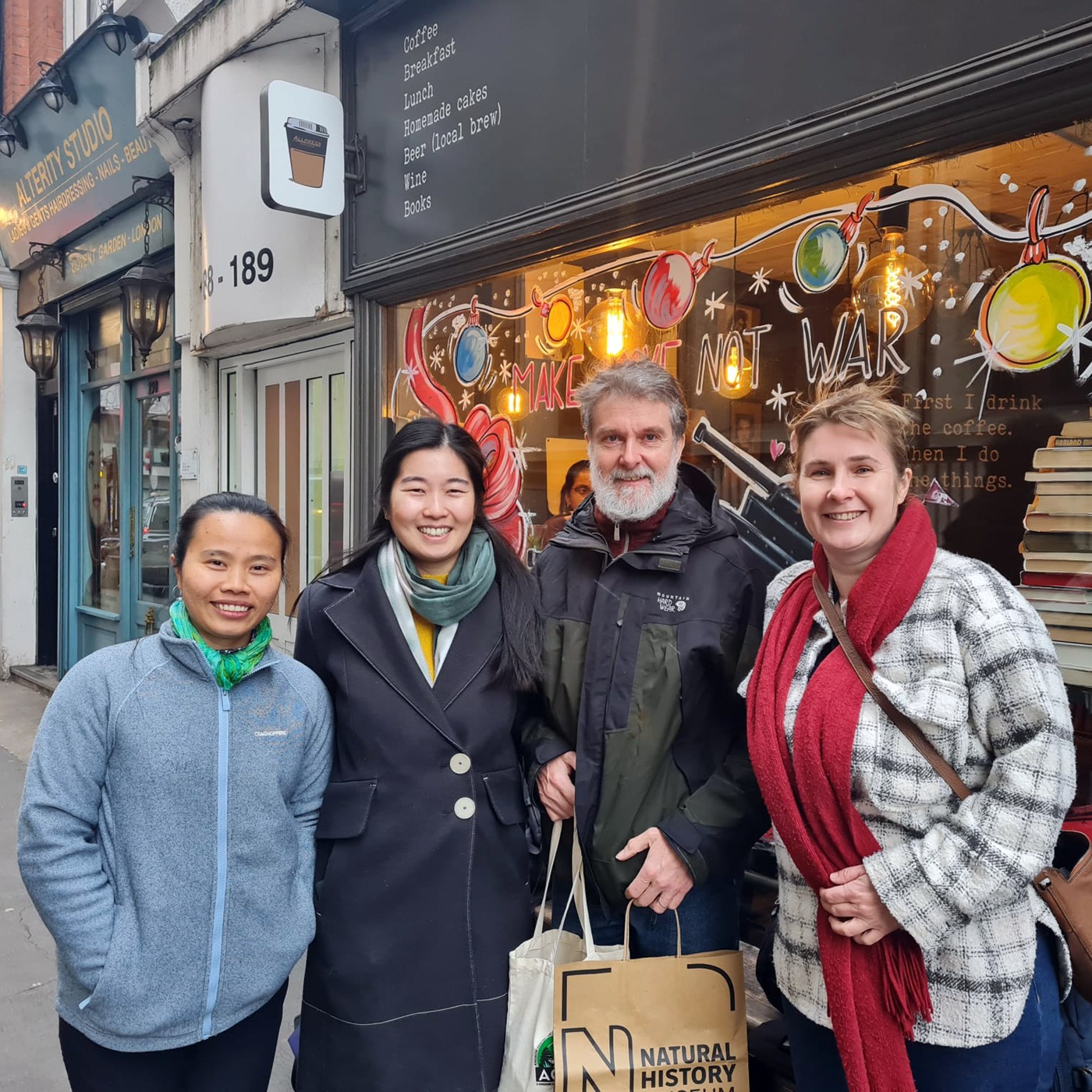
Three Biologists Reflect at Midnight on Decades of Experience in Conservation Research in the Annamite Mountains
72m 41s
This podcast transcription features a conversation among members of the Sila Foundation—Lorraine, Rob, and Minh—along with Rob's son Ben. They gather to reflect on their collective decades of experience working in conservation and research across Southeast Asia, specifically in the Annamite Mountains. The central theme is their quest to find and protect the saola, an extremely rare, antelope-like bovid discovered in 1992, which they fear could face extinction like the dodo. However, they emphasize that their mission extends beyond a single species to the preservation of the entire Annamite ecosystem, a unique and ancient mountain range with a stable wet climate that has served as an evolutionary refuge for numerous endemic species. Each speaker shares their personal journey into this work, from student expeditions and accidental career paths to being inspired by local connections and even the movie *Avatar*. The discussion underscores the urgency of conservation, the profound human impact on biodiversity in a short timeframe, and the foundational goal of creating meaningful, lasting change in the region.
[Music] It's two minutes to midnight. We're in London. I'm here with Rob Tinnons, Minn-Nin, and is it Ben Tinnons? Yeah. Right? Rob's son, my name's Lorraine, Lorraine Scotson. My self and Rob, we work for the Sila Foundation. Minn is our research associates. And yeah, Ben, you're Rob's son. Quite a rare situation that we're in here. So we thought it would be a good opportunity. At least I did to record a podcast while we're all in the same place. So what would be the most appropriate theme of a podcast? The best use of time, given our three collective sets of experiences working in Southeast Asia. I decided it would be to reflect a bit on our decades worth of experience working in the region. We've all worked for many, many years in different parts of Southeast Asia, in conservation and research. And how that's brought us to where we are today. Like, why are we doing the work? Why have we chosen the path that we're on right now with the Sila Foundation? Quick recap, Sila Foundation for Animate Mountains Conservation. We're on a quest to find one of the rarest animals in the world. Probably the rarest terrestrial mammal in the world, but as much much bigger than that. And what I hope listeners get from this podcast is an understanding of the role that Sila plays in a much, much bigger movement for really creating meaningful change in conservation in the animate mountains. We'll start with maybe some introductions. So, Rob Timmans, that's our technical director. Rob's been working for, well, you know what, Rob, why don't you introduce yourself? Give us a little summary. Who are you? I'm always stumped when people ask me that because I'm actually where I get to go. So I started working in Southeast Asia in the China in the early 90s. So my first time in the China in life was in 1992. And I guess I've been going back ever since. Work for most of my career as a essentially consultant for the mainly for the big NGOs. What was the first thing that took you over there? Were you not at university and you got some funding to work? As a student at Cambridge, those are tradition of student expeditions, particularly in the bird in community. So the bird in community almost always students organized expeditions over the summer holidays. And yeah, so that's kind of how I first ended up in the lab, although I finished as a student by the time I got to lab. So the lab trip was organized by several of us. Actually most of us had already graduated. And it was kind of the culmination of it actually more than a year sort of planning and fundraising. And it was sort of the the blue had been, you know, a close communist country for 30 plus years. And suddenly, the lab was starting to open up. And so this was the first opportunity for basically, you know, Western biologists to get into the country. So we said it jumped on the chance. And for people who don't know geographically, lots of people mispronounce it as loud. Southeast Asia, sort of sandwiched in between five countries, landlocked. Right? Yeah. Lots of people didn't know. Between time and the two countries everybody knows about. Yeah. So men, you're from, I'm sorry, anyone mispronising your name. You're from Vietnam. So what's your introduction? So it's quite interesting. Not like so many special lot animals, what is cover in the area, corn the atomise. Which is the mountain range, a lot of the butter up in Vietnam, now in Cambodia. So if they all discover in 1990s, it's sadly kind of like the same time when I was born. I mean, I was born in 1990s, not 1990s, but considered roughly that. And I actually was born in the area and just like right next to the other mountain as well. So I have a lot of my discoveries or have seen adventures when it was more looking for animals, but I never had a chance to go to forest for sure. But later, like so that maybe that reason why the whole world, my life's having written by the animal, the nature. That I just wish to work with them a lot as I can. So I ended up like working start to work. I was subject relating to nature on. In 2017, was some anti-bene work. And like he's talked to me before like, do you remember my first day working with like nature? I said I remember really well because at the time like the other time movie. Avatar? Yeah. Just out. Is that the one with the old tree? The 3D one. One with the old ladies? Yeah. Yeah, yeah, yeah. Okay. Yeah, so I saw the scene, I'll like to make the forest where it's sparkling. And it's beautiful. And that's how I also went to the forest and everything is beautiful with that. I mean at night time and you see everything where sparkling in the forest. And that makes me just like never forget. Awesome. I never, yeah, I never heard that before. You sure? You're supposed to be that. I've seen the movie. I made a pen on the season, but for sure. And it's tropical forest. It's like at dark and I can see everything sparkling around. It's wonderful. But yeah. Okay, thank you. So I'll just, you know, introduce myself. So let me know, obviously, I don't know how obvious it is, but I'm Scottish. I ended up in Southeast Asia by accident. I was on my way to Africa. I wanted to go work with big cats and just go to go to job. Or whatever volunteer position in Cambodia and showed up and found out there were bears there and. And really never look back to be honest. So I ended up working for the day, day and a half or so and bear research and before getting involved in the work that we're doing now. So very lucky, accident ending up in Southeast Asia. We all work in the animal mountains, which is the mountain chain that runs forms almost the entire border between Laundry and Vietnam. And it extends just a little bit into Cambodia as well, right? We're very, very focused on the sila discovered as men said, you know, 19, it was in 1982. And Antelope, like, I always say Antelope. Yeah, we've got it very Antelope-like, but the special thing about this animal is that it's a ballad. And the antelopes are also bovens. So sila and antelope are in the bovens family, closely related to wild cattle. Evolutionary speaking, it diverged. What do you think seven million years ago, you think? It was in the, yeah, Maya scene, the point at which the wild oxen sort of diversified. It's quite, you know, when you think of it, how old sila out? You know, we spent the day walking around museums in London. I was in the Natural Hedge Museum, you guys were in the, was it the Victoria and Albert Museum? Yes. And like, one of the things that came that really got to me today was the sense of that how young we are as a human race. You know, I found it a little bit overwhelming thinking of being sila. They've diverged seven million years in the goal. And like, look what we've done in just 1000 or so years, you know, to sila and to all of the, you know, all of the other incredible life that share the habitat and the animal mountains. Look what we've done in just around about 1000 or so years of activity. Like I sat on my calculator while I was in the Natural History Museum and was estimated, okay, so if I lived 100 and if we look at, okay, roughly, the history of humanity is like, let's see, 2000 years. If I lived 100, then that means that I've been alive for roughly 5% of the history of humanity, which I don't know, I mean, it's an overwhelming sense of responsibility, I think, that comes with that, right? The impact that we can have as individuals in such a short, high-nil aspect of the history of time. Yeah, such a doubtless session. Can we go to the Natural History Museum? Did you, you saw a dodo? It did, right? It did. And you also saw the rate "ok". I didn't see a great, no, I, but yeah, I'm sure maybe the rate "ok" is it? The great "ok", yeah. It just blood-growing next to the dodo. Is it as close as the dodo in the museum? I think there might be more than one dodo in the British. There is. I saw two in two different locations. Yeah, so the D2 species also destroy that human. It's not a sharp town. Yeah. And that's what the sailor might become. Like the symbol of the sailor may become something parallel to the image of the dodo, right? I mean, so, I think, yeah, the sailor has somehow very much similar fate. Quite similar fate to dodo and "ok" either the way. That way they just like, mass, they have abundance, population, maybe on Iceland, on one island. And they just like be naive, if as well, they're gentle anymore is a very, and people just go there and mass-cuelling everything. So that the thing that, so maybe we're either able to not be bothered and see the animal run away really fast.
But the salad is very gentle animal. Yeah. It's a very gentle animal that we can like, one captain in the walk in a captain before. That was Matah. Matah. Yeah. Yeah. The Martha was the, the, the, the, the salad that Bill, Bill Robyshaw looked at. Well, observed. Yeah. It was held in captivity and was that, she like sits my date so. Oh, yeah. 26. Yes. And so I think the same way is oak and doda. And I never thought of that before. And I am innocent. And but we don't have salad. We end up in the same fate. Well, that's it, right? I mean, the image of the doda was very powerful, but we don't want the salad to just be a, just be a name, love of, of, of failure, essentially. Hopefully not. Okay. So anyway, this is not just about sailor. And that's one of the points that I'd like to hammer a horn. Then the time that we have saw this is really about the animal mountains. The habitat that, so I thought sailor and dammit to the animal mountains, right? They're not found anywhere else in the world. Rob, can you give us a rundown of some of the key, I mean, nobody's heard of the animal mountains. I think 99.9% of people in the world haven't heard about them. So can you give a little rundown of some of the key attributes? I mean, it's a very small area, right? So it's not like the Himalayas, which are essentially a huge mountain range or the Andes, which stretched, you know, the whole length of a continent, essentially. The animals are relatively short in terms of mountain ranges. And they were, and they were very relatively narrow, very actually pretty old, amountings. I mean the Indo-Chinese Peninsula has got a very complex but all geological origins and these made up a complex arrangement of all plates and the the animates sort of predate. As far as I understand it the animates kind of predate the formation of things like the andles and the Himalayas which are relatively young the mantin ranges. Did you put a number on that? No, all mantin ranges are millions and millions of years old but it's hard to say. So they're not like amazingly high like some of these newer mantin ranges but just because of their location and their you know sort of geography as with many mantin ranges they create sort of very special climatic conditions and it's those climatic conditions that have essentially given rise to the you know the unique biodiversity of the animates. The eastern slopes of the animates have a essentially an ever wet climate. There's basically rain every month so they never get very dry. The eastern slopes on the VM side right? On the VM enemies so yeah and that especially to those very wet forests that the most unique elements of the animates are all toyed and so you know if so if so if so there's one of many species that are very toyed to and dependent on this essentially ever wet forest. So they're home here I like to have formed like 50 million years ago. 50? 50 five zero. 50 million years ago. Where? The Himalayas. The Himalayas region. Yeah and that might much much longer than that. Older than that. Yeah I'll I'm sure what I'm at more than 66 million years ago. It's exactly. Six million years. At the natural's who's here. Did I hear you right Rob? You said they're not as high. So you mean because they're older they're not as high. They're not throwing any. Yeah they're not so the animates are not growing anymore. You know the Himalayas are still growing. And he's just still growing. That's why they're so white. The animates are getting lower and lower because they're older. They stopped growing well potentially millions of years ago. Given idea of like or would it be helpful to give an idea of the terrain sort of what the mountains look like? Yeah so I mean the the the animates of relatively rich somewhat simple in the sense as well because they're basically just a relatively straight single single line of mountains. A single bridge. Yeah in many ways it's a reason that there are two countries that allow Vietnam is because there's a major range that divided human cultures. And you know the animates are kind of the three sort of geographical kind of parts to the animates which are generally referred to as northern central and southern animates blocks. And each of the three those three blocks have got their own kind of slightly different sort of biotic assemblages of species. So the species differ a little bit between each of the blocks. And then coming from Vietnam is that I mean from in Scotland for example I've always been aware vaguely as a child and more acutely as an adult of like say the Keren warms mountains in Scotland. Is that something that you know as a child? Were you aware of the animate mountains as a geographical feature of your country or is that you know are the iconic in Vietnam? Generally among the general public. Certainly like for sure people recognize the animai because basically like the whole how they say the whole country evolve the coastline on the right on the east but also on the left of us it's like the whole and a long mountain range is it right? So and actually the area that I was born is also maybe like the one of like blue sand the point where how to say the area the narrowest area of Vietnam. Oh really? Yeah this about maybe the narrowest one is about only 50 km from the coast to the mountain then obviously like for sure like as the soil up mountain the mountain mountains all the time I just don't know whether that will I seem more or not it's just something like in my mind that yeah I love it now because we have a sea we have the mountain we have a stream nowhere I'll have it that's it that's what I thought when I was more and I quite love it because it's so close each other too so I can easily get to the sea and that can easily go to the mountain so that's something I'm really in tune. I don't think I've ever spoken about this with you guys before so be interesting to hear what you think about it so one of the ways I describe the animate mountains as kind of as an evolutionary factory for endemic species operating in the similar way as sea you know like the Galapagas islands and the Molley archipelago where essentially it's like inland island habitats that have you know that geographical isolation has driven the evolution of endemic species do you think that's a fair representation or just a little nonsense? it's poetry it's more complex because they're all so refuged here so islands islands are not so in a island by geographic theory something has to do arrive on the island and then evolve into some of you yeah yeah okay what is on on a mainland situation you can have a species which was always there which in the past could have been very widespread but then you know because of climatic changes that species distribution gets restricted to to an island right? yeah so it's an opposite yeah so it's a combination of the two could you explain why it's so isolated and I think a lot of the species in the animites go you know back to the myocene or even before you know over millions of years obviously climatic fluctuations borderland movement distributions have moved around but obviously certain places on the globe have remained more constant than others? do you have an idea of why the animates remain more constant than others? because they're basically like from what I read a bit like as I leave my same somehow I have the question relating to that so that's really really a chance to dig deeper so what rapset is correct it's like more correct in a way like it's a lot of activities in living the combination of the climate, the glacier movement you know like the glacier formation and also the movement of the plate different plates of the of the earth just like the plate move and create a collapse of the India India into like what you call that? the thing I read yeah and we're forming that the Himalaya so the the eight-cell this azure let the power up like the animite were formed much more before that it's also forming in the same way that like a plate you know the heating of the plate that we ate the formation of the animites so when the animai forms it will create a difference in the the elevations so when the elevation we also create a different climate. Myroclimate.
there. So, higher elevation would be like colder as well or at the same time like riot climate on one side and like hudement more, more humid climate on another side. Especially like there also a time that like when the glacier formation is also connecting like the mainland with like the Malaysia Indonesia areas too. So, there's a lot of change maybe of the memo during that time or is all wrong shape in his head. Yes, that. Can I just interject here in point 8 and Robin Minner married? It's an important dynamic to point out. Sorry, carry on, Rob. No, we're sent. So, what the most important thing with disability the animites is that for some reason the animites have maintained a wet climate probably since the my scene. So, for seven million years there hasn't probably been a significant period of drawing in the animites probably on the eastern slope. I don't know enough about it, but I suspect it's got something to do with the fact that you haven't got an extensive continental shelf on the Vietnamese side. The actual continental shelf on the Vietnamese side is really narrow. So, even during a place to close the glacier maximum. Wet air high. Yeah, right. The coast was never very far away from the animites, but I don't know enough about it as to how it maintains that's a wet climate on the eastern side for all that period. And also information about the monsoon climate as well. The monsoon doesn't matter so much because the monsoon climate on the other side, right? Communities which would appear to be much younger, right? There's no evidence of old species in the monsoon or habitats on the western side. Yes, the eastern side with the wet climate where all of the the refugial kind of species are associated with. But maybe that also maybe the one reason. Yeah, the monsoon quite like reasoned, but it's also made one up the reason that causing the shrinking of like many unit species, you think, into like very small population where maybe other places that anymore go extinct and it can't survive? Well, but we're in a glacier minimum at the moment. Yes. So, in theory, the animite habitat at the moment is that it's maximum. And it was during the glacier or maximums when animite habitat was probably at its minute, you know, wits for its habitat, wasn't it? Was it at minimum? In that, and that's probably where the complex pattern, the younger pattern in the animite is further, so, you know, I mentioned the northern, central and so on the animites. Each of those have developed like islands and they probably developed like islands because during the glacier, maximums, each of them were sort of isolated islands of whatever green forest and that's where you have northern white sheep given, southern white sheep given, northern yellow sheep given, southern yellow sheep given because they started to evolve on these in these islands of whatever green forest and similarly red shank doug, gray shank doug, black shank doug and very sort of species with similar sort of patterns down the animites. So, you know, a key point being we've got an area of just extreme uniqueness based on all of these factors we've been discussing. High level of, and of, of, uh, uh, uh, venomous state, so really high numbers of species you don't find anywhere else in the world. You know, top five, you said something earlier, I mean, you wrecked the animite mountains sort of on a global scale. And the area of, you know, high biodiversity. And then just based on the Mayer, Mayer's paper before it classified many different biodiversity hotspot. Biodeverse hotspot, that's the word I was looking for. And just only in that status asia region that already have four biodeverecity hotspot. Yeah. Um, so people may hear a lot, but like indoor, nasia, malaysia, that in one hotspot and absolutely the animites in that hotspot. Yeah. And is it amazing that like, can you see like, if you look at like maybe the map of the world, the hotspot quite like spreading out, but just only in tiny region of like, status asia, we already have that four hotspot. Because our hotspot hotspot. Yeah. Yeah. Yeah. So yeah. So the point is the animites are incredibly special, but they're threatened, right? Yeah. One threat is lack of awareness. Just so many people have even heard of them, which translates directly into being an under-resourced region in terms of conservation investment, let's say. So we're really at the start in terms of what needs to happen to be able to successfully conserve the animite mountains. So comes up coming back to the theme of this discussion of this podcast. So yeah, it's been threatened, like maybe Rob, you have been in the status asia for so long that you you observe what's happening in the forest for more than 30 years because you know, you start at aspedition when you just finish your student debris. And now you still be in the region and working in the forest. So of course, you know more about it's trained up what threatened in the wildlife over there? What's sure? For sure. For sure. And I was right when I when I when I started. Now, I used to think that things couldn't get worse. And I used to think that yeah, that things were fairly terrible in the 1990s, but that everything was going to get better. And I was so wrong. Well, okay, so we'll take the inevitable deep dive into the negative aspect of all this then. Okay, so Rob then in your experience 30 years, right? Three decades. Yeah. What hasn't been working? How would you articulate the problem? I would say just underestimating the pressures to exploit and the difficulty to actually manage exploitation in an effective way. And what do you mean by exploitation? Just a way that sort of natural resources, particularly, particularly large mammals, have been, you know, it's all economically driven. It's all driven, driven, at a global scale. We're not talking to the very local scale here. It's all driven by essentially global politics and a global economy, which sort of filters down right down to the, you know, the very local level, the forest level. And you know, it's mainly been influenced by East Asia, particularly China and Vietnam. But you know, it's all sort of tied into the sort of global trends. Okay, so during my Vietnam, men, what's Vietnam doing? I mean, that's actually an interesting point about like why we have so many challenges in working in like concert, the wildlife species, the nature in Vietnam or Laos. I remember that we had to go to the reality here is like, you know, Vietnam out of war very recently, is it right? Laos as well. So the, when I look at the, the history of like conservation biology, how it's developed and when people start to recognize about the importance of conserving the nature and the animal for human sustainable living. It's a long time ago and it's much, much more before the war in Vietnam. And it means people, maybe Laos people don't have time to really think through what they need to conserve. Because they need to leave, they need to survive. So of course, we don't have a lot of awareness, you know, building up is not so normal to accept that reality. But the, the reality is also set at the same time because we are running out time to conserve our nature as well. So whether we catch up in time to protect and our biodiversity, is that really, really a big challenge that let Vietnam allow me to face with in the, to now in the future too. And if you could, if you could name the single greatest threat,
on the ground, you know, to wildlife walking through the forests and the animal mountains, what would you say that is? So illegal hunting is like the biggest issue. So the fappin is not deforestation is it? It's not hunting is that that's something interesting because the forest patient may be the biggest issue in the China, no what you call Malaysia, Indonesia, countries, but in the animal is illegal hunting is the biggest. Especially now because like the number of the animal, really not having the gliding still fast, that is so hard to see any wildlife, more or it's hard to harvest a lot wildlife anymore. People apply the method called snare. Nearing, yes. And they employ in a really intensive way, million millions of snare and forest to try to catch for anything remain. And it's such a it's such a it's such a cheap and cruel and effective and indiscriminate way of hunting. Basically the people who have a demand, they can just go like the meat of man can just go to anywhere and ask the people who are familiar with the area, you know, and they provide everything. I I provide you with snare, I provide you with food. You just go to forest, do that word, I pay you money. If you get an animal, I pay you more. So that's why we believe Cylar is so rare, predominantly snaring, maybe maybe further, maybe historically hunting with dogs, but in more recent times, snaring right over the last 50 years I'd say. Yeah, because search, he's surged in hunting, particularly snare. Snare very in this ruminate is right. And it's very passive way of hunting as well. They cover the snare anymore don't know. Just like I keep like when we talk I talk to Rob about that issue. I said like just imagine like you have some mouse trap in the house. You think that like if you don't know about a recent mouse trap in the house, what you would like you will get trapped by that mouse trap one day. It's a right. So it's the same like the animal leaving in their home and millions of traps there, millions near there. How can it survive? I mean I got caught in snares regularly when I was in my surgery work. But small small snares so like little you know, so things are said to catch you know rodents and things so pretty harmless. But still you know just scary is it right? Yeah. I mean actually that it was one time also like at the time I was still in 2017 in 2018 when I was starting work with the nature and do some work and forest. The rancher actually the people who stopped me getting trapped by this snare. On my legs. Like a big one. Quite a big one. He's like this big snare and I said man be careful. Yeah and then he just got stuck me and I said what? What? I didn't see it at all. You know and I said look and he just put the stick onto the snare and it boom. I said oh my god look he used to save me if no I would be hand up from the wrap. And then he's quite small. So she might actually have hung up. Yeah. Yeah you're smaller than a bear. So are you from the goodness? Okay so that was the that's that's the horrible part that we should maybe be able to talk to him about the more positive aspect of what we're doing. You know after it roaps 30 years or so of reflecting and men probably united both be working maybe for a similar length of time maybe 15 to 15 years or so working conservation. I started to I mean I started to involve with nature work in 2017. Yeah it's 2017. Yeah so I was probably 2007 when I first started out in the low. Yeah so let's talk a little bit now about the solution. Right so I mean when I was back when I was you know essentially what the silent foundation and role has been doing over the last two years is building you know your dreams actually right. So everything that you've wanted for the last 30 years. So do you want to sort of describe that too? Yeah I mean we focused on salad you know we the salad poses a unique challenge and therefore it requires a unique kind of solution but at the heart of it all sort of conservation I think you know politically in inlayo in Vietnam in China is just kind of realizing what really take you know to achieve what you need to and I think what I've learned over the years on and one of the biggest failings of conservation is that almost always there's never the true amount of resources that are needed to actually affect you know a change that's actually going to be meaningful and too many essentially almost not all but a large majority of conservation initiatives this day are fallen short largely because they fell way short in the resources that they had available. And your told you specifically for Southeast Asia right? Yeah yeah yeah and particularly you know one of the major resources that almost all projects fall way short on his human resources having the right people having the right training having you know the sort of long-term vision that it's going to take to actually put in place what's necessary and have that be actually something that's you know doesn't vaporize as soon as money in as soon as expertise disappears which usually happens after a two or three or four year funding cycle. So projects last two three four five years and then everything vaporizes and everything goes back usually to zero sometimes to negative figures. So yeah the hour or the dream I guess has been to actually put in place all the resources that we need and have that be something that isn't going to vaporize in a few years time. But just like on the resources point before we go on to the human aspect of it you give me an example sometime ago I think it was the black food ferret in America which was yeah and and how many millions of dollars the yesterday had been put into that. I'm not sure but probably hundreds of million right. Maybe not hundreds but more to tens of millions of millions of yeah. So the disparity between resources that are you know allocated to the Western world yeah versus where I think you could see you know in many places conservation has worked right yeah and it's what you know it is working for black food ferrets yeah but it doesn't work on a shoestring budget. No yeah yeah for a sporadic excuse me budget. So continuity of resources and scale of resources is obviously a key factor. Then the second one you talked about was the you know the expertise right and that's where the team that you're building comes in right. Yeah yeah I mean it's you know it's not just about funding it's also very much about the right people finding the right people who have the capability and the motivation and the wish and the desire to do everything that's needed and that's that's you often usually lacking in conservation again in the region. That's the funny thing is that right. Roughly always not really keen he just keen on technical things but he's not like the person who he not like giving a seven out of training anybody and now let's see you change and you you train a lot people there and now. So before you get before you start getting into talking about this incredible team that you've built one of the reasons I understand so much the value of this and the meaning behind what you're saying is from my experiences when I was back sort of in my early 20s doing field surveys and different parts of love at that time I was serving bears and just for my PhD research alone I spent four years leaning out the forest maybe two three three month blocks three times a year. Every time I moved site I would have to have I would get an entire the new team of people and new team of strangers so I'd have to go through the sort of getting to know you process the the training all the troubleshooting that comes with it all the uncertainty and get the work done and and to be honest that was 99% of the work just just getting to grips with this new team and almost as soon as we've done that they don't go home and I've moved in you site and I'd have to do the whole thing over and over again and it was exhausting and it took up most of my bandwidth and most of my energy just to do that alone so what we're doing now with the Sila Foundation and this sort of vision that Rob's created is is to build a permanent team that have that continuous
as a self-contained team that will always work together and be able to move around together. So you can probably see it better than I am. Yeah, I mean, you know, sort of, I think it's a lot about kind of discovering the right people in law, right? Who you know when, you know, not that we're going to leave them high and dry, but even if we did, you know, would actually go on and, you know, move forward with conservation. So we put an awful lot of effort into trying to, you know, recruit and discover the right people. And very much sort of focused, I guess, I mean, we've probably done the biggest or the most extensive recruitment drive of any conservation organisation in the China, in trying to find the team. And that's, you know, and it's not exactly, you know, I wouldn't say it's even over now, you know. We need to always keep looking and that's, you know, our team's great, but it could be better and we should look more. And there's a lot more, you know, the so much potential out there, but you've got to find it and you've got to put the effort into getting those people. And a really, a really key thing to point out here is that this is a, this is a low-led team. I mean, you are the only foreign or on the team. And we were talking about this earlier today and that this is breaking the traditional model of essentially importing expertise, having having foreign or international led projects where implementation is in the hands of, you know, foreign experts who then go home and take all their expertise back home again whenever the project ends. Right, whenever the funding cycle ends. So like the real key at one of the real key attributes of the team that you've built is that you're the only foreigner in the team and they're already, they're already able to work, you know, without without you being there, right? Here's you were sitting here in London and they're all out in the forest searching, you know, doing some of the best work in the region in terms of searching for asylum, documenting biodiversity and animal medicines. And you're only just getting started, you know, they've only been working now for, I think they got, we recruit them in January 2023. Yeah, just over a year. Yeah, it's actually recouped my team. So we didn't talk yet about who this team are and what they do, right? So I always summarize that as three. Well, I mean, it's more than that. We're the, I've got a detection dog unit. We've got a wildlife tracking unit. We've got our technical, our technical, you know, I never called it this our technical unit and then there's the logistics arm. So it's really is one of the most is a multidisciplinary high level high capacity versus hell self-contained, incredible biodiversity monitoring team for the animal mountains. Entirely composed of people from low apart from you, obviously. Yes. How did that make you feel knowing that you built that team? I mean, it's what you mentioned, right? I mean, it was always been a dream to be able to work with it, you know, work with a team that was competent and motivated and I'm kind of driven. And so it's, yeah, I mean, it's incredibly satisfying and it's incredibly, I guess, humbling as well in a way, you know, thinking about it. And I think, you know, for the first time, I don't feel, I say this and I say this to me all the time. I don't feel like watching a teacher myself, but if I'm surrounded by people who are gifted and motivated and interested, I don't feel, you know, I almost feel like I'm a terrible teacher. But I'm so angry. Really, really, really, and people, so I don't, don't really have to do very much to. No, he's not terrible teacher. He lays in teacher. Wait, wait, wait, wait, wait, wait, wait. No, but when the student motivated him, he would become a very, very enthusiastic teacher. Sometimes too much. Because sometimes he will just keep teaching and not, if he can, maybe we'll be able to overwip up the knowledge of somebody new as well. But like, yeah, so he can come from many different ways. But it's very annoying. You know, you're even made up and you give everything to the person who you want to teach. That's really the best thing. We're talking like, is it 25? 25 people are on this team? Yeah, yeah. So let's talk about some of the applications of the team. So, you know, everything's been. the spark in all of this has been the sila. That's been our driving motivation, but it's by no means the end goal. It's the starting goal. So, what do you see? I mean, for me, if I strip it down to its barest parts, I see this, you know, animal-monetrating research and monitoring team, let's call it as a monitoring tool. And you know, a tool to me, and it's okay, if you disagree, if you strip everything away to the simplest parts, effective conservation requires monitoring, like effective monitoring. You can't manage effectively without having robust, continuous and systematic monitoring data about diversity, threats. Again, just in this more simplest terms, you're trying to conserve species. You need to know is the population increasing? Is it decreasing or is it stable? And why? In the more simplest terms. So to me, that's how I see the applications of this team is being able to fill that critical niche in what's needed for effective management. Like, how do you see it? Am I being too simplistic? No, I mean, I guess the way I see it is a team that has the, you know, everything kind of well science conservation sort of depends on questions right? And being able to answer those questions and monitoring is just another type of question, right? So in terms of understanding, you know, as you say, conservation is very much understanding trends and understanding what's happening. So I see the team, you know, our team as the most versatile and effective way of answering the questions, the pertinent questions that need answering to provide effective conservation, long to effective conservation. And, you know, by sort of developing a team in the way we have where, you know, as you've sangler a, these sort of different components or sort of fitting together. You know, we're trying to create a team that whatever the question is given to them. It's going to be relatively easy to repurpose and redirect so that question can be relatively easily answered without having to reinvent the wheel every time you need to answer the question. So, you know, I guess that's the way I sort of see it. Like stopping this perpetual reinventing of the wheel, saying up permanent resource, a permanent system, a permanent, you know, we want to be the go to resource for, you know, for ourselves obviously, but also for the other other organizations working in the out of my mountains that have a need for high level. Okay, I mean, you said it's a monitoring. You're saying it's more than monitoring. That's fair enough. So, aside from looking for a sailor, what could you visit as some of the other applications just just quickly? If you go down the list of priorities and needy documenting new species, right? I mean, I know that's not particularly the priority. Yeah, I was going to say that I wouldn't call that one of the priorities, but that's one of the applications. That's why the applications quite easily. Yeah, it's to me that you could potentially document a new species every day if we try to in the out of my mountains every day. If he's going to. No, as long as you've got a, you know, by new species, you don't might, you know, you venturing into invertebrates and plants and everything. Yeah, I mean, like a large mammal or. Yeah, yeah, we couldn't fly out of the large mammal every day, but yeah. But certainly a new species to science wouldn't be too difficult through 165. Yeah, it wouldn't. That's probably the tip of the iceberg in terms of the actual numbers, you know, on discrete species in the animals. Well, like you say, that's not the priority. I mean, I would say the priorities get sneering under control. The priority. Well. I mean, the, the, the renumerous priorities. And then just just achieving achieving effective management is.
one, but you know, I mean, there's so many elements to achieving effective management. I mean, the the the area that the team is most likely to help with, I mean, you know, what, what, as you say, one sort of monitoring, but one, another aspect that the team like ours is helping, you know, sort of support, you know, enforcement patrolling in in situ. That will be fairly easy to adapt the team to, you know, what do you mean by that exactly? Like, well, to inform enforcement, so to speak, feed information to law enforcement teams. Yeah, yeah, or to work alongside law enforcement teams. I mean, you know, detection dogs are used routinely in enforcement efforts. Human tracking teams are often used, you know, alongside enforcement teams. And our dogs are trained to detect snares, right? Yeah, for their own safety. For their own safety, but yeah. Yeah, so I mean, yeah, there's a lot of it. It wouldn't be difficult to repurpose or, you know, just new directions for the team. That will be easy enough to do. And that's what we want, right? We want we want a future. You know, one of the things, when you talk to both, I asked you how you feel about this team and you feel very obviously very positive and optimistic. For me, it's a different perspective. For me, it's frankly terrified because of the commitment to each one of those individuals. We've given them a job. We're all afraid of their career. We're encouraging them to branch out into something probably none of them even dreaded about as a child. And we don't want to ever have to take that away from them, you know, so it's a huge responsibility in terms of keeping 25 plus individual people on the path that we've put them on, you know? So I do find that quite terrifying. Do you know, I don't think like you put them on any path. Everybody have a choice. When you offer it and if you're what you offer, fit them well, then we keep following and then we do that following their all-heart as well. But if you, what you offer and not, right, for them, I really never stay. So you don't need to be bothered about that. I feel like that because like just like me and I saw from many, you know, just one of my students as well, he somehow, I feel like working in a few also requires some special skill that you need to help you to maybe like you call on survive, but it's not really survive from like the insurance situation, but like more like you can work in a hot condition, climb up the mountain or something like that. My student like his physical or adaptation and being not good. So maybe after this few trip, I would give up. But then after that few trips, he'd keep like doing much more. No, I want more future trip. I want to do more work. I want to work with more life. I can't stop myself. I mean, and what I can do is like, okay, this is like many ways that you can work with nature. You don't need just only working the field to work with the nature. There are also many ways that you can work. Which one you refer, if you want to refer, you can, is there anything? And tell me which one that you like and we support you in whatever way that can. So yeah, so I think like we're not forcing anybody here. No, I guess that's not what I, you know, I certainly wouldn't think that we're forcing anybody, but we have, I believe, quite dramatically influenced the life path of a lot of young talented individuals and obviously offering them, you know, giving them salary and they've got families that they're supporting. And so it's kind of from that near-term responsibility, you know? Yeah, I got that boy from the first one. I can feel that. I mean, because it's quite like plenty in the situation that way, you know, like in the past, like, just like, seem like we are a Southeast Asia. Country is not very lucky to do any conservation work maybe. In the sense that like when they get out of the war and they get the peace and they didn't have in that time to catch up with like what they need to do with the nature, with the wildlife and already like on the funding, you know, quite cut down to like, short-term funding before they select people can be supported with long-term funding for conservation. I mean, and big come on, this reality, there's no work that like we just like give you a short-term achievement at home. It's a really long-term commitment to show impact and we to fell into that period of like, short-term funding and very short-term funding as well. And it's of course a real challenge for anybody who reinstate and conservation can pursue that pathway. And now like we meet with the challenge also how to support we talk about sustainable living and sustainable environment or conservation. Does it work with your support, isn't it right? We still support people who can continue to do the job. Well, in a way that like, support their life. That's very simple. But like, it's so challenging and important. In this period of time and so this is really what we need. So I read what problem we have many priorities in a very challenging time that like many things need to be kept on the same route to work out efficiently. It's like, effective management system, good awareness from the public, everyone. We have need to have a good generation who have like a good capacity to work with conservation. So there's a lot of elements there that we need to really push up and somehow look like your recent project. Like, what's finding the solar is not just only about finding solar but in the solar support the new generation of LOW citizen to aware more about the nature, about the wildlife, about biodiversity and also build up that capacity to follow and pursue this pathway. It's really meaningful. And I definitely encourage it's hard to visualize unless you've met this team and been in the same room as them. I definitely recommend going onto our website www.cylibandation.org and just take a look at the photograph of our team and read their individual bios to see if you can get better sense of who we're actually talking about here. Okay, so before we wrap up, I thought it would be a missed opportunity not to share some anecdotes. We've always been a lot of time in the forest. So should we go with like one story each of maybe our most bizarre, scary, crazy experience while working in the forest? Men, do you want to go first? Oh, there's many. There must be. I mean, we can do a whole other podcast of what it's like as a woman working in the forest, but let's leave that for another day. It's absolutely like life is quite funny in a way that like maybe the most challenging one. Sometimes it will become like something that more interesting things that you experience as well as right. As long as you overcome that challenge at a time, so maybe just one of my most recent experience. Because we got lost in the forest, basically like it would need at a time I've worse like in a really hungry mood that I need to get out of the forest as soon as possible to be able to fly to the US to catch up with my study to start my PhD degree because like the permission of the COVID causing the permission delay until I took a few days before I need to fly. So I just can conduct a survey really in urgent mode. Somehow like at that time I didn't think much because I had the things of so many things and then I had the one local person to go to Iyer's to go I should track it but I didn't and he took it on the wrong way. Did he take the shortcut home? He said it a shortcut to home. It's not a shortcut to home. But anyway somehow like we started early in morning like around 6 o'clock 7 am and we had to get home you know get out to the road to range station very early at 6 pm something and it messed up the plan because like it told us the whole morning get lost in the forest and I realized that we got lost and we got lost we woke up early in the circle and then told it the the I told the local person said I think we got lost. This is the location basically you go in back to the camp and he still didn't believe me. He said fly I just stay here you can run that direction to go back to the camp until just speak it out whether we lost it or not I'm awake for you here. But anyway so we figure out that we got lost and we just like but I have to get out of forest so we know that we're going to be able to get out of the forest.
that side that we work a fast way we can we took like running in the forest you know like racially rush out the forest and unlucky we seem like we catch up like we get out in the forest around like 6 or 7 pm but we couldn't cross the river because like the flood from the upstream they caught really intensive uh uh uh uh what wave and very strong currents so basically we couldn't cross the the river or the stream at all and nobody can fire us at all too so we had to stay there and have a picnic oh but oh quite over there and my student at that time but oh just think that like a picnic here we don't need to have much chance to like enjoy by reputify on and stay under the rain it was raining it's raining the whole day it was so out close wet but we still put fire on and this is basically a net until like around like 10 pm or 11 pm the water started to be like quiet a bit and we tried to cross over and and you were just waiting through the water yeah and the bad thing is that like the there were local person who leaving us see like he feels shy and he got lost and he took like this appear from us in the forest so he got left from us too um and he carried my backpack and my passport in the back of the head I couldn't fly back to the city in time you're kidding and we took away overnight car to go back to the city so it's very hot to get a time but it worked well you got your passport back in the end yeah he ate all my food in the back that um he used all my work at in my back because he appeared like he would not be able to get lost because local people know it but it's just like he appeared the next morning you know after we got out at him letting me out here the next morning that like he ate all my food then so he ran out don't know at least he didn't steal your passport no you know you know that life because we work and know that they all very good people yeah just like yeah you know sometimes we just get too much coffee then maybe and we took the last bit it's quite nice like now we did when we come back to the village and we took the half and talking about the story uh but yeah that's quite scary moment of it yeah also like maybe you just slow down don't be panic enjoy what you can and see what will happen yeah okay I'll tell my that I'm gonna let Rob finish with his um so again I have loads obviously but probably one of the silliest things is I would spend 10 weeks 10 days the two weeks in the forest and as the only woman in the team it would always be quite whenever whenever I get out of the forest and we would go into like these tiny little villages we often had had barely seen foreigners before let alone foreign women like Western it Westerners I mean sorry I would feel quite I don't know claustrophobic is the right word but just you know really needing some of my own space you know you just didn't have any personal time you know because you're kind of always with people and you know so at one point I remember getting out of the forest and into one of these tiny little villages and just you know really feeling a little bit crazy because I wanted some of my own space and going and hiding in a toilet to eat a bar chocolate and by a toilet I mean a little bit of a shack with a hole in the ground right yeah it's a bit and like it I was in there and had this bar chocolate I did not want to share with anyone but they didn't want anyone to see the east it this is what and I'm sure there were children peering at me through the gaps in the bamboo you know whenever the band here I'm having this bar chocolate thinking what has happened to me what has become of my life there you go that's made quite distinctive way of enjoying your chocolate yeah I think it was a really rubbish bar chocolate as well so anyway that's mine Rob he has so many maybe he's just a story about scaring people instead well yeah I'm not sure what sort of story she says it's a turtle I mean yeah Min mentioned just mentioned what Min just mentioned was something that has come up a few times I get in conversation of just freaking scaring local people scaring local people yeah not intentionally but just there's the boogie man yeah yeah basically as a you know just a a foreigner appearing in front of the mat of the blue usually with a long beard and after many months in a forest no shirt on sandals yeah no shirt on short sandals and yeah I guess their vision of a you know an evil forest spirit and life and I more than one occasion I've had people essentially running white screaming from me but in a village or in the forest I kind of in forest on yeah but within sort of you know the the the the the the the the so exactly yeah yeah yeah yeah the zombie can be let's fall the fresh stage so you need your attention you're you're out by yourself yeah looking for something or other yeah burning or whatever and bump into someone that's just collecting some food or yeah and that I mean and some you know usually if I can see the situation coming you try and make yourself aware and make you know not be sort of a surprise situation but that doesn't always work out the way you want it to work out and they would think you were like a people are you going by or pin your buy yeah what be concoi they're like the city station variation of like Sasquatch or Yeti so it's you know the subspecies the citations whatever of the variant yeah variant there's two there's pin your buy it's all and then people quite the the the small hairy ones so yeah you'd be like a third one maybe third version again y'all we found a new species yeti supergareous is it all the rumors you must have caused my goodness stories they'll be telling for years to come with this ghost they met in the forest yeah that's funny okay right we're gonna wrap up because it's now much much later than when we started so my question to both of you I talked about this about the start right so if you live to be a hundred years old you've shared 5% of human existence you know essentially on this world right if we lived to 100 so where do you want to be in 25 years time when your 5% share is spent where you want to be like they're not physically aware but like you know what would lead you to feeling okay good I did good it's a good career happy with what I've achieved to be optimistic let's say we're still extant which would mean we've found them we've found more than one cellar several cellar yeah I mean it's been significantly improvements in in conservation effectiveness and conservation management you know things are doing more scientifically and pragmatically in in conservation the prioritization follows sensible guidelines and sensible approaches that sort of you know essentially solid data driven yeah essentially that yeah but achieving that is it's going to be not what not work but it's definitely possible it's definitely possible yeah and I'll pay you in I'll give you more time so in the 50 years time where do you where do you want to I mean I just suddenly like when I read the book and talking about drop staffed shallor to shallor yeah absolutely yes one of our earlier book about like you know his trip to study station especially in the animais is it so he hope to see the same thing like the the wildlife is they do a lot like a wildlife spotting and in there the singers or like when I siting in in there in India right so expect to see the population you know wildlife a lot like that and we can see you know wildlife around so that's absolutely 9/2 like it's like it's lessable accessible wildlife like no it's more like we can we don't need to like have to go re-hardify wildlife just like even we have to go into the forest very far and it's still challenging to see wildlife is right but like this in the population is still abundant and there's a lot wildlife many species like live and how many maybe and then people can easily go and looking for a wildlife sighting easily and it can be a really maybe popular spot because like
Imagine, in 50 years people can see salad. Is that amazing? That's something that I have for sure. You know, I also think like to be able to achieve that, like we really need like a system that like can help monitor, help manage everything more efficiently. And I'm talking like many, everything here in Luba bread while the population, you know, and the resources. So with that, it's really like it needs a lot of joy and effort from like the government, different conservation organizations, and you know, even the young generation now they're in the public. We need to get on the same page. The government will enable a system that can help us conserve the nature in a better way. The mechanism that can help motivate conservation work, that would be amazing. So that's what I would love to see in the 50 years that like we can manage the wildlife well and control the threat. Yep. When's 50 years, you know, what's that weighty? 74. 74. Okay, so let's meet back here. And evaluate our success. Yeah. Okay. I think that's good. We've had a pretty good chat, anything, anything. Is that something that Ben gets real love to see? But if 50 years you can go there and see wildlife, and let and what you can see. Yeah. Yeah, be great. Yeah. So you'll wait for your first trip to South and say, yeah. That was awesome. That's awesome. Thanks so much guys. Thank you. We're done. Thank you for tuning into the Sailor Foundation's podcast. If you want to find out more about us, then head over to our website at www.sailafoundation.org. You can stay in the loop by subscribing to our newsletter. You can follow us on Facebook, Instagram, LinkedIn and even YouTube. And if you're feeling extra inspired to make a real impact on conservation in the animal mountains, consider donating through our website. Thank you. Hit subscribe, tell your friends, talk to you again soon. [Music]
Podcast Summary
Key Points:
The podcast features members of the Sila Foundation discussing their decades of conservation and research experience in Southeast Asia, particularly the Annamite Mountains.
The foundation's primary quest is to find and protect the saola, one of the world's rarest mammals, which symbolizes a broader mission for meaningful conservation change in the region.
The Annamite Mountains are an ancient, biodiverse, and geographically unique range that acts as an evolutionary refuge for many endemic species, including the saola, due to its stable wet climate.
The speakers reflect on the urgency of conservation, drawing parallels between the saola's precarious fate and extinct species like the dodo, emphasizing human impact and responsibility.
Personal stories highlight how each individual's background and accidental or inspired journeys led them to work in the Annamites, united by a passion for protecting its unique ecosystems.
Summary:
This podcast transcription features a conversation among members of the Sila Foundation—Lorraine, Rob, and Minh—along with Rob's son Ben. They gather to reflect on their collective decades of experience working in conservation and research across Southeast Asia, specifically in the Annamite Mountains. The central theme is their quest to find and protect the saola, an extremely rare, antelope-like bovid discovered in 1992, which they fear could face extinction like the dodo.
However, they emphasize that their mission extends beyond a single species to the preservation of the entire Annamite ecosystem, a unique and ancient mountain range with a stable wet climate that has served as an evolutionary refuge for numerous endemic species. Each speaker shares their personal journey into this work, from student expeditions and accidental career paths to being inspired by local connections and even the movie *Avatar*. The discussion underscores the urgency of conservation, the profound human impact on biodiversity in a short timeframe, and the foundational goal of creating meaningful, lasting change in the region.
FAQs
The Sila Foundation focuses on Animate Mountains Conservation, aiming to find one of the world's rarest animals and create meaningful change in conservation efforts in the region.
The saola is a rare, gentle, antelope-like bovid discovered in the 1990s, considered one of the world's rarest terrestrial mammals and endemic to the Animate Mountains.
The Animate Mountains form the border between Laos and Vietnam, extending slightly into Cambodia, and are known for their unique, ever-wet climate and endemic biodiversity.
They act as an evolutionary refuge with a stable wet climate for millions of years, fostering many endemic species found nowhere else, similar to island ecosystems.
Rob started through student expeditions in the early 1990s, Minn was inspired by local nature and the movie Avatar, and Lorraine arrived accidentally while en route to Africa, leading to bear research.
Species like the saola risk extinction due to human activities, similar to the dodo and great auk, with their gentle nature making them vulnerable to overhunting and habitat loss.
Chat with AI
Loading...
Pro features
Go deeper with this episode
Unlock creator-grade tools that turn any transcript into show notes and subtitle files.
 PodcastTranscript AI