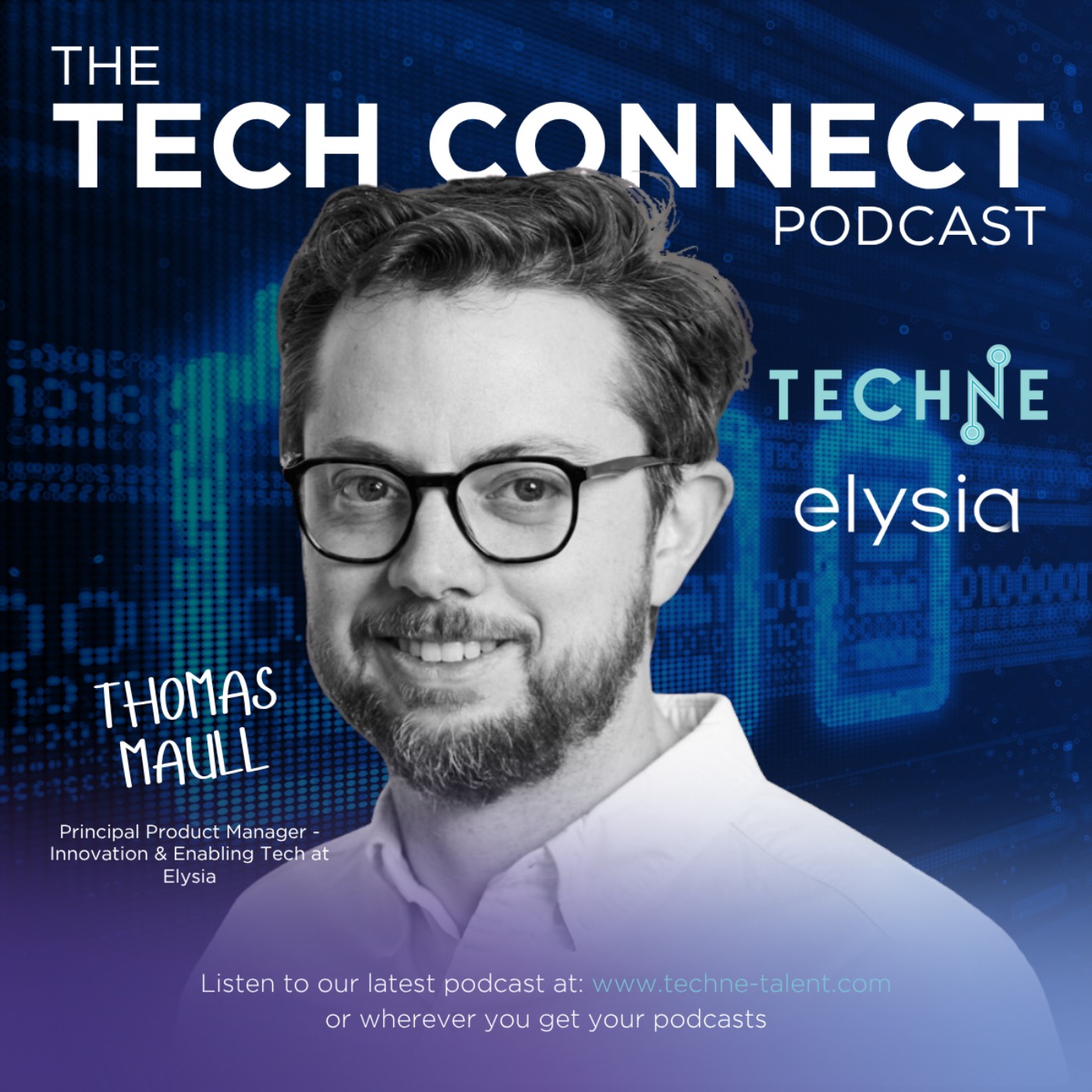
Thomas Maull, Principal Product Manager - Innovation & Enabling Tech at Elysia
32m 6s
The Tech Connect podcast delves into innovation stories across sectors like automotive, aerospace, and energy. In a recent episode, Tom Maul, the Technical Strategy Manager at Elysia Battery Intelligence, shared insights into his career evolution. Starting in mechanical engineering during the Great Recession, Tom transitioned into litigation consulting before venturing into battery intelligence. His passion for automotive led him to Formula E and LMDH, where he developed algorithms for battery control. Tom's move to the UK in 2020 further fueled his career growth, emphasizing the importance of vision and adaptability. He highlighted the rapid impact potential of battery intelligence due to its software-based nature. Tom underscored the key skills for success in this field, including electrochemistry knowledge. His journey exemplifies the significance of building a vision, adaptability, and continuous learning in navigating career transitions and achieving professional fulfillment.
Transcription
5546 Words, 31643 Characters
You're listening to the Tech Connect podcast, where we go behind the tech and ahead of the
curve.
Each week, we bring you inside stories from the front lines of innovation across automotive,
motor sport, aerospace, defence, energy, and beyond.
Real conversations, bold ideas, the future of tech told by the people building it.
So let's get connected.
I'm delighted to welcome Tom to this episode of Behind the Power through our Tech Connect
platform.
First of all, how are you, Tom?
I'm doing well.
No problem at all, and obviously, for people who don't know who Tom Maul is in the industry,
John should set up a quick introduction for us.
Sure.
So my name's Tom Maul.
I'm the technical strategy manager at Elysia Battery Intelligence, and through that, supporting
Fortescue Zero and Fortescue Metals Group, our ownership structure.
Fantastic.
Before we even jump into anything, create or work related, let's just put that in the
bin for a millisecond, and we'll focus on, Tom, outside of work, what do you like doing?
So I think at the heart of this, I'm a car nut, and as part of that, I've been working
on the same '80s sports car for the last 15 years.
Rebuilding the engine, rebuilding the suspension, tankering with the interior, all the things
that you do as you keep these old and degrading cars on the road, so that's been quite a labor
of love.
More recently, my wife and I bought a house in Oxford, and we've been working on repairing
that, bringing the kitchen up to standard, tearing down some walls, so all the tankering
things that you can do.
Brilliant.
I think, for any football fans outside there, Cloudia Raniere is known as the Tinkerman,
but we're going to brand you, Tom Maul, as the Tinkerman of the battery space.
Is that okay?
That's American.
It goes completely over my head, but I appreciate it.
Absolutely.
Listen, you've got a really interesting career story, and the way you entered the battery
space is a little bit different, and it's a great story to share.
So, what I'd like to do is just to take you back and go through, do you want to just talk
through your studies and how you entered the space?
Sure.
So, when I graduated from university with a degree in mechanical engineering, I knew
that I wanted to work in the mobility space.
As a car nerd, that was sort of the pinnacle for me.
But also, I had the very unfortunate or fortunate timing to enter the workforce right during
the peak of the Great Recession.
So excellent timing on my part, but I ended up at a company called John Deere making tractors
and combine harvesters out in the Midwest in the US, and it was a really interesting
job both in what I learned and also what I learned that I didn't necessarily want to
do.
So, as you might imagine, it was quite a big company atmosphere, and the things that people
truly cared about, their true KPIs, were more about building their career and not rocking
the boat than really innovating.
And I worked there for a few years in a few different roles, but when opportunity knocked
it a couple of years later to move into an area of engineering called litigation consulting
or expert witness work, I took that quite happily.
But I do think that time at Deere was super helpful in understanding how these big companies
operate, what is truly important to them, and a bit about that really scaled ecosystem
or processes are the most important thing.
Yeah.
And I think you managed to scratch probably the itch.
If you didn't scratch it then, you'd probably try to scratch it later on.
So, the fact you scratched it and found out it wasn't right for you could have been one
of the best things as well.
Absolutely.
Absolutely.
Yeah.
The litigation market, I found this very insightful when I speak to you behind the scenes.
Do you want to provide a breakdown of how that career evolved?
Yeah.
A few years into my Deere career, I was approached by a company in the Midwest called SEA, which
really specializes in what's called litigation consulting or expert witness work, and really
what their main business is, really supplying consulting services to OEMs, to supplier,
tier one suppliers in automotive and outside of automotive, looking at VFA accident reconstruction,
looking at civil engineering cases, and also working for plaintiffs who've been injured
by, injured in events that may have been caused by product failures, et cetera.
So, both representing defendants and plaintiffs, and for me, I think there's a little bit more
work in the defendant side.
So, really looking at incidents where people had been injured or whether that was recall
work or looking at sort of the overall strategy of what happens when engineering doesn't quite
go to plan.
And I found that work incredibly rewarding.
I will say that that was a really, a huge change in my career.
It was much more entrepreneurial.
You're really looking at building your own brand, building your own business.
And while I had incredible support from my colleagues and managers at SEA, it was really
up to me to make good decisions about how to manage stakeholders and manage my own sort
of internal business.
And I found that to be incredibly freeing, especially after working in a much more restrictive
environment a year, and really exposed me to a different way of seeing the world and
taking part in these conversations from a VP of engineering level all the way down to
the engineers and the people who had been involved in these incidents.
So, really the full spectrum of how engineering decisions actually play out in the real world.
And I think it also gave me a flavor for how technical communication can be done in the
most effective way possible.
So, really communicating what your findings are both to your internal stakeholders as
well as communicating externally.
Yeah, absolutely.
I think bridging that gap commercially, it took you or propelled you immediately to bigger
thinking, systems level thinking, the bigger picture thinking, however we want to phrase
it.
So, primarily with a lot more pressure based on the industry that you're actually in.
Yeah, I found the pressure quite rewarding.
It's a very adversarial field.
And so, you end up communicating your opinions, your decisions, then often those decisions
are or those opinions are subject to extreme scrutiny by the opposing counsel, the opposing
expert.
And really, you're building your own credibility while also looking at the credibility of other
people's arguments.
And I found that game to be rewarding and fulfilling, especially as you get to the truth of things
and especially as you're able to ultimately communicate both to a jury, a judge, an attorney,
but also back into the ecosystems where these designs took place.
These engineers sometimes aren't really sure what happened in a given case.
And I think it was our responsibility to basically come up with an opinion of R is the engineering
decisions that took place here at fault for an incident?
Or was this a case of misuse, abuse, and really ignoring the safety warnings that may have
come with a given product?
And I think that helps to really clarify what happens in really pivotal incidents in people's
lives, whether they've been injured or whether they've been accused of designing a product
that may have had something to do with this injury.
Yeah, absolutely.
From the US to the UK, so before we even talk career, how was that?
How was the shift personally for you from US to UK?
So my timing was a bit strange.
I moved to the UK in August of 2020.
And if you remember, that was the times of extreme lockdown.
But ultimately, it's been a very rewarding experience.
I think the opportunity to live in a different culture and to see how things are done in
a different place and actually enjoy the richness of the culture here has been incredibly
rewarding.
I think, as any expat will tell you, you still miss home, and also you have a lot of mixed
feelings about the place that you come from, especially, I think, for Americans right now.
That's a real concern, I think we all empathize.
Yeah, it's definitely not something I regret.
It's probably one of the pivotal decisions of my life, and I'm very proud of it.
Yeah, no, that's great to hear.
Linking it back to your career, do you want to talk through how the move evolved and ultimately
what's happened since?
Yeah, absolutely.
So as I'd been in the expert witness world for four or five years, my career was developing,
things were going well.
But I also had a bit of an itch inside, which is that as an expert witness, you're really
a critic.
You're criticizing people's designs the way that engineering was performed, you're criticizing
the way that it was implemented, or you're criticizing the way that a product is operated.
I really wanted to go back to contributing as opposed to being on the sidelines and pointing
out where people had maybe not lived up to a standard.
So with that, I had a very aggressive non-compete, and I really needed to distance myself from
my former career.
And I think around that same time, Formula One was becoming very popular in the US,
and certainly I had sort of glommed on to that as a pinnacle of engineering and design,
and just Googled how to get to F1.
And I think the common route is through Formula Student in the UK, and then going into F1.
So then I Googled, I think, best Formula Student teams, which pretty quickly led me to Oxford
Brooks Racing, and I decided to move here in 2020 and really treat OBR as a full-time
job with the Masters a bit on the side.
And the thing that really shone through in that experience was the drive towards performance.
Everything was measured against how fast does this make the car.
And to me, the area where performance could be gained the most rapidly at that time was
in understanding how to deploy the battery and the traction that that battery created.
So I got really into longitudinal controls of an electric vehicle.
And the key to that very quickly became the algorithms themselves on battery control.
And that's really my first interface with what we call today battery intelligence.
And that, of course, spiraled into phone calls to alumni who were active in the space and
then reaching out to the ecosystem around Oxfordshire, and that pretty quickly led to
a conversation with Tim Engstrom, who's my boss today.
And I think I joined up in May or June of 2021, really before I was supposed to, before
I was even done with my exams even, I think, or maybe it was the week after.
But it was as quickly as I could.
And I remember distinctly, as I was interviewing with the Formula E teams, the Formula One
teams and with Tim and the Advanced Battery, what was then the Advanced Battery concepts
of Williams Advanced Engineering, asking, what's the KPI here six months in?
What do we need to achieve for this to be a success?
And in the big Formula E and Formula One teams, I got sort of wishy-washy answers around
driver dashboards and maybe understanding an MGUK a little bit better.
And Tim was right in, we need to do anode control on regeneration for the LMDH project
that we were immediately launching into.
And I was like, oh, that's cool.
Let's do that.
And it was really around, from my perspective, it came from a, how do we drive performance?
How do we get the most out of these systems?
And at that time in the motorsport context, and then today, while we have a lot of interaction
with motorsport still and some really exciting motorsport programs in the offing, once you
expand your horizons outside of motorsport and into driving performance in automotive
and then even, for me, the most exciting is back into off-road, what we call off-road
or really the heavy industry mining applications that we also support today.
It's fascinating.
Straight away, we've gone through your career.
We've got an underlying passion for your career.
But when we talk about optimizing performance, it's like there's a torch gone off and Tom
comes alive.
And it's great to witness how your career evolved even deeper coming to the UK.
Yeah.
It's something I'm very thankful for.
And that mindset was really something that I think the interface with formula student
really set off in me.
And I think what I found, though, was that the most pure deployment of that actually
was more in electric, for me, at least, was more in electric motorsport than in Formula
One at the time, which is so based in computational fluid dynamics and compressible fluids, whereas
I really wanted to drive performance in the EV and battery space.
So if I take a moment now and say, let's just have a recap.
When you look back on your own career, what are you most proud of to date?
I think it is the work that we did in those early years deploying algorithms into Formula
E and LMDH.
That was the time in my career when I was really boots on the ground or fingers on the
field and really building out the algorithms that we used to build those models, to control
those batteries.
And I go every year to watch Le Mans.
It's something that I do in my spare time, but it's very rewarding to see those cars
shoot by.
And I especially get a big kick out of the pit launch, which is fully EV and one of the
duty cycles that we simulated again and again and again and modeled again and again.
So I get a real kick out of that.
And I think today, as my role has evolved into one that's much more in management than boots
on the ground, it's still exciting, but I think you're just a little bit less connected.
I think that feeling of actually building the fundamental building blocks is so exciting
and so rewarding.
Sometimes when we do the podcast, the format, you know, who are you outside of work?
Well, I'm a tinkerbath and 80s sports car and you've gone from tinkering and 80s sports
car to then contributing to having an algorithm running ultimately on Le Mans, I'm going to
see it.
I just think that's phenomenal.
Yeah, it's been a rewarding journey.
And I think I would encourage anyone who kind of feels that in themselves to look at this,
because I think it's one of the places where you can really climb to the peak of what's
possible in motor sport and really do the most revolutionary work.
I think the controls that we did in Formula E and LMDH were actually revolutionary at
the time.
Tom, I hope you don't mind me saying this.
Regarding obviously your technical background, the start of your career, obviously turning
your hand to some incredibly complex algorithm development.
By gosh, that was a steep hill to climb for you and by God, did you execute it really
well?
Yeah, about that journey and how you executed that and how you executed that niche technical
challenge ultimately for yourself.
Yeah.
I mean, I think a lot of this had to do with some of the things that I learned in earlier
in my career, especially in the litigation space.
And one of those things was bet on yourself that you have to have the confidence to jump
into something where you don't know all the answers and that you don't have everything
figured out, but that you can figure it out and that this is something that you can learn
and if you surround yourself with the right people that ultimately that's the most rewarding
thing that you can have in a career.
And I'm very lucky in that regard.
Elysia is made up of some of the most talented individuals that I've ever seen assembled
into one room.
So it's absolutely a privilege to go in there every day and learn from the people around
me.
And I think you have to be confident enough in yourself to ask the dumb questions.
And you're exposed to people that have incredible experience or incredible insight into very
specialized areas of electrochemistry or controls or data science that you raise your hand and
say, actually, that doesn't make sense to me.
Why are you doing it that way?
And I think that's what makes it such a rewarding journey is really the ability to keep learning
and keep learning and be a forever student, which is something that it comes quite naturally
to me.
And it's something that I think I see in a lot of the folks at Elysia.
There's no wrong question to say.
I think the wrong action is by not asking questions.
Yeah.
Yeah.
I mean, you need to be aware of the resources that can help you.
And there are so many, and I think a lot of them are your coworkers, a lot of them are
the people around you.
And also just there's so much in the field of academia.
I think battery intelligence is so closely related to academic research that you're
really paired with brilliant folks that are doing a lot of this in academia.
And you're really bringing it into an industrial ecosystem and the ability to scale this technology
more than just achieve it in the lab.
Yeah.
What I find incredibly important about your career is the following, go and build an academic
foundation that's linked to your vision.
But by God, there's so much power in building a vision for yourself.
You did that.
Come into the UK.
Okay.
F1 Motorsport.
Let's do this.
Then you broke it down.
And you say, okay, here's my secondary pillar.
Then you went and got yourself in front of the right people doing the formula student.
That has carved this path and it's all linked to the vision.
So I think if people out there, yes, get involved in the detail, get involved in the foundation.
But if you want something, go above and beyond and go and get it in the industry.
And you can certainly do that if you have the right mindset.
And keep iterating.
Yeah.
I thought I was heading to F1.
And actually, that wasn't where I wanted to be.
So I made it just a small change into a place that was a much better and much more rewarding
fit for me and my career.
And then I thought I was going to go into dive deep into cell modeling.
And that was incredibly rewarding for a time.
And then a little bit of a pivot into technical strategy and all these things sort of build
up and you keep pivoting and keep adding in the skill sets that you need to really achieve
in these new areas of your career and having the confidence to better yourself to do that.
But also being willing to say, OK, that was fun.
Let's try a different thing now.
Let's talk batch intelligence.
So yeah, I suppose my first question to you is why come and consider working in the batch
intelligence space just based on your own journey?
So I think the thing that's most powerful about battery intelligence is how fast you
can make a real impact.
Battery intelligence fundamentally is software, and the speed to deployment in software is
just incredible.
So again, going back to 2021, 2022, these were days when we would build the software, test
the software and have it running on a race car in days, weeks, or maybe a month.
This is that happens so rarely in larger ecosystems and it happens so rarely when you start bringing
in hardware.
And so battery intelligence as a software based ecosystem, the ability to get more out
of a battery system right away is just so powerful.
And I think it decreases the time scale in which we're able to have an impact.
Yeah, absolutely.
And I suppose for individuals out there for you to be a success within this space, what
do you think it truly takes?
I think battery intelligence is a field that can really apply to almost anyone.
Battery intelligence is a place where anyone, I think, can find their home.
And it's really about finding the right home.
And I think where we see so many success stories, there's really three key fields.
But also, that's just sort of the tip of the iceberg.
There's so many more skill sets that are necessary.
But the three key ones to me are electrochemistry, so really bringing that fundamental knowledge
of how batteries work on an electrochemical level.
Then the systems and optimization approach, and that's probably where I fit in the best.
And this is really people who understand how to integrate these systems together and create
a really powerful battery system and all the things that can go wrong along the way.
And then last is the data scientists, so the people that can take all of this big data
and then make sense of it and bring it back into the ecosystem so we can close the loop
as to what's really occurring in these systems, again, at electrochemical or systems level,
but actually feed that back into the algorithms themselves.
What separates Alicia in this space?
So I think one of the big things that separates Elysia from other battery intelligence companies
is that we really are looking at the full ecosystem of how batteries are controlled,
deployed, and degrade.
And what I mean by that is that we're looking at certainly deploying our embedded algorithms
onto systems across the world, and that really gives us the ability to control those batteries.
It's sort of the muscle, if you will.
And that's really around optimizing the performance.
And performance can mean a bunch of things, but for us, it means the ability to fast charge.
It means the ability to go longer and take your battery down to more extreme depths of
discharge.
It means the ability to cycle that battery longer than anyone else can.
That's really the KPIs in performance, but I think the other side of it is the battery
analytics space.
That's where we're really taking probabilistic-based approaches to measuring these batteries
and measuring their degradation over the long timescale and feeding that back into the embedded
systems.
We're really building our performance on a basis of prognostics.
So, the ability to account for the one in a million cell.
When we talk about, one thing that we quickly experience in battery intelligence, and I
think everyone's been through this, is that if you're optimizing towards the mean cell,
you can drive incredibly high performance, far past the datasheet in a lot of cases.
However, when you're looking at these large populations of cells, when you're looking
at the millions of cells, you need to account for latent defects in the manufacturing process.
You need to account for degradation that may have occurred due to anomalies in the cooling
system or corner cases of operating point.
And once you start doing that and you realize they need to feed all this back into the performance
side of it, it really changes the way you view the problem.
It's very interesting.
That's really interesting.
Tom, you talked about the performance side.
Can you provide a breakdown of how the analytics side of battery intelligence is starting to
form?
Yeah, absolutely.
So, I think this is one of the most exciting areas in the space.
And really, this is around supporting electric vehicles and ESS or stationary energy storage
out in the real world.
And stationary energy storage is really the massive batteries that today support renewable
energy and support the time dependence and the difference between when we're able to
capture renewable energy through wind and solar and when we actually want to use it
in our power grid.
So, fundamentally, it's necessary in order to enable these assets to support us today.
And really, what the analytics looks like is taking the same signals, current voltage
and temperature.
These are the signals that we work with every day in battery intelligence and gleaning electrochemical
insights about what is happening within those battery systems.
And particularly, we're looking at degradation and degradation that is likely to cause a
safety incident.
This is the really powerful way that we're able to really increase the performance lifetime
and safety of these assets by observing these degradation mechanisms very early in these
vehicles or assets life and then correcting for that.
And this is really what I was talking about when I talked about a holistic approach.
It's not enough to just maximize the performance of your mean cells.
You really have to be looking at the entire population of cells and then making intelligent
informed decisions about how to maximize the performance in those mean cells while still
managing the cells that are more likely to have latent defects or degrading more rapidly
due to edge case conditions or failures in cooling systems or what have you.
With you getting involved in more, you know, technical strategy and plugging the commercial
bridge, if we like, how do you foresee the batch intelligence space evolving maybe more
from a commercial standpoint?
I think the evolution is really going to take place.
I mean, we see it today in the battery industry at large where the West is really struggling
to compete with China, both in the EV space as well as, you know, more evidently the battery
space.
And, you know, I think we really need to pivot towards an ecosystem of improved data
sharing all the way from the mine to the vehicle.
And if you look at our, you know, Chinese competition and I would hold up BYD is a pretty
excellent example of this.
You're really taking data streams that really bridge that gap all the way from the field
back to, you know, the battery manufacturing processes and even precursor materials.
And so to really compete with that in the West, we need to adopt similar techniques,
even if we don't end up adopting, you know, similar business models.
So that really means taking data from the field and then feeding that back all the way
into battery manufacturing, into precursor materials and really closing the loop in
how we address battery problems so that we're able to iterate faster, bring Gigafactories
online quicker and increase their ramp rate and really make a case for why the West can
build batteries.
And I think, you know, we need to make that make that case urgently.
Absolutely.
That's a brilliant insight.
It leads on to a couple of last questions here for you.
So the top statement for you is why consider the battery intelligence space?
Because to some people, this may be deemed as a new space, but it's evolving very quickly.
So I suppose what's the why behind it from your perspective, Tom?
I think that's why you should consider the battery intelligence space.
Yeah.
You know, this space is growing so fast and we're we're shaping it, we're able to come
in and really take ideas into production incredibly quickly.
And I think it's a place where good ideas rise to the top, because there hasn't been
sort of this calcification that you see in so many parts of industry, there's the winning
ideas are truly promoted on the basis of those ideas.
But that, I think, is the most compelling reason.
I think the other thing to really say is that it's a place that that I feel incredibly
privileged to work, simply because the impact it has on the climate.
We are, as Fortescue decarbonizing all of our mining by 2030, it is millions of gallons
of diesel burned every year.
And the ability to make such a rapid change in such a, you know, compressed timeline is
absolutely a privilege.
And this is in addition to all the work that we get to do to support external clients,
such as our public partnership with JLR, and all of the work that we do in the ESS space,
even strictly our internal work, the impact of that is incredibly, it's incredible privilege
to work on, frankly.
There's a few industry players really trying to take force in the battery intelligence space
and they come at the industry with their own unique and different angles, I suppose.
The USP for illiteracy, if you can sum that up for me.
Yeah, absolutely.
So I think, you know, within the battery intelligence space, a lot of our competitors
want to take a small slice of the problem.
They want to really address the fast charge KPI or they want to address battery anomalies.
And I think this is an approach that, you know, ultimately is not going to going to
pay off.
And I think the Elysia approach of really taking all of those problems and treating
them as the same problem, which they are, you know, they're different sides of it.
But we need to be able to look at battery anomalies to make good decisions about fast charging
them.
If we can't loop all of that together, then we can't ultimately make the step change
in performance that's necessary for EVs to really make the next step in adoption and
performance.
From an insight from, you know, if somebody was to come and enter the battery intelligence
space now, can you just provide a little bit of insight of what the day to day might look
like?
We'll answer that question with a few stories of people who've recently joined Elysia and
what their weeks look like.
One of our relatively recent joiners joined us from Coventry University and her day to
day looks like testing some of the latest motorsport cells in the lab, parameterizing
a new generation of battery models around that testing, and then working to get that
deployable into an ecosystem to support some of our newest motorsport work and algorithms
that will support the next generation of our motorsport algorithms.
Other new joiners are working primarily in the field of data science and probabilistic
machine learning, so applying Bayesian techniques to a wide variety of datasets that we're able
to get off of vehicles in the field.
So we're monitoring about 60,000 vehicles in the field today, as well as development
vehicles out in our clients' fleets.
Brilliant.
I think from my perspective, we look at why come and consider the batch intelligence space.
Techniques come from a heritage of working within the software and systems domain, ultimately
across automotive motorsport, and we've seen, we've done lots of work on BMS technology,
we've done lots of work on ultimately hardware-based systems.
Why we get excited about the batch intelligence space and why we've decided to grow our recruitment
efforts and support the talent pools in migrating maybe to this space.
It is, for me, a combination of next-generation technology.
It's ridiculously fast-paced, so you have that nice motorsport ilk.
It's definitely pushing engineering boundaries.
It's going into the unknown, and for me, the story or the, you know, we talk about visions
and the purpose behind the industry is for the good.
And I know that's a very short summary, but by God, when you actually go deep into what's
the batch intelligence, the impact the batch intelligence space can have and the why behind
it, that will resonate with so many people.
Yeah, it truly is a privilege to come in and work towards, you know, very aggressive decarbonisation
goals and keep sort of your head down in all the politics around EVs and batteries and
some of the sort of turbulence that can occur there, and instead just be working on solving
the problem and really, you know, making an impact that I think our children will thank
us for.
Even in my life, I'm seeing dramatic changes in the climate, and to really have my hand
to the oar in that race, I think, is incredibly rewarding.
So a huge thank you for joining me.
It's a special episode to focus on the batch intelligence space and the insights, your
career story to get into this space, what you're doing in the space and the insights
into Elysia has been absolutely fantastic.
So I'd like to take the time to thank you very much for the involvement.
Awesome.
Well, thank you so much for having me.
I really appreciate it.
Podcast Summary
Key Points:
The podcast features stories from the innovation front lines in various sectors.
Interview with Tom Maul, Technical Strategy Manager at Elysia Battery Intelligence.
Tom's career journey from mechanical engineering to battery intelligence and Formula E/LMDH.
Summary:
The Tech Connect podcast delves into innovation stories across sectors like automotive, aerospace, and energy. In a recent episode, Tom Maul, the Technical Strategy Manager at Elysia Battery Intelligence, shared insights into his career evolution. Starting in mechanical engineering during the Great Recession, Tom transitioned into litigation consulting before venturing into battery intelligence.
His passion for automotive led him to Formula E and LMDH, where he developed algorithms for battery control. Tom's move to the UK in 2020 further fueled his career growth, emphasizing the importance of vision and adaptability. He highlighted the rapid impact potential of battery intelligence due to its software-based nature.
Tom underscored the key skills for success in this field, including electrochemistry knowledge. His journey exemplifies the significance of building a vision, adaptability, and continuous learning in navigating career transitions and achieving professional fulfillment.
FAQs
Inside stories from the front lines of innovation across various industries like automotive, aerospace, and energy.
Tom Maul is the technical strategy manager at Elysia Battery Intelligence.
Tom Maul entered the battery space after working in engineering and expert witness consulting, eventually transitioning into battery intelligence.
The speed to deployment and impact that software-based battery intelligence offers motivated Tom Maul to work in this field.
Key skills for success in battery intelligence include knowledge of electrochemistry, data science, and technical communication.
Chat with AI
Loading...
Pro features
Go deeper with this episode
Unlock creator-grade tools that turn any transcript into show notes and subtitle files.
 PodcastTranscript AI