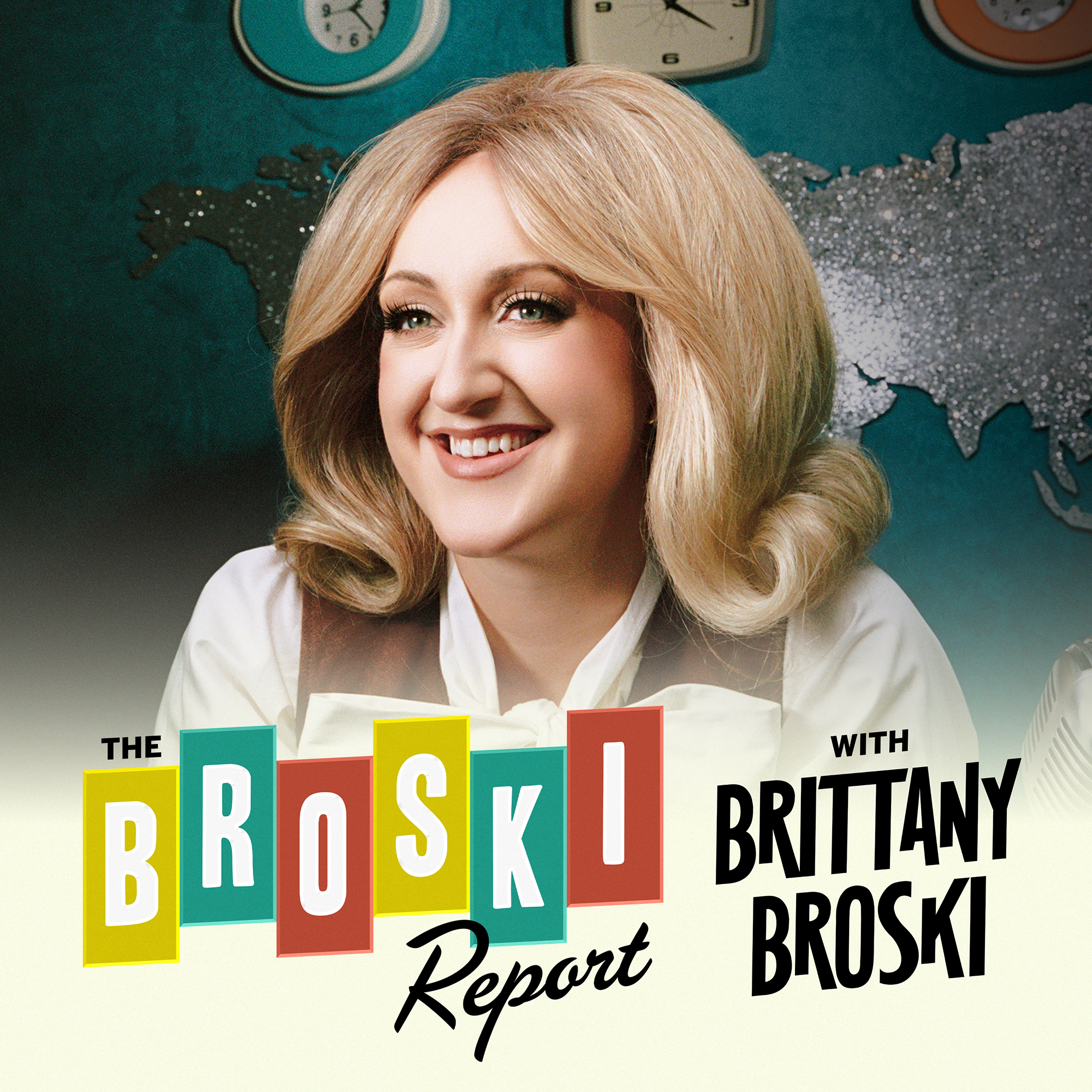
Brittany Broski reflects on her personal growth through journal prompts, focusing on curiosity, learning, and emotional self-awareness. She shares how her interest in songs like "Movement by Hosier" and "Georgia on My Mind" connects to her feelings of being seen and moved by art. The episode then delves into a critical examination of social media, criticizing the addictive design of algorithms that manipulate attention and feed users into cycles of distraction. Broski links horror films across decades to the collective fears of each generation—ranging from alien invasions to psychological trauma and digital surveillance—showing how monsters are manifestations of societal anxieties. She expresses deep concern about how digital culture has eroded authentic human connection, replacing real interactions with performative, algorithm-driven experiences. The narrative emphasizes that while technology offers convenience, it also fosters emotional isolation and desensitization. She reveals personal vulnerability around her need for love and identity, and concludes by committing to deeper engagement with literature such as Toni Morrison’s *Beloved* to better understand trauma and human experience. The episode ends with a call to action: to resist digital immersion and instead seek genuine, analog connections that foster empathy and emotional depth.
**Resumen**
Brittany Broski reflexiona sobre su crecimiento personal mediante prompts de diario, enfocándose en la curiosidad, el aprendizaje y la autoconciencia. Comparte cómo sus canciones favoritas, como "Movement by Hosier" y "Georgia on My Mind", le conectan emocionalmente y le hacen sentir vista y movida. El episodio explora en profundidad la crítica a las plataformas de redes sociales, denunciando el diseño adictivo de los algoritmos que manipulan la atención y generan ciclos de distracción. Broski conecta las películas de terror a lo largo de los años con los miedos colectivos de cada generación: desde invasiones extraterrestres hasta traumas psicológicos y el miedo a la vigilancia digital. Destaca la preocupación por cómo la cultura digital ha erosionado las conexiones humanas reales, sustituyéndolas por interacciones performativas. Expresa vulnerabilidad personal sobre su necesidad de amor y su identidad cuando el amor está ausente. Concluye con una promesa de profundizar en la lectura de obras literarias como *Beloved* de Toni Morrison para comprender mejor el trauma y la experiencia humana. El episodio termina con un llamado a la acción: resistirse a la inmersión digital y buscar conexiones auténticas, análogas, que fomenten la empatía y el desarrollo emocional.
This episode of the Broski Report is brought to you by Etsy.
Shop original gifts that will make everyone on your list feel seen this holiday season.
Direct from the Broski Nation headquarters in Los Angeles, California,
this is the Broski Report with your host, Brittany Broski.
Hola a todos, y bienvenidos al Broski Report, con tu estrella, Brittany Broski.
Guys, welcome back!
My battery died.
Welcome back!
If I was a FNAF animatronic, that would be gag.
Can someone draw me?
Can someone draw me as a FNAF animatronic?
And why did they give Chica a BBL?
Do you think in FNAF 2 they're going to have the BBL Chica?
With the, like, hourglass and kind of like B-cups, maybe?
I don't know. Food for thought.
If I was a FNAF animatronic, I think I would be a good one.
I'd be like, guys, we can't keep doing this. We're kids.
Guys, come on, we're just kids.
Why are we killing people?
But honestly, if I was, actually, if I was a FNAF animatronic, I'd go along with the flow.
I feel like I'd be kind of spineless.
I'd be like, oh, we're all killing people.
Well, I don't want to be bullied for, like, not killing people.
There's, nothing is worse.
Murder can't be worse than being bullied.
Okay, you got murdered.
Okay, well, I got bullied.
So, come on.
You have to understand where I was coming from, at least.
You have to understand where I was coming from.
Okay, guys, what are we doing today?
While I wait for you guys to,
draw me as a FNAF animatronic,
I'm going to go ahead and jump into
something that I've been trying to do
to check in
with myself, okay?
And that is
journal prompts. But, like, light-hearted,
easy ones. It's not like,
when did it begin? It's not that.
And it's not like, when was the last time you felt whole?
Okay? Those ones are, or
what can you release? What can you,
that shit is heavy. I want to
start with something that is
basically how,
I want to structure this, is I'm going to say
the prompt, and then I'm going to
give my answer, and then
I need you guys to maybe, in your
head, think about it as well. Just,
let's have a little exercise, you and me.
Whoever, wherever you are, if you're driving,
if you're running, if you're walking, if you're working,
if you're stealing company time.
Period. Let's do it together, okay?
We're going to start with this little exercise,
and then I'm going to go into why
this headpiece I've donned
today. Why I have elected this headpiece
today, okay?
So, let's go ahead and get started.
And by the way, if you're not subscribed
to the Berserker Report YouTube channel, what
the fuck are you doing? Like, actually
that's going to piss me off. You're
rocked with me for 115 episodes
and you're not subscribed to the Berserker. Oh. Oh.
You fucking hate me.
I know y'all don't particularly care for
me, but I didn't know you hated me.
Okay.
I'll keep that in mind when I cut
the rations this month. Yeah,
when you bitches are eating moldy biscuits.
Yeah, I remember that.
Okay, let's move on.
Okay.
Here's the first prompt. And I don't
remember where I got these. I'm sure they're somewhere. Maybe I
got it from TikTok. Maybe I got it from the
godforsaken app TikTok.
What color
is your favorite song?
Okay, now I've gone ahead and
written. An interesting question, right?
Where are the synesthesia people
at? Phineas, I'm looking at you.
I've gone ahead and written three answers.
And I'm going to go through those now.
Movement by Hosier.
This is one of my all-time
favorite songs. It's a song that whenever
I hear that first
zing, zing,
zing,
I, like, something,
my spine is a little straighter.
I'm looking around like I'm kind of panicked.
Like, this song
is a sleeper agent for me.
And when I hear it, I feel
like myself. Does that make sense?
Do you guys understand?
What?
Movement by Hosier, to me, is the perfect song.
The progression of it, the way that
it ends, the
he did his thing
on that fucking song. Also, the
lyrics, fantastic as per usual.
We expect nothing less from
a Hosier record. Movement by
Hosier, to me, is blue.
Okay? The beginning of the song
opens with
you are the
right of movement. No, sorry.
How does it begin?
Never heard it, actually.
Never heard it. Need to listen
to it. It's like the
light through the water from
the bottom of a pool. Those are
the lyrics. As if you are, like,
on the bottom, laying
flat on the bottom of a pool,
staring up. And
to me, there's this beautiful,
beautiful mixture of
comparing that to
how you view
how a love will move
through you and in you and how you
witness it, how you bear witness to that
love. Actually, yeah, we have to look
up the lyrics really fucking quick.
Right.
I still watch you when you're grooving, as
if through water from the bottom of a pool.
You're moving without moving.
And when you move, I'm
moved. You are a call to
motion. There, all of
you, a verb in perfect
view.
If a man said I was
a verb
in perfect view,
like, the depths of
how you have to
see isn't even
see doesn't capture what that
means. You know what I mean? Like,
to be seen and to see your partner
to, like,
utterly bear witness
to the beautifully
tragic existence of someone
that you fucking love.
Not even love, that you
worship. That you worship as
an elemental deity.
You witness
their act of being
as an elemental
phenomenon.
Like, what the fuck
is wrong with him?
There, all of you, a verb
in perfect view, like Jonah
on the ocean, when you move, I'm
moved. When you move,
I'm put to mind of all that I
want to be. When you move,
I could never define
all that you are to me.
Oh my god!
My nipples just got hard.
Okay. Okay.
So move me, baby.
Shake like the bough of a willow tree. You do it
naturally. Move me, baby. You are the
right of movement. The right.
R-I-T-E. It's reasoning.
It's reasoning made lucid and cool.
I know it's no improvement.
When you move, I move.
You're less pollunin' leapin'.
Or Fred Astaire in sequence.
Honey, you, you're Atlas
in his sleepin'.
What the fuck? Now we have to look up
Atlas. Okay,
so here is my question, right?
Atlas in his sleepin'.
Atlas, as we know, holds
the world up, right?
That's Atlas.
I don't want fucking open AI.
I'll kill you!
This. This is Atlas. Atlas
who holds the
world. Story of how the Titan god Atlas
held up the world.
So, when Atlas sleeps,
does he ever
sleep? Does
Atlas sleep?
Atlas is a Titan condemned to hold
up the heavens or sky for eternity
after the Titanomachy.
Titanomachy.
Titanomachy.
Atlas also plays a role in the myths of
two. Once again, we're looking
at Greek mythology on Wikipedia.
Atlas also plays
a role in the myths of two of the greatest Greek
heroes, Heracles,
and Perseus. According
to the ancient Greek poet Hesiod,
Hesiod, Atlas stood
at the ends of the earth in the extreme west.
Later, he became commonly
identified with the Atlas Mountains in
northwest Africa and was said to be the
first king of Mauritania.
Why was he. Why was
he condemned? When the
Titans were defeated. Oh, because Atlas and his brother
Minotius sided with the Titans in their
war against the Olympians.
Many of them were confined
to Tartarus, but Zeus condemned
Atlas just to. Titans were. Okay,
what the fuck?
A common
misconception today is that Atlas
was. was forced to hold the earth on
his shoulders.
Eww.
Eww. But classical
art shows Atlas holding the celestial
spheres, not the terrestrial
globe. Now, what the fuck are the celestial
spheres? The solidity
of the marble globe borne by the
Farnese Atlas may have aided
the conflation, reinforced in the 16th
century by the developing usage of Atlas
to describe a corpus of
terrestrial maps.
The celestial spheres
were the fundamental entities
of the cosmological
models developed by Plato,
Eudoxus, Aristotle, Ptolemy,
and Copernicus.
And these celestial models. the apparent motions of the fixed stars and planets are accounted for by treating them as
embedded in rotations. I don't give a fuck. Okay. You know what? Actually, while I was eating my
beautiful lunch I made for myself today, I watched a YouTube video about brain rot.
I'm kidding. I'm kidding. I watched a video about brain rot, attention spans,
and how we need to put more emphasis on learning. Of course, I agree with all these statements. A
big theme of this podcast is I come on here and I talk about the importance of learning and
continuing to be a student of life and how if you find something that interests you, learn everything
you can about it and teach about it and seek community that finds that. There is such an
important nugget of identity to be found in learning and continued education, at least for
me, speaking for me personally.
Growing up, education was a big part of how I identify who I am. I pride myself on these pillars
of my personality. One of those things is being smart. I like the feeling of being smart. When it
comes, however, to social media and to algorithmic-based interests and algorithmically curated
media. By that, I mean things that are fed to you, like on TikTok, Instagram, whatever. I'm not
seeking that shit out. It just comes to me. I guess you could say the same about YouTube.
Obviously, there's a YouTube algorithm, but at least on YouTube, I go to YouTube to search shit
mainly. From there, of course, it recommends on the browse feature.
These videos come up for me because I like some of the commentary channels that post these videos.
I can't remember her name, but she posted this one about how brain rot was the official
Oxford Dictionary word of the year for 2024 and how that really signals something about society,
which I also want to talk about in a second, about fears, like sociological fears and how
monsters of the time are reflective of those fears. Monsters and media and creatures and
things.
How there is a physical embodiment of all the taboos and maybe things that are shunned in that
era of media, of society, in American society, of course. All these things are very topical to me,
and when it comes to shit like this, where obviously I Googled Atlas because I wanted to
know. I click on all this shit. I go, okay, now I'm on a rabbit hole because this shit interests
me.
Like, I feel like there is a shackle around my waist where I start to run towards something and the shackle, like, it's like a dog collar.
It, like, lurches me back.
And it's like, you don't get, what about all this stuff over here?
And I'm like, yeah, there's stuff over there.
Hold on.
Let me go back to this bullshit I was trying to, that I wanted to know about.
Like, leave me alone.
Why are you trying?
I want to know about this.
Because I clicked on it.
And now I'm over here, dude.
Like, shut up.
It for real pisses me off, dude.
It pisses me off.
And I'm mad at myself because I pride myself on being smart.
And when you are smart or identify as smart and you are fooled by something, someone, clickbait, whatever it is, we're all victim to it.
It happens to the best of us.
But I'm left.
I'm left with this residual feeling of, like, shame and embarrassment of, like, what I just did just there.
Celestial spheres don't give a fuck.
But I do give a fuck.
Right?
Because learning about celestial spheres is something that, in five years, I wish I could bring up in a conversation.
Well, obviously, Plato and what's-his-name worked on the celestial spheres.
Like, I have a really, it's similar to.
Maybe in high school or college, you would, like, learn a bunch of shit.
Not even learn.
You would memorize a bunch of shit, dump it out on the test, and then never think about it ever again.
I feel that way today.
When I click on a Wikipedia link or a Google search that I actively sought out because I want to know, I don't remember it.
Because halfway through, I'm like, I don't give a fuck.
And that is so bad.
And I'm actively, like, actually, today, I'm making a decree to myself.
Enough.
Enough.
I have to fight through this.
And then I watched this other YouTube video that was like, she was talking about how to rewire your brain into not even wanting to scroll.
Like, scrolling will soon feel foreign because of these drastic yet slight changes.
And by that, I mean like a long-term plan to drastically change your toxic relationship to social media.
And while you can still engage with the media you like, I feel very fortunate because podcasts and, you know, longer-form content is a direct rebellion and reaction to this just inundation of short-form media.
I'll be watching a TikTok and I'm like, it hasn't even been two seconds.
And I'm like, I know I'm not going to care about that.
I didn't even give it a chance and I'm already scrolling.
And also TikTok got rid of the feature where you can. You can click not interested and it'll, like, the video as a whole you're not interested in.
Now you have to go in and then select, I'm not interested in either this creator, this hashtag, or this, you know, whatever the fuck it is.
I don't even know.
I don't, it's never that.
It's like the whole. I'm so pissed off.
It is the whole concept of what this video represents.
That you thought, TikTok algorithm, that I would like this.
Fuck you.
And I'm not interested.
And I actually, I'm not even going to watch this to the very end because I know I'm not interested.
And so I click it.
I want to hit not interested.
And you used to be able to do that so you could train your algorithm.
Now you can't.
Now I have to say I don't like this.
It's nothing against the creator.
It's nothing against the fucking hashtag.
That's not the problem.
The problem is the algorithm.
And it's just getting worse and worse and worse.
Every fucking video is creator earns commission.
It's promoted.
It's an ad.
It's an unskippable ad.
It's, or even the fucking videos that you can't do 2X on, which is a whole other thing.
Why do I have to watch everything in 2X?
I'm not retaining any of that.
I'm not retaining any of that fucking information.
Do you, am I finding community here?
I am so over it.
I'm over it with myself.
And I feel like this is an opportunity.
Like we're at a turning point with our relationship to social media.
And it's a,
a tricky thing, right?
Cause my job is on social media,
but that doesn't mean I don't have fatigue from it.
That I don't have fatigue as a consumer of social media.
I love my job.
And I'm very,
very grateful that this is what I get to do.
There's nothing else in this world that would satiate my soul than doing what I do right now.
But there are also things that you can,
can critically call out of the severe issue with these platforms.
Tumblr,
Pinterest,
Instagram,
TikTok,
everything that used to bring me joy as an internet user is so inundated with ads.
And I understand people need to make money.
Okay.
Of course I get it.
And again,
I am a creator.
The whole reason I get to do this job is because brands pay me money so that I can put that money into a set,
like the broski report set or the Royal court set,
or,
you know,
accommodating dealing with Hollywood.
Like there has to be,
a reinvestment into your business,
of course,
but when it starts to affect like the actual usability of your app,
and I'm looking at you Pinterest,
I love Pinterest.
If you do that shit with an ad blocker,
half,
maybe three fourths of the tiles are blacked out.
They're blacked out because it's all ads.
It's just so frustrating.
It is so,
and it's like a necessary evil.
So when I sit down to watch these YouTube videos that are like,
brain rot,
this attention span,
that whatever.
And then I like actively try to rectify it.
I feel like I'm in therapy.
This is how I talk in therapy.
Sorry guys.
Are y'all rocking with me?
Are y'all fucking with me?
When I try to rectify my relationship to,
and my behavior towards social media and my addiction to it,
because I do have a tech addiction,
duh.
Okay.
I have a tech addiction,
but it's like functioning because it has to,
be because this is my job doesn't mean it's not an addiction.
It is when you try to rectify it and you get nowhere or
what I just ran into where I'm trying to rectify it.
And I get frustrated with myself because my attention span is telling
me it's the shackles pulling me back.
I don't know what to do.
I get so frustrated because I don't know what to do.
And it makes me feel bad about myself.
Okay.
Is that what y'all wanted to hear?
I'm sure the majority of you.
I'm sure the majority of you guys can relate.
I mean,
it's so,
it really starts,
it fucks with your,
your self image.
It fucks with your self image.
I don't know.
know. Okay, let's go back. Damn, I made it one question into the journal prompts, and I've talked
for 20 minutes. Like, what the fuck? Another one of my favorite songs, Georgia on My Mind,
specifically the Michael Bolton version. It's one of my favorite songs ever. That song is green.
And then Play God by Sam Fender, that song is gray. That song is like industrial gray.
Another question, when you look at the stars, what do you feel? What do you feel when you look
at the stars? My answer, small. I feel infinitely small in both the best way and the worst way.
And I have this feeling, because again, I don't know if we've covered it already on this topic,
megalophobia. Hey, I have that. Megalophobia is so fucking for real for me. And the stars aren't
necessarily something that's large that I'm afraid of, or like something that intimidates me or
by its physical size. But it is like, it is so incomprehensible that when you start to partially
comprehend it, it overwhelms my nervous system, and I genuinely start to freak out. I feel the
same way about like heights. I feel the same way about the universe, about death, obviously. Like
anything that just makes me. So the stars make me feel small in a great way that's like, wow,
how lucky am I? How random?
Is my existence. And, you know, the whole point of life is living and whatever. But
when I look at stars, I think it's also kind of meaningless.
It's also kind of meaningless. Okay, moving on. Who would you have narrate your autobiography?
Josh Gad. Does love conquer all? My answer, yeah, of course it does.
You have to choose to believe it does. What is your golden rule? What's your golden rule? I have
two. Number one is leave it nicer than you found it. I always clean up after myself because there's
nothing worse than someone coming into your space and disrespecting it. Even when like when I'm in
a public bathroom, if there's, you know, if I'm washing my hands and I have the paper towel and
I see a paper towel on the floor, I'll use the paper towel to pick it up and put it in the trash
can. Like, leave it nicer than you found it.
Fix the throw pillow, fold a blanket. Just like leave it nicer than you
found it. Another golden rule, do it now so you don't have to do it later. Just do it now. Just
get over with. You don't have to worry about it later. And now that one is easier said than done.
Way easier said than done. But again, do it now so you don't have to do it later.
What's something about yourself you find hard to understand? This is a great question. And I wrote
some kind of crazy shit down. I wrote some crazy shit. Damn. Okay, we're kind of getting into it. I wrote, I'm someone else
entirely when you remove the need to be loved. Trying to meet that person every day and my brain
fog makes it hard. That's what I wrote. I am someone else entirely when you remove the need
to be loved.
Because so much of a woman's existence, you can decenter men. But this shit is wired into our
blood. If I am not desired and loved, who am I? Right? And of course, I know who I am. But there
is this monster, this monstrous part of me that so deeply desires love that it's almost like when I
get it.
I worry I won't know how to hold it. Y'all rocking with me? I also, let me move
on for a second. We're going to go away from the journal prompts and we're going to go through this
crazy Instagram carousel that I found that I felt we needed to touch on what I talked about about
five minutes ago. This is from an Instagram account called PopMyBub. PopMyBub. PopMyBigFatBub.
Horror as a mirror. Okay. How interesting is that? We're just going to scroll through it. I'm
going to read it and then we'll discuss it at the end. Okay. And I'll get to why I'm wearing
the dragon helmet in a second. Every generation creates the monster it needs. The idea goes back
centuries. Horror has always been a way to externalize fear. Before therapy or social
media, stories were how we processed collective anxieties. We couldn't talk openly
about taboos like sex, disease, or power. So screens turned them into beasts. How do I stop
this? I hate it. Okay. And then it takes us chronologically. 1800s, the birth of the modern
monster. The Gothic era introduced creatures like Frankenstein. Not a creature. Frankenstein was a
doctor. Okay. Dracula and Dr. Jekyll and Mr. Hyde. People feared what human ambition might unleash.
Frankenstein's creation reflected the fear of invention, a symbol of the outcast, the unnatural,
the consequences of playing God. Dracula, on the other hand, embodied everything Victorian society
repressed. Sexuality, foreignness, disease. Monsters became metaphors for everything polite
society couldn't name aloud. And I wonder if this will get into this of why the resurgence
of telling these stories now. It's so interesting to think about.
The immigration crisis, quote unquote, I say that in very thick quotes because
it is a crisis completely created for political propaganda. When you think about this idea of
otherness, of an unwanted, monstrous presence who's wreaking havoc on, like, Nosferatu being
told now, Frankenstein, and then Robert Eggers' werewolf movie coming out. All of these, it just
feels so. Because this is always the question, right? Like, I love to ask this question to
actors and directors and any creative. The question is, why now? Why make this art now?
And sometimes it's, you know, just unfortunate timing for when a project gets greenlit,
when you get funding for a project, whatever. You can be ruminating or ideating on a concept
for a long time before it actually gets picked up. Of course, I understand that.
But it's also, like, these executives who are greenlighting these projects,
why now? It's such an interesting question.
1950s, fear of the outsider. Again, post-war America was obsessed with order, conformity,
and the enemy within. It was like McCarthyism and all that. Enter alien invasions, invasion of the
body snatchers, the blob, the thing from another world. The plots were about aliens, but they were
really about communism, infiltration, and the terror of losing your individuality in a collective.
Cold War paranoia turned the monster into the outsider, something that looked like us,
but wasn't. Even Godzilla, born in Japan after Hiroshima, was a walking metaphor for nuclear
trauma. It's also so interesting around this time of, like, how it was always the monster and a
woman. And I really, really, really loved that aspect of Frankenstein, of, of,
Guillermo del Toro's Frankenstein, of there is a reflective, almost, like, affinity between Elizabeth
and her acutely feminine energy and how she is the only one, other than the old man, to see
Frankenstein's creature as a gentle, almost child, like, as a newborn, and to,
you know, treat that with the gentleness that it deserves. I also love, Guillermo said that
on set, was there a name for the creature? Was there a name? And they called him Adam,
because Adam and Eve, because it was God's creation, because it was God's first creation.
So, basically, that's, it made me cry first time I heard that, so. But again, very interesting that
there is such a distinct relationship between the creature and Elizabeth, and how they almost seem to
complete each other. They, they see each other. And it's also very interesting around, you know,
these movies, like, it's always the woman, it's always the monster and the woman,
because women have empathy. 1960s, the birth of psychological horror. The monster moved inside
the mind. The decade that gave us Psycho and Rosemary's Baby, the fear came from the familiar,
mothers, husbands, neighbors, and ourselves. Psycho exposed the split between repression
and desire. Rosemary's Baby turned domestic life into a trap of paranoia and control.
Holy shit. God.
I was, by the way, I was addicted to Bates Motel. When that shit first came out, dude,
I would rush home from class in college to go watch Bates Motel on my laptop, and I would go
I had it bad.
for officer Romero wasn't that his name officer Romero Bates Motel yeah sheriff sheriff Alex
Romero dude Nestor Corbonell I needed him bad because he protected oh my god he knew what was
up he knew what was up and he tried to protect the mom dude and he played such a good uh who's
Freddy he played the good doctor as well Freddy Highmore is that his name
Freddy Highmore yeah he was scary as fuck in this show yeah I love that show and there's also like
the aesthetics of Bates Motel it was very satisfying for like any of the weird bitches
that like that dark macabre you know just like the spooky because it kind of leans a bit
gothic in whatever you want that
to be
gothic has such a wide array like myriad of meanings and definitions at this point gothic
can mean anything so yeah it has that very dark um like haunted neon vibe and it's like
in modern times but it feels like it's from a different time just it was very well done I enjoyed
it 1970s 1980s sex slasher and suburbia when cultural norms cracked civil rights feminists
sexual liberation, horror shifted from outer space to the body itself. Damn. Films like Texas
Chainsaw Massacre, Carrie, The Exorcist, The Fly were all obsessed with flesh, puberty, and control.
The final girl became the moral anchor, the pure one who survives. It reflected both fear of women's
power and guilt about repressing it. Bro! 1990s, fear becomes entertainment. Scream, I Know What
You Did Last Summer, Urban Legend. Characters joked about horror rules while still dying by
them. It was irony era horror, fast, pop culture savvy, built to entertain as much as scare.
Underneath the quips was a new unease, the rise of 24-7 media and reality TV blurred,
what was staged versus real. The Blair Witch Project turned that tension into a phenomenon
that felt like found footage, almost too real to be just a film. I watched The Blair Witch Project
when I was in seventh grade, and I genuinely like, absolutely not. Absolutely not. To this day,
I haven't finished it. And I know that it's not that scary, but it's one of those things that's
the unknown. It's like Lovecraftian.
What I'm imagining is actually so much worse than probably what it is. Because the human
imagination, why can we scare ourselves so bad? What is that? What is that? How does The Blair
Witch Project end? The Blair Witch Project ends with the camera dropping to the floor after an
unseen force attacks Heather in a creepy abandoned house's basement. There was, okay, you know what
actually scarred me, which I'm going to try to Google in a second?
That scene where they find like, it's human teeth. Do you remember that? It's in like a
leaf or like a piece of cloth and it's human teeth. And it was like, as a 12-year-old,
13-year-old, I remember being like, oh, so there's nothing scarier. I don't know why that
scared the living fuck out of me. I don't know why. I'm actually going to, I'm going to read
the premise. Blair Witch Project, Wikipedia.
1999. Psychological horror film. Written, directed, and edited by Daniel Merrick and
Eduardo Sanchez. One of the most successful independent films of all time. I wonder why
that is. Maybe it's because it kind of like summed up an era. Also like maybe this fear of
turn of the century. I know a lot of people were freaking the fuck out. They thought the world was
going to end in the year 2000. Like maybe this was one of those things. It's a found footage
pseudo-documentary in which three students hike in the air. It's a
to the Appalachian Mountains. Haunted. Near Burkittsville, Maryland to shoot a documentary
about a local myth known as the Blair Witch. I don't want to watch it. I don't want to.
They conceived of a fictional legend. Oh, it's not even real.
They developed a 35-page screenplay with the dialogue to be improvised. Whoa. A casting call
advertised on a magazine was prepared by the directors.
About 20 hours of footage was shot, which was edited down to 82 minutes. Damn. Shot on an original
budget of $35,000 to $60,000. The film had a final cost of $200,000 to $750,000 after post-production
and marketing. $750,000 to make a movie and they made $250 million. That's gag. That's gag.
Oh, it went to Sundance. It was a sleeper hit.
Okay, here's the plot. And for any of you guys that have seen it, sorry, I haven't seen all the
way and I want to watch it. I don't want to watch it, but I want to know. The film purports to be
footage found in the discarded cameras of three young filmmakers who had gone missing. In October
1994, film students Heather, Mike, and Josh set out to produce a documentary about the mythical Blair
Witch. Locals tell them of Rustin Parr, this is in Maryland, a hermit who lived deep in the forest
and abducted seven children.
In 1941, he murdered them all in his basement, killing them in pairs while having one stand in
a corner facing the wall. Ew! Ew! The students explore the forest in North Burkittsville to
research the myth. They meet two fishermen, one of whom warns them that the forest is cursed.
He tells them of a young child named Robin Weaver who went missing in 1888. When she returned three
days later, she talked about an old woman whose feet never touched the ground. I don't want to
read this.
Hey, I'm actually alone, and I'm actually getting scared in my dragon hat.
I was supposed to talk about dragons this episode. That's what I wanted to do. I wanted to talk about
dragons. Now I'm scaring myself. I'm reading wikipedia.gov, and I'm getting scared as fuck
in my own house.
The students hike to Coffin Rock, where five men were found ritualistically slaughtered in
the 19th century. Their corpses later disappeared.
Okay, perfect.
Camp for the night. And the next day, find an old graveyard with seven small cairns.
Now, what is a cairn?
A human-made pile or stack of stones raised for a purpose, usually as a marker or as a burial mound.
The word cairn comes from the Irish. Everything goes back to fucking Ireland.
They find seven small cairns, one of which Josh accidentally knocks over.
Fucking dumbass Josh. Dumbass bitch-ass Josh.
Dumb-a-punkin'.
That night, they hear the sound of sticks snapping. The following day, they try to hike
back to the car but cannot find it before dark and make camp. They again hear sticks
snapping. In the morning, they find three cairns built beside their tent. Heather learns
her map is missing. Mike reveals he kicked it into a creek out of frustration, which
provokes a fight between the trio as they realize they are lost.
They head south. Why would you ever watch this movie?
I'm getting scared as fuck.
They head south. They head south using Heather's compass and discover stick figures hanging from
trees. I don't like it. They again hear mysterious sounds that night, including children laughing
and an inhuman groan. After an unknown force shakes the tent, they run outside and hide in
the forest.
Upon returning to their tent, they find their possessions have been rifled, and Josh's
equipment is covered with slime. They come across a river identical to the one they crossed
earlier and realize they've been walking in circles. Josh vanishes the next morning, and
Heather and Mike try vainly to find him. That night, they hear Josh's agonized cries but
are unable to find him. They theorize that his yells are a fabrication by the Blair Witch
to draw them out of their camp.
Like hunger.
Games. Like mocking. J-Jabber. J-Hunger. Games. PETA! PETA!
Heather discovers a bundle of twigs tied with fabric from Josh's shirt the next day. Upon opening the
book,
Heather discovers a bundle of twigs tied with fabric from Josh's shirt the next day. Upon opening the book,
on opening the bundle she finds a blood-soaked scrap of his shirt containing bloodied teeth
and hair so that's actually making sense because that's the part i've seen
although distraught she does not tell mike that night she records herself tearfully apologizing
to her mike's and josh's families taking responsibility for their predicament she
admits that something evil is haunting them and will ultimately take them
is it almost over bro that same night they hear josh calling out to them again and follow his
voice to the abandoned ruins of the house of rust and par of course they find it featuring
children's bloody handprints on one of the walls trying to locate
locate Josh. They first go to the attic, but do not find him. Mike then hears Josh's voice in the
basement and quickly heads downstairs. I'm going to, I'm going to speed run this because I'm
actually, I'm like, I cannot express how fucking scared I am right now. And I'm just reading the
Wikipedia. Mike then hears Josh's voice in the basement and quickly heads downstairs where an
unseen force assaults Mike, causing him to drop his camera. Heather enters the basement yelling
and her camera captures Mike standing in a corner facing the wall. Heather calls out to him, but he
does not react. The unseen force assaults Heather, causing her to scream and drop her camera. The
camera continues to record for a few seconds and then cuts to black. Okay, perfect. So actually,
I actually, there's goosebumps all over my legs. Damn, they marketed this with missing person
posters. That's scary as fuck. What the hell? To portray it as real? Bruh. For its basic cable
premiere in October, 2001 on FX, two deleted scenes were reinserted.
During the end credits of the film, neither deleted scene has ever been officially released
until Second Sight Films Blu-ray release in November of 2024. What the fuck? What the fuck
scenes are those? What's the response? It drew acclaim from critics. Rotten Tomatoes gave it an
86%. Full of creepy campfire scares, Mock Doc, The Blair Witch Project keeps audiences in the dark
about its titular villain, proving once more that,
Imagination can be as scary as anything on screen. Is that not exactly what I said?
Okay, going back, I'm, why do I keep scaring myself?
I don't like it. I don't like it. And what the actual fuck was I talking about to get us here?
I was talking about Hosier about 20 minutes ago. How did I start talking about The Blair Witch
Project? Oh, we were reading that Instagram thing. Yeah, here we go.
The Blair Witch Project turned that tension into a phenomenon that felt like found footage
almost too real to be just a film. This was fear becomes entertainment.
Okay, now we're in the 2000s. Entertainment turned cruel. Dude. Oh my God. I've never thought about
it through this like critical lens before. Like all of this is true.
All of this to me feels true. After 9-11, fear and violence was everywhere on TV and the news
in video games and horror dropped the irony mirrored and horror in video games and horror
dropped the irony mirrored that saturated dropped horror dropped the irony mirrored that saturation
dropped and horror dropped the irony mirrored. What the fuck? I feel like I'm having a stroke.
That sentence, this sentence doesn't make sense, but I'm going to read it anyway.
After 9-11, fear and violence was everywhere on TV, in the news, in video games,
and horror and video games and horror dropped the irony mirrored that saturation
and horror dropped the irony mirrored that saturation. Okay. That doesn't make sense to
me, but okay. Suddenly death had no logic. This is so tea. When you think about like
how humans in mass react or respond to like a, a, uh, widespread nonsensical
tragedy, I'm thinking immediately of like surrealism after world war one, how so many
people across the globe literally were like, that should not have happened. It makes no sense that
that happened. This was entirely avoidable. The severe loss of life, the suffering, the like
loss of norm, normalcy. There is no way to make sense of it. So I guess nothing fucking matters.
And then that's when.
Surrealism became a huge trend or a huge, um, source of inspiration for a lot of artists because
yeah, it doesn't make sense. And you're valid as fuck for saying that. And this honestly kind
of mirrors that it's so funny how we find these cycles like history and art just constantly repeat
and repeat and repeat and it's new versions and it's through a different lens and it's through
whatever, but it's the same. It's the same because we don't learn. Final destination.
Pain became the point like saw and hostile and terror spread like a virus, the ring, the grudge
found footage movies like paranormal activity or Cloverfield blurred the line between fiction and
reality. Do y'all remember? Um, what's the other one? Not paranormal to insidious dude, insidious
paranormal activity and the conjuring all like, I am not absolutely not. I don't like scary movies.
I don't.
I know some people love horror movies. Like I can watch a campy horror film. Like, Oh, this is,
it's gross. And it's like kind of fun to laugh at. Sometimes those kinds of movies freak me the fuck
out. I can't do it. I genuinely cannot do it. I'm not the one turn it off, turn it off. Now I'm
leaving the room. I'm so serious and turn it down. Even quieter films like the others and the
orphanage carried the same dread is the others. The one where they stand outside of your fucking
house with the,
the audience stopped laughing. Damn. Yeah. Whoever wrote this is period. Even quieter films like the
others and the orphanage carried the same dread. The audience stopped laughing. 2010s, the horror
within movies like the Babadook hereditary and midsummer made grief loss and codependence feel
more terrifying than any ghost. Damn. Critics called it elevated horror, but it was really
emotional realism. Fear.
Fear that looked like everyday life. Get out turned racism into psychological horror, polite,
liberal, and suffocating. It followed, it follows turned sex and anxiety into a slow,
inscapable dread. The genre became a way to talk about depression, trauma, and inherited pain.
Things that don't die, but linger. Even in death, they linger. 2020s, digital horror, identity horror.
Their fears went virtual. Now the monsters are algorithms, influencers, clones, and AI companions.
Black Mirror, Megan, Swarm, Smile, Companion, all ask the same thing. What happens when we become
our own creation's prey? What the fuck? What the fuck are we talking about? I'm posted up in the
crib, scared shitless.
I'm scared shitless. Visibility has replaced violence as the new terror. We fear being watched,
misrepresented, duplicated, or worse, forgotten. The monster is no longer a stranger. It's our
reflection. It's our reflection. Okay. The way she worded
that seems a little cringe. I will admit it seems a little cringe, even if it's true. Okay. And I've
been seeing a bunch of critiques about Frankenstein. I've been seeing a bunch of critiques about Frankenstein.
I've been seeing a bunch of critiques about Frankenstein as being the same thing of like,
it's because the real fucking monster is us. It's humans. Yeah. Okay. Duh. Right. But at the same
time, valid point. Same time, valid point. This to me is very interesting because what's left?
I almost feel like that's the eternal question. What's left? Have we explored all these other facets or even sub-genres
of scary movies, of horror, of the different ways to play with the human psyche? What is left other
than we've pushed it too far? We have pushed it too far. I worry about this, honestly, a lot. I
worry about social skills of the youth, decorum, concert etiquette, meeting people in person. I've
had people come up to me on the street and just like, they talk to me like I am not a real person.
And this isn't like a complaining thing, but it's to serve as an example of life now is through a
screen and it is not interpersonal. It's not interpersonal in a way that actually facilitates
connection and empathy. I genuinely think that this is the final stage of like deterioration.
Like we are deteriorating as a society. And this is again, cyclical and a dark age is probably coming.
And I don't say that to scare anyone, but just look at the trends. And that's why it's important
to resist. And it's important to do things that are analog and to find human connection in ways
that don't revolve around social media or around, you know, capturing the moment digitally.
This to me is very interesting because it is true. We fear being watched. The way that
I am spoken to sometimes as almost a video game character or like a chat bot where it's a complete
disregard for my humanity. It's just take this fucking picture with me. It's not a hello. It's
not a please. It's not a, I love your videos. It's no human, no humanity behind the eyes.
And I mean this for the younger fans, which I don't, if you're under the age of 17, watching
my videos, thanks for being here, I guess, but that's not,
there, I have a lot of feelings on that. Okay. And it is a scary thing to think that you could
be influencing the youth. I hope that I'm, oh, for the love of Christ, I hope I'm influencing
the youth in a positive way. But these things scare me, right? Like, your sense of reality is
so warped. I don't know if it's fixable. You have to have hope that it is fixable. But oh my God,
this question of filming strangers, I've had people take photos of me and then DM it to me.
Hey, queen, didn't want to come up to you, but saw you. Here's a picture I took.
That is very odd. Constantly being surveilled. And what does that do to your psyche? And you
don't even have to be famous to be surveilled. Everyone, we live in a surveillance state.
Everyone is being watched all of the time. Your phone watches you, your laptop watches you.
It's never ending. This is, to me, the final stage. And you know what's going to be interesting
is what comes after this. I don't know. Is shit going to collapse? Are we going to go back?
Right? Like, what I was trying to say is we've been desensitized to so much.
Watching a movie from the 50s, I bet that shit was fucking horrifying back then. We watch it today,
Child's Play. Blair Witch Project, shit like that, where it's psychological horror, to me,
I think is more evergreen because we're scared of what we don't know. And that will always be true.
But in the age of infinite access to information, and you think you know everything, or even worse,
AI tells you, this is a definitive truth.
When that's not how the world works. Even, like, scientists and scientific research,
you can establish something as a theory, and years later, it can be disproved once we have
more information. So all of these things wrapped up into what scares the society that has seen it
all. We have seen it all. I watch war crimes on my fucking Instagram feed every day. How do you
sit here and say that doesn't desensitize you to some things? And that makes me feel
sick. I don't want that to be the case. So you have to actively work against those things where
this isn't just content. This isn't something to pass the time as I'm sitting on the toilet.
This is real fucking life. And social media, I feel like, is a reality, but it's not our reality.
It's not a true reality. It's a virtual reality. And some people are trapped in it.
It's just a lot. It's a lot. It's a lot.
It's our reflection. Perfect.
Every generation rewrites its nightmares, but they always point back to us. From Frankenstein's
ambition to Midsommar's grief to Together's disintegration of relationships, fear has
always been a portrait of the moment. Horror changes shape, but the instinct remains the same.
To name what we cannot face and to see what we pretend to hide. Whoa. This was tea.
Ooh, someone commented and said, so fascinating. I wonder what the next decade will bring.
Fear of loss of resources. Us against them. Like, leave the world behind. Yeah, I feel like the
dystopian thing happened in 2012, 2013, which also would have been, I wish they had included that.
I mean, this is horror, I guess, but more so like trends of what's on the collective psyche,
what's on the collective mind. There were a lot of dystopian novels being written around that time of
the 2012, the Mayan, the Aztec calendar, world's going to end. Like, there was a real frenzy,
a fear of that being for real. Like there is anytime. There's like the rapture,
the rapture shit happens every couple years. We know the crazies are there. We know the
crazies believe this shit. And we know the crazies are going to try to force this down
everyone's throats. They're going to buy up a bunch of the resources and then the shit doesn't
come and they're humiliated. You never hear from them until the next time it happens where they're
convinced. We are so hellbent on like,
we know the world is ending. So I'm going to save myself, you know? So it's interesting to,
I mean, that's, I love dystopian and I need to get more into it, like dystopian fiction,
because while it makes me sad and it kind of scares me, as an adult now that I'm not like
in high school or I'm not having to study this for a class or whatever to write on it,
it's interesting from one adult to another adult to think,
this is your thesis or your theory or your fanciful imaginative scenario of how you think
this shit's going to go down. How do you think this shit's going to go down for real? Margaret
Atwood style, Susan Clark style. Like it's crazy to think even like science fiction dystopia,
something like a Dune or Red Rising where what in that author's life have they seen
that might be different from what I've seen? And I'm like, well, I don't know. I don't know. I don't
know what I've seen or, you know, age gaps or whatever, but like, what have you lived personally
where it would move you to write this piece of fiction? And I've been, oh my God, do y'all
follow Dua Lipa? Dua Lipa interviews these authors. I'm just, I am in awe of her. She to me is like
the perfect woman. She is kind. She's smart. She's thoughtful. Obviously she's incredibly talented.
She's beautiful. She's fashionable. She is so,
she leads with her heart as well. You know, like she has these genuine
conversations with these authors seeking to find connection. And it is from such a place of fandom,
you know, like you can tell that she's a true fan of these people she's talking to and interviewing.
And it's such a joy to watch. What a gift we have in Dua Lipa. I watched her talk to Margaret Atwood
and I was gagged, completely gagged. I need to watch the whole thing.
I just saw clips on Instagram and I was like, also what a blessing to have Margaret Atwood.
I want to read Beloved. I really want to read Beloved by Toni Morrison. 1987 novel by American
novelist Toni Morrison set in the period after the American Civil War. The novel tells the story of
a dysfunctional family of formerly enslaved people whose Cincinnati home is haunted by a malevolent
spirit. Obviously I need to read it.
This has been, it's on my shelf. I bought it a few months ago. I just think that these,
like, it's interesting to start viewing literature and fiction specifically through
that lens of like, it tells you so much about their lived experience and what maybe haunts them
and what plagues the mind. And it's, you know, to be moved to the point where you have to
write it down. I just, I don't know. I've been thinking about that a lot lately.
Okay. So I guess next episode, I'm also going to wear this dumbass fucking dragon helmet because I
wanted to talk about dragons. I'm so glad I ended up talking about the end of the world.
Classic, classic Bruce Keen report moment. What the fuck?
Okay, guys. Is Beloved a horror novel? That's a good question. It's considered a horror novel
by many, though it's also a work of historical fiction and literary fiction that uses supernatural
elements to explore the deep seated trauma of slavery. It contains classic horror elements,
like a ghost story in a haunted house,
but its most terrifying aspects are the realistic horrors of slavery, say that,
and its lasting psychological impact on individuals and a nation. Yeah, I have to read it.
Okay, guys, let's do the plugs. Josh Hutcherson on Royal Court. Go watch it. Just go fucking watch
it. I love him down. I couldn't love him more if I tried. He is so, that's my brother. That's twin.
Go watch that.
We have an exciting one coming out this week. Okay, so keep your eyes peeled for that.
We have broski.shop for moomoos and for podcast merchandise. Keep your eyes peeled on that the
next week or two. Something's dropping soon. We have an official Patreon. If you want this episode
ad free, go ahead over, go on a Patreon. We've got it there for you. We have an official Broski
Nation playlist. Speaking of which, I have some songs of the week for you.
I've been doing High Kings recently, The Parting Glass by High Kings. It's stuck in my head all the
time. I found this song recently and I was like, you know what? Hell fucking yeah. It's called
Falling Down a Well by Jack Jay. I love that song. It came on randomly. I do love, obviously,
looks. We have to talk about looks. Give me a moment, okay? I know y'all want the review. I need
to spend quality time with this album and I'm not done yet. I'm not done yet because what is going
to piss me off is if I come on this podcast, I'm going to be like, I'm going to be like, I'm going to
piss me off. If I come on this podcast and I start flapping my fucking gums and then a month later I
come back and I have a much more in-depth soul bond, like in-depth connection, understanding,
and soul bond to the album and I have already done the Rosalie episode. I want to really sit with it, have it seep into my pores, and then I will give y'all my review.
I promise, I promise, I promise I will. Okay. The last song that I will give you is,
I don't know if I said this a few weeks ago, I've been, I've still been on this kind of like,
not country, but more like Tyler Childers, Ciara Farrell, maybe Ty Myers, like this kind of kick.
Ciara Farrell has this song called Chitlin' Cookin' Time in Cheatham County. That's one of my favorite
songs ever. I love that damn song. I don't know why. Don't ask me why. It's so good. I do love
Dracula by Tame Impala as well. That's been on my list. Okay, guys, thank you so much for watching.
And sorry that we kind of, we really, really, really hit that rabbit hole today. So.
So I appreciate y'all listening
and I will see you next week.
Love you.
Bye.
Thank you to Etsy for supporting the Broski Report.
For special and personalized gifts this holiday season,
shop Etsy.
Podcast Summary
Key Points:
Brittany Broski reflects on her personal journey of learning and self-discovery through journal prompts, emphasizing the importance of curiosity and intellectual growth.
She critiques the addictive nature of social media algorithms, highlighting how they manipulate attention and create cycles of distraction and digital fatigue.
The episode explores horror as a mirror of societal fears, tracing how each generation’s monsters reflect its anxieties—from technological fears in the 2020s to existential dread about identity and surveillance.
Broski expresses concern about the erosion of genuine human connection in a digital age, where surveillance, performative interactions, and virtual personas replace authentic relationships.
She draws connections between cultural myths (like Frankenstein and the Blair Witch) and real-world fears, showing how horror evolves to represent collective trauma and psychological unease.
A personal revelation emerges around her emotional need for love and validation, revealing vulnerability in her identity when love is absent.
The discussion culminates in a call to resist digital desensitization and embrace analog experiences that foster true empathy and human connection.
The episode ends with a personal pledge to deepen her engagement with literature, like Toni Morrison’s *Beloved*, as a way to understand trauma and the human condition.
Summary:
Brittany Broski reflects on her personal growth through journal prompts, focusing on curiosity, learning, and emotional self-awareness. She shares how her interest in songs like "Movement by Hosier" and "Georgia on My Mind" connects to her feelings of being seen and moved by art. The episode then delves into a critical examination of social media, criticizing the addictive design of algorithms that manipulate attention and feed users into cycles of distraction. Broski links horror films across decades to the collective fears of each generation—ranging from alien invasions to psychological trauma and digital surveillance—showing how monsters are manifestations of societal anxieties. She expresses deep concern about how digital culture has eroded authentic human connection, replacing real interactions with performative, algorithm-driven experiences. The narrative emphasizes that while technology offers convenience, it also fosters emotional isolation and desensitization. She reveals personal vulnerability around her need for love and identity, and concludes by committing to deeper engagement with literature such as Toni Morrison’s *Beloved* to better understand trauma and human experience. The episode ends with a call to action: to resist digital immersion and instead seek genuine, analog connections that foster empathy and emotional depth.
**Resumen**
Brittany Broski reflexiona sobre su crecimiento personal mediante prompts de diario, enfocándose en la curiosidad, el aprendizaje y la autoconciencia. Comparte cómo sus canciones favoritas, como "Movement by Hosier" y "Georgia on My Mind", le conectan emocionalmente y le hacen sentir vista y movida. El episodio explora en profundidad la crítica a las plataformas de redes sociales, denunciando el diseño adictivo de los algoritmos que manipulan la atención y generan ciclos de distracción. Broski conecta las películas de terror a lo largo de los años con los miedos colectivos de cada generación: desde invasiones extraterrestres hasta traumas psicológicos y el miedo a la vigilancia digital. Destaca la preocupación por cómo la cultura digital ha erosionado las conexiones humanas reales, sustituyéndolas por interacciones performativas. Expresa vulnerabilidad personal sobre su necesidad de amor y su identidad cuando el amor está ausente. Concluye con una promesa de profundizar en la lectura de obras literarias como *Beloved* de Toni Morrison para comprender mejor el trauma y la experiencia humana. El episodio termina con un llamado a la acción: resistirse a la inmersión digital y buscar conexiones auténticas, análogas, que fomenten la empatía y el desarrollo emocional.
FAQs
The episode explores how social media platforms, algorithms, and digital culture have transformed societal fears into horror, with monsters reflecting real-world anxieties like surveillance, loss of privacy, and isolation. It also reflects on how horror mirrors collective fears across generations, from Frankenstein to AI and digital identity threats. The host discusses the psychological impact of constant digital exposure and the erosion of authentic human connection, warning of a cycle of fear and detachment in modern society. As a result, the episode promotes analog experiences and intentional human connection as a necessary counterbalance to digital culture. In Spanish: El tema principal del episodio sobre redes sociales y el terror es cómo las plataformas digitales y los algoritmos han transformado los miedos colectivos en terror, con monstruos que reflejan ansiedades reales como la vigilancia, la pérdida de privacidad e isolamiento. El episodio explora cómo el terror refleja las preocupaciones colectivas a lo largo de las generaciones, desde Frankenstein hasta la inteligencia artificial y la identidad digital. El anfitrión habla del impacto psicológico de la exposición constante a contenidos digitales y de la erosión de la conexión humana auténtica, advirtiendo sobre un ciclo de miedo y desapego en la sociedad moderna. Como resultado, el episodio promueve experiencias análogas y conexiones humanas intencionadas como contrapartida a la cultura digital. En español: El tema principal del episodio sobre redes sociales y el terror es cómo las plataformas digitales y los algoritmos han transformado los miedos colectivos en terror, con monstruos que reflejan ansiedades reales como la vigilancia, la pérdida de privacidad e isolamiento. El episodio explora cómo el terror refleja las preocupaciones colectivas a lo largo de las generaciones, desde Frankenstein hasta la inteligencia artificial y la identidad digital. El anfitrión habla del impacto psicológico de la exposición constante a contenidos digitales y de la erosión de la conexión humana auténtica, advirtiendo sobre un ciclo de miedo y desapego en la sociedad moderna. Como resultado, el episodio promueve experiencias análogas y conexiones humanas intencionadas como contrapartida a la cultura digital.
The host uses the term 'rabbit hole' to describe how curiosity about a topic—like celestial spheres or brain rot—leads to unexpected and overwhelming information, often distracting from the original interest. This process feels like a mental trap, where the user is pulled deeper into content with no clear exit, causing feelings of shame and frustration. In Spanish: El anfitrión usa el término 'bolsa de conejo' para describir cómo la curiosidad sobre un tema—como las esferas celestiales o la 'rotación cerebral'—conduce a información sorprendente y abrumadora, que a menudo distrae del interés original. Este proceso se siente como una trampa mental, donde el usuario es arrastrado más profundamente hacia contenido sin una salida clara, provocando sensaciones de vergüenza y frustración. En español: El anfitrión usa el término 'bolsa de conejo' para describir cómo la curiosidad sobre un tema—como las esferas celestiales o la 'rotación cerebral'—conduce a información sorprendente y abrumadora, que a menudo distrae del interés original. Este proceso se siente como una trampa mental, donde el usuario es arrastrado más profundamente hacia contenido sin una salida clara, provocando sensaciones de vergüenza y frustración.
The host’s two golden rules are: 'Leave it nicer than you found it'—to maintain cleanliness and respect in spaces, even public ones—and 'Do it now so you don’t have to do it later'—to avoid procrastination and complete tasks immediately. In Spanish: Las dos reglas de oro del anfitrión son: 'Déjalo más limpio de lo que lo encontraste'—para mantener la limpieza y el respeto en espacios, incluso en lugares públicos—y 'Hazlo ahora para que no lo tengas que hacer más tarde'—para evitar la procrastinación y completar tareas inmediatamente. En español: Las dos reglas de oro del anfitrión son: 'Déjalo más limpio de lo que lo encontraste'—para mantener la limpieza y el respeto en espacios, incluso en lugares públicos—y 'Hazlo ahora para que no lo tengas que hacer más tarde'—para evitar la procrastinación y completar tareas inmediatamente.
The host sees horror as a mirror of societal fears, evolving over time to reflect cultural anxieties—like alien invasions during the Cold War or AI and surveillance in the digital age. Horror externalizes what society cannot openly name, such as fear of the unknown, loss, or power. In Spanish: El anfitrión ve al terror como un espejo de los miedos sociales, evolucionando con el tiempo para reflejar las ansiedades culturales—como las invasiones extraterrestres durante la Guerra Fría o la inteligencia artificial y la vigilancia en la era digital. El terror externaliza lo que la sociedad no puede nombrar abiertamente, como el miedo al desconocido, a la pérdida o al poder. En español: El anfitrión ve al terror como un espejo de los miedos sociales, evolucionando con el tiempo para reflejar las ansiedades culturales—como las invasiones extraterrestres durante la Guerra Fría o la inteligencia artificial y la vigilancia en la era digital. El terror externaliza lo que la sociedad no puede nombrar abiertamente, como el miedo al desconocido, a la pérdida o al poder.
The host is deeply concerned about how social media platforms prioritize ads and algorithmic content, making it hard to find genuine content and fostering addiction. She criticizes the loss of control over content discovery—like the removal of 'Not Interested' options—and warns that this creates a cycle of surveillance, desensitization, and emotional fatigue. In Spanish: El anfitrión está profundamente preocupada por cómo las plataformas de redes sociales priorizan anuncios y contenido algorítmico, haciendo difícil encontrar contenido auténtico y fomentando la adicción. Critica la pérdida de control sobre la descubierta de contenido—como la eliminación de la opción de 'No interesado'—y advierte que esto genera un ciclo de vigilancia, desensibilización y fatiga emocional. En español: El anfitrión está profundamente preocupada por cómo las plataformas de redes sociales priorizan anuncios y contenido algorítmico, haciendo difícil encontrar contenido auténtico y fomentando la adicción. Critica la pérdida de control sobre la descubierta de contenido—como la eliminación de la opción de 'No interesado'—y advierte que esto genera un ciclo de vigilancia, desensibilización y fatiga emocional.
The host calls 'Movement' by Hosier one of her all-time favorite songs, which she says makes her feel alive and connected. She describes the song as blue, linking its lyrics to feelings of love, motion, and witnessing someone’s essence. In Spanish: El anfitrión llama a 'Movement' de Hosier una de sus canciones favoritas de siempre, que dice que le hace sentir vivo y conectado. Describe la canción como azul, vinculando sus versos a sentimientos de amor, movimiento y testificar la esencia de alguien. En español: El anfitrión llama a 'Movement' de Hosier una de sus canciones favoritas de siempre, que dice que le hace sentir vivo y conectado. Describe la canción como azul, vinculando sus versos a sentimientos de amor, movimiento y testificar la esencia de alguien.
Chat with AI
Loading...
Pro features
Go deeper with this episode
Unlock creator-grade tools that turn any transcript into show notes and subtitle files.
 PodcastTranscript AI