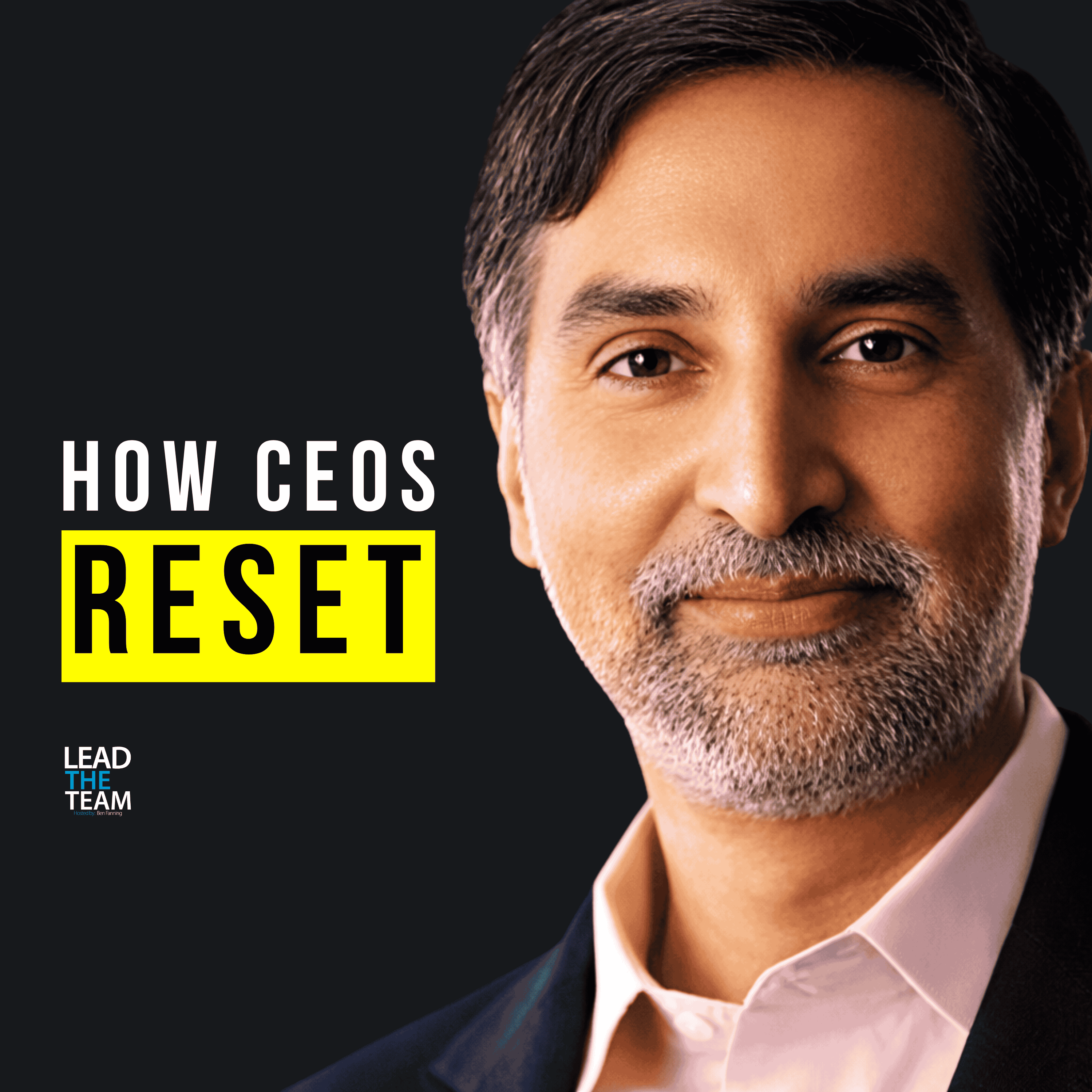
This RESET Made Him a Better CEO (VitalEdge's Vikram Savkar)
25m 26s
The podcast features Vickram, a CEO who, during the pandemic and after becoming a father, found himself in an unsustainable 24/7 work spiral. Realizing this was detrimental to his family and personal well-being, he consciously established strict boundaries between work and home. He created rituals like switching computers, changing clothes, and using clear signals to indicate when he was off-duty, which helped him become more present at home and more efficient at work. Vickram also adopted a highly structured calendar with protected time for focused work and breaks, and he learned to delegate and trust his team deeply, a lesson reinforced by his reading of classic literature and his early career experience as an assistant to a conductor. He highlights that empowering others and maintaining a balanced, disciplined approach are key to effective leadership and sustainable success.
What happens when a CEO finds himself trapped at a 24 hour work spiral at the exact moment he becomes a new father? A lot of leaders fill their work creeping into every corner of their lives, but the story shows the breaking point. And this comes from someone who knows pressure well, the Crum Savcar, CEO of Vinyl Edge. Work was almost 24 hours. You were never away from your desk, you were never away from your computer. Pretty quickly I realized that he was not going to work for my family, it wasn't going to work for me personally, it wasn't sustainable. So he built one habit, one boundary that didn't just save his family life, it actually made him a more effective leader. Everybody would know, now Daddy's home. In this episode, Vickram breaks down the simple signals and rituals that rebuilt the dividing line between work and home. And why did this shift to make him more present with his family and more efficient at work? If you've ever struggled to turn it off, this is your blueprint. Makes me better at work because it forces me to be more efficient. This is the CEO habit that saved his family and strengthened his leadership, let's get into it. Welcome back to lead the team, I'm your host Ben Fanning, and this conversation that you're going to hear is meant to challenge, inspire, and ripple out. It's not just a podcast, it's a positive movement to build better leaders, and you can help by taking just 10 seconds to rate and follow on Apple, Spotify, and YouTube, and drop a quick review over on Apple. This helps more bold leaders discover the show and keeps the mission alive. Enjoy. Vickram, take me back to the moment you realized your work day had turned into a 24 hour spiral, and why that forced you to change as a leader and as a father. That was a period that transformed so much about how we approached our life, our work. There's so many different ways in which I took lessons that I still tried to heed today. But if I had to pick one, I would say it was a really conscious approach to the dividing line between work and home. Before the pandemic, as you recall, we tended to blend those things, you would come home from work, you were in the office before the pandemic, you would come home from work, and you would have your iPhone and you might be texting or checking emails throughout the evening. There was a little bit of blend, and it wasn't good back then, but it wasn't out of hand. What happened in the early days of the pandemic is that that dividing line disappeared entirely. And I think many of us found ourselves in the first few weeks in a place where work was almost 24 hours. Now I had a newborn in 2020. And I think pretty quickly I realized that this kind of 24 hour work cycle was not right. It was not going to work. It was not going to work for my family. It wasn't going to work for me personally. It wasn't sustainable. So what I developed pretty early, two to three weeks into the pandemic was a really rigorous approach to working when I was working and putting work away when I was with my family. I used to have little signals. I had two computers, a personal computer and a work computer. And when I was done with work, I would shut the work computer, move it off the desk, move the personal computer. I would take my work clothes off. Everybody would know now now I'm home now Daddy's home. And then I would be home with my family. And then of course later I would jump on, but I worked really hard to create some conscious dividing lines between work and home. That boundary you created is such a vivid signal between working home and it reminds me of something you mentioned. Mr Rogers comes in, takes the shoes off, puts a sweater on and it's sort of like a fun thing. But to your point, like high functioning like CEOs are doing the similar thing right making that transition like you've got a ritual going to work ritual and coming to have a ritual. I will be absolutely honest with you. I was thinking of Mr Rogers. I actually learned from that example. It suddenly became relevant. I had certain clothes that I put on when I was working and everybody knew Daddy's working and I had certain clothes that I that I put on when I was at home. And I did actually think about Mr Rogers in the setting because it was very active. Are you setting up like work blocks in your day or do you set a timer or what are you doing to like increase your focus level. I do I schedule all this things. I have a rock star assistant who has worked with me for for many, many years through multiple companies and multiple jobs. We know each other well. And she understands how I need to set up the rhythm of my day, get certain things done in the morning needs certain time throughout the day to just think or to write or to work on sort of non urgent activities. And I have a very structured calendar. Some meetings, some free time. There's no question that that if I did not do that any free time that I had what would get sucked up by by some kind of emergency. I always imagine season business. So I do believe in having an incredibly structured calendar. This is important for leaders of things like you do you have meetings sort of set with yourself. Like you're like, Hey, this is just me on this calendar. But I've got to do something by myself or and how easily is that ever taken with. But by other people I do I have blocks of time that are just for me working on certain things or thinking about certain things and one block that that I have to say I try to keep sacred is lunch. I try to have a real lunch where I don't have any meetings. Another lesson in the pandemic I worked through almost every lunch in 2020. And I found that there wasn't enough time to think so coming out of that my system and I agreed we're going to have real lunches and maybe that's time to catch up on some things outside of work often it's time to catch up on things at work. But it's a block of time in the middle of the day where where I got a chance to reset and go a little deeper than you can in the in the run of play. Yeah love that important note for people right it sounds like your old growth mine later to like the it sounds like the pandemic really it was a crisis and business and people's personal lives. But she really it really transformed how you work like you thought deeply about how you were doing things you changed I do your calendar I allocate your time. How you like your before work rituals after work rituals and so you really it's like a crisis is bad but it's also opportunity for growth that's right I think it was wrong manual or maybe somebody else said never let a good crisis go to waste obviously the pandemic was one of the hardest things that any of us have ever managed through. But there's no question when I look at how I approach things before and how I approach things after I think stronger techniques now and the crisis of the pandemic forced me to develop those so I feel better off for no question. You talked about some habits that reshaped your leadership that reminds you of something that you wrote all linked and you wrote a very interesting LinkedIn post a while back called six not business books that make you a better business leader. And I saw that headline I was reading it and I was thinking okay he's probably going to be writing about fiction or you know some books you ever heard of instead I was surprised that the books were like worn piece by Tolstoy pride and prejudice by Jane Austen and like a lot of heavy duty classics. My question to you is like what inspired you to go off and write those and if those books hadn't shaped you what habits or instincts do you think could have taken over your leadership and where would that path have taken you. Well I'm glad you found that I'm glad you enjoyed it was fun to write yes it's not the normal thing to write as a CEO obviously I read my share of business books and HBR articles and so on. But I do try to carve out time every day to do some some real reading what I'll call real reading and it could be as short as 50 minutes 20 minutes before I go to bed. 45 minutes to an hour but but I have found in my life when you are when you are reading something that's not connected to your work you're going to be in a better place over time you're going to have more balance I think it's more sustainable you're going to be more thoughtful more reflective so I believe in keeping non business reading a part of my life and so that year I think just before Christmas I decided for fun to sit down and pick six of those non business books that that had a big impact on me. But they did have a big impact on me in the ways I talked about in the article there's some very deep lessons to learn from from works of literature works of philosophy outside of business. Many different lessons I shared in that piece I would say if I had to pick one and answer to your question that I think it was a fork in the road for me it's this concept of. Of being willing to trust and rely on your team to accomplish the majority of what you want to accomplish as a leader rather than believing you have to do it yourself I think anybody who ends up in the CEO role probably has a bias to action I have a bias towards action I like to make things happen I like to get involved it's how I got where I am. But the higher you go the more you have to realize that you getting involved in making things happen is not the key to success for an at scale business it's really about building culture and empowering the team to innovate to take accountability to take ownership. And so one of the lessons you have to learn as you rise is when to take a step back and to let other people lead.
and transform and grow. And some of the books that I talked about, they are really impressed that wisdom upon me. And that's a good example of a kind of wisdom that I think sometimes you get from literature more than from business books. Business books are all about how you as the leader can impact your organization. I think literature is sometimes wiser in understanding that the best way that you can lead sometimes is by leading directly and sometimes is by trusting. And I would say what I leaned into was radical trusting. Yes, I created a process and a structure for the team to do a lot of market research, interview a lot of customers, go out there and understand what the unmet needs were in the market. I implemented a rigorous approach to lean, to help guide the way we turned ideas into new products. So I overlaid some things. But ultimately, I needed to trust that the team was going to go out there, talk to the customers and come back with the right idea. If I had tried to-- here's what I think we should do, two weeks into the health care market. I think we would have got it wrong. But I didn't say that. I said, come tell me what you think we should do. Work through this process. Tell me where the big opportunity is. They came back and told me. I believed it. I invested in it. I supported it. We launched that product. It became an instant success. And now it's a juggernaut and has really transformed that business. And I would say that came from a process of trusting the really smart people on the team who knew the market better than I did. You've got some pretty serious career chops, academic chops. You might could have figured something out. But if you would have gone through it all your own, it may not have been as strong. And the people-- everyone else might not have been bought into it because you will have told them what to do versus having them help drive it. You're absolutely right. And it's a very important point. And it's not just a question of coming up with the right idea. And I don't believe there is just one right idea when you're innovating. I think there's probably two or three different things that you could do and be successful. But you're absolutely right. He is that belief and the follow-through and the commitment by the team. Having an idea is nothing. Execution is everything. And if the team is motivated to execute on it, to do the hard yards over the next year, a year and a half, then you'll succeed. And when it's a vision that they have created, then you're in a stronger position for them to have buy and execute. Then if you bring the tablets down for them out. Are you looking to increase sales, grow your brand, and share your leadership message? Then check out our business podcast program. Each week, more people listen to podcasts that have Netflix accounts. And one third of the US population listens to podcasts regularly. So your customers and team are already listening to podcasts. It should be yours. Discover our five-step profitable podcast framework and what results you can expect for your company by setting up a 20-minute call with my team at binleads.com/schedule. That's binleads.com/schedule. You learned some leadership lessons early on in your career, too. And your first job was pretty unusual. Now you're really getting into the deep track span. That was a long time ago. But yes, it was an amazing experience. My first job out of college. I was a musician growing up. I played the piano. And when I graduated from college, I wanted to work in the arts world initially before I decided I wanted to transition to business. And I was the assistant to a legendary conductor, named Benjamin Zander. There's an itanic figure in music. I-- what the book is, infinite possibilities? Is that what it is? Yeah. It's similar to that. Yeah, it's-- Wow. OK, yep. If you read it, it's an amazing book. And it is expressive. His leadership philosophy. So I got to work with him for three years, helped him with the orchestra, everything he did. He's a titanic figure. And I learned a huge amount. An example of what I learned, and that's relevant to business, is very similar to what we've been talking about. The conductor is a charismatic figure. And bin Zander is a credibly charismatic figure. He stands up there on the lectern, on the podium, and makes 120 people perform incredible works of art, like Mahler Aide or Beethoven 9. But he said to me once, and had a huge impact on me. He said, you know, Vikram, the critical moment in my musical career was when I realized that the conductor does not make a sound. Not a single sound. All of the sounds that you hear come from the musician. The conductor's power is just leading musicians to be at their best, to do their best. It was a profound insight. And I would say it really has shaped my business career. Again, I have a bias for action. I have a bias for rolling up my sleeves and trying to help the business. But as a leader, you really need to be a conductor. He said the agenda, timing, you keep everybody marching in the same direction. You can never forget that it is the people in the business who do all the hard work come up with all the brilliant ideas. And I think the more clear you are about that, the more you can focus on empowering and inspiring. And that's, I think, how you produce the best results. That's a powerful leadership insight in your academic background, also shapes your thinking. You studied physics and classics at Harvard. Am I correct on that? That's true. That is an unusual mix, my friend. You're like a guy who's got his foot in two completely different worlds. You're like, I'm going to study like crazy, both these worlds until I figure out which one I want to do. How do that stretch your thinking? And where do you see that kind of influence showing up today? I love both physics and math and hard sciences. And I love classics and literature. And I continue to love both today. And when I got to college, I just could not come up with the reason why I should drop one of them. So I did both. And Harvard led me, which was very good at the time. It was a different age, too. I think people encouraged focus a little bit more now. And back then, I think there was more tolerance for the idea of being wide-ranging. So I appreciated it. I loved both. I did them both all the way through college. If there's something I learned, it was that there aren't-- there's no need to have boundaries or to put boundaries for yourself. There's no need to believe that just because you're in business, you can't read literature. There's no need to believe that just because you're good at math and quantitative, which was really the foundation for me, that you can't also be creative. I would say I've given myself permission in my career to be all of the above, to work with the finance team, to build our forecasts, to work with the marketing team, to build our advertising campaigns, to work with customers. I've given myself permission over the course of my career to be involved in everything that a business does, and not to believe that anything is out of bounds or something that I shouldn't be involved in. I've been involved in our volunteering programs, or setting up our offices. So I would say over the course of my career in life, I've allowed myself to embrace everything that makes a business work. And I think that is something that a CEO needs to do. Like in orchestra, if you want to bring it back to that metaphor, every single piece matters. If one piece of a business is out of kilter, you're not going to achieve your greatest results. And so I try to care equally about everything that we do and put equal time into every aspect of the business. I would say that's a lesson I took from my background. Before we go on the next piece of this, I mentioned, you know, I'm not going to Harvard, being super famous Ivy League school, obviously. And I'm curious, you reflecting back, what did going to Harvard and going that around? How did that impact your success in your career? Every college that you go to has wonderful opportunities. All that matters is what you make of the opportunities you have not where you go. And I believe that 100% community college to Ivy League and everything in between, you can find your best life anywhere you go. I deeply believe that. But that said, Harvard was a paradise. There were so many incredible professors from whom I could learn. And there were so many incredible peers from all across the country, all across the world, with passion for so many different things. I learned so much from all of them. It was a wonderful experience. I would say if there's something that I took from that, that shapes me today, it's a sense of depth. I think one of the things that I experienced that Harvard is not to be comfortable with a light engagement with things. Always push deeper. You're reading something. Don't just write a simple essay about the top level theme of what you were reading. Really plumb the depths and try to understand it and read a lot of critical literature. If you're working on math, don't be satisfied with baseline math, try to understand complex analysis for you analysis. And so on, push yourself to get to the depths. That was very much the atmosphere there when I was in college. There was a lot of peer movement in that direction. You could learn from the people around you. Always pushing deeper and deeper. And I would say that's something that I still try to do today in business as well. Don't just have a proximate business strategy. Let's move into such and such adjacent market. Really try to understand specifically, in depth, what is the competitive opportunity?
what is the value that we can create for customers? What can we do that will be transformative for their businesses so that we can monetize that, we can create value out of that? I would say pushing for really deep specific understanding of opportunity is something that came from my education. - Thank you for that. Make for sharing that on the website. And I can see that. Like you see it emerging in your LinkedIn posts about non-traditional leadership books and how, hey, when you push deeper, these things are all about leadership and self-leaders leadership. Now, fast forward to today, starting to land the plane here on our interview. When you stepped into Vital Edge, you inherited a company that had been born from a major merger, right? To legacy platforms, to cultures, a big global customer base. What lessons have you learned since you've been there? - So many lessons. I would say one is that there's no such thing as too much communication. When you merge two companies, it's very important for everybody from both companies to feel like they are valued, like they're important, like they're a core part of your mission going forward. And I think when you do mergers and acquisitions, it's so easy to get that wrong, to focus a little bit more on one side rather than the other, the pandemic, actually, if we wanna go back to that was a time when I took my commitment to communication with the team and customers to the next level out of necessity. I brought that lesson with me. And in this merger, I've tried very hard to communicate very deeply with all entities to make sure that everybody knows that they're a core part of the mission and stitch them into the power of them to drive the mission. And so that I would say is the lesson. I think when you do a merger and acquisition, there's no such thing as too much communication. Like as sort of the pinnacle organization on that front, what is your role in driving communication? Like do you see yourself as like the go between the culture driver or like the example? Like what's your role and make fostering that priority throughout the company? I spoke earlier about how as the leader, it's important to understand that you don't need to do everything yourself that you need to trust your team. An interesting exception would be communication. I believe as the CEO, you have to communicate the key messages yourself and reiterate that at multiple levels of the organization. I think communication is one of the sacred functions of leadership. And so I do try to set those messages, set the key notes, connect with people directly as often as I can. That said, it's important for the ELT and other leaders to then reinforce and cascade those messages. It's incomplete without that. But I do believe that the words that you shape, the messages that you shape as the leader, become disproportionately important. And I try to do that. What's the North Star right now if he is the leader in this organization or you're leading it? So Vital Edge is clearly the market leader in our space. We are the leading ERP company for heavy equipment dealers globally. We have a strong legacy and a strong foundation to build on. That's it. It's important for a company to never rest on its laurels. I see a huge opportunity in this market over the next five years to establish even stronger, faster growing leadership by reinventing ourselves, transforming ourselves through innovation, through AI. There's a number of specific opportunities I could get into. We're well down the road. And I'm very excited and optimistic by what I think we're going to roll out over the next couple of years. I think we're going to take ourselves from here to here. So what I focus on as leader of this business is to support that transformation and to make sure that everybody understands. We're not going to remain exactly who we are. We're going to take our game to the next level. And everybody is a part of that effort. It's a team effort. It's a huge opportunity. It's a huge responsibility. It's a huge necessity. And we're all going to be working together every day to make sure that five years we're now. When you describe us, you describe us in ways that go well beyond who we are today. Yeah, I like that little nugget you offer there. Like describing your vision of the company. But then you're also talking about how our customers are going to describe us. So like the vision is not just the picture I'm painting. It's also what's the market going to be saying? Where our customer is going to be saying. And it takes it to the next level. Let me start thinking about that. I think you have to start there, actually, Ben. You work backwards from that. If you work forwards from who we are and ask yourselves, what can I add to the products we have? I think you get 10% of the way there. If you start with a clear vision of what do I want customers to say about us? In our case, I want customers to say that we power their entire technology stack from the front office to the back office, liberating them to focus on their customers and to grow and make that true. Then you will get there. And I believe you have to start from that vision. >> Victor was put a phone that I thanks for joining us on Lead the team. >> Thank you, Ben, so much. >> Want to boost your productivity and decision making? Get vital insights from each episode delivered directly to your inbox. A great resource whether you've listened to the episode or not. Go to bidfanning.com/insight.
Podcast Summary
Key Points:
The CEO realized his 24/7 work cycle during the pandemic was unsustainable, especially after becoming a new father, prompting a need for strict boundaries.
He implemented clear rituals to separate work and home life, such as using different computers, changing clothes, and establishing "Daddy's home" signals, which improved both his family presence and work efficiency.
He emphasizes structured scheduling, including protected time for deep work and lunch breaks, and advocates for trusting and empowering his team rather than micromanaging, drawing lessons from both literature and his diverse background.
Summary:
The podcast features Vickram, a CEO who, during the pandemic and after becoming a father, found himself in an unsustainable 24/7 work spiral. Realizing this was detrimental to his family and personal well-being, he consciously established strict boundaries between work and home. He created rituals like switching computers, changing clothes, and using clear signals to indicate when he was off-duty, which helped him become more present at home and more efficient at work.
Vickram also adopted a highly structured calendar with protected time for focused work and breaks, and he learned to delegate and trust his team deeply, a lesson reinforced by his reading of classic literature and his early career experience as an assistant to a conductor. He highlights that empowering others and maintaining a balanced, disciplined approach are key to effective leadership and sustainable success.
FAQs
Establish rituals like changing clothes or switching computers to signal the transition from work to personal time, ensuring everyone knows when you are fully present at home.
Implementing a strict dividing line between work and home, such as shutting down the work computer and changing clothes, forced greater efficiency during work hours and improved presence with family.
A structured calendar prevents free time from being consumed by emergencies, ensures dedicated blocks for deep work or thinking, and helps maintain focus on priorities throughout the day.
Reading literature or philosophy outside of business fosters balance, encourages reflective thinking, and can provide deeper insights into leadership, such as the importance of trusting and empowering teams.
A conductor doesn't make a sound; similarly, a leader's role is to empower and inspire their team to perform at their best, rather than doing all the work themselves.
The pandemic forced a reevaluation of work-life boundaries, leading to the development of more structured routines, rituals, and time management techniques that improved both personal well-being and leadership effectiveness.
Chat with AI
Loading...
Pro features
Go deeper with this episode
Unlock creator-grade tools that turn any transcript into show notes and subtitle files.
 PodcastTranscript AI