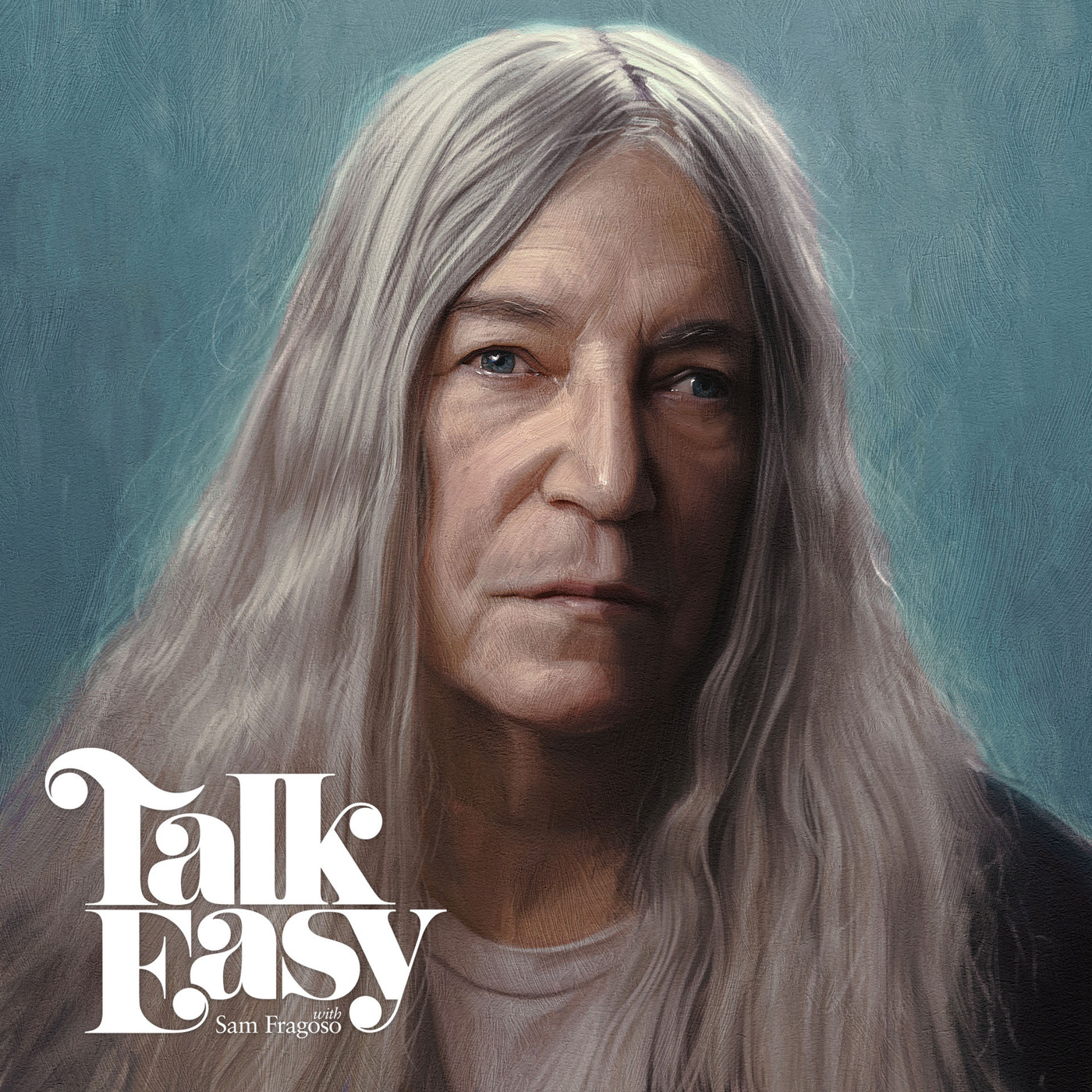
This is talk easy. I'm standing for a go so welcome to the show. Today, Patty Smith. Smith has been hailed as the godmother of punk, the people's poet, a defining voice of her generation. She's been inducted into the rock and roll Hall of Fame. She won a National Book Award for her memoir, Just Kids. She's even been asked by Bob Dylan back in 2016 to accept the Nobel Prize in literature on his behalf, which she did. There are so many more titles and disciplines I could list here, but all of that stuff, she told me, is just semantics. Quote, I am ultimately a worker. And the work, well, it speaks for itself. When I sat with Patty, she was in between completing one tour and beginning another. Last year, she traveled the globe around the 50th anniversary of her seminal debut album, Horses, which Rolling Stone recently described as, quote, "a declaration of mutiny, a statement of faith, and the trans figurative powers of rock and roll." The fact that Smith, at the age of 78, spent months on the road feverishly performing the record in full to pack audiences, is just further proof of her enduring punk rock spirit. She's now somehow finishing up another tour, this time for her new book, Bread of Angels. It's just stirring, vivid memoir that begins in her post-World War II childhood, where the first glimmers of art and romance took hold back in 1950s New Jersey. That's also where we begin today's conversation. An act one, in sickness and in health, we discuss her early creative awakenings, discovering Bob Dylan at 16, and the summer job that inspired her infamous poem, Turned Song, Piss Factory. Then, act two, coming to New York, her nomadic years with Robert Maplethorpe, in and out of the Chelsea Hotel, her run-in with the Rolling Thunder review, the whirlwind of making horses, and why, come the end of the 70s, she left it all behind. And then finally, act three, Living with Laws. We talk about giving voice to those whose time was tragically cut short. Her tireless desire to continue to evolve as an artist, and the protest and politics that have shaped some of her best and most urgent work to date. This is an episode that I think everyone here on the show has wanted to do for a long, long time, and I just can't tell you how excited we are to have her here. I hope it means as much to you as it did to me without further ado. Here is Patty Smith. Patty Smith, welcome to the show. Thank you, happy to be here. You're on a short break from the tour at the moment, right? Well, I finished our horse's tour, and now I'm on a short break before I do a small book tour. Okay. How are your mornings these days? Are you writing? I don't write much when I'm on tour because it's such an external collaborative energy, and I find it hard to find any solitude on the road. So I've just learned to accept that that's what I'm doing. And now that things have quieted down, I'll be able to write again. I'm not worried about it. It's the muse has not fled. I'm just on a short sabbatical until I can have my normal morning quiet time to write. So right now I'm reading, but not writing, not writing, but that's only going to last for another week or so. And when you do start writing, is it at a desk or is it in bed? When I start writing, I go to a place to have coffee and I sit and have my coffee and write. I like to write over morning coffee with some kind of quiet buzz around me. So I like writing in cafes. And later I do editing at home and further writing. But my initial notebook writing is usually in a cafe anywhere in the world. And does anyone ever come up to you at one of these cafes and go, oh my god. Well, usually it's so early. I don't get much of that. There may be some people who recognize you, but they're so tired that they can't be bothered to do anything. It's too early in the morning. But I always go like if I'm in Paris, I'll go to floor at seven o'clock in the morning when it opens before a lot of people come in. And I always go at the moment a cafe opens and just sit and write. I like that atmosphere. Speaking of writing, this new book of yours, it's called Bread of Angels. And I wondered about its origins because back when you and Robert Mabel Thorpe worked together bouncing around New York, he would say to you, quote, nothing is finished until you see it. Where did you first see Bread of Angels? Funny enough, I saw it in a dream. I had a dream like around 10 years ago that I received a package and the package was a white book with the white ribbon. And it had four like Irving Penn style photographs of dresses, which had been my dresses. A childhood dress, the white dress Robert gave me, the white dress, my brother Todd gave me, which is on the cover of the book and my wedding dress, which was an old Victorian tea dress. And the book was an autobiography and it was divided between these dresses. And when I woke up, I was, I still had my hands open holding the book. And it was so fully realized in my dream that it seemed to me a sign. So I eventually, that's how it became a book. I wanted to write about my life, my childhood, which was exceedingly magical, but I decided it in a certain way. It would be a book of some way weaving gratitude through it to my siblings, my parents, people that were important in my life, my mentors, my husband. And so I began it. You had a pretty prusty and childhood, growing up in Chicago, Philadelphia, and then finally South Jersey, where you were often bedridden. In the new book, you write about contracting tuberculosis, scarlet fever, measles, ribs, chickenpox. I know you grew up in a household that believed in God. Yes. But did battling those illnesses shake your faith at all? No, because I grew up in the early 50s and kids were always sick. They didn't have any vaccines. They were still developing the polio vaccine. It was after World War II. Many children who lived in poor neighborhoods had tuberculosis or polio. So I didn't take it personally. And only one time when I got what they called back then, the Asiatic flu was the pandemic flu of 1958, sort of a bird flu. That was the worst thing I ever had to negotiate where I actually, I just didn't want to wake up. You remember it? Well, because I had such horrific migraines as well as fever, body pain. I was quite sick, but I was also glad because I was the tallest and probably the toughest of my siblings. So I was always glad I got certain things they didn't, like they didn't get TB or scarlet fever, because I felt I could weather them better. If you were a girl, your mother would take you to a neighbor's house where somebody had the measles because they said that if you had measles later in life, if you were pregnant, it would hurt your child. So they would intentionally put us with other kids so that we just get it over with. And everyone accepted, we were all going to get chickenpox. We were all going to get the measles, all get the mumps. And we did and we survived. And, you know, we were back on the playground. Neither of your parents finished high school, but they both were pretty avid readers. What did they like to read? Well, my mother loved romance novels. She read a lot. She liked to reread her books from childhood. She liked books like Mandingo or shoes of the fishermen, the popular books of the day gone with the wind. And my father, he read a lot of philosophy, science fiction, uophology, the Bible, other sacred texts. My father was really a surcher. My mother looked at books for entertainment and comfort. And my father looked for answers. When your mother would be cooking dinner for you and your three siblings, would you ever hear your parents having philosophical discussions? My mother wasn't the type to have philosophical discussion. She loved to talk, tell stories, but did your father try? He would try, but always failed. So, but my father was very good at luring in religious groups. One day it was the seventh day of Venice, a Catholic priest, anyone in to sit and talk and spar about the Bible or whatever they wanted. And he'd play the devil's advocate even. He'd go against what he really thought just to see what they thought. He was a very interesting man. He had a very expansive mind. In a TV interview.
Stockholm back in 1976. You said your father who served in World War II believed in the development of the country of the mind. He believed the mind was a country and you had to develop it, you had to build, build and build the mind. How did he do that? And then how did you? I think my father was always inquisitive, intelligent. He was a bit melancholic. He was very contemplative. He built it by study. He built it by study and continuous reading by asking questions. And I tried to model myself after him, even though my subjects were different. Yeah, what were your subjects? Well, when I was a child, it was always fairy tales and fairy stories. And then it was mystery stories like Nancy Drew. So I'd like detectives, I'd like Sherlock Holmes. And then I discovered art and it was that became my number one art and poetry became my the thing that I spent the most time studying, whether it was Irish poets or French poets or particularly French literature and art, the history of art, you know, whether it was the Cienese primitives or Medigliani Picasso, surrealism, I love studying art. You mentioned modeling yourself after your father. Do the two of you ever have disagreements about art? We agreed on a lot of things and had very similar outlook on things but not art or music. My father hated rock and roll. He liked Miles Davis, but not he wasn't like rolling Kirk or even some of later Coltrane. He liked things that he understood where he understood even if it was complex mathematics, that he understood the mathematics of that music. He loved classical music. And in terms of art, he liked classic art and fine draftsmanship, even draftsmanship with imagination like Dolly or some of the surrealists, not Jackson Pollock and certainly not Picasso. He didn't understand that kind of work. And it was always funny to me because he seemed so brilliant, so open-minded about human rights and people. And he was just one of the most open-minded people I ever knew, except when it came to art. He was not open-minded. He was very close-minded. He would never accept Jackson Pollock as an artist or Cubism. What about when he watched the Rolling Stones on the Edith Sullivan show back in 1965? Yeah, that was one of our first argument was about Picasso. And the second argument was about the Rolling Stones. Did you win the first argument? No. He didn't win arguments with my father. Okay, well, this just came it out. Tell me what your side of the Isle sounded like. Well, I was just too young. I was 12 years old. You were overmatched. I was overmatched. But I also felt like I he understood my concept why I liked Cubism because I felt like it showed like when it was a portrait, the many facets of the mind or the facets of a human being and not just the looking at their face, but different aspects of their personality or their thought process. He thought that was interesting, but he didn't feel that Picasso executed it well. And with the Rolling Stones, he just didn't like anything. He didn't like what they looked like. He didn't like the way they moved. He hated the music. You know, we all had a crush on some Rolling Stone. I like Brian Jones. I love their music. I'd love to dance to their music. So there wasn't any point arguing about it. You just had to accept, you know, he just didn't take it. You wrote in Cree magazine back in 1973. Blind love for my father was the first thing I sacrificed to Mick Jagger. That's a bit dramatic, but you know, the idea is so you could have said I sacrificed it to Picasso. But the beautiful thing is my father understood the more important things. It wasn't important to me whether he liked Mick Jagger, but it was important that when I had questions, whether it was about religion or life or relationships, he took the questions very seriously and tried to answer these questions in the most open-minded way possible. Tell me about you as a teenager. You said once that you grew up in a quote, much tougher part of Jersey than Bruce Springsteen. Every school dance I went to, somebody was stabbed. Well, they weren't, you know, usually no one was killed, but you know, it was that time killed. It was just young guys being territorial. But I like that you're making the distinction that you grew up in the tougher part. Well, yeah, because that was the thing. Sort of silly, but I was from South Jersey and South Jersey was always looked at as the Hick area, you know, in the central and North Jersey was, you know, closer to New York or South Jersey was not a culture spot. We had no galleries, no cafes, not even a library nearby. But I had such a great education. I went to a very diverse school with had a high black population. So I had a great education. I learned about culture and and Nina Simone and a lot of the kids were like hip or two art, for instance. I could talk with some of the the kids. I knew the black kids about, you know, surrealism and look at their drawings, which were very surrealistic and dancing, just the best dancers. And also everybody sang. That's why in some ways, it seemed really sacrilegious that I got a record contract and did a record because where I'm from, practically every girl in school could sing is good or way better than me. And what would you say like the Ronuts? Yeah, like girl group songs or I was into more like darling love, you know, you might sing he's a rebel or but there were girls that sang way better than me. I mean, they were as good as like a lot of our young R&B singers, but it was just it was the time period, you know, it was 1962, 1963 and also music because you sang good. It didn't mean that you were going to try to like be a star or have a lot of money. You were just the best singer in the neighborhood or the best singer on the street or the best singer in 10th grade. The idea of this ambitious idea of what to do with this natural talent. It's not like today where people instantly will find a way to capitalize on it. It's just the thing people did in 1964 you and your mother had an argument and as a way to I think apologize or or make peace, she bought two records of Bob Dylan's from the bargain bin at the five and dime. It was actually in it. It was the bargain bin in the drugstore where she worked. They were like 98 cents or something. It was another side of Bob Dylan had a black and white picture of him on the cover of course and my mother knew I like black and white photography. She looked at him and he looked like some kind of person that I might be attracted to like you know because I had a lot of R&B books around and she'd like looked at him and and that's why she bought it. She didn't know anything about Bob Dylan, but she brought it to me and I put it on the record player and you know I was completely smitten, but that was my first Bob Dylan record that I owned. You mentioned R&B O. Did you find his work to have some R&B ODE in quality to it? Oh absolutely. Was there a song in particular that felt like that? Well, I'm sure there was a lot of them, but like hard rains gonna fall. A lot of the patterns are the way a mid-young girl she gave me a rainbow. A lot of the lines reminded me of illuminations like after the day loose or certain poems of his, but also young Bob Dylan and young Arthur R&B O. looked very similar. You know they had that round sort of cherubic face but very intense eyes you know sort of like a bad angel, but I discovered R&B O first and moving from R&B O to Bob Dylan was pretty seamless and I didn't pretend to understand everything I couldn't break down desolation row nor did I have any desire to anymore than trying to break down all of season and hell. It took me years to comprehend every word that R&B O wrote. I sometimes think understanding has nothing to do with art. You mentioned Bob Dylan songs. I consider you're lined by line. You would think I've read a lot, I've heard a lot. I still don't know what happens in those songs. Well they're not meant to be broken down really. I think it's also a lot of it is aesthetic. When I first read R&B O I was 15. I was reading illuminations. Truthfully I hardly understood any of it, but the language was so beautiful. I was beguiled by the pure language and so it wasn't important to understand it. What was important was that I found some kind of kinship in this language. Just like when I was seven and I saw like Vogue magazines for the first time. I don't know why I was drawn to these photographs of Irving Penn at seven years old, but they spoke to me. I couldn't explain why. And even at Jackson Pollock, the first time I stood in front of a Jackson Pollock, instant recognition. But I don't speak art speak. You know, I'm not a critic, I'm not an essay writer. Other people can
do that. I am affected by certain work very viscerally and sometimes it elevates me intellectually, but I'm not an analytic style person. Around the time you discovered eliminations, you were working at your first job in a factory. Can you tell us the backstory of what many consider to be the first true punk song in Piss Factory? Well, I mean, I found the book and I was so beguiled by it. And I because I couldn't grasp the meaning of all of these poems, I would read them over and over. I got a job in a factory. It was a non-union factory, very hardcore workers and a lot of hard working, but semi-eliterate people working at this factory, women, mostly old women. And I was this young upstart. I had no business working there. I mean, they had a whole community, rules and regulations, hierarchy, but I was just a teenager who needed a job to try to make money to go to college. So I wasn't on their level. And I was also unintentionally disrespectful to their system. Well, I mean, because I came in, everybody seemed to be work and slow. I would work faster because I was bored. They would all have an idea like, we only work at this pace because then we'll only be expected to inspect beapers or whatever we had to inspect. But then I came in and was like inspecting twice as many, which put their whole system out of whack and then would make expectations of them higher. So I was, as the poem says, screwing up the quota. Now I can look back and have more compassionate for these women and understand that I was just passing by trying to get a job. This was their life work. This is where they had their first job at 16 and would probably die having this particular job. Do you think some of that friction was because a part of you knew that this would not be your last job? Oh, not a part of me. I had no intention. It was a horrible job. I was there simply to make money in the summer. You know, I was working, you know, inspecting these beapers that would go on toddler's tricycles. And so you had to squeeze them to make sure they beeped. And if they didn't, you throw them in a bin all day long for hours and hours. But when I had a little time off or lunch time, I would, you know, sit and read my illuminations and even have in a book in the, a lot of these women couldn't read. So it was in a front. I didn't do it as in a front. I took a book because I was bored, really. And at one point they grabbed the book out of my hand and they they conjured me in the bathroom because sometimes I would go in the bathroom and just read. And because I was reading, they grabbed the book and half of it was in French. And seeing that it was in French to them, it was just a foreign language. So being in a foreign language, they took it as being communist. To shorten the story, I wound up with my head ducked into the toilet after someone had urinated. That's why the poem is called "Piss factory." They were teaching me a lesson. So you saw them pee in the toilet. Then they dunked your head. Yeah. But you know what? It was like, it just wiped it off. I mean, I wasn't like a whimper or anything. I wasn't going to die because, you know, I got like little pee on my face. But it wasn't the worst thing that could happen to a person. Yeah, it was a drag. It was, you know, I didn't like it. But, you know, I realized that these people would never read from Bo that they were never going to get out of South Jersey. They were never going to get out of this factory. And it was really hard, you know, to hold any kind of deep grudge. I did write the poem because it happened. And it was like, maybe that's how I got closure with it. But that poem meant a lot to me when I wrote it because I told it exactly how I felt. Because back then, being a teenager, I wasn't so compassionate. I was more like I shrugged it off. And in my 20s, not so compassionate. But now I look at it a lot different, you know, in the whole other way. These women were surviving. And I was just pass them by. As someone passing by, you described yourself as someone who in the midst of the dead felt alive. Did you feel that the only way to continue feeling and being alive was to go to New York? No, I went to New York to get a job because I was, you know, 20 years old. I had left college. I didn't have enough money to finish college. I had a decent job in Philadelphia. They were really hard to get. I was laid off. And there had been the New York shipyard in Camden, New Jersey had been shut down. And 30,000 people lost their jobs. So there was no jobs to be had. And when I lost that job, I just knew I wasn't going to find another job. So it had nothing to do with my lofty question. No, it wasn't lofty. It was like, I needed a job. I had bent in New York City. I knew a few people in New York City. I knew there was lots of bookstores, lots of restaurants, lots of places. Maybe I could get a job. So I really went to New York, even though in Piss factories says, and I will get out of here, I'm going to go to New York City and be somebody. It's more poetic license. In the truth of it is I was going to get on that train, go to New York City and get me a job and be an artist someday. But my initial need was employment because my parents had no money. And I had no money. And you had to have some money to survive, to eat. Why don't we take a quick break? Okay. And when we come back, New York City. That's more after the break with Patty Smith. As we head into the New Year, I've been thinking about how to improve my financial health. Spending money more intentionally, making space to fund the activities I actually care about. I assure you, managing money doesn't have to be a struggle. It doesn't have to be difficult this time of year. Monarch is the all-in-one personal finance tool designed to make your life easier. It brings your entire financial life budgeting, accounts, investments, net worth, and future planning into one big dashboard on your laptop or on your cell phone. Start your new year on the right foot financially and get 50% off Monarch subscription with code talk easy. Whether you want to review your spending or start a fresh budget altogether, Monarch does the legwork for you. It not only tracks your spending, it lets you know what goals are realistic and then helps create a pace for you to reach them. Unlike most other personal finance apps, Monarch is built to make you proactive, not reactive. When it comes to this new year, achieve your financial goals for good. Monarch is the all-in-one tool that makes proactive money management simple all year round. Use code
[email protected] for half off your first year. That's 50% off your first year at Monarch.com with code talkeasy. There's something about the start of a new year that always makes me crave a clean slate. Oftentimes that fresh start begins at home. That's why I've been resetting my space with cozy earth. I started with their Baja Bedding set. It's a full set with matching sheets and duvet cover inspired by the serene colors and dramatic textures of the Baja California landscape. The collection brings a lively yet elegant blend of texture and pattern to your bed. The reversible design, premium fabric and tireless colorways make it the perfect set to create your own resort inspired haven at home. I've also tried cozy earths Lux bath towels and they don't disappoint. They're incredibly soft and plush made with the blend of cotton and visco from bamboo using innovative zero twist technology. The result, towels that feel gentle and dry you off quickly and efficiently. What I've realized is that when home feels taken care of everything outside of it feels more manageable, better sleep, smoother mornings, a little more ease in the day. Cozy earth isn't just about comfort, it's about creating a place that helps you recharge and it's a risk-free decision to try cozy earth because they offer a 100 night sleep trial. Try them out and if you don't love them return them hassle free. They also give you a 10 year warranty because once you feel this level of comfort, you'll want it to last a decade. Start the new year off-right and give your home the luxury it deserves make home the best part of life. Head to cozy earth.com and use my code talk easy for up to 20%
And if you get a post-purchase survey, be sure to mention you heard about cozy earth right here. Refresh your routines with comfort that makes every day feel like a new year. Coming back, can we read a passage from your new book, Bread of Angels? It's 1967. You've landed in New York City, don't look back on the mind in more ways than one. And here we are. I stepped out of Port Authority bus terminal with my plaid suitcase. My greatest desire at the time was to surrender as an artist. Perhaps I lacked the necessary skills, but I had the willingness to develop them. For I believed in the truth of my calling, and was single-minded in my pursuit to find work. It had come to me as if struck with an aesthetic paralysis. There was no fausty impact connected with my youthful vows. No expectation from godly elements. In choosing to be an artist, I knew I would be on my own, yet still hope for a compatriot and providence led me to him. That word developed. We talked about it earlier with your father and the developing of the mind. What was the truth of your calling when you arrived in New York City? How did you understand it? Well, I understood it when I was 12, and I experienced an epiphany looking at the work of Picasso. I vowed that that's what I would be. I would be an artist. When I thought of artist, I thought of creation, whether a writer or poet, I didn't define it. I did have dreams of being a painter, but in that realm, not in the realm of commerce, not in the realm of a lot of the expectations for a girl. When I grew up, girls, they became hairdressers, secretaries. They got married and nothing wrong with any of those. But I perceived that I wanted to devote myself to art. And back then, in the mid-60s, early 60s, being an artist was not a vocation that parents embraced because especially if you were a lower middle-class kid. Because parents wanted you to either settle down and get a family or have a job that you could count on. And certainly being a poet wasn't probably the most lucrative job. So that is what I meant. I just decided I didn't care if I had a suffer. I didn't care if I didn't have any material things, but I wanted to devote myself in whether you're developing mental or physical skills to live and work as an artist. And the dreams of your generation, like how did you understand those at the time? How do you understand them now looking back? Well, at the time, I was brought up in South Jersey. I wasn't as sophisticated. I was very sophisticated, I'd say. I understood a lot. I had read a lot of French poetry. I was very well read, but culturally not. I didn't really understand the growing culture. I didn't understand that I had come to New York City in the summer of love. I didn't know what the summer of love was. I didn't take drugs. I had never seen drugs in person. I saw a small joint once when I was in a jazz club. One guy had one. We were allowed to look at it. I didn't really have a whole grasp on what was happening culturally with my generation. I mean, I learned it. I quickly evolved. I quickly saw. What did you quickly learn? Well, that there were burgeoning movements, you know, the civil rights movement or fully formed movements, the anti-war movement. It wasn't just that you were young. And of course, you were against any kind of social injustice and racial injustice or against the war. Now there were all of these movements that were an organized people. And also there were a lot of drugs around. Our music was changing. The conversation within our music was changing. And you know, now I was living in Brooklyn and then New York. I was living within it, not reading about it. So when you're living at the Chelsea Hotel with Robert Maplethorpe, working at Scribner's Fifth Avenue bookstore where you made about $65 a week, you write about this period lovingly and just kids. And tell me with your kind of manic energy and don't look back, walk, what did Robert do to give form to your poetry? Well, I mean, I met Robert. I didn't really know a lot of people. I was again, looked upon by some people as a bit of a hick. Did you see yourself that way? Well, no. I thought I was, you know, I sort of south Jersey. We're cool people. But you know, I didn't quite dress right. Again, amazing because how much of your style influenced future generations? My style came right from thrift stores. You know, thrift stores weren't so popular then. I, in Camden, New Jersey, I got a lot of cool clothing from, you know, the Salvation Army and things. But I wasn't really concerned with those things yet. I didn't know how important it was to dress cool or look cool or have a cool haircut. What Robert gave me was confidence, you know, he, Robert had complete confidence in himself as an artist. He was a bit shy when I met him. He was a bit of an outcast in a certain way. But he had no qualms about his place as an artist, his abilities as an artist or as future as an artist. And I was still trying to figure those things out. And Robert wanted me to be as confident as him. And having someone who you believed in, believe in you that fully was very, very important in my own evolution. How did he go about instilling confidence? Were they like maple throre, pep talks? No, no, he wasn't like that. He just believed in what I did. He loved my work. I'd read him my poems. He loved my poems. He got them. He'd have me read them over and over. He'd sat on the floor and drew together and when a professor would come to our apartment to look at his work, he always asked the professor to look at my work. I never had a boyfriend like him. I had a couple of cool boyfriends, but not an artist, you know, whose work I admired and who admired me. I mean, we're only 20 years old. And both of us, young 20, like right now, a 20 year old is much more worldly, sophisticated, probably with more tools, maybe more knowledge about the world. And we lived a very sheltered life for a little while. We went to work and we came home because we didn't have enough money to do anything else. So we spent the better part of '67 and '68 and part of '69, you know, living a fairly quiet life and listening to music and trawling and planning and daydreaming. It wasn't until 1969 when we moved to the Chelsea Hotel that things ramped up. And how did you feel about the ramping up? You know, things move quickly, but when you're young, you just adapt to the speed of your surroundings. You know, and I was still working. I mean, I was five, sometimes six days a week working at the bookstore and in the night writing poetry or doing what we did. And there were a lot of well-known people that passed through the Chelsea Hotel in those days. And so, you know, whether it was William Burrows or Salvador Dali or the Almond Brothers, it could be anybody, you know, with a lot of people passed through the Chelsea Hotel in those days. One of the best things about it is I met many of my mentors. William Burrows was the most important to me, but I met all kinds of people. I learned about performing from Johnny winner Jim Carroll was a fine poet. I met the creators of hair who and Sam Shepard and Bobby Newworth. I mean, it was, I met really great people who really supported me. I don't know why, but just as I had when I was young, I was always well supported by my siblings. And as I was evolving, I got a lot of support from very gifted people. A few years back, Martin Scorsese directed a documentary about Bob Dylan and the Rolling Thunder review, which you make a very, very brief, but I think significant appearance in. I read somewhere that later you called that night of October 23rd, 1975, an unexpected gift. What did it offer you? Well, I mean, I had spent a little time talking and hanging out a little with Bob Dylan and he asked me to, he talked about this thing he wanted to do. He was more like a vagabond review or some kind of thing where a lot of poets and some music and you go from town to town and it sounded interesting. And then I was asked to come to, I think it was Gertie's folk city someplace and I didn't really know what the agenda was. And then there were all these people, a lot of well-known people, a lot of well-known musicians and poets and they were all performing something. And I wasn't quite sure what my duty was going to be. And then they are in the water.
announced me and I realized that I was expected to do something. So I just improvised a poem. It was both exciting and nerve-wracking because I'm looking over and there's Bob Dylan and Alan Ginsburg and John Baez and all kinds of people. And I wanted to do good, but also I was myself and I had a certain amount of swagger, I suppose. And I sort of like hit a wall because Eric Anderson, because I had no music, joined me on guitar. He just spirit moved him and he did, which was good, except the introduction of another sound threw me off. So I was a momentary disaster because I lost my thread. And so I just remembered this thing that Sam Shepard had always said, you know, in improvisation, if you lose a beat, and then another one. So I just took Sam's advice and I just took a curve and found some way to get my way out of the situation and did all right. And then I took off. I'm trying to walk in another dimension. And then I took off. He was the first doctor in rock and roll. He walked toward the palace. But what was interesting about it is I had forgotten about it. And Martin Scorsese was doing this film and he got in touch with me because he was looking for the rest of the footage of me at Rolling Thunder. And I said, I was an on-rolling thunder because I was sort of, I was cut. I was given a very kind boot from Rolling Thunder. Was there a reason for that? I just think that I just didn't fit in. It wasn't my scene for one thing. I was a 70s kid. I was more 60s people. They had a different way of being. And truthfully I was probably irreverent. But it was fine with me because I had other stuff to do. But Marty really liked the clip and I said, are you sure? Because I seemed to me that it wasn't that great or anything. But he liked it because it was an illustration of immediate creation. But it wasn't anything schooled or planned or mapped out. It was just spontaneous creation. So I went up and met him and talked to him about it. And I said, if you like it and it's okay with Bob, of course you can use it. But it's also, if you were asking about performance, a window of how I operate as a performer. You know, with a certain amount of risk and faith in one's abilities. And that all stemmed from poetry. And my performance with a rock band really came from moments like the one in the film where I had to think of my feet and improvise poetry and then organically worked with musicians and people. And you know, we evolved as a rock and roll band. It's still a rock and roll band that hopefully would always take some risks, would improvise and sometimes fail or sometimes get on a new plateau. You just spent the past year touring the 50th anniversary of Horses. Thinking about the album back then and now, how do you see the record's mission statement? Well, back then I saw, first of all, it was a privilege to do a record. And if I was going to do a record which I never thought I would be asked to do, I wanted to apply the things I had learned from the records that I loved and not comparing myself to them, but Jimmy Hendrix or Bob Dylan or, you know, some of the things that John Lennon did or I just felt it was my duty to offer something that might have been new or instructive or freeing something even cinematic. What do you mean cinematic? And that when people listened to the whole record from beginning to end, it was like they went through something, not necessarily something you could script or break down, but that they went through something. And that's what I tried to do with Horses. It all starts happening so quickly after that record. When you told David Remnick, at first I could pretend I was and don't look back, I enjoyed it for a while. But I was also starting to act out. What would that look like? You know, just intolerant, you know, if people made a mistake or I just found that, you know, the stress of being on the road being shuttled from country to country, city to city radio station to radio station after a while, you know, I found like being agitated. You do this whole job and you're supposed to have a car outside and you've like been working all day and it's pouring rain and they forgot to call the car. So I get really pissed off and you know, considering my upbringing, getting pissed off because somebody didn't have a car for me, it was not like that's not the kind of person that I was raised to be nor planned to be, but you start acting sort of privileged. And some of it, you know, it's not because you know, one's a total asshole. It's just because one lives a stressful existence. And also if you get popular, you have people all over you. You know, I've had girls trying to cut my hair. You know, it's just like you sometimes just need a break or you need protection. But you know, you can also start acting like you deserve that even when you don't. I didn't come out of the womb to be in a privileged rock star. I liked being rock star. It was really cool. I feel actually I was really lucky and it was actually a cool thing to be a rock moral star for a while. But it's not what I at 12 years old vowed to do. You know, it's not enough to be a rock moral star. Maybe for some people it is and that's okay because it is a cool thing. But I wasn't evolving. I was being a rock moral star, but I wasn't writing. And it comes at time where you have to put the you know, skids. You have to put the brakes on things and check yourself out. When did you design within yourself that you were going to leave? Oh, after I did horses. But no, I did horses and thought, okay, I even thought I would go back to a bookstore and work. Because we didn't make all that much money. But we were able to travel, which was awesome. And we got asked to do another record and I thought, well, I could do that. Also my brother, my brother Todd, became the head of our crew. He loved touring. He loved the band. He loved working. And I loved working side by side with him. And part of my motivation to keep going was for Toddie. And you know, I like the camaraderie of my band. I like being a leader. I was a leader when I was a kid and I liked that role. And were you afraid of disappointing them if you left? Well, I knew I would disappoint people. I wasn't afraid of it. It was like knowledge. After also four albums, I felt like I didn't have anything more to contribute. I had to learn about the world. I didn't know enough about the sufferings of other people. I didn't really understand what was happening globally in our world, what was having politically in our world. Or as a human being was I growing. Certainly I wasn't growing as an artist. Although I did some good things. I wrote some good lyrics. I just felt like I didn't have anything more to contribute at that time in my life. And I think that it's a good thing sometimes to stop and take stock of yourself, replenish yourself, you know, do new studies, you know, search for new scenes, new sounds, new noise as Rumbot would say. And that was that time in my life. So tell me when you're in Detroit, you have two kids, you get married. How did that replenish you? How did that change your art? Well, I wasn't looking at my domestic life for being a mother or wife to inform my art. I mean, I was an artist and, you know, I was a writer. I just found certain times early in the morning when I could study and write on my own. My husband and I studied together. And that life replenished me as a human being. I saw things more. I understood my mother more after I raised children. What did you understand? Well, I understood her strife. I understood that she was, you know, a woman with four children working as a waitress and had worked with her.
as a waitress for years. You know, you take it for granted what your parents do sometimes. I suddenly understood why I was given so much responsibility as a kid because she had no choice. You know, it's just you understand human beings, you understand what it's like to be a human, you understand what it's like to have your own strife, have your own period where there's not enough money or one of your children are really sick or you know, it's just I looked at things differently, but not just my mother, just the human condition, the famine in Somalia or what people, what other mothers, while I was feeding my children, you could watch the news, you know, in 1988, 1987, feeding my infant and watching Audrey Hepburn in Somalia speaking to a mother whose baby dies in her arms as they're speaking of starvation. You look at things a lot different when you have your own child, at least I did. But in terms of being an artist, you know, I don't ask for other situations to inform me as an artist, whether it's performing with my band or the people, you know, that is my responsibility. It comes from within. Well, it comes from within and a synthesis of everything that you're learning, but I don't ask or depend on others to replenish me. I find my own way. It could be just a new book, a walk by myself, sitting alone, having coffee, you know, it's there's no particular formula for this new book, which is so beautifully written. Thank you. You said that you wrote it because you wanted to give voice to people whose voices were cut short. It was one of the reasons. In the 14 years you were married and living in Detroit, you write, "Sate for the hours of giving birth to my son and daughter, you two were never apart. We had dwelled beneath the clock with no hands, lived inside the same skin, sailed the same boat that never left the land." When Fred passed on November 4, that was a birthday of a Robert Mabel Thorntman. Yes. What did you make of that coincidence? Well, I mean, it's just something that it passed through my mind, but on the other hand, Robert passed away on March 9, and that was the day I first met Fred. When Robert passed away on March 9, we knew that Robert was quite ill. We knew this was imminent, but Fred felt a bit disturbed that Robert passed away on our particular day, not our wedding day, but the day we met March 9. And then Fred passed away on Robert's birthday. It was, you know, it's like the fearful symmetry of Blake. I've seen so many patterns in my life, some beautiful and some heartbreaking. So I just accepted it as one of these patterns in life that I've seen over and over. How do you learn to walk again with these wounds? Well, I mean, at that point, I'm a responsible person, even in the worst of times I had two young children, and I love life. You know, I've always loved life. I've always struggled to keep it when I was really sick, except for, you know, the one time when I was just too sick to raise my head. I've always fought, always fought to live. I am happy every day that I have an opportunity to do new work or find new work, or, you know, experience something even nature. I've often quoted like one of my favorite Jimmy Hendrix lines, "Hooray, I wake from yesterday." I actually feel that. I wake up in like today. I felt like sort of groggy little sore, you know, I don't know why I felt a little crappy, but a lot of things I had to do today that were interesting, including coming here. So yeah, I just think, how do you do it? You just you know, a lot of it is by desire. At the worst of times, I didn't ever have a moment where I didn't want to live. I could say I didn't want to have to live without Fred, but in the end, I didn't want to end my life. You know, I just feel that also, you know, human beings are very resilient, and we are asked to endure a lot. And the stories, you know, when I was young, there was the story of, I can't remember the name of the family. I'm sorry, but there was one woman who had, I think, seven sons in World War 2. It was a famous story. Every single one of her sons was killed in World War 2. After that, they made a rule after her family name that you couldn't send all the children from one family to war. All the sons, I mean, I think about people like that. That woman had to keep going. She lost all her sons. People I know or people you read about that have four brain operations on tumors or they're they're battling pediatric cancer or that people go through all kinds of things in life. And so, you know, we all have our trials. And just like when you asked me about illness, I never took being sick personally. I don't take the loss of all these people personally. And in fact, people have often said, I can't believe all that happened to you. And I would say it didn't happen to me. It happened to them. And, you know, that's self-realization. Remember that we are all given one life. And how we respond to pain or illness or loss is the thing, you know, that keeps us going. Our response we can keep replenishing ourselves and want to live even more fiercely. And, you know, I'm just one of those people that just wants to live. I mean, I'd love to live till 102. So we'll see. All right, we're going to take one more break. And when we come back, act three with Patty Smith. A well-built wardrobe is about pieces that work together and hold up over time. That's what Quinn's does best. Premium materials, thoughtful design, and everyday staples that feel easy to wear and easy to rely on, even as to weather shifts. A couple of the everyday essentials I keep going back to, organic cotton sweaters, versatile polos, lighter jackets that keep you warm during those in between months. And because Quinn's works directly with top factories and cuts out the middlemen, you're not paying for brand mark. Just quality clothing that's built to last and made with real attention to craftsmanship and ethical production. I have a couple cashmere sweaters from Quinn's that have held up great. You may have noticed them on the video versions of this podcast, that blue one that I wear. That's Quinn's, even when I wore it in New York, through the early winter here in Los Angeles, which has been all kinds of inconsistent. It served me well. It looks great. And most importantly, it doesn't break the bank. So, refresh your wardrobe with Quinn's. Go to Quinn's.com/talkeasy for free shipping on your order and 365 day returns. Now available in Canon 2. That's Quinn's.com/talkeasy free shipping 365 day returns Quinn's.com/talkeasy Part of your response has been this tour that we've talked about, which you've spent a lot of this year on the road at performing horses and other songs from your discography. I'm thinking about the song People Have the Power, which I know Fred had big ambitions for. He hoped that it would reach people that it would make people who felt less than it would give voice to their righteous cause. I think it was. It wasn't a big success when it came out, but now playing it around the world, what has that been like? How has that felt to you? It makes my first of all, my son and daughter quite happy, especially my daughter. I was pregnant with her when I was doing the vocal. In fact, we had to stop recording after that because by the time I finished my vocal, she was really kicking. And I always associate her with the song. And she knows they both know their father's expectations for the song. It was his concept. People of the power was his title. I wrote the verses for him. And it all but failed in its time. It didn't get much airplay. We did a video with a video. It just it all but failed. And not because Clive Davis, who loved the song, didn't try to do something with it. It just it didn't capture the imagination of the time in 1988. But now everything that Fred hoped for has come true. I've been in marches in Paris where they were. It didn't matter what the cause was all over the world. Or I've been places where I've seen marches in Spain, women's organizations, unions, all kinds of people, anti-war environmental activists,
But everywhere, everywhere. And it's just, it makes me feel vindicated for Fred. You know, it makes me feel happy. And right now it actually passed because the night is my most popular song. And I'm grateful for because the night, it's not like they were in competition. But I'm glad that Fred's music and Fred's concept is at this point in my life my most successful song. We talked earlier about the hopes of your generation, the era. I remember once on stage, you said, my generation, we had dreams. We had dreams, man. And we fucking created George W. Bush. Well, now I could save him worse. Well, that's what I want to ask you. Donald Trump and I are six months apart. So I could not possibly tell that because one has life and one has the opposite. Even Dited George W. Bush on stage before reading the Declaration of Independence, then listing crimes you believed were worthy of impeachment. In this political moment with the 250th anniversary of this country upon us, what would an indictment of President Trump read and sound like from Patty Smith? I mean, I couldn't even begin to count these things. I just, you know, we all wake up to it every morning and go to sleep with it every night. It's so overwhelming. It's like every single thing, even like something like the East Wing, destroying the East Wing really made me ill, let alone the million things he's doing. And, you know, speaking, calling countries, shitholes, calling their people garbage and what he's doing to our environment, the disrespect of our Native Americans, the disrespect of his racial bias. And the hypocrisy, I think the hypocrisy is the thing that, you know, I saw a little thing of, you know, American citizen. I can't remember what country he came from. If it was Vietnam, but he was an American citizen. He fought in two wars for us. He came an American citizen, got a purple heart, was wounded twice. But he, after he came back from, say, Iraq, he had a drug problem and was, you know, punished for it. This was very common, as we know, after Vietnam, I saw it so much. Our soldiers come back having experienced hell, having done things that they never thought they would do terrible things. And he was sober, clean and sober for 14 years. This man, I think he was, perhaps he was Korean, was arraigned by ice. He was captured, sent to Korea and a senator was trying to speak for him and saying, why can't you bring him back? He was left Korea seven years old. He doesn't know the country. He's an American citizen. And the woman, you with the cap, I can't bear to say her name. So self-righteous. Well, he committed a crime. At the same time, as our president is giving pardons to terrible criminals. He pardoned all of the people from January 6th. He's pardoned drug lords. He's pardoned just all kinds of terrible people and forgiven them through a pardon. And they're acting self-righteous about one of our veterans who sacrificed so much. Now I know this is one small example, but the hypocrisy that we have to face every single day, the lies and the hypocrisy. And so I can't really answer your question because it would take hours of venting. And for Bush, that was a very specific thing. We were fighting against him going into a rock. Bush in retrospect knows that it was the wrong decision. As you were talking, I couldn't have but think of the quote your father often said to you from Robert Burns. Man's in humanity. My father said that almost daily. He'd watch the news. My father was, he wasn't a perfect father. He wasn't a perfect man. But yet he contained a beauty because he had expectations of mankind. Not to be great, but to be good. And he fought the Japanese. He went through hell in the Philippines. He went through hell in New Guinea. Came back with malaria, but what broke his heart was us dropping not one but two atomic bombs on citizens when it was not necessary. That was the thing that he came back with, that he had fought these people. We had defeated them, yet still did such a terrible thing, setting precedent, horrible precedence for the future. And he was a good man. But no, I don't know. I was just thinking about my dad. I mean, my parents, I miss all these people. I mean, my father died in 1999. I still miss him. I miss my mother, even though my mother and I had a lot of conflict. I miss her. I miss all my people. And sometimes, sometimes I can talk about them for hours. And just talking, telling stories and sometimes all of the sudden, the fact that I just can't walk out the door and see them becomes so painful and unbelievable. It's like when you're a kid, you think everything's going to go on forever before you learn about death, whether it's good or bad, it's going to go on forever. And of course, it doesn't. Before we go, Patty, there's a passage in your new book. "Britain of Angels," that I've not been able to stop thinking about since I read it. I just thought maybe you'd want to read it. Okay. Let's see. For a long time, I maintained a vestige of innocence, a feathery whisp adrift somewhere inside me, affording me a generous measure of enthusiasm, tempering loss and disappointment. I held a consistency with my youthful calling, a blood vine circling the ankle of a twelve-year-old girl, a messenger attaching his wing and bruising her heel. I felt blessed with the aspiration to produce worthy work. But recently, I've sensed a pulling away. Macquarieau dropped its tapping my skull as I fitfully seek sleep. My ears press against the pillow, repeating a phrase, pulsating. We who no longer believe. When did I write that? And why? It disturbs me. Have I really felt that for more than a few swollen moments? Strong out characters of the alphabet do their perverse dance. Walk in the background, precise notes flowing, a horizon of mathematics. My coffee grows cold as the lively cafe slowly empties. I become acutely aware of my hand resting on the edge of a blank page. Fate and experience traceable in the mystical anatomy of my open palm. I have a lovely, lined and young, simultaneously. I grip a drying pen and seek to unearth a kernel of truth, accomplishing very little. Subjective truth cannot change the course of things, nor dispel the fury of nature. It is the direct result of horror, morphing into shame. I order another coffee, more people, less people, making little impact on my productivity, somehow, the day disappears. Leader that Nate, preparing for sleep, I feel a warmth spreading across my face. At first it frightens me as if overcome with fever, but then I empty myself in a rare moment of surrender. A dialogue seems to fill the room, unbidden, enlightening. What is God, presence in the face of suffering? My sister comes to mind, those who believe. Can you tell me about the woman who wrote those words? Well, I'm still her. I think at the time it wasn't that long ago, really. This is not old writing. This is the beginning of the last chapter of the book. It's just, I don't know, in the last two years, you know, I'm getting older. I'm going to be 79 years old. My mother only lived to be 82, and suddenly chronology has a different meaning. I've never thought a whole lot about that. What do you mean? Well, how long do we have? You never thought about that. Because I've always sort of been a young-ish person and always survived whatever came up. But you start thinking about it, not intentionally.
But when I think about it in just a little over a year, I'll be 80 years old. That's a number. And I have so much to do and so many things I want to do, so many things I want to write. So I don't know. I mean, these kind of feelings, I think one thing I can tell you about is we have these feelings that are sometimes a little dark. Sometimes we feel disenfranchised even from ourselves. But we come back like a boomerang. You know, I mean, later on, I think in the same chapter, it's like the question is asked to me, do you believe in us? And I answer, I believe in everything. And sometimes I feel that. But I think, you know, we all go through doubt, self-doubt. Mother Teresa wrote letters to the Pope when she started doubting her own faith. This is a woman who talked to Jesus regularly when she was young, who went all the way to India from Croatia five foot tall to help rescue the dying or give comfort to the dying in India. She felt doubt. She felt Jesus had abandoned her. Jesus said, Father, why has Thal forsaken me? It's that kind of feeling. It's not the feeling. It's not the feeling we're going to feel all the time, but sometimes we do feel that. But there's always the other side. And that's joy, gratitude. So I think in terms of like who this person was, maybe I don't feel like her right the second, but I'm still her. My last question. I don't know if there's a better example of someone coming back like a boomerang. I think that's how you said it. Then your performance in Stockholm in 2016. Oh, for the at the Nobel. Yeah, it was at the ceremony where Bob Dylan received the Nobel Prize and you performed that song. You fell in love with all those years ago back in South Jersey. A hard reign is going to fall. Can you tell me about that day and that performance? First of all, I was so well prepared. I knew that song so well that I also taught it to myself backwards. I could backwards and forwards. I had loved it since I was a teenager. I knew it. I didn't doubt it. And I don't know what happened. It's very similar. Actually, I've had two of these moments that were in the face of a high pressure situation in Guaradi's folk city. Also for Bob Dylan. I don't know if Bob is like good or bad luck. I mean, he's been very good to me and I've always loved him. But both of my greatest disasters for me just happened to have something to do with him. We started the song and I began it with confidence. I wanted to do it as perfectly as I knew how without mistakes or flaws because I didn't want to draw attention to myself. I just wanted to sing Bob Dylan's song and my biggest nightmare happened. There was giant global cameras because it was being seen all over the world. I could look down and see the king and the queen and all of the Nobel laureates. I'm getting anxious just hearing this. And behind me was the orchestra and I think it was like the third verse. I just went blank. I didn't have my glasses. I didn't have the lyrics in front of me. I only had whatever I contained. But at that moment, I could not find a single word. I'm sorry. I'm sorry. I'm sorry. Could we start that section? I apologize. Sorry, I'm so nervous. So the newborn babe with wild wolves all around it. So the highway of diamonds with nobody on it. I saw the black branch with blood that kept dripping. So the room full of men whose hammers were bleeding. For me, it was, I can't even say how terrible it was. Not because I don't, I have no trouble failing. I have no trouble making mistakes in my concerts. I make them all the time. I don't have a problem. I'm good at pulling myself out of a disaster. But I wasn't improvising. This was when I was there to do a specific task. The important thing was to set myself aside and do what was required of me. And it was terrible. Somehow I pulled out of it. And when I looked down for a moment when I asked to start again, I looked down and there was the king, the king of Sweden. And he was like rooting for me, showing you know, they were all rooting for me, all these people. The Lord, everybody was rooting for me. I felt that somehow I was able to pull myself out of it. But I was very, very disappointed in myself. Because again, I had drawn attention to myself where I least wanted to do that. And the next morning I went down for breakfast and I sort of like went down for breakfast a bit sheepish. And there was all these Nobel laureates having breakfast. A lot of science, you know, physicists and laureates of the past. And I came down there and they applauded. And I said, oh no, I'm so sorry. And I started apologizing to all of them and they taught me a great lesson. And they said, don't apologize. They said, this was a wonderful moment for us because every one of us was nervous. We're not performers. We're like scientists, mathematicians. We're like complete nerds. We had to suddenly be on a world stage, maybe make a speech, maybe shake hands with the king. And when they saw me have a difficult moment, they realized that everybody has them. You know, some things we go through. And if they serve other people, like I'd never want to have to experience that again. And I wish it didn't happen. But I have to say at least once a week someone comes up to me to mention that and says something about it, something very nice. And I realized some things that happen in life and some things we do as performers or artists are not for ourselves, but for others. And if others draw strength by our failures or our faltering, then that's its own reward. So I'll live with it. The imperfection was kind of perfect. It's what happened. People always try to say, Patty Smith, she's a musician, she's the godmother of punk. They kind of talk about you like you're on the Mount Rushmore of rock and roll or something. It's, you know, they use all these terms. Above all, even at 79, do you see yourself first and foremost as a worker? Yes, that is the answer I always give. I know I'm a good worker. I work every day. I work hard. It might not always be something that the people will say or anyone will benefit by, but I do my work, whether it's a domestic task or writing a poem or doing a performance or speaking to you, I do my work. You know, if I had to be very specific and only choose one vocation, I would choose writing above everything. And without hesitation, I feel privileged that I got to take so many photographs to drawings installations for formal over the world and make records. But for me, there's nothing like the book. It's like my dream. I dreamed that, you know, a book was delivered to me. And so I decided to deliver the book in reality. And it's what I fell in love with at three years old books. And I'm still in love with them and still in love with the idea of writing them. Well, I hope you can get back to the cafe tables or the table in your house. There's no question I will. Patty Smith, thank you for all the time and all the work. Thank you, Sam. Thank you. You're right. Yeah. Yeah. That was quite a journey we went on. [Music]
And that's our show. If you enjoyed today's episode with Patty Smith, be sure to share the program on social media, tag us at TalkEasyPod. I want to give a special thanks to Rick to Random House, Betsy Learner, Beck, Kiki Georgia and our guest, Patty Smith. To find our new memoir, Bread of Angels, visit our website at TalkEasyPod.com. For more episodes with other great musicians, I'd recommend David Byrne, Questlove and Wiseblood. You can follow us on Twitter, Instagram and TikTok at TalkEasyPod. If you want to purchase one of our mugs that come in cream or navy or the vinyl record we made with writer, Fran Liebowitz, you can do so at TalkEasyPod.com/shop. TalkEasy is produced by Caroline Reebok. Our executive producer is Jynnex Abravo. Today's talk was edited by Finn Nallen. It was mixed by Andrew Vastola. It was engineered by Steve Totally out of city box in New York City. Our music is by Dylan Peck. Our illustrations, Krish Hashanai. Photographs today come from the in-immutable Sarah Schneider with research assistants from Pierce Harvey. This episode was made in partnership with Higher Ground Media and I'm Sam Fragoso. Thank you for listening to TalkEasy. I'll see you back here next Sunday with actor, comedian and fellow podcaster. We'll learn that. Until then, stay safe and so long.
 PodcastTranscript AI