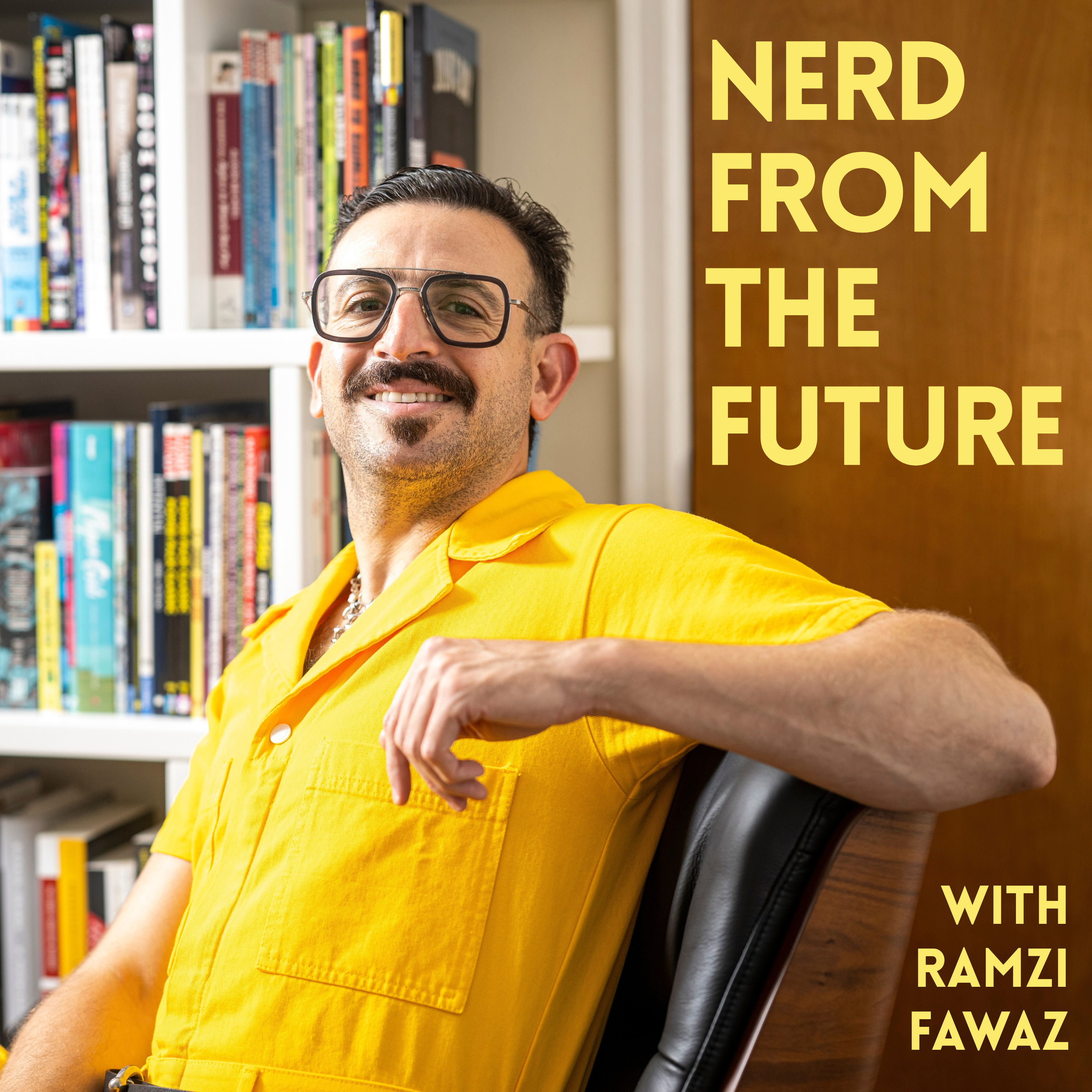
Thinking Like a Multiverse: Ramzi Fawaz on the Psychedelic Humanities
from Nerd from the Future
85m 53s
This transcription is from a podcast bonus episode where host RancifalWaz presents a live conversation at UC Berkeley about his forthcoming book, "How to Think Like a Multiverse: Psychedelic Pathways to Embracing a Diverse World." The central thesis posits that the transformative mechanisms of psychedelic therapy—such as ego dissolution and emotional reinterpretation—closely parallel the goals of humanities education, which uses art and culture to expand perspectives and foster healing. The discussion, with colleague Ramsey McClazer, explores how this interdisciplinary "psychedelic humanities" field can address the fundamental challenge of engaging with human diversity in a constructive, affiliative manner, moving beyond xenophobia, neoliberalism, or rigid identity politics. Key hurdles noted include a lack of genuine collaboration between psychedelic scientists and humanists, as well as academic inhibitions around discussing drug experiences or fully embracing immersive aesthetic practices like video games or raves. The conversation frames the work as a form of academic self-help aimed at cultivating a mindset that welcomes multiplicity, inspired by both psychedelic insights and contemporary popular culture.
This is Nerd from the Future, inviting you to embrace your inner nerd. Everyone needs a nerd from the future. You know who I'm talking about. It's that passionate, smarty pants who comes into your life with new ideas and new ways of seeing the world that change, well, everything. I'm your host, RancifalWaz. [BEEPING] Hey, nerds. Welcome back to the show. As a gift to all our listeners who've been traveling along with us for our first season, we've got a really special bonus episode for you this week. On September 25, 2025, I had the incredible privilege of joining my colleague, Ramsey McLaser, at UC Berkeley, my alma mater, for a public conversation about my recent research and writing in the psychedelic humanities. You heard right. There were two Ramseys in the house that day geeking out like nobody's business. The room was packed with an amazingly diverse audience of faculty, undergraduate and graduate students, and many Bay Area community members interested in plant medicines and psychedelic healing practices. Some of my own former students from a seminar I taught at the World Renowned Estilent Institute last summer were also in the audience, so there was a ton of love in the room. Just to give you a little background, I'm in the middle of writing a new book titled How to Think Like a Multiverse, Psychedelic Pathways to Embracing a Diverse World. In this book, I explore how the key elements of psychedelic therapy, including emotionally transformative experiences with plant medicines and deep interpretations of the experience afterward, overlap in many ways with the approaches we use to teach about our literature and culture in the humanities classroom. Basically, I make a case for thinking about humanities education as a kind of psychedelic therapy, but one where we use art and culture instead of drugs to change people's lives for the better. You'll see that I was fully in my element at this event, talking freely and playfully about these ideas with dear friends and former mentors in the room. The Q&A was lively and energetic with both friendly questions and some combative ones near the end, but a little productive conflict kept me on my toes. The nerd from the future team felt this was a perfect way to top off our first season, with a live episode of your host nerding out in front of an audience. Before we start the show, I want to thank the Center for Interdisciplinary Critical Inquiry at UC Berkeley for hosting this awesome event, including the Center's director, DeBartie Sonial, and its manager, Brianna George. And of course, a huge shout out to my name, twin, Ramsey McClazer, who teaches in the Department of Comparative Literature at UC Berkeley. Let's start the show, nerds. So thank you so much, Damon, for the introduction and thanks to everyone who made this event possible. I'm delighted to be here and in conversation with Ramsey. And before the conversation gets going, I'd like to offer just a bit of backstory to shed some light on how I approach Ramsey's new work and how I understand its importance. I've been grateful not just to understand, but also to experience firsthand his new work's curative power as I've read and we read it for today. So whether or not Ramsey knew it would be, preparing for our conversation has for me already been healing. For a long time, every couple of years or so, I'd have an interaction that would go like this. I'd be at an academic conference or another similar event and I'd introduce myself to a colleague I'd never met before. Then after a minute or so, I would come to understand that the person I was speaking with thought they were meeting not me, but the other gay Ramsey. So these interactions might not have been so memorable for me, right? They might not have left such a deep and lasting impression. If it weren't for the fact that repeatedly I could sense my colleague's disappointment when I told them which Ramsey I was, so I could see that they were a little let down by my clarification because it meant that the person they at first took to be a celebrity, for was, was in fact only me, McGlazer. So because this kind of conversation would recur, I developed a low grade complex related to it. And although this may sound ridiculous, it may sound ridiculous to some of you, but I really did begin to wonder whether there was room enough in the profession for more than one Ramsey. And so it's been both a pleasure and a balm to read Ramsey's latest work and I've been especially moved to find that this work seeks secure for the kind of competitive individualism that would have us believe that it's both possible and desirable to be the only one. The search for such a cure or rather for what Ramsey calls a comprehensive form of self and world retrieval, maybe we can come back to that phrase, takes him to various places from the psychedelic session to the humanities classroom and from the multiplex to the multiverse Ramsey. We are so fortunate that you're here to guide us through some of this journey. So I'm hoping you'll be willing to start the conversation by just telling us a bit about how you arrived at your current project, how did you discover the psychedelic humanities or how did they discover you? Well, first of all, an embarrassment of riches. Thank you both so much. This is so beautiful. I just want to say that Cal is my alma mater. Some of my greatest mentors are here. Kevin's Goodman, Kathleen Rand, so I am a product of this intellectual universe and I'm in awe and honored to be in conversation with you. Thank you. I came into contact with the psychedelic humanities somewhere about two-thirds of the way writing my second book, Clear Forms. I was writing about a variety of queer and feminist cultural objects, some of which were directly from San Francisco. And one of them was Tales of the City. Some of you may know the serial gay fiction Tales of the City. And I was shocked that maybe one scholar had ever written an academic essay about Tales of the City. And so I wanted to study it in its original context. So I did something very unusual, which is that I interviewed 30 people who had read it in the chronicle as it came out in the 70s. And that was really transformative. And I gave a paper about this at the San Francisco LGBT Museum and Center. And at the end of that talk, a man raised his hand like a septigeneerian gay guy, raised his hand and he said, "I love what you're doing. I'm totally with you." But you never talk about the fact that all of us that were participating in women's egg liberation were always on drugs. And like a huge way in which we were exploring our sexualities and really sort of opening out the possibility of destabilizing these categories like gay and lesbian, straight, gay, whatever, was the fact that these drugs were completely transforming our affected universe, like our emotional universe. So that was part one. That was like the first of three things that led me there. And as I explored more in the career in the 70s, drugs are everywhere, right? The caucas, the classic glam drag group were always on LSD. You just see it in the water, literally and figuratively. The second, of course, was just like everybody else. I read Michael Pollan's "How to Change Your Mind" while I was under lockdown for the COVID pandemic. I had a fellowship at the Stanford Humanities Center and suddenly we couldn't go anymore to the school. So I was in San Francisco and I'm reading this book and I'm sort of mind boggled by the specific chapter where he talks about the neuroscience of psychedelics, where he talks about how we're finding out that you can, that psychedelics rewire the brain, that there are these transformative effects that make that he describes often psychedelics like language, like it works on your brain and I kept, as I was reading it, I was like, he's just describing humanities education. Like that really kept returning to me. I was like, he's really describing what we do in humanities classrooms, except we don't use drugs, we use art and literature to invoke these transformative effects. And then the last was that I was just watching a bunch of popular media that looked really psychedelic. So I was watching, you know, I went and saw everything ever where I was once and my brain exploded into a thousand pieces. You know, I saw the spider verse movies and was just a gogg that they're so critical of identity politics. They're all about affiliation across identity. I watched the television show Undone. It's another amazing psychedelic media text I was reading, the Southern Retrology and I said, once there was a critical mass of these texts, I thought something is happening. Like this is not an accident. There is a cultural phenomenon happening where media and popular culture is catching on to the psychedelic Renaissance and it's sort of metabolizing it aesthetically. And the last thing I'll say there is that at the same time, I was also thinking like, what do I want out of this career, you know, sitting under lockdown when I was almost a full professor and I was thinking like, I've moved very quickly through the career. What do I want to do with my life? And I really had a moment where I was like, I actually want the work that I do to have some kind of healing effect on people. Like I want it to be consonant with this Renaissance and I want to also be healed by it. And so those things all sort of came together all at once and that was, and the spider version of these was really where it started and I went from there. Amazing. Could you maybe describe some of the challenges you've encountered as you've done this work which is remarkable not least because it's truly an interdisciplinary, right? So I'm just wondering how you've worked to explain, explain, right? The value of the humanities declensions and scientists and how conversely you've made humanistic insights legible to them. Yeah. You know, I am not sure that I have convinced any scientist of anything yet.
I would say that one of the big challenges of the field is that there is a huge amount of pomp and circumstance around the desire for the study of psychedelics to be interdisciplinary, and it's not clear to me that scientists have the bandwidth or even care that much what humanists are saying. And I might just be in the wrong places. You know, we have a Transdisciplinary Center for the Study of Psychoactives at Madison. It's an extraordinary center. I'm so grateful to be affiliated. But if we're being honest, it's not Transdisciplinary yet. It is really mostly scientists and pharmacists who are doing very, very narrow studies. So I was saying earlier, you know, most studies in psychedelic science are asking extremely specific questions like, how does 10 milligrams of psilocybin administered to people between this age and that age affect one aspect of depression? Right? So, to me, they're in desperate need of conversation with humanists to be able to think about the larger historical, political, social dynamics of what it is they're doing, and also kind of like the so what? Like so if you're going to be able to use 10 milligrams of this to be able to help depression for what? And what else? Like, is all of this work really just to find a magic bullet for little idiosyncratic elements of stress on the human body? Or are we actually trying to change hearts and minds in really important transformative ways, not so that at the end of the day people will all be liberal or progressive, but literally so that people can think in a more expansive way? And so that's kind of number one. The other hurdle that I find and it's weird to talk about this is that so many humanists are so, they're all proves. Like, I don't know how else to put it. It's like you talk to humanists about drugs or having fun or going dancing and it was like, what? You know, like there's just such an anxiety and a fear about like losing control among a group of scholars who spent their entire life studying aesthetic experience, which is about the loss of the self to some kind of artistic or creative or imaginative phenomenon. So I mean, I write about that in my essay "Tripping on Mushrooms with Edward Said." I say, there's a really weird dissonance between how much we talk about feelings and effects and sensations and the aesthetic and yet we don't really like to have feelings, like as humanists. And I, a good example of this is PMLA, you know, many of you know, is the premier journal of literary studies. I've talked with their current editor a number of times about pitching a theories and methodology section about the psychedelic humanities in some way. But then I ended up editing a special issue of a South Atlantic quarterly on this topic and I thought, I don't want to rehash the same thing. So I wrote him and I said, listen, I have a really controversial idea would you be open to this idea. I said, what if you did a theories and methodology section with professors writing about how doing psychedelics changed the way they do scholarship? And I thought, this is a really great opportunity for humanists to intervene because scientists have a huge struggle talking about this because if they talk openly about doing psychedelics, they could have their licenses revoked, they could lose funding from the government. So somebody has to talk about the actual drug taking experience besides just clients. And so I said, in my pitch, I said, this is a really good opportunity for humanists to talk about it. Look, if Michael Pollan can write a whole book about him taking drugs and not get fired, like we should create, right, we should create an environment. And the pearl clutching was, it was so like we could get legally in trouble. We're not telling people to do drugs. We're just talking about them, right? So there is this deep anxiety that to talk about something is to say you should do it, is an imperative. So I find that one of the hurdles is that there's so much we could learn that we're not learning because we're afraid of saying it. Most scholars I know drink like a bottle of wine every night. So it's like, it's not like we're not engaging in altered states, right? Like every scholar I hang out with in Madison is always in some way altering their taking weed, they're doing whatever, but somehow talking about how having a powerful altered embodied experience might change and improve the way we study is really off the table often. And I think we need to break through that. That has to change. Do you think that applies to aesthetic experience also? Do you think there's a similar inhibition when it comes to engaging with aesthetic experience? Yes, because think about it. It's like, I said it today in today's workshop. It's like, could I possibly convince any of my colleagues to go to a rave, right? Or like just to go have a sensory experience that is outside of your norm. You know, when I was, I taught study abroad in London last season and it changed my life. It's like the coolest thing I've ever done. If you're a graduate student or a faculty member at some point or another, you need to teach study abroad at your institution. It's so cool. And I remember just being overwhelmed by aesthetic experiences. Like every single, I told people that sometimes I would be walking in central London and I would have to avert my eyes from a street because there was too much to see. I was like, it's also beautiful. It's also beautiful. I can't. And I loved feeling kind of overwhelmed. I would go to a museum and I would go to raves and I would go tell my students that I was doing these things because they were also doing them. And we were having a shared experience. They were like, I went to this dance club and I did this and I went to this music event. And it was so powerful to have a shared experience with students. So we were all going to different locations but we were all being activated in an aesthetic and embodied way. And that I think, yes, I think there is also a limit to what people will expect. Like I'm going to give one example. I gave in the workshop. Unbelievable to me that over a billion people on this planet play video games and not a single professor I know who isn't in games studies plays video games. Like, don't you want to know what other people are doing? I play video games all the time. It's life changing. It's they're more interesting than most novels being published today. You were in an immersive movie for 65 hours. It's amazing. Like if you don't have kids, you have time to play some video games. Right? And so like the fact that people are not accessing all of these other things they could be doing, it's surprising to me. I don't know if it would be helpful for people new to your work or maybe for you to lay out the contours of the project. Yeah. So I'm writing a book called How to Think Like a Multiverse, Psychedelic Pathways to Embracing a Diverse World. And I'm kind of pitching it almost like an academic self-help book. And the book has two dimensions. It begins with this just fundamental problem that we all are struggling with, which is I start with a question of like, why is it so difficult for people to respond to human diversity without wanting to annihilate everyone? Like that is a problem that I just want to understand better. Like what is the mindset required for human beings to encounter plurality, multiplicity, diversity and say, oh, that's cool. Like that's really interesting. What's going on? Like what is that? And so it struck me at the beginning of the project that I am very dissatisfied with the answers that the interdisciplines offer. So I say in the book, I say like, we have three dominant modes for understanding difference that are sort of like out in the ether. And one of them is xenophobia, just hate other people. The second would be neoliberalism. Like, oh, it's great that people are diverse because then we can exploit their diversity, we can make money off of it. And then the third and the one that's supposedly most ethical is the social justice discourse that's about protecting and guarding different identities from harm and appropriation. And while I say in my work of while these are very, very different logics, they sort of lead us to the same place, which is difference is wrong or scary or it's good, but needs to be protected. And it leaves such little room for the idea of communing freely across our differences. There's so little room for like affinity and attachment and borrowing and sharing and like any notion of reciprocity, which all of us know in our interpersonal lives. Like we all live every day talking to people who are not like us and not wanting to destroy them. So I started with wanting to understand like, how do you invoke that mindset? And I was fascinated by the ways in which psychedelic science is showing us that one of the potentials of psychedelic experience is like the loosening of the grip on one's rigid sense of self long enough to open out to kind of like access effectively the multiplicity of the world. So that fascinated me. And in my own psychedelic therapy, I had experienced an encounter with levels of multiplicity I'd never like I was just in in touch with so many different aspects, not only of myself, but all the people in my life. And I thought, okay, so maybe what I want to do is talk about how these psychedelic forms of popular culture, what they all seem to be doing is trying to invoke in their audience a sense of such dramatic dislocation from the way you view the world that you could suddenly see more than you could before. Like when you watch everything everywhere else, whether you love it or hate it, I know people who hate it because it's just difficult to watch. Like you see one Asian American woman and suddenly you're like, she's a million things, right? And so suddenly you're like, maybe I have a million things. And the spiderverse movie goes outward. It isn't about how he's a million things. It's about how there's a million versions of this kind of being of the spider person. And I thought each one of these texts seems to be trying to work on a different sensory aspect of being a person in order to leverage open something new. Part two, which was unexpected. Like I did not think this would come about was that the more and more that I had my own psychedelic therapy experiences in group therapy and the more that I read about psychedelic integration, which is the process of taking a psychedelic experience and therapeutically processing it or making meaning of it, right? And integrate it.
creating it into your psyche, the more I thought, this is exactly what humanity's education is. This is literally what we do. We like assign works of art, literature, and media, which have like a transformative effect on students. And it's not just a metaphor. You are reading and watching media that is activating electrical signals in your brain. It's just that you're not ingesting drugs. Then we sit in a classroom every week and we integrate the experience collectively and there is a guide who is a professor who has a whole host of interpretive capacities to help people work through what's happening to them. Every humanities professor who's ever taught has received that email from a student at the end that is like, you change my life. This blew my mind. I am a transformed person. And I thought, why don't we talk about that as a psychedelic experience? This is an extraordinary value of the humanities classroom that we don't talk about, which is that it literally has the potential to not only make people whatever, critical thinkers, expansions, but you actually kill them in a way. I wanted to ask you about this. Because of something you write that's very moving in the introduction to the special issue. You write, and I'm going to quote you for just one second, that quote, the simple fact that students frequently feel better about themselves and more confident in their ability to confront the challenges of daily life because of what they learn in the literature and cultural studies classroom. So a version of what you've just shared with us. Your students are clearly extremely lucky to have a guide like you. I'm wondering though, what you make of the moments when humanities teaching makes students feel worse? I think they're also not infrequent. So it could be I'm assigning the wrong objects. I know you're, of course, aware of these moments that have been, not least because you're arguing also in that piece against treating psychedelics as panacea or the teaching of literature as that, right? That simple, univocal, healing agent. So could you say more about this? What do you do when a student comes up against a limit or is disabused, disappointed, disillusioned or devastated by an encounter with an aesthetic work? Well, so I want to frame that with a little piece of wisdom I received from a friend of mine who's a burner. He goes to Burning Man every year. And he said one something that I found really interesting. He said even a bad trip is a good trip. And what he meant was the idea that like setting aside, like the very small percentage of people who have psychotic breaks, et cetera, which is why in the clinical setting, there's all of this care around who should and should not take psychedelics. But setting aside these extreme cases, I think he's really fundamentally right. What he's saying is that most bad trips are about a sustained hours long encounter with some very difficult feeling state. Like where you get really lost in thinking about like your mother's mortality or about like your aging or whatever. And that's painful. Like it is a painful encounter with something for a very long amount of time. And what's extraordinary about coming out on the other side is that you realize that you are resilient enough to live through that. And then you're like next time I'm going to create a better setting so that I don't go into this really dark space. But I think like that is the point of MDMA assisted therapy, which has its problems, right? It just had this huge debacle at the governmental level, whatever. But it's basically not about making people feel happy. It's about making people be able to access the full range of their susorium. So they can recognize that even bad, ugly, disgusting, painful things, you can live with them. And I think that is what we're supposed to be doing with our students. - So forgive me the quick speech. - I don't know. - Detour into my own teaching. But this week in my grad seminar, we talked a lot about the aphorism of adornos according to which I'm just going to quote him, "wrong life cannot be lived rightly." - Oh, just kidding. - And so if someone says to you, it sounds like you're saying that it can, right? That wrong life can in fact be lived rightly. Is that person mishearing your argument or is that in fact what you're arguing about? - That's probably right. - Okay. I mean, I love adorno and he's also unbelievably moralizing and he's extraordinarily strict about what he thinks is radical and not. And I'm just not. Like I don't have that investment. I don't think that people can live by that level of strictness. And also everybody in this room knows if you are somebody committed to serious, long-term behavioral change. If you're like, "I would like to change as a person over time," it is unbelievably slow. And you go back and forth and you go back and forth and right. And it requires a lot of spaciousness. So like I wanna give my students spaciousness to go wrong on the path to figuring out what is right for them, not what is right according to a theorist, right? Or according to a political ideological program. So for me, it's like what I try to do to go back to your earlier question is to open up a space where I create like all the feelings are okay. Like put them all out. This disappointed you why? What were you expecting of it? Like I'll give an example. My students, I teach them on the weeds like every year. It's my favorite movie of all time, obsessed. And I always have students who are like, why aren't they lesbians? (audience laughs) Like, we're like, why isn't it about black people? And I'm like, "cause it's not." Like why do you want it to be something that it's not? Like I can give you 10 movies that are about black outlaws, right? Like if you want that movie, there's another movie. And so what I press at them is I'm like, you're allowed to be disappointed, but I'm curious why you have set yourself up for this disappointment when you could receive the world as it is not as you want it to be. And I think part of what is really great about psychedelic experience at its best is that far from creating delusional thinking, if done in a setting that is driven towards positive behavioral transformation, you're doing psychedelics to ultimately see things as they are, not as just you have projected onto them. And the irony of that is that psychedelics are so deeply shaped by people's mindset that it requires a lot of cognitive work to not get lost in your own delusions. So I think part of our job in the classroom is to honor students' feelings and then be like, where do that come from? Why do you need this from the cultural text? What would open out if you release that attachment? What if you let the movie be what it is, then you can see that it's in form of anarchist feminism. It's precisely about saying, "Girl, if you want to be a lesbian, go do that." And if you don't, you don't have to do that. Maybe you have the best friend, right? And maybe you want to go off into the unknown with them. Like, do you do whatever, right? Like, why does it need to be fixed? So I think like, I don't know if that's an adequate answer, but I think it's like clearing the space for all of the feelings and then saying, we're going to now interrogate those feelings lovingly. - I mean, I think that actually anticipates the next set of questions I wanted to ask you which are about the symptom, just the category of symptom. And again, apologies to anyone in the audience who doesn't want to enter my real house, but since I work, it's like, when, politically, the symptom has a specific meaning, right? It's not just a source of suffering to be alleviated or eliminated, but a message to be read. - To hold it. - Right? Yeah, exactly. And so I would just love to hear more from you what you make of this, how you see your work as relating or not to this understanding, specific reason for symptom. - Well, I might use a teaching version 'cause you and I talked about this earlier, right? Like, I don't think this quite squares with the symptom exactly, but it's like my version of it, which is that, you know, I'm sure many of us in this room who teach experience this, it's like students come in and they have certain attachments and they are committed to certain ideological positions, certain values, and then those values go from being a position they're taking to being a symptom. Like, it becomes like, there's a rep, like, almost a repetition compulsion where they have to sort of like keep reading or interpreting the world through one line. So I'll teach a class called Queer Ethics, and it's like the students can't stop talking about consent. It's like the one framework, as though all of sex is about consent, and I'm like, you know, consent is one aspect of sex, not all of its aspects. So my version of this, my version of being a psychoanalyst in the classroom is at some point, when I see that frame sort of overtaking the possibility of diverse conversation, I say, okay, you know what, I'm gonna play along. Let's say this is the only thing that's operative. Let's take it to its nth degree and see what plays out. So I'm gonna give a really weird example. In one of my classes, the Queer Ethics class, I'll have all these undergraduates who are like, we will read unlimited intimacy, which is a very challenging book that is about condomless gay sex, and about its possibilities and its ethics and whatever, and students love, they're very intrigued by the argument. They were concerned that the book is very exclusive, that it's predominantly about white gay men, and that he's celebrating a universe in which lots of other kinds of gay men are not desirable, like if they're a color, if they're not muscular, or whatever. So I said, okay, I'm intrigued by this contradiction between you love consent, but you want inclusion. So I said, so if somebody asked you, like, would you have sex with me, would you have sex with anybody on the planet? And they're like, absolutely not. And I was like, so by your standards, you are exclusive, and thus retrograde and conservative. Like, you can't have bugs, though. You can't have universal inclusion all the time and consent all the time. Like consent is fundamentally exclusive. It says, yes here, no here, right? It's about, don't touch me, yes touch me. And it is fundamentally exclusive, and it's gonna work against your liberal values, and you're gonna have to hold the two intention. Like, that's the nature of sex. Like, there are sex spaces that are deeply exclusive. I spent years being like, why am I not included 'cause I have this high voice and people like masculine, what 'cause they don't want it? Like, I'm not gonna make people like me. Like, you have to move on. Like, at some point you have to be like, okay, like, I'm gonna go create my own thing. So like, I don't know if that seems like a good example, but it's like, I see them like, that is their symptom, which is that they can't handle contradiction. And I'm like, I push them all the way to that, and then they're like, oh wow.
like I didn't realize it. I'm like yeah that's called you have to split decisions. Sometimes it's consent, sometimes it's not, sometimes like you have to decide. So I don't know if that's an adequate answer but yeah. This one's like a few years ago but I do do this to my students all the time. I really like to push them to the limit of that like another very silly example that I've talked about actually in other episodes of the podcast and I said this in the workshop. My students often love to perform a very wrote sort of boring political theater in which there will be conservative students that will take like a really whatever. A position that offends other people and they know that it's gonna offend people and then they're like waiting for people to be offended and then the liberal students are like all too happy to be offended and then like pounce on them and then it like produces this just like nightmare and at one point I said to them I was like what if you just stopped like what have you just stopped doing this thing and what it's like instead of worrying about offending people you say what you actually believe not what you think will be in San Diary let other people answer honestly and you don't have to be the moral police on the left right we go back and forth and what comes out of this conversation is that some of the conservative students say but in the dorms some of the other students in the class said if they ever heard that we voted for Trump they would never speak to us and I look at the left wing students and I'm like you sound kind of like a fascist like I like so you're literally telling people I will exclude you permanently from my entire realm even though I'm all about inclusion and I love everybody so I'm like could you possibly see why that might not make sense right so I think like I try at all these moments to kind of show them how when they hold on to certain logics in such a rigid way they're actually contradicting their own values and that's okay if they're okay being hypocrites but if they you know if they want to actually live out some other values they might have to think that through you've entered the terrain of the final set of questions I wanted to put you a trap to do or have to do with how the fact of current fascist resurgence has entered the classroom for you and how how you've worked to deal with it how also if you want to say how it relates to sure the work you're doing as well let me start with the psychedelic question I want to remind everybody like we all sort of know this but we don't always say it explicitly like there is nothing about psychedelics that inherently articulates them to radical or libertary politics at all there's a huge spate of literature being published like there's a great essay by Niche de Bano and Brian Pace that is all about right wing psychedelia how QAnon shaman's are obsessed with LSD and so with that to me what's so great great in the sense that it forces us to be responsible it's like there's no magical it for mass evisoration like when you know these drugs can be used for really positive transformative effects and some of the most heinous forms of violence it means the responsibility lies in the people who use them administer them how we use them in what context there is no out from responsibility so one of my problems with the science is that there's a succession with being like what if we could find a one chemical in every single drug that if administered to everyone equivalently would always create healing and it's like girl that's what everybody has wished since the beginning of time like that's what Hannah are right right about like we've always tried to find an out for human contingency and that the end point of that is usually just killing everybody because human beings are unpredictable and you cannot control them so for me I always start from the idea that in fact it is a good thing for our ethical compass to realize and be and be clear-eyed about the really pernicious uses of psychedelics because it reminds us that whatever social transformative power they have will not ultimately lie in the drug it will be in the worlds that we create around the drug taking experience and and just like in the mindset and that is integration which we can get to in a second now how do I deal with the question of a fascism in a classroom I it's exactly what Damon said I was really a really meant a lot to me that you use the word democratic a number of times like I think it's fair to say that if you read across my offer and I owe a lot of this to Catholic one Catholic Moran and a few other people like Libby anchor some of you might know brilliant political theorist like I really have gone from being an American cultural historian to being a democratic political theorist who uses popular culture to talk about democracy and one of the things I do in my classes is I'm like the thing we have to cultivate is our ability to confront plurality in ourselves and others without freaking out like that is really what I want for them it's like I'm not there to tell them to go fight Trump or to do this they can decide that if they want I want them to learn how to be able to decide something together like how to make a critical judgment about the world and then move forward with it and I mean this really relates to the psychedelic experience because what healing is it what what is involved in healing with psychedelics is that you have this amazing effect of transport and then you need to decide what meaning you want to make out of it and what you want to do with it that requires you to to take in a lot of data and manage a lot of variables so I think what I keep doing now is signposting for my students like this is a miniature version of a democratic space it's somewhere in between the private and the public because we're not out in the public realm but we're public in that we're at a public institution you guys pay to go here you own some portion of the university at least conceptually and so this is a place where we practice democratic judgment like making decisions and let me tell you this is so hard because they live in a world of right and wrong and good and bad and so they think that making a judgment about anything is making a moral claim about whether it's good or bad and I'm like no it's just deciding for the moment how you want to live together and then you might change your mind later and training them to do that to me is the most anti-fascist thing that you could ever do because the fascist impulse is to say the world is too complex there's too many people just just look we'll decide for you that's I think about Wendy Brown when she says in undoing the demos she says there's a million versions of democracy but at the end of the day isn't it better to be able to rule yourself with others than to have someone tell you how to be world right and I remind my students I'm like I think you guys often forget because you're so overwhelmed with anxiety that it actually sucks in the long term to have other people tell you how you should live all the time in the short term it's great because it's like you guys remember your mom telling you what to do and now you're like sure just tell me what to do 10 years from now when you are desperate to live the life that you wanted to create that will become a nightmare so you might want to start thinking about cultivating the capacity to deal with negotiating differences and decision-making with others so I think that's kind of the way that I am approaching it now there's a liberal argument in favor of complexity range that prevents us from taking sides so ward but so that's not it lies somewhere in the middle like everything's always like oh we can so what okay I'll give you an example one of the things that I one of the critiques I get from other humanists often about my work is that they're like but what about an undecidability like what about opacity and unlike I don't want to be opaque to the world like if you want to do that bless you like if you want to always remain in a state of opacity to the powers that be and you can't be caught and you're elusive and you're identical good for you like live like love for me I want to be able to make decisions about how I appear and I don't see how we can actually like the same people who are saying that are always asking me about real material conditions and I'm like well how do you change real material conditions if you never decide anything you have to take a position and you can always change that position but sometimes you have to stand somewhere and I find that that is the hardest thing for my students to do because they know that once you take a stand somewhere you will be judged by others other people will look at you and be like really what about that and so what I tell them so what so then you either defend your position or you change it and like you change it by taking in other perspectives that's what the feminist political theorist Linda's really says she says like perspectives are only cordial or changeable by other perspectives so my feeling is like if I'm always not deciding by using complex like the world can be complex and you can take in a lot of complex data and then make a decision based on that complexity like why would complexity mitigate the ability to intervene in something and in some ways that is what has made academics irrelevant in the world is not only the deconstruction of the university and neoliberalism and like the fascism and the list goes on but also our own anxiety about saying anything clearly and directly enough that it would look like it landed someplace that couldn't account for every position all at once and it's like well up that's the nature of living in the world you're not always right so anyway I'm very heated about this as you could tell but yeah like I really do I'm you know what be complex and decide so living in the world makes me want to ask before we open this conversation up to audience questions one final thing in this question I should say is informed by my ongoing conversation with Stephanie young about psychedelics and state violence so you've just stood towards this but I just I want to bring the question a little closer to home and concretize it giving you another chance to say what you'd like so we've seen in recent months and years all too clearly it seems to me that far from being necessarily opposed like a psychedelics and state violence so I'm thinking ayahuasca and ayahuasca
by K-holing and murderous government cuts, altered consciousness and ologarchy are tripping in truly heinous forms of white supremacy can be compatible, right? I know this is a difficult convergence to address, but I'm sure you've thought about it. And so I wanted to give you a chance to respond in any way you'd like, especially against the backdrop of the Bay War so many technologies of today's state violence originate. - Yeah, I don't actually find this that difficult to answer because I think that confluence is descriptive of the reality of every single field in our society, all of us know professors who are anti-intellectual. All of us know religious people who are deeply immoral. Like we all know the confluence of a position and hypocrisy, right? The idea that psychedelics might be taken up in deeply heinous violent formations is no surprise in a world where drugs are part of a global exploitative economy, where people want to be able to dissociate from their own forms of violence, where people want to create reasons for explaining away their murderous intent. That's like what Aaron Saldoni talks about. He says, what's really happening with IDF soldiers if we're being honest is that they're being manipulated by their state to think of themselves as good people for murdering and they are probably internally like fucked up over this, right? Like something's happening to them and then psychedelics become a replacement for doing the actual work that is required to process that you've been forced to be complicit in atrocity. So on the one hand, I'm like no surprise. And then the other I would reiterate what I said earlier, which is that it increases that much more exponentially the need for responsibility, right? For actually thinking about these issues in ethical terms about what would it look like to use and think about psychedelics ethically? What does it look like to respond to diversity ethically? What would it take? And another way to put this is that the humanity is one of its greatest struggles is that we're good, we're so good at talk, we're so good at insight and we're so bad at action, right? And I'm not talking about political action. Like professors should prevent, they should do their work. They don't all have to be like frontline activists and organizers. If you want to do that like beautiful, I love that. But I also think that the professor's job is to also be at the university as an interlocutor to young people. But we are so bad at modeling the things that we are talking about to our students. Like I write about this in my work, right? That most professors I know are overworked, depressed, don't take care of themselves. Like people pleasing, often unfriendly, they produce dysfunctional, departmental, dynamic. That shouldn't be the case. Like if we're saying that we study the multidimensional beautiful ascetic creations of humankind and how it changes you and improves your wellbeing, we should be able to model that it's healing us. It's a bad look when you can't. And it's really hard to sell that. So that places the incredible responsibility on us to live up to what we are claiming. And I think the same is true of the psychedelic realm. It requires us to have a theory of psychedelic experience that links it to ethical projects in an intentional way. I think that's a great note to open questions on. I am thinking about the times that I don't psychedelics and kind of guidance often with indigenous elders and the use of applied medicine, instead of kind of recreate the way that is mostly used in the US. Sure. And the idea that it often feels not just losing the grip of the self, but losing this boundary between the human and the non-human and the chanting and the non-sentiment, feeling the breath of a tree or like connecting with a rock or a bird or a spirit or a ancestors. The boundaries of tie and stays and spiraling. So I'm thinking about the difference between healing and alming. So I'm also thinking about the idea of intention and adoring is really important to apply medicine, like setting up intention and the iOS go guys you wherever you need to go or as you said, no ship is ship is ship. And the time of processing, so I'm wondering how do you see that in terms of like also terms of queer communities and how much intention is and how that way of caring is also in practice in like a psychotic experience. But if it all be taken into the knowledge which could see it in tobacco as well as a plant, so healing as a connector in indigenous traditions and then the biggest industry. So you are exactly getting at the heart of like in this project, I'm really trying to get to a place where I say, at the end of the day, it's not about the drugs, it's about the frameworks that we bring to these experiences. So if you do not have a framework that is organized specifically about activating the sensoria, not numbing it, using it to connect to people, using it to have a more expansive sense of your relationship to the world of the universe, which can happen in many different contexts, right? But if you aren't setting an intentional framework that you actually follow through with behavioral and transformative structures, then you are going to get things like numbing. Like you actually have to go into psychedelic experiences, thinking like I'm also as a human being capable of addiction, of obsessive thoughts, like you have to actually articulate the experience to frameworks that are about working to improve people's relationships with others, not to shut them down. So you're really just talking about like what is the frame within which you offer the experience? And I think that that's key. Now when it comes to queer communities, I have not read as much as I would like to about how queer communities are using psychedelics, although there's an amazing book that Shakruna Institute put out that is all about, it's like, queers in psychedelics. But in the book Trippi, do you guys know the book Trippi by Lon Doney as his last name? He's a New York Times journalist. He talks about going on an ayahuasca retreat with a group of queer folks and how he had mixed feelings about it, because he thought it was an unbelievably healing special place, but also the framework was so heavily focused on trauma that most of what they talked about was suicide. And like being on ayahuasca and talking constantly about suicidal ideation, felt to him very dissonant and that it magnified something really difficult and painful. And so that was an interesting situation in which a really intense worry about harm and reproducing harm weirdly accentuated the focus on that thing. And so my view is if what you want is for psychedelic experience to be multiplicitous and never to be one thing, it is powerful and important for people to experience it in lots of different contexts, in lots of different frameworks to see which ones work with their health and healing. People want to lose their ego in the United States, because we live in a very ego-driven society. But when you go somewhere else where ego is not the dominant factor of a culture, that may not be a thing that you need to shed. So like different environments will ask for different things. But I think when it comes to the question of numbing, it really is about how do we set intentions about what we want the drugs to do for us. - Hi, Stephanie. Hi, I'm from the Rames United. I've been talking a lot of the things that come to this. It's a bit fantastic. I was saying it around zero, and you're other around Z. - Yeah, one of the things that's most psychedelic to me about your material is that it's quality of seeing the world as it is. You're just sort of going on with you. - Students can't be, but just some kind of reason, right? - Yeah, yeah, yeah. - You need to be one of the practice agreements in ways that you can, which you talked about today. - Yeah. - But I think, I've been able to talk about what you're saying is like, oh, let's look at things as they are. - Yeah. - Let's not tell the journey, well, it will tell me it's like Drick's water, right? - Don't you hold on to me. - Yeah. - My lessons are very simple. - Yeah, you should take care of your body. I think the knowledge of it is that it's in the world, right? So I'm pretty concerned, I'm going to think about what you really side stuff, which is the mission of the crisis in the humanities, which is deeply belaborate by million people, and it also seems to be like your responding to pretty succinctly, right? - Yeah. - Self-help for the humanities. - Yeah. - And at the same time, there's some way, which by side is stepping it, I wonder what gets up down. - Yeah. - How are you sure we're talking about the ones? - Yes. - And I want to just include this right now, but at university, there's something murderous that has been in universities. - Okay. - So I'm going to include sort of the data that the humanities have been trying to do in university in ways that we don't, we do that on the campus as well. So I'm wondering how yourself help for the humanities. - I love this question. - It's a part of the reason I sidestepped the crisis of the humanities rhetoric is because I, one could argue that we've always, the humanities has always been in crisis, and so if it's always been in crisis, then what's the point of even naming it as such? But one could also say that to me, it's a crisis of pion, honestly. We are so bad at explaining what we do to anyone outside of the university. Like literally just explaining to people that we teach people how to read and write and talk, like doing a podcast has been a revelation. Because this, I get people who write me, students who are like, this is the clearest articulation I have ever heard of what you do in the humanities, and I'm like, haven't you just taken four years of school? There is a way in which we as professors are often
and so at a distance from how we explain ourselves to each other so well. Like we have such rarefied specific ways of explaining to each other our projects, but to sit in front of an ordinary person and just be like, yeah dude, we just sit and we read and we talk about it. Like it's not that difficult to process. You know, we have a problem of getting the word out that what we are doing is valuable and it matters. And what I find weird about that is like, it's really not that hard to have a very quick conversation with someone who thinks that STEM is king to tell them that like most of the students who study that never go into fields with those jobs. All of the work in computer science is gonna now be done by AI. There is a very easy way to show that the humanities is like never gonna get old because the capacity to simply be able to communicate with people to be able to like move in the world as a full person is a necessary part of most jobs. So to me, the reason I don't go too deep into it is because what I wanna try and do is to model what the humanities does best without belaboring the idea that it's failing to do it or that we're doing at bad light. Like I'm like, let me just show it to you. Let me just show you what it would look like to just do humanities work at its highest. I think I address those crisis in the humanities the most explicitly in my essay, "Tripping on Mushrooms of the Edward Said" in which I say like, maybe the real crisis is not simply that we don't get funded that people don't care about us, but that we ourselves have a hard time modeling what is beneficial about what it is that we do. And if we could do a better job living what we teach, people would be like, oh, I want some of that. You know, I remember having a graduate student say something very painful to me. She said, I look at what you guys do and it looks miserable and I don't wanna go into academia. And I have made me very emotional because first it sort of hurt my feelings 'cause I was like, I think I'm pretty cool. And like, I think I trained you really well. I'm like, this is actually pretty fun. But I think that she could see that there was a sort of, like, there was a group of people who despite struggling with all of these budget crises are generally well-resourced, get to teach whatever they want, actually get to study the thing they want and are fucking miserable. And she was like, it's a bad look. She was like, I don't know, like, this doesn't seem fun. And I thought like, that's our problem. We have to change the PR around that. And that requires us to deal with our bullshit, like honestly, because if you are teaching everything that you want, if you are well-resourced university, you should not always be in a state of crisis about it. You should be trying to lift up people who are literally not resourced. - Well, I was just gonna say this 'cause they said crisis in the end is I needed myself because I was like, no, no, no, no, it's just such an overused term that they say all so many things inside of it. But I guess the other surround I really am thinking about is something you just said well-resourced university work. I think you know, this around higher ed in general. - Yeah. - And the big mind is also, which is something that the podcast is addressing. - Yeah. - And that's really uneven, right? And we talked a little bit today about like material terms and I'm sorry, this could keep a lot of it. There's material terms in the job as it is distributed across the university. - Totally. - Quite a lot of things. - 100%. - And do some of that. - Well, just to follow, I mean, so better PR is not gonna stop that merger from happening, right? - No, that's true. - Mm-hmm. - Just wanting to know if you-- - No, absolutely. - Yeah. - I don't know that there is an answer to that question except like complete revolt, right? A collective revolt against the neo-liversation of the university, which we're not particularly good at or trained to do, 'cause we also wanna keep our jobs. And we-- Right, like, so I'm just talking about that one little humble part of like if what we want is greater public buy-in to what it is that we do, like we are going to have to be able to articulate it in a public forum much more decently. Like, why did I do a podcast? I did a podcast because I listened to hundreds of podcasts and all I hear whenever professors go on podcasts is social scientists and scientists from Harvard, Princeton, Yale, and Brown. And I'm sitting there being like, are these the only people who come up with ideas that are worth talking about? Like, I don't-- why is nobody talking to humanists? The only humanist I have ever seen on a major show is Bruce Robbins from Columbia talking on Fereezabaria. And it's like Bruce Robbins is fantastic and I love him and he's so smart. But it's also like, why are you talking to the people that are the most established and famous in their field? Like, he's been famous forever. Why don't you talk to people in their 30s who are starting teaching, who have all these interesting ideas? And I thought, I want to like put those people front and center from poor schools, from well-resourced schools, from Ivy Leagues, from small, cal state schools, like all of these different voices. And you know what I get? If students are like, you guys are so cool. Like, you guys are so interesting and cool. But we just don't produce enough forums to get that out. So I absolutely agree. None of that is going to fix the structural reality. But I think that if what we want is an electorate that sometimes votes in our favor, we will have to make it so that in their imagination, when they think about us, they think that we are actually cool and that we're doing things that are cool. So the last thing I'll say is like Matt Brim, who teaches at CUNY Staten Island, who teaches at a poor school is how he would describe it. He does an amazing thing. He invites his students parents to come to class. Because most of them are like, why are you wasting your money going to school? And they leave after an hour and a half, and they're like, this is so awesome. He's so awesome. This is so fun. I didn't know this was so fun. It's that basic. I'm going to be building on this. I love this. And what we've said earlier around like creating a space in a classroom where students can explore. And we have these ups and downs, the key times in space. And I mean, it sounds like a lot of this is better around the fact. But I'm exciting and thinking about that. I was fortunate enough to experience discussion with you outside of the community. And not as-- I'm only going to 20s, but I'm going to be there. And it was really powerful and meaningful to not just-- I was doing a lot of podcasts, doing a lot of things, but experiencing discourse in a space is a very different level of learning and expansion. And I was curious-- I think you're talking a lot about the role of academia. And your starting to grow as ideas out in different ways. But I'm curious if you have other thoughts on outside of academia, how do we create more space for students to study? And what does it look like outside of just universities and colleges and these safe spaces? What a great question. It's so nuts and bolts. It's like people need to remember that they have the capacity to invite other people into a space. When you think about the radical feminism of the 1970s, or gay liberation, which I write so much about, that was all grassroots everyday work. It was like women saying, you know what? Why do we meet in my living room on 10th Street in New York City? And 20 women come and start talking in a conscious-less raising session. And then they model that for other people. And then they spread the word about this way of being. So that suddenly, there are all these radical feminists running across New York City every day going to meetings, meetings, meetings, meetings. This attempt to revitalize public space that is not all on the internet, that is not all social media, where we actually do things in a very local way. One of the things we did-- I think was in my class at Esselin. And one of the days on that seminar was about radical democracy and cosmopolitanism. And we literally practiced deliberative democracy by debating every single thing that happened for two hours. And it was so fun, and it was really hard. And we talked about how we have such a low tolerance for that. And what would it look like to invite people into a space over dinner, where you just talk about something you all read? So the anarchist group, the Invisible Committee, in their manifesto called Now, they say, in a world that radically alienates all of us and atomizes us, the most radical thing you could do is make dinner for your friends. It's just off or something to people. And there is a way in which, without setting for yourself, the standard of changing the world, you could do those things and just get practice at it. So a wrench will say, people who never practice getting together with others, talking to others, deliberating over questions are very unlikely to start to do that when the chips are down. She's like, it's very unlikely that the people who never practice, communing with others when dictatorships falls are like, I'm ready to be in it with you. So I think like, really, the answer is so combayah and cheesy. But it's like, create little versions of the public square in your own life, invite people to do things in a sustained, regular way where you're always talking through ideas. I had a student in London at one point we were talking about deliberative democracy and popular culture. And he flippantly said, so what? We're supposed to all suddenly start being out in the public square. And I was like, why not? I was like, why are you poo-pooing that thing? Like, do you ever go out in the public square and talk to anyone? Because we don't have a public square anymore. So like, it's not the answer. Again, I think it's sort of like cliche. But I don't know that there is another answer. Like, that is the answer. It's like, create the thing that you want in miniature and then take it from there. And if that's all you want, great. And if it becomes a model of a larger political practice, that's also great. So what you're saying about practice is so compelling. If I could just ask the follow-up. So if someone were to say, it's not holding yourself to the standard of changing the world, but rather holding fast to an aspiration. Yes. Right? And if that's off the table.
What is authenticity? If the aspiration, which is everywhere under attack, is off the table. Like how do you respond to that kind of critique? The aspiration of changing the world. Well, you said, oh, we shouldn't, we shouldn't hold ourselves to the standard of changing the world. We should focus on these local spaces. Oh, what I simply mean is if holding yourself to the standard of changing the world is paralyzing you, then it does need to be set aside. If it's galvanizing you, go for it, girl. Right? Like whatever it is that drives you to be able to act is to my mind a good thing. And if you're like, but I can't do anything unless it's going to change all local politics in my town or whatever, you might be setting yourself up for disaster. Because it's not something you can achieve in one fell swoop. And I think that being able to have more humble ambitions, where you say, I want to change the world. Maybe one way of doing that is just changing something on my street. Right? I mean, this is what I think a lot of people talk about like emergent strategy, like the Adrienne Marie Brown stuff, where she's like, start really local. I think that's all I mean. I have very big ambitions and aspirations. I wouldn't want to take that away from anyone. I believe in changing the world. My version of changing the world tends to be as your question positive, less about the complete restructuring of material conditions, which is a question I get asked often. And I often, I'm like, I just don't think that's what I'm doing. Like, I would love to. There's other political strategies that do that work. And if you create a forum for me to participate in that, I will. But I don't think that any material transformation can happen in the world unless people's framework for thinking about a problem shifts. And I think that the problem we are running into in our country now is that people are so viciously and fiercely attached to their own frameworks for understanding the world. That it is like we all sort of need to figuratively drop acid and like shake it up. And we need to just break out of these logics. Another way to put this is if your idea of changing the world is really rigid. If you have one idea of what changing the world is, maybe find ways to shift the frame of what you think world transformation is and then try to create some small version of that. I wanted to ask you, you would say a little bit more about capacity. I really like them, because I don't want to be OK to the world. I also would aspire to that. My question is, what about you truly look into yourself? True. I ask this in part to gesture towards some of the friction between psychedelics and psychoanalysis. There was some people come up, because I think that those two feel to take that in our way. Psychoanalysis, in part, you are always a creature. Sure. I thought there was some milk. The unconscious is that we cannot actually bone. And at least to how I've seen psychedelics talk about it, it's an expansion and opening of the line, what you can know with the mind. So I'm curious about that. I'm also curious to me, because I was talking about education and came up with this conversation. And I was in a very live question for our students. I don't think that is ever more opaque to myself than I was in my team. [LAUGHTER] Students really know what frame-horses are. But can I ask you, did you want to stay opaque to yourself? Was that a level-of-the-way? You guys are both either. OK, sure. I'm not a body. Which is part of why people go to school. Right? Like, people go to school in order to have a better understanding not only of other people but themselves. So let me backtrack and explain where my binging and opacity comes from. And it really comes from a specific disciplinary space around queer studies. Anybody who circulates in queer and trans studies in the last 20 years knows that there was, at some point, like, the field at some level, queer studies is the study of weirdos. Like, that's what it is. It's a field that is a study of the people who don't fit in, like misfits. And that, to me, was always very compelling when I first entered the field. Sometime in the mid-2000s, there was a major move in the field towards describing all of these forms of failing to live up to norms as a form of liberatory escape from those norms. So words like failure, opacity, assimility, fluidness, formalistness, there was this kind of embrace of the idea of what makes queer people and other misfits so radical is they can never be captured. Nobody can ever understand them fully. They're always opaque to the world, et cetera. And after a while, I remember thinking with my colleague, Iadalavihusin, we used to say, I don't want to be a loser. I don't want to be a failure. The queer art of failure. I'm not-- it's not my aspiration to fail and everything. I don't know. I don't always want to be misunderstood. I would like to be seen in my various dimensions, even knowing that I can never be seen fully because I'm multi-dimensional and I'm multiverse whatever. I can hold both things at once that I'm multiplicitous. And there are dimensions of my being that can be articulated to other people. And I can live with that reality. So I found, as I taught more and more young queer people, that they glomed on to that language of opacity. And they sort of fell in love with it. They were so seduced by it. And it allowed them to take this very irritating formation. Nobody understands me. I can't believe nobody understands me, but you never could. Like, that's the game they're playing. Like, nobody understands me, but they never could. Because I'm just so unique and weird. And I'm like, no, you're not. You're another human being on the planet. And there's been billions of us before. And you can actually be understood. There are ways to convey your form of gender or sexual non-conformity. And yes, at the end of the day, you will never be fully understood because we're not telepads. That is the beauty and the majesty and the mystery of being a person. So I am critical of the tendency to elevate the notion of opacity or not being understood to a liberatory calling. It's one thing to say. They are a marginalized subject. Like Vivian Huang's book about queer Asian-American form is all about how Asian-American people are often made invisible in our culture. And so they are a pake to the culture because they are invisible. That's a historical argument about the way in which some people have been framed. One does not then need to celebrate opacity as this great thing. And this is where she and I and others disagree, where I think that queer studies then wants to elevate the idea of remaining opaque to yourself and others as somehow-- it's like the idea of undecidability. Like always being liminal is the best thing. And I'm like, sometimes you're liminal and sometimes you're not. And it's not possible to live permanently in that space. Judith Butler would say that's an unlivable life. So my thing is, don't we strive in some aspects to want to understand ourselves better? Isn't that why we get educated? Don't we go to therapy in order to understand ourselves better? The point isn't to achieve a moment where you are fully transparent to yourself. But rather where you train your senses to be able to better register your own complexity, like your own multiplicity. That to me is what's so interesting about psychedelic experience. The idea, not that you will become transparent to yourself, but that you will feel more in your body. You will have a broader opening up of a range, of feeling states. And it will be like, oh my god, I didn't know that I could receive that much. I said in the workshop that great quote from Jeff Fandermier's annihilation, the first novel of this trilogy, where a character says, I no longer felt like a person. I felt like a receiving station for a series of overwhelming transmissions. And my thing is like psychedelic experience is about becoming a receiving station and realizing I can feel this much and more. I can't believe it. That's amazing to me. And that to me is a form of self-understanding. The last time I had a psychedelic therapy trip, I wasn't letting go of anything. I wasn't like, I have to let go of this trauma or whatever. I have never trusted myself more. I was just overwhelmed by sensation and in my mind I was like, I'm fine. I was like, I can actually handle this much. I can receive this much. And it was such, I really did feel transparent to myself briefly. And I liked that because I knew that it was temporary. I was like, that's great to know that I can touch that thing. And then next week I'm going to be in a bad mood and be like, I hate myself and everybody. And that's OK. So I don't know if that's a good answer to your question, but yeah. Thank you so much for providing me with safe space for this conversation. I feel like we're very much at eager for more. Thank you. That's so generous. And so my name is Chia. I'm a native from Mexico. And I want to say, for the past six or seven years, seven folding space between here and Guajáca, particularly within Los Angeles, a whole children, as we said in magical mushrooms. And my question is pretty good. So I have a couple of them. One particularly is, as you all right, you know, in the 50, 60, 70s there was this lady in which we know that there was this wave in which people that were particularly psychologists that knew that this medicine was provided there, particularly by the school of the elderly, or by the young, or something. And so what I saw in her-- and so what has been my challenge-- I'm curious to know about yours-- is for me not to replicate what happened in those times. So even though I am someone that is holding space every summer, taking care of it, why in summer? Because it's our monsoon season. And so that's when the magical mushrooms grow.
And so every year there is that feeling of maybe being responsible, right? So I'm curious to know how you feel about this particular event that are continuing to happen. Yeah. Because I have been going back and forth from the past. I want to say seven years, but honestly through generations because I come from that living. Yeah. And so I do have a responsibility. I'm aware of my very clearly and I seem to be like you, I was in academia and I was strongly caught by my ancestors to get out. That was in there for a couple years. Yeah. So here in you speak about your students saying, oh wow, that's a great name. That's what I mean. Right, but I didn't even know about it until I was in it. Yeah. Right? And now fast forward, 12 years later, it was a full circle because I was asked to do the medicine that my ancestors were doing back and forth. And so even though physically being here is a challenge in my mind and my heart is beautiful to come back to this space. It's for us to be able to hear one another, right? But also knowing where academia is now, what the context of what happened back in a couple years back. And we'll be happening because I see how much tourism has grown in one particular being this town. So I will do a disclaimer that I should have done with the crisis. I, a crisis of the humanities question, which is that I'm not going to be able to answer the larger structural problem of tourism, which is right, it's so beyond my cake rate. It's like something that governments need to be intervening in. Like so much activism has to be done around that. But I will talk about what I think I'd better at, which is the frame. By sense, I'm still learning, like I consider myself a student of psychedelic studies and history and there's so much more I want to learn. But it seems very clear to me that the framework that says there are indigenous people that have had these things for generations. They have ownership over the meaning of it. And then there are white western people that are exploiting it and abusing it is not working. Because it ignores histories of exchange, of the idea that this is, Platonitisins exists everywhere around the world. There are some people that have way longer experience than others. But it doesn't mean that they aren't themselves evolving. Like part of what Aaron Saldania says this is like part of what it does is it says the people that have had ancient traditions are stuck in time. And they're only using it in one way. And then there's these people who are exploiting it. What I would like is for us to talk more about like how are all of these groups responding to contemporary realities and changing and evolving the way they administer and frame psychedelic medicines in response to those realities. So like one way of being responsible for the spread of something is you could educate people about its history. You could also talk about what what healthy meaningful exchange looks like that is non-exploitative. You can ask people to, you can signpost what that looks like and offer best practices and invite people into that. And what that might do is give people the tools to then go circulate those best practices elsewhere or to adapt them. But it requires a willingness to say no one group has universal ownership over this experience. They are just some of us that are more proximate to long histories of its use. So I think part of what happens is that there is such a focus on like especially white middle class Americans using all of these drugs exploitatively that we actually don't put the responsibility in their hand to be like what do you, what is the tradition you want to create in the United States of psychedelics? There's more people being in a constant defensive stance of being like I don't want to be racist but I also want the drugs. And I think if we can, like people are going to do the drugs. They're seeking about Americans are really struggling about their mental health, about their relationships with their politics. Like they're going to seek out everything but its meditation yoga. We're going to have to accept that Americans are really trying their best to find their way out of this nightmare and they're going to do it in a clumsy and weird way. And if the framework is always one of like original bearers and owners of the experience and the exploitators, you're not going to create the conditions in which the exploitators are going to come up with a better self understanding of why they want to access these drugs. So my thing is like we need to change the frame where we talk more and there's a book that does this really well. There's a new book that's, I forget the name, it's about global psychedelic cultures. And what it tries to show in a series of essays is that there's so many different cultures globally, modern ancient, you know, etc that have been interacting with psychoactive drugs and the book is saying there's no group of people that have pure ownership over these plant medicines. They're different, they're differing competing traditions. And if we could talk about like what is your tradition, how do you pass, what is the tradition of passing it on and then giving people best practices and then saying to them, you need to figure out what your tradition is. Like I think that's what we need to do is to demand a responsibility for Americans to figure out what they want their tradition to be. And part of my project in this book is like the tradition should not be a magic bullet for misery. It really should not be that. That is not a sustainable goal. That's a very American thing. You know, the last one was opioids and the one before that was valium. Like it's just not, there's no magic pill. So I think we need to come up with a better, more intelligent tradition for the western and American use of it. And I think that people that have a longer tradition have the ability to say like what is the tradition you want to leave? Why don't you come up with one? I don't know if that helps. That is a good answer. But yeah. So Emily's had a question right outside. Right outside. I'm going to use the math. You all hear me? Yeah. So I move to ask this question in part because I've been listening to the passions. Yeah. You're speaking of your relationship to your students and your care for the young generation. So I would invite you to maybe open your perspectives all of you and take four minutes and watch Violet Apex, 19 year old Violet Apex, speech to the UN yesterday. Oh, okay. Speaking to the UN Commission on Teens in Door Air. This space was referred to as safe. I don't think it's safe or accessible to many of us. And I think it makes no sense to talk about the psychedelic transformation of the brain and our cognitive strategies, whether it's through these plants, whether it's the use of mushrooms and or literature and art. I mean, that also acknowledges the circulation of the brain, all of the brain organ imaging virus that is also having tremendous effects on the flexibility of the brain and on young people's abilities to concentrate, to read, to retain things. So in the absence of any kind of acknowledgement of this ongoing circulation of this virus, an absence of any desire on the part of the professional academic class that actually addresses and to acknowledge it, then it's very hard for me to take. I mean, I just want to, again, I'm speaking from a place of not actually having the pride of my consciousness. Yeah. And it's okay. It's okay. It's okay to actually take a great deal of pleasure and incidences and still be an unhappy person. I want to say it would be absolutely necessary to say that we need to all be perfectly functioning as a sign of the common to your consciousness. Oh, I think that's totally fair. Okay. So that's just-- Man, but may I actually respond to that? I mean, the last thing I want to go back to your question is ask you to think about the state of mushrooms, the state of different qualities across the world, and what manner are we on? If you think that we can somehow, again, avail ourselves of these drugs and not think about the ways in which the quality that is made possible to the purposes of this vast amount of them, are being completely just made that more. I absolutely agree. I would say there is a huge body of work that explores that. If I didn't talk about it, it's only because I also--I don't think of myself as an expert enough to be able to talk about that aspect. And then if I may, thoughtfully, push back on something, I think you're absolutely right that is something that we've come--like, we think about COVID like it's over, and I totally agree. Like, it's a framework I'm not interested in here, and I think that's totally fair. But I'm just going to say, I actually find the hegemonic aspect of academia the depressive side of it. As somebody that is very energetic and that is usually pretty upbeat, I've actually spent most of my career around very depressive introverts who are constantly re-containing me in my space. And it is the norm that, effectively, you are supposed to be downbeat in the field. So in some ways, I'm not trying to negate the misery or the unhappiness or whatever, which is all legitimate. I'm trying to actually create space for the other thing to say, like, if we are so invested in feelings and effects, why can't we say that all of the effects are welcome? And I have actually found that my upbeatness is usually associated with naivete, immaturity, like all of these things that I'm constantly having to push back against, and I'm like, "Grow not all of us are in that space." You know?
I'm with you, trust me, and some of my closest friends in the academy have the complete opposite affect that I do, and I adore them. And I think I try to create a lot of space for them. And I think in some ways, I'm actually trying to make a little bit of space for those of us who do not, who are not oriented that way, if that makes sense. Yeah. But I really, I mean, you're absolutely right. And I would say that like I'm at a stage in which I think a lot of us in this room are, where we're taking risks around COVID and we've sort of normalized it. And I think it's it's it's absolutely a frame that we should be thinking about. And it's you're you're just pressing at the limit of whatever it is that I thought about presenting today. Yeah. You've been so generous and dancing with laser and amazing. I know you're incredible. Thank you so much. There is room. There is room for two and more. Thank you. Thank you for having me. Nerd from the Future is produced by Ramsay Fawaz, Oliver Gehrhars, and L.A. Olsen, editing by Oliver Gehrhars, research by L.A. Olsen, original music by Robbie Landsberg, original key art photography by Bryce Richter, with special thanks to the Wisconsin Alumni Research Foundation, the University of Wisconsin Madison English Department, and Reagan Marshall. To find out more about our guests or purchase their books, you can visit our website at www.nurdfromthefuture.com. And if you're interested in learning more about me, your nerdy host, you can visit my website at www.rancyfawaz.com, where you'll find links to my books, published essays, and teaching materials. Hey, thanks for joining the show, nerds. See you in the future. you you you you you you you you hey thanks for joining the show, nerds. See you in the future.
Podcast Summary
Key Points:
The host, RancifalWaz, shares a bonus episode featuring a live conversation at UC Berkeley about his book-in-progress, "How to Think Like a Multiverse," which connects psychedelic therapy with humanities education.
He argues that psychedelic experiences and humanities education share the goal of transformative, expansive thinking, using art and culture instead of drugs to foster openness to diversity and multiplicity.
The discussion highlights challenges in interdisciplinary work between scientists and humanists in psychedelic studies, and critiques the academic reluctance to engage with altered states or immersive aesthetic experiences.
A personal anecdote from Ramsey McClazer illustrates themes of identity and healing, relating to the book's core question of how to positively engage with human diversity beyond fear, exploitation, or protectionist frameworks.
Summary:
" The central thesis posits that the transformative mechanisms of psychedelic therapy—such as ego dissolution and emotional reinterpretation—closely parallel the goals of humanities education, which uses art and culture to expand perspectives and foster healing. The discussion, with colleague Ramsey McClazer, explores how this interdisciplinary "psychedelic humanities" field can address the fundamental challenge of engaging with human diversity in a constructive, affiliative manner, moving beyond xenophobia, neoliberalism, or rigid identity politics. Key hurdles noted include a lack of genuine collaboration between psychedelic scientists and humanists, as well as academic inhibitions around discussing drug experiences or fully embracing immersive aesthetic practices like video games or raves.
The conversation frames the work as a form of academic self-help aimed at cultivating a mindset that welcomes multiplicity, inspired by both psychedelic insights and contemporary popular culture.
FAQs
It's a show that encourages embracing your inner nerd, featuring discussions on new ideas and perspectives, often with a focus on interdisciplinary topics like the psychedelic humanities.
It was a live recording from September 25, 2025, at UC Berkeley, where the host RancifalWaz joined colleague Ramsey McLaser for a public conversation about psychedelic humanities research and writing.
The book explores how psychedelic therapy elements, such as transformative experiences and deep interpretation, overlap with humanities education, arguing that art and culture can be used like therapy to positively change lives.
Interest sparked from researching queer culture in San Francisco, reading Michael Pollan's 'How to Change Your Mind' during COVID lockdowns, and observing psychedelic themes in popular media like the 'Spider-Verse' movies.
Challenges include scientists often overlooking humanistic insights, and humanists being hesitant to discuss drug experiences due to professional anxieties, despite studying aesthetic and altered states.
Both aim to transform perspectives and foster openness to diversity, using art and culture instead of drugs to expand minds and encourage communal understanding across differences.
Chat with AI
Loading...
Pro features
Go deeper with this episode
Unlock creator-grade tools that turn any transcript into show notes and subtitle files.
 PodcastTranscript AI