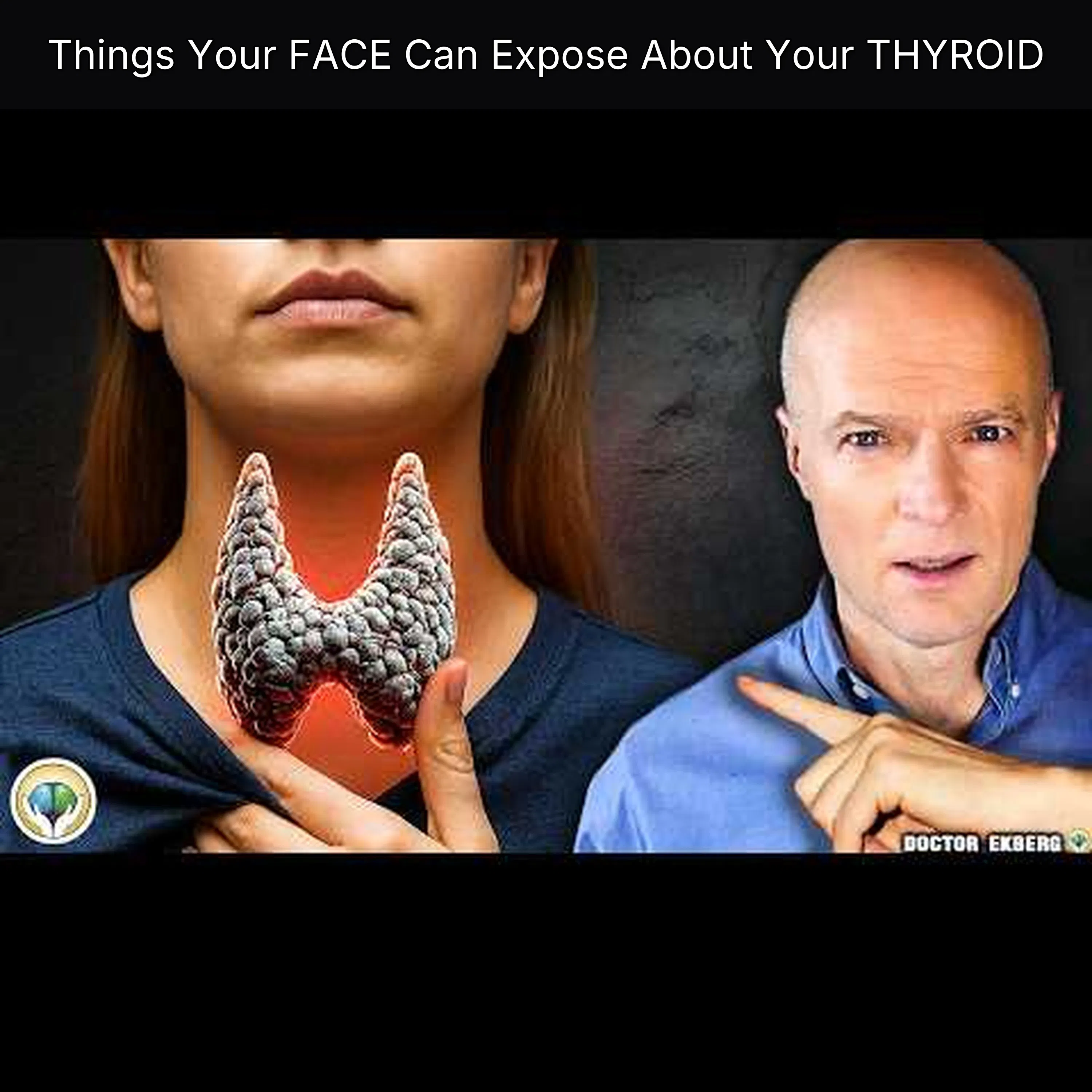
The transcription highlights how facial signs can indicate thyroid health long before standard symptoms or lab tests appear. Early indicators include loss of the outer third of eyebrows due to disrupted hair follicle cycles, puffy or swollen skin from fluid retention, pale or yellowish complexion from reduced circulation and beta-carotene conversion, dry or rough skin from slowed cell turnover, and a fuller neck from goiter (iodine deficiency). Droopy eyelids, bags under the eyes, and dull facial expressions reflect decreased muscle tone and nerve impulse speed. The thyroid, a small butterfly-shaped organ, regulates every cell’s activity through hormones T4 and T3, affecting metabolism, heart rate, and digestion. Common blood tests only measure TSH, which is insensitive and fails to detect autoimmune Hashimoto’s thyroiditis—the primary cause of hypothyroidism in developed nations. Comprehensive testing should include T4, T3, and antibodies (TPO and TG). Iodine is beneficial only for deficiency-related goiter; in Hashimoto’s, it can aggravate autoimmunity. Historical treatments like Royal Lee’s Thytrofen PMG use protomorphogen extracts to calm immune overreaction, a concept now modernized as peptide bioregulation. These insights emphasize early detection and targeted support for thyroid health.
Your body and especially your face often gives your critical clues about your health. But what do these signs mean? And are you going to catch them or miss them? Hello, health champions. Today we're going to talk about what your face can tell you about your thyroid. And these thyroid changes, they don't happen very quickly. They're not dramatic in the beginning. They're very subtle, they develop over a period of years or even decades, and your very own face is one of the first places that can tell you about these changes. Long before you see any of the classic signs like fatigue or weight gain that most people associate slow thyroid function with. And also, long before any of the standard lab tests will tell you, because the only thing they normally tests for for the thyroid is TSH, which isn't even a thyroid test, which we'll talk more about. One of the first things that can show up on your face are its eyebrow changes. If you start losing that outer third of the eyebrow, that could be a slow thyroid because the T3, the active form of thyroid hormone, influences the cycle of that hair follicle. And with low thyroid function, then that hair follicle goes into resting phase too early. And the reason it starts affecting the outer third is that it has less blood circulation in the outer third than toward the middle. And the thyroid affects every cell in your body. Even though it's very small, it's a tiny butterfly shaped organ. It sits right around your Adam's apples. If you find that little bony point, even though it's called an Adam's apple, women also have it, but it's less prominent. And you have basically like the four wings of a butterfly on the top and the bottom on the sides of that. And you can feel a very slight puffiness to it. And then you're feeling that thyroid. And it is only about half an ounce or 14 to 15 grams on average. But yet, it influences every cell. We have 40 trillion cells in the body. And every single one of them have receptors for that thyroid hormones. The thyroid influences the function. And like I often talk about, every cell in your body does something specific. Every cell has a purpose. We don't keep cells around for no good reason. And the thyroid and these receptors, they are going to tell that cell how much to do of whatever that cell is supposed to do. So the quantity and the rate of activities determined by the thyroid. And it's sort of like the accelerator or the gas pedal if you will for every cell in the body. So some examples of what it will affect are your skin, your heart rate, your muscle tone. So a slow thyroid is going to slow the heart rate. It's going to reduce the muscle tone. It's going to reduce the circulation. It's going to reduce the metabolism. How much energy that you make? How many calories you burn if you will. And it will even affect the speed of your digestion. So if you have a hyper thyroid, if you have an overactive thyroid, then basically all of these things are going to increase. And if you have an underactive thyroid, then all of these are going to slow down. Now I want to show you something real quick. It's called Harrowers Chart. And it was about 100 years ago. He was one of the early endocrinologists to study hormones. And it's not for you to memorize any of this, but just to emphasize the importance of the thyroid. So all of these different organs and body systems, they affect each other. They talk to each other. If there's a line here, there's a direct relationship, a direct communication link. And this is a very simplified chart. It gets way, way more complicated and involved. But the point is, Harrowers put the thyroid in the middle because it's at the core. It's such a critical importance to this whole system that everything pretty much depends on the thyroid. The second thing you can see is a puffy or swollen face. And this is often referred to as Mixed Adema. That's the medical term. And it's a very classic sign of hypothyroid. What you're going to see then is a puffy, doughy, and swollen appearance of the skin. And the reason is that with a low thyroid function and less circulation, the skin is going to hold on to fluid more than normal. And as a result, you get this puffy appearance, especially around the eyes and the cheeks. The third sign is if you have pale skin. And this would be pale or yellowish. The pale is more so because of a slower blood flow. And the hardest place to get blood is to the periphery. The furthest away from the heart, which is hands and feet. That's why they often get cold with hypothyroid. But also the head and the face is further from the heart. And it also has to work against gravity. So when circulation and heart rates and heart pumping slows down, very often will end up with a pale washed out look. Now if we get more of a yellowish look, that could be because a slow thyroid also lowers the conversion of the beta-carotene into vitamin A. And beta-carotene is also called pre-vitamin A. Carotene is what gives carats their color. So that orangey color gets converted into vitamin A. But if we have a slow thyroid and we do less of that, now of course that beta-carotene can start building up and accumulating and creating a little yellowish coloring. And this would happen especially as a tint around the nose and the mouth. Sign up before is dry or rough skin. So of course when the thyroid slows down, like we said, everything slows down including the turnover of the skin cells. We also have a slowdown of the oil production. So as a result now we get a drier, flakier, and more leathery skin appearance. And this would be especially around the cheeks and on the forehead. Sign number five is a change in the jawline. So if you have usually kind of prominent cheekbones but the neck starts filling out, get a fullness around the front of it, then that could be a thyroid problem called a goiter. And this is a little different and we'll talk about why and we'll clarify that as we go through this video. The goiter is an enlarged thyroid that is caused by iodine deficiency. So the thyroid uses iodine to make thyroid hormone. But if we don't have enough iodine, then the thyroid is going to try to compensate by getting bigger and it can get huge and get many, many times bigger. So in some cases it sort of fills out the whole front of the neck. In some cases it just gets a little bit more puffy and enlarged. And this is one we really want to understand, not just observe, we'll understand the mechanism because goiter and iodine deficiency is the number one reason for hypothyroid worldwide. And this happens in countries where they don't add iodine to the table salt or where the soil is naturally very poor in iodine. But we need to talk about and understand iodine a little bit extra also because if you do a search, if you ask for advice on a thyroid, what do I do to support my thyroid, 95% of that advice is going to be to take iodine. And there are two scenarios here and you never know if it's going to be right for you if you don't understand this. If you have a goiter, if your thyroid is enlarged because of iodine deficiency and especially if you also get your blood test back with a high TSH, that means that the pituitary is screaming because the thyroid is underperforming and the thyroid is trying to do more work and it's growing. Now iodine is the perfect thing for you. It's exactly what you need. However, if your thyroid underperforming because of an autoimmune condition called Hashimoto's, then iodine could actually get you worse and when you talk about this, so you fully understand it. Now rather than the one marker they test for called TSH, there are five markers minimally that you want to get to understand what's going on. But first we need to understand how does the thyroid work, otherwise you won't understand those markers. So it all starts with the hypothalamus and the pituitary. This is up in the brain. The hypothalamus senses if we need something, it senses
a signal to the pituitary and the pituitary releases TSH, thyroid stimulating hormone. And this goes down to the thyroid, which listens to the pituitary, the pituitary is like the boss, it says go do some work. The thyroid starts making T4, which is the raw material. It's the thyroid hormone, but it's not the most active form. And now this thyroid hormone goes into circulation and it makes its way at some point through the liver and the gut. And here the liver and the gut have the capability of activating it, of turning this T4 into T3. So even though we have a whole lot more, like a hundred times more, T4 than we do T3, the vast majority of activity lies with the T3. So when it's activated, it's going to do a whole lot more. And then when we have enough of this T4, now that floats back in the bloodstream and the hypothalamus senses how much of this hormone we have, so it slows down on the production of TSH or the signal to the pituitary to make TSH. And here are some of the big problems with only testing TSH. First of all, TSH is not very sensitive. It doesn't catch a lot of early cases. Part of that is because it doesn't pick up on everything. Part of it is because the range is so wide. The normal lab range is from 0.45 to 4.5. If you're within this range, you are not going to get a flag. You're going to be considered normal. And then after you get over 4.5, if your thyroid is underperforming, your pituitary is going to increase the TSH to ask for more until it gets over 4.5. And now they diagnose you. They consider you hypothyroid and they prescribe centroid, which is a synthetic version of T4. So you're just simply replacing the hormone that your thyroid is no longer making. And that wouldn't be a terrible idea. And sometimes it is very appropriate and necessary, however, here's what we need to understand. More than 90% of hypothyroid function cases in the developed world is autoimmune. It is Hashimoto's thyroiditis. And now if we simply replace the hormone that isn't made, then we're ignoring the whole autoimmune aspect of this. And TSH not only does it miss a lot of subtle cases, it also won't tell us anything of whether this is autoimmune or not. So we need to understand that the autoimmunity is a disease process that is breaking down the thyroid. And if we simply ignore the disease process and we just replace the hormone, now we're allowing that autoimmunity to continue. Whatever those factors were that created the autoimmunity and the underperforming thyroid, they're still there and they're allowed to continue and possibly get worse. And if we allow them to get worse, now that autoimmunity can get spread, can get aggravated and start affecting other body systems as well. So at the very minimum, we want to test five markers. TSH is still a very useful marker, but in addition to that, we want to test total T4, total T3. And we want to test some antibodies, some autoimmune markers called TPO and TG. So TPO is an enzyme called thyroid peroxidase. We want to test for the antibodies against that. TPO Globulin is a protein that sort of holds on to the thyroid hormone and we want to measure that the antibodies against that. But now remember, I talked about iodine, that when is iodine appropriate? Well, if you have an iodine deficiency, if your thyroid is enlarged and your TSH is very high, then it's safe to say, not 100%, but very, very high likelihood that you need iodine. And I would recommend natural sources like kelp or seaweed if you can get it, but they're not the only ones that will help. However, if you take iodine when you have an autoimmune condition, now what's going to happen is this iodine is going to be a raw material for this TPO enzyme to increase the activity of your thyroid. You're going to get more TPO, you're going to get more thyroid globulin and there's going to be more exposure to the immune system. There's a strong likelihood that you're going to aggravate your Hashimoto's thyroiditis. You're going to increase that autoimmune condition. So that's why I recommend you get these markers and every blood test that we run are going to have these antibodies on it. And that's going to give you a very good understanding. Now, if you find some problems here, now there are additional tests that you can get, but these five will serve as a really good baseline. But they're still not all you want to test because there are other things that can affect the thyroid as well. So I would recommend that at first, at least, you run a complete metabolic baseline. So you get your metabolic factors, your blood sugar, your insulin. So you get some inflammation markers like reactive, c-reactive protein. And you also get a cholesterol panel that measures your particle size because those are indirect markers of inflammation and heart disease risk. And now you can look at the whole picture and see what is going on with the thyroid and what other factors are influencing that whole system. So I made a blood work course, I'll put a link down below where you can check it out and you can start understanding much more about that. But a lot of people also like to have someone to talk to. So we have some staff at my clinic that will guide you through that if you like. It's like an educational consult where you can start understanding your situation better. But let's get back to the guy behind this chart, Henry R. Harrower. He's known as the father of functional endocrinology and he was a strong proponent about something called organotherapy. And this was over a hundred years ago. He did most of his work in the early 1900s. And organotherapy is a principle that was known already to the ancient Greeks. And they called it similebous, which simply means that you take something similar for the organ you're trying to treat. So if you're trying to treat your pituitary, then you eat a little bit of pituitary. And we're going to talk about why this could be a good idea. However, it was ridiculed by the contemporary endocrinologists. He had some success with patients, but he didn't gain much respect for his ideas. However, this was at the time of the infancy of nutrition science when they didn't even know what a vitamin was yet. But they were starting to figure these things out and how to support the body with nutrition. And one guy who latched onto this, who studied some of this and then built on it, was Royal Lee. He was the founder of Standard Process, which is one of the largest nutrition companies today and one of the few, if not the only one, that does whole food supplements, whole food concentrates. And he did something called a PMG. We're going to talk about more. And the product specifically for the thyroid that he developed was Thytrofen. And he did this about 100 years ago, and by 1940, in the 1940s, he had products for virtually every organ system and to directly support, but also other products in the hundreds to complement the picture. And what Royal Lee did, instead of simply taking and eating some pancreas or eating some thyroid, what he did was he created an extract that he called a proto-morphogen. And what this was that's different is that it's not the entire gland. It's not the whole tissue, but he went in specifically into each core, into the nucleus of the cell, and he took out some nucleoprotein extracts. And the way that these work is that they're like a unique ID tag. When you take portions of a protein, that's called a peptide, and it's like an ID tag that can be recognized specifically by
the immune system. So the immune system knows if this protein extract, if this fragment, comes from a pancreas, or a liver, or a kidney, or a thyroid. And the whole problem with autoimmunity is that it's your own immune system attacking your own tissues, which isn't a completely bad idea, but it's over reacting. So what's happening is your organs, your cells always have a certain turnover. Your cells are breaking down. They're spilling all their contents and your body is recycling that. Well, these ID markers, they have to be recycled by the immune system so that they're safely taken care of. It's part of a normal process. So you're supposed to have a tiny bit of autoimmune activity, if you will. But what happens with an autoimmune disease is when this gets out of hand and the immune system is overreacting. It's doing more than just picking up the trash and it's going after the organ itself. So what Royalee figured out was that if you ingest some of this PMG, some of this proto morphogen, and you have some of these ID tags in your gut, and they get out maybe a little bit in circulation, but mostly in the gut. Now your immune system is going to get, look at that like a decoy, and the immune system, part of the immune system is going to go after this PMG extract instead of the gland. So therefore, we're calming down that immune system. We're calming down that overreaction. And now, especially if we eat right and get some good sleep and put the body in a healing state, at the same time, now we can support the cellular repair process of that organ. And again, the product he specifically developed for the thyroid is called Thytrofen PMG, which is a good place to start. It may not be the only thing that you need to do. So again, you need some help to talk through this with somebody. I do have some people on my staff will do an educational consult, but this is a safe place to start. It's a food product. It's not an education. It has no hormone in it, so you're not going to do any damage. So, Harrower did his work around 1900s, and Royal Lee did most of his in the 30s and 40s. And what's happened today then? So, for about 60, 70, 80 years, not much has happened, but then today it has become popular again. And they're doing a lot of research on this in the medical field because they know now it works. But they're calling it different things. So they call it Immuno Organotherapy. They call it Immuno Modulation or Peptide Bio Regulation, or they've also called it Biologically Active Peptide. So, I don't know if you've noticed that there's a lot of peptide products out there, a lot of peptide supplements. So, the name has changed. They use new language, but it's the same idea as it was almost 100 years ago when Royal Lee refined this, that it's about a targeted, it's about providing the body, a targeted information for the immune system from the same type of tissue. And as usual, when the medical profession and the modern research picks up on something, they pretend that it's a new idea that they came up with it. And of course, there is little or no credit to Lee or Harrower. Sign number six is Drupi Eyelids. And this has to do with muscle tone, like I mentioned earlier. If the thyroid slows down, we're going to lower muscle tone. And one of the most sensitive areas is in the muscles that lift the eyebrow. That's specifically called levator palpabray superiores, which is just a medical name for the muscle that sits on the top and lifts the eyelid. And of course, this could then give you that tired look like your eyelid doesn't open all the way, even if you have gotten enough sleep or even if you're not really tired. Sign number seven is bags under the eyes. And when the thyroid slows down, so does circulation and lymph drainage. And now we get water retention. And again, the face and the eyes is a sensitive place so we can get that puffiness and bags under the eyes. The eighth thing you could see on your face would be dull or slowed facial expression. So again, muscle tone and transmission speed could be affected. So slower, nerve impulses and muscle response time. As a result, you could get flat or slower look. And with that, you could get less animated facial expressions and also less emotional expression. And then the last two, I want to cover are going to have to do with a hyper thyroid. Most of these signs are going to be about hypo. And it's because hypo is by far the most common. Now hyper thyroid, when it's overactive, it's the opposite with just about everything. It is still usually an autoimmune disease, but it's a completely different process. And the way you would know to go look for it and to order those antibody tests is if your TSH is very, very low, not just a little bit low, but it's starting to get close to zero. You get a result back and it's like zero point zero, something. Now that's the time to go order the antibodies for hyper thyroid or gravestis. So sign number nine would be a red or a flushed face. And if hypothyroid slows everything down, hyper thyroid speeds everything up, including blood flow and including body temperature. And as a result, more blood and you have a heat, now you get that flushed look. And number 10, if you get oily skin and acne and especially around the jawline, this could also be hyper thyroid. And what this is now, it's the opposite again. It's an overproduction of the oil glands and you would find it mostly around the jawline and you would get this greasy oily skin and you could also get some acne. If you enjoyed this video, you're going to love that one. And if you truly want to master health by understanding how the body really works, make sure you subscribe, hit that bell and turn on all the notifications so you never miss a life-saving video.
Podcast Summary
Key Points:
The face can reveal early signs of thyroid dysfunction, such as eyebrow thinning (outer third), puffy or swollen skin (myxedema), pale or yellowish complexion, dry or rough skin, changes in the jawline (goiter), droopy eyelids, bags under the eyes, and dull facial expression.
The thyroid gland, though small, influences every cell in the body via hormones (T4 and T3), affecting metabolism, heart rate, muscle tone, circulation, and digestion.
Standard lab tests often only measure TSH, which is insensitive and misses early or autoimmune cases; more comprehensive testing should include total T4, total T3, and antibodies (TPO and TG) to diagnose Hashimoto’s thyroiditis, which accounts for over 90% of hypothyroid cases in developed countries.
Iodine supplementation is beneficial for iodine-deficiency goiter but can worsen autoimmune Hashimoto’s by increasing thyroid activity and immune exposure.
Historical approaches like Harrower’s organotherapy and Royal Lee’s protomorphogen extracts (e.g., Thytrofen PMG) use tissue-specific peptides to modulate immune response, a concept now revived as peptide bioregulation.
Summary:
The transcription highlights how facial signs can indicate thyroid health long before standard symptoms or lab tests appear. Early indicators include loss of the outer third of eyebrows due to disrupted hair follicle cycles, puffy or swollen skin from fluid retention, pale or yellowish complexion from reduced circulation and beta-carotene conversion, dry or rough skin from slowed cell turnover, and a fuller neck from goiter (iodine deficiency). Droopy eyelids, bags under the eyes, and dull facial expressions reflect decreased muscle tone and nerve impulse speed.
The thyroid, a small butterfly-shaped organ, regulates every cell’s activity through hormones T4 and T3, affecting metabolism, heart rate, and digestion. Common blood tests only measure TSH, which is insensitive and fails to detect autoimmune Hashimoto’s thyroiditis—the primary cause of hypothyroidism in developed nations. Comprehensive testing should include T4, T3, and antibodies (TPO and TG).
Iodine is beneficial only for deficiency-related goiter; in Hashimoto’s, it can aggravate autoimmunity. Historical treatments like Royal Lee’s Thytrofen PMG use protomorphogen extracts to calm immune overreaction, a concept now modernized as peptide bioregulation. These insights emphasize early detection and targeted support for thyroid health.
FAQs
Early signs include losing the outer third of your eyebrows, a puffy or swollen face (myxedema), pale or yellowish skin, dry or rough skin, changes in the jawline from a goiter, droopy eyelids, bags under the eyes, and dull facial expressions.
Low thyroid function reduces T3 hormone, which influences hair follicle cycles. The outer third of the eyebrow has less blood circulation, so hair follicles enter a resting phase too early, causing hair loss.
A goiter is an enlarged thyroid gland, often caused by iodine deficiency. The thyroid tries to compensate by growing larger, which can lead to fullness or puffiness in the front of the neck.
If the slow thyroid is due to an autoimmune condition like Hashimoto's, iodine can aggravate the autoimmune response by increasing thyroid activity and exposing more tissue to the immune system, potentially worsening the condition.
The five key markers are TSH, total T4, total T3, and antibodies TPO (thyroid peroxidase) and TG (thyroglobulin). These provide a fuller picture of thyroid function and autoimmunity.
Facial changes like eyebrow thinning, puffiness, or pale skin can appear years before classic symptoms like fatigue or weight gain, and before TSH levels fall outside the normal lab range (0.45–4.5).
Chat with AI
Loading...
Pro features
Go deeper with this episode
Unlock creator-grade tools that turn any transcript into show notes and subtitle files.
 PodcastTranscript AI