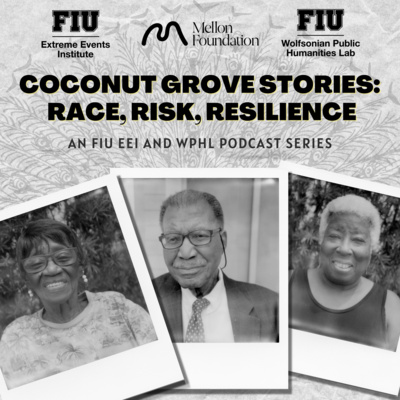
This oral history interview, part of the FIU CFJ Project, captures the experiences of two elderly Black women, Dr. Simons Brown and Alma Anderson Gibson, who have lived in Coconut Grove, Florida, for nearly a century. They describe a childhood in a tightly-knit, segregated community centered on Charles Avenue, where everyone knew each other and families like their own were supported by neighbors. Both attended segregated schools and faced racial barriers in higher education and employment. Mrs. Gibson recounts her nursing career, including being denied work in the operating room at Jackson Memorial Hospital due to her race and being forced to take classes off-campus from the University of Miami. She later earned a bachelor’s degree at Columbia University. Mrs. Brown highlights her unwavering love for Coconut Grove, calling it her permanent home. They reflect on the dramatic changes in the neighborhood: from segregation, where Black and white residents lived separately and Black children were told to "go home" by police, to today’s integration, where people of all races freely walk the streets. However, they lament the loss of community intimacy, replaced by large homes and fences that isolate neighbors. Despite these shifts, both women express gratitude for progress and urge younger generations to seize educational opportunities they never had.
[ Music ] >> Good morning. This interview has been conducted for the FIU CFJ Project. The interviewer is me, my key of Brown. I'm a resident of Coconut Grove, and also I work with Hope Through Art, LLC. [ Silence ] >> My name is Natalie Guevara. I am a recently graduated FIU graduate student. I'm a ITMATHA CROLE doctoral student in the Department of Global Social Cultural Studies at Florida International University. >> The narrators with us today is >> The Dr. Simons Brown. >> The Alma Anderson Gibson. >> The interview is taking place at Christ E. Piscoeville Church in Miami, Florida on May 30, 2022. >> So to open up, I want to actually ladies, Mrs. Brown and Mrs. Gibson, tell me about your life here in Coconut Grove. >> Well, I think I should start since I'm the oldest friend, Vika. Mrs. Brown was born twin. I'm Tell Amanda Simons Gibson boy here in Coconut Grove on December 17, 1926. And I was baptized in this church on March 20, 1927, when I was three months old. So I'm a true native, the live abominant wife. And so my neighbor's bringing us right here in Coconut Grove. And I think I have a passion for Coconut Grove. And I don't say I'm from Miami. I've always been from Coconut Grove. And I grew up here. And all of my young life was spent on Charles Avenue, 3382 Charles Avenue. And I stayed there until I was an adult. When I went to nursing school, came back and stayed there while I worked. And finally moved. And the veterans had some houses built in Richmond Heights just for veterans. And my uncle and my law had bought one of those houses. And he came to me and he said, "Though I've got a house in Richmond Heights, in Richmond Heights, too far." And I could give it to you if you pay $300 down. And the only out to pay $29 a month. And so in 1950, it's the first time I really left Coconut Grove to live somewhere else, other than when I went to school. And so it's been a ride for me. I remember when my mom was born, we were so excited. Because the first twins that we knew about, she and her brother were born. And they lived right down the street from us at that time. On Charles Avenue, the mother did. And so it's exciting to be doing this interview today with Mrs. Brown as the other person doing this because we have both Coconut Grove Heights. Now, I went to call or Coconut Grove Elementary School for training, training for color. This was called a town back in the day. And we had color town and white town. And I was brought up in Coconut Grove, call it town. And went to Colton Grove, when it was Coconut Grove Elementary for training school for color. And that was the name of the school at that time. So all of my elementary school years were spent there. And then it was finally changed. And when I was in high school, took to a Washington Carver high school. But it was Brown. I was Brown, I'll tell you, she went to Booker T. Washington, which is a different thing from one of the school in Coconut Grove. So I finished when I was 17 and went to St. Agnes School to nursing in Raleigh, in Raleigh, Carolina to do my nurse's training. And fortunately, they had Uncle Sam, it started the United States, Cadet Core. And I was fortunate enough to become a cadet nurse. And a couple of weeks ago, a picture came out of me on the page in the paper. I saw it when I was 19 years old when I took this picture in this uniform that they had given us. They gave us a beautiful uniform and I came home only one time. And those three years, that's been Raleigh. And I took that picture. And that picture is circulated all over the place of his kayak, did a podcast as you're doing it. Apparently, someone from that group gave that picture to the Mime of Times. And when I saw it, I said, "Oh my God, they showed me when I was just 18 or 19 years old in the cadet nurse uniform." And so my life has been one of trying to do whatever I could for the community. And I guess you've heard enough about me right now because you probably have questions about other things that I've been involved with. But I let Ms. Brown now tell her story. Oh, I'm Federico Brown and I have lived in Cote, New York all of my life. There are more and I have similar backgrounds. We choose to stay here. I think we're some of the only people that wanted to remain in Cote, New York all our lives. My family asked me, "Separate times, why don't you choose to stay in the grow? Why don't you move out?" And I don't know. It's just like planning a tree. When you plant the tree, you see it grow up and it remains there until the end. And that's how I feel about Cote, New York. So, and I have similar background. We both lived on Charles Avenue. At that time, it was the most popular street in the grow. Everything happened on Charles Avenue, not that I was born on Charles Avenue and it was famous. It was just a popular street for us. We were a small community. Everyone was like a big happy family. Most of us were left alone because our parents had to work and I had two neighbors. I tell my grandchildren all the time. I had two neighbors with me. They were my so-great-grandparents. Josephine Walker and Miss Ellen Sturham. My mother went to work. Those two ladies took care of us. Like we were their grandchildren. And all of the families in Cote, New York growing up as a child, they had an interest in all of us. We couldn't get any trouble, into any trouble because they knew it before we went on. And I said, "Talk, how did they know that already?" And how they communicated, I don't know because there were no telephones, no cell phones at that time. So they just had connections, I guess. And as Thelma said, this part of the grow, which is known as the end of the grow, was connected with, we call the white grow, which is not called Coco Walk and whatever have you on main highway. So we had an easy way to get to white grow if we choose to do so. And as Thelma has said before, and I don't want to repeat what she said, it's because we just have similar backgrounds living in the grow as children. One thing I can say about the grow, and I tell my grandchildren, please, if you just remain here, you'll find out that it's centrally located. You can get from point A to point B. When my friends visit me coming from other places, and I pick them up from the airport, they said, "Gee, you got it fast." I say, "Well, I don't want to do it far from the airport." It's right down the street. They can't believe it. And when I'm going to other places, I get that fast, I say, "How did you get it so fast?" I live centrally, and I got it fast. And I really think that's why most people are trying to move in the grow because they found out that it is centrally located. Believe me, it is. As the M.I. said, we all attend it, said to get it schools. But it was a learning experience for me, and I tried to pass it on to my grandchildren to know that everyone is human. We all have for a purpose and a reason. And maybe that was our reason so that we can be connected with each other. I enjoyed my day, as you see, I'm still here. They can't move me with a bulldozer. And I loved the girl I met the carver, as Delmer has said, and it was the colored school then. Fortunately, my brother and my sister, there were three of us that attended Booker T. Washington. High school, we graduated from that school. And at that time, Booker T. was the well-known black school. I love the girl, and I won't give it up as you know. I've been in '90s some years, and my grandchildren try. You still want to live it? Yes, until I passed away from this earth. And they know that the girl is my home. Okay. How has your community?
community evolved or changed over the years? We've had so many changes. I think I need to go back and just let you know that this section was founded by the Hameans who came here and dug out this area. And Charles Avenue used to be named Evangelist Street because the first three churches, color the churches were founded on Evangelist Street first, Macedonia Baptist Church and Second St. Paul A. M. E. Church. And third was Christy Piscopal Church. And all three of them were in the one block with 33-year-old Neblocke of Charles Avenue. Evangelist Street at that time. And then it was finally changed to Charles Avenue because the fro family brought up most to the land around here. And the Mr. Frode decided that Franklin and Charles and William were named after his sons and the names of those three seats could never be changed by any municipality. And so we were in this area founded in 1876. Where the city of Miami was not founded until 1896. And so I always have people know. And so, when I go, it's very special. And as I said earlier, in 1950, I had the opportunity to live in Richmond Heights. But when I got married in 1967, I came back to Coventon Grove. And so I have been here back as a resident since 1967 and reside on Franklin Avenue. And we'll never live anywhere else. And at the bachelor's side of nursing, I ended up -- I have a story always to tell about something in my life because I wanted to go to the University of Miami. And they told me at that time if I found 12 students and came back, they will give us an instructor and he could teach us at another campus because we couldn't go on the University of Miami campus. It was 1955. And so there was a young man who was a driver's -- a driver's education person who knew a lot of people. And he was wanting to go to University of Miami. And right now, I'm not recalling his name, but he found these students and they gave us an instructor. And he taught us in his home for the first semester, the English 101. And for the second semester, we had another instructor who took us all the way over to Booker D. Waston High School where they gave him a classroom, the teacher's class. So I never was able to go to the University of Miami to school. But this young man went and he was one of the first colored people to get a degree from University of Miami in 1961. >> Well, not to cut you off. Was his name Roy Berry by any chance? >> He was from the Liberty City area. >> Yes, he was. >> He'll come to me. >> Because I met one and his name was Roy Berry. >> All right. I see the name wouldn't come to me right off. But I remember very well that he was the one who got the students together for us. And so it's an amazing dream. >> He gave sports, correct? >> Oh, yes. >> As well as -- >> Yes, that's what it is. Roy Berry, yes. >> Okay, yes. So this is what happened. And then when I got to nursing school, I had specialized training, Operator Room Technique, and I wrote to Jackson Hospital. This is 1947, young people. And I wrote to Jackson and said, I had graduated from -- I graduated, I was coming home in August, and I wanted a job in Operator Room. And they sent me the data saying that I was being accepted. So I got here. And August of 1947, I went to Jackson and said, I'm Del Mann, and I'm a graduate nurse. And I'm coming here to work in Operator Room. They took one look at me and said, uh, uh, uh, uh, uh, uh, uh, dirt and so on. You can't work in the Operator Room. But if you work on the Colet floors and get someone who experienced maybe one day, you'll be able to work in the Operator Room. Well, I decided I wouldn't do that. I wasn't about to do that. So I woke up in the morning and I was like, I'm going to work in the Operator Room. So I took my little can up to get on the bus and go to -- good now I'm going to get on a train at those days so I could be the bus and went up to my spawn beach. And I went to the St. Mary's Hospital. And again, like Jackson, they said, oh no, I'm sorry. We don't have any Colet's working in the Operator Room. I saw at least you honest about it. Thank you so much. I came back home and I'm a sick girl. You got to work. You either go to Jackson or Christian. Well, Christian was a small hospital and I didn't want to be in no small hospital. I wanted to be in the big hospital. So I went to work at Jackson in 1947. And really I enjoyed it. I really had a ball. I really -- you know, I don't know where I got it from, God knows. I don't know where it came from. But I was one of these who's terming to be Miss Anderson because I say when I was in nursing school, when I turned 18, they called us Miss and they told -- we had to call a lot patient, Missed and Missed. And that's what I was going to do here. So all the Colet nurses who were there decided, girl, you're going to get fired because you are a nurse. I don't want to be called a nurse. I said, "I don't call the white nurses a nurse." They called them Miss and Misses. The white should -- they call us nurse when they call the white nurses Miss and Misses. So when young men, I had three young men who used to come from Book of Dew Austin High School and they used to come and I said, "Look, we're going to respect our patients. Everybody's going to be Missed and Missed and Missed and Missed Anderson. I'm not nurse Anderson." So they had a -- oh, they had a good time. I wasn't -- one of them became a doctor. I'm like, "McKinney." "McKinney." "McKinney." "McKinney." "McKinney." "McKinney." There were three of them, but I remember all their names. But they said, "We like to be here when you're here because you make us do things right." And they were coming from Book of Dew Austin High School. His high school students working took me earn money at the school and they really enjoyed. And I enjoyed the time I was there and I left in 1949. And you have to know Jackson used to be the city hospital. It was the city hospital until 1949. And in 1949, the county took over. I left. It went and worked a year at EJ Hall's clinic, which was a clinic downtown Miami. And I stayed at the year. And then the next year I said, "Oh, I'll go to Washington. I'm going to North." I don't know. I really thought I was going to North, going to Washington. You don't. People may not realize this. Washington is not up north. Washington is still in the south. I get to Washington. I couldn't work in operating room in Washington. So I stayed up there one year and worked in emergency room. And I came back and went back to Jackson in 1951 and stayed until 1955. And it wasn't until I was ready to leave there that the laws changed and they were able to call a nurse's miss and miss his. And I'd never self-aggress and direct a nurse who said to me, "Well, you got your wish before you're leaving us." I said, "Well, I didn't do it. The government did it." I said, "It took the government to change this culture." And so this is how it happened. So I never worked in operating room. And since that time, you know, I left in 1951 to the out-to-pop. And I worked in the out-to-pop. And then is when I'd after when to do a nurse to my, I couldn't go there, but anything except a way out somewhere. So I decided to add some land down and goose and I saw. And I went to teach the scholars at Columbia University just to get the bachelor's science and the nurse. And so I went to New York in 1959. And then I came back out. My work time was up there with teenage drug addicts, a little hospital in the Bronx call room aside where they caught, sent all the addicts off a treatment. And so that was a nice experience. And while I was going to school, I was working. They needed a registered nurse at night. So I was able to work at night and still get my classes to in the day. So when I came back home in 1963 and went back to the out-to-pop. And then I got married in 1967 and I left the out-to-pop and went to work at Mount Sinai Hospital and was the supervisor of the outpatient clinic at Mount Sinai. Then I quit work in 1980. And since that time I've just been involved with the community. My husband died in 1982 and I started to give some a moral fun. And the rest is history. The rest is history. So I think I've said enough. His proudest point of add or experience to this. OK, I think the question was about the changes that have been made in the grow. next you know.
As you know, we were segregated then, as Thelma has said, the colored people lived on this side, and the white people lived on that side and behind me. And we really, as a child growing up, and I told my children, we had our limitations where we can go as colored children. We couldn't go on this side. They can go over on our side and play with us, but we couldn't go over on this side to play with them. So we were really segregated. I said that to say, how segregated we were as children and as people. So, in growing up, in this little area, we found ways that we can make ourselves comfortable. We had families that cared for us as children and gave us things that we needed, not that we wanted as these young people, that we needed as children. And I was telling my children to see the big change now. I'm glad I live to see the change, because on my street, I live on Franklin Avenue. I would never see and thought I would never see when the other people which were caught white walked down the street, free as a bird, with their dogs, with their children, and everything, and even living in the grove among us. We were just segregated, but I'm happy that God saved me to see the changes, to see that we are all regardless of our skin color. We are all human beings, made and created by God. And so this is a big change for me. When I see that, we had single family homes, and I look around and I say, wow, another big structure going up. Everything is two family homes, separation by strawberry. We knew our neighbors, and I said all this, they said this, we were kind, we spoke to each other, we knew each other, we had a feeling for each other. But now I can't, I don't even know my next door neighbors, because they got a big strawberry tree here, to divide us, I guess, but why I live in a neighborhood if you don't want to know your neighbors? And I really have seen a big change, and I mentioned to my grandchildren every day, I never thought I would live to see what is going on and quote, "No, grow on this side, color town," as it was called, happening now, where other people can walk down the street, with their dogs, their children, and I don't think they're being attacked. And after a child, we used to stand on the corner, I told my grandchildren, 'cause they didn't have no treat like to us on this side, and sent James right here, and Charles being the main street, they had a treat like, so we would stand on the corner of a group of us, this is how we socialize, things are different. And the white policeman, because we didn't have any black skin policeman at that time, and they would tell us, "Niggas, go home." We would say, "Well, we're already home." Well, going to your house, not doing anything, just socializing, and thanks to Mr. Robert Dunn, he opened up DoDrop N, which was a serving pharmacy for the community entertainment for the black children, and that's where we had to socialize. We were limited, but we made it through the help of God. And Thoma has mentioned many things about her school, and its segregation, and what have you. We couldn't go to any of the white schools. We had to go either out of Florida, to most of my friends went to San Olson, Augustine, to his grandma said that she went, "And thank God for family, Florida, "so that they had a school for children, "so they opened up for black children, "and so they opened up for you, university." And that's where we went, and thank God for Mary McLeod, but Thun, who saw the necessity for her people, and the children to receive a higher education, and she opened up a Thuncupman College, and that's where I went. So it was real segregated, and I turned my turn, y'all have so much opportunity. You don't need to go out of town. You can stay right here, it's open to you. Take advantage of you of it, because I couldn't. So I have seen a lot of changes. - Okay, and so now we're going to go ahead and allow Natalie and Arti. To go ahead and ask some questions that they have. - For you both. - All right, I'm gonna start it off by asking, what are some of the major disasters or crisis events that your community has experienced? - What is? - Let me repeat again. What are some of the major disasters or crises that your community has experienced? - Okay, as you said, hurricanes was one of the disasters. I remember boarding up several times for hurricanes, and fortunately, our houses were well built with the pine wood so they didn't fall apart, I'd come down, and now everything has changed. We have the type of protection for hurricanes, not in fact, windows and what I have you. So I have really been through some hurricanes, and thank God we were all saved and still alive. So that was one of the disasters. The other disaster, as I said, and I tell my grandchildren, was not being free to eat in restaurants or to protect of anything that was in the other section of time. But we survived and we made it. - Oh, you want me to, oh, I'm sorry. (laughing) You know, it's amazing when you talk about hurricanes, because we as children, you just enjoy the fact that we had hurricanes, because all the fruit would be on the ground, and we would find ourselves going down the street, picking up mangoes or lemon lines, off the trees or apocotapyrs or whatever was on the ground. And when the winds came, we were all excited, because our houses were built off the ground, and they said the wind went under the house, rather than through the house. And so even though we boarded up our windows and had everything protected, we were also excited about going around after the hurricanes. But in this area, it's amazing how we never had the destruction like they had in so many other areas when they had hurricanes. And it was because the way the houses were built. And it's amazing to think that it's called it children. You know, we couldn't really call it what a fountains and call it bathrooms and white bathrooms and white water fountain, all that all get aware. And so we were at a time after hurricanes, they're as bad as we are. They can't do anything and go anywhere. And so we were used to some of us having to go to the outside, privy and all that kind of stuff. So I was at an exciting time. And we tried to stay up to see the winds. It's an, you know, it's just amazing when I think today of how when the hurricanes are coming, and once I go to bed, I don't worry about what's going on outside, but when I was a child, I know it was so exciting because I knew afterwards that what we were going to be able to go out and find around the neighborhood and the soya's who lived just down the street from us at the guava tree and the lime tree that was on right on the street and the lines were all being there. And then we had almonds. And you know, today, you have almond trees and these children don't know what almonds are. We used to be able to open the almonds and go get the nuts out of the middle of them. And it was just an exciting thing for me to be around after the hurricane. Today is a little bit different. The hurricane that we had, oh, that was the real bad one that really tore up the south in the county where so many homes were lost. And so many people had their roofs, their roofs repaired and that sort of thing. So, unfortunately, we had, at that time, a congressperson, I was seeing your bullet was on the streets getting people to bring in food and water and things to supply the family.
with the things that they needed in the South end. They couldn't get in the stores because the stores were all closed at that time. So after her gains, the community got together and had these food drives and everything going on to help the people survive. And the government came through and they were able to rebuild a lot of homes. Some people sold out and left the area completely, but others stayed in the area. So a question I have for you both is you mentioned a little bit about how the community came together after the hurricane and helped each other and get through the disaster. So now seeing the way things are and how things have changed, what do you see as the threats to your community today? Well you know it's a pretty much the same. We still have people who come together and we can be happy from other areas now who come in. And almost every week they bring food and everything to this church to give out. And it's amazing when we're sitting here on Sunday after church. You see people bringing in different items all during the Sunday's after service and all the churches, Plumas churches especially. Plumas has been very good at helping to supply the area with stuff. So that whenever something happens, it seems that the community had with churches and that people in all get together and decide. And you know it has changed so much because now this is we on Franklin Avenue, I call it Millionaires Road, the houses are now selling for a million five on Franklin Avenue. And we were all built these allowances. It's valued at three or four hundred thousand dollars and now they are up to almost a million dollars. So where we live, it's really has changed to a point where there are very few blacks still living in the area. But I also have to tell you that we were called, called it up until 1970s. And in 1970 the young people decided that we were black and black is beautiful. We came to the slowest everywhere. And we were so excited about black is beautiful. And I say when I was coming up black was a cause for it. My brothers look at me and they say, "Are you black fool?" And I say, "Yeah, you're red fool and we call one a black fool." And so it was just amazing when for this ten year period from 1970 to 1980 we were black. And then in 1980 another group decided we were African Americans. And so we went from being called it or Negro to black and then African American. And so the Afro American is the thing that saw the start through the years now. But I always say I just like to be a good American. I'm still just an old American girl born and going to grow. So that's the way I look at it. But I have always been a black woman or an African American woman or whatever you want to call me. But it's just amazing how things do change over time. The communities have been able to stay together and bring in to help one another. And to add to what she said, "During hurricanes all our neighbors will be concerned about each other whether we want our windows forwarded up or any little thing that they can do to help us survive." And I noticed when the stores were closed, I had one neighbor that went all the way to Fort Lauderdale. But she came back, I mean she came across and asked me, "Did I need any ice or anything like that?" And I told her, "Yes, I need a bag of ice because ice was melting." And she brought me two bags of ice. So why I am saying this is because everyone helped each other. To follow up from that, you said the community helped each other as in the neighbors and everything. What do you think would also help to protect your community from any further threats now? For the threats? Yes. As a shark and disaster is the thing. Exactly, yes. Well as I have said, I don't know if I'm telling you, I really don't know my neighbors. That's one big change in the grow. I would offer help if they would receive it, but we don't even speak to each other. I don't know them, they don't know me. You know, they move in the neighborhood. So I don't know. Fortunately we haven't had anything like that so we can expand on what would happen. I don't know because we're not helping each other now. So I really couldn't say what would be the outcome of what if a disaster should happen with the neighbors be helpful or what they be selfish or I really couldn't answer that. We still know the blacks of African Americans and I know a block that we live in. But because of what has happened, whites have moved into the area and they're on their own. We have one neighbor who rides a motorcycle and have a car and they just get up and the people in the rooming house across the street and they never speak. So you never get to know who they are. So it wasn't for the liensies who live across the street of Mr. Woods and his self-proud Gibson and Gibson, which is Charles McGrathson. The six houses right there and then the one on the corner of the only black families living there now. There's another black family and one of the Simpson houses but they don't tell. They don't speak and they don't say anything. They just get in their cars and away they go or if they're walking in the street. Now we just have to take them morning to everybody as we walk the street every within the morning or get afternoon if you're on your way back but they don't do that today and so there's no neighborliness as far as what we've got we were used to in coming up. But again things have changed because you have all these gadgets that we never had. I tell people all the time, I look at that iPad, I get a lot of stuff on it, I get something from everybody from everywhere but I don't answer because I don't know how to type, I don't know how to do all that, and I don't want to learn. That's the sad part of it is I don't want to learn. But it's just one of those things that's exciting to see the way things have changed and what's happening in a community that you like to call your own. I think I own this community because all my life was spent on Charles Avenue. My grandparents lived on Grand Avenue so I got a chance to go over there and spend some time but basically it was all right around Charles Avenue. So just considering how things are changing, how do you see a possibility? It seems like neighborliness is something that's now missing in the community and is there in your opinion a way to break people together as the neighborhood is changing? Well, like I said, I am observing, I'm still observing and comparing and I know that the neighborhood is not a neighborhood anymore. I don't know what you call it but we are experiencing segregation and that's what I call it because we were neighbors and we were like family. So you mentioned Goomba, this brings out the behavior culture of those behaviors that lived here and I don't know how this one is going to turn out. I keep teasing her about it. It's not the same anymore. You know, everything is money making. You know what I mean about that and it really was supposed to bring the culture together, the people together. But as Samma said, we're living the same era next door neighbors. We don't even see our neighbors anymore. Getting their cars like she has said and I don't want to repeat and that's how we live. I'm not used to living like that and I'm sorry it's really happening in the grow. We have one big family, one big community loving and helping each other and you talking about change. I don't even know my neighbors next door. Like I said, they don't beat you. You say good evening. They turn in and we grew up. We're saying, "Hi Miss Molly, everything alright? Hi Mr. Brown, you need any help?" That has gone forever. In fact, they don't even say hello. They don't even ask me, "Well who's your next door neighbor?" I don't know. You don't know your neighbor? No. Because they don't introduce themselves. They move in, they move out and that's it. And they don't want to be bothered with us. When I said, "I'm talking about dark skin."
American, I heard Thelma used to wear a color. I was used to that word color and Negro. Now I tell 'em because Thelma and I grew up when the word black, that was a sensitive word to call another person black and my growing up. So I never used that word. I say I'm color or even Negro. That's the two words that I use for myself and I identify myself. So I don't know if they don't want to be among the color of us or it's convenient for them to buy a home cheaper, any buy it, and they don't have neighbors. It's a friendly atmosphere is gone. That's all I can say. - So to end it out with one last question, how do you guys explain the incinerator when you guys were growing up and now that you found out that you guys were basically growing up near an incinerator in Coconut Grove? What are your thoughts about that? Did you guys know at that time that you were going up are around an incinerator? - Close to incinerator. - Yeah, the old smoky. - Old smoky. So we lived down on the other end. Incinerator was near Corkock, called High School and we lived a mile south of where the incinerator was. So it was exciting for us to walk around incinerator. You just go to school, walk in down in a jaw's abinor and go behind the incinerator. Or it was exciting to see the things going on. We had no idea that there was something wrong inside if we could get sick as a result of the incinerator being there. And so it didn't come up all while I was in school. And so this was a new thing to me when I finally heard about these blocks because when they tore down the cemetery, my husband brought all these blocks and we had a block wall. We had a block wall built out those blocks that came from around the cemetery. So we had no idea that the seas might come from that. So I know it's bound me no more about what's going on. - Okay. We had, like the family said, we had students that were going to cover and we will meet here on the corner of Charles Avenue, a group of us. And that was a short pathway from our side of the street, to what, like the family said, as a path, our incinerator to go to Calva, elementary and engineering in St. Petersburg. So it didn't bother us at that time. Like she said, it was put there. We didn't only result later that it was dangerous, but it wasn't until they integrated Calva that they decided, but we don't need that similar, 'cause their children were going to Calva then and they said, well, we need to close it down because of how we-- - And I mean to interrupt you when you say they or they. - The other people. I don't wanna say white, but the government at that time, Cal gave us, and Cal gave us just began to recognize the black on that side of, they would never recognize before, and I was growing up. They couldn't say they lived in the Gables. They could say it now, but they couldn't say that. And I had friends that lived on that side of the Gables, and they were living in the Gables, but they couldn't say they did, because this king color wasn't white. So as I was saying, only when they integrated Calva elementary, did they decide that it was a health problem for their children to inhale the results of what was burned in the incinerator and decided that it was closed. If that wasn't true, believe me, I think that incinerated right there right now, if it wasn't for integration of Calva. And I'm speaking from not with someone told me what I know and what I learned. It only grows because other people, when I say other people, other than my skin color, were going up to Calva. - Now, I know we say we're gonna end it down, and I'm just gonna close it up. Do you also think that this came about too when the park on Douglas Road next to Sweden, street was discovered to be contaminated. And I believe that's back then was-- - I was talking about a three-ton town. - Yeah, no, but I'm saying the park next to Sweden town on Douglas Road where the English center is. Not too long ago, a few years ago, they redeveloped the park, and they found out that it was contaminated as well, but if I'm correct, that also was where you guys went to swim. That was where the Caucasians gave you, gave the African-Americans at that time a place to play and swim in that area. And I'm quite sure it was called something else, right? - That was Sweden town, it was founded by Black family from the Bahamas, and she's talking about Douglas Road Park in Kitchen, I know. It was a rock pit, we called it a rock pit in my day, and they dug for car rocks and it left a hole and water was there. Black kids didn't go to the beach, we couldn't go anywhere. So they made that like a little place that they can go to swim, that's what she's referring to. It was a rock pit. So, and it was like a city don't place too, they had old tires and whatever you out there. And Black folks lived right near there on that one street which was called Sweden town. Or after that, I don't know what they call it at night 'cause they tell me it was never no Blacks out there. And I say they need to look up their history and find out who was out there. I tell them that, Black folks were out there. And that's how that came about, and then they built the school. - No, but I'm saying that's where you guys went to swim and most of them went to swim 'cause we couldn't go to their beaches and what have you. So they found no places like Denny Key that was always a nice little place to go. You can find a place, but that was one of the main places where some of them went to swim. - And how do you feel now that park has been redone over? And it's more utilized by his standings and other people outside of the community, then the community residents that used to utilize it, misgipcin and Mrs. Brown. - Well, the people who live out there and are different from what lived at there. But I wanted to go back to this incinerator because Dr. Patterson's mother lived just one block away from that when she was in the greater. So she knew more about what was going on down there than we did. But when they told her they'd incinerated down, they said they found this, whatever that is, that they found. And they had to clean all the sand out and they found the same thing out in that block. So they made a different block over there because that's where the, you know, it's still amazing how the black folk came in and bought all of it because Mr. Sweeting and the whole family and all the different families who lived up in it. I think the only blacks that's still there now is, Mr. Hall. No, the halls are there to the two. The halls are then the, the hall is still there. So they're the only two black people still there and they were about to eat homes out there at the time. They had the air, but the park was always as a spanics over across the street. So that was a different kind of thing and they cleaned all that up. And they cleaned up the parks up in the village that had the contaminant in it. They finally cleaned up down there and built the fire college. Yeah. But never came to any of your homes to clean up. Not as far as I know. So you got, it was a cleanup all around you guys. (laughing) Yeah. But never came to clean up your properties. I can't, I can't say that they never did 'cause I don't know, I don't know if they cleaned it up. But I know they built the fire college on that, on that map. And the fire college is still there. Yeah, it's still there. And you guys never was offered any assistance being checked for anything after they discovered that it was contaminated. There's a lawyer that's been working with the Ministerial Alliance. How did you live by the-- Not to some say they know more about that. Did you add your family? Not to some say they know a little bit more about that that we do, but I know there's an attorney who's been working with the Ministerial Alliance. And they have been trying to people design forms that they had if they lived close to that. To see if any of them had any of these problems as a result of the contaminant was in there. Well, it was a pleasure. I am going to let Natalie and RT close out. Again, this is my key.
you Brown and I thank you ladies very much for coming and interviewing with us today. Thank you for having us. Ms. Goodson, Ms. Brown, it was an honor to meet you both and to speak with you. Thank you so much for being here with us. Good what? For being here with us and for sharing your stories it was an honor speaking with you both. It was an honor to speak with you. The honor speak. Thank you. Thank you. That's our invite. And as I said I do hope that what we have said, Thelma and I don't press it up please and say put this word put if I said, "Deeza die, that's our language." So don't press it up. Write it the way we say it and maybe some of our children will understand what their ancestors story went through. Thank you to both of you for sharing again your experiences and taking the time to obviously educate others about how you have grown up here and went in the growth and how it's changed and how you've been affected by that. Thank you. Thank you for inviting us.
Podcast Summary
Key Points:
The interview, conducted in Coconut Grove, Florida on May 30, 2022, features lifelong residents Dr. Simons Brown and Alma Anderson Gibson discussing their lives and community changes.
Both women were born and raised in the segregated "colored town" of Coconut Grove, attending all-Black schools like Coconut Grove Elementary and Booker T. Washington High School.
Mrs. Gibson pursued nursing through the U.S. Cadet Nurse Corps, faced racial discrimination at Jackson Memorial Hospital and the University of Miami, and ultimately earned a degree from Columbia University.
Mrs. Brown emphasizes her deep attachment to Coconut Grove, describing it as centrally located and a place she will never leave despite family pressure to move.
The community has evolved from strict segregation to integration, but both note a loss of neighborly closeness due to modern changes like larger homes and fences.
Summary:
This oral history interview, part of the FIU CFJ Project, captures the experiences of two elderly Black women, Dr. Simons Brown and Alma Anderson Gibson, who have lived in Coconut Grove, Florida, for nearly a century. They describe a childhood in a tightly-knit, segregated community centered on Charles Avenue, where everyone knew each other and families like their own were supported by neighbors.
Both attended segregated schools and faced racial barriers in higher education and employment. Mrs. Gibson recounts her nursing career, including being denied work in the operating room at Jackson Memorial Hospital due to her race and being forced to take classes off-campus from the University of Miami.
She later earned a bachelor’s degree at Columbia University. Mrs. Brown highlights her unwavering love for Coconut Grove, calling it her permanent home.
They reflect on the dramatic changes in the neighborhood: from segregation, where Black and white residents lived separately and Black children were told to "go home" by police, to today’s integration, where people of all races freely walk the streets. However, they lament the loss of community intimacy, replaced by large homes and fences that isolate neighbors. Despite these shifts, both women express gratitude for progress and urge younger generations to seize educational opportunities they never had.
FAQs
Both narrators were born and raised in Coconut Grove, living on Charles Avenue. They describe a close-knit, segregated community where families and neighbors cared for all children.
Black children attended separate schools like Coconut Grove Elementary for 'colored' and later Booker T. Washington High School. Higher education often required leaving Florida, such as attending Bethune-Cookman College.
She was denied work in the operating room at Jackson Hospital and St. Mary's Hospital because of her race. She eventually worked at Jackson on the colored floors, insisting on respectful titles for patients.
The narrators note a shift from strict segregation to a more integrated community where people of all races live together. However, they also observe increased privacy and less neighborly connection.
Originally called Evangelist Street, it housed the first three black churches. It was later renamed Charles Avenue after the Frow family's sons, and the name cannot be changed by any municipality.
They feel a deep connection to the area, describing it as a tree that is planted and remains. They value its central location and strong sense of community.
Chat with AI
Loading...
Pro features
Go deeper with this episode
Unlock creator-grade tools that turn any transcript into show notes and subtitle files.
 PodcastTranscript AI