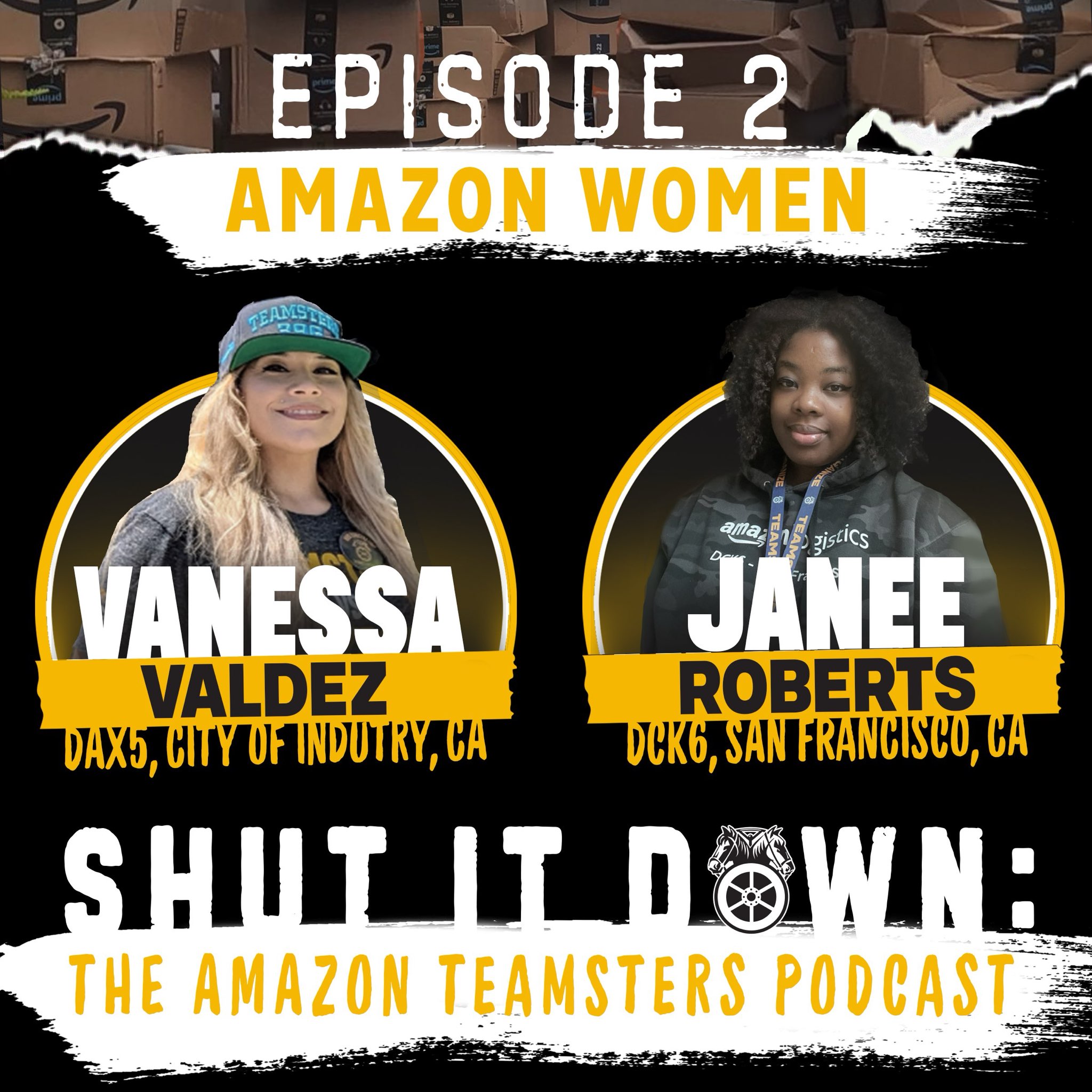
This podcast episode features Amazon workers Vanessa and Janae discussing their experiences organizing with the Teamsters. Vanessa, a driver, was motivated by the desire for better pay and dignity, contrasting her conditions with unionized UPS drivers. She describes exploitative practices like excessive package loads and unsafe routes, exacerbated by Amazon's control over daily operations. Janae, a warehouse worker, notes a decline in working conditions post-pandemic, with safety compromised for profit. Both highlight the particular challenges faced by women, including higher injury rates, discrimination, and harassment. They emphasize that organizing, driven by solidarity, has already achieved changes like reinstating safety positions. The workers aim to challenge Amazon's narrative of being a great employer by fighting for fair compensation, respect, and improved safety through collective action.
[MUSIC] Welcome to Shut It Down, the Amazon Teamsters podcast. I'm Randy Corgan, director of the Amazon division at the International Brothers of Teamsters. This is where workers are taking on one of the biggest corporations in America. And you get to hear right from them how they're doing it. When they're doing it, and all of their success. On today's show, we have the Women of Amazon, the NASA Valdez from DAX5. Janay Roberts from DCK6. You're going to hear this incredible story and how they built to a majority, how they successfully marched on the boss, how they led their co-workers, and many others across this country and making changes right on the job. Let's get to it and let's hear from them. [MUSIC] We have some great guests for this podcast. I'm super excited to be sitting here with these amazing women from Amazon. One driver, the other out of a warehouse. I think gives us a great perspective, gives listeners a great perspective in the differences between the jobs, but also has us really, really drilled down on the similarities of those challenges in the particular areas. And what workers can do to help one another out. Vanessa, you're a driver at DAX5. Why don't you introduce yourself and talk about a little bit about why you started to organize? I've been working out of DAX5 City of Industry for six and a half years. I'm a mother of five, grandmother. And I first got introduced to the union by the first strike. And I didn't know what to think at first. I gave my number and about a week later, my organizer Jenny called. We had a beautiful conversation and I wasn't all in. I had one foot in, one foot out. But after my first big meeting with the UPSers and other organizers, it felt the solidarity and felt the support that I had because I was really afraid. Yeah, so you had a little fear, little in the beginning, maybe, you know, a little reluctance to get involved. What got you over the hump? Feeling the solidarity truly, really feeling the support and the whole process, having my eyes open, really, to the bigger picture of it all. It unlocked something within myself and helping find my voice really when I was silent because I had mouths to feed and I was just trying to survive. And I found hope. That's a powerful story. Let's get deeper into it in a bit. Janae Roberts, DCK6 Warehouse. Why don't you tell us about yourself? Hello, my name is Janae Roberts. I am an LA native group in England. Came here to San Francisco in 2017, came out here for school. And as any bro college student does, get a summer job. And that summer job just happened to be Amazon. So I've been in and out of Amazon on contracts since 2020. And I've been at DCK6 for two consecutive years. And just like any thriving establishment, the quality does decrease as the profits increase. You have something an interesting dynamic. Your mom worked at Amazon as well. Can you talk about that? I am a second gen Amazonian. My mom worked at Mem, one down in Mississippi. She joined Amazon. We both joined back in 2020 during the pandemic. And we were convinced that Amazon was handling the workplace, being at a workplace while that there was an infectious disease going around that they handled it pretty well. They were yelling at people with bull horns to stay six feet apart. And one other people weren't even saying anything. So we took that as a class at the time. But things shifted, didn't they? Yes, they shifted and it didn't take too long. We'll get into that in a minute. We'll drill down a little bit more. I want to shift back to Vanessa here. And I want to ask, have each of you, if you could answer this question, we'll start with Vanessa. First, why did you start organizing? What was going on that made you venture into the space? What was happening at work? It first became just the desire to be able to provide a better life for my kids, hearing like, what could be achievable in a contract? I wanted that. Talking to the UPSers, I want to live in that world. It's not going to be handed to me, so we got to fight. And what were the differences that stood out to you between what UPS happens at UPS versus what was happening as a driver for Amazon? Biggest thing, the dignity and the respect, you know, to be compensated for the sweat off your back, your hard work, such a long days away from your family, the sacrifice, you know? In December, when Amazon was publicly saying, these are not our drivers, they don't work for us. What was that like for you and your fellow drivers? It's disgusting. You're washing your hands of your very own workers who park in your facilities. We enter your warehouses. We leave at the end of the day. Hopefully safe is disgusting that you won't recognize us and hear us out. You bring the heat. We're going to bring the heat also. And that's what you all are doing, hasn't it, right? That's what we're doing. It's crazy to hear them try to distance themselves and basically say these are not our employees legally, but on the flip side of it as you experience in your route while you're doing your route. If you take a long bathroom break or if you didn't complete certain deliveries, you get to hear from Amazon. Is that the kind of what happened there? That's absolutely correct. Only my paycheck does not reflect Amazon. Everything else about my job. So everything's got a smile, except for the paycheck, right? Yes. Talk about how they have control over your route throughout the day, how does that make you like, how does that impact you? The number of stops, the number of packages, all is controlled by Amazon. They set the pace of work. The algorithm is set by Amazon, not DSPs. There was no such thing as a group stop when I first started. It was one stop for one stop. Now they've added not only group stops, but multi locations within the group stops. And when they first introduced it, it was like, okay, cool, a coldest sack of homes, yeah. And then they abused it. Now it's sometimes whole apartment buildings, one stop. And you'll have multi locations, you'll have to do a whole building as one stop. But let's say there's seven houses, each one, maybe we'll have two or three packages. You're exploiting work. I had someone tell me in the comments, like when I make the little videos for the teamsters, all Amazon does is provide work and safety, because we were talking about safety. And in my head, I was like, you're not providing work, you're exploiting it. And the new people that come in, they don't get that. This is the norm to them. Never would you see 300 packages unless it was Pete Christmas time. Now 300 packages is nothing. It's expected to have over 300 packages every day. New people don't know that. Now I want them to know that this is not normal. And Amazon tries to kind of have this sort of brand or message or narrative that they're a great place to work. They take care of people and these are good jobs that they're supplying. One of the things I'd like to point out, and we'll shift to you here in a minute, Janine, to talk about the warehouse side of it, is that an Amazon driver versus a UPS driver, a UPS driver in any neighborhood in the country that's there making a delivery can afford to buy a home in just about any one of those neighborhoods they're making a delivery. But an Amazon driver statistically can't buy a home in any of those neighborhoods. After six years with the same company, I make 2275. And if I look at it statistically, I believe a UPS driver was making that somewhere in the 1990s. Yeah. So for Amazon to have this narrative, and I guess in one breath, you say, maybe this is why they don't want to claim that their yours is because they're not paying enough. But in the end, they're clearly exploiting the situation where they have complete control. And so that's got to, you got to kind of look at that and go, hey, like, what's up, this very wealthy company is very successful company. They brag about their success on a regular basis as a matter of fact, the owner of their company just recently had a 56 million dollar wedding or something like that, right? So you know, the reality is you've got to share the wealth in the community in which your people are buying your goods and services. So today, let's shift gears over to the warehouse. And let's talk about why you organize the sounds like in the beginning. You felt like, oh, Amazon's doing a really good job. You know, they're keeping people six feet apart, obviously, making a group of cash during the, they're in the onset of the pandemic, right? Because everybody else is staying home while a bunch of you are having to go to work every day. Their profits explode at, you know, at this incredible level. And what was the shift for you to start moving in the direction with your co-workers to organize? What was it? I like to call it the, well, it has a lot of names. People call it a lot of things. But I particularly like the movie Coraline. And the story of Coraline is just like how everything is perfect in this world where this little girl like wants like all of these things as she gets all of these things. And then slowly, but surely everything just starts becoming reality. So where it's just like a rotting place that she perceived is perfect. And I think that that's probably the perfect description of what Amazon was. When new hires come in, they think that it's not bad. But then when you start working in there consistently and you realize how hard they are working you and the wear and tear on your body that it actually does take just to do your job. And how much corners that they are cutting and how much that they actually don't care. It's insane. So you saw the shift. You saw the shift happen from where it was, you felt like there was this, you know, emphasis on making sure that you're safe to now profits more important than anything else. Yes. And I think it was due to the pandemic, which we know skyrocketed Amazon's profits at that time. And I'm pretty sure even before I was there, it was heading in that direction. But I think that full force like the small amount of time that it took for them to get as bad as it is is very alarming. Because women that work at Amazon and the two of you being in very different jobs but sounds like facing some similarities. The aspect of women in Amazon, how does that play into this? What's that dynamic in a, I guess, you know, you tell me it looks like a pretty male dominated industry, right? Is there a challenge there or their dynamics there that you believe organizing is going to help you with? Yeah. I think there's always going to be challenged for women to do anything because we always have to create space for ourselves first, you know, nobody is ever going to give us the spot. And if we are given the spot, it was, you know, fighting tooth and nail us and the person trying to give us the spot because, of course, women having a voice, women having loud opinions, it was never appreciated in society. And even though we're in an era where we're trying to shake those, those kind of like, you know, notions off or those traditions off, it's still prevalent, you know. We still have to create space for ourselves. And even me as a black woman, twice so, you know, for Vanessa as a woman of color, twice so because, of course, they're not going to be looking to us to try to make a change or to do the right thing. They're always going to be looking for us to just shut up and put up because that's what we've been doing for years. Right. You're not going to change, right? Right. We're making that norm that years is describing right now. Vanessa, what do you have to add to this regarding being in a male dominated industry? Is this one of the things that drove you to organize too? Is that fairness and that kind of, you know, I don't know. I'll let you take it from there. Women of Amazon as drivers, and I'll say in the warehouse, we not only carry the weight of packages on our backs, but we carry the heavy weight of being overlooked, overworked, and not recognize the weight of having to prove yourself in a male dominated field, you know, can I keep up? I can carry this package, you know, up these flight of stairs too, like, and I'm not going to complain, you know, that weight. And now we carry, you know, this campaign, and that's why we'll win. And when you carry the weight of the campaign, you know, there's lots of examples of specific items or situations or issues that you've either, then a petition drive on, a march on the boss, or you've, you know, you've demanded that management acknowledge something in particular, and you said, we want that changed. And you've been able to get some of that change. Is that correct? Yes. And obviously you, the women at, at Amazon and women at Amazon are leading that charge. You were leaders in that charge of making that change. So thank you very much like those of us that are part of this industry and see the challenges in it. We, we absolutely appreciate that movement. But for listeners, let them hear some of those specific things you feel like you've changed with that powerful voice that you have. Of course. Well, like I told you, DCK 6 humble beginnings into this campaign started with two women. Like, two women who were dog tired with basically working just as hard as the men. And then also being women and having to create a space for ourselves and taking care of ourselves and others. Right? With Leah, it was her taking care of herself. And then also being, you know, support for her, her, her aunt, for me, after my mother was injured, I'm now supporting myself and also helping to support my mother because I'm a daughter. And if I can help support my mother, I'm going to do so. It's for DCK 6, it started with two women just having a conversation and being honest and vulnerable with each other. And then we started having those conversations with our co-workers. What are the issues that we're having here at DCK 6? Most of our issues was, of course, pay because we live in one of the highest the most expensive city, like, you know, in the US. And then also it was safety, especially for me, since my mother got, you know, got injured while she was at work, you know? So seeing them cut corners, we were like, safety is a big thing. And then also it kind of like just trickled down to finding the core of why safety was an issue. And at least for DCK 6, because I can't speak for any other facility, under staffing. Making us pulled in all different types of directions with volumes that, like, would make everybody's head spin. And then also, you know, making us carry that by ourselves with not having the head count to pull it off, yet we still did. So we were able to create a petition where we reinstated one of the positions that our facility thought would be a good idea to take away. It was the diverter position where somebody would actually push the boxes and, like, push and pull the boxes according to the aisle numbers, which would make us say for us, so we're not leaning over the belt and having our best get caught inside the belt and everybody's able to reach because, like I said, we do have, you know, small people, particularly women who are out here just, you know, trying to feed their families and try to, like, you know, get some extra money reaching over this belt. Yeah, which lens of the statistic of, you know, women in Amazon warehouses, you know, they face higher injury rates than others do. Is that, is that your been your experience as well? Yeah. There's been multiple times where I have seen people injured. I have been injured myself, and then also, like, my mom has been injured. It's definitely something, like, that statistic for, at least for me, is something that I can physically see for myself just looking around my facility. We have a associate right now who is injured who's been going through, you know, a worker's comp for a few years now, you know, and still hasn't been settled. And then also, we've had people who have been injured and then fired. And I can tell you, I can think of at least three of them that have been women. Statistics also show us, Vanessa, not just statistics, but surveys have also showed us that there's gender-based discrimination that happens with women as well at Amazon, you know, harassment, other things. It's not set out loud, but, you know, I've seen, you know, how women can be given, you know. It's different. It's different, you know. And it's intuitive, but stuff like that happens is very intuitive, but some things don't need to be said, you know, it shows itself, like, definitely that discrimination. We've also had a sexual harassment, which is majority women, at least in my experience, like, having, you know, somebody who's supposed to be an authority figure, like, hovering over you in the aisles where we only have one exit and one entrance, you know, lingering for a little too long, wanting to talk for a little too long while you're just trying to work. And especially in our facility, which is technically, I think it would probably be a 24-hour facility in our ships, run from, like, 9.50 pm all the way until, like, 11, 11.50 am. That's two different ships, but it's early in the morning for somebody to be hovering over you, talking to you about things that are probably not work appropriate, you know? Right. Experience, creepiness, like, outside, like, in the field, like, at night in sketchy neighborhoods, like, that's where I feel like, uh-oh. What does Amazon do to help you with that? No, and you've, you can let them know, like, please don't give me this route again because I was approached by this person late at night, and I don't feel safer. I don't know if anyone's familiar with Holt and Pomona, but there are, um, working ladies on Holt. And sometimes you will be there at night and you don't, you don't feel safe. You don't know what's there. Right. And that lends into, like, the UPS or a union environment versus a non-union environment is when you get into spaces like that, you have the ability under a union contract to say, this is undeliverable. Yeah. So, so now what you're talking about, maybe not necessarily something discriminative, but you feel the pressure of having to make the delivery yet, you know, just because of that pressure that Amazon creates, right? You said Amazon's in control, and, and just not feeling the general, the average worker doesn't feel like they've got this line and they can draw and say, that's undeliverable. I'm not going to deliver it without getting some sort of, you know, that part so they may tell you, like, if I bring it up, they may, they may say, okay, you know what? If you feel that unsafe, then bring the packages back, but it's not that simple, then it's going to be on me, like, it's going to be on my numbers, you know, but as it couldn't get it done, what do you mean? It's going to be on your numbers. Explain that. So people know what you like. That's the pressure that they create. You know, it's, this driver didn't get it done. One of the things that we would love to stipulate that we've also been talking about is workers is the fact that when we do have stuff like, um, authority figures, like, you know, being a little creepy, being a little too hovering, being a little too hands on, is the fact that nothing happens except maybe this person being transferred. And then they're in another facility where nobody knows what has happened with this person. Like, I, and one of the things that we want to stipulate in our contract is for there to be a track record. If you're transferring this person, the whole facility should know why this person is being transferred. Like, you know, because he was being, because he or she or they were being a little too handsy, because they were being a little too hovering and being creepy, especially when we have, you know, up to like, uh, the, the lowest age that we have in there is 18 year olds who are, you know, what I believe still in their teens, if you still have a teen after your number. Yeah. Your team. Yeah, your team, you know, and we have people in there who will pray on that. And especially when we have teens who are at their first job that don't know what to do, that don't know the protocols on what, what to do when, when this kind of thing happens. And don't want to say anything because it is their first job. They don't want to rock the boat. Who want to do that? Rock the boat at their first job where they don't really know anything. And they're depending on this person to learn, uh, their environment, their workspace. Amazon has definitely capitalized on the fact that they hire a very young workforce or individuals that are just entering the workforce speed and efficiency, right. And, and where people aren't aware of what is really going on in the industry or what has gone on the, in, in, in, in the industry for the last 100 plus years, like these are clearly obstacles that were faced 100 years ago, 70 years ago. They were in a lot of cases resolved through union organizing and getting union contracts where almost the entire industry was organized at one time. And that balance was there, equality was there. There was a lot less of these situations. And now you get a company like Amazon driving a message where come to work for us 18 years old, the first place that they land. Individuals aren't, they just kind of fallen along going, I'm just going to do the best I can make a few bucks here. And like you just pointed out, weren't, they're praying on it, exploiting it. I think exploit is the best, is the best word because statistically we found that 70% of workers are looking for a job within the first week of going to work for Amazon. Once they go there, they quickly find out it's not quite all it's cracked up to be. And they're all almost immediately kind of looking around trying to find something else. And so, you know, with you all being the face and the, and at the forefront of leading this, organizing, leading the movement and helped grow this movement. How does it make you feel? And what are your favorite parts about that growth? What are your favorite parts about seeing it, you know, kind of cascades into the next group that's, that's stepping up and doing things in another part of the country or maybe another part of the city? I know I asked you two or three things, but feel free. Who wants to jump in here? Vanessa? You look like you do. Okay. Just knowing that I now have the opportunity to help change my community members' lives, educating them on their rights where before like me, I didn't know my rights. I didn't know anything about what a union was or is and sharing that with others and then watching it grow, then realizing their own power, seeing their own value when someone finds their voice and then wanting to utilize it. And it's a beautiful feeling of actually you can feel it grow like together and feeling the protection of one another and knowing that, you know, Amazon is powerful, but feeling like, you know what, we're more powerful, like we need to get everybody on board like let's do this. Right. Isn't it cool dynamic to see? First of all, you are, you're the individual that you feel it yourself when you're kind of stepping through and your head gets a little higher. You have a little bit more confidence because you're feeling that solidarity, you've conquered that fear, right? I can see both of you nodding your head and kind of going, yeah, yeah, yeah. But then there's a whole new layer when you're helping someone else do it, right? And you watch their transition. You watch that aha moment where they, they kicks in and they go, hmm, oh, we can do this. It's a dicking. Right. It's the best word organizing because sometimes it's the down parts when someone's like a brick wall and they, they just don't get it, you know, they want no part of it and it's like I'm fighting for you. I'm fighting for us. Like, look at, they don't see the bigger picture. They don't want to see the bigger picture. It's like about me or whatever their, their, their, but you guys, you guys just had a recent victory with first aid, right? With getting first aid. Oh, yes. Real quick because that energy led right into a victory. My big thing was gloves. It was our, our win was gloves and first aid kits. And for me, gloves are a big safety issue because it not only prevents infection or injury, it's helps protect like the wear and tear on your hands and they give you that good grip on packages. So if you have to balance something heavy on your body, you have flights of stairs, you feel safer. You don't have to convince me on gloves. I got you. No, no, go ahead. I'm sorry. I'm just having fun with it. Years ago, we used to be, years ago, we used to be providing gloves and then they just stopped. And we got it. I asked for a commitment from the managers. I said, and we marched on Monday. I said, by Friday, I would like to see a commitment and see gloves on our drivers by Friday. And by Friday, we got, it's not amazing. It's amazing. It's, you know, it didn't feel small to me. Right. It wasn't a small win to me. That's right. These are significant victories. Janae, do you have a similar victory? You know, I think part of this, part of the story is that dynamic of looking in the other people's eyes as they are getting it and they're like, oh, yeah. Yeah. You can do that because you had your own aha moment, right? Yeah. That's the first journey. I was scared to call it that. The aha moment. Yeah. And then the second one is you led somebody through you. These powerful women at Amazon have led others through that aha moment yourselves. Like you are impacting millions of workers. I hope you all understand this. Like maybe it's what happens sometimes when you're in the middle of this, sometimes you don't see how big it is when we did a show the other day. And I was calling the ladies heroes and they're like, no, we're not heroes. By the end of the show, they're like, yeah, we're heroes anyway. Do you have a similar example of how you helped walk people down this path? And inspire them, educate them. And now they have that confidence themselves to bus through whatever that challenge. Yeah. We have plenty at DCK 6 where like our like many marches on the boss. That's what we call it. Many marches on the boss, which is like just following through with management. We've had white to blue badge conversion, which was won by, you know, marching on the boss. And that that created a lot of aha moments, especially for the people who were coming in kind of like during the strike and didn't know what was going on and was slowly learning what was going on. And they got to see the demonstration of worker plower of us coming together. They've been temporary for a while. And according to Amazon, they're on like seasonal contracts, which means that they can pretty much end it at end their job at any time without repercussion because they were technically seasonal. But there is no rhyme or reason for people who are converted. And so the fact that these, you know, these workers had not been converted after working over six months at this facility because usually like, again, when I first started the seasonal contracts were three months. So they had already worked there three months plus, you know. They were able to see that through worker power, we were able to do something, which was get them from blue badge to white badge, even though nobody knew what the requirements was to get, you know, a white to blue badge at this point in time because they kind of just make up policies on the fly whenever they want to. And they give us these kind of like answers, but they don't even follow through on what their answer was. So we've had that, we've had times where we marched on the boss for like our petition. Just before we got recognized where we got our our diverter position reinstated, we've had marches on the boss for like, um, let's throw, let's drill down on that for real quick. Yeah. Don't mean to cut you off. I just, I want to shift to something. I think it's really important as we close this, this episode out. And that is, is fear is you, you all have obviously conquered your fear. And as you said, you've carried that with you, right? You had a phrase. I meant to write it down because it was really good. And I need to steal it from you. But you've conquered that fear and you've been able to challenge it and channel it and use it in a positive way. And then you've been able to do it with others and you've been able to educate others. I guess I'd ask two questions like, how and why must you overcome it? Like what? I think that the what people can get out of this exchange from you is, especially being powerful women at Amazon, leading this movement that you've led. Doing the things that you've done accomplished, chipped away at these things that you've chipped away at. You all know that fear is the biggest obstacle for others to join in. How and why must you overcome it? Let me shift to Vanessa first. You're going to get your most already. It's okay. Like let it fly. Like this is, we got to not be concerned. We got to let it fly. It's okay. Workers, workers respect it when we let it fly every now and then. And we are emotional. And we, you know, we are passionate and we're upset about a particular situation because that means we're all in. We're all into this space. Yes. So, so, you know, if you want to go or pass it to her for a minute, it's up to you Vanessa. How? Why must we overcome it? I started off, you know, getting into this for me, you know, when organizers would ask me, what would $30, you know, mean to you in your life? They went from all that to truly, with the union, my eyes being open to the bigger picture, like workers out there, ask yourself, what's scarier speaking up and fighting back or staying silent and letting our children and our community members, children inherit the same broken system. That's what I see. And that's what I want to be a part of like we need to change the future really for all of us, for all our class of people to alleviate the suffering that goes on for the future. I've talked into drivers, you know, who joined Amazon just for health care drivers who are working sick with cancer, you know, things need to change. It's broken and this is my fight now. It's not even about me. I'm all in altogether delivering packages, delivering power, delivering justice for the future of all of us. Sorry. Okay. I'm telling you. So don't be afraid. Don't be afraid. I was so afraid. I still have fear now, fear of isolation, of retaliation, of intimidation. I've been guilted by my DSP owner because I hold the most seniority with his company. You can't make me feel guilty anymore for wanting better, you know, for myself and for everybody else, don't let anyone guilt you, you know, don't let your boss guilt you. All of us here will have your back, but we need to do it together. I'm sorry. That's my big. There's no sorry here. That's not big. That is on point. It is exactly what workers go through and trying to balance, why am I doing this? And you just like in my opinion is doing this for over 30 years, it is the real reason why workers go down this journey. It is why they, why they take on their employer, their super wealthy, super rich employer and say, something has got to be different. You said it's a broken system and we're going to fight to fix that and we're going to leave it for someone else. That's not just being transactional. That's got real meaning to it. That has, that has spirit. It has heart. It actually defines us as, as a people. I think we're, more of us are cut from that cloth than not be that cloth. We just have to tap into it. Jenny, what do you, what do you have to say to that? Well, first of all, every time the Nessik gets emotional, I get emotional too. Okay. But good space for that. Yeah. So everything she said, everything she said, like fear feeds into so many things. And it can be the driving force for a lot of big and major decisions in life. And I definitely would say fear is probably why we have gotten thus far. And it's not, oh, fear of like Amazon. It's fear of living in this world where trillion dollar companies like Amazon can just pull the strings and determine what happens to us. If we allow that to happen, I think that's when humanity is lost, when everything is lost. That's the big battle that we are fighting besides, you know, a union contract, besides safety, besides, you know, what's going on inside the warehouse and what's going inside the Amazon vans. It's the fight to make sure that companies like Amazon aren't, aren't the ones to determine what happens to us just because they have the bigger dollar. It should not be that way. That's not what this country is supposed to be about. It's about working hard, you know, and the average American, like what I picture the average American is is somebody who works hard for their paycheck could go home and actually enjoy that paycheck and their lives from that. But that is lost because of companies like Amazon. And it is fine for people to want to work hard and, but at the same time, it should be your choice. It should be an option. And companies like Amazon is taking the option away from you. When Amazon is making you work hard and forcing you to work hard, then it's not a choice. And that is not freedom. That is not change for them. Yeah. There should be a fair exchange. It's okay. It's okay to do these things as you described, but there should be a fair exchange for that. It should. It should. And apparently for companies like Amazon, they're not going to listen to the individual, but they're going to have to listen to the majority. And that's where it was. That's right. Yeah. We see everybody flared up when she said that like, oh, yeah, that's where we are, right? I got to point something out that the two of you said that's just incredibly incredibly jumped out and psyched this moment, you both use the example of fear, but she said, I'm more fearful of what happens if we don't do something versus the risk of what we're doing in this moment. And I'm telling you that is very, very powerful. Our history in America has been littered with, with, you know, bad choices by a society bad, but people rose up, conquered their fear and paved the way for a woman's right to vote, paved the way for civil rights, paved the way for equality, trying to get as close to equality as you can, they, they risk their lives. Some of them lost them, some of them, many of them lost them. But if you're born in the last few decades, you, we have not been taught this history enough for us to respect its journey. So for me to hear what you just said, it, it fires me up, I'm so inspired by you because you're recognizing the fact that the fear of what we don't do is, is greater than the fear of any consequences of what we do right now. Right. Well, Amazon's watching closely, they would love nothing more than for workers to say silent have fear in us so they can keep pushing, pushing, pushing. Some of their most profitable moments is built off of worker and driver silence. I think it's time for us to disrupt that because you're not going to profit off of our suffering. 90 more. We're not going to allow it. If you're listening to this right now, I'm going to, I got to issue you a challenge. Like, go back. Rewind that, listen to that section again and hear what Vanessa and Janay have just said and how you have described that fear, conquering it, that journey, what is next and look within yourself and try to figure out what can I do to make it better for my kids? What can I do to help my coworker help? What can I do to help the next person who's going to come into the job market? How do we turn these jobs into something where when you go to work for Amazon, I can buy a home in the community. Never forget that you can connect to teamster.org/amazon. Always you can reach out, you can connect, you can get information, you can connect to more of this dialogue, you can connect to other videos. I'd like to give you each just a brief minute, maybe 30 seconds on. What would you like to close and listeners to hear from you? Let me start with you, Janay, first. What would you like to close on for listeners to hear and how you've gone down this journey and how inspired you are by those going down the journey and what do you see? What do you want to say at last 30 seconds? We are fighting at this point for survival in a world where companies are taking over and it shouldn't be that way. And I want to say to anybody out there that we're doing this for us and for you. For the workers and the drivers, this affects us just as much as it affects the people who are buying from Amazon, people who are associated with Amazon, even using the Amazon web services. Like this affects all of us. So your fight is our fight and our fight is your fight. Vanessa? Know your rights, workers. Know your rights, so you know you don't have to settle. Know that your community members are going to fight with you. Don't stay silent. What part of history do you want to be on? Things are not going to change on their own. We have to be the change. I can see why millions are inspired by you. These amazing and incredible, powerful women at Amazon. Thanks for joining us today. What a powerful conversation. Hearing how the women at Amazon have conquered their fear, led other workers through conquering their fear, educated their co-workers, the community and others in the industry to take charge. They tapped into the bravery in which has led them through their entire lives and they paved the way for others in a male dominated industry. Just incredible to hear this powerful story, the emotion and absolutely just laying it on the line and how building their union really inspired them to take the next steps. I think the most compelling thing that came out of this is how they described their fear and what they faced right now versus and just moving that out of the way because if in the future they did nothing, that fear was far more dangerous to let just sit there. Are you ready to shut it down like them and if you are, see you there and tune in.
Podcast Summary
Key Points:
Amazon workers are organizing with the Teamsters to address poor working conditions, low pay, and lack of respect.
Key issues include exploitative workloads (e.g., excessive packages, unsafe routes), safety hazards, understaffing, and gender-based discrimination.
Workers highlight the disparity between Amazon's public image and the reality of the job, contrasting it with unionized positions at companies like UPS.
Women face additional challenges in a male-dominated industry, including higher injury rates and harassment, but are leading organizing efforts.
Organizing has led to specific workplace changes, such as reinstating safety positions, and aims to secure dignity, fair compensation, and a voice on the job.
Summary:
This podcast episode features Amazon workers Vanessa and Janae discussing their experiences organizing with the Teamsters. Vanessa, a driver, was motivated by the desire for better pay and dignity, contrasting her conditions with unionized UPS drivers. She describes exploitative practices like excessive package loads and unsafe routes, exacerbated by Amazon's control over daily operations.
Janae, a warehouse worker, notes a decline in working conditions post-pandemic, with safety compromised for profit. Both highlight the particular challenges faced by women, including higher injury rates, discrimination, and harassment. They emphasize that organizing, driven by solidarity, has already achieved changes like reinstating safety positions.
The workers aim to challenge Amazon's narrative of being a great employer by fighting for fair compensation, respect, and improved safety through collective action.
FAQs
Workers were driven by the desire for better pay, dignity, respect, and improved safety conditions, inspired by the solidarity and support they found through union organizing efforts.
Amazon drivers face lower pay, less job security, and are often not recognized as employees by Amazon, unlike UPS drivers who earn higher wages and have union protections.
Warehouse workers report high injury rates, understaffing, and unsafe working conditions, including repetitive strain and inadequate safety measures, especially for women.
Women at Amazon experience gender-based discrimination, higher injury rates, and harassment, often feeling overlooked and overworked in a male-dominated industry.
Amazon initially emphasized safety during the pandemic but shifted focus to maximizing profits, leading to increased workloads, reduced staffing, and deteriorating working conditions.
Workers have successfully petitioned to reinstate key positions, like the diverter role, to improve safety and reduce physical strain in warehouses.
Chat with AI
Loading...
Pro features
Go deeper with this episode
Unlock creator-grade tools that turn any transcript into show notes and subtitle files.
 PodcastTranscript AI