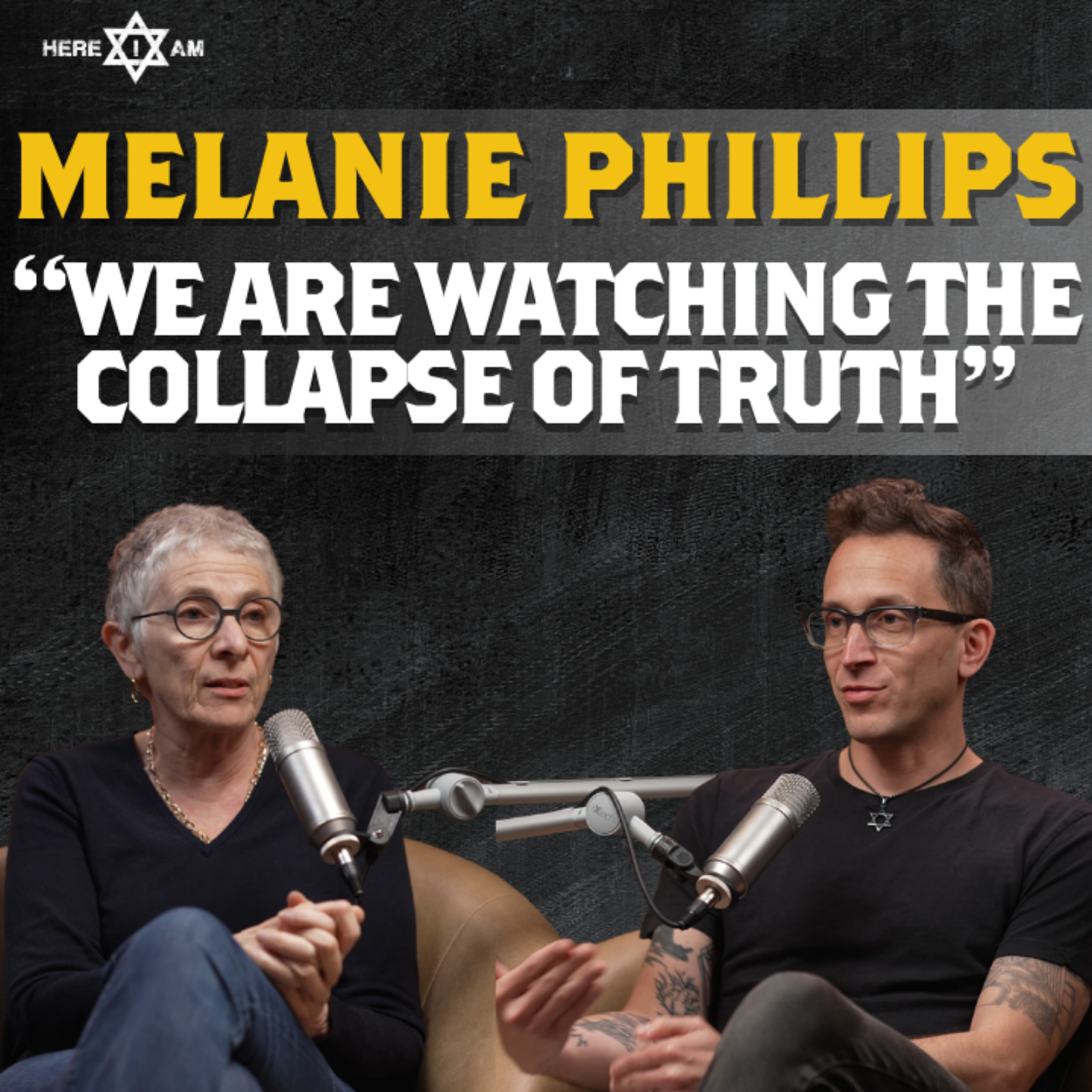
The West Is Losing Its Moral Compass | Columnist & Author Melanie Phillips
from Here I Am With Shai Davidai
1h 17m 24s
Melanie Phillips, a British journalist and author, recounts her personal journey from a British Jew living under societal pressure to identify as apologetic and politically silent to relocating to Israel, where she feels fully authentic as a Jew. She argues that British Jewish communities have long internalized a culture of self-censorship, especially in how they view Israel, due to fear of being labeled as disloyal or antisemitic. This mindset, she claims, was exposed during key events like the 1982 Lebanon war and the 2000 Second Intifada, when Israeli actions were vilified while British media upheld a double standard. Phillips asserts that this shift reflects a broader collapse of objective truth in journalism and academia, where personal feelings and ideology override facts. She sees anti-Semitism not as a simple hatred of Jews, but as a deeper, systematic pattern of demonization, false accusations, and a unique historical animus toward Jewish people and their nation. Central to her argument is the claim that Western civilization’s moral and political foundations—such as justice and human dignity—originate in Jewish and Christian traditions. The events of October 7, 2023, represent a critical inflection point where the West faced a choice between supporting civilization or barbarism, and its failure to do so signals a cultural crisis. Despite deep fears, Phillips remains hopeful, believing in Israel’s strength and the enduring resilience of the Jewish people as a vital force in global history. She urges listeners to support families affected by the ongoing conflict in Israel as a form of solidarity.
Crown coins to single winning never sounded so good. What would you do if you won big at Crown coins casino real people win real prizes every single day?
Hi, this is Michael from Dallas, and I won 40k and finally renovated my home. Visit crowncoins.com sign up in seconds, enter code crown and get a free lucky will bonus.
You may win up to 10,000 sweeps coins. Crowncoins.com that's C-R-O-W and coins.com. No purchase needed.
Code Val for new users on void were prohibited by law. 18+ terms and conditions plush. The universities, the intelligentsia, abolished the idea of truth.
We have a long fight ahead of us. Here I am. Here I am. And here I am with Shai Davidai.
My guest today is a British author, journalist, broadcaster and thought leader. And she's already snickering at my introduction, but that means we're going to have a good conversation.
We'll have a discussion. Here I am with Melanie Phillips. Great pleasure to meet you at last.
And thank you so much for coming and I know you have a flight to catch. And we've discussing a bit you are a sort of globe trotter in the past years.
And we'll get to talking about that. But we'll start with the first question. Melanie Phillips, what kind of a Jew are you?
Well, I suppose I'm an unapologetic enough with a bullshit kind of Jew.
And the next question that always comes up when people say unapologetic is who is expecting you to apologize?
Really, I mean I come from Britain that's where I was born and brought up. And they expect British Jews to be apologetic all the time.
They expect Jews to be on their knees. They expect Jews to live on the condition that they observe certain requirements, which is never to identify as a people, as a nation, but to become and live as people who are just just like everybody else.
And it was when I finally realized that I was being confronted with a choice that I had to choose.
If I supported Israel, I was to be considered no longer British. And that was said to my face. And it was implicit in what I was reading, what I was hearing.
At that point I made the choice. I moved my center of gravity, well in fact I went to live in Israel. I moved my center of gravity over a period of time, but I bought a place in Jerusalem as a result of that after just a few years.
This was at the beginning of the notice. About three, 2004 I passed a little earlier. I made that decision. I could no longer live like that.
So I stopped being apologetic. I hadn't realized I was being apologetic until that moment. But I stopped being apologetic.
But you don't seem to me like the kind of person who you tell them, okay, you either be British or be or support Israel and would pack up and leave.
You seem like someone who would stay and fight and kick and punch.
No, there was no point really. I thought there was no way you can fight people who will not allow you to fight. There's no way as a journalist I could use argument to put the case if I was being deprived of platforms.
It was pretty pointless. But in any event, I came to the realization after a very long period of time, not quite sure of the sequence of events quite honestly.
But after a period of time I came to the realization that this is entirely personal to me. But I could only feel a complete Jew by being mainly in Israel.
What were you giving up when you were in Britain? What was I giving up?
By leaving? Well, no, you say you can only be a complete Jew. So what was the lack of completeness?
I was a Jew that was being apologetic. I was a Jew on condition. I didn't realize this.
I was the kind of Jew who thought being Jewish was always very important to me.
I would consider it to be part of my identity. But I was mainly British. I was a British person. The Jewish stuff, which was important, always very important.
But nevertheless, it was an add-on. It was an important add-on.
I knew it was very important because over time, when I felt it was being abused, the Jewish part of my identity, by Britain, I did kick against it.
But I hadn't realized quite how important it was until I moved my centre of gravity to Israel where I can just be myself. And I realised now what myself is.
And I realised that I wasn't really myself when I was in Britain. This is very personal. Not every Jew would think that. Not every British Jew would think that. Not every diaspora Jew would think that. It's entirely a matter for one's own circumstance and one's own psychology.
But I do think you're articulating something that many Jews are experiencing. Some of them may not even be able to verbalise it in the way that you're doing.
And you say when you move to Israel, looking back towards the Melanie Phillips in Britain, before the move, what was she like? And how are you now different?
It's a very hard question to answer because I've been on what is quaintly always called a journey. So many of us are on a journey.
And I've been told I've been on a journey for some time. So I suppose I must have been on a journey. But there were certain punctuation points in this journey.
And for example, in 1982, when I think I really started this journey, I was then a rising high flier on the Guardian where I spent best part of 20 years. And I'm fond of saying to my former Guardian colleagues in so far as they ever speak to me, that the Guardian is what made me what I am today.
And strangely, they don't seem to like that very much when I say that. But anyway. So in 1982, I was on the Guardian. I was a high flying person. I was an editorial writer. And that's when Israel was in war at war in the Lebanon. It's a very controversial war.
And that's when it was made quite clear to me, right? It was in made clear in terms that I could not question the way in which Israel was being viewed, which was up as that was the first time I heard the Israeli described as Nazis.
So just to place the audience in the context. So 1982 was what started as a limited operation ended up becoming a whole war, ended up becoming an Israeli staying in southern Lebanon until 1999 2000.
It was to eradicate the PLO, Yasser Arfat, and successfully so move them all the way to Tunisia. So you don't have your Iraq enemies two miles, two kilometers away from your northern border.
Exactly. And even back then you were already facing.
Yeah, look, I was I'd never been to Israel until that point at that point. In fact, I didn't go to Israel to the year 2000. But I never into Israel, never to go to Israel. It wasn't my thing. I didn't think about it very much. It was, you know, I didn't disapprove of it, but it was for other people.
I was a domestic social policy writer. And I was an editorial writer. But it bothered me. First of all, it bothered me how the Israelis are being described as Nazis.
And how it was being conceived as an aggressive operation in Lebanon. Israel had gone to war in an aggressive way.
But they hadn't. They gone to war in a defensive way. It was to root out the Palestine Liberation Organization, which was causing, which was a center of terrorism against Israel.
But it wasn't being presented as that at all. It was presented as an act of wanton aggression in which a very large number of innocent Palestinians were being killed.
And I was troubled by this because I thought it was wrong, just factually wrong and prejudiced.
And I was also troubled by the fact that at this time, and because of what was going on in Lebanon, we British Jews were being accused of somehow being complicit in this.
We were all accused of suddenly being clannish and all basically subscribing to the same thing and acting as a pack.
And it was about Jews. And I thought what's going on. And then I was particularly concerned that the Guardian, which was in my eyes, then, the acme of wonderfulness because I felt like them.
I thought I was among friends and colleagues all marching behind the same banner of progress and decency and truth and standing up against abuses of power and against prejudice of all kinds and all that kind of stuff.
Which I thought then and I still think those things are what I believe in. But I thought we were all on the same side.
And in all innocence, I said to them, why do we have seem to have a double standard?
I sat the father and caused the death of between 10 and 40,000 of his enemies in the course
of a few days in Homer.
And this was a bog-standard foreign-page news story, no particular consequence, just a
news story, no op-eds, no editorials, nothing.
But whenever Israel hit or killed a few Palestinians in Lebanon, it was a front-page splash, it was
outraged at tutorials, it was furious op-eds, and so I said to my colleagues in all innocence,
why do we have a double-standard?
And there was a dead silence, and I realized I crossed a line, and they all said, well of
course there's a double-standard, because the Syrians, like the rest of the third world
as we then called it, the developing world, they're not brought up in the same way that
we are, and we do you, they said to me, they we do you, the great honour of assuming that
you are brought up in the same way, and in fact you tell us you are more moral than us.
I become you, and I become more moral, we are all brought up to believe in the sanctity
of human life and human rights, that's what we believe in the West, and the Syrians and
the developing world, not brought up to think that, they're not brought up like that at all.
So we can't judge them by our standards, that's racism.
The irony of an argument like that is, it's probably the most imperialistic colonialist
argument you can make, precisely.
In the name of anti-imperialism, anti-colonialism, precisely.
It removes all agency from the quote unquote indigenous people, but then holds the people
that you have somehow educated for your British mandates in Palestine as most culpable for
everything.
But this isn't an argument being made by some half-wits unknowledgeable person.
These are very intelligent people that have probably heard all the arguments against
that's double standard, that have heard all the arguments and are still holding onto
that.
Not sure they had heard the arguments, but they certainly believed what I've just said,
and I said to them that this is racism, and at that point I realized that I could no
longer use them as a load star, no longer regard them as the moral arbiters, that I had
thought they were, and they were on the other side to me.
I'm not sure that they had ever heard of themselves accused of a double standard before, and what
I came to realize after a long time was that by definition, since they were left wing,
they thought themselves to be moral and decent and good and wise and of course above all intelligent.
And if you descended from any part of being left wing, you were not just wrong, but because
they were moral and decent and unknowable and so on, believing in all good things, you
were evil.
And consequently, you could say any kind of fact, you could bring any kind of factual evidence
to bear upon their argument, and they would, by definition, say it can't be true because
it's coming from her, and she is evil and a right-winger, and she's evil and a right-winger
because she opposes what we believe to be the case, and what we believe is axiomatically
right and true and good and wonderful.
But the fact, the veracity of facts should not depend on the source of the fact.
But you think, I mean, I think shouldn't that be, isn't that journalism 101?
No, yes, of course it is, but journalism 101 disappeared back in the mists of antiquity
when I was trained as a journalist, and I was, you know, in those days journalism was
governed by certain rules to do with truth and honesty and openness and balance and fairness
and above all, distinguishing between fact and opinion and above all, making sure that
your fact as far as you can see, were accurate.
And that's how you got to an approximation of what was true.
And then around the 1980s, perhaps earlier, the academy, the universities, the intelligentsia,
abolished the idea of truth, objective, what happened?
Well, it was just sort of basically said, there's no such thing as objective truth.
The anyone who believes in objective truth is a moron, must be uneducated because any
sophisticated person knows that everything is relative.
And that became the kind of mantra of progressive opinion, and journalism went down the same
rabbit hole, journalism said, it is dishonest to say that we purport to be objective.
We purport to be fair because we all bring our own prejudices to the party.
We all bring up own prejudices to what we write and what we brought up.
Which is true.
It's absolutely true.
But nevertheless, you know, we were trained once to try and overcome that and to be as
fair as possible and to park your prejudices before you got into the broadcasting studio.
And then it was said very explicitly that was dishonest and what was honest was to parade
your prejudices and to uphold what you believed in your opinion to be true and to say your
opinion.
And there was therefore no such thing as a lie.
I remember when people used to write things and claim to be having seen something happen.
And it didn't happen because they didn't see it.
And it was said, well, is it right that we should publish this because isn't it kind
of a lie?
The reporter wasn't there.
She didn't see it.
She's made this description, but it's not true because she wasn't there.
And the answer was, no, no, no, it's fine because it's the broader truth.
Because we know that in this case in the Bosnian war, back when we know that the Bosnian
Muslims or the victims or the Serbs.
And so any description that accords with that belief is true, but it wasn't true.
She didn't see it.
It didn't happen.
But I want to understand, and granted, I've never been in a newspaper or any journalistic
organization.
I've never been at the desk.
But I want to understand how this idea of there is no objective truth came about to take
over.
Because if this was a new age yoga class and you'd say, look, everything is relative.
Let's flow.
OK, I can understand why it would take hold there.
I can understand how it can take hold in the arts world where everything is subjective.
How can the idea of no objective truth take hold in a place that is supposed to be dedicated
to the truth?
You asked that from the position you're coming from, from all the experiences you've
had.
I'm trying to understand.
The center of the promulgation of lies, and it started, in my view, back when, when
I'm saying, happened, that the idea of objective truth and other window, I mean, it was all kinds
of then extremely fashionable philosophers who basically said that.
And they were people who, you know, I mean, why do people believe all this rubbish?
Why do people believe nonsense? Why do people believe people who are, you know, clinically
insane, like Jean Jacques Rousseau and, you know, all those kind of people, you know, nature.
They were clinically mad.
And yet they've had the most enormous influence on the thinking.
I mean, how can people believe six impossible things were all breakfast?
But they do.
I mean, I can't tell you the certain, you know, precisely how this took hold.
But it did take hold.
The whole way of thinking about the world took hold, and it was to do with, you could
say, hyper individualism that we all make up our own truths, our own identity, you know,
that the idea, the very idea of anything, of any external authority imposing its disciplines
upon us in any way is an affront and an assault to on our personal, sacred autonomy.
And that to realize ourselves as human beings, and we have a duty to ourselves to realize
what is inside ourselves.
And therefore we have the right to stipulate that what is right for us is what is right.
What is true for us is what is true, Oprah Winfrey, to Meghan Markle.
Your truth, she said, never would he sniggered and laughed.
But that is the orthodoxy.
Your truth, you can't say, you can't say to me the liberal, you can't say that what
happened in Gaza.
Is this that the Israelis are behaving out of a defensive position rather than aggressive?
You can't say that, and it persuade me because I know that it's simply your opinion and
you are very partisan, and your opinion is no better than my opinion.
You can't tell me these are facts.
There are no such thing as objective facts.
Everything is a matter of opinion.
Everything is a matter of personal perspective.
It's like shroating a cat, you know, is the cat in the box, well it depends which way
you're looking at it.
No, the cat is in the box, no, you can't say that.
That is so uneducated.
It's exactly the same sort of thing.
Well, I think maybe the newest iteration of this is the cat in the box or no, is I don't
care.
I don't even know if there's a box.
I don't care.
Yeah, okay.
Five.
I've decided there's no cat or I've decided.
It's the same thing.
So truth goes out the window, either you don't care or you deny it.
It amounts the same thing.
Lies win.
That's the universe we're living in.
There's no such thing as lies anymore, it's only a matter of opinion.
And I prefer, you know, my lies to your lies because my lies go along with, you know,
how I feel about things.
And you know, I believe what I'm seeing on the television about these terrible, starved
children.
It doesn't matter to me that you're saying that these weren't starved children.
These were dying of terrible diseases.
I don't actually believe what you're saying because you are a partisan Jew.
But even if what you're saying is true, it's of no relevance to me because I am responding
to images of suffering.
I am therefore a good person because my heart is bleeding.
You're arguing with me.
You must be a callous person.
It's just as simple and as stupid as that.
But that's taken over.
My feelings matter more than your facts.
Why?
Because my feelings are authentic to me.
They're part of me.
I produce them.
My individual, individualness matters more than anything else.
It defines everything.
I'm entitled to define things in the image of my individual perceptions.
It's that.
That took over in the academy decades ago, and it produced a situation in which we can
literally reinvent ourselves.
I can identify as a man or a woman.
It's the same thing.
I am the author of my own authenticity.
My own authenticity trumps everything else.
It trumps objective facts.
There is no biological basis for sex.
It's all a matter of personal perception.
I can be whatever sex I want to be and I call it gender.
I can make up my own identity.
It's all the same thing.
What wins, what was sacrificed, what was exchanged was truth for power because the narrative
that wins in any of these situations depends on the power relations.
Who has power over whom determines who's narrative wins.
That takes different forms in different contexts, obviously, but that's what it's all
about.
We're living through the same phenomenon the whole time.
I assume now, after four decades of dealing with this, you have crystallized your thinking
and understanding of this, but when you were first confronted with this back in the
early '80s at the Guardian, what was your reaction, how did you come to terms of it?
I was tremendously upset.
I mean, this is if you wake up one day and you find that your family has been abusing
you and you can't believe it because of your family and you can't believe how stupid
you've been.
You can't believe that that was actually happening because how could I not have known this?
How could I not have noticed?
So you go through that and then you go through that painful process and then you find that
you can't really leave it very easily because they're your family.
I found it extremely difficult to separate myself and it took me years, in fact, to separate
myself.
Did you stay?
Well, I was in kind of internal exile at the Guardian, Guardian newspapers because complicated,
the Guardian bought the observer and then Guardian iced it, but anyway, so the last ten
years of working for Guardian newspapers, I worked for the observer after it was bought
by the Guardian, for the last ten years of working for Guardian newspapers, I was in
the kind of internal exile and- Why didn't they just get rid of you?
Oh, the Guardian never gets rid of you.
The Guardian makes it unbearable for you so that you walk.
Heaven forbid they should sack you because that's unpleasant, that's what horrible employers
do, that's what people abusing power do, they're decent and good people, so they just
make your life unbearable, and then they can deny it to themselves, and then you walk
because after all, you are not really a decent person anymore, so of course you walk.
That's what they did at Columbia, okay, I can believe it, that's how the left is.
It doesn't even have the honesty of its own appallingness.
When did you walk?
I think it was '93 or something, it was '79, I can't remember, it was after about 20 years,
and I went to the Sunday Times and then worked for an even more right-wing paper called
The Daily Mail for 12 years, and then I went to the Times after I was, yeah, it's a long,
it's a long unhappy story, but you're asking how I was at the Guardian, I was pretty devastated
really by the whole thing, but nevertheless it was like a tie that I couldn't easily break,
and I felt the same about Britain, and I still feel it, I can't bear to live there, and
for various reasons I very much prefer living in Israel, but Britain is what made me, it's
where I was born and brought up, it's made my character, it's an indelible part of me,
I will always be British, and I grieve what it's becoming, and what it became, and what
it's becoming.
I grieve, I worry about it, I fret about it, I write about it.
What has it become, I was going to ask in your view, but we'll talk facts and truth
for what has it become?
Well, you know, it's a great danger of sentimentalizing what has been lost, and I'm very aware
that I fall into that trap probably.
But I remember, you know, my image of Britain is one of a place that was committed to fairness,
had a great gentleness, a civility, a great reverence for reason and reasonableness, set
its face against extremism of any kind, very stoical, decent people, slow to anger, but
capable of righteous anger.
But above all, very kind of grounded, it went with the anti-extremism, they were very
suspicious always of intellectuals, quite rightly so.
They believed in, you know, seeing what they, they believed in what they saw around them.
They were rooted in reality.
And from that, I think Britain, you know, was the, or England, was the crucible of many
wonderful things that they gave to the world, civility in political life, fairness and justice.
It's absolutely in the DNA of Britain, fairness and justice.
And all that gone.
People no longer know what it means anymore, the whole, the English language has been hijacked
and subverted, so words like justice have come to mean injustice.
Passionality has gone out the window, a great degree of, of really, very uncivilised behaviour,
very, very disorderly, I mean, there's a great tradition in Britain of disorderly behaviour,
but one has to go back, I think, several hundred years to find us, you know, to find a Britain
which was disorderly, which was, which was, given to great violence, I mean, it turned
its face against all that in the modern era.
And that's the best of person I think, you know, that's just, but I do want to push back on that because and this is not something personal. It's every time the thought arises in me as well of like, you know, things have gone to hell in a, you know, in a hand basket.
Is this something that is just a recurring theme throughout history that every few decades we look back and say people used to be civil, to be rational, used to be stoic, not very historical, irrational, and emotional.
How do you separate the natural historical sociological tendency to do so with this time, I am correct this time.
One can only look at, you know, what was and what is, but from one's own experience, from what one's reading and hearing, you know, one's impressions of the society which are grounded in actual experience.
But yes, I mean, it's often said, it was often, you know, it was something that was hurled at people like me when I was at the Guardian, you know, sentimentalizing the past.
There was a golden age that we all hankered back to and that was around 1952 when, you know, women were in chains. That was the standard of discourse when I was going through all this, you know, sort of change of my worldview.
And that is true, people do look back and sentimentalize the past, that is true. But that doesn't mean that it's not necessarily true at any one time.
I mean, you know, if one was in, I don't know, you know, one doesn't like to use the analogy, but never unless I will.
In 1930's Germany, while might have said, you know, we didn't used to be like this. And in fact, that's quite a bad example because they probably didn't used to be like that, but anyway.
No, but I think the point stands, like, you know, sometimes you're right, sometimes it was cause for alarm. So what is, what is it like to be a British Jew in England right now?
And I'm asking because if one was only to take the Guardian's perspective, it's incredible and all Jews should move to England.
If one was to only take social media perspective, then it's horrible. It's all burning down and not just being Jewish, but being in England right now is not the right thing to do.
Where does the truth stand?
Well, at present, as so often, it's somewhere between the two. It's perfectly possible to be a Jew in Britain at the moment and live a perfectly pleasant life. You don't get attacked. You don't see our pleasantness. No one is horrible to you.
You're not bothered by the discourse. Now, that sort of Jew very often will be living inside a Jewish bubble. They were living in Jewish part of town. They will have Jewish friends. They will have Jewish neighbors.
They wouldn't have much to do with the non-Jewish world. And I think even more important than that, they're the kind of Jewish person for whom Israel and what it's doing and what is being said about it is not that important because Israel is not that important to them.
And they may not even, more than it not being that important to them, they may subscribe to many of the views that are coming at them if they listen to the BBC.
They may not behave react as I do react, which is with horror and revulsion and I feel ill just listening to the BBC coverage of Israel because the sort of Jew I'm talking about in Britain is listening and is not seeing anything terribly wrong about what they're hearing because they kind of subscribe to many of the same kind of views about Israel.
So that sort of Jew doesn't really have a problem at the moment. And that sort of Jew also, if that person is on the liberal wing of life, they will take the view that people like me who talk about the threat from the Islamic world to Jews about the disproportion amount of virulent anti-Semitism in the Muslim world and in the Muslim community in Britain.
They will say, well, she's just Islamophobic and they will tune it out. They will tune it out and they won't see what I see.
They just don't see it in the same way because they're coming at life and the world and the society around them looking at it through a prism which kind of grays out all that stuff.
Now there are other Jews for whom that is not the case. They feel quite desperate. They understand what's happening. They may have children or grandchildren who are running the gauntlet at British universities.
They may themselves have had personal experiences or have heard of people with personal experiences of going, for example, to a hospital for treatment and being confronted by a nurse wearing a Palestine pin.
They will feel as if they are being confronted by a nurse wearing the equivalent of a swastika and they will be surrounded in a society in Britain which doesn't understand that and thinks that's a terrible thing to think and thinks that's Islamophobic.
And those sorts of people are beside themselves because they don't know what to do because they're completely rooted in Britain. They're family and their life is in Britain.
They can't conceive of packing up and things aren't that bad yet and maybe they won't become that bad ever maybe hopefully hopefully but the level of thankfully at the moment the level of personal pain is nowhere near enough to force vast majority of Jews to say it's time to go.
Some are because they can't bear to live like that. They can't bear to live in a society which is making it clear as far as the elites are concerned that they view Jews with disdain or indifference and they quite indifferent to the attacks on them.
They think there's nothing particularly terrible about the attacks on them and they're living in a society which is from the point of view of this particular type of Jewish person, very aware that what's coming up in terms of the discourse about Israel is based on wall to wall lies and demonization.
But again pushing back for the argument sake, you've just described two in very broad strokes two different groups of Jews and saying one will be completely comfortable with the other is feeling the unease.
Only if we only take that as face value then one would say well clearly this isn't anti-Semitism. If there's a large swath of Jews that feel completely comfortable and they go on with their daily lives when the prime minister and other in his clown entourage they do speak up after something like the Manchester shooting on Yom Kippur.
So really it is about Israel and not about being Jewish or about anti-Semitism. That is the crux of the matter and now we're talking about the views and your view about Israel is what positions you as a target.
The other Jews don't have those views, therefore we're not a target, it's not anti-Semitism, it's something else.
I don't see why it follows that it's not anti-Semitism. Certainly there are Jews who don't feel it to be anti-Semitism and there are Jews who feel it is anti-Semitism but they're not personally affected by it.
But that doesn't mean it's not anti-Semitism. I mean it is often said as you know that what we're looking at is simply opposition to criticism of Israel, opposition to Israel or even at worst an animus against Israel but it's only about Israel.
It's nothing to do with Jews per se and this is the idea that anti-Semitism is simply the Nazi formulation. It's Jews as race, Jews as people.
Well that's not anti-Semitism. That was a particular iteration of anti-Semitism.
But anti-Semitism in my view has over the course of history has mutated and morphed into different forms and taking different forms in different contexts but it's always had certain immutable unique characteristics which mean it is on a different order of a different order of magnitude and type from any other kind of prejudice.
unique characteristics include
targeting Jews for defamatory lies,
for accusations not based on truth,
seeing Jews as demonic, seeing Jews as uniquely,
all powerful and yet at the same time disgusting and low,
but all powerful, controlling events
in their own interests to the demirative of what he else,
and behaving as a kind of global conspiracy to that end.
In other words, it invests this particular group of people,
Jews, with particular characteristics,
which cause unprecedented, unparalleled fear
as well as disgust and loathing.
And all these characteristics,
I think are unique, and there are many more,
but unique to anti-Semitism, double standards,
holding Jews to a standard which is not only higher than,
you expect for anyone else, but impossible standards.
These are not all characteristics,
I think are unique to anti-Jewish prejudice,
which we call anti-Semitism,
and they are identical to how Israel is being attacked.
And that's what distinguishes the attack on Israel
from just criticism of Israel,
which of course it should be criticized,
just like any other country should be criticized,
but it's not criticized like any other country.
It is singled out for a campaign of vilification
and demonization based on all these characteristics,
which is a treatment afforded
to no other people or cause or country on earth.
Now, that, to me, is not a coincidence.
It is the same thing.
Now, that doesn't mean that people who are portraying Israel
in this way are themselves anti-Semitic.
They may think very well of Jews,
but nevertheless, they are,
I think there's a difference between the people
and the thing, the people may not be themselves
anti-Jew or anti-Judaism,
but the discourse that they are giving voice to
is itself anti-Jew fundamentally,
not least because the idea that you can separate Zionism
or Israel from Judaism,
I think is also a mistake by which I mean this.
I certainly don't mean that to be a Jew
you have to be observant or orthodox or religious,
and I certainly don't mean that to be a Jew,
you have to be a Zionist or go and live in Israel.
There are many Jews who don't take any of those boxes,
but I've always thought of Judaism as a kind of three-legged stool
consisting of the people pursuing their faith in the land.
That's what Judaism actually is,
and if you try and kind of cut off any of those legs,
then it's not Judaism anymore.
So to me, anti-Zionism, which is what is behind,
I think so much of the animus against Israel,
is actually anti-Judaism, something which is,
I fully accept not acknowledged or accepted by a lot of people,
but that's how I see it.
So for those reasons, I would not distinguish between
the onslaught on Israel and the onslaught on,
and I would not distinguish it in the onslaught on Israel
and anti-Semitism.
I would say they are basic to the same thing.
- I want to read a quote from a column of yours,
I don't know if you remember this,
but you wrote an astonishing access has developed
between Islamic Jew haters and the left.
Marching behind the banners of human rights,
producing chance of Hamas, Hamas, or Jews to the gas.
You wrote this, it was titled the Return of the Old Hatred,
and you wrote this in 2004.
- Did I really?
Well, I agree with myself.
- Which, you know, I agree with your past and present self,
but you could have easily have written this last week.
- Correct.
- Has this been inevitable?
Since you have mentioned, you know,
you've written about this 21 years ago,
and I should say this was in the Guardian,
and they have the thing at the top that says,
this article is more than 21 years old,
and typically they put that common on top
to make you just show it's maybe it's not as relevant,
but it actually shows how relevant the fact
that it was there 21 years ago, and yet no one listened.
Do you think that in this 21 years since you wrote this,
things could have taken a different route?
- No, no, I think this is on this,
looking back with hindsight,
I think it always was inevitable.
- I think what a number of people in the Jewish community
said in the year 2000 was prescient and true,
although they then sort of forgot it in the years that followed
until this current uproar started after October 7, 2023.
What was said then in to year 2000,
which is when I kind of came to that, that around that time,
I came to the conclusion I could no longer live in Britain
as a British Jew.
What was said by so many in the British community,
Jewish community at that time,
was we'd been living in a fool's paradise.
We thought after the discovery of the extermination camps,
antisemitism was finally put under its stone forever.
We'd never go away, but it was, you know,
it was, what was discovered was so such a shock
to the Western psyche, they finally understood
that what they had allowed to incubate as antisemitism
was who completely unacceptable and it was gone forever.
And we now know, said the British Jews to themselves
at that time, that was untrue.
We were living in a fool's paradise.
We had basically a 50 year holiday
from antis-open antisemitism.
What prompted that acknowledgement in 2000?
Oh, it was because what happened in 2000
was that the interferes started in Israel.
Israelis were being blown to bits
in pizza parlors and on buses.
The Israelis basically went to war
in the disputed territories of what's called the West Bank
in order to put down this armed violent murderous insurrection.
It took them a number of years.
A lot of Israelis died.
But as soon as the Israelis started to try to put down
this murderous uprising,
in Britain, the uproar started that the Jews were Nazis.
They were behaving like Nazis.
That was the second time I heard this.
The first time I heard this was in 1982, in Lebanon,
about Lebanon.
Now it was what they were doing in the West Bank.
And then the anti-Jewish hatred was open and brazen.
And that's when it was said to my face
and it was said to my face on national television.
You are guilty of dual loyalty,
'cause I was defending Israel.
And I'd been to Israel precisely twice at that point,
just in the space of six months to see our daughter
who had come to Israel on a gap year.
But I was guilty of dual loyalty.
I was no longer British, no longer properly British.
And a lot of British Jews felt that at the time.
And they said, it's kind of all over.
And they kind of forgot it
because after the interfered was finally put down,
everything kind of went sort of back to normal-ish.
But I didn't feel it was ever go back to normal
because I had decided in the year 2000,
or around about that time,
that we had been living in a fool's paradise,
that the idea that British Jews
would ever be anything other than their own sufferance,
their own condition was wrong.
And I went back, I started reading.
I started reading a lot that I hadn't read before.
I read back into the history of the Palestine mandate
when the British reneged on their binding legal duty
to settle the Jews throughout Palestine
and tried, it was the first two-state solution
to give away the Jews in part of the Jews in Harris.
the Arabs to stop them from murdering everybody, and I saw that going back to the Balford Declaration
of 1917, the Jews at the time in Britain were horrified by the Balford Declaration, absolutely
horrified, because it would mean that they might come under suspicion of dual loyalty because they
would have their own homeland, and that couldn't be. And I realised that, you know, this was Minhag
Anglia, that the Jews of Britain had always been on their knees without realizing it. They'd always
been timid because they'd always tried to keep their heads below the paraphrase, the British
Jews are famous for keeping their head below the paraphrase at all times, working behind the scenes,
having forbid they should stand up for themselves in public, it might create anti-semitism, because
they were always there on sufferings, because they'd been allowed back or brought back from exile,
you know, this is a country which had driven them out, it had slaughtered them, and then driven
them out back in the, you know, 11th, 12th centuries. And so I realised that, you know, it wasn't a normal
situation, and so it seemed to me that, you know, there was this underlying problem, and that
what had been unleashed, and I was, I was looking at the trends in British and Western society,
you know, I was a social policy journalist, I was looking at cultural trends, I was looking at
the destruction of education, the destruction of the traditional family, the destruction of the
attachment to the nation, on the basis that Britain and the West were born in the original
sins of colonialism and racism and whiteness and all that, and there was something fundamentally wrong
with the West, because it was found in all these terrible things, and therefore, you know, the West
had to be basically remade in a completely different, different, to become a different kind of
society, I've created a different kind of world, and what had to be destroyed was the core values
of the West, therefore, and the core values of the West, I knew, came from Judaism, okay, Christianity
was the foundational creed of the West, but Christianity didn't come from nowhere, and those values
that everybody, including secular people, took for granted, valued, you know, respect for everybody,
everybody's human, everybody had equal respect because they were all human beings, respect for
human rights, putting compassion, justice in compassion, as the key elements of a society.
Well, all we call it enlightened, or liberal Western values. Exactly, so the idea they came from
the Greeks, because they were enlightened Western values, they came from the Enlightenment,
because they were rational, and the Enlightenment was all about the Greeks, and if it didn't come from
the Greeks, then we were all programmed in our DNA, with universal values, they weren't universal,
they came from us, they came from the Hebrew Bible, heaven forbid, I should say such a thing,
but they came from the Hebrew Bible, and they came from Jews and Jewish people and Judaism,
and this was not surprisingly, I saw to my horror that all these Jewish things were at the
eye of the storm, and so it seemed to me that with the West determined to commit cultural suicide,
which was a view that I came to gradually, and increasingly, over the years, that I was right
now all these things, it was over for the Jews or the West, because the society that turns
in itself will turn on the Jews. But, you know, even if we only take the time stamps that we've
mentioned here in 1982, 2000, 2001, and then 2023, it could be that the West, in general,
in the United Kingdom and England in particular, are engaging in this cultural suicide,
but it could also be that just every 20 years we're going to have some sort of wave,
the Jews of the diaspora are going to be worried, and then calm down, and 20 years from now,
someone will be digging up something you or I or someone's writing now, and saying, "Oh, look,
they knew it back then." Are we on this never-ending cycle, or is there actually a way to talk this
person off the ledge? Don't kill yourself. Well, I think there is a way of talking the person
off the ledge, but I think the question you're asking is this sort of cyclical issue?
Are we at a standing point? Are we at some sort of inflection? Yes. I wrote that in the book that
was published in January of this year. It's called The Builder's Stone, How Jews and Christians
built the Western, why only they can save it? And I say, in terms, this is an inflection point. October
7, 2023 was the inflection point. That was the point at which the civilized world, the so-called
civilized world, the Western world was presented with a choice, faced with what had happened in Israel,
on that terrible day, and then faced with the war that Israel waged after that in order to ensure
that it should never happen again, which was being threatened that it would happen over and over
again until Israel was destroyed and the Jews were murdered. The West was faced with a choice. Do
you support civilization or barbarism? And it did not choose to support civilization. Instead,
it pretended to itself that the Jews, the Israelis, the Jews were the barbaric people for defending
themselves, themselves against barbarism. And at that point, I thought this was an absolutely
seismic inflection point. And it was the death knell of the West. And I thought that the
inflection point was this, that the West had to decide, was it going to commit cultural suicide?
Because if it chose barbarism over civilization, it really did. And if it continued to do so,
if it really turned against the Jews, if it really was indifferent to or even supporting people
who were trying to wipe out Israel, then it was no longer capable of thinking of itself as a
civilized society was supporting barbarism. And it had a choice to make. And until this moment,
it has, I think, made the wrong choice. Now, could it pull itself back from the brink absolutely?
Does a society, which is sliding towards the edge of the precipice, does it inevitably go over?
Or can it stop itself? I believe it certainly can stop itself, but it has to want to stop itself.
It has to want to live. It has to want to survive. And in order to want to live and survive,
it has to tell itself that it should survive, that it's worth surviving, that it is itself so valuable,
it really must survive. Now, until this point, it has told itself, it's rubbish, it's bad,
it's evil, it has to be replaced by something quite different, quite different, universalism,
universal values. It must un-de-anchor itself from its core values that are particular to the West,
and I would say particular to Christianity and to Judaism. But it can stop that. It can decide
to defend itself. So far, we haven't seen much sign of that in terms of the leadership of the West.
I draw a distinction between the leadership of the West and the lead. The leadership,
the political elites, the political cultural, religious elites, the people who are the cultural
and political leaders of the West, including basically all mainstream political parties.
Have been careering off towards the edge of that cliff for decades.
And as a result, in the broad mass of the people they represent, millions have risen
up against that. That's why we've seen the rise of so-called populist parties. In Britain,
Nigel Farage's reform party, in Europe, a whole number of populist parties. In America,
the first and second Cummings of President Trump. Whether or not you like these people,
whether or not you like these parties is not the point. The point is that the impulse that's
brought them to power is the people who are saying, we no longer have any faith or trust in the
political establishment overall completely, because they have abandoned us and have abandoned the
idea that there is something worthwhile in our nation, being a particular nation, our culture,
being a particular culture, our civilization, being a particular civilization. They're denying that
this has any validity.
o'r rydych chi wedi'r rydych chi wedi'r rydych chi wedi'r
a gweithio'r yng Nghymru i'r cyntryddio'r yna i'r cyngryddio'r cyngryddio'r cyngryddio'r cyngryddio'r cyngryddio'r cyngryddio'r cyngryddio'r cyng
ni'n ni'n ni'n ni'n ni'n ni'n ni'n ni'n ni'n ni'n ni'n ni'n ni'n
ac mae'n gweithio'n gweithio'n gweithio'n gweithio'n gweithio'n gweithio'
mae'r iwi'r unrhywodraeth ymwysioedd ymwysioeddioedd yn unrhywodraeth yn unrhywodraeth yn unrhywodraeth yn unrhywodraeth yn unrhywodraeth yn unrhywodra
o'r islamofobio, mae'r islamofobio'r islamofobio'r islamofobio'r islamofobio'r islamofobio'r islamofob
yn fawr yn fawr yn fawr yn fawr yn fawr yn fawr yn fawr yn fawr yn fawr yn fawr yn fawr yn fawr yn faw
i'w i'w i'w i'w i'w i'w i'w i'w i'w i'w i'w i'w i'w i'w i'w i'w i'w i'w i'w i'w i'w
"I'm simply stating a fact that the identity of Western civilization, the cultural identity, is founded upon Christianity and upon, therefore, the Jewish roots of Christianity as well."
And those, okay, there are other things also in Western civilization. There is the influence of the Greeks and so on.
But the idea that Islam played a great role in the development of Western civilization is a lie.
But, well, many Muslims would point out to Al-Jabrah.
Oh, for goodness' sake. I mean, first of all, there are all kinds of things that Muslims claim which don't actually originate in the world of Islam.
But the idea that, you know. Al-Jabrah being one that did, you know, Al-Jabrah and. Well, I mean, for goodness' sake, I mean, that's not a fundamental to Western civilization. I'm sorry. It really is not.
I'm talking about the moral and political and cultural qualities that make up what we consider to be the West.
And it's not a disparagement to say that, you know, Judaism and Christianity are what made it.
It's not a disparagement to the Greeks. I was not insulting the Greeks to say that they were slightly more marginal.
But this idea that, you know, Islam alone has to be placated by this.
No other culture says how dare they exclude us. No other culture says this. Why?
Why are they so particular? Because they want to become. They want to be established that they are part of the West. Therefore, they cannot be taking over the West if they are part of it.
It's not true. They're not part of it. Muslims are welcome in the West, in my view.
Welcome to live in the West on the basis. on the same basis that every other minority lives in the West.
Which is the settlement that was reached around the Enlightenment. It introduced the idea of tolerance.
And it was based on the belief, on the idea that the host culture enabled or permitted or was tolerant of or welcomed communities of minority communities of faith of culture to do their own thing to form their own communities of faith and culture.
And that was tolerated in a way that previously it hadn't been. Great thing.
But those communities had to subscribe to overarching cultural values such as, for example, over time these developed the rule of law, one law for all, fundamental to Western democratic societies.
Now, if you are part of a culture that does not believe in one law for all, if you believe that your law, Sharia law, is answerable to no secular authority because it is the word of God.
Well, then you can't have one law for all. That's where these cultures don't necessarily fit together properly in a way that fits with the liberal democratic ideal of how our society should be organized.
So there's a problem. So the idea that you're disparaging a culture that hasn't grown up, that isn't part of your own civilization and that in some respects is inimical to it and is a threat to it.
That's not just wrong, but it's very dangerous. If you're being bullied into saying it's part of you in order that you should no longer see it as any kind of threat, which in certain respects, if you are upholding a religious, its religious tradition in its pure sense, it is a threat in my view.
There can't be one law for all. That is a fundamental challenge to a fundamental core precept of Western liberal society, liberal democratic society.
If you can't even say that, then there is a real problem. That's what I hear when I hear this argument. Do you think sometime in the future may come a point where we look and say the West as it stands is based on Islamic Christian Jewish values?
No, it wouldn't be the West. It'd be something completely different. I mean, people may want that. They may want it to be of no particular cultural tradition.
But once you start saying it's everything, then there's nothing. Maybe people want that. In which case, the West commits cultural suicide because it prefers to be nothing. Maybe that's what it's going to do. Personally, I think that will be a tragedy, but that may be the way it's going.
Everybody says, you know what? It's really not worth it. And it would be so much better if we all basically believed in collectively, believed in nothing.
So everyone does their own thing. That's great in principle. Except that if you have a culture which believes that it has a God-given duty to make everybody else conform to it.
Then if you are not going to defend your own society and your own culture, you've had it
Is that way baby will want to live? I think if he was put to them like that
They would say absolutely not, but if it was put to them like that they would say
This is Islamophobic and you can't say that so that's where we're at
Well, I think we we there's so much more to dig here
But unfortunately you have a flight to catch and to London of all places
We're gonna end with the here I'm lightning round the series of rapid fire questions. There's no right or wrong answer
No, dear the first thing that comes to mind nightmare
Melanie Phillips. What is one thing people don't know about you?
I'm a really
Shy person
What is one thing people don't know about the Jews
One thing people don't know about the Jews
the Jews
are a
religion a
People and a land all fused together. That's what most people don't know about the Jews
If you could be invited over if sorry if you could have any Jewish person over for Shabbat dinner from any moment in history that are living
Who would that be?
Mm-hmm any Jewish person from history my goodness. What a question
I'm completely stumped and there are so many
I
Think I would like to have Jesus to ask him what he really thought about everything and particularly what he thinks that what's going on now
What is your favorite Jewish holiday?
My favorite Jewish holiday is Sukkot
where we live in booths and I find that quite magical and
I find this idea that we do something as absurd as
Living in a rain sodden windtossed hut which blows away well not so much in Jerusalem, but never that I certainly in Britain they will blow away
in a perverse
Determination to live as our ancestors did I think that is absolutely wonderful
What is your least favorite Jewish holiday?
My least favorite holiday is
Simhat Torah
All that celebration. I just don't do celebration. I like tragic tragic festivals the true Brit
When do you feel safest
When do I feel safest
Well, I feel safest when I am in Jerusalem
That's quite not quite when that's quite rather where so when or where do you feel be safe? I feel safe in Israel
Lee safe. Oh least safe
Where do I feel at least safe? I feel at least safe in Israel as well
That's a Jewish condition
What gives you hope? What gives me hope is Israel and the Jewish people?
I I become a little ray of sunshine since relocating my central gravity to Israel
I feel that there is you know
The course of history is not going to end in disaster. I feel there. I think the Jewish people are the eternal people
Israel is the eternal land and Israel and the eternal people Israel and the Jewish people will
You know despite this terrible period, which I think may you know, we're not over it yet. We're not through it at all
I'm full of fear about the immediate
prospects for
peace in them in the Middle East
Various in various ways various reasons, but I feel that ultimately Israel will emerge much stronger and
Will continue to be a light unto the nations that don't understand the difference between light and darkness
And the Jewish people will continue to survive and thrive in Israel
Elsewhere, I'm not so sure, but that gives me optimism and hope
It's a very Jewish and British answer your hopeful answer was filled with fear and despair, but I love it
Finally every episode I urge the listeners to donate to one charity if it does good in Israel the Jewish diaspora or the world in general
Where would you want people to donate to this week?
this week to
the
families of those who have lost their lives in this war in Israel in some way where soldiers, hostages or whoever
Melanie, where can people find you and your work?
They can find my journalistic work on my website, which is melonyphilix.substac.com
They can find me on social media on Twitter. My Twitter handle is Melanie latest and
on Instagram at the real Melanie Phillips not to be confused with the false Melanie Phillips
Indeed absolutely not to be confused and your book the Builder Stone
It came out from wicked son and can be found on Amazon. That's right. Yes
So thank you for taking the time before your flight and
Here I am with Melanie Phillips. Good luck to you and all that you do and thank you for having me. Thank you
Hi, I'm Michael Greenspan. Shai's father of law. I'd like to thank you for listening to the here
I am podcast with Shai Davi Dai here
I am is recorded at the cave production house in Hackensack, New Jersey and is brought to you in partnership with Abby
Sophia and Ademi Productions. You can find us on Instagram, YouTube and wherever you get your favorite podcasts
I'd also like to extend my deepest gratitude to everyone at Ademi Productions for turning Shai's dream into a
Reality and to all our donors and partners for their unwavering commitment to fighting for Jewish civil rights
Most importantly, I'd like to thank you our listeners. Let's be honest none of this would have been possible without your support and
dedication showing up is half the battle. Thank you for showing up. Thank you for being there. Thank you for saying here I am
Winning never sounded so good. What would you do if you want big at crown coins casino real people win real prizes every single day
Hi, this is Chelsea from Dallas. I just hit the jackpot one over 1,500
Visit crowncoins.com sign up in seconds intercode crown and get a free lucky wheel bonus you may win up to 10,000 sweeps coins crown coins.com
That's C-R-O-W-N coins.com. No purchase needed code valid for new users on void were prohibited by law 18 plus terms and addition plus
Podcast Summary
Key Points:
Melanie Phillips left Britain to live in Israel, where she feels she can authentically express her Jewish identity without being apologetic or constrained by British societal expectations.
She argues that British Jews have historically been pressured to suppress their Jewish identity, leading to a culture of complicity and silence, especially regarding Israel.
A major turning point occurred in 1982 and again in 2000, when she witnessed how Israel was portrayed as aggressive and the British media dismissed criticism of Israel as a double standard, often rooted in colonialist and imperialist thinking.
Phillips contends that the abandonment of objective truth in academia and journalism—especially among the left—has led to a culture where personal feelings override facts, and anti-Semitism is disguised as criticism of Israel.
She asserts that the attack on Israel is fundamentally anti-Judaism, not merely opposition to a political policy, because it involves demonization, false accusations, and a unique pattern of prejudice against Jews.
The events of October 7, 2023, marked a pivotal inflection point where the West was forced to choose between supporting civilization or barbarism, and the failure to stand with Israel signals a deeper cultural crisis.
Phillips believes Western civilization’s core values—like justice, compassion, and human dignity—are rooted in Jewish and Christian traditions, and their erosion threatens the survival of liberal democracy.
She sees hope in Israel’s resilience, viewing the Jewish people as the “eternal people” and believing in their long-term survival despite current challenges.
Summary:
Melanie Phillips, a British journalist and author, recounts her personal journey from a British Jew living under societal pressure to identify as apologetic and politically silent to relocating to Israel, where she feels fully authentic as a Jew. She argues that British Jewish communities have long internalized a culture of self-censorship, especially in how they view Israel, due to fear of being labeled as disloyal or antisemitic. This mindset, she claims, was exposed during key events like the 1982 Lebanon war and the 2000 Second Intifada, when Israeli actions were vilified while British media upheld a double standard.
Phillips asserts that this shift reflects a broader collapse of objective truth in journalism and academia, where personal feelings and ideology override facts. She sees anti-Semitism not as a simple hatred of Jews, but as a deeper, systematic pattern of demonization, false accusations, and a unique historical animus toward Jewish people and their nation. Central to her argument is the claim that Western civilization’s moral and political foundations—such as justice and human dignity—originate in Jewish and Christian traditions.
The events of October 7, 2023, represent a critical inflection point where the West faced a choice between supporting civilization or barbarism, and its failure to do so signals a cultural crisis. Despite deep fears, Phillips remains hopeful, believing in Israel’s strength and the enduring resilience of the Jewish people as a vital force in global history. She urges listeners to support families affected by the ongoing conflict in Israel as a form of solidarity.
FAQs
Melanie Phillips argues that criticism of Israel is distinct from anti-Semitism, but that the discourse against Israel often includes anti-Jewish characteristics like demonization, defamatory lies, and a belief in a Jewish global conspiracy. She contends that such attacks are fundamentally anti-Judaism and not just opposition to a policy.
Melanie Phillips moved to Israel because she realized that being a complete Jew required living in a Jewish context. In the UK, she felt she was an 'apologetic' Jew, constrained by British expectations, and only felt fully authentic in Israel, where her Jewish identity could be lived without compromise.
She believes Western civilization's moral and political values stem from Judaism and Christianity, particularly from the Hebrew Bible. She sees these values as foundational, not marginal, and warns that dismissing them risks cultural suicide.
She claims that in the 1980s, universities and the intelligentsia abandoned the idea of objective truth, replacing it with relativism. This led to a culture where facts were deemed subjective, and journalism lost its commitment to truth, balance, and factual accuracy.
She observes that many British Jews live in a 'Jewish bubble' and are not personally affected by anti-Israel sentiment, while others feel deeply threatened by rising anti-Semitism, especially in academic and public spaces, leading to a divided experience of being Jewish in Britain.
Yes, she argues that the idea that Islam played a fundamental role in shaping Western civilization is a misconception. While acknowledging Muslim contributions, she maintains that the moral and cultural foundations of the West come from Judaism and Christianity, not Islam.
Chat with AI
Loading...
Pro features
Go deeper with this episode
Unlock creator-grade tools that turn any transcript into show notes and subtitle files.
 PodcastTranscript AI