The Very Wild, Very Real Plan To Build AI Data Centers In The Ocean - EP 65 Garth Sheldon-Coulson
79m 15s
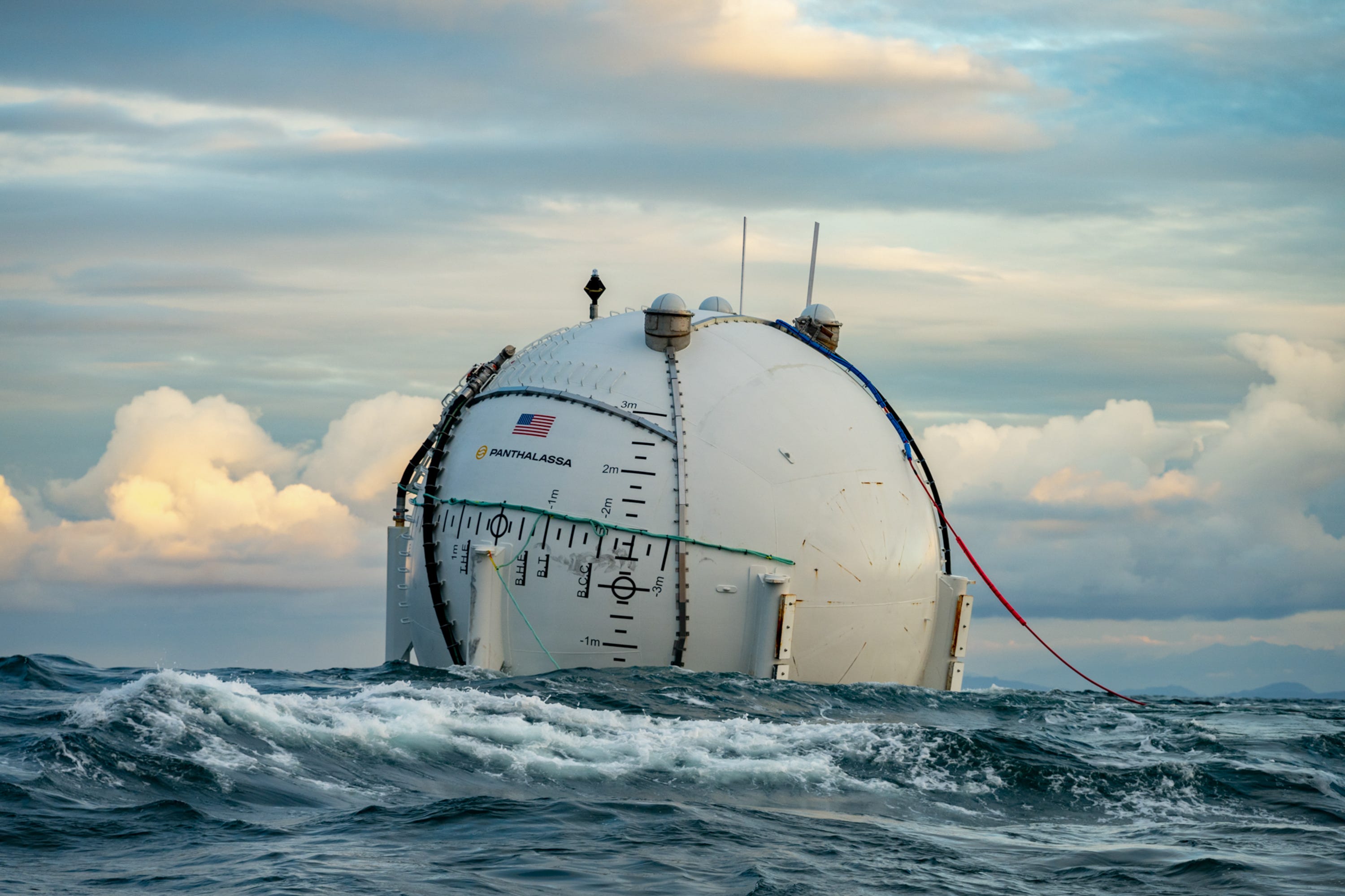
Pantholassa, co-founded by Garth Scheldon-Colson, is pioneering a system to capture energy from waves in the deep ocean, far from shore. The core of the system is a "node," a large, hollow structure (up to 20 meters wide and 80 meters long) that uses wave motion to pressurize water and drive a turbine with only one moving part. This design is deliberately simple to ensure durability and mass producibility, avoiding the moving parts that have plagued previous coastal wave energy efforts. The company aims to deploy these nodes in high-energy ocean regions, such as the southern hemisphere’s wind-driven wave belts, where energy is available continuously. This approach, Scheldon-Colson argues, could achieve the fastest energy deployment in history, from concept to gigawatt scale, by eliminating the need for land-based infrastructure like cables and foundations. Initially, the power generated will be used for floating data centers, an application that reduces pressure on land-based grids. The company emerged from Scheldon-Colson’s macroeconomics background at Bridgewater and a realization that the deep ocean is one of only three energy sources (alongside solar and nuclear) capable of supplying tens of terawatts. After a decade of development, including breaking prototypes and long walks to refine their approach, Pantholassa is now focused on scaling their technology for commercial deployment.
if we go super fast and follow the plan that we're on with manufacturing, that will be by far the fastest progression from conceptualization to gigawatt of deployment of any energy technology in history, including gas turbines, including salt, and a solar took 50 years to do that, including nuclear, anything. And that's driven by the fact that it is so darn simple. [MUSIC PLAYING] [MUSIC PLAYING] Welcome to the Core Memory Podcast. This is actually Vance. Have a guest on today who I think you guys are going to-- your mind is going to expand and be blown away a little bit. Garth Scheldon-Colson, thank you for joining us. My pleasure. You are the co-founder and CEO of Pantholassa. Tell me how you say it. And some people say pantholassa. Some people say pantholassa. OK. OK. It's amazing. Company and I am where we're definitely going to talk about the origins of it. I'm going to briefly take a crack at pointing us in the right direction, and then we'll dive in on all the details. But so you guys are broadly in the getting energy from the ocean business. You've been around for about 10 years. Yeah, we started 10 years ago. OK. A bunch of SpaceX, Blue Origin style, heart attack, people, been up in Portland, beavering away for 10 years in relative secrecy. I mean, there is some stuff out on the internet. You guys put out this great video and people can find tidbits about what you do. But you haven't really gone in to gory detail. I think it's fair to say about the vision. That's right. Yeah. Quasistouth. And so, yeah, well, let's get into it. I think we first talked, I want to say, it was like three years ago or something. And I heard you, somebody told me there was this incredible company help in the Pacific Northwest. It would be right up my alley. And it definitely is what I mean, why don't you describe the basics of this machine? Maybe the place to start is like, we're not just trying to build a machine. The machine is part of it. But really, it's a system that we're trying to build. And what the system does is capture energy from the middle of the ocean. And so, you need, as part of that, a machine that's really good at capturing energy. But you need a whole ecosystem of other things to build those machines and send them out. You need things in some of our deployment models to bring the energy home or in others of our deployment models. We have computers living on the systems. So there's a whole ecosystem with the goal of really unlocking this new energy resource for humanity. And what is that new energy resource? It's the ocean, far from shore. So this thing that we have, you know, a giant 70% of the planet contains enormous energy in the form of waves, in the form of the winds that are blowing over it. And yeah, so we're building the system to go and harness that for the first time. Yeah. So these things, what do you call the object itself? The object is a node. So these nodes are out in the deep ocean where the waves are quite large and they're getting the energy from the waves, from that motion where nobody's harvesting this or making use of it today. And you have this system of the water rushing in and out of these nodes. And then there's a turbine on the inside that's getting spotted out. We're going to go into deeper detail on this. And then, so you're producing energy and then you kind of have two options. Once either you take that energy and like bring it back to shore or you do something interesting right at the node. Is that exactly? That's exactly. Yeah. Okay. And then, so for the last 10 years or so, you've been working on building these nodes and I, you kind of, I'm sure you start out with a relatively small one and get bigger and bigger. What is the, just to give people the picture in their head, the first ones that you hope to commercialize, what size with these? Can you like paint an image of this machine? Yeah. So the machine is designed to capture the energy in a way that uses as few moving parts as possible. People have looked at waves coming onto shore in the past and said like, oh, it would be great if we could capture that. They built systems on shore that have like flappers or maybe things that slightly offshore that have articulating members. And the history of those efforts is not spectacular. A lot of those moving parts systems break really easily and they're expensive. And there's actually not that much energy that comes up close to shore anyway. And we can go into why and all of that. But what we said was what if you could build the system that lives out there and therefore doesn't have an attachment to anything, it's just a self propelled system like a ship but it doesn't look like a ship at all and can go and sit there and has no moving parts if you can get away with that or we have one moving part, it's the turbine. And so over many years we said like what would those constraints be that could allow you to design a system like that? What we converge to is a system that's a lot like a hydrodame actually. It works by moving water into a pressurized place and driving a water turbine and recycling that water back and the water basically goes in a cycle. That's all driven by the up and down motion and the up and down motion is driven by the waves that are coming through. In the region that we want to go to, you have those waves all the time. So you can be deploying these systems there on all the time which is different than solar different from wind. And these regions are huge. You can deploy really as many systems as you want. What are the top ideal regions? So if you had a map of the world and you colored it by wind speed, you would see over parts of North America. For example, you'd have green, that's like medium wind speeds, Texas is like medium wind speeds, Australia, medium wind speeds. When you look out into the oceans, particularly in the southern hemisphere, you see this bright red band that's like 25% of the earth's surface. And in those regions, you have just insane winds all the time and that's creating these waves that are on all the time. So those deployment regions, there's also ones in the North Pacific, North Atlantic. If you can deploy there, you get this really high power density all the time. And so what we're really trying to achieve is a renewable resource that doesn't have those same limitations of extreme intermittency. And that also doesn't require all the same kinds of infrastructure builds that you need to do things on land. Okay. There should no briefly. I, I just, my finger, people are watching this and wondering what happened. I will spare you the details of this. But this is why I have this ridiculous page and I have no idea where the nurse tied this bow. But, it's beautiful. Yeah. Yeah. I hope you're not in pain. I'm okay. This is kind of like day, this day four of this dry. I was in pain. So, okay. I cut you off from, from giving kind of like the dimensions. It is almost looks like an alien craft. Yeah. It looks like a big lollipop sort of. Yeah. Yeah. You know, it's got a big top part that's wide so it can take the forcing from the waves at the surface. Then it's got a slender cylindrical part that goes down quite a ways. And at the top you might be 20 meters across and then you might go down like 80 meters. Yeah. Like they're big. They're big. 20 meters across. Yeah. 80 meters long. Okay. Yeah. And the cool thing is their hollow. Yeah. Their hollow because inside is just a bunch of channels that cause the water to move around in the right ways to drive that water turbine. So you can be big but really like a balloon you're not using that much material. And then what is the turbine feeding into? The turbines in one of these channels inside that is capturing the water after it's been deposited in a pressurized place. And then the water flows through the turbine back to an unpressurized place. But like if you're if you're spending the turbine, what is it? Where's the energy get directed? Oh, it goes from the turbine. The turbine has a generator attached. So power comes off. We condition the power. And in our primary application right now, we're basically building ocean data centers. So all of that power is being converted into energy for the computer chips that live right there on the platform alongside it. All right. What I want to talk about this so bad. I'm going to take us backwards for one second though. I remember living through the dot com boom. And we had a very similar situation to today. People were building enormous data centers. There was an energy crunch. I remember all of these title companies that you're talking about out of nowhere. I used to cover the stuff in pretty gory detail. There were all these startups that wanted to do energy righted right by the shore. They built a bunch of prototypes. They were being funded by like Wall Street banks and there's some in Europe, some in the US. And then to your point, I just feel like I've never heard about these companies ever again. And so you know, I think it's a boom bust kind of thing. The dot com bust came. I think probably oil got cheaper and started to change some of the economics of these things. But so what you were saying before that there's just not enough title action to make those make sense. I was always curious what happened to these things. Yeah. Well, if they were title. So there's there's a couple categories of ocean energy. There's title, which takes it from the slow motions from the moon. It's like, you know, day long cycles. Then there's
currents, which is like the Gulf Stream, you know, is a current. It's driven by thermal gradients or a little bit by wind, but then there's waves. And waves is driven by the wind and it exists at the surface, comes into shore as things you can surf, but is out in the middle of the ocean as like these unrelating motions of water. So three very different categories. We're doing waves. Waves is by far the biggest of those. And waves is driven by the winds far from shore. So like for example, you get good surfing in Hawaii from waves that are being created in Alaska or in the Southern hemisphere. So these waves can travel for very long distances without diminishing. And that means that they're storing up that energy and you can take it any time of day, any time of night. Okay. And so the back-endless.com period, it was probably these first two categories. It may have been, yeah, I'm not sure what people were, I'm sure there was waves stuff happen again too, but all of these had this same problem of like moving parts close to shore, expensive, bringing the energy back on a cable. So you're having to touch the seafloor and drill thing in. We tend to think that it's basically the wrong approach to try to do it close to shore with these pretty mechanical systems. The approach that we're taking is like mass produced, these really simple, almost hollow objects, low precision, they self-propell out to the resource. You can deploy as many as you want, you can deploy as fast as you want. And they're super efficient, super cheap. It's basically the fastest deployment model for energy, the system that we're building. Because you don't have to do all this other infrastructure. You don't have to build infrastructure. You don't have to take trenches, you don't have to get people going to a site. It's literally mass production. And this is what people like try to achieve with other things. It's like solar panels are sort of mass produced. You can have one factory that spits them out. You stuff to go and install them somewhere. You still have to run transmission if you want it on the grid. What we're trying to do is decouple even more than that with a mass-producible system. So our systems, once you mass produce them, you send them. They have no dependencies on anything except the satellite connection. >>Okay. Yeah. >>So it sounds like you didn't dig in a ton on this stuff that I was seeing. I just feel like I heard about this. People playing in the Zarina and then this idea went away. And maybe I just wasn't paying close enough attention. But is that the case? This was kind of a thing. People were looking at for a while in different forms. >>And then people have been doing, even wave energy people have been doing for the censure. >>Okay. >>Different forms. >>Okay. >>And so then you might say, well, what makes our thing different. >>I want to kind of the origin story because I'm picturing you guys sitting around. I mean, I know some of it, I think, which is like, okay, people are starting to do nuclear fusion. There's doing tons of solar stuff. It's like, we don't want to do what everybody else is doing. There's already a ton of money and efforts along these lines. We see the ocean. It feels like this is not fully tapped. So we're going to go do that. But I'm just picturing a bunch of you guys sitting around and like, we're going to let's just build this crazy object that sits out there. What is, how did this even come about? >>Well, my co-founder and I, we came out in our own ways. But for both of us, it was really like where on the planet can you get huge amounts of energy? It's really a process of elimination for principles kind of thing. I won't, I'll spare you going through all of the different energy sources. But at the end of the day, there's really only three that can get you tens of terawatts of new energy. A terawatts is like a third of the global electricity supply today. So if you can do multiple terawatts, you have the ability to double the global electricity supply. Solar, tens of terawatts available, nuclear, tens of terawatts, and then middle of the ocean, tens of terawatts. Those are actually the only three. And then you can go to space for more solar if you want that. Nuclear includes fusion and fission. Both of those have tens of terawatts. Everything else is pretty capped, actually. And so we were pretty stunned. I was pretty stunned when I started to look into it that, wow. So, you know, of one of the only three resources that can get you tens of terawatts middle of the ocean, nobody is trying to build the tech stack that could live there and capture it. Instead, they're doing coastal stuff, which is fine, but it's not really getting access to that real resource in the middle of the ocean. So when you're talking about these tens of terawatts, you and your co-founder are trying to predict where humanity is going to go and what it's going to need in the decades ahead. And it's a, you know, we got on to the compute energy thing quite early, actually, because, you know, you could look at the energy growth curves and see this was even in like 26, 2016, 17, that it was already exponential. You know, you had exponential growth. You had alpha-go happening. You had these breakthroughs in AI happening. And even if that exponential just continued the way it had up into that point, you were going to see this start to pressure the grid within 10 years. And that's what's happened. But I think, you know, for myself at least, I came at it from the perspective of humanity needs more energy. It's what drives living standards. You know, you can look at all of the correlations. Anything you can do to provide cheap, sustainable energy at terawatts scale that's being used for something useful is an extremely good thing for humanity. So you know, when we're doing floating data centers, even though that energy isn't getting back to shore, we're offsetting the need to build new power plants on land. We're keeping energy prices lower on land. So it has these knock on effect, no matter where on the planet you do it, as long as you're doing it for useful applications that would be getting built somewhere. All right. What do we do at Core Memory? We cover innovative, fast-moving, forward-thinking companies, which is why Core Memory is sponsored by Brex. Because Brex is the intelligent finance platform for many of these companies, 30,000 companies from startups to the world's largest corporations. rely on Brex's technology for their finances. They've got smart corporate cards, high yield business banking, and expense automation tools that are fantastic. I hate doing my expenses and Brex's AI's software run right through those expenses, figure out where we're spending money and take care of so much stuff for you. So you don't have to waste your time on it yourself. Go to Brex.com/corememory to learn more and just get with the program. Let's get going. Let's get out of this archaic finance software and move toward the future core memory and Brex. And so I definitely see your point about don't need infrastructure in the same way. There's parts that are easier. I mean, the first time I heard about you guys, I was like, yeah, but everything is harder in the ocean. So water is corroding everything. You've got these things in the most difficult conditions of your eligible and then you've got to get something back from wherever you've put these things. And so I could see some of the ease, but then it would have been daunting to me to begin to approach this. It is daunting. I remember walking around in those early days before we had developed the tech that we have now. We had systems in our minds, even ones that we prototype that had pulley systems or two bodies, stuff that we consider even then we considered it bad. But I remember just walking around the hills where we were outside of LA and just trying to imagine these systems operating in these huge conditions. And it was really depressing because if you have a system that's not perfect for this without moving apart solid state, simple, made of steel, just like a big beach ball made of steel, like that will survive, a ship will survive, a solid steel object. But if you have these contraptions, it will not survive. And so it was those sort of depressive long walks and lots of prototyping, lots of breaking things that see that sort of led us to this set of constraints that we adhere to and then we now develop the technology that we have. And you personally were not at somewhere like SpaceX. That was not it. Yeah. I mean, what were you doing immediately before you did this start up? So I was immediately before I was at Bridgewater. Which, you know, I do, but no tell us. Yeah, so it's a hedge fund founded by Ray Dalai. I think a lot of people have seen him in more recent years. And it focuses on macroeconomic investing. So what that means is looking at big movements between things like interest rates, currencies, equity markets on a country level, not like investing in Google, but investing in the whole US stock market and the mechanics that drive those things in relation to each other. So I ended up there because I had had a long interest in economic theory that I pursued all through grad school, even though I wasn't really doing that kind of degree. But it's just something I really cared about. And so Bridgewater was a perfect place to land. It sort of combined a lot of my interests in energy and finance, but with economic theory and other things. So I was there for two years. I was working for the chief investment officers doing all kinds of different research on whatever happened to be. They need a Bridgewater out of school. Out of grad school. Yeah, that's what I thought. And I might. Okay, so you're sitting around your Bridgewater, quite a successful business. You kind of had a very nice life, you know, investing in things, making a lot of money. And instead, you decide to do a hardware startup, which is, you know, can be a calamitous decision. Thank God I didn't know how hard it would be. You know, it's that thing you never would do it if you knew. But yeah, it was, you know, Bridgewater was great. Like extremely smart people working on extremely interesting problems. But for myself, I was like, you know, boy, I've gotten all this trading. I've gotten to school for a long time.
time, like, wouldn't it be nice to use that to build a really positive some new technology or new something that can really deliver value at the sort of base level, providing commodities that help us all live. Yeah. Help us all have things that we need, like, roads and schools and that kind of thing. Here you are, 10 years later. You still look sane and it's close, close call. So what was, I mean, you talked about these different ideas you were batting around and what was like, how long did it take you guys to get to settle on really the machine you were going to tackle and then how did you go about it? It took several years. But the thing that, so I'll talk about my co-founder a little, I found him on-- We should name him. Brian Moffat, credible inventor, incredible problem solver. He spent a lot of time at places like Disney Imagineering, Google, different R&D companies, quintessential inventor type, very lateral. Right. He's the guy who will come up with 10 ideas. Seven of them will violate the laws of physics. Two of them will not work. One of them will be absolutely brilliant. And I found a YouTube video he had posted of a talk he gave of him describing, first of all, the different attempts to harness wave energy. And in a very nice way, highlighting some of the challenges that they would face or had been facing on the basis of some of that complexity cost being close to shore. And then in the latter half of the video, discussing the technology that he had created, this was like the precursor technology to what we have. So it had many of the same principles of like, man, it better just be solid state. And we were able to learn on the basis of prototyping that system and then prototyping many other systems. At each stage of that prototyping, we learn new things. And by the time we got to the system we have now, it really encapsulated all the things you need. So you guys, it's like a marriage made on YouTube. It was. And I flew out to LA like pretty quick. We had, you know, chick-fil-a for four hours. We both agreed to quit our jobs at the end of that conversation. And that was, you know, in these initial years, were you in LA in the workshop? Yeah, we had a house, we had a garage. I mean, before that, the vagaries of like being a new entrepreneur, I spent like half my life savings on an office. That was like huge, even though we had no people, you know, anyway, you learn things early on. But no, then we got a house and we got the garage and we had our labs set up in the garage. We had Dan. Dan was our first hire. He was at SpaceX doing engineering on the drone ship that catches their rockets. Yeah, yeah. So he was our real hardcore engineer. What stands last name? Place. Okay. And were you set up in El Segundo or Hawthorne? We were up in, more park next to Cine Valley. Okay. So we had a house that was just our company house, you know, doing all the things. But even before we had the house, we would go out on sea trials. You know, Brian had that prototype of that early device. We would, I remember I, you know, at least three sea trials where we took that system out. It was a big long tube that had a turbine in the middle and it had a certain shape to drive the turbine. We toss it off the back of work boats, dangle it. And the boat was acting as the buoy, pulling this thing up and down through the water. And then we would measure how much water was going through the turbine. That was the principle of operation of that early device that we had. And those early sea trials worked, you know, they, we saw power in the turbine. But we had no ability to simulate the system yet. We didn't, you know, we didn't have a lot of the principles of how much mass that system would need to create the optimal up and down motion. So like many things along the way that we learned, but that system did some good things early on. Were you guys bankrolling this yourself? That's the idea. Yeah, for how long? Like a year or so. Okay. And then we raised from some angels, you know, who I knew. Yeah. Including the chief investment officer of Bridgewater. And when you, and then the quest becomes to build the first like proper, proper prototype. Is that, or I mean, I see you already had a prototype. Well, we had that prototype, but no, it was, it was really, you had to go through a whole series of creating new versions of this tech. And the way to think about this is early days of airplane or early days of wind turbine. I don't know if you've seen like all the crazy designs that existed in wind turbines early on or airplanes, you know, before the Wright brothers, even after the Wright brothers, you still have to figure out lots of things. So even after you start to get some of the principles, you still have to encapsulate them in the right structure. And you have to get the, in our case, you have to get the plumbing right. And so there's, there was five years of just R&D to turn this. And so this is a new thing. I mean, if, if you look at the, the properties of this device, right, it's got to be a power plant. It's got to be really mass-producible, just made of earth abundant materials like steel. It's got to be a vehicle. It drives itself around out there. It's got to do that without moving parts too. Like, you know, we can't have propellers or motors. This is a mobile system. So you need all of those things. We want all of those things to be created by the fluid dynamics of the structure and nothing else. So many pieces to sort of get right. Somebody questions again. This is so fascinating. Okay. Does it, what you say in drives itself around out there? You guys, if I remember right, I mean, you, you today, you take them out to see on, on like a barge, right? We don't take them out on a barge. We throw them out at certain distance. So they're just dragging behind, yeah, dragging behind a tugboat in a horizontal configuration. So remember, it's like this lollipop, lollipop is horizontal, and then we press a button and it flips vertical. Okay. Then you release it. Okay. And then it begins operating. When it's in that vertical configuration, it moves around. From, from just the shape. Everything works because of the shape. But it's the water that's moving, it pushing it around. Correct. And then what's, but what is giving it some direction? There's an asymmetry in the shape so that it's up and down motion causes some water to be pushed backwards. Okay. And that causes it to move forward. And then we have different ways of steering it. So that all you have to do is sort of rotate it around its central axis and it goes. So we can drive them around like Roombas out there now. You're giving it like a waypoint and it's just gradually heads toward that. Exactly. Okay. Yeah. Okay. Because I've been in a sail drone before, but I mean, I guess they have some, they've got a sail that, yeah. Yeah. At their, at their disposal. But that is wild. Okay. I've seen these things. I didn't realize that. Yeah. Well, the one that you were going to come and see, ocean two, didn't have that propulsion yet. Okay. So that one was always tethered to a craft to a tugboat. But since then, we've deployed systems that do have the propulsion built in as well. And we're doing tests right now of a system like that. So, so yeah, now all of the pieces are in place to have these, you know, it is a self propelled hydroelectric dam that feels itself using wave action. This is sci-fi stuff. Okay. When you're talking about them being out where the waves are really large and pretty deep water. I mean, how far away are we talking about? And they're, they're, they're steering themselves all that way. Right. So how far? Well, we take them out some of the way. You know, we take them out 50 miles, maybe two. We haven't figured out the optimal distance to take them out. And that depends on actually a lot of different things. In the future, that won't even be humans doing that. We'll just have an autonomous system that sort of sucks onto the front and toes it autonomously releases it. And then it goes. So we want the whole thing to be on autonomous flow. Okay. You shouldn't need humans in any of those marine operations before long. But even if you take it 50 or 100 miles, how far does it have to go? Well, then it flips and then it goes, you know, another 200 miles and other 1000 miles just depending on where you want to be. And that's, that's also a question of do you want to be in the places with the best energy? Or do you want to be a little closer to shore so you can bring it back more easily? Yeah. But, you know, the system is designed to be able to support any of those. And in the future, we want to have fleets of these that are far from shore, you know, very far from shore just operating and not in the way of anything, not in the way of shipping, not in the way of fishing. And, you know, quite spread apart too from each other. So it really shouldn't bother anything. How many miles a day can they do at an ideal? I just want people, everyone just pause for a second. Either look on the show page for this podcast or go to the website and just see the shape they don't look like they would. No, they're not, they don't look like exactly. I mean, they're this vertical thing. They've got huge amounts of drag, frontally, you know. But, but yeah, we figured out this way that they sort of bob along and they sort of bounce when you see them in a wave tank. They sort of, it's sort of like, yeah, sort of like a bunny rabbit bouncing along and drawing forward. And so, like, how much ground could they cover in that? They go about a knot, not in half, so they could do like what 30 miles a day. Okay. Okay. And so in your vision, there's just hundreds of these sitting in some ideal spot and they're just producing energy. Yeah. More than hundreds. And then you have to find somewhere where there's not tons of boat traffic and which is relatively. In the Southern hemisphere regions, people don't go there for, you know, conventional human activities. Again, I have so many questions. I'm not sure which order to go in. So I'm just going to start blurting it out. Go out. And if you're out in this territory away from land, I mean, do you have to get permission from different bodies to be there and who's, who's, who do you have to cut in on energy deals and all of that? So we want to be a great citizen of the ocean. And as we go on, I'm sure we'll need to develop new procedures for, you know, making people aware of our presence beyond the standard. [BLANK_AUDIO]
But the standard includes beacons that give our location, it's called AIS, give our location by radio and satellites can pick that up and lights and horns. So all the standard things that you would want, but these things are pretty big. No one's going to really miss them. Since day one, the core memory podcast has been supported by the fine people at E1 Ventures. They are a young and ambitious VC firm in Silicon Valley investing in young and ambitious companies and people. Thank you so much to E1 Ventures for all your support. I mean, they're big. And again, just to bring up sale drones for people who don't know, it's essentially sort of a robotic sale boat. And I mean, they've been sailing for years with dozens upon dozens of these sale drones. And they stay out of boats, ways. And as far as I know, they've never had any incident at all. And so, I mean, when I first started to hear, when I spent a lot of time with sale drones, this is crazy. Man, just give me a running image. It seems very difficult to me, but the ocean is large. And with the AIS tracking system, I mean, it's quite sophisticated. And so we know relatively well what's happening out in the ocean and where things are. Exactly. It's a much easier autonomy problem than cars, by many orders of magnitude. Because there's nothing to run into out there. Okay, so before we talk about like 20 meters wide, right? And so how much energy would each one of these produce? Each one is on the order of 200 kilowatts up to a megawatt, depending on size. That's a lot. It's a pretty sizable amount. Yeah. So that's, you know, the historic way people talk about it is like a kilowatt is an American household average power consumption. So that's a rate of power consumption or production. And so we produce 200 kilowatts to a thousand kilowatts per node. We're making breakthroughs pretty regularly that are increasing our power and all of our simulations and stuff. So I think we're still very early in where we will get, like we may get to, yes, you know, more than a megawatt node. And then within the ecosystem I was describing, we will also in the future, if we want to, have ways of aggregating the energy from nodes to central platforms, if that's useful for certain applications. But for the primary application of the floating data centers, the cheapest and most mass-producible format is for the chips to live right on the system that's producing the energy. So you're not having to move it anywhere. It's just all being consumed right there. And that allows you to be super fast at mass production and it minimizes the cost. You can have battery in the system or you cannot have battery in the system. So all right. I'm not going to leave people and suspense too much longer. We're going to do the data centers because it's a Barker's idea to me. But just one more frame of reference for people in your idealized world, where would the cost of energy from this type of system stack up against solar, natural gas, just to give people a frame of reference? Yeah. So we already have designs that are two and a half cents per kilowatt hour. That's in our, you know, once we're mass producing them at scale kind of thing. We need a factory that's turning them out at the right rate. But when we do that, they'll be at two and a half cents. That's below solar in most places. That's below natural gas in most places. And I think we'll probably eventually get to like one and a half cents per kilowatt hour. So that's really unusual. And then for a renewable resource, it's particularly unusual in that it doesn't have the intermitency, at least not to anything like the same degree as solar and wind. So we don't need nearly as much battery or any battery. If you want to run your chips all the time, and that's another big cost that you get rid of. And then there's another big cost you get rid of in that we get to be in this really beautiful thing called an ocean that's really cold. And so the chips can just live in a canister down at the bottom and they get to exchange their heat with the ocean for free. No big chillers, no using water for evaporative cooling. You don't even have to build a structure. It's just the same structure that's housing all of that. So you also get to eliminate the costs of your conventional data center. Okay, all right. I saw some of, I've got a little skepticism on some of this big sense, the cooling part. Okay, let's break it down. If you have a data center out of C, first of all, that's insane, but very cool. Would this be, I mean, tell me what it looks like with the nodes in relation to some kind of structure with the computing or the computing is all inside the node. Compute is all inside of it. So you've got what, like server racks? Yeah, like each node, you know, as these racks get more and more power dense, like they're actually going to 500 kilowatts or it might go out per rack, you know, in some of the most crazy AI chips. So that's like one rack per node. That's not a lot of, you know, it's not a lot of space. Okay. So it can be embedded within the node in many different places. Today's racks, it might be four or five racks. And the way that I like to think about it is, it's a big iPhone. It's an integrated electronics appliance. Okay. That happens to be, many stories tall, happens to be making its own energy. But you know, how much work did Apple have to put into all of the electronics to package them in this beautiful form factor? But was it worth it? Of course it's worth it. Because now you have this thing that you can just mass produce and doesn't have dependencies on anything except the wireless network. So you can make as many as you want. Things that adopt that can leap frog landlines, they can leap frog infrastructure. So we're trying to give customers the ability to leap frog all of that infrastructure development by just mass producing this one unit. But how does the math post, how does it check out if you're doing, you know, I went to Stargate with Sam Alvin and, you know, you're in West Texas, real estate's cheap. You're in a big building. It's packed full of thousands upon thousands of server racks quite densely. Again, what you're saying about the water cooling, they've got a ton of infrastructure to do cooling, they look very expensive and hard. But then you've got these gas turbines that are right on site. How could the economics possibly be comparable if you're having to do one server rack per node, get all this stuff out to the ocean? Yeah, it's just counting up the different costs that they have and it's counting up the different costs that we have. But, you know, our biggest cost is just steel. Creating this hollow structure, low precision, you can make that using these very simple steel rolling pieces of equipment that form these things together. It's sort of like making big pipes. Then you stick in a really small turbine that you've machined and a generator attached to that power electronics and you can count all of that up and you do the math and it's two and a half cents per kilowatt hour. Natural gas is also really cheap. Like they can make gas powered electricity at like three cents per kilowatt hour. The problem right now is that it's really hard to make it fast. So drilling your gas wells but more importantly, getting the gas turbines is really slow. That's a big, complex piece of equipment, like eight year lead times right now, hard to scale up the capacity to make those. So alongside our low cost, which is an important part of the equation, is that we're super fast once we get going on this. It's a true mass production thing that's like very low precision and you can make those factories as large as you want them to be spit out as many nodes as you want. And then you don't also have to build the data center. The data center similarly, like there's the cost. There's all the electrical wiring. There's the walls. There's the chillers. The chillers have to be produced somewhere. But you need a lot of labor to do all of that. You need electricians. You need plumbers. And that's the big constraint right now on a lot of this stuff is like, where is the labor, the skilled labor to build? So our mass production scheme has much more automation, like per unit of energy production than, you know, sort of hand building data centers and power plants. Okay. So you guys disclose how much you think a node would cost to manufacture? Like order of magnitude of million dollars, it totally depends on the size and power level and stuff like that, but order of magnitude million dollars. Yeah. Okay. So there's these nodes floating out there with a bunch of GPUs in them and then they have to get the data from the ocean to somewhere. And so satellite is presumably your best at making up. That's where we start. Yeah. So you're what? You're star linking these? Star linking, type or, Blue Origins new thing. Okay. Okay. Which is fast, but not like fiber fast. Correct. So this was my biggest question, I think, which is like, I understand you can send the data and do things. It just seems like the name of the game, especially in AI, everything is speed. You're dealing with enormous volumes of data and it just, it seems like a lot to be kind of putting on a satellite internet. Yeah. So it really depends which part of the AI stack you're doing. So for example, if you're doing training where you have 100 megawatt cluster and you try to break that out and put that on nodes, the speeds that you need between those clusters way too fast to be doing training. So we might be able to do training of smaller models or different kinds of post training where you're refining the models that work on smaller clusters. But we're not targeting that. So we're targeting is just hundreds of gigawatts of inference. Yeah. Okay. So just spitting out the results. Just spitting out the results. And if you, if you look at it, the rate of data that goes into a cluster, delivering tokens and then the rate of tokens that comes out is actually very, very small. And you can, when you use chat GPT, you can experience this, you know, you type a query since they're thinking for a while. It's, it's back some text, but it's like, it's, it's spitting back a few kilobytes of text. You're giving it, maybe a few kilobytes.
of text, and it's sitting there doing tons of energy consumption during that time. So the rate of data per unit energy is extremely low. And that actually seems to be characteristic of intelligence in general. Like intelligence is sort of compression. It's like the bit rate out of my mouth to your brain right now, not high. Your brain is doing a lot of processing to make sense of that, and then you're going to give me a small stream as well. And so the more that happens, and then the next step after that is you put a lot of those different agents working together in the same place. And if they're in the same cluster or in nodes that can communicate by radio, you can have a lot of these intelligences out there just doing their thing among themselves. And yeah, sending stuff back by satellite, but a lot of activities can happen just in your distant location. And you guys started the company, Starlink was not even announced. I don't think I'm trying to go back in time. And people were doing like some satellite internet, I was pretty bad. I think Starlink has progressed way faster than anyone besides Elon. Maybe it would have imagined. And it is super impressive. So you were saying earlier that you guys were predicting where you thought data, you would have this exponential growth of data would go, but were you also just banking on the fact of something like Starlink coming into existence? To some extent, yeah, our beachhead market and compute was just going to be Bitcoin mining. You can do that over almost no internet connection. And then we thought some of our early patents, we talked about putting fleets of nodes out there effectively working as a giant coordinated brain. We called it brain simulation. We also called it artificial intelligence in those patents. But we knew you could get the radio links going between them and then maybe you bring a fiber buoy out to the fleet to do the final hop or something like that, meaning fiber optics out and then the buoy comes up and then you do radio from there. But then as Starlink started to get going, we're like, okay, great, this is a much better plan as well. I was wondering about the fiber piece because obviously that is in the ocean and is interlinking countries and continents. Is that still an option at all? Yeah, it's, you know, we'll use the satellite networks, but also you can just run fiber out, bring it up to a surface buoy. And now your mesh network of all the nodes has a fiber backhaul. Okay. That is just part of that same mesh network among the buoys. Okay, so I mean, the wildlife is, I mean, I have an entire company devoted to like pushing you, seeing where the future is going and I mean, there must be some people you talked to were like, this is fucking nuts. Oh, yeah. Yeah. Yeah. I mean, even when you describe it also matter of factly and I know you have, I see the hardware and you've built it out, but I think like the idea of a floating AI data center, setting everything up through space is, is, is bonkers. Yeah, it's a little bonkers, but then it's like, you know, if you want to think about it from first principles too, it's like, boy, you want to do a lot of compute. Wouldn't it be nice to just make these mass-producible objects that you can just put in a giant heat sink that has energy fluxing through it all the time? Yeah, it is like the best for principles way of doing it. And it does rely on each of those units not having to create a data rate out, but that's actually, you know, if you look at our brains like cortical columns are exactly this way too, they've got a ton of interconnection in each cortical column. But then the projections between cortical columns are like few relatively with fewer synapses and relatively low data rates. So having lots of hyper-concentrated units. How do you, what do you, how do you protect the server? When you see water-cooled systems, I mean, I've seen them for the last like 30 years, you know, there's this, it's very controlled obviously. You want, you don't want the liquid anywhere near the electronics and it just seems like you would have so much going on inside the system and then yeah, how are you getting the-- You're not bringing seawater into the loops, right? Yeah, so we have a cooling loop that's using the same kind of stuff that you would use in a data center. And then that exchange is its heat to the ocean in a loop. And that loop is in a part of the system that's not conducive to getting biofowl or anything like that. And maybe it's a stupid question, but the server rack is just, it's in some kind of waterproof
-- Correct, it's a box. A box? Okay. Okay. And yeah, people sometimes are like, wait, can you put servers at sea, you know, and it's basically, it's putting computers in a box. It's like in your car, you know, it has computers satellite. Yeah, like if I were to-- I don't want to put a server rack in the ocean. I'm going to hear it, but I get it. I mean, this can be solved. Yeah, it's sealed off from me. Yeah, okay. And when we, you mentioned it before and we hit on it briefly, but when we first talked, I mean, a lot of this, it was a little bit less tied to doing stuff out that sea. And if I remember right, I mean, it was a little more of, we're going to produce energy in the ocean and then get it back to shore somehow. Is that-- and it sounded like that still isn't possibly in-- Yeah, so the road map, the original road map was like Bitcoin first, easiest thing to do, requires almost no satellite way to make money. We sort of skipped over that now for the most part. Then AI, again, is just compute, which can live on individual nodes and you can scale that. We didn't realize that, you know, chat GPT and that kind of thing would come so fast, but once that exists, it can scale really fast. And then fuels. So fuels means you take the energy, you turn it into a chemical product. That's right, you guys were making hydrogen, right? Yeah, okay. And so Ocean One, which was one of our early prototypes, is making hydrogen. It also had the compute systems on it. So Ocean One was both, Ocean Two was just compute. And Wave Hopper, which was a more recent prototype, was the propulsion piece. So, but yet hydrogen and other chemical fuels, you can make them there, get them onto a ship, take them to platforms that are out there that can be doing things or getting it all the way back to shore. This is a more distant part of our road map, especially now that AI has become such a big thing because we're really a perfect platform for high energy compute and we're going to scale on that basically for the first, you know, I don't know, probably 10 years. I mean, if I was playing the devil's advocate, I'd be like, okay, you guys going to start with Bitcoin. It was hot. Now it's not. AI is hot right now. It may stay that way. It may grow exponentially, but it could all bust as well. And you guys are kind of chasing the thing of the moment to make this make sense, you know what I mean? Yeah. Well, it could be. I mean, we had Bitcoin on our road map before Bitcoin had its run-ups. We had AI in its road map, even then before AI, you know, I guess you can go look at the patents and see, but I think we were ahead of the sort of hype moments for these technologies. And, you know, and fuels has always been there too. So I mean, it is the case that you can't connect ocean stuff to the grid. You need applications, but I think that we've been correct in predicting the compute energy exponential and basing the company on being able to provide a solution to that. When you were explaining these ideas, you were coming to life not really during this like hard-tech boom that we're in now. Yeah, it was really hard to raise money for things like this. And it was a wild idea. Who got behind this? So the first group of angels that invested one of my old mentors, former private equity guy who I had done an energy project with on the East Coast, and then the chief investment officer, Bridgewater, and then another gentleman who had a small climate fund. So they were in very early and then Founders Fund came in and did our seed round. And so I give credit to those groups for, you know, basically listening and saying like, let's look into these claims about compute energy, let's look into these claims about this resource. And I hear from folks, for example, at Founders Fund that some of the things we were telling them then provided the basis for some of their other investments on Bitcoin, on things like Crusoe, because, you know, we sort of packaged that up and said, like, hey guys, take a look at this crazy thing that's happening. This is going to go to very large levels of energy. You're going to need people building a lot of data centers. You're going to need ways to produce power to rate that humans have not produced power recently. So, who did you mostly deal with at Founders Fund? Scott Nolan did our first investment. You know Scott? Yeah, I know Scott from back in the, when I was working on my book, Unieland, he was early SpaceX. He worked there. And then now he's doing like, he's making nuclear fuel, right? Yeah, yeah. He's got the company. He's got the really hard bug. When you, okay, we talked about a bunch of these different stages where, where argue guys at now in terms of producing these nodes. So, right now we're developing two things simultaneously. We're developing what we call the Ocean 3 fleet. Ocean 3 is our next series. It's a series of small nodes designed to demonstrate all of the pieces working together. We'll be deploying that starting this year off of the Pacific Northwest. What's what's small? Small is like in physical terms. It's about a little less than 10 meters across the top, pretty low power levels, like less than 50 kilowatts per node, designed to just exercise manufacturing and be able to get as many reps as possible.
manufacturing and demonstrate all the pieces working together. Then simultaneously, we're developing the manufacturing plant. Like I said, we can bring together all these different pieces of capital equipment, really simple things. There's sort of like pasta rolls for steel and things that take those rolled pieces and align them and put them together and do automated welding at the seams. You can configure those pieces with very little labor and very efficiently put nodes together because they're just these hollow, sausage-shaped objects. So we're developing that line as well. So once we're done with those two things, then you'll see, "Okay, well, we've got the nodes. They work. You can make them bigger. You can deploy as many as you want." We know how to manufacture them. Spit them out very quickly. By late 27, we'll have the ability to start producing larger commercial scale nodes, probably in this other hemisphere. Those nodes will give us much higher power levels and then we can start to do commercial deployments for our customers. As you get bigger, what are the curves in terms of what a size give you here? It gives you the higher power level on each node. Once you get up from 10 meter diameter range up to 20 meter diameter range and then you put it in those oceans that are more energetic, then you just get the 400 kilowatts or the higher power levels that you want. It is quite with rockets as the bigger you can go. All the math starts working better and better and better. There's a sort of optimum for us. It's not just bigger, it's strictly better. It depends which ocean you're in. It depends how big the waves are. If you get too big, you start to be larger than the wavelength in the relevant way. You start to not capture as much energy, but you're using more steel so it's not worth it. So there's a nice optimum size for each place that we go. All right. Another devil's advocate question. You talked a lot about how simple the machines are. The techniques are all there to build them. 100% get. Nobody's ever done this before. You got to figure out how to actually do this. Hard tech is hard. It always takes about a decade, at least for the most interesting companies I've ever covered to actually just start getting going. It's usually year 12 where things become the most interesting. But you know, couldn't wouldn't somebody come to you and be like, well, part of your pitch is that this is so relatively easy. This is attractive because these things are relatively simple to make, but you guys have been at this for like a decade and it still looks like they're quite hard to make. I think that's a reasonable thing for somebody to ask. The first six years was all just developing the tech that we have now. So we had to go through several iterations. Those technologies in some cases were entirely different from each other. It was a very different experimentation and prototyping. And so if you draw the line at the point where we had the first versions of our system, either on paper or in prototypes, you know, small prototypes like this, to now, it's actually been crazy fast. And if we go super fast and follow the plan that we're on with manufacturing, that will be by far the fastest progression from conceptualization to gigawatt of deployment of any energy technology in history, including gas turbines, including salt, you know, solar took 50 years to do that, including nuclear anything. So I think it will be actually the fastest to a gigawatt of any energy technology ever. And you said it sounded like you're saying other people are looking at deep oceans. Like, what's your competition? Who else is working on this and what are they doing? We're not aware of any other company that's trying to do the middle of the ocean in this way. In any way, there have been many other wave energy companies. There are obviously like offshore wind turbine companies. And there are a lot of people doing energy for compute. There have been people doing energy for fuels. But no, I don't know of any other ones who are doing middle of the ocean energy capture. Okay. I mean, just, you know, we've got space data centers that are people are talking about now. This week I was at a stealthy startup, which I think will be de-stealth by the time I was there, but they're using rat neurons to try to get more efficient AI models. I mean, it's like the moment of people trying out new ideas. Yeah. Yeah. I mean, yeah, there's going to be huge innovation, you know, analog chips of different kinds, maybe biologically inspired, yeah, photonics of all different shapes and sizes. So yeah, huge innovation. If it's done with conventional silicon and there's not some like really neuromorphic design, it's going to consume a lot of energy. So we feel pretty safe with that. But if someone makes a breakthrough, like a breakthrough to a Refic, you know, it'd be nice if you could use 30 watts. Is China working on I think like this? Not to our knowledge, but you know, they may suddenly start sometimes happens that way. It does. I mean, this is the parallel. I remember covering a massive windmill company based in Massachusetts that we wrote a story about this. These Chinese spies got the source code for their controller and then, you know, there's a couple of years later, they were out of businesses. Yeah. Brutal. We have some notes there, almost literally, in a sense that China doesn't have the resource. They don't have waves. And we have our patent coverage in all of the jurisdictions in the Southern Hemisphere, for example, that are close to the resource. And you do need to build the systems and deploy them pretty close to the resource. Like you couldn't build them in China and tow them in fully assembled form to these areas. That's wild. Okay. Yeah. So, and this I think is actually one of the drivers of why sort of the West has stopped investing in really cool technology. I don't know if you've read the Founders Fund manifesto and stuff like that, but I think a big thing that's happened is like, if you invent some really cool new industrial process, the Chinese are going to do it too. And they'll do it with lower cost structure. And you and the West are not going to get the returns that you would have gotten if you had been able to capture the rents from that. And obviously, Solar is the biggest example of that where we've entirely lost the manufacturing base, but many other things too. So that is another, you know, such as it is like selling point of what we're doing, which is we're not going to be dependent on Chinese supply chains in the same way. And it's not going to be possible for them to take the manufacturing processes and take them offshore in the same way. And where specifically when you're talking about the Southern Hemisphere, it sounds like that's the ideal first place that you will go. Can we be more specific about where? You can do it in Australia, which has a great industrial base. You can do it in New Zealand. You can do it in Chile. You can also do it in certain places in the North Pacific and North Atlantic. But we're really, you know, the whole premise is like you want to be hanging out in the parts of the ocean where the energy is the best. It's similar to space data centers in that sense or something. You want to be going to really where the energy is building the optimal thing because the data rates required to do AI stuff, for example. And many of these other really high energy forms of computing allow you to do that and put it where it's best. And if you're 200 miles off the coast of Australia, does Australia have to get paid for that? Where is that fair game? So I don't know how it works from a taxation standpoint, for example, but we intend to deploy the systems mainly in international waters. We will be manufacturing in host countries and we'll figure out where that is and we'll hopefully have great relationships with those host countries around the manufacturing and about the deployments. We'll be moving systems through those waters. We'll have big operations in those countries. And so we definitely want to have great relationships with any country that wants to host us. Once we get out into international waters, we still want to abide by all of the same regulations that one would abide by if you had autonomous systems close to. I know nothing about this except did a little bit on deep sea mining companies and it just gets, it seems like it's really been a battle to figure out. It's different because you're grabbing something off the ocean floor. People aren't sure yet, but some people argue that has these downstream effects on the environment or surrounding. Whereas I guess I could see if you guys are just kind of bobbing in the ocean. You're just bobbing. You would still have some of the same questions, right? It doesn't affect anything. You want to study that. We do study that. Things like acoustic signature, maybe if you have concerns about thermal, maybe if you have concerns about biofallowing, are you creating some habitat or something like that. So you want to study each of those things. We think that we're quite benign, certainly compared to most energy technologies and then very much compared to touching the sea floor. We never touch the sea floor and the treaty and legal framework sort of reflects those differences. The sea floor is really protected and you need to go through processes to even have the rights to do research and to touch the sea floor versus like law of the sea. There's shipping already and huge amounts of ships with huge motors that make a lot of noise and all of that. We don't have any of those harms and we work within the law of the sea framework which basically says like this is a global comment. People have a right to be there. You have a right to have your sailboat, you have a right to have your ship. That came out of a time when there were countries that tried to effectively colonize the ocean and establishes their sovereign jurisdiction and the world basically said like no, this is
This is for everyone. And so that's the framework in which we're operating today in my change in the future. And obviously we would want to be a part of that discussion. And in your autonomous vision of these going out on their own and maybe even one day having fuel brought back with a lot of boats and everything, I mean, what is tending to these as something goes wrong? And yeah, just maybe where do they end up when they've done their life? So this is the beautiful thing. At the end of life, they're just steel, recycle the whole darn thing and make new nodes. So from a supply chain, sort of like life cycle perspective, it's definitely one of the best things. Even in our most extreme deployment scenarios, we only use a tiny, tiny fraction of the global steel supply. And then it's entirely sustainable because we can just reuse all that steel. We don't have big things that need to go and land fills or that are leaching things into water supplies or anything like that. As far as getting the nodes, we have the ability to go and recover them. Obviously that we can drive them home in most cases while they're operational. If one happened to have a mishap and shut down, we can still go and recover it and bring it back to shore. Okay. And what got you guys to Portland? Oh, I mean, we were in LA. LA was great. We did some good early work there, but we really wanted to be in a place that was a little more like what we considered to be livable. And that maybe you have SpaceX engineers who want to have, you know, house and nature. It's a little more, what would you say? There's more options, I think, in Portland. And so we decided to plant there. There's also great steel fabrication. There's the rivers to get things out. So there were some practical considerations too. And then it turns out there's incredible people in Portland. We didn't know that we'd have luck recruiting there, but there's like incredible technologists in Portland as well. So we have a team that's maybe half Portland natives, half people we've recruited from Texas or Seattle or LA or San Francisco, things like that. And have you decided where you'll try to mass manufacture them first? We haven't yet. We've been analyzing different sites both for, you know, just literally the lay of the land and where would be a good place to put this access to the resource industrial base population center. And so we think we'll have several good options and we're starting those conversations now with potential host countries and so forth. So you're futuristic vision, which I don't know how many years off this would be, but you would have this manufacturing plant close to the water's edge. And it's like opening up and off the nodes go on their journey by the what, by the hundreds by the thousands. Yeah. In, you know, you're deploying these nodes, they're getting made in a highly parallelizable factory so that you can expand it easily and they come to shore probably on rail and you put them in the water either with a crane or a slipway. And then an autonomous system eventually toes them out 50 miles or 100 miles and they flip and they go on their way. And when they want to get a new payload or we want to do any maintenance, they come back to shore in the same way you grab them, you bring them back. And so it's really just like SpaceX boosters. If you can establish that very autonomous circulation, then that's, you know, you're centralizing all of your labor intensive activities in one place where you can make that really perfect and then the systems do the rest. I do. You have like a matter of fact way of talking about this futuristic and sophisticated stuff. I guess you've been at this for a while. This is like, it's all very normal to you. Yeah. It's become normal. Yeah. But yeah, it's funny, right? Like the pieces build on each other. We didn't have the whole picture at the beginning and I'm sure there's still things that will figure out or learn how to do better. Like, you know, we're always developing ways to make the nodes more powerful. And so like I said, I think we're still not really anywhere close to the bottom of our cost structure. Where did you grow up? I grew up in Hong Kong. Did you? Yeah. Okay. Like all through high school or? Through age 15 through freshman year of high school. Okay. What does your parents do? My mom worked for the Methodist Church. She was nominally missionary. She ran something called the liaison office between the church and the US and churches in China because it was pretty closed off at that point and you needed that point in Hong Kong to do things. My dad worked for a university there. Okay. Doing all kinds of different things like academic exchange and other things like that. And so were you more like, "Finance is a kid" or were you engineering? No, no, neither actually. Yeah. I did a lot of coding as a software guy. But I did philosophy in undergrad, along with neuroscience. But I was really into, you know, philosophy and how to think about the world and a little bit of philosophy of mind, but then also how brains work and how that relates to software. Yeah. I feel like I'm having, I've been doing a poor job of articulating what was going through my head. But yeah, I feel like you have a theory of the world, you know, and that this is your birthing, this thing to go into the world you want to see. You know what I mean? Yeah, I feel like I'm still expressing this poorly. But your mind, I could tell, which is just coming at this from a slightly different angle, just the way you express it all. Yeah. Thanks, yeah. Anyway, it's good. No, no, it's good. Yeah. It is a new world, but it's not just like my vision. Yeah. You know, this is something that we, you know, the thing that I learned early on is like when you get the right people together and you establish a good framework for innovation and creativity, all kinds of things start percolating up. And you've got to be pretty brutal about cutting down the things that definitely will not work. But then you get great ideas and it starts to come together into this system. But like I think that this system, whether we make it or someone else, is pretty inevitable. Right. This is certainly one of the best energy resources on the planet, if not the best. It will exist in a place that has the easiest way to move mass anywhere. You can make things in one place and you can send them out autonomously. We have the autonomy now. We have the satellites. The resource is there. We know that you can capture it in a insanely low cost and you can have the best thermal transfer anywhere. So it's like this system will exist one way or another. Is this something that Trump administration is into? I feel like you're confusing. You're doing manufacturing in America, but there is like this almost like green angle to this. Yeah. I feel like this puts some people in a difficult spot because they don't know where this fits. Yeah. Yeah. It is a hodgepodge. We want to do a lot of manufacturing in the US and we'll be making a lot of turbines here. Power electronics. We're obviously making our systems here now. Whether it's Australia, New Zealand, Chile, these future countries, New Zealand and Australia are allied countries. And then like I said, the ocean is everyone. So we want this to serve everyone. Well, Andrew just did that huge deal with the Australian Royal Navy around this go shark autonomous submarine. I was a multi-billion dollar deal and they built it in Australia and it really seemed that it was totally cool. It really worked out. Yeah. So it's sound, I mean, so there is like some world where maybe the first factory is in Australia. The first big factory will be in one of those southern hemisphere countries very likely. And Australia is a prime possibility because they do have a very strong industrial base. At that point though, our manufacturing slope is so steep that you can be hitting 50 gigawatts by 2035 and it's just about how much do you want to parallelize this manufacturing plant? Okay. We want to be going very fast to get this manufacturing plant developed. How many people work at the company to pull this off so far? Today it's about 100. And we're hiring rapidly right now. So and then we'll start hiring manufacturing teams in the host countries as well. What's like the single biggest thing that worries you the most about this that you feel like maybe you haven't solved yet? I mean, the manufacturing piece is the piece that we as a company have the least experience in. So we have excellent people. Many of our manufacturing people are from Tesla. We'll be hiring many more excellent manufacturing people, but this system has not yet been mass-produced and we will encounter issues as we develop those processes. I think that as manufacturing processes go, this one is likely to be on the simpler side. You battery chemistry, it's not semiconductors, it's literally bending steel and welding it together quickly. And that has existed in shipbuilding, it's existed in wind turbine towers, pipes, all kinds of other things. So I'm reasonably confident that we can develop that. You guys have been pretty quiet. You put up this video which I'm taking myself over. How many views does it have? It is a lot. Oh, I don't know. But yeah, it got caught by the algorithm somehow. I was like, fuck man. I should have made that. You're really kind and invited me up though. I had this like, it was a tough time. It was not working and then so I was sad. But still relatively quiet. You guys are talking like a little bit more now just because you feel like with everything that's going on in AI world, you want people to know what you're up to.
or-- - Yeah, well, we're starting to develop relationships around these manufacturing sites. And so it's starting to be time to tell the story. - I see, okay. - And we're gonna have that ocean three fleet out there later this year. And so we wanna be telling people about that. We're gonna be announcing some big commercial partnerships later in the year as well. And so all of the pieces are coming together now and we wanna get the story out a little more. We're hiring big time. We'd love to bring more people onto the team. So if people happen to see this and are interested, then, you know, we have a lot of jobs posted right now and we'll have more pretty soon. - They've come to the right place. And in the ocean three, it would be off the coast of Washington. - Yeah, Washington or again, exactly. Yeah, it'll be several. It'll be ocean three is a series. So there's three dot one, three dot two, three dot three. And that will be the first like mini fleet to be able to be proving out all of those concepts. - And we might be able to come-- - Come, yeah. - Do you still go out and about a lot? - Oh, I mean, for the last ones, I did, yeah. - I did. Are you a ocean worthy human? - I get less seasick than my co-founder. So, yeah, that was always a joke. But no, I think it's great to be out there. It's actually my happy place. You know, when you've got the swells coming through and you're on a tugboat and you see all of this power, but it's a very slow form of power. And this has been the hard thing in wave energy. It's like massive quantities of water undulating slowly. So there's huge force if you can capture it, but very little speed. And how do you make that drive the water turbine or drive a generator that wants to spin fast was always the big challenge. - Yeah. - One of many challenges. - Yeah, yeah, okay. Well, I avoided any sort of Wayne's World joke. (laughing) - Is that, is that, do you get that? - Yeah, I do. - I'm sorry. (laughing) - It's for the best. (laughing) Is there, is there really we missed? I'm sure we did, but do we get the big stuff? - I think we got the big stuff, but yeah, it's, I mean, let me just, let me talk a little bit about the compute platform. - Yeah, yeah, yeah. - In terms of the aspects of where we're going with this. You know, the big challenge in compute energy right now, is that it's really hard to build energy quickly, particularly in the West, like China's building 45 gigawatts a year of new capacity, largely coal, some solar, some nuclear. In the West, we've sort of atrophied on some of those dimensions, and these projects take a long time to plan. - Like somebody told me today, and I think it's true, China did more solar last year than the US has ever done. - Yeah, I don't know if that's manufacturing or actually deployment, but it might even be deployment. - Yeah. - No, no, I think it is deployment. - It's deployment. - Yeah, yeah. - So they're, you know, they're doing everything. They're really good at energy. If it turns out, and I think it's very likely that it turns out that energy is what drives dominant in AI, then we've got a big challenge in the West to achieve those levels of scaling, and it's a challenge for all of the big companies that are trying to deploy models, the folks that we talk to, you know, things that look good on paper sometimes can take a long time to develop, 'cause you can't find the labor, or you can't get the permits, and so forth. So what we're offering is a platform that you can literally just mass produce, and it's not that you mass produce it, and you still have to find a lot of people to deploy it. You've literally mass produced it. We'll develop payloads with you that contain whatever compute hardware you want. As long as it fits within our performance envelope, we can host it, and you can deploy that system at any scale you choose, almost at any speed you choose, starting in about 28 or so. And that we think is a new paradigm for compute energy deployment. It has some similarities to space data centers, but we think we have a lot of advantages relative to that in our speed. - Yeah, I guess the space data center guys just came along out of nowhere, the last like a few months. And we love the space data center guys. We think they're getting attention for good reasons, because there's a lot of pain that they're providing a solution to solve. And it's that similar kind of paradigm of go where the energy is, and that was always our motto from the beginning. - But Delian, at Founders Fund, he's super anti-space centers, because for obvious reasons to me, I mean, it's very difficult to do, and you're just, you know, it's a very inefficient path and so in many ways to getting the end result you want, but clearly Founders Fund is into your idea. So they see less levels. - Yeah, it's, you know, space data centers has a lot of challenges. You know, you can, people know what they are. They've got radiation to deal with. They've got getting rid of the heat to deal with. They've got a launch cost. They've got lots of vibration on launch, you know. Even harder for them to get data there. Like we can run fiber out. They can't, anyway. So there's different, but I think, you know, what I've noticed in technology is that like when a lot of smart people think about something, you can find solutions. What we're trying to develop is a platform that has many of the same advantages and fewer of the disadvantages. We've got great heat exchange. We've still got the mass production and deployment. It costs something like, you know, 50 times less for us to get a megawatt to our target location than them. And we can basically bring the systems back and swap chips whenever we want to. - And there's no like rare earth weird components that is, you know, involved in all this. That's, I see there's so many times in so much of the other energy stuff. - Yeah. - That the supply chains are tough for a lot of things in energy. I mean, obviously nuclear and fuel and stuff like that. Solar panels, you know, it's the manufacturing base has concentrated in China. So that even if they like nominally come from Southeast Asia, actually they're coming from China and inverters too. So it is really tough to develop a technology that the supply chain is really under your control. We do have a little bit of rare earth in the magnets in our generators. We could get rid of that if we chose to, but the rest of the system is just steel and paint basically. So it's a really, you know, it's a supply chain that we can control and that the rest can do the manufacturing. And that's a different thing compared to most of these energy technologies. - So they kind of, once they go where they want to be, do they stay in place or they're always rolling around? - They always roll a little, but we can tell them to go in circles, we can tell them to sort of drift this way and then come back that way, but they always have a little forward motion. I mean, when you talk about that, like how well do you know that that works? I guess it 'cause you've steered them. - We've steered them. - We've done it. - Yeah. - Yeah, we've done it at sea, we've done it in wave tanks, we've done it in simulation, and lastly, we're still making that system better as we go, but yeah, it's a very effective propulsion system. - How dense can they be packed? Like if you had 100, how much space would that take up with the ocean? - We tend to, in most of our models, we think of them being about a kilometer apart from each other. - Okay. - Yeah. - That's governed by things like, you know, you don't want them to be so tight that the ones in front capture, you know, reduce the wave height, so the ones in the back don't get any energy. You want to provide a nice spacing, and you can calculate what that needs to be. - Okay, okay. Thank you, Garth, so much, man. This is, it's like, it's one of the coolest ideas I think is it's so different to what other people are trying to do. And, yeah, yeah, I appreciate that. - And it's great to chat with you. - Yeah, and maybe we'll do some stuff later in the year with Ocean 3. - I look for any excuse to get on about with the camera and got it, minute. - Or a plane. It might be so far out that we want to, but. - We do planes too. - The boat is good too. (laughing) - And knock on wood, I don't want to get myself in trouble, but we have a very non-sea sickness crew. We've proved ourselves in the past. - Cool. - Great, actually great to chat with you. - Thank you, thanks so much, man. I appreciate it. The Cormary Podcast is hosted by me, Ashley Vance, and, or Kylie Robison, or both of us together. It is produced by me and David Nicholson. Our theme song is by James Mercer and John Sortland, and the show is edited. Always by the John Sortland. Thank you so much to Brex, anyone ventures, for all your support. And thank you most of all to everybody for listening. We're watching, we love you. Please leave us a like, a review, a subscribe. All those tremendous things. Thank you, and we'll see you again.
Podcast Summary
Key Points:
Pantholassa is developing a system to harness wave energy from the deep ocean, far from shore, using simple, mass-produced nodes with minimal moving parts.
The nodes are large, hollow structures (e.g., 20 meters wide, 80 meters long) that capture wave motion to drive a water turbine, generating power for onboard uses like ocean data centers.
The company claims this approach enables the fastest progression from concept to gigawatt deployment in energy history, due to its simplicity and lack of need for coastal infrastructure.
Deep ocean wave energy is a vast, untapped resource (tens of terawatts), available continuously unlike solar or wind, and is one of only three sources capable of supplying tens of terawatts globally.
Pantholassa’s initial commercial application is floating data centers, which offset land-based energy demand and avoid grid transmission challenges.
The company has spent 10 years in relative secrecy, evolving from complex prototypes to a focus on solid-state, durable designs inspired by the need to survive harsh ocean conditions.
Summary:
Pantholassa, co-founded by Garth Scheldon-Colson, is pioneering a system to capture energy from waves in the deep ocean, far from shore. The core of the system is a "node," a large, hollow structure (up to 20 meters wide and 80 meters long) that uses wave motion to pressurize water and drive a turbine with only one moving part. This design is deliberately simple to ensure durability and mass producibility, avoiding the moving parts that have plagued previous coastal wave energy efforts.
The company aims to deploy these nodes in high-energy ocean regions, such as the southern hemisphere’s wind-driven wave belts, where energy is available continuously. This approach, Scheldon-Colson argues, could achieve the fastest energy deployment in history, from concept to gigawatt scale, by eliminating the need for land-based infrastructure like cables and foundations. Initially, the power generated will be used for floating data centers, an application that reduces pressure on land-based grids.
The company emerged from Scheldon-Colson’s macroeconomics background at Bridgewater and a realization that the deep ocean is one of only three energy sources (alongside solar and nuclear) capable of supplying tens of terawatts. After a decade of development, including breaking prototypes and long walks to refine their approach, Pantholassa is now focused on scaling their technology for commercial deployment.
FAQs
Pantholassa is a company that captures energy from the ocean using nodes. These nodes are hollow structures deployed in the deep ocean that harness wave energy to power systems like ocean data centers.
The node uses the up-and-down motion of waves to move water into a pressurized chamber, driving a water turbine. The turbine powers a generator, and the water is recycled in a continuous cycle.
The ocean covers 70% of the planet and contains enormous energy from waves and winds, especially in regions with high wind speeds. This energy is constant, unlike solar or wind on land, and can provide tens of terawatts of power.
Previous efforts focused on coastal systems with moving parts that were expensive and prone to breaking. Pantholassa uses mass-produced, simple hollow nodes with no moving parts except the turbine, which self-propel to the resource and avoid complex infrastructure like cables or seafloor drilling.
A typical node is about 20 meters across at the top and 80 meters long, with a hollow interior containing channels to direct water flow.
The best regions are in the southern hemisphere, North Pacific, and North Atlantic, where there are constant high winds and waves. These areas cover about 25% of the Earth's surface.
Chat with AI
Loading...
Pro features
Go deeper with this episode
Unlock creator-grade tools that turn any transcript into show notes and subtitle files.
 PodcastTranscript AI