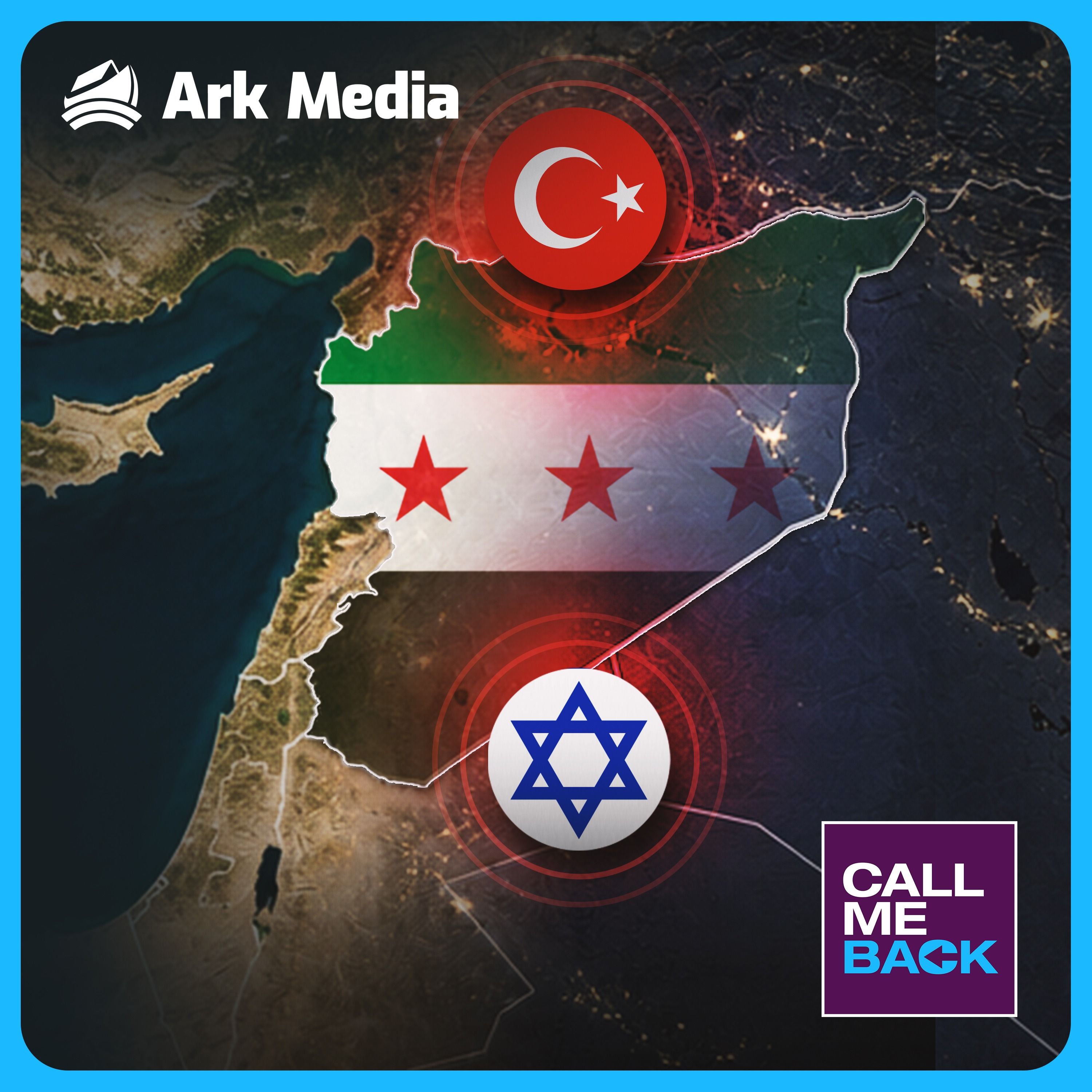
The Turkey-Israel Proxy War in Syria - with Nadav Eyal
from Call Me Back - with Dan Senor
42m 58s
The podcast discusses the escalating Israel-Turkey tensions in Syria, marking a breakdown of a year-long quiet arrangement where Turkey held influence in the north and Israel operated in the south. Israel’s strike on the Abu Al-Duhar airbase, aimed at preventing Turkish radar and military deployment, signals a red line against Turkey’s expansion toward the Golan Heights and Damascus. This comes amid Turkey’s broader ambitions to position itself as a regional superpower, invoking Ottoman history, and its recent defense pact with Saudi Arabia and Pakistan, which some view as a new Sunni axis filling the vacuum left by Iran’s weakened position. While Turkey gains leverage in Washington—evidenced by Erdogan’s role in blocking Israel’s Kurdish gambit against Iran—its influence is more transactional than Israel’s deep U.S. alliance. The strike’s public handling by Netanyahu has drawn domestic criticism as election posturing, with defense officials preferring discretion. Turkey frames Israel as the destabilizing force, using rhetoric about defending Palestinians and even dreaming of governing Jerusalem, while supporting Hamas in Gaza. Despite the friction, experts suggest a direct war is not inevitable, as both sides have mechanisms like a hotline and continue diplomatic backchannels. The episode underscores a shifting regional order where Turkey’s rise challenges Israel’s security and U.S. interests, leaving questions about Washington’s role in managing this new confrontation.
Over the years, ARC Media has become where people go to actually understand Israel and the
Jewish world. Our subscribers make that possible. Join us at ARCmedia.org, and to our subscribers,
thank you.
You are listening to an ARC Media podcast.
Erdogan is trying to reposition Turkey as the main actor, the superpower in the region.
And this, of course, invokes our history. Palestine, Eretis Reel was controlled by the Ottoman Empire
up to 1917, as was the entire region. As far as the Israelis are concerned, if they will not draw
the red line now and stop the Turks from doing what they're doing, and we're not going to allow
Syria to become basically a military base of Turkey, then we will find Turkey on our border
in the Golan Heights, or physically militarily in Damascus.
It's 7 a.m. on Wednesday, August 26th in New York City. It's 2 p.m. on Wednesday, August 26th in
Israel. Before today's episode, a quick housekeeping note. On Thursday, October 22nd, just five days
ahead of the Israeli elections, call me back. We'll hold a live taping at the Stryker Center in New
York City, where I'll sit down with Dan Shapiro, Dahlia Scheinlin, and Brett Stevens to discuss
what's at stake in Israel's 2026 election, and what its results will mean for the US-Israel
relationship. Tickets have just gone on sale, so if you want to join us, please follow the link
in the episode description. Now onto today's episode. For nearly a year, Israel and Turkey have
run what seems to have been an unspoken arrangement in Syria. Ankara gets political and economic
primacy in Syria's north, Jerusalem keeps its freedom to strike in Syria's south, and neither
side says so out loud. Well, that arrangement seems to have broke on August 18th when Israel struck
the Abu Al-Duhar airbase in northwestern Syria, citing intelligence that Turkey was about to install
radar and military infrastructure there. Israel's defense minister, Israel Katz, warned Ankara against
what he called "dangerous adventures," who was the most direct Israeli-Turkish military friction
in years. But many had warned about it coming, including on this podcast. Eleven days earlier in
Mecca, Turkey signed a mutual defense pact with Saudi Arabia and Pakistan. To put this in context,
Turkey is a NATO commitment-binding military power. Pakistan is a nuclear-armed state,
and Saudi Arabia is the custodian of Islam's holiest sites. This arrives at the moment that Iran
is at its weakest position in 40 years. Its proxies gutted its nuclear program set back its regional
corridor severed. This all raises an uncomfortable question. It's the vacuum left by Iran being filled
not by American-broker peace, but by a new, Sunni power access led by Turkey, which is increasingly
painting Israel not Iran as the region's destabilizing force. Meanwhile, it's not clear what,
if at all, is the U.S. foreign policy agenda as it relates to Turkey. What we do know is that
President Erdogan did convince President Trump to derail Israel's plan to activate Kurdish forces
against the Iranian regime at the outset of the war with Iran. But what else is the U.S.
approach to Erdogan and Turkey? To understand what happened in Syria and what these developments
mean for Israel and for the region, I'm joined by Arch-Media contributor Nadavayel, who has been
tracking this shift for over the past year, from Turkey's role in helping to end the Gaza war,
to its blocking of the Kurdish gambit in Iran, to the emergence of a new axis around Ankara, Doha,
and Islamabad. Are Israel and Turkey now on a collision course that Washington may not be able to
or perhaps want to even stop? My conversation with Nadavayel right after this brief message.
This episode of Call Me Back is brought to you by the Jewish Communal Fund, JCF.
The high holidays are a time to reflect on what matters most, including the impact we hope to
make in the year ahead. For 54 years, JCF has helped individuals and families put their values
into action through thoughtful philanthropy. As the nation's leading Jewish donor-advised fund,
JCF empowers donors to give more strategically, maximized charitable tax savings and make a
powerful difference with their giving. Through financial expertise, operational excellence,
and highly personalized service, JCF makes it easier to support the causes and communities
that matter most. Learn more at JCFny.org or follow the link in the episode description.
Jewish Communal Fund, strategic giving, powerful impact.
Nadav, welcome back to the podcast. Thanks for having me then.
So, Nadav, for the better part of a year, Israel and Turkey have avoided direct confrontation in Syria,
despite perhaps provocations, despite mutual suspicion. What was the thinking behind that
quietly agreed upon status quo? Just explain that and then I want you to talk about why does it
appear to be coming to an end? Well, Israel and Turkey historically had, at a certain point,
very close relations and even after the rise to power of Erdogan, Israel maintained these security
relations and so did Ankara. Now, this hasn't come to the media attention, but on the one hand,
you would hear speeches and sometimes attacks by Erdogan that border on the antisemitic or cross
over the line of antisemitic, but on the other hand, the defense administrations on both sides,
the Turkish and Israeli used to talk a lot and had a lot of collaboration, including exchange
of intelligence. And this was, of course, done with Prime Minister Netanyahu and Erdogan knowing
about it. I still remember working on Capitol Hill as a young foreign policy staffer in the Senate
in the 1990s and the Israeli government when they'd come to Capitol Hill were often lobbying on
behalf of Turkey. In other words, Turkey was relying on Israel's presence in Washington congressional
relations, executive branch relations to advance Turkey's strategic position in the region.
That's how synched up Israel and Turkey were. And the interesting thing is that Erdogan has these
ways of attacks against Israel and there are several Israeli Prime Ministers, not only Netanyahu,
even Olmer, suffered this kind of manic behavior by Erdogan. On the one hand, he could become
Israel's best friend and then a few months later something would happen usually with the Palestinians
and Erdogan would position himself again as defender of the faith, defender of the Muslims,
the Palestinians attacking Israel in words that are very unbecoming for an ally.
I would see like at his campaign rallies when he was, Erdogan would speak in these almost
ottoman, he would invoke like these ottoman themes that he was playing this role in the region.
It was Israel as a foil, not just in its own right, but in the context of Erdogan leading
the like resurgence of the Turkish Empire. Yes, this new Ottomanism is something that you see
across the Erdogan administration for many years. You even see this in ceremonies. People can
basically Google this and see that when this Turkey wants to present itself to the world,
when people are hosted in Ankara or come to Istanbul, they aren't presented with magnificent
shows of power that relate to the Ottoman Empire. And the suspicion in the region, by the way,
not only by the Israelis, but also by Arab countries, is that Erdogan is trying to reposition
Turkey as the main actor, the superpower in the region. And the history is that Palestine, Eratis Rael, was controlled by the Ottoman Empire up to 1917,
as was the entire region until World War One. Now, it's not only about history, it's about the
future. And let me give you just one example that is less discussed. And then we can turn to Syria.
Turkey is operating an apparatus of sorts in East Jerusalem, assisting the Palestinians there.
So it has its own charities or local charities that are infused by Turkish support, Arab
Palestinian charities that are funded or supported by Turkish foundations that operate in East
Jerusalem, which as far as Israel is concerned is, of course, a sovereign part of Israel,
in supporting, for instance, students so that they'll be able to have daycares for their kids.
Again, funded by Turkey or by Turkish elements. And this is an example that is brought by the Israelis
as to the attempts made by Turkey to penetrate not only the region, but also even Israeli
society and specifically the Palestinian society. So Nadav, as it relates to this quiet agreement,
unwritten rules of engagement in Syria, what was that about specifically and why did that end?
I would say that calling it rules of engagement is a bit too much.
Israel and Turkey were on this path of collision from the moment that the
HTS took control of Syria and they took control of Syria supported by Erdogan.
This was a huge win for Erdogan, the change of government in Syria, the way that
Jolani became the leader of Syria. He sees this as an area of influence and Israel
was trying to maintain, to block the Turkish influence. How? Basically, as far as
the Israelis were concerned, yes, the Turks were in the northern parts of Syria, the
areas that are considered to be Kurdish areas that they see as risking their
national security. They're also placed to some degree in the Idlib area and this
was the case before Jolani to control of Damascus. And the Israeli signaled to
Ankara. This is where it ends for you militarily speaking. You control about five
percent of the Syrian territory. We will not allow you to go further south towards
Israel, to have a presence towards Israel. They had, as they saw it, the Israel
and agreement with the Syrian new government that this would not be allowed.
And what the Israelis argue has happened in the last few weeks is an attempt by
the Turks to develop their outreach in Syria down towards the south towards
Israel. And this is the reason for the conflict. This is the reason we're
speaking this morning. Okay, so let's talk about this conflict. On August 18th,
Israel struck the Abu Al-Duhara airbase, as I mentioned in the introduction,
which is in northwestern Syria, a key point that Israel's now engaging in
northern Syria, where it had not generally been before. The Israelis are saying
they had intelligence that Turkey was preparing to deploy radar and military
personnel there. How does Erdogan read that strike? And then, of course, how does
Netanyahu read Turkey's response? The Turks see this as an
aggression by the Israelis. First of all, there is a denial. There is a denial
and they are back. We might discuss this by Tom Barak, who's the ambassador to
Turkey. But they're saying there was no intention to have a military, a
real military presence there. So they see this as a classic Israeli's trigger
happy aggression. Israel presented to the Syrians before the strike. And it did
so not only to the Syrians prove as to the deployment or to the approved
deployment of Turkish forces into the space. I need to underline that Abu Duhara
is really up north in Syria. It's not close to the Israeli border at all. It's
just south of Aleppo, of Halib. And for Israel to strike there is something
that is out of the ordinary on many different levels. First of all, it's the
first time that Israel is striking an area or a base or a target because of
Turkish influence. And it's an example of a crisis, a struggle for hegemony in
the Middle East. And this crisis of hegemony is now right now focused on the
Syrian front. Now the Turks see this as an attempt by Israel to break the
rules of engagement because as far they are concerned, this is northern Syria.
This is not the Golan Heights. It's not the areas in which the Jews'
minority, very supportive of Israel and vice versa, lives. And why does
Israel feel a need to even operate there? As far as the Israelis are concerned,
if they will not draw the red line now, the line in the sand, and stop the
Turks from doing what they're doing until Ankara, we're seeing what you're
trying to do in Syria. And we're not going to allow Syria to become
basically a military base of Turkey. If we are not going to do this right now,
then we will find Turkey on a border in the Golan Heights or physically,
militarily, literally in Damascus. And this was the logic behind this
strike that was supported and pitched to an extent by the idea.
Okay, so on our July 9th, 2026 episode, so we're just talking about a few weeks
ago, you said, and I'm quoting here, the Golan Heights today is not a border
between Israel and Syria. It's a border between Israel and
Erdogan, the president of Turkey. So is what we just saw in Syria, the
opening shot of this proxy war that you were previewing?
Let's hope it wasn't. Turkey is not just another country in the Middle East.
Turkey is a NATO power and it's a substantial military force.
It's not even Iran down. It's flying U.S. aircraft.
It has influence in the West and specifically in Washington, D.C.
It's essential for the security of the West and specifically of the EU.
But to your question, this is one of the worrying elements of the strike.
And one of the things that Israeli security sources are telling me and have
told other journalists in Israel is, did we say that this strike needs to happen
to signal to the Turks that they can do whatever they want in Syria?
We did. Did we tell Israel's government you need to be public about this?
We absolutely didn't. And look at the difference. And I think that's
a material difference. And maybe something that Ambassador Barak
has alluded to. Why would Israel say this out loud?
Why would the Prime Minister be so public? If you go on the Prime Minister's
spokesman website, you can see a very detailed video
in which a spokesperson in English and Israeli spokesperson
explains that strike and says Israel controls 0.5% of Syria.
The Turks control 5% of Syria and they have no security threat out there.
So this is a campaign. And what the Israeli IDF sources and defense officials
are saying, if it was up to us, we would have done this quietly.
Netanyahu doesn't see this that way. And this is all connected to the Israeli
elections to that extent. Okay. If this is really a story about who
fills the vacuum that Iran left behind, what is the actual opening that
Erdogan is seeing? And what is he trying to achieve as it relates to Iran's
shrinking influence in the region? There is a space in the region
and Turkey wants to fill the space. This regime in Syria
replaced a regime that was supported by the Iranians and by Hezbollah,
who are Shia fundamentalists. And they were to a certain degree
rivals. I don't want to say enemies of Turkey.
Turkey has a policy of maintaining relations across the region.
The way of describing the region as a Sunni Shia divide
is to some extent true and to some extent extremely superficial.
It's not how the region actually operates. Turkey maintains relations with Tehran.
Turkey was essential in trying to stop the war right now with Tehran.
Turkey doesn't control Hamas, although it's a Sunni fundamentalist
organization and Turkey is controlled by an Islamic party in the end of the day.
But Turkey can influence Hamas. So these are structures of
influence, of patronage and hegemony that control the region.
And Turkey tries to assert itself in the center.
If Iran is going down and Turkey still maintains a great relationship with
the Trump administration, there's no doubt about that.
There's no doubt that the president has talked about President Erdogan as a friend.
Turkey is trying to build itself up in the region as a kingmaker,
as a patron. And to a certain degree it already is.
I just saw an incredible clip from Lebanese senior minister
saying something like we have learned that we can only trust Allah,
but after trusting Allah we can trust Ankara.
And this is from Lebanon. This is just one example
and the same can happen in Syria. Now to be fair about this,
Turkey does have a security interest in Syria and it relates to the Kurds.
Turkey has seen the Kurds as the main threat to its national security for many years.
They operated from Syria. So for the Turks to be in these regions,
these parts of Northern Syria is completely understandable.
So Turkey is a member of NATO as I mentioned in the introduction.
It's actually I think it has the second largest army,
second largest military in NATO. And yet it appears to be drifting east into a
Sunni Asian access, this arrangement with Saudi Arabia and Pakistan.
And I don't want to overstate the significance of this Turkish
Saudi Pakistani pact because I'm not sure there's real teeth there,
but that being said, it is at least symbolically important.
It's basically saying it's putting its chips in the east rather than the west.
So what is your reaction? Do you view that as a zero-sum game?
Not necessarily, but let's look at the facts on the ground.
The facts on the ground is that they have just signed less than 20 days ago
a defense pact, Saudi Arabia, Pakistan and Turkey.
And this is very much looking to Asia and eastwards.
Now this defense pact, according to Khan Fidan,
the Turkish Foreign Minister. This is identical to Chapter 5.
of NATO that you mentioned an attack against one of these countries equals an attack against all of them.
And this actually complicates the NATO situation. You have a NATO member that has just basically at
least formally signed off its fate to countries like Pakistan and Saudi Arabia. Pakistan might be in
a conflict with India anytime. Yeah, let's just stay on that for a moment because I think it's
sometimes hard to visualize exactly the practical implications of this. And so this is the example
you're sending right there. So Pakistan and India are in this constant border dispute on off
again, but it's always there. So imagine Pakistan finds itself in a more intense
kinetic situation with India. And it goes to Riyadh and Ankara and says, hey, we have a defense
pact. We're under siege. We need you in here. Does this obligate Turkey in a conflict against
India? And if Turkey is then, I mean, again, I don't want to go through this parade of
horribles. But if then Turkey's security is compromised. Does that then obligate NATO? Now,
I'm sure most NATO members would say that's preposterous to see the implications, the practical
implications when a country gets itself overextended in too many defense packs or too many
multilateral organizations whose interests are not synchronized. I mean, that's putting it
politely. In some cases, their interests are actually in complete conflict. Yes. And for
intents and purposes, this looks like a NATO that is both Islamic and Sunni. And look what you
have there. You have one country that has nuclear weapons, Pakistan. You have another country
that is a member of NATO and has the biggest, strongest army in the Middle East. Besides,
I would want to say beside the idea of, but the Turkish army, when it recruits everything,
it's bigger than the idea of course. It's a bigger country. And it's a regime that has
an affiliation with the Muslim Brotherhood. How does this correspond with NATO, basically,
what the NATO member officials are saying from these countries, then, they don't really treat
this seriously. And I want to say something about that just for context. So from time to time,
you hear about these kind of defense packs across the region, specifically by the way in the Middle
East or in Asia. And they mean nothing. They're just dead on arrival, their formalities,
they're done for domestic politics, for posturing, nothing happens. And a good example is the conflict
between Saudi Arabia and Iran. There are various packs there to begin with. And nothing really
happened. Nobody actually implemented Article 5 of sorts. And Article 5, just for our listeners,
is the actual article in the NATO Treaty that obligates NATO to come to the defense of any NATO member
that is under attack. I just want to give you some context to that, Dan. So in 2023, the head
of the Intelligence Division of the IDF said in an open conference in the ISS, we have a new
Sunni axis with Egypt, Turkey, and Qatar that is a rival to Israel. This was in April of 2023.
We are more than three years later. And did this axis actually have power? Of course, many would
argue that Qatar is an enemy state towards Israel, but did it operate together with Egypt in Turkey
in October 7? Not really. And that's just one example. So to contextualize, you need to look at
what's going to actually happen on the ground. But in terms of international destabilization and
the way you want to look at peace and security in Asia and around the world, these kind of military
packs, they are definitely not good news. And specifically, not for NATO. And for Israel,
having the Syrian state as a patron state by Erdogan is very bad news. They just don't want to engage
with that. And they want to hold out of Turkey. A good question, I think, is, can Israel do that?
Does Israel have the power to stop Turkey's expansion in the region? Even if it thinks it's
essential for its national security, can these really do this? And can they do this by force?
And the jury is still out as to that. We'll be right back.
The high holidays invite us to look back on the year behind us and consider the future we want
to help build. For 54 years, Jewish communal fund, JCF, has helped individuals and families transform
their values into meaningful philanthropy. As the nation's leading Jewish donor advised fund,
JCF simplifies charitable giving while providing the expertise, stewardship, and personalized support
that help donors give with confidence. JCF is about more than where you give. It's about having
a trusted partner who understands what matters to you. Whether you're supporting the Jewish
community, Israel, education, healthcare, the arts, or any other cause close to your heart,
JCF helps turn generosity into lasting impact. And we're back with Ndavayao. Okay, I want to stay on this Mecca Joint Defense Agreement,
the Turkish Pakistan-Azadi Agreement. And again, I don't want to overstate the significance of it
because many I've spoken to in the region say there's not that much to it, don't read that much
into it. But all that being said, if you could briefly summarize from the Turks, Saudis,
and Pakistanis, each of their perspectives, why now? Why implement this or announce this now?
So we both tried not to overplay this, but let me give you a quote by the Pakistani Defence Minister.
He said that one of the purposes is to unite, to challenge the threat, the joint threat that's
coming from Israel to the Muslim Ummah or to the Islamic Ummah. And he said Israel is a threat
to us all. And all Islamic countries have to adopt an approach that will be united as to Israel.
So the Israelis are reading this. You asked about the Pakistani approach. The Israelis are
reading this and they're seeing that. For Pakistan that I remind our listeners was essential
and is still essential in the negotiations with the Iranians, again, has friends in Washington
DC, always had friends in Washington DC, but his biggest rival is India. And what do they get
from Saudi Arabia here and from Turkey? They get both power and maybe an access to energy
or an access to energy markets and the ability to influence them. This is for Pakistan, right?
As far as Saudi Arabia is concerned, here you have Pakistan that is the only Islamic nation that
has nuclear weapons. And that's material also has influence in Washington DC. And for Saudi Arabia,
it's essential because it's the Pakistanis that were very handy in stopping the Iranian war
right now, right? So they prove their worth. And of course, you have Turkey that has this
enormous army and influence in Syrian Lebanon. The Saudis see themselves also as
factions of the new Syrian Lebanon. Both are Sunni infused. Saudi see themselves as the leaders
of the Arab world, the guardians of the faith. And of course, the leaders of the Sunni world too.
So for them, it's essential. It's also about economy and market and all of these
contracts to rebuild Syria and rebuild Lebanon. There is a lot of money involved there.
And as far as Turkey is concerned, this increases its clout across the region. And again,
gives it access to East Asia with Pakistan. That's essential for its security. Again,
nuclear weapons and the rest, it makes sense. By the way, the Turkish Foreign Minister is saying
we are considering offering other countries to join. And he himself is saying that Cairo
Egypt is considering joining this pact. Of course, Egypt has a peace treaty with Israel. And
up until that peace treaty, Egypt was Israel's most dangerous enemy. And it remains the potential
most dangerous threat to Israel in the region simply because of the size of Egypt.
Okay, but I've heard some concern expressed that this new Sunni access is an attempt to build
some kind of regional arrangement that displaces the Abraham Accords. This is not my view,
but I do want to like, present this because I've seen this criticism out there or this concern
out there. Do you think that's an overstatement? I think all the sides of this agreement still don't
know the purpose of this agreement. There's a spectrum here. On one side of the spectrum,
there's the nightmare of Israeli intelligence and policy. And that is that these people are
convening in a room and asking, how can we destroy Israel? On the other side of the spectrum,
these people are convening in a room and are saying, what are we going to do now with that?
And just to explain how flexible and adaptive the region is, I need to say that before the strike
Israel was talking with Syria, the head of the Mossad, the new head of the Mossad, Roman Gothman,
was talking with the Syrian foreign minister, who was published. And after the Israeli strike in
Abu Duhor, the head of the Mossad met the Syrian foreign minister. And this was again published.
And in these conversations, the Mossad told the Syrians, look, this is the reason we're worried
about this. This is our information. According to one Saudi report,
The Israelis also told the Syrians, "Look, the Turks have placed intelligence devices in these and these places across Syria and they're listening to whatever you're doing in these places in Syria, and the Syrians sent a message after the strike that for them it's back to businesses usual and they want to cooperate with the Israelis and they don't want to have a conflict with Israel."
So what I'm saying down is that this can still be shaped.
Is there a collision course possible there? Yes, but can Israel play a role in changing that course and can Ankara do that too if it wants to? Absolutely.
Nobody serious in Israel that I'm speaking with is saying, "No, Ankara decided that a war between the countries, a direct conflict, is inevitable. Nobody wants this at this point, say, serious people in Israel, and across the Middle East I'm speaking with."
So Turkey's casting Israel right now as the regions destabilizing actor, which is interesting as opposed to Iran being the regions destabilizing actor.
How does that framing help Erdogan at home? So every strike like that increases his argument that he is defending national security of Turkey and of course defending the Palestinians.
This within the populace within the Turkish public, this is the most essential issue. Gaza still controls the news, the civilian casualties there.
And a strike by Israel is essential. If you watch the Turkish channels and I've seen, I don't speak Turk, but I do get the translations.
You see a lot of discussions on another element that we need to bring into this conversation. This is the relations that Israel has with Greece and Cyprus.
Now, this is essential to understand the entire entanglement. Israel has close security relations with both countries Cyprus and Greece. Both are members of the EU.
And Greece is of course a senior member of NATO, a counterweight to Turkey in that sense. And the reason this is essential is of course that for Turkey, if you're talking about war in the last 60 years, the war that they were preparing to is in war against Israel.
It's a war against Greece. And this is the longstanding conflict between the countries and of course the occupation of parts of Cyprus and the rest.
Because of that, the fact that Israel has a military relationship with the Greek army that it has joined drills, that Israeli military industry has increased its relations with the support of the government.
Very openly with these countries, this is seen by Ankara as a threat. So if you ask the Turks, they're saying we didn't open this kind of collision course. It's you guys that did with all of your engagements and public engagements of the Prime Minister standing there talking.
And of course the Israelis will say are you joking? You supported and you still support terror. And I'm bringing another final element not to confuse you Dan and that's the support of Turkey for Gaza.
So one of the things that happened in the last month is that the Israelis having a sit down in the Prime Minister's office with the board of peace people including Jared Krishner and others and Shlomi Binder, the head of the Israeli military intelligence Aman presents proof that the Turks are supporting Hamas in Gaza.
Actual proof of funding to Hamas in Gaza and that this funding might be finding its way to the military wing of Hamas because it's the same organization.
And the Israelis go this is what Turkey is doing and they also want to have part in the rebuilding of Gaza they want to have influence in Gaza. And at the same time they're supporting Hamas which is against the policies of the United States in the region.
Now Israel and Turkey have like a hotline to prevent any conflict in Syria. They actually have a mechanism like a red phone.
Yes, they do. Wow. And they have this since May of 2025, but Israel decided not to pick up the phone and not tell the Turks that it's going to attack.
And the INSS for instance and Israeli probably Israel's foremost military and strategic think tank is saying that that was a mistake that Israel has risk a very important mechanism.
Okay, you've reported Nadav that Erdogan personally derailed the Kurdish component of Israel's Iran war regime change plan just loosely defined with one phone call to Trump.
What does that tell us about how much leverage Turkey now has in Washington because I think there's a tendency to look that event and read a lot into it and I do wonder if we read too much into it.
So I want to be absolutely accurate about that. I have no idea what happened on that phone call. We do know that the president himself has said things about the message that came from Turkey as to the possibility of Kurdish involvement.
And I am quoting Israeli sources that are saying that one of the reasons that Washington told Israel you cannot go ahead where the Kurdish invasion is the fear that it will lead to a direct conflict between Israel and the Turks because of the long standing policy of Turkey to minimize the influence of Kurds across the region and seeing them as the main national security threat to Turkey.
And a terror threat to Turkey and because of that Washington didn't want that Kurdish invasion to actually happened because it received warnings from Turkey and from Erdogan.
But I do not know and I will add to that speaking with intelligence officials in Israel they told me we don't know what happened in that phone conversation between Erdogan and Trump.
All we are hearing is that the Mosad is speculating as to what happened there. So that's the inner fighting within the Israeli intelligence community.
But to your question and very briefly Dan Turkey today enjoys a lot of recognition and understanding in Washington inner circles you know that well you probably know that better than I do people don't evaluate the extent in which Turkey has influence in town.
And he does right and some would say Turkey today almost has the same kind of influence that Israel has in terms of influencing the power quarters.
I don't think that's true. I don't think so either. Yeah it's overstated. Yeah more than a notch up and and the basic explanation is really simple.
Israel has still even after the war in Gaza it has grassroots support across wall.
It also has military capabilities and intelligence capabilities throughout the region that Turkey just simply doesn't have that the US really leverages.
You just don't have the kind of integration between sent common the IDF you don't see anything comparable to that between the US and Turkish military.
And to your point in terms of the alliance between the United States and Israel is like it's almost like a cultural issue in the United States.
It's not just a geopolitical issue. It's not just a strategic issue. There's a resonance among the American electorate not just the Jewish community but you know large swaths of the Christian evangelical community in the United States.
You see this playing out right now in American politics and different primaries.
The depth of that connection to Israel even though it's going through a challenging time right now but still there's nothing like that.
If you ask the average American what is their view of you the US relationship with Turkey if they would have a view it would be purely transactional terms.
It's like well maybe we get something out of the relationship they're not thinking about the depth of the history of these two countries relationship with each other.
I don't think any American politician goes to his consistency and says our shared value or shared values with the Islamic party that is leading Turkey today.
And still there are American politicians to talk a lot about the shared values between Israel as a democracy and this great republic the United States.
But to the point I want to say something about the influence so why is Turkey influential and the answer is of course take a look at the war in Gaza.
How did Hamas actually agree to release all the hostages something that most commentators including myself frankly thought would be very difficult to achieve.
It has a lot to do with Qatar and Turkey specifically with Erdogan joining this pressure and he's credited he's credited and you know what then he should be credited one of the problems there is that Turkey is playing the same game that Israel is playing with its own electorate.
So Israel is very unpopular in Turkey with in devout Muslims who see what's happening as far as they are concerned in Palestine.
I just saw a senior Turkish politician saying to his constituents my dream one day if allow will grant me my dream is to be the governor of Jerusalem.
The governor of Jerusalem which he it's an ultimate phrase.
It's Ottoman exactly exactly where you have people from. He will be the governor.
You know because Jerusalem is just going to be a district of the Turkish Empire.
It's part of the inter-Turkish empire and you have these equivalents of like the colonial office in Turkey that would deploy officials to these.
It's like it's like it's just imagine a British politician that says my you know my dream is to be the governor of the sea.
Something like that. So Israel is looking at this and they're seeing this but on the other hand it's playing politics which by the way is what the Israelis are also doing and they did with this strike and I'm stressing this again.
Strike, maybe you need to strike that.
airfield in Turkey and you will need to draw a line in the sand but make an entire celebration
out of it and have the defense minister cuts and have the prime minister and have videos
on the prime minister's office website explaining the strike, do you actually need that?
Well the fence officials in Israel are saying you don't and they're actually saying this
is an election campaign.
This is an election campaign and by the way you have politicians in Israel from the center
of the center left blaming Netanyahu for heating this up for political purposes.
You have Yalgolan saying this entire strike, the strike itself should have happened, not
only publicizing the strike but also the strike itself.
Eisenkaud doesn't share this, Bennett doesn't share this, they didn't say that.
They still see Turkey as rival but it just gives you some sort of context to the entire
process in the last month.
All right Nadive we'll see if the settler colonial agenda of the Erdogan regime will inflame
the American left to the same degree that they have been activated over the last few years.
I couldn't resist.
Yeah, of course but you don't understand the rules of engagement there.
If it's Turkey that does this, it's liberation.
Right.
Of course, of course, of course, it's right to law be on the American college campuses
we'll be seeing the Turkish flag and photos of Erdogan being celebrated.
Okay, Nadive, we will leave it there.
Thank you.
This is a great explainer tour de force and issue will be staying close to, never dull
moment in this region that you and I spend so much time talking about.
So thank you for this and I'll speak to you soon.
Thanks very much, Dan.
As we close today's episode, a final thought for the high holiday season.
This is the time of year when many of us reflect on the values that guide our lives, the people
who have shaped us and the impact we hope to have on the generations that follow.
Philanthropy is one way we carry those values forward.
Jewish communal fund, JCF is a philanthropic home where individuals and families can turn
generosity into lasting change, whether you're supporting the causes you care about today
or creating a legacy for tomorrow, JCF helps you give with intention, purpose and confidence.
This high holiday season consider not only what you want to give, but the future you want
to help create.
One more at JCFNY.org or follow the link in the episode description.
Jewish communal fund, strategic giving, powerful impact.
Podcast Summary
Key Points:
Israel and Turkey had an unspoken arrangement in Syria, with Turkey controlling the north and Israel striking in the south, but this broke on August 18th when Israel hit the Abu Al-Duhar airbase to block Turkish military infrastructure.
Turkey, Saudi Arabia, and Pakistan signed a mutual defense pact in Mecca, positioning Turkey as a rising Sunni power filling the vacuum left by Iran’s decline, while Turkey casts Israel as the region’s destabilizer.
Turkey’s influence in Washington is significant—Erdogan reportedly derailed Israel’s Kurdish plan against Iran—but it lacks the deep cultural and strategic ties that anchor the U.S.-Israel alliance.
Israel’s strike was publicly celebrated by Netanyahu, sparking domestic criticism that it was election-driven, while Israeli defense officials preferred a quieter approach to avoid escalating tensions.
Turkey’s new Ottomanism, including rhetoric about governing Jerusalem and support for Hamas in Gaza, fuels Israeli concerns about a direct collision, though neither side sees war as inevitable.
Summary:
The podcast discusses the escalating Israel-Turkey tensions in Syria, marking a breakdown of a year-long quiet arrangement where Turkey held influence in the north and Israel operated in the south. Israel’s strike on the Abu Al-Duhar airbase, aimed at preventing Turkish radar and military deployment, signals a red line against Turkey’s expansion toward the Golan Heights and Damascus. This comes amid Turkey’s broader ambitions to position itself as a regional superpower, invoking Ottoman history, and its recent defense pact with Saudi Arabia and Pakistan, which some view as a new Sunni axis filling the vacuum left by Iran’s weakened position.
S. alliance. The strike’s public handling by Netanyahu has drawn domestic criticism as election posturing, with defense officials preferring discretion.
Turkey frames Israel as the destabilizing force, using rhetoric about defending Palestinians and even dreaming of governing Jerusalem, while supporting Hamas in Gaza. Despite the friction, experts suggest a direct war is not inevitable, as both sides have mechanisms like a hotline and continue diplomatic backchannels. S.
interests, leaving questions about Washington’s role in managing this new confrontation.
FAQs
For nearly a year, Israel and Turkey had an unspoken arrangement where Ankara got political and economic primacy in Syria's north, while Jerusalem kept freedom to strike in Syria's south, without either side openly acknowledging it.
Israel struck the Abu Al-Duhar airbase in northwestern Syria on August 18th, citing intelligence that Turkey was about to install radar and military infrastructure there, marking the most direct Israeli-Turkish military friction in years.
The defense pact, signed in Mecca, is symbolically important as it aligns Turkey with a Sunni axis including Pakistan, a nuclear-armed state, and Saudi Arabia, custodian of Islam's holiest sites, potentially complicating NATO dynamics and signaling a shift eastward.
Erdogan uses Israeli strikes to bolster his argument that he is defending Turkey's national security and the Palestinians, which resonates with the Turkish public, where Gaza and civilian casualties remain a key issue.
Erdogan reportedly convinced President Trump to derail Israel's plan to activate Kurdish forces against Iran, though the details of the phone call are unclear, with Israeli sources speculating that Washington feared a direct Israel-Turkey conflict.
Turkey has significant influence in Washington, but it is overstated to say it equals Israel's. Israel retains grassroots support, military capabilities, and intelligence integration with the US that Turkey lacks, making the US-Israel relationship more deeply rooted.
Chat with AI
Loading...
Pro features
Go deeper with this episode
Unlock creator-grade tools that turn any transcript into show notes and subtitle files.
 PodcastTranscript AI