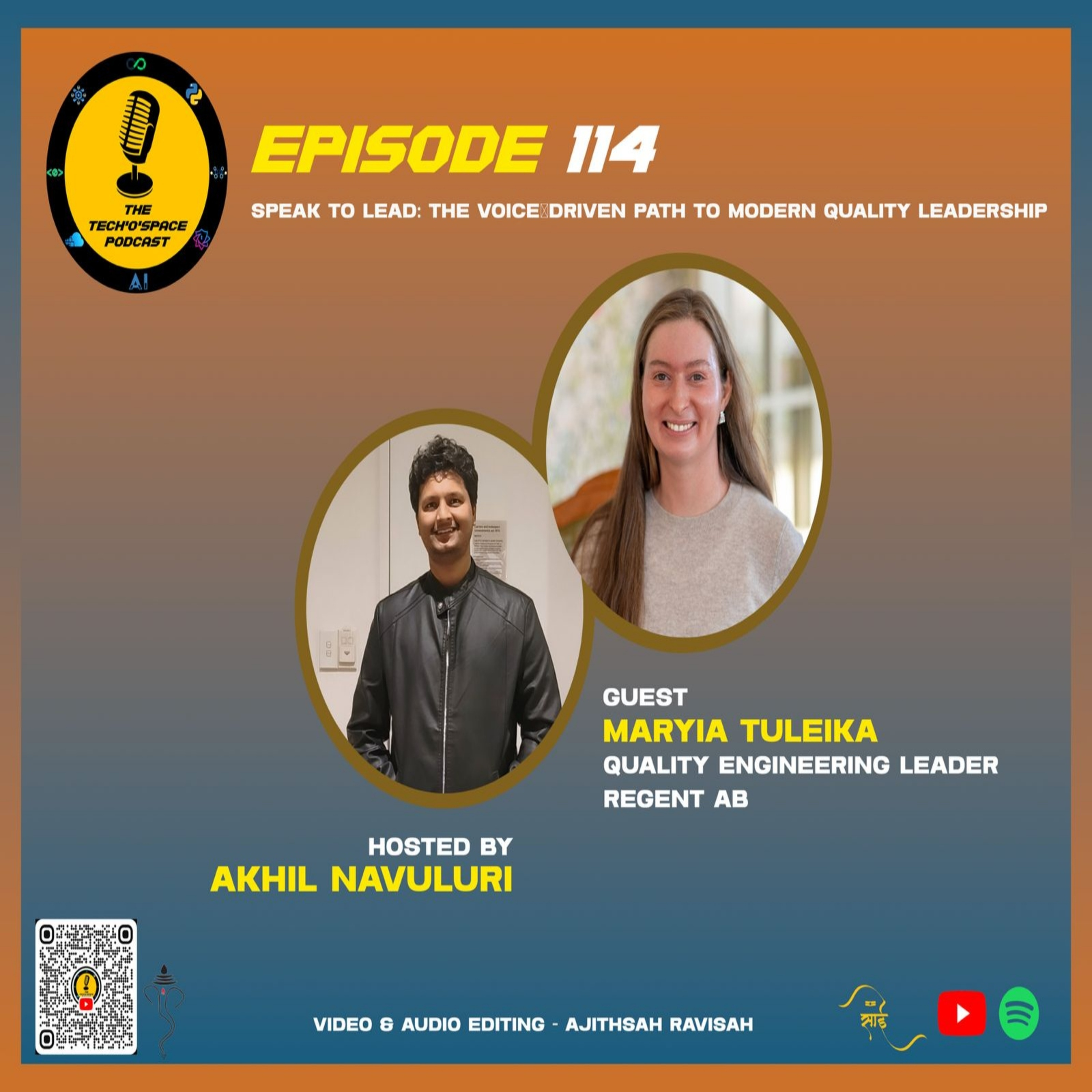
The Tech’o’Space Podcast Ep 114 - Speak to Lead: The Voice‑Driven Path to Modern Quality Leadership
70m 41s
In this podcast episode, host Kathila Gloria interviews Maria Tuleka, a quality engineering leader from Stockholm, Sweden. Maria defines quality engineering as building quality into processes from the start to reduce bugs and risks, rather than just testing at the end. She describes her journey into public speaking, which began with mentoring and teaching after missing the stage from her musical childhood, and culminated in a successful first talk about creating a test automation framework for embedded hardware and software. Maria emphasizes that the choice of automation tool is less important than mastering fundamental engineering practices, enabling seamless tool transitions. She advocates for public speaking as a skill that enhances storytelling, helping professionals frame data into compelling narratives to influence management and teams. A key anecdote involves testing a chatbot that revealed security vulnerabilities, which she communicated through a story to prioritize security over speed. As a leader, Maria focuses on protecting her team through thorough planning and creating a supportive environment where challenges are seen as learning opportunities. She encourages listeners to start small with public speaking, such as presenting at meetings, to build confidence and career advancement.
Hello, this is your host, Kathila Gloria and welcome to the grand year episode of the Echo Space Podcast series. In this podcast episode, I'm super thrilled and honored to be collaborating with one of the most eminent and prominent industry leaders of the IT industry and the quality engineering space. And she happens to be Mrs. Maria Tuleka who happens to be the quality engineering leader of the company Regent Abbey and she's the founder of the company New Feature and she's based out of Stockholm, Sweden. So Maria gives me an absolute pleasure to welcome you to this podcast initiative of mine. So Maria, how are you doing and how are things in Stockholm at the moment? I'm delighted to participate in this podcast and hello everyone. I hope you enjoyed this episode done. I'm super happy to be here. Okay, perfect. So Maria, as I was just asking you, like how are things in your home city in Stockholm at the moment? Well, it's quite cold right now. What do weather is nice because you know, in Sweden everyone loves skiing and snowboarding and doing lots of stuff with snow. So it looks really, really nice. Outside, everything is wide and nice. So I like the weather. It's how it's supposed to be at this time of the year in Sweden. So it's really good. How about you? It's pretty good here as well in Hyderabad as well because the winter has just come down and the weather is getting a little bit moderate now and it's good to travel outside rather than being in that cold weather. So it's pretty nice at the moment. I see. Cool. All right, Maria. So without any further ado, let's kick off with that podcast segment. All right, Maria. So I'm curious to ask you this. Like, Maria, if you want to tell about yourself to our listeners, like how would you introduce them? Like, who are you and like, what is the problem that you know that you care the most when you deal with the quality engineering space in the IT industry? All right. Well, I'm a quality engineering leader and I'm working with different companies establishing a good quality engineering process. And when I say quality engineering, then I believe that quality is not an answer. At first point, quality is something that we could build and build in the process from the start because you know, it's not just about trekking and catching bugs. It's about building a process where the bugs are less likely to appear. And now when we give trust to our colleagues involved in the self-training engineering process, then we get better results. And also identifying risks early in the process and making sure that everyone's aware about them and taking them into consideration and trying to make a bunch of measures so that every project succeeds and makes the best success at the customer side. All right. That's pretty good to know. That's a pretty good time. Let's say, introduction about yourself, Maria. I was also cute myself two years back and I worked in the SDLC projects with software development lifecycle projects. So let's say, Maria, you're doing the quality, what do I say that you're doing the testing for a particular project. And you have literally monitored critical bugs and also the deadline is approaching really quick. So what are the measures that you take to solve that and help your team come out of that kind of a situation? Well, of course, a leader, I want to protect my team from in the first place this situation from happening so that, well, a good estimation of time and preparing and planning, that's the most essential step that shouldn't be skipped. And I think that many companies underestimate the weight and the importance of planning and thorough preparation analysis of risks of what could happen and like how quick we could deliver and what obstacles we could meet and how to prepare to meet these challenges. So yeah, of course, I see my primarily goal as a leader to protect my team from this type of events. And even if it's happening, then it's kind of my goal is to make the best of the situation. And we all learn from mistakes. And I think that the best is to create the atmosphere when all the problems are seen as challenges and as an opportunity to learn to analyze, to do pre-mortem and post-mortem. And it's like plan in advance and then also analyze what could we have done another way compared to what we did right now. But yeah, of course, tricky situations happen and that's a good thing because that's an opportunity to learn in and for next time. Absolutely. I mean, you should say the thing to your team that no worries about getting such situations, but anyway, you'll eventually pass through it. So I really love your approach, Maria, the way you're telling that I will do anything to protect my team and that's always the right approach. And I see when I was seeing you talking about it, I see a true leader is giving a complete approach to it. So that's really remarkable, Maria. I think our listeners would definitely get inspired by this, let's say, this trait of yours in this broadcast segment. Now, Maria, just tell me about this. How did you move into the public speaking quality and community work? Three things together. How are you able to balance it? Well, this story starts in my childhood when I was, well, I think I started to appear on stage even, I started to kind of talk because I was, I was singing and my family is a musician family, my, both my mother and my father, their musicians. So I started to, to be on stage quite early, even though in a completely different context. So when I was studying in the university, it kind of stopped because I didn't have the same opportunity. And I was studying mathematical linguistics. It wasn't like much more about the appearing on stage. Of course. It was still when I started to work for as a consultant, I was kind of missing this feeling of being on stage and performing and getting the energy from the audience and so on and so on. So I started to kind of think what, what, what could I do to get back to this amazing feeling. And I actually started with mentoring people and teaching some classes at the company where I was working back then. And then after a few years, I've been on one of the meetups for speakers, for presenting some stuff. I don't remember what it was, but I remember having a conversation with one of the organizers who asked me if I could be the next speaker on the next event. And I was like, hmm, maybe it's a, it's a good point. I wanted to be on stage. I need to try this. It took me a while to prepare my first presentation. And of course, it's not the same as just singing according to a script that you got from your teacher, right? So that's how it all started and done. It kind of started to unfold and I got invited to teach at the, now in the schools here in Stockholm teaching, test automation and testing to students or later becoming best engineers and developers. And lately I've been also involved into conference organization. So I'm organizing testing conferences here in Stockholm and Sweden and also being part of both review board and program committee.
for some of the biggest European conferences, testing conferences right now I'm working with the host app. So we are creating an amazing program from the next host app conference. And we're looking for applications. So if you're listening and wondering what could be the next step in your career. So let's have a chat and if you're wondering how it works to start. So I'm here to help you to make these first steps and support you. Yeah, so it's kind of an interesting journey because you never know how it unfolds and where the next opportunity is going to be. And I think that public speaking is very important for every professional to not just to be able to be on stage. Right? It's not a thing that everyone needs to kind of implement and have in their career. But just to be heard, to have a place at the table and to raise your voice so that you can communicate better. I think it's a good step forward and advancement in any engineering career. So I really, really encourage you to make this step and don't be afraid to make your first appearance. It doesn't have to be very big, right? Well, well, started somewhere and it's good to make some bad steps in the beginning. It could be just a short five minutes presentation on the next meeting. It could be a small presentation on a meetup. Just whatever the main thing is that it's the best is to speak about the topic that you're really leaving for, that you're really, really like and would like to share. All right. That's very interesting, Maria, that's good to know. Now, listeners, you've already heard it from Maria that if you need any help with respect to career guidance or anything, you can always reach out to Maria and she's always there to help you out. You could just DM her directly on LinkedIn. Now, Maria, you told me that in the conversation that you help out children and some students to learn test automation. So when we talk about test automation, what are the tools that you suggest? Does it have to be Selenium Cypress or what exactly do you prefer by teaching them? Well, of course, right now there is a lot of hype around AI and that it's going to replace everyone and so on. And this is, this technology shift is only accelerating the need for essential engineering knowledge and how to build reliable stuff. And in connection to test automation, I would say that the tool doesn't matter that much. The basics of good engineering practices, of good patterns of automation and how understanding how it works, that's the most important part. So what I usually recommend to my students, because they don't always can just choose whatever tool they want. But they kind of adjust to what they're being told to you. Right? So it doesn't matter which tool do you choose to start with. The main thing is to understand how it works. And then if you understand how it works and understand the good practices and patterns in software engineering, then you could shift to another tool without much friction. So my best advice is to really, really get into the basics. And even sometimes even essentials of mathematics and computer science. That's the best thing you can invest in your time in. Yeah, so it does matter whether it's a learning on playwright or whatever framework you choose. It's your choice. It's your preference. Absolutely, absolutely, Maria. That's the right point. Nobody, you told me like first, first, you know, when you were doing the public speaking on stage, you were a bit afraid and you had that residence and you were supposed to give a presentation. So, me, I know like exactly like what was your first presentation about on stage? My first presentation, that's a good question. I think my first presentation was about the, what I was a long story, because I wasn't invited to work for a company where they were producing embedded software for like for specific tools. And then they didn't have any test automation there. And they, they invited me to set up test automation framework and collaborate with the developers to understand what they need and with how it is supposed to work because it's now like, you know, at that point it wasn't that common that embedded software companies had test automation frameworks because it was both hardware and software and it's kind of hard to combine. So, it took me a real while to understand if it's even possible to create test automation framework. And it took me maybe a half a year to just collect ideas, collect different, you know, requirements and limitations of the system to know where to start. And at that point I even, I was not super fluent at C++ and C, at low level level programming languages, so I had to learn that as well. But I got enormous support from my colleagues and they were all a bit skeptical, but at the same time very interested in how it could go and what we could do. So it was really long and at the same time successful project that resulted in test lab where several teams could run their tests on the devices, directly on the devices that they or the tools that they use. So my first presentation was actually about this path. And I was super inspired because like, I mean, I came to the company where there was no test automation ground at all. And then together with the team we went through this path to a really successful test automation project and test lab and so on. So I was really, really proud and was easy for me to speak about because I was already like, you know, boiling in this feeling of achievement. So it was easy, easy to share this experience with the audience and it was kind of very successful talk. And then it started to kind of continue in the same direction than I was, I got invited to speak here and there and I liked that. Interesting. I'm really surprised with the fact that test automation was even linked to hardware because I totally understand that test automation is with software. But hardware like I'm like, okay, test automation is going a very different root altogether. But that is like very inspiring and a very different approach. And I hope you learned a lot from that and now you're doing the best of things. Right, Maria? Sure. Yeah, of course, that project taught me a lot because most of the test automation engineers are working with websites where everything is known. You don't have to worry about hardware. You don't need to install new things and so on. It's already done by CICD pipelines and so on. But the one working with the hardware, you need to pick a hardware version first and then you need to install the software and then check that it got installed and so on and then you also have to use different
protocols to communicate with the hardware, it's not easy as well and sometimes it gets distracted, disrupted and so on. So yeah, there are a lot of challenges, you know, and I even yeah, there were a lot of civil situations and anecdotes connected to this. Even small fires were started while trying to run some tests on the, on the, yeah. So on different different. Oh my god. Very extreme rule then. Yeah, it was, it was a bit stressful, but fun. Right, when you look back at those things, you feel it's fun, but at that moment, you'll be a panic like, okay, how do I, you know, overcome this and what are the things that we need to do? So of course. Yeah, I think in this, in this challenging situation, the most important part is the support of the team and the management and then that's why I as a leader right now, I try to, to kind of take the responsibility for all this tricky situations on me because I want to provide this freedom of creativity to the team because you know, if everyone is restricted to only to what they are told to do, yeah, then yeah, it's kind of hard to, it's hard to produce good stuff one, one proceeding with this type of leadership. Absolutely, Maria, totally agreed. Now, Maria, let's head back a little bit more to your public speaking extent. Now, Maria, why do you think, you know, public speaking is useful, you know, beyond the stage, like you told me on stage, you know, that is required, but beyond stage also, what do you think that is a useful thing? It's useful, for sure, because it provides, it not only provides opportunities, like when, when you're on stage, then you could get of course better opportunities to communicate with people around you and with the management, more opportunities to talk to management and the best engineering, the best engineers in the industry and so on, but also one year out and the project and working for a company, you get the better chance to express yourself to be heard and to better express your ideas, because every idea is based on a story and when you're involved in public speaking, then you kind of know how to frame any problem into a story, then you kind of realize that any number is just a number, but when you when you wrap it up into a story, then it's much easier for people to understand why you care about those numbers, and most of the people in the management team, they just don't care about them or while they care about some numbers, but if you really want to make them do something to make some actions upon your request, then it's super important to tell a story about why it matters, about why you care, and in this connection of course, public speaking helps a lot, because it's what it is about what's public speaking is about. All right, perfect. So when we talk about storytelling, Maria, do you remember any incident where you gave a storytelling about test auto motion on beyond the stage, where people got resonated with that? Yeah, I think the most prominent anecdote that they have about this is that well, you know, right now everyone is speaking about AI, but not that many are thinking about security aspect of this technology integration. So I was testing charpod, and then it was like it was not public, it was just a demo product that they wanted to kind of set into production, and then my first test was just to ask for a forename of the previous customer, and then the charpod gave me directly all the details, and I was like, okay, maybe that's a good starting point to start conversation about security, about securing these types of systems. So I created a cool story about how how how killed this charpod was, and how it met all the requirements, and so on, and then we ended up there, not like being complied to all the DDPR, and so on. And that created this, you know, memorable moment for everyone to understand that yeah, security is something we need to care about, we need to take into account and kind of pay attention to it. So and it was easier for everyone to understand, not just technical team that, okay, we need to put aside some time to analyze the system, the system, and how we can guard it, and not just like, you know, get the request from a product management team that we need to ship the feature as soon as possible, doesn't measure how it works just ship it. And so, but then everyone kind of got attention to it, and the rumors started in the company, and they said like, yeah, sure, we need to wait until this project is more mature. So I think it was a good thing to communicate. Interesting, that's a pretty interesting anecdote. Maria, so Maria, when we talk about that charpod, you know, was that bilingual, you know, was that in Swedish and English, or let's say, only in Swedish, like, how did you communicate with that charpod? Well, usually, usually I don't limit myself to only one language, because you know, in Sweden, everyone is speaking both Swedish and English, and I also speak some, if you need different languages, so I try everything and, yeah, you know, it's a good test as well. Interesting, you know, I've been to Sweden myself, I've been to Stockholm, and I've first, you know, the thing in Sweden in your country, like, you know, when then I start, people first think, you know, you're Swedish, but then you say, I mean, you say, I don't know, then they start speaking in English, so I really like the way you don't two approaches, you know, that they manage with two languages, so that really impress me the most. Yeah, that's cool thinking about Sweden that everyone speaks English on a really good level, so you can absolutely just come on and enjoy. First show, first show, yeah. All right, Maria, that's a pretty good anecdote, and really I love the thing about that anecdote, you know, about where you were just correlating, and you know, you were talking a lot with the chat board, and then you were understanding, what are the confidentiality things that we need to take into place, that's really a required thing again. Now, Maria, like, how do you think, you know, that leaders can support speakers in their teams? Like, what are the measures that you have to take? Yeah, well, first of all, it's good to create a friendly environment, where everyone can say what they want to say, and that's a good opportunity to grow as a speaker and as a team member, and as a technical professional, and also don't be afraid to make this first step to ask for for the opportunity to like just talk to your team and say, "Oh, I want to present this in that, and this would be the good for first step, and then you want to go bigger, then of course, there are a lot of opportunities out there, and many were almost all conferences there doing so called call for papers. It's when it's the process when conferences collect abstracts for for the potential talks, and then they choose from the list of the abstracts that they collected. So just don't be afraid to send a paper to, and I usually recommend to focus on one or two papers and not like produce a file.
for 10 papers that program committee usually thinks that they can't be of a good quality if the speaker is kind of just the producing abstracts and not worrying about the content of the talk. So and many conferences, they have slots for beginner speakers. So even if you're first time speaker and don't know whether it's a whether the conference is a good fit for you you can always ask for feedback and yeah as I said many conferences they have slots for first time speakers specifically. So I try to be as specific as possible. So I've reviewed many abstracts now and I often see that some potential speakers they try to describe the topic on on a very high level and then for us as program committee and review board it's kind of hard to understand what what the talk is going to be about and then we hesitate to choose this type of abstracts because you know you can't guarantee if it's going to turn out well or not but when the the potential speakers they list kind of okay I want to talk about this and that and it kind of I will start with this and then proceed with that and the main summary or key takeaways are that and that and then it's kind of indicating that the talk must be good because speaker already puts some time into preparation and so on. So I really recommend don't worry too much about yeah about sending an abstract just just make just take some time to to prepare a good abstract and then and then everything will be fine and there are a lot of people out there helping new speakers and newcomers throughout so organizations where they provide free support for new speakers so if you want to you can could kind of send yeah or a cluster and then you'll get a mentor for your talk and so on so it's really recommended. Absolutely that's a right recommendation and a right advisor Maria. No Maria suppose you know your suppose a person is giving or let's say a new comma is giving a speech or let's say a presentation and a conference so what is the thing that you suggest them do you suggest them that they should you know give a complete higher level picture of what the topic that they're talking about or they should go a little bit deep you know on the concept that you know they're breathing about which one do you suggest them. It's good to focus on just one idea that you want to tell to your audience so that they want tomorrow they they kind of wake up after the conference they remember this one idea that you share. Yes if there are many situations what people try to fit in a lot of stuff in the presentation and then it's kind of hard to remember oh I remember he was he or she was talking about something but I can kind of formally just one sentence of what the idea was so first is good to concentrate on the on just one idea that you want to provide to your audience and then frame this idea into a story to where you kind of introduce the problem and then kind of show how to solve this problem and then summarize it into kind of summary to your kind of summary of the talk and then of course it's a it's good it's good to remember that the main person in the presentation it's not you it's it's the audience it should be about them about solving their problem not your problem because you know everyone who's coming to to a talk they want to hear something that will help them come to the office next day in the morning and do their job better or be inspired or get a hands-on technical guidance on something or maybe just get to know a framework or a starting point about a technology that they are interested in because sometimes or often the best talks are about basic technology knowledge that can be applied in different ways right and I think for the beginner speakers it's easier to speak about their experience because the biggest fear we have as humans is appearing in stage and then be judged by someone you know that's the that's the fear of everyone and there are a lot of studies that show that okay everyone fears that or almost everyone and but if you if you share your story your path no one can say you're wrong right because it's your story it's your experience no one in the audience can argue that it's kind of not true right and so so the easiest way to start with public speaking is to share your story your experience whatever you had whatever situation you had on your project and how you solved it and providing a framework or guidance on how to act in similar situations if the audience will happen to face the same situation so yeah that's a pretty good format Maria really really you know this actually helps out people you know people who are listening to this podcast and if they want to foray into public speaking they'll definitely you know grab all the points that you have shared in this podcast segment and definitely they'll do really well in their public speaking so this is a this is an amazing advice trust me you know this I would just like to bookmark this saying that you know this is the best advice given by an industry leader towards public speaking trust me it's it's really lovely yeah thank you all right Maria so Maria I you know I just you know came to know that you know you wrote a book about public speaking so I want to understand like what gave you that inspiration and what made you decide that you wanted to write a book in the first place well actually there is a story about this book it's it's not published yet it's going to be out in mid-February or in a few weeks and it's going to be free so everyone is welcome to read on this I guess we're going to publish all the links as soon as it's available and the story about this book is that I was speaking at your store conference last year and I gave a talk it was it turned out pretty well okay not like you know the top rated but it was good so I was trying to to collect to to tell about my experience appearing on this conference and talking about the topic I was interested in and I asked my colleagues my audience about their best advice for the newcomers if they want to start or if they want to improve their public speaking skills and I got a normals response from the testing community on LinkedIn so I've got so many commands and everyone was like oh you know my best advice is this oh you know my best advice is that and then the conversation started like it took like a storm and I was like I need to elect and summarize all this knowledge because on LinkedIn you know it is going to disappear at some point so I started from there I collected all the commands that I got from the LinkedIn audience and then I also founded with my friends and colleagues a community beyond quality community that is also the main idea there is
to help newcomers with any questions, not only public speaking questions, but if you have a tricky situation on your project or if you want to write an article or blog post or if you want to start speaking at the conference, then you can get help there from experienced colleagues and so on. And there will also run research, different research topics also with the help of the community. So I started my research about public speaking where I also kind of continued asking people about advice about public speaking. So I collected all the commands and recommendations and books and videos and different blog posts about public speaking. Yeah, and then they summarized it, combined with my experience in the book and I think it turned out really, really well and interesting. So if you want to read it, I really recommend it. I would love to, you know, I would love to read about public speaking because since I am a podcast to myself, I also want to improve certain gaps, you know, sometimes where sometimes I fall to, you know, sometimes when I go on the street, sometimes you have that initial hesitation, that initial scare, like, you know, so many people are there. I want to overcome that and, you know, do more and more public speaking on stage. So definitely this would be a good recipe for me to overcome my career. Yeah, yeah. And the big is, is divided into three parts about how to decide that you, okay, if this is for you kind of to find the purpose why you would go on stage because everyone's motivation is totally different. It could be anything from just sharing your knowledge to maybe promote your services and so on and so on, because it could be very different. And then the second part is about preparation, how you prepare a gift presentation, how you do it. Practical steps to achieve, achieve a good presentation. And then the third part is about presentation, how, how you kind of get your nerves under control and braving exercises and so on, and so on, practical ways of delivering in a good manner. So yeah, go ahead and grab a coffee as soon as it's available because it's free and it's really, really nice. And it's not only kind of my opinion, it's a collection of wisdom from the testing community and the best speakers in testing world. So I recommend to give it a read. Amazing. So whenever it's released, Amario, you need to share the link with me and I'll be the first person to talk about it. - How did that? - All right, perfect, Maya, that sounds really good. And I really love the backstory. You know, that made you to write this book. Now, having said that, I'm keen to understand this. Like, who is this here? I mean, where are you aiming this book for? Like, why are you a target audience? So let's say target users for the book. - The target audience is very broad and it's not only aimed for testers, but the general, generally for everyone who is willing to get on a tech stage or public speaking stage, of course. I'm talking more about technical speeches, but it could be applicable for anyone who wants to, who wants to appear on the conference or on a big meeting or wants to share their ideas. So everyone from the very beginner to advanced speakers, I think everyone could find something new there, of course, because it's based on the collection of experiences of different speakers and were very different than I tried to stay neutral and both share my views, what works for me and then also show what works for others, 'cause we're different people and some prefer to deliver more emotional and star show kind of presentations, but at the other hand, some speakers, they tend to provide very structured, experienced based information that is very technical and there is a lot of points on this scale, so it could be anything and I wanted to inspire people to make this first step or advance their current situation and public speaking. - Okay, interesting, Maria, that's a beautiful overview on it. Now, Maria, how do you think someone can practice public speaking without a big stage? - Yeah, well, exactly as we discussed, it doesn't have to be big from the start. I think meetups is a good first step if you want to appear outside of your company because of course, even within the company, there are a lot of opportunities to speak up and kind of, for example, take the ownership of your daily standups and create any activity, for example, warming activity in the standup or present whatever your team has done during the week, during the spring, then so on and so on. So there are a lot of public speaking opportunities out there or appearing on the podcast, right? That's also a good opportunity. There are a lot of meetups both online and offline and I'll say online is a bit easier to start with because you appear in your home setup and it's easier to have this non-face-to-face conversation and then the next step would be to go to a meetup and test your skill there. And of course, we prepared for some tricky questions. There's always someone in the audience who wants to test you but it doesn't mean that they want to harm you. It's just the type of people that is really, really curious. So don't treat it personal too personally. So I think that's the good way to start and to go. Just know that you don't have to please everyone. Absolutely, absolutely. And I've heard that in Sweden, there's a thing called a break kind of thing called Fika. In the Fika time, all of you just gather around and other than work, you discuss about all the other things like about sports. But do you take this Fika also like a place of where people can improve their public speaking? I mean, they're not talking technical anyway, but you don't talk about some of the things. And all of the things. Of course, Fika is the essential part of Swedish culture and it's kind of suckered here. So you can't keep a Fika because it's a type of socializing. Yes, you know, it's a cold climate and people tend to kind of be at home and with the family and so on. And Fika provides the opportunity to socialize and to discuss any topics in relaxed manner. And I really liked it. I really liked it because it's warm and cozy and people relax and start to share stuff and discuss really, really interesting things like hobbies and what have happened in the world lately and so on. So I think it's a good opportunity to train public speaking even though it's like a micro-step, but still it's a good way to communicate. Absolutely. And what I feel is when people are relaxed, that is the way they're actually, they will improve their communication and they'll speak up. If you're going to, I mean, first versus people are getting pressurized or let's say, too many things are let's say crumpled upon them. If they're relaxed and in part of a Fika, then they will open up really well. They'll talk a lot and that will enhance the public speaking. Yeah, and even enhance the connections and create the network.
to network with other people that you might not be working directly with, but if you want to create the network of your friends and the company, then it's a good way to go. Absolutely, Mario. Now, Mario, why do you think public speaking is a leadership skill? That is very much required and testing. I think that as testing professionals, we really need to know how to communicate the findings and how to communicate what we do and why it is important to the leadership team and to all the stakeholders because if we don't frame it in a good way, so that people understand why we need to do this or that to make the product better, then we're going to fail at our mission because the goal of testing is not collecting bugs. It's making the product work in the best possible way and balancing both business needs or money and user needs because if we create a product that is not useful for anyone, then it's going to die. To communicate these types of things, we need a really good communication, public speaking skills, so I would recommend anyone to really learn how to do that and practice it in your project. Absolutely. Now, you have observed that in different projects, you have seen this, let's say, a debate between developers and QA and they don't get along because QA people, they find out the faults what the developers come up with. But how do you, I'm going to say that, how do you enhance that? How do you eliminate the differences between the developer and QA? Here, I think public speaking also goes a long way because I don't think that developers and testers are supposed to fight or make a war on the project because they are the same. The same is to deliver a product that the end users, customers enjoy. If you manage to establish this collaboration in good way, then it's going to be easier for everyone in the team and not the only, and this concerns not only the developer part of the team, but also product management and UX and so on and so on because maintenance team, customer support. The communication is everywhere. So if you communicate in a good way with all the stakeholders and have allies in all these different slices of the company, then the chances that quality is going to be better is much more compared to if you just do your bug hand and not share the insights and don't do the preventive work in advance and don't communicate with all the stakeholders and get input from them and communicate your feedback to them as well. So it's not just one way street, it's supposed to be multi-way communication in order to succeed. Absolutely, I really love this point and trust me, with this, the developers and QAs will now I think stop their war. I mean, not war, let's say, so-called war. They actually are fine with each other, but during the project time, there's some tension that builds up. Okay, why are we getting stopped here by the QAs and QAs are like we're just doing our job. So I mean, this is just like a so-called war, but again, you know, that those differences will go over time and people will not have any of that issue as things become much more easier and technological again in the upfront, what I can say is. I'm very much curious and inspired by this fact. Would you like to shed some spotlight into being the testing hero of the year 2025 and having said that, what was your groundwork to achieve that title? Well, I looked at the motivation why they kind of assigned me this title and it was because I shared my knowledge, kind of unconditionally and that's that's a big honor for me to get this recognition because I really want to to make our industry better, to shift it forward, to create meaningful connections, to create a space for anyone to speak up, to create new speakers, to invite new members of the community to make them seen and heard and to create this safe space to share their knowledge, their experience and just make the world and the testing space better. Perfect. That's amazing. Now, when you got that title, like, what was your initial reaction? Like, did you believe that, you know, is it really me in a whole god title or like, what was your instant reaction? I mean, like, would you like to share about that? Yeah, when I first saw that I was in it, no, it could be, it could be real. It couldn't be real because it's like a dare-propouled joking. Yeah, but then I got this, yeah, and this title and so I'm really pleased and happy to be recognized and I'm really thankful for the community to have this recognition. Interesting, interesting. That's pretty good to know, Maria, that is very, very, you know, let's say inspirational as I just was earlier mentioning out. Now, Maria, you know, before we actually conclude our podcast segment, you know, let's take a lighter route. You know, all this while I was completely, you know, bombarding you with, you know, questions about QA, about public speaking, about your journey and you know, about all the things, you know, that you've experienced and also different aspects of public speaking again. So now, this time, we'll take a pretty lighter route in the form of a very quick rapid fire round where we're just going to talk about your likes and interests. So are you ready with the first round of, you know, with the first question of the rapid fire round, Maria? Yeah, sure. Go ahead. All right. So the first question to you, Maria, so Maria, since your business, Sweden and football, you know, plays a huge, you know, part in your first sporting culture, what is the football team that you like the most? Let's just support the most. Oh, football team. Well, I know I'm not really interested in football. I'm more into skiing and snowboarding. That's my thing. Okay, skiing and snowboarding. Do you have any, or a particular, let's say, at least that you follow on, let's say, you know, idealize when you look when you're, you know, when you're following skiing and snowboarding. No, not really because I prefer to do it myself and like, not really following the sport. Actually, I don't even have a TV at home. So I probably need to buy one, but I kind of managed the last 20 years without a TV, so I don't know if I will ever buy one. I prefer to walk and do snowboarding and do some family time doing sports instead of watching it. That is true. That is absolutely true. Now, why don't you tell me that you know, other than Swedish and English, you know, you speak some other few other languages. So what are the languages that you're fluent in? Well, yeah, that's a long story as well because I've been born and raised in Belorys and there, there are two mother tongues and it's a Belorussian and Russian language. So I'm fluent in those two, and then English Swedish. And I also been studying at the Ligwistik University and I'm quite fluent.
a German and then when I moved to Sweden I also learned Spanish and then because Sweden is quite close to Denmark and Norway and they have quite similar languages so I can actually communicate in Norwegian a bit as well because it's kind of similar to. I've been learning or studying a few other languages but I didn't get too long into them so yeah. I mean seriously like you you learn more than let's say seven languages I mean you need I mean that's more than enough I mean it's not more than enough but that's really like like more than anyone's ability so that's really remarkable again. I'm a language nerd both human and programming languages. All right okay perfect that's good and then I think you know you're qualified to be a polyglot you know who knows multiple languages. Oh thank you. Yeah interesting that's nice. Now you know Maria since you know I am from India and you know I'm of the Indian origin I'm keen to understand this like what is your favorite Indian food that you always like to try? Oh Tik Masala is my favorite or go to this actually I ate it yesterday we have a lot of Indian food restaurants in the area so yeah yeah I liked it and actually I've been to Hyderabad years ago as well. I've been to a wedding and there. Hyderabad okay yeah so and it was really nice and very hot. Yeah it is it isn't something like a plus 45 degrees still here so I was like yeah I was dying. Which one did you travel to Hyderabad like was it in the summer or let's say? It was February. Yeah no it was February. Yeah I understand in February almost in the end or let's say in the mid the heat wave you know the heat wave starts and then March becomes unbearable. Yeah Good interesting you had a good time in Hyderabad that's that's really nice to know. Now what are your good restaurants in Stockholm that you would like to recommend the listeners? Restaurants in Stockholm. Yeah oh well I don't know because I usually pick a restaurant that I haven't been before is like everything in you every time I pick just a new place. I want to like a lot Asian food and the kind of a fusion food. Local food is really nice as well but it's it's kind of different because I eat a lot of local food at home so when I'm going out then I try to pick something else and there is a really good choice of restaurants here in Stockholm and you can pick anything from Asian to African food, and the Latin food, whatever like tacos and burritos and sushi and yeah I even go to yeah to to some African like Ethiopian food is quite unusual and you're supposed to eat with ounces like yeah yeah yeah it's it's really nice as well. I've heard about African food but never tried African food till date you know there are little bit similarities between the Indian spice and the African spice but never got a chance to try African food till now. It's very different. Okay let me see let me just try and then I'll let you know like you're okay then out of the videos. All right interesting now is there any particular let's say Belarusian word that you would like to you know teach me or let's say you know may make me speak any your interesting Belarusian word. Dra-nik. Dra-nik. Yes you're you said it perfectly that's the national the national dish of Belarus and it's made of burritos and super delicious. So since you know you're a polyglot and you like to you as you just told me that you're a language node I'll just tell some words in Hindi so if you can you know just try to speak it out you can take your own time but I'll just give you a few words. If you have to you know read someone you'll let's say how are you you can just say it in Hindi like this. It's like up up. Kessie. Kessie. That's right you want it don't. Okay that's that's interesting. One day I learned. You will you will definitely because you know the way you learned other languages it will be no surprise for me that you know you're master Hindi and all the other languages in the show trust me. Oh well you get a long way with just English. Oh yes that's not supposed to be. No problem. No no no no problem you can you know you can manage it out in in India with English many people speak English but if you go to the north of India certain people they start speaking in India and their their approach is a bit different. Yeah nice. In sense you know my one question I just wanted to ask you in the starting of the conversation you told me that you know you're both both your parents are musicians so while growing up what was the type of you know music genre that you were into like what music used to hear the most. I was both classical music because like you know they like to play the piano and I learned how to do that as well and local local music like not national music but you know pop and rock and a bit of everything folk and so on. Yeah so it was a mix of everything. Interesting that's a pretty good combination and a fusion again. Now I'm just like more last three questions for you Maria and Robert Farrinon. So what is your favorite holiday destination that you always like to travel to? Yeah it's a bit of everything. I think Estonia where my mom family is from is my favorite destination. I've been there a few times or quite often Thalin is a great city with a pretty beautiful old town so I like to be there. Okay that's nice. Special during holidays and Christmas time they have a really nice Christmas market. Thanks Christmas market okay. So in Sweden other than Stockholm what is the other city that you always like to travel to? In Sweden up north it's not a city it's just it's rather really small small place with just a few people that are living there and it's called Abysko and it's the best place in the world to watch Aurora you know the beautiful lights in the sky. So other lights yeah. Yeah, Northern lights. Okay I would love to watch Northern lights someday but I have to see the exact time you know sometimes they say it's the winter. Sometimes they say it's the other season so I'm not pretty sure like it's impossible to predict. So if you go there but at that place if you go there for a week that's it's almost guaranteed that you see something at least. Okay right. So now in this I mean in this entire conversation you know we were talking about public speaking so having said that do you have any favorite books that you always like to read? About public speaking. Yeah I think Rob Lambert he has a githbook zero to key note where he also writes about public speaking it's a githbook and then there are also a lot of free sources like on TED talks and so on that are available for free and you can just watch the videos and they're pretty nice as well. Apart from public speaking do you read any other type of books? Let's say Johnus let's say fiction, autobiography any of that. Well right now I mostly read professional books and I read a lot with my daughter so I guess she's four years old and I read children books like a lot like at least one hour before going to bed so it's not that much time left for me to read the non-fiction books. I'm not the most the professional books right now. Nice, interesting read and interesting Johnus for show. So Maria finally thank you so much for you know taking time from my from your busy schedule and you know being part of my podcast initiative. I just love the the conversation thoroughly today. The way you know you were giving a lot of
of key notes. Let's say inspirational roadmap for our listeners on public speaking and you know what test automation and about your journey. Then all the other things that you know were linked to leadership. So it was a plethora of let's say conversation that we had today in this entire public, you know, podcast segment. So finally, I really thank you so much for you know, being part of this session. It was a lovely conversation through all. Thank you so much. Thank you for having me on your podcast. All right. All right. Let's just on this note, this is your host, Tuckin Lovlo, Rishan Goffer. We'll be back with another podcast episode with another eminent industry leader. Very soon. Till then, keep listening. Goodbye, straight to you, N'Alfa. Thank you.
Podcast Summary
Key Points:
Maria Tuleka is a quality engineering leader based in Stockholm, Sweden, who emphasizes building quality into processes from the start to prevent bugs, rather than just catching them.
She transitioned from a childhood in a musical family to public speaking in tech, starting with mentoring and teaching, then giving her first talk on setting up a test automation framework for embedded software with hardware.
Maria advises that the tool for test automation matters less than understanding core engineering principles and patterns, which allows easy adaptation to any framework.
She highlights the importance of public speaking beyond the stage for storytelling, which helps communicate ideas effectively to management and teams.
A memorable example she shares is testing a chatbot for security flaws, using storytelling to convince her team to prioritize security over rapid feature delivery.
Summary:
In this podcast episode, host Kathila Gloria interviews Maria Tuleka, a quality engineering leader from Stockholm, Sweden. Maria defines quality engineering as building quality into processes from the start to reduce bugs and risks, rather than just testing at the end. She describes her journey into public speaking, which began with mentoring and teaching after missing the stage from her musical childhood, and culminated in a successful first talk about creating a test automation framework for embedded hardware and software.
Maria emphasizes that the choice of automation tool is less important than mastering fundamental engineering practices, enabling seamless tool transitions. She advocates for public speaking as a skill that enhances storytelling, helping professionals frame data into compelling narratives to influence management and teams. A key anecdote involves testing a chatbot that revealed security vulnerabilities, which she communicated through a story to prioritize security over speed.
As a leader, Maria focuses on protecting her team through thorough planning and creating a supportive environment where challenges are seen as learning opportunities. She encourages listeners to start small with public speaking, such as presenting at meetings, to build confidence and career advancement.
FAQs
Maria Tuleka is a quality engineering leader at Regent Abbey and founder of New Feature, based in Stockholm, Sweden. She focuses on building quality into the development process from the start to prevent bugs.
Maria prioritizes protecting her team through thorough planning, risk analysis, and preparation to avoid such situations. When challenges arise, she treats them as learning opportunities, fostering a supportive atmosphere and conducting post-mortem analyses.
Maria started public speaking by mentoring and teaching classes, then gave her first conference talk about setting up a test automation framework. She now organizes testing conferences and encourages professionals to speak to be heard and advance their careers.
Maria advises that the specific tool, like Selenium or Cypress, doesn't matter as much as understanding good engineering practices and patterns. She emphasizes learning basics and fundamentals of computer science to easily adapt to any tool.
Her first presentation was about setting up a test automation framework for embedded software at a company, which involved learning C++ and collaborating with developers. She shared her successful journey from zero automation to a functional test lab.
Public speaking helps professionals express ideas effectively by framing problems as stories, making it easier for management to understand and act on requests. It also opens opportunities to connect with industry leaders and advance one's career.
Chat with AI
Loading...
Pro features
Go deeper with this episode
Unlock creator-grade tools that turn any transcript into show notes and subtitle files.
 PodcastTranscript AI