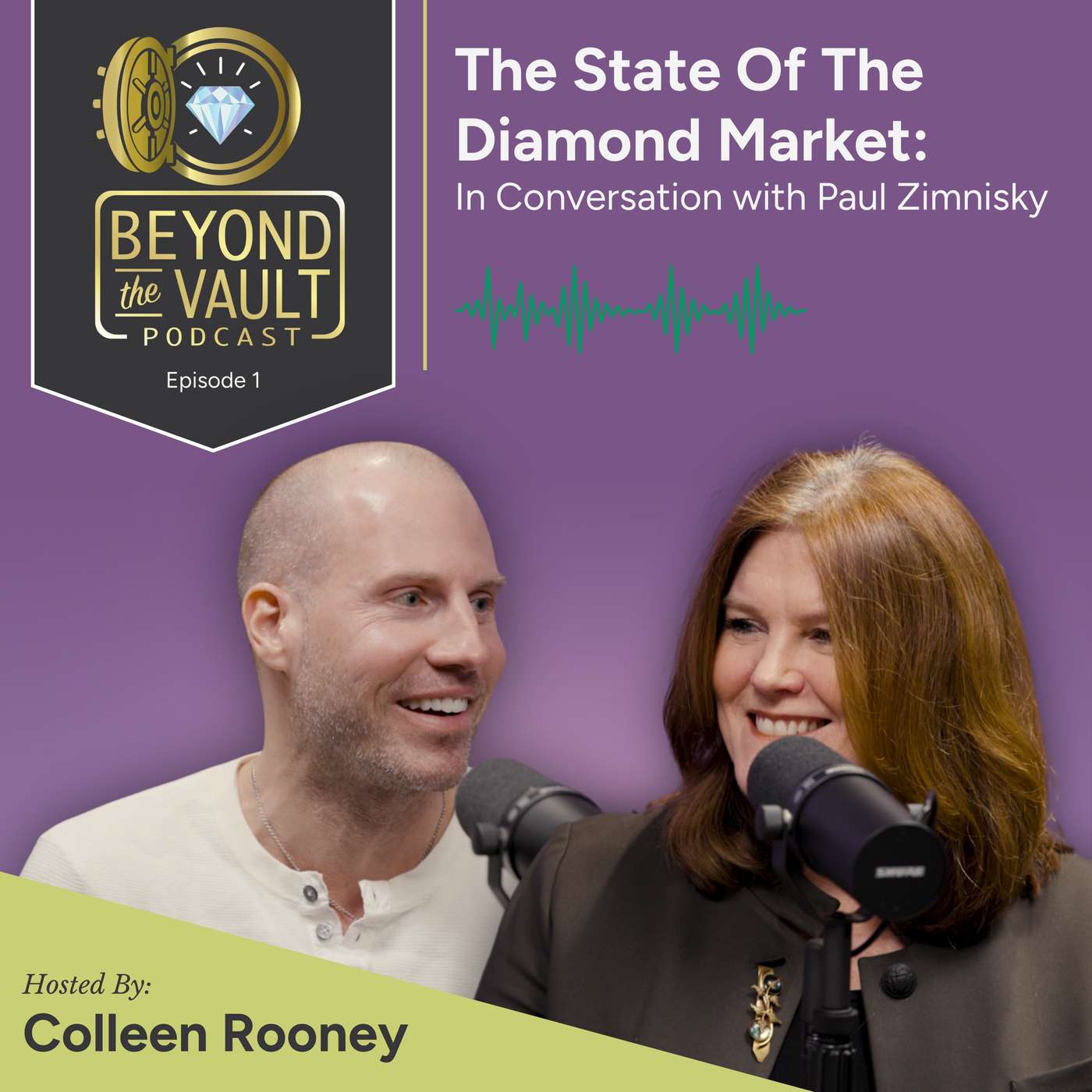
The State of the Diamond Market: A Conversation with Paul Zimnisky
from Beyond The Vault
25m 46s
In this debut episode of *Beyond the Vault*, host Colleen Rooney interviews Paul Zominski, a renowned diamond industry analyst. Paul shares his journey from covering natural resources on Wall Street to focusing on diamonds, captivated by the industry's mystery and global reach. He emphasizes the rarity of natural diamonds, describing them as "relics of nature" that require significant effort to mine, and contrasts them with lab-grown diamonds, which are increasingly perfect but lack unique origin stories. Paul highlights the need for better storytelling to convey diamonds' positive impact, using Botswana as an example—a country transformed from poverty to prosperity through diamond revenues. He discusses 2025 as a disappointing year due to tariffs and economic uncertainty, but sees potential catalysts for 2026: resolution of US-India tariffs (currently 50%), the sale of De Beers, and the return of Russian diamond production to support marketing. The market is polarized, with high-end natural diamonds and affordable value pieces thriving, while mid-tier businesses falter. Paul advocates for transparency initiatives like Signet's "Story Diamonds" to trace origin and authenticity, noting that natural diamonds' imperfections make them special in an era of AI-driven perfection. He finds purpose in the industry's passionate people, from geologists to designers, and believes natural diamonds will continue to command premiums through compelling storytelling.
Welcome to Beyond the Vault. I'm Colleen Rooney your host, Chief Corporate Affairs Executive at Signet Jewelers. Together we're going to get to know the most amazing people of our industry, and more importantly, hear what fuels their purpose and their passion. For our debut episode, we're kicking off with Paul Zominski. He's like an encyclopedia. He's a legend in our industry, a frequent teacher to me, and certainly a wealth of knowledge. He had an amazing discussion today with Paul. He talks about diamonds as relics of nature. He talks about his hopes for the future, and we even got to learn what his favorite piece of jewelry is. This is Beyond the Vault. The podcast where the jewelry industry takes center stage. We talk with the leader shaping what jewelry means today. From craft to culture to the moments that matter-boost, these are the voices shaping the future of the industry. Paul, thanks so much for being here. We'd like to start first question. You're our first guest, by the way, which is thank you. What an honor to have you here. You've taught us so much, but listen, I would love to know, and I know folks would love to know, just basically how did you get into this business? What led you here? Yeah, so my background is as a financial analyst on Wall Street, and I covered the natural resource complex. It's mostly oil and gas, and the bulk commodities, fertilizer and copper, and the precious metals, diamonds are a really small part of the natural resource industry when you look at it, just as an individual component. I always found the diamond industry to be completely unique. There's not a lot of information about it if you're an outsider, and I think the fact that it's so opaque and it's kind of mysterious has always intrigued me. And on top of that, it's such a global industry. I've always liked geopolitics and international business, and the diamond industry checks all the boxes. So I've been focusing on diamonds specifically for over 10 years now, and I'm independent. So I can kind of be as objective as necessary, and I love the industry, and I love the people. And you're like seriously sought out. You're podcasts, by the way, hit 25,000 downloads. Congratulations. Huge. You were in 10 countries, I think last year. Amazing. And you're right. I think for me, the first time you ever see the diamond mining operation, you're like, wow, diamonds really do incredible good for the world. And so you must be really proud that you get to help so many people during this time. That's I think the one area that maybe the industry isn't leveraging as much as it should. I think there's a lack of understanding of first off, like how rare natural diamonds are. We're talking about the larger higher quality. You know, talk about that. Talk about the rarity. I think when you go and visit a mine, you just see the cup, you know, the size and the scale on you kind of appreciate the engineering that goes into it. And how many people are employed and like, you know, high school level jobs. It employs. It's the sort of thing where I think you have to see it in person. And you feel it in your heart. Yeah. And again, I think especially when you look at what the industry is going through right now with, you know, the emergence of, you know, mainstream emergency of lab ground diamonds. And they're both fine products, but the origins are completely different. And I think sometimes we kind of get lost and maybe lack appreciation for how difficult and how expensive it is to actually, you know, get, you know, natural diamonds to the consumer. And I think, you know, again, if I'm being objected, I think the industry is maybe doing itself a little bit of a disservice there by conflating the tone. I think that's something you and I have talked about offline. We can get into that more of that later, but, but again, I think I wish the consumers would get to see what I would see. And I think there would be a different level, I think, of appreciation for, you know, some of the these products that are used in jewelry and they are, you know, truly rare relics of nature. I think you're right. I mean, even we had the opportunity to meet Minister Behollo last year who's the Minister of Energy and Mining in Botswana and she calls himself a product. She's a diamond baby. And so even just thinking about Botswana, they used to be the lowest GDP in Africa now. They're the highest. Like, I think you're right. I think if you gave advice to the industry on how do you take that message forward, what would it be? Yeah. Well, and again, I think the industry is definitely aware of this. I think it's being aware of and actually being able to execute it on a large scale are two different things. And I think the transparency initiative, I know you have had a big initiative with. I want to story diamonds with Claudian, Jared, right. But I think that's really the direct in the industry needs to go. I think we have to get to the point where all natural diamonds come with an origin and then you can kind of build on that story. And I know I think in your product and some of the products available in the market, you could, you know, you get a diamond and you can see a picture of it in the rough. And I think that gives it a different level of perspective and again, the story behind it. I think a lot of Americans probably don't know where Bahtuan is. They probably, you know, can't point at it on a map. So I think it's our job as an industry to kind of articulate that and kind of tell that story to the consumer. I think it makes the product so much more rich and so much more meaningful. That was certainly highlight for me and many of us at Signal was the launch of story diamonds. I want to ask you what a highlight for you was in 2025, Paul. Do you have any memories that you want to share? Yeah, so I mean, I did I traveled a lot last year. And again, that's kind of what I love about this industry. I think from, you know, in industry standpoint, maybe when I think about kind of what we went through, you know, from the standpoint of an analyst, I actually do think 2025 was a rather disappointing year. There was a lot going on. Obviously with the tariffs and the, you know, economic uncertainty. But at the end of the day, I think the American consumer in particular has been relatively resilient by and large. I think there's a lot of distractions. You know, in the industry right now, I think, you know, the beer's being up for sale again, the tariffs, I think, just still the industry marketing initiatives. So I think the industry didn't actually as well as it maybe could have, you know, given more, we where we ended up from an economic standpoint. So I think, I think what that does is it sets up 2026 for some really important catalyst. And again, I think the first one that could really provide a boost would be the, you know, some sort of resolution to the the tariff situation. What does that look like? What would be a positive resolution? Right. So I mean, for the industry, the diamond industry, it's India's the key. There's still a 50% tariff on Indian imports. I think the supply chain, I think, on your last call, I think, JK and Joe articulated what you're doing, you know, quite well, which is you're being nimble and you're kind of finding ways to create efficiencies throughout the supply chain. So I think a lot of the industries done a good job with that. But at the end of the day for loose diamonds coming into the US, there's no way around a, you know, the 50% tariff. So I think the price impact and the way the consumer has reacted hasn't been maybe as, you know, problematic as we may have thought, you know, going into this, you know, this time last year and March of last year, you know, that said, I think if we did get some sort of resolution. And as it stands right now, if the US does strike any sort of trade deal, that's official with India, natural diamonds will get an exemption. So I think these are the sort of things that could provide, you know, at the least, you know, a sediment boost and kind of give, you give us some, some positive momentum, you know, again, debiers is up for sale. There should be some sort of understanding of who the new owner is going to be. Hopefully by the end of this year, I think that could provide some confidence that the industry needs. I mean, you know, you guys are the, basically the leader downstream and debiers is the leader upstream. And I think the industry wants to know what debiers is going to look like, who they know and who's going to be before they make some, you know, longer term capital commitment. So that's a huge industry catalyst. And then I think, you know, the war in Ukraine continues to be something that does impact the diamond industry. All the humanitarian stuff aside, you know, for just talking just from a business standpoint, it has been disruptive to the industry. The Russians are the largest producer in the world by volume. If we're talking diamonds. And they were one of the biggest contributors to industry marketing. And that kind of has been halted after the sanctions. So there's a lot of, you know, potential positive catalyst on the table. So, you know, three very big things. Yeah. You know, Tara, for leap, be huge, positive outcome for debiers would be huge. And then, you know, El Rosa back in the picture, you know, to help with marketing could be huge for the industry. If you had a big picture thought on who won in jewelry, you know, we report the end of this month's end of our fiscal year. So we don't report till March. But generally speaking, what do you say? Who's winning in jewelry and why? Yeah. So I think this kind of fits in on what we're just talking about that there definitely are, you know, two ends of the market that are performing high end and lower end. I think you cannot under, you know, state the importance of quality and craftsmanship. So I think really well made jewelry. In a lot of cases, it's more important than the actual materials being used. So you see companies that really have, you know, high quality, you know, unique designs are doing, you know, very well. You know, large diamonds are doing well. I mean, the natural diamond market, buying large has been underperforming the last, you know, two, three years. But if you want, you know, an elongated fancy shape, that's two, three carrots.
short supply right now that are trading at a big premium. I mean, these are diamonds that are tens, hundreds of thousands of dollars. So, I mean, the fact that that market's hot right now tells you a lot. And then again, at the lower end, I think it's the same thing. I mean, companies that are getting the price point right and they're providing customers, nice story at good value. That's doing well. So I think that's kind of the story right now. And I think if you're kind of stuck in between your kind of indecisive, what your business strategies, I think that's where some companies are running into problems. So I think you kind of have to pick a lane and kind of go with it. And I think, from most businesses, I think that tends to be a pretty good approach. - How about, Lam, you're talking about, there is a trend we're seeing it too for the larger natural diamonds. What are you seeing? What's the state of the natural diamond industry today, Palm? What's where do you want to see it go in 2026? - Yeah, I think this again, kind of, I would just kind of continue with what we were talking about before with, I think, I think some of these transparency initiatives are essential. I think that is the right direction for the industry. I would like to get to the point where, with every natural diamond, it is attached to an origin. I think that's a definitely a way to distinguish the product from other similar competing products, whether it's lacquer and diamond or moise. And I think at the end of the day, I think we just have to remember that diamond, it's a romantic purchase. And I think there's something very romantic about it. A ballac of nature that's a billion years old that came to the surface through a volcano. That's a pretty special story. And again, I think it's a unique product that consumers are going to continue to want and value and pay premiums for. But you have to kind of get the story telling right now to kind of remind consumers that this is a special product. And I think, again, when the industry does that, right? It excels. - And if you're right, I mean, one thing we struggle with and we're trying to figure out this year is also how do we tell the story of how diamonds do good. And so that diamond from Botswana actually powers electricity, hospital schools helps an emerging country like Botswana. So that's something that's top of mind for us too. - Yeah, I think the narrative of the problems associated with diamonds, say 30 years ago, that still resonates with a lot of consumers, unfortunately. A lot of it has to do with the blood diamond, but we, for instance, I came out in '99 with Leo de Capri, which was an entertaining movie. But it's the industry is so different. And even then, it represented those represented a really small percentage of production. So it's up to the industry to explain to the wider consumer that natural diamonds will do so much good. I mean, and again, Botswana is kind of the story that gets told because Botswana is a country, I think it was one of the poorest countries in the world on a per capita basis now. It's one of the wealthiest and Africa. It's the highest credit rated country and Africa. It's the lowest in the corruption index, public education, public health care. - Maybe one of the most watched engagement of last year was somebody who's from not too far from here, Reading Pennsylvania, happens to be a famous person. Her fiancee happened to buy a natural diamond. Who am I talking about? - Right, yeah, Taylor Swift. - Taylor Swift, I know. So the birthplace of K and Taylor Swift have that in common. But talk about what she bought and, you know, - Yeah, that was like that. - Give it a little bit of a boost to the environment. - It did, I mean, that should be a huge, huge, I mean, that we had Zendaya, we had Miley Cyrus. I mean, that's like a, those are a huge potential catalyst for the industry. I mean, they went with natural diamonds, which makes sense. But it's like, even with that, it was like some of the stories that I read, you know, I read on it. Some of the writers were like, make it seem to be that it was unclear if it was an natural diamond when it was. So again, like, these are areas where I think the industry just needs to do a little bit of a, I better job kind of getting that story out. - Yeah. - But I think, you know, when you look at Taylor Swift's diamond, it's an older stone. It's an antique diamond. - Yeah. - And I think that kind of gets into what direction the natural diamond industry is going. Now, I think you and I kind of talked offline about the DeBeer Sets or Diamonds collection, which is like more like off-writes and some, you know, ambers and champagne colors and that sort of thing. But I think, you know, with natural diamonds, you know, they aren't perfect. And again, that's, I think, part of what makes them unique. We're getting into this world where, with AI and robotics, everything's gonna be like perfect. And I think it was, on New Year's Day, I think it was the CEOs of one of the big social media companies came out and he was talking about, like influencer content. And he was saying like with AI, the content is getting so good, it's perfect. It's getting very, very difficult to distinguish what's human-made and what's, you know, made by AI. And he said, don't strive for perfection if you're a human content creator. - Just be yourself. - Just be yourself. And it will come off as more authentic. And it will distinguish you from a perfectly, you know, made piece of content that was automatically generated. And I think it kind of reminds me a little bit about, you know, what's going on in natural, you know, versus those, say, the man made a live-grown diamond industry. I mean, with live-grown diamond, the GIA basically stopped grading using the same criteria that they do with natural diamonds because they said like the very large majority are getting to the point where they're just top quality. So they're really a need for that nuance anymore. And that's just the reality. I mean, you get a beautiful, like really nice high quality, you know, live-grown diamond are the very affordable price. But they're all like getting to the point where they're all kind of perfect, right? And natural diamonds are not perfect, right? But it reminds me of, you know, what I heard that saying about was just like the fact that it just reminds me very much of, you know, digital like AI content versus like human-made content. It's just like a theme that's that I think is pervasive in our generation. I mean, I-- in the role that I'm in, I mean, I think that we are all looking and striving for the truth, the real, the natural, the authentic. And so I think it's something to watch in 2026. And certainly, you know, natural diamonds have an origin story for folks that don't, you know, aren't deep in the industry like you, Paul. Where do most lab production-- what countries does the most lab? Yeah, so it's-- I mean, so historically-- so I think the lab people don't realize that. I mean, we've been producing, you know, we would call it up until 10 years ago. It was just called synthetic. That was just the term the industry used. But I mean, there's been synthetic diamond production for 50, 60, 70 years now. And so the very large majority of diamonds used for industrial application are synthetically made diamonds. The very large majority of those, probably over 90% are produced in China. So China has a history of, you know, and a legacy of being a leading, you know, manufacture of synthetic or manly diamonds. So they're producing a lot of the jewelry quality man-made diamonds as well. India is up there with China. I would say those two nations represent, you know, probably three quarters of lab-grown diamond production and almost all of those diamonds are cut and polished in India. So that's kind of the way that that works. With natural diamonds, again, Russia's kind of the largest producer by volume. Botswana we talked about. Botswana, they're the largest producer by value. Canada was that their largest producer in the world their minds have kind of run their course. They're getting to the point where the reserves are running out. So I mean, so there is, you know, some evolution, I think where the natural diamonds applies to me coming from. We're going to be seeing more coming from Angola. They're working closely with debirs to develop some of those assets. Yeah, for the most part, it's going to be the manly diamonds that are producing Asia. And we're going to see the natural diamonds produced in Siberia, Sub-Saharan Africa and the Canadian Arctic. And I also think it connects this globally, right? And so with the story diamond program, we look at the diamond and we think about, wow, this connects me all the way back to Botswana. Yeah. And so I think you're right. I think it's going to be really interesting. And that connects to purpose. And so we don't talk about it a lot, Paul. But when you strip away things, the numbers, all the analysis you do, what in your mind it gives you purpose in your-- I mean, it depends. I could basically cover any industry I want. And I continue to cover this industry because I really like the people. And the people are genuinely, extremely passionate. Whether it's, again, the geologists that are prospecting new deposits, I mean, they love-- They do. What they do. It's amazing. They're just passionate and genuine. And then you get the draw-by designers. I mean, the artists. I mean, they're genuinely passionate about what they do, the marketing people. I mean, it's people that care about this industry. I mean, what other industry can have something that comes from the earth, a miracle born from the earth in diamond orgold, whichever? And then connect it to emerging countries like Botswana. And then connect it through all the incredible sustainability efforts that we all are a part of. And then give that gift of emotional storytelling to consumers like you and me. So I happen to be wearing a gift from my grandma. It's a great Jade Ring. And there's-- it wouldn't be a stahop picked out, but it just keeps me with her, even though she's not here. And so it's really fascinating. It's probably my favorite industry by far. Dory makes people happy. - Yeah. - It shouldn't make you happy.
And like a great example, I mean, you look at that and it makes you think of your grandmother and it makes you happy and there's a positive. There's like a positive dynamic to that. So I mean, I think it is nice to work in an industry that produces things that make people feel good. So I think it's important to not lose sight of that. But again, I think that's why the people that are in this industry tend to be quite passionate about it. And I think that's that's kind of unique. Is that why it's such a resilient industry, do you think, because it has so much meaning to us all? Yeah, and it's, again, I think we have such practical, rational lives. We have very routine-oriented lives, you know, this day where people go to work and they come home and they make dinner and the weekends are busy and accounted for. And it's like we have like very structured, I'm very structured person. I like to have like a routine and a structure. But at the same time, I think it's fun to do things that are impractical and less rational. And I think, you know, jewelry kind of serves, you know, but that purpose to an extent. And taking a day to, I don't know, look at your hand and appreciate that. Yeah, I think jewelry, especially like rare jewelry or, Erlin jewelry or jewelry made with, you know, precious materials that we can't have as much of, you know, as we would like. I mean, talk about gold for a second as like inspiration for natural diamonds, you know, talk about the price of gold. Yeah. And yet demand for gold is still in all time high. Yeah, I think so. I used to cover that industry quite closely and, I mean, gold's crazy right now. And I think that's just kind of a brawm or somewhat for just uncertainty in the world, the US dollar is losing some favorability. There's, you know, populism happening globally. So again, I mean, I actually kind of enjoy covering these industries because I, again, I enjoy a geopolitics. And macroeconomics. So all this stuff kind of ties in. But gold, gold's been been an exciting thing to watch. So interesting. How about you? What's your favorite piece of jewelry? So I'm just by nature. I'm a minimalist. Yeah. I don't have like a lot of material things. I like, I'm kind of one of those people that wants experience. I own literally, I think three pieces of jewelry. I'm wearing two of them. I have, this is a watch. I got this at a cage or a store in New Jersey, probably 12 years ago. And I like it's titanium and sapphire and it's light and it's like a nice modern watch that serves purpose. I have this silver chain that I wear pretty much every day. It's a miraculous metal. I got a confirmation when I was a child. I wear that. And I have like a nicer Swiss watch at home. I think that's about it. So I'm kind of minimalist, but I wear it though. I think you have jewelry wear it. And I have, you know, three pieces of jewelry. Or I have two of them on today. So I think that that kind of works for me. And you're also, I've loved getting to know you. You were really helpful to me as I, you know, was newer to the industry. You and I met when you were the keynote speaker at the India Business Commercial Consortium known as GJP. Yeah, it was that that was at the Indian Consulate and Upper East Side of Manhattan. Yeah. I remember that. Yeah. Was that one of the countries you traveled to last year? Yeah, I was probably at this point probably about a year and a half ago, but yeah, so just to give you a quick quick run. So I was in India and goal. A lot of Europe, like Portugal, Germany, Italy, Switzerland. I just got back from Dubai a couple of months ago. I was in the Northwest Territories of Canada visiting one of the mines there. So I mean, again, just a truly global industry. And I love that. I just I like, you know, meeting people in different parts of the world and kind of imagining what it would have been like to kind of grow up there. That that's kind of what I find interesting. The world's like big and it's like we don't get to see as much of it as I think we should. I know that's what I like so much about this industry. And we get together usually March. Everybody comes to New York. The jewelry show. It really unites us as people. Yes. You know, it's like that whole one tribe. And I would say this industry does a really good job of that. I think they're I think like the social offensive industry puts together. So many like just independent organizations this industry has, you know, with the RJC and. Yeah, world of accounts. Yeah, I mean, it just goes on and on and on. I mean, it's it's a very self regulated industry. Yeah. And again, I think that's just maybe another example of why it's been it's been so resilient. Well, I love getting to know you people don't know that you while you may be very practical and you know disciplined. And I think that's the first thing that you do when you wake up in the morning. Oh, geez. I. I put the actually I used to drink coffee first thing the more I know I drink tea for my first drink of the day. So I get the the kettle going and then I literally make make my bed. And you live near the ocean. I live by the ocean. Yeah. So in the summer, I'll do that and I'll have a tea and then I'll go for a swim in the ocean. Yeah. I think that's how that can get to work. And what people to get to know that I love that. Well, Paul, any closing thoughts, anything we didn't talk about that. I think I think I know it's kind of conversation flows easy with you. I like having you as a friend. Me too. Your future value the relationship with with segment. I think you're a good steward for the downstream segment of the industry. I'm excited about where we're going. I think this is going to be a great year for a segment, but also the industry and so appreciate you keep teaching us things Paul. Great. Thanks so much. Thank you.
Podcast Summary
Key Points:
Paul Zominski, a former Wall Street financial analyst, transitioned to covering the diamond industry over 10 years ago, drawn by its opacity, global nature, and unique challenges.
Natural diamonds are rare "relics of nature," and the industry must better communicate their origin stories and positive impacts, such as Botswana's transformation from low GDP to Africa's wealthiest country.
Key industry catalysts for 2026 include resolution of US-India tariffs (currently 50% on diamonds), the sale of De Beers, and potential return of Russian diamond production (Alrosa) to support marketing.
The market is polarizing
Lab-grown diamonds, mostly produced in China and India, are increasingly perfect and affordable, but natural diamonds offer authenticity and uniqueness, akin to human-made vs. AI-generated content.
Transparency initiatives, like Signet's "Story Diamonds" program that traces origin, are essential to differentiate natural diamonds and remind consumers of their romantic, billion-year-old story.
Summary:
In this debut episode of *Beyond the Vault*, host Colleen Rooney interviews Paul Zominski, a renowned diamond industry analyst. Paul shares his journey from covering natural resources on Wall Street to focusing on diamonds, captivated by the industry's mystery and global reach. He emphasizes the rarity of natural diamonds, describing them as "relics of nature" that require significant effort to mine, and contrasts them with lab-grown diamonds, which are increasingly perfect but lack unique origin stories.
Paul highlights the need for better storytelling to convey diamonds' positive impact, using Botswana as an example—a country transformed from poverty to prosperity through diamond revenues. He discusses 2025 as a disappointing year due to tariffs and economic uncertainty, but sees potential catalysts for 2026: resolution of US-India tariffs (currently 50%), the sale of De Beers, and the return of Russian diamond production to support marketing. The market is polarized, with high-end natural diamonds and affordable value pieces thriving, while mid-tier businesses falter.
Paul advocates for transparency initiatives like Signet's "Story Diamonds" to trace origin and authenticity, noting that natural diamonds' imperfections make them special in an era of AI-driven perfection. He finds purpose in the industry's passionate people, from geologists to designers, and believes natural diamonds will continue to command premiums through compelling storytelling.
FAQs
Paul started as a financial analyst on Wall Street covering natural resources, including oil, gas, and precious metals. He was intrigued by the diamond industry's opacity, mystery, and global nature, and has focused on diamonds for over 10 years.
He describes them as 'truly rare relics of nature' that are billions of years old and brought to the surface by volcanoes. He believes their rarity and unique origin story make them a romantic and valuable product.
He recommends increasing transparency by attaching an origin story to every natural diamond. This helps differentiate natural diamonds from lab-grown ones and reminds consumers of their special, romantic appeal.
Key challenges included tariffs (especially a 50% tariff on Indian imports), economic uncertainty, the sale of De Beers, and disruptions from the war in Ukraine affecting Russian diamond supply and marketing.
Potential catalysts include a resolution to tariff issues with India, clarity on De Beers' new ownership, and the return of Russian diamond producer Alrosa to help with marketing efforts.
Both the high end and lower end are performing well. High-quality craftsmanship and unique designs succeed, while companies offering good value and a nice story at the right price point also thrive.
Chat with AI
Loading...
Pro features
Go deeper with this episode
Unlock creator-grade tools that turn any transcript into show notes and subtitle files.
 PodcastTranscript AI