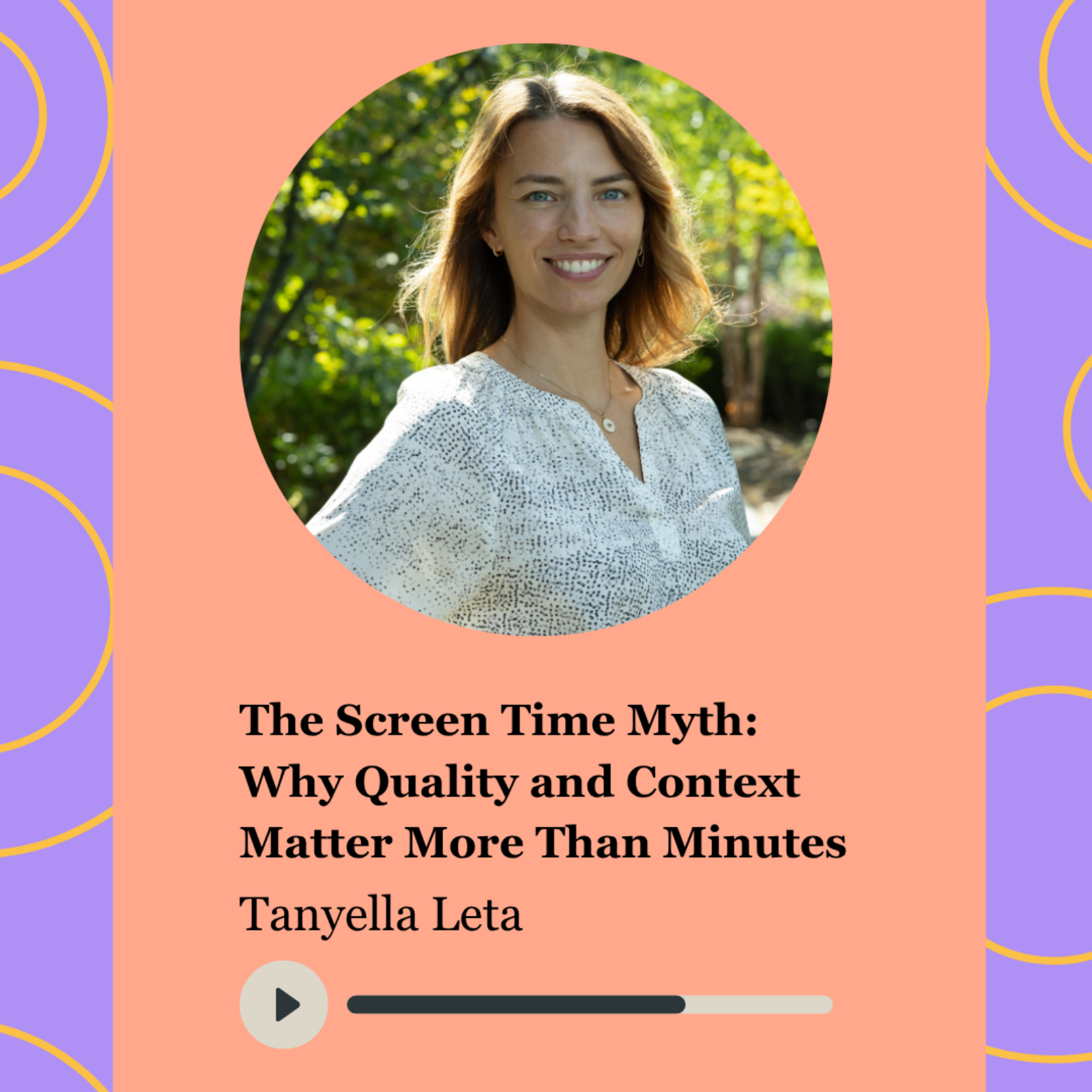
The Screen Time Myth: Why Quality and Context Matter More Than Minutes w/ Tanyella Leta from Maka
16m 2s
The podcast episode reexamines screen time, arguing that focusing solely on duration oversimplifies a complex issue. Instead, parents should consider three factors: the child's individual development, the content's quality, and the context of viewing. High-quality content is intentionally designed to support development through thoughtful pacing, clear narratives, and pro-social modeling, while low-quality content often prioritizes engagement with rapid cuts and loud stimuli. Technology should align with childhood by avoiding features like infinite scrolling and auto-play, instead incorporating natural stopping points and safety measures. Co-viewing with parents enhances learning by linking on-screen experiences to real life, turning media into a tool for connection. The discussion encourages moving from guilt-driven decisions to intentional, informed choices, emphasizing that thoughtful screen use can coexist with healthy child development when balanced with other enriching activities.
Welcome back to the Connected Childhood Podcast by Ami, where we explore the intersection of technology, parenting, and childhood development. I'm your host, Rashi, and in each episode I speak with educators, clinicians, builders, and parents who are rethinking how learning and development, as well as technology can work with families. Today we're unpacking one of the most emotionally loaded topics and parenting, screen time, but instead of asking how many minutes is okay, we're asking questions like what kind of content, in what context, and how does it actually affect our kids? I'm joined by Tanyaela Leta, co-founder of Maca Media, whose work focuses on thoughtful, high quality children's content. Together we're talking about how we can move from guilt to intention and how companies like Ami and Maca Media are trying to design technology that truly supports childhood. Tanyaela, thank you so much for joining us today. Thanks for having me, Rashi. Of course, so just to kick things off, we've all been conditioned to think about screen time as a number. 30 minutes and hour definitely none before bedtime is something that we hear very often. I'd love to know from your perspective what gets oversimplified when we focus on only quantity and what dimensions should parents actually be thinking about instead? Yeah, well, first, I'm going to say I'm really excited to be here, especially because I think Ami and Maca share such a similar mission around designing technology that really supports childhood rather than competes with it. And at Maca kids, we're building a curated children's media platform that's grounded in developmental science. And what we've learned, and I know this resonates with is that this is one of the biggest oversimplifications is the screen time conversation and reducing it just to one dimension, just to minutes. And I think we've reduced something that's really complex actually to just one dimension. I think that's because it kind of makes headlines, right? Like, minutes are easy to measure. It's easy to put into guidelines. It's easy to debate in heated total. But timing is just one variable in a much larger developmental picture. So, for example, two children can watch the exact same amount of screen time and have completely different experiences and outcomes. And that's because we know that screen time isn't just about quantity. So, at Maca, we think about screen time as being shaped primarily by three key factors. So, the first is the individual child, the second is the content itself, and the third is the context for watching that content. So, we like to ask, you know, on the first one of the individual child, like who is this child developmentally? And as parents, you know, he's caregivers, educators, you know, you know the children that you're raising or that you're working with. You know their differences. And so, you know that how they're going to respond differently to certain kinds of content. So, that's the first thing. It's like understanding who the child is. And that screen time intersects with that individual child and where they're at developmentally. And then the second is the content itself. Like, what exactly are they watching? So, it's very different watching something on a screen and we'll talk about, you know, stimulation levels and content, but highly simulating content versus something that is more low-paced content as educational versus just entertaining. And then the final piece is the context. So, like, what's happening around that moment? Are you as a family, like engaging in watching that content together? So, I mean, I think it's important to say, right? Like research does show correlations between heavy early screen time use and things like a negative impact on children's executive function, even language delays. But I think when we're reading these studies and these headlines, it's important to note that those findings are correlational. They're not necessarily causal. So, often, you know, when we're looking at that data, we're seeing that's what what's what may be happening is that screens are displacing other rich developmental activities, like conversation, stuff, play, reading, connection. So, it might not be that screen time is causing all these negative effects. It's that it's reducing the amount of time for these other developmentally positive experiences. So, I think when we shift from how many minutes to, you know, is this intentional? The conversation becomes much more empowering and much less guilt driven. And honestly, you know, at Maca, we work a lot with with parents. And I think that sometimes the guilt parents carry around screen time can be just as harmful if not more so than the screen time itself. Absolutely. We hear a lot about guilt from parents around using screens. We also know that there's a lot of different content out there and not all kids media is created equal. From a creator's lens, what actually makes content high quality or developmentally supportive versus just digital noise? Yeah. So, from a developmental lens, the quality really comes down to the explicit intention with which that content has been created. So, you'll notice that low quality digital content tends to share similar traits, right? Like rapid scene cuts. It might be loud audio, high-press saturated visuals. And we also see there's a platform component here with recommendations that lead to this endless auto-play loop. So, it's content and platform experiences that are engineered for engagement and not engineered for development. Whereas high quality programming, on the other hand, you'll notice like thoughtful pacing, very clear narrative arcs and modeling of pro-social behavior. You'll notice also that often the content leaves space for processing, which will just actually deprosis what they're seeing. And also that it supports language and emotional development intentionally and explicitly, not just, you know, accidentally, but you can see there's almost like a curriculum behind the content. But it doesn't just mean that educational, you know, educational content only explicitly doesn't just have to mean academic. So, you know, watching really good quality stories where character, when navigating frustration, friendship, or repair can also be like deeply supportive of what we call informal learning. So, in our model at Maca, we look at dozens of indicators of quality and media. We use AI and a human and the loop approach to analyze shows and transcripts and have experts that review and vet every show across these different dimensions of quality. I think the way you described it is really helpful. And I can certainly think of different examples of the media that you were talking about. So, at Ami, we often describe what we're building as the anti-tablet. So, this is something that supports routines, learning and calm engagement, but it's intentionally designed to be put down. I'd love to know, Taniaela, from your experience, what would it look like for children's technology to truly align with childhood development instead of competing for attention? And what do you wish more products in this space got right? Yeah, I love this question. And I think, you know, both of us are trying to build towards that future where technology does respect childhood. I would say that if children's technology were truly aligned with child development, it would feel a lot more calm. It wouldn't be optimized for time on a device or endless engagement. Like you said, designing for putting the device down. I think most children's digital products today are built on engagement economics that are really optimized for adulthood and even then as adults, we find it difficult to handle things like auto-play, algorithm, you know, drifting you into different parts of being to that infinite scrolling. You know, I'm certainly guilty of that. And those mechanisms are fundamentally misaligned with how, you know, young brains regulate attention and emotion. It's a lot to ask young children whose objective function is not fully developed, even young adults, right, to be able to deal with these mechanisms. So I think development we aligned tech would include natural stopping points, you know, stories ending, thoughtful pacing. It would eliminate those manipulative reward loops that reward you would dopamine for continuing to be on the technology. It would treat safety as non-negotiable. So no ads, no rabbit holes into dark corners of the internet. No, not extracting children's attention as the business model that underlies the company. And I say all this at like at the same time, I'm really excited about technology. I believe we have to meet parents where they're at as well. Now, I'm not a purist in terms of tech. I think technology has to meet the reality of modern parenthood and give them tools to make healthy choices around screen time. And I don't think screens are inherently bad. There's not evidence that supports that. I think the issue is
that when platforms are built to compete for attention rather than support children's development and regulation, that's the problem. So when we make in supporting the child and the entire family context, when that becomes the focus instead of engagement metrics, the entire experience shifts and technology can be just such an incredibly powerful and positive tool for children. Yes, absolutely. And what you said about the infinite scroll, the algorithm drift, I mean, adults find this so challenging to navigate and the reality is it's that much more difficult for our children to be able to do that when their young brains haven't fully developed yet. I would love to know about how kids experience media also changes basis based on context. So whether they're watching alone with a sibling or with a parent, what differences have you seen from sort of passive viewing and more connected or co-viewing experience with parents, for instance? Yeah. So firstly, I want to gently challenge that term passive viewing 'cause it actually, you know, a misnomer for what's happening. So when a child is watching well-designed content on screen, their brain is actually highly active. So they're processing language, narrative, emotion, visual cues. So in the academic world, researchers now often using the term receptive media rather instead of passive media for that reason. There's research, one of our advisors, Dr. Alade, and she's an advisor to us at marker, shows that children who watched high quality educational media, you know, in a receptive media, so just a show were better able to transfer math concepts to a new context than children who played interactive games teaching the same concept. So we see like, I think this idea that like interactive is always better, it's not necessarily the case, it depends on the skill. So some shows actually help viewers better with generalizing, help children take on concepts and generalize them to other contexts as well. So receptive media and just watching a show isn't nothing, you know, there's real cognitive work happening there. I think where context makes the difference is this relational layer. And co-viewing, as you mentioned, such a perfect example, like when a parent or sibling engages even lightly, it helps children connect to what they're seeing on the screen as they're watching a show to real life. So a simple comment like this character, you know, she looks frustrated. Have you felt that way? Helps to deepen integration on what we call informal learning. So even, this is really powerful, even if a show is not great quality. If your kid loves it and you talk to them about it and engage them in discussing it, you're actually supporting the healthy development just because of that relational layer and how powerful it is. - That's great. That's great. - That's a great segue into sort of the next topic around parent guilt, which we spoke about a little bit earlier this episode, but we hear about this a lot from the army community that even the most thoughtful parents carry so much guilt. So if you were sitting down with a parent who feels like they're failing because of their child's screen use, what mindset shift would you offer to help them move forward with confidence instead of judgment? - Yeah, I mean, such a big problem that we come across. I mean, I would say if I was sitting with a parent who felt like they were failing because of screen time, I would first say the anxiety you're feeling is evidence that you care deeply for your child. And for many parents, screen time has become a proxy for the question, am I a good parent? And that's such a heavy thing to attach to a single behavior. Like we all know parenting is not measured in minutes. It's measured in patterns of care, connection and intention over time. So when it comes to screen time or anything, it isn't about, in my view, elimination, it's moderation and thoughtfulness and not everything a child watches has to be educational. Like fun has value too. Decompression has value. You know your child's best. We really believe that. And Marka that parents know their children. And sometimes giving your child 30 in calm minutes so you can reset. So you become a more regulated parent. That's profoundly beneficial for the child, for the entire family. So I think we need to move from, I'm failing because my child watched an hour of this show to I made a thoughtful decision in a real life moment. And I think when we shift from shame to intention, hopefully we can help parents regain their confidence. Confidence parents make better decisions, ultimately when they're not by guilt. Absolutely. I love this idea that it's not about eliminating screens. It's about designing better ones and using them with more intention. Teniela, thank you so much for so much nuance, so much thoughtfulness and compassion around a conversation that has been so black and white. And if you're curious to learn more about what we're building at Ami, the four and one early childhood hub, you can learn more at omni.ai. Our pre-orders are now open. We'll see you next time on the Connected Childhood Podcast. Thanks for joining.
Podcast Summary
Key Points:
Screen time should be evaluated beyond just duration, focusing on content quality, context, and the child's individual developmental needs.
High-quality children's media is intentionally designed with thoughtful pacing, pro-social modeling, and developmental support, unlike engagement-driven "digital noise."
Technology aligned with childhood development prioritizes calm engagement, natural stopping points, and safety, avoiding manipulative features like auto-play and infinite scrolling.
Co-viewing with parents or caregivers enhances learning by connecting on-screen content to real-life experiences, reducing guilt and fostering intentional media use.
Parental guilt around screen time is counterproductive; shifting focus from shame to thoughtful, context-aware decisions supports healthier family dynamics and child development.
Summary:
The podcast episode reexamines screen time, arguing that focusing solely on duration oversimplifies a complex issue. Instead, parents should consider three factors: the child's individual development, the content's quality, and the context of viewing. High-quality content is intentionally designed to support development through thoughtful pacing, clear narratives, and pro-social modeling, while low-quality content often prioritizes engagement with rapid cuts and loud stimuli.
Technology should align with childhood by avoiding features like infinite scrolling and auto-play, instead incorporating natural stopping points and safety measures. Co-viewing with parents enhances learning by linking on-screen experiences to real life, turning media into a tool for connection. The discussion encourages moving from guilt-driven decisions to intentional, informed choices, emphasizing that thoughtful screen use can coexist with healthy child development when balanced with other enriching activities.
FAQs
Parents should consider the individual child's developmental stage, the quality and type of content being viewed, and the context in which it's watched, such as co-viewing with family.
High-quality content features thoughtful pacing, clear narratives, pro-social behavior modeling, and intentional support for language and emotional development, avoiding rapid cuts and overstimulation.
Developmentally aligned technology includes natural stopping points, calm engagement, no ads or manipulative loops, and prioritizes safety and regulation over endless screen time.
Co-viewing adds a relational layer that helps children connect on-screen content to real life, deepening learning and emotional integration through discussion and engagement.
Shift from focusing on minutes to intentional use, recognizing that thoughtful decisions in real-life contexts, including fun and decompression, are valuable for both children and parents.
No, screen time itself isn't inherently harmful; the issue arises when platforms compete for attention rather than support development, displacing other enriching activities.
Chat with AI
Loading...
Pro features
Go deeper with this episode
Unlock creator-grade tools that turn any transcript into show notes and subtitle files.
 PodcastTranscript AI