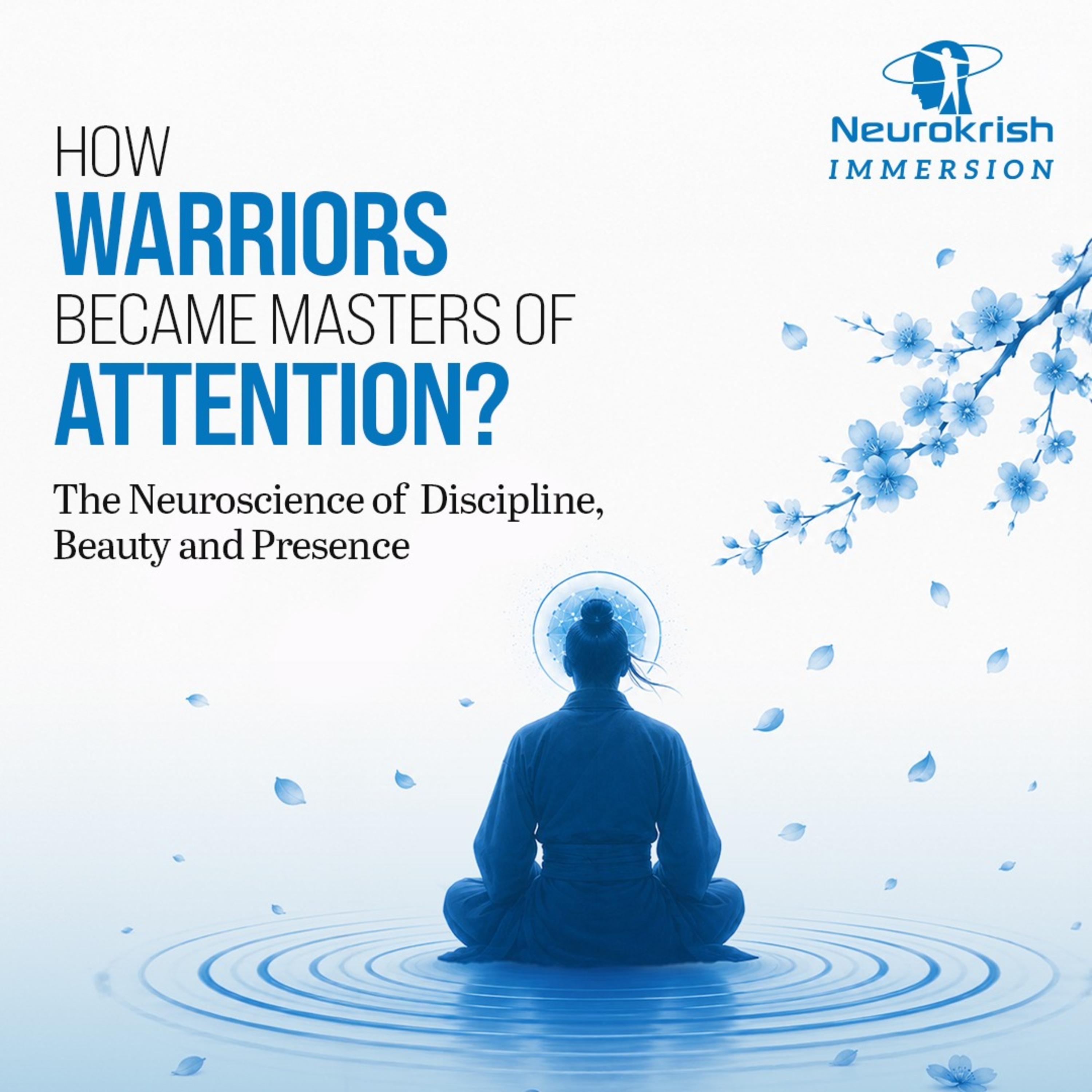
The episode explores the evolution of the samurai mind from a warrior culture rooted in war and survival to a profound philosophy of mindful living. Originating in the chaotic Sengoku Jidai, where conflict defined daily life, samurai were forged through vigilance, loyalty, and discipline. Three pivotal leaders—Oda Nobunaga, Toyotomi Hideyoshi, and Tokugawa Ieyasu—represented different responses to chaos: action, adaptability, and patience. As peace emerged, the samurai’s identity transformed. Their martial values shifted into governance, education, and moral responsibility, forming a psychological framework in Bushido. This framework drew from Shinto, Buddhism, and Confucianism to promote sincerity, integrity, and inner coherence. Practices like the tea ceremony, calligraphy, and flower arrangement became tangible expressions of mindfulness—teaching presence, attention, and respect for impermanence. Concepts like *wabi-sabi* and *omotanashi* emphasize beauty in imperfection and proactive care. The journey illustrates how power becomes order, order becomes beauty, and beauty becomes wisdom. Even after the formal end of the samurai class, their values live on in modern systems like Toyota’s Kaizen, where continuous improvement reflects disciplined awareness. Ultimately, the samurai story is not about historical imitation but about personal transformation: learning to live with stillness, attention, and care in the face of modern noise and urgency. The finest swords, it concludes, are not forged in battle but in stillness.
Welcome to the Neurokrishimershan. In this episode we are discussing the Samurai mind,
a journey from war to mindful living. There are times when inspiration arrives from unexpected
places, not from the pages of a scientific journal, not from the consulting room, not
even from the quiet hum of an MRI scanner. Mine arrived one evening while watching a historical
documentary series on Netflix called The Age of the Samurai. Like many viewers, I began
with a certain expectation. I expected swords, castles, battlefields, rival clans, and the
drama of conquest. I expected war. What I encountered instead was something far more profound.
Beneath the armor and beneath the legends, I found a meditation on the human condition
itself. I found a story about fear and ambition, discipline and beauty, violence and restraint.
And slowly, as the episodes unfolded, one question began to take hold of me. What happens
when the war ends? It's a deceptively simple question. It belongs to medieval Japan of course,
but it also belongs to every civilization, every family, every institution and perhaps
every human being. What happens when the struggle that shaped us no longer defines us?
What happens to the warrior when there is no battlefield? What happens to power when
it is no longer consumed by survival? Can power become order? Can order become beauty?
And if beauty is cultivated long enough, can it become wisdom? And this is the subject
of today's Neurocrish immersion. Today we journey into the samurai mind, but it's
not just about a history of Japan. It's not a celebration of the sword, nor a romantic
account of warrior nobility. It's an exploration of how a civilization that lived through centuries
of conflict gradually transformed its warrior energies into mindfulness, aesthetics, craftsmanship
and grace. It is a story about how raw force was disciplined, how discipline was refined,
and how refinement entered everyday life. The samurai mind, as I see it, is not finally
about war. It is about mindful living. To understand the samurai, we must begin not
with the zen gardens or tea rooms, but with chaos. We must begin in the Sengoku Jidai,
the age of warring states when Japan was not a unified nation, but a fragmented landscape
of rival domains, completing warlords and shifting loyalties. For nearly two centuries,
war was not an interruption of life. War was life. Castles, rows and burned. Families
rose to power and disappeared. Alliances formed in the morning and dissolved by night. Trust
was fragile. Death was familiar, and the sword was not symbolic. It was survival. And indeed
watching the age of the samurai on Netflix, this is what I understood. And this is what
the age of the samurai captures so powerfully. It does not allow us to enter Japan through
the polished door of later elegance. It places us first in the dust and blood of society,
struggling to survive itself. One begins to understand that the samurai were born not
as philosophers, not as artists, scholars or tea masters. They were warriors forged
in uncertainty. They came into being in a world where vigilance was rewarded. Loyalty
was necessary. Hesitation could be fatal, and honor was not a decoration but a structure
that held life together when institutions were fragile. And as the episodes in that program
recounted so well, three extraordinary figures emerged in this world. Oda No Bonaga, Toyotomi
Hideyoshi and Tokugawa Yasuo. They are sometimes remembered as the three unifiers of Japan,
but psychologically they represent three different responses to chaos. No Bonaga was
explosive genius, ruthless, innovative, impatient with old forms. He embraced firearms when
others remained bound to older codes of battle. He shattered tradition because he understood
that survival sometimes belongs to those who can break with the past.
Hideyoshi was adaptability embodied, a man of humble birth who rose beyond every expectation,
reading people, circumstances and opportunity with astonishing fluency. And Yasuo was patients
perhaps the most underrated of psychological powers. He waited, he endured, he watched
others burn bright and burn out. He understood that the deepest victory is not the dramatic
victory of the moment, but the creation of order that lasts beyond one's lifetime.
There is an old saying associated with these three men. If the Kuku bird refuses to sing,
No Bonaga says kill it. Hideyoshi says persevered, Yasuo says wait. And that describes all three
of them so well. And indeed that capacity to wait may be one of the great frontal achievements
of civilization. Modern neuroscience gives us a language for this. A society under chronic
threat resembles a nervous system in chronic arousal. The Amygdala remains alert. The body
anticipates danger. Attention narrows towards threat. Trust becomes selective. Reaction becomes
quicker than reflection. In such a world, the limbic brain as we keep talking about it
is always near the surface. Fear, aggression, loyalty, rage, grief, suspicion, courage.
These are not abstract emotions. They are survival tools. But prolonged threat also creates
a problem. A society cannot live forever in the state of alarm. A person cannot live forever
as a reflex. A civilization cannot remain permanently limbic. At some point, if it has
to endure, power must become order. And this is where Tokugawa Yasuo becomes more than
a historical figure. After the Battle of Sekigara, in 1600, he did not merely defeat his rivals.
He created a structure. The Tokugawa Shogunate brought peace to Japan for over two and a half
centuries. And with that peace came one of the most fascinating psychological transformations
in history. The samurai whose identity had been forged in war now had to live in peace.
The sword remained, but the battlefield receded. This is an extraordinary moment. We should
not pass over it too quickly. Four generations men had been trained to fight, die, obey,
sacrifice, and defend. Their bodies, families, and social status had been organized around
conflict. And then, almost suddenly in historical terms, the great wars ended. What then was
a samurai to be? What happens to the warrior when the war no longer requires him? And indeed,
this is how I started my quest to understand what happened to the samurai and off the samurai
after these great wars. We see versions of this question everywhere. The veteran returning
from combat asks it. The athlete after retirement asks it. The patient who survives a serious
illness asks it. The founder who builds an institution and then must step back at some
point in time asks it. Even nations ask it after revolutions. Who am I when the struggle
no longer supplies?
my identity.
Tokugawa Japan answered this question not by abolishing the Samura mind but by redirecting
it.
The Samurai became administrators, scholars, teachers, bureaucrats and custodians of order.
The martial discipline of the battlefield migrated into governance.
The loyalty once offered to a warlord became loyalty to a social structure.
The vigilance once directed towards enemies was redirected towards conduct, etiquette
and responsibility.
Literacy expanded, education became central, confusion ideals of hierarchy, duty and moral
cultivation entered deeply into Samurai life.
The household became a sight of training, character became something to be shaped.
And this is where Bushido becomes important, though we must be careful not to simplify
it.
The way of the warrior was not merely a code of bravery or loyalty, although those were central.
Over time, especially during the long piece, Bushido became a moral psychology.
It grew from several streams.
From Shinto came reverence, purity and a felt relationship with nature and ancestry.
From Buddhism came impermanence, detachment and the acceptance of death.
From Confucianism came duty, hierarchy, education and social responsibility.
And these influences together created an inner architecture, rectitude, courage, benevolence,
respect, honesty, honor, loyalty, self-control.
These monotmen to be admired from a distance, they were to be cultivated, rehearsed and embodied.
And perhaps the most beautiful of these values is Makato, often translated as sincerity.
But sincerity here is not mere politeness, it is alignment.
Thought, word and action brought into coherence.
What one believes, what one says and what one does should not live as three separate lives.
And there is something deeply neuropsychiatric in this idea.
Many forms of distress involve fragmentation.
We think one thing, feel another, say a third and do a fourth.
In a life and outer life lose alignment.
The Samurai ideal of Makato points towards coherence.
It suggests that integrity is not only moral but psychological.
To live with sincerity is to reduce the distance between the self one performs and the self
one inhabits.
Bushido then was not simply about dying well.
It was about living with form.
It transformed raw power into ordered conduct.
It gave the warrior a way to exist in a world where war no longer supplied daily purpose.
But order alone is not enough.
Order can become rigid, it can become sterile, it can harden into mere hierarchy.
For a civilization to mature further, order must become beauty.
And this is where Japan becomes astonishing.
The same culture that had been forged through war began to cultivate some of the most refined
practices of attention the world has known.
Zen entered the Samurai world, not merely as religious doctrine, but as a discipline
of presence.
Zen did not promise the warrior that death would vanish.
It taught him to meet reality without flinching.
It taught him to act without being clouded by anticipation, fear or regret.
It taught him to attend.
The concept of motion, often translated as no mind, is easily misunderstood.
It does not mean stupidity or blankness.
It does not mean the absence of consciousness.
It means freedom from inner clutter, the mind that is not tangled in self-commentary.
The Swordsman who is not trapped in yesterday's mistake or tomorrow's fear.
The archer who does not overthink the release.
The calligrapher whose brush moves because attention and action have become one.
In modern language, we might speak of flow, of attentional frameworks, of the quieting
of excessive self-referential processing.
But the Samurai did not need our terminology.
They discovered through practice that the mind performs best when it is fully present.
The monk's brain, and you can listen to that podcast in our series, reminds us that
mindfulness is not merely sitting with eyes closed.
Mindfulness is a way of inhabiting reality.
And mature Japanese culture seems to have understood this at a civilizational level.
Mindfulness entered not just monasteries, but tea, brush, garden, theatre, hospitality,
and work.
Perhaps the tea ceremony is the most beautiful example of this.
To someone unfamiliar with it, the Japanese tea ceremony may appear almost impossibly
simple.
Water is boiled.
Tea is prepared, a bowl is offered.
Guess, receive it, and yet, within the simplicity lies an entire philosophy of attention.
Sen No Riku, the great tea master, did not merely refine etiquette.
He transformed hospitality into contemplative practice.
The tea room was small, often spare.
Sometimes entered through a low doorway requiring even the powerful to bow.
In that gesture, social status softened.
Arm, ego, and rank were often left outside.
Inside each movement mattered, the placement of the utensils, the sound of water, the texture
of the bowl, the pause before drinking, the season suggested by the flower, the scroll
selected for the occasion.
Nothing was excessive, nothing was casual, nothing was harried.
The four principles of the tea ceremony, harmony, respect, purity, and tranquility are not merely
aesthetic ideals, they are states of mind.
Harmony brings the person into relationship with others and surroundings.
Respect creates reverence for the moment and the guest.
Purity clears both space and intention.
Tranquility is not imposed, it emerges when attention has done its work.
This is mindfulness made visible.
The tea ceremony teaches that ordinary action when performed with complete attention becomes
sacred.
It is not what is done that transforms the mind, but how it is done.
A bowl of tea becomes a mirror.
The harried person discovers harry.
The distracted person discovers distraction.
The attentive person discovers that simplicity can hold infinity.
Caligraphy offers another window.
In caligraphy, the brush reveals the mind.
There is no real hiding.
A stroke made once cannot be withdrawn.
Exitation appears, force appears, restlessness appears, calm appears.
The brush becomes an extension of the consciousness.
The ink records not just a character but a state.
To write beautifully, one must first settle inwardly.
The hand cannot produce what the mind refuses to become.
And this is why caligraphy was not merely writing.
It was self-cultivation.
Each stroke required breath, posture, timing, pressure and release.
Too much force.
and the line becomes crude. Too little and it lacks life. The calligrapher must be both
disciplined and free. Form must be learned so deeply that spontaneity becomes possible.
This is a profound lesson for any mind. Freedom is not the absence of structure. Freedom
is structure internalized so deeply that action becomes grateful. Ikibana, the art of flower arrangement,
speaks the same language. To arrange flowers is not simply to decorate a room. It is to attend
to relationship. Line, space, asymmetry, season, emptiness, proportion. A branch is not placed
merely because it is pretty. It is placed because it speaks to the whole. Empty space matters as much
as form. Restrained matters more than abundance. The flower is alive but also passing. It's beauty
contains its disappearance. And this is where Wabisabi enters Japanese consciousness, the beauty of
imperfection, impermanence and incompleteness. A cracked bowl may be more beautiful because it
carries time. A weathered surface may hold more truth than polished perfection. A fading blossom
may reveal more than one in full bloom. Wabisabi is not pessimism. Its tenderness towards reality.
It asks us to stop demanding that life be flawless before we find it. Beautiful. Zen gardens
continue this education in attention. Stones, gravel, moss, carefully pruned trees,
rake lines suggesting water without water. The garden does not shout. It invites. It offers
the mind enough form to rest and enough emptiness to expand. To sit before such a garden is to
experience the discipline of less. The modern world fills every silence. Japanese aesthetics often
protect silence as a sacred space. Haiku, too, does this in language. A few syllables, a season,
a frog, a pond, a sound, a moment. The poem does not explain everything. It opens a door.
It trusts the listener. And this is another form of mindfulness. The refusal to overfill
experience. The willingness to let a moment remain spacious. The North Theatre does something
similar with movement and time. Slow gestures, masks, controlled voice, ritualized presence.
To the impatient eye it may appear almost motionless. But that is its discipline. It trains the
viewer to see subtly. It asks attention to deepen rather than consume. And in this way,
Japanese culture repeatedly teaches the same lesson. When the mind slows, the world becomes
more visible. And all of this tells us something crucial about the Samurai mind.
The transformation of the Samurai from warriors to people of peace was not achieved through one
doctrine. It was cultivated through daily practices. Te, brush, flower, garden, poem, theatre,
sword, bow, gesture, hospitality. Mindfulness did not remain an isolated meditation technique.
It became culture in Japan. And this is why the story of Miyamoto Musashi is so compelling.
As a young man, Musashi was fierce, restless, almost elemental.
He fought dwell after dwell and survived. But the later Musashi is the one who interests me most.
The man in Riga and Okabe. The man who painted birds. The man who sculpted. The man who wrote
the book of five rings. The young warrior had mastered combat. The older warrior sought clarity.
The book of firings, for example, is often read as a manual of strategy. And it is that. But it is
also meditation on perception. Musashi understood that victory depended not merely on technique,
but on seeing, seeing oneself, seeing the opponent, seeing timing, seeing emptiness,
seeing without distortion. His famous counsel do nothing which is of no use is not simply practical
advice. It is an entire philosophy of economy. Remove excess, remove vanity,
remove distraction, act from essence. Perhaps maturity, therefore, is not the loss of force,
but the refinement of force. The Samurai class formally ended with a major restoration.
Their privileges were abolished. Their world disappeared. There was resistance, rebellion and grief.
The Tsasuma rebellion led by Saigo Takamori is often remembered as the tragic last cry of the old
warrior order. Yet the Samurai spirit did not vanish. It migrated again. Samurai families produced
educators, administrators, thinkers, soldiers, entrepreneurs and industrialists. Shibusawa Aichi,
often called the father of Japanese capitalism, came from a Samurai background and carried forward
the belief that ethics and enterprise need not be enemies. Commerce for him had to retain moral
purpose. Profit without virtue could not build a healthy society was the belief. Japan would
face devastation again, especially after the Second World War. Once more, the country confronted ruin.
Once more, the question returned. And once more, Japan answered
through discipline, adaptation and work. Today we see the Toyota production system,
which may be far removed from the Samurai culture. But yet, one can sense a continuity in values.
Kaizen, continuous improvement is mindfulness applied to process. It asks the worker to notice,
to refine, to correct, to begin again. Genchi, Gen Butsu, go and see for yourself,
is attention grounded in reality rather than abstraction. Respect for people, reduction of waste,
humanity before the process. Willingness to stop the line when something is wrong,
these are not merely industrial techniques. They are habits of mind. The factory becomes a dojo.
The engineer becomes an artisan. The assembly line becomes a sight of disciplined awareness.
Quality is not inspected only at the end. It is cultivated at every step. And this is a profound
cultural idea. Excellence is not an event. It is practice. It is attention repeated until it
becomes character. The sword has become craftsmanship. And yet for me, the most moving expression
of this cultural mindfulness did not come from a factory or a museum. It came from my own experience
in Japan during a visit to Kumamoto almost a decade ago. What I remember most is not efficiency,
though everything was efficient. It was not technology, though technology was everywhere. What I remember
is consideration. The interpreter assigned to me had studied every slide of my lecture before
we even met. A hotel staff member quietly solved the problem of a forgotten belt without fast
or embarrassment. A taxi driver, seeing me enter a rain-soaked garden, stepped out of his car
and shared umbrella with me, walked with me, guided me through a shinto shrine, and even showed me
how to pray. These were small things, but small things are often where civilisations reveal themselves.
The Japanese word omotanashi is often translated as hospitality. But hospitality is too thinner word.
Omotanashi is attention directed outward. It is scared without performance. It is the anticipation
of need before need becomes a request.
It is service without servility, grace without display.
In Omotanasi, mindfulness becomes kindness.
And perhaps this is the final movement in the Samurai journey.
Power became order, order became beauty, beauty became wisdom, and wisdom when lived deeply
enough became consideration.
The warrior did not disappear.
He was transformed.
The energy that once defended territory now defended standards.
The vigilance that once scanned for enemies now noticed the discomfort of a guest.
The discipline that once sharpened swords now prepared tea, wrote characters, arranged
flowers, built cars, and held umbrellas in the rain.
And this is why the Samurai mind continues to matter.
We live in an age of noise, speed, and reaction.
Our battles are different, but not absent.
We fight in inboxes, in boardrooms, in families, in politics, in the private chambers of our
own minds.
We are surrounded by stimulation, outrage, and urgency.
The limbic world has returned in digital form.
We too must ask, what happens when we stop living as if everything is war?
The Samurai story does not ask us to become Japanese.
It does not ask us to imitate rituals without understanding them.
It invites us to reflect on our own relationship with power.
Where is power in us still raw?
Where has order become rigid rather than graceful?
Where has beauty disappeared from daily life?
Where has attention been replaced by speed?
Where might mindfulness move beyond meditation and enter the way we speak?
Work, heal, host, write, listen, and live?
For mindfulness at its deepest is not a technique.
It is a way of being present to the world.
The monk, as I often say, may discover it in silence.
The Samurai discovered it in the sword, the brush, the tea bowl, the garden, the craftsman
discovered it in the workshop, the host discovered it in the needs of the guest, and perhaps
each one of us must discover it in the ordinary circumstances of our own lives.
When I think back to the age of the Samurai, I no longer remember only battles.
I remember the long arc that followed them.
I remember a civilization struggling first to survive, then to order itself, then to
refine itself, and finally to offer the world a model of mindful living.
I think of a sword resting beside a brush.
I think of tea prepared in silence.
I think of a garden after rain.
I think of a taxi driver holding an umbrella for a stranger, and I return to the sentence
that now seems to hold the whole journey.
Civilization's mature when power becomes order, order becomes beauty, and beauty becomes
wisdom, perhaps the same is true of people, perhaps the same is true of the brain.
The finest swords, the Samurai eventually discovered, are not forged only in battle.
They are forged in stillness.
Until next time, this is the Neuro-Christian Martian, we are on Apple, YouTube, and Spotify.
Thank you so much.
Podcast Summary
Key Points:
The samurai mind evolved from war-driven survival to a philosophy of mindful living, rooted in discipline, reflection, and presence.
During the Sengoku Jidai, constant warfare shaped samurai as vigilant, loyal, and reactive, with three key leaders representing explosive action, adaptability, and patient endurance.
Peace under the Tokugawa Shogunate allowed samurai to transition from warriors to administrators, educators, and custodians of order and ethics.
Bushido integrated Shinto, Buddhist, and Confucian values to cultivate inner coherence, with *makato* (sincerity) emphasizing alignment between thought, word, and action.
Japanese aesthetics—tea ceremony, calligraphy, flower arrangement, and Zen gardens—became embodied practices of mindfulness and attention.
The samurai journey reflects a deeper psychological transformation
Modern practices like Kaizen and *genchi genbutsu* show the continuation of samurai values in industrial and daily life through mindful attention.
True samurai spirit is not in battle, but in everyday consideration, hospitality, and the quiet presence of care—exemplified by small, mindful acts in daily life.
Summary:
The episode explores the evolution of the samurai mind from a warrior culture rooted in war and survival to a profound philosophy of mindful living. Originating in the chaotic Sengoku Jidai, where conflict defined daily life, samurai were forged through vigilance, loyalty, and discipline. Three pivotal leaders—Oda Nobunaga, Toyotomi Hideyoshi, and Tokugawa Ieyasu—represented different responses to chaos: action, adaptability, and patience.
As peace emerged, the samurai’s identity transformed. Their martial values shifted into governance, education, and moral responsibility, forming a psychological framework in Bushido. This framework drew from Shinto, Buddhism, and Confucianism to promote sincerity, integrity, and inner coherence.
Practices like the tea ceremony, calligraphy, and flower arrangement became tangible expressions of mindfulness—teaching presence, attention, and respect for impermanence. Concepts like *wabi-sabi* and *omotanashi* emphasize beauty in imperfection and proactive care. The journey illustrates how power becomes order, order becomes beauty, and beauty becomes wisdom.
Even after the formal end of the samurai class, their values live on in modern systems like Toyota’s Kaizen, where continuous improvement reflects disciplined awareness. Ultimately, the samurai story is not about historical imitation but about personal transformation: learning to live with stillness, attention, and care in the face of modern noise and urgency. The finest swords, it concludes, are not forged in battle but in stillness.
FAQs
The samurai mind is not about war, but about mindful living. It represents a transformation from raw warrior energy into mindfulness, aesthetics, and discipline, showing how conflict can evolve into peace, order, and wisdom.
After the end of prolonged warfare, samurai shifted from combat to roles like administrators, teachers, and custodians of order. Their vigilance and loyalty were redirected toward conduct, etiquette, and daily responsibility, shaping a culture of mindfulness.
Bushido evolved from a code of bravery into a moral psychology combining Shinto, Buddhist, and Confucian values. It emphasizes integrity, respect, self-control, and sincerity, promoting alignment between thought, word, and action.
The tea ceremony teaches mindfulness through attention to detail, presence, and simplicity. Each movement—like placement, sound, and pause—reflects states of mind such as harmony, respect, purity, and tranquility.
Wabi-Sabi is the beauty of imperfection, impermanence, and incompleteness. It values natural decay and simplicity over polished perfection, teaching that true beauty lies in the passage of time and life’s transience.
The samurai journey shows how raw power can become wisdom through discipline and mindfulness. Today, people face similar challenges in work, relationships, and daily stress—asking how to live with presence instead of reaction.
Chat with AI
Loading...
Pro features
Go deeper with this episode
Unlock creator-grade tools that turn any transcript into show notes and subtitle files.
 PodcastTranscript AI