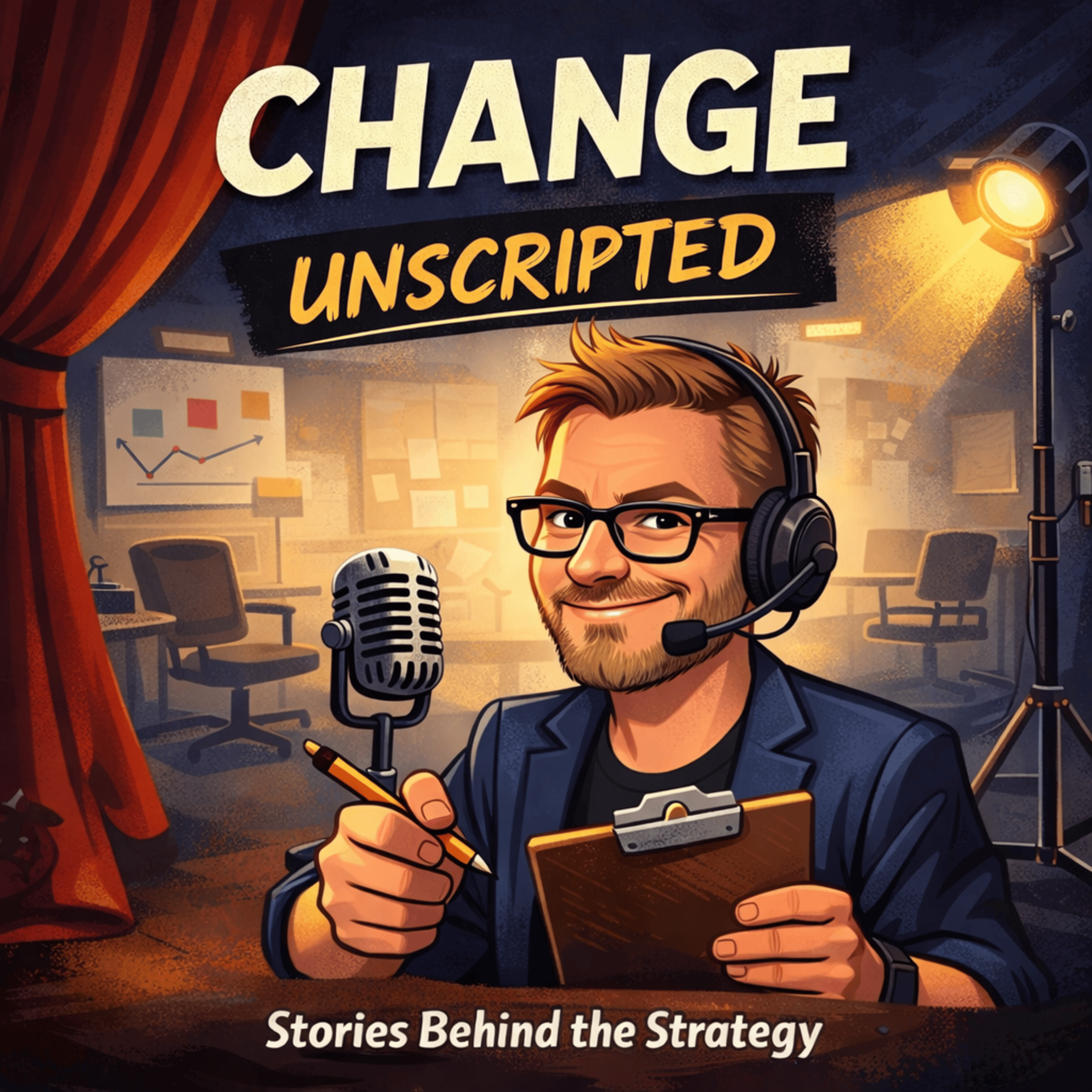
This podcast episode explores AI’s impact on work, leadership, and human psychology. The host opens by noting how AI has sparked excitement, fear, and skepticism, with people quickly taking sides—evangelists, skeptics, or confused onlookers. He draws parallels to historical reactions to technology, clarifying that original Luddites were skilled workers fearing skill devaluation, not anti-innovation. He argues humans are poor forecasters, overestimating short-term change and underestimating long-term effects, leading to binary reactions of panic or dismissal. The host observes that AI adoption is driven by social proof—employees watch how leaders and peers use it—and often asks "are we allowed to use this?" rather than "can it do this?" He shares personal examples, like using AI for bedtime stories, contrasting kids’ normalcy with adults’ conferences. Guest Chris Varitis, senior director of revenue operations, discusses AI as a technology, business, and people shift, stressing that it must solve specific problems to gain adoption. He notes skepticism and curiosity, with AI reducing tasks like meeting notes or code analysis from weeks to minutes. They debate whether AI hurts expertise development; Varitis argues it complements expertise, accelerating onboarding and decision-making, but cannot replace seasoned judgment. He emphasizes simplicity and adoption—tools must be intuitive, like Amazon or Google Maps, to succeed. The conversation concludes that AI won’t replace humans but will replace those who don’t leverage it, and leaders must ensure processes remain simple to drive organic adoption.
A few years ago, nobody was talking about AI at work. Today, every company is talking about AI. Every conference is talking about AI. Every LinkedIn influencer is apparently an AI expert. And every employee is trying to figure out, "Should I be excited? Should I be worried?" And is this thing eventually going to write my performance review? Now, what's interesting isn't the technology. The technology is impressive. What's interesting is the human reaction to it. Because if you've listened to this show before, you already know what happens when humans encounter change. We panic. We deny. We overreact. We underreact. And eventually, we start making PowerPoints about it. Flip the plans to the pan. Why more fuller here we go again? ♪ Boss call baby cries ♪ ♪ Life remixing every line ♪ ♪ Change on scripted ♪ ♪ Here we go ♪ ♪ Left through the chaos ♪ ♪ Still the show business ♪ ♪ Bedtime plots were splendid ♪ ♪ Change on scripted ♪ ♪ Never ended ♪ ♪ Change on scripted ♪ ♪ If that clear we're making it up along the way ♪ ♪ Messy mighty afterific ♪ ♪ Welcome to Change on scripted ♪ - Welcome back to Change on Scripted. The podcast where we talk about change, leadership, psychology, organizational behavior, and occasionally, whatever fresh chaos the business world has decided we're all supposed to be experts at this week. Today, we're doing something a little different. For starters, I'm not alone, which is probably good because we're talking about AI. And as you noticed, that was not one of the topics covered in my opening introduction. So for the first time on the show, we're bringing in a guest. So here's the format. I'll spend a little time setting the stage, a place I always love to find myself. I'll talk a bit about why AI has everyone simultaneously excited, terrified, optimistic, skeptical, and somehow posting daily thought leadership about prompt engineering after using chat GPT twice. Then we'll bring in my friend, Chris Veritas, who leads teams, works in revenue and finance, and has been thinking about what AI means from a leadership and a business perspective, which means he'll bring a perspective that's significantly more useful than whatever AI generated thought leadership article showed up in your feed this morning. Now, what's fascinating to me isn't actually AI. It's how quickly humans reverted back to being humans. Because within about six months of chat GPT becoming mainstream, everyone picked side. Some people became evangelists, some became skeptics, some became professional LinkedIn prophets, and most people quietly opened a browser window and thought, am I supposed to know how to use this yet? And that's when I started laughing. Because you've always seen this before, not the technology, the reaction. When electricity showed up, when computers showed up, when the internet showed up, humans basically ran the same playbook, which brings us to the Luddites. Now, if you've ever called someone a Luddite, you've probably meant that they're anti-technology. Now, but the original Luddites weren't running around England yelling, "Down with innovation!" They were scared, skilled text teleworkers, who were watching new machines change the value of skills they'd spent years developing. Sound familiar? Because that is not at all different from the conversations happening around AI today. Most people aren't worried because chat GPT exists. They're wondering what happens when something they've spent years getting good at. Suddenly becomes faster, cheaper, or easier. The technology isn't the scary part. Figuring out what it means for your expertise, that's the part that keeps people up at night. And here's the psychological trap I think we're all falling into with AI. Humans are terrible forecasters. Not financially, not politically, not technologically, just generally. You're my financial advisor, as I say. You know, if I could accurately predict the future, I'd be on a yacht somewhere, not talking to you, which feels relevant because every AI conversation right now seems to involve someone predicting the next decade with absolute certainty. And historically speaking, humans have a pretty terrible track record of doing that. We consistently overestimate what can happen in the short term and underestimate what can happen in the long term, which means every time a new technology appears, our brains immediately jump to one of two conclusions. Either this changes everything tomorrow, or this is a fat, it's gonna be gone in six months. We don't really have a middle setting. We have panic and we have dismissal, you know, which explains roughly 70% of the internet. And that's what makes the AI conversation so strange right now. You know, depending on who you ask, AI is either going to eliminate half of all jobs by next Tuesday, or it's basically a fancy autocomplete. You know, the truth is probably less dramatic and more interesting. Because most major technological shifts don't arrive like a title wave. They arrive like a leak slowly, quietly, one workflow at a time, one habit at a time, one, hey, this actually saves me 20 minutes at a time. And that's where the psychology gets interesting because most people aren't resisting AI. Most people are waiting for social proof. Now we're in a new territory. They're watching. They're seeing what works. They're seeing who gets rewarded. They're seeing whether leaders actually use it. They're seeing whether their peers use it. They're seeing whether admitting they used AI makes them look innovative or lazy. In fact, some of the most interesting conversations I've heard recently, haven't been, can AI do this? They've been, are we allowed to use AI for this? Which is a completely different question. I've seen this shift firsthand. When I started consulting over a decade ago, if you wanted to brainstorm 50 ideas, congratulations. You were about to spend several hours in a room with sticky notes and varying levels of enthusiasm. Research reports took days, sometimes weeks. Slide decks took forever. Meeting notes were typed by hand by whichever poor soul got volent-told. Today, AI can generate ideas. Summarize meetings, draft reports, build presentations, organize action items, and somehow, still leave me formatting issues I have to fix myself. Which is amazing. But it also got me wondering, if the grunt work disappears, where does expertise come from? Because whether we like it or not, a lot of us learned our jobs by doing the boring parts first. Nobody starts as the executive presenting to the CEO. You start as the person updating slide 47 at midnight, wondering where your life went wrong. Nobody becomes a great strategist by magically becoming strategic. You become strategic by doing the research, reading the reports, building the decks, making mistakes, learning patterns. AI is making all of that faster, which is incredible. But it raises a really interesting question. How do we develop expertise? When fewer people have to walk the same path. And of course, there are AI enthusiasts. They wouldn't even hear this argument. I had one leader who collected AI licenses the way some people collect baseball cards. Chat GPT, got it. Internal AI, got it. Gemini, absolutely. You probably would have licensed the toaster if someone told him it used machine learning. You know, at one point, I wanted to ask, do you actually use all of these? And the funniest part is my kids, they don't care about AI at all. They treated the same way they treat electricity. It's just there. Meanwhile, adults are holding conferences about it. My kids are just annoyed when it doesn't work instantly, which honestly may be the most accurate prediction of the future I've heard.
And what's even funnier is that the primary use of AI in my house isn't productivity. Nobody's optimizing workflows. Nobody's increasing efficiency. Nobody's leveraging synergies, whatever those are. We're using it to create bedtime stories. Stories where my kids are the heroes alongside their stuffed animals or Pokemon. You know, honestly the plot varies wildly from night to night. Last week, my son went on an adventure with Greninja, a German shepherd stuffed animal, and what I can only describe as a very emotionally supportive snorlax. And nobody cared that AI helped write it. They cared that it was fun. Which might be the most important lesson in this conversation. Every generation inherits technology differently. That feels revolutionary to us. Feels normal to them. My kids don't see artificial intelligence. They see a story. They see a game. They see a tool. Meanwhile, we're all standing around debating whether civilization is ending. Which means someday, my kids are probably going to roll their eyes when I tell them, "Oh, back in my day, we had to write our own emails." And they'll respond, "Okay, Dad, let's get you back to bed." Which brings me to Chris Varitis. Because well, everybody is debating what AI can do. Leaders are trying to figure out what people are going to do. How teams change, how work changes, how trust changes, how careers change. Which if you listen to this podcast before is really the part that I am interested in. So rather than just hearing my perspective, I wanted to bring in someone who's actively leading through this shift and thinking about what it means for teams, performance, and the future of work. Because the conversation isn't just happening in technology departments. It's happening in finance, revenue, operations, leadership teams, boardrooms, everywhere. So, now professionally Chris is the senior director of revenue operations at Paychecks, where he spends his days thinking about revenue, finance, business performance, and all the things that keep companies moving forward. That is only part of his story. Because outside of work, Chris is also my longtime friend, occasional beer drinking companion, trusted dog sitter, and somehow one of my children's favorite people on the planet. In fact, my kids don't call him Chris, they call him Mr. Crayons, it's a long story. And honestly, if you've ever met him, that probably tells you more about his leadership style than his LinkedIn profile does. So while Chris absolutely has a perspective on AI, business, and how work is changing, he's also someone I've spent enough time with to know he'll tell us exactly what he thinks. It's not just what sounds good in a conference keynote. Chris, welcome to Change Unscripted. Thanks for having me. Of course. So, I talked a little bit about AI and how everything's kind of changing. In your work and how you've experienced AI, do you see AI primarily as a technology shift, a business shift, or a people shift? Yeah, I think it's probably a combination of all those. How would I kind of synthesize it down is if AI is not embedded into specific workflow flows or solving a specific problem. It's just another tool that people will ignore, right? You need to lead with what is that time to value? What are the pain points? What are the problems that we're looking to solve? Is it seller productivity? Is it adding time back to a seller's day? Is it automating workflows? Is it assuming code coverage with product enhancement? All be it internal or external systems? So, I think it's all of those things with different contexts depending on what your use case is and the problem statement that you're looking to solve. So, you talked a little bit about automating workflows. And I think that's some place that I've seen AI use primarily, at least in the type of work that I do. And I think with that comes some level of obviously communication, but some level of fear curiosity of, okay, if I'm automating a workflow, it means that someone is doing that work today. And it's repeatable. And it's repeatable, right? So, it's something that could be done by a machine because it is repeatable, but in doing so, I am taking that responsibility away from an individual or set of individuals who's doing it today. Sure. So, when you're implementing some type of AI right within your workplace and you're talking about automating workflows, what is the biggest reaction you're seeing from folks? Is it fear? Are they excited to use the tool? Are they kind of skeptic that it's going to be effective? Yeah, I think it's probably a bit of skepticism, right? Because you have to build the quote unquote trust with whatever, you know, Claude or using Gemini or using Copilot, right? Name any of the big players out there. And then it's also a lot of curiosity too around, I never thought that I could do X in the sense of this, for example, very elementary around meeting minutes and meeting recaps, right? Longer the days of, oh, well, I got to pull up a one note and I got to scribe all of the action items, the summary, which then pulls you away from being engaged in that conversation. 100%. I remember one of the first things I was asked to do when I joined a project was to take verbatim notes. Right. I wish I had AI. Right. Same. I think from, from my seed, what we do with daily is just around the level of effort that goes into, let's say, hey, we want to introduce a new step in an existing process. Typically, to understand the implications, if we were to introduce this improvement or gathering another data point in a process, it would take two weeks for a human to scrape all the code base and look at, okay, well, if we want to do this, we need to go left of this to look at that. And then we also need to go downstream to understand the implications of what it may potentially touch or break where now you can take co-pilot GitHub, for example, prompt engineer and ask it a question, hey, what do I need to be aware of if we want to introduce X into this step in the process? I think that's where a lot of the curiosity is coming from my experience just around adding time back to the day and getting, again, time to value, right? Again, two weeks is now maybe 90 minutes. So a big, big shift in that paradigm, for sure. And from a fear of perspective, I think change is inevitable. And yeah, there is a bit of, am I going to have a job in three years because AI is going to come in and replace me. I'm very skeptical of that view. AI is not going to replace a human. It's going to replace those humans that don't know how to leverage AI. And one of the things I know I touched on earlier, and I'm curious about when we talk about reducing the amount of time to complete something, right? You said two weeks becomes 90 minutes. And one of the things I mentioned earlier is if AI removes some of those pieces that I was joking around about writing verbatim notes earlier, making slide decks and doing research that takes so much. And I think I learned a lot of my expertise from having to do that base level work that leaders weren't doing. And now is being done by AI in order to cut deliverables, the amount of processing time, etc. So if AI removes some of those call it entry level work that we're asking analysts and folks right out of college to do, that historically people have learned from and become leaders. How do leaders create the next generation of experts that now are utilizing AI to do a lot of the work that they would have grown their knowledge from previously? Yeah, that's a great question. I think you could argue both sides of the house, right? One is, as you step in like, you know, before the onset of AI, right, that helps you get to understand the business and all the processes as an entry level individual coming in. But with that, there's a lot of doors to knock on. A lot of questions to ask where, as I see it, now it helps ramp that individual faster. So let's say a new individual comes into a new company. They're learning the business. Let's say historically, they're not driving results or adding, quote, unquote, value within the first until like day 91 or day 101. Now with the onset of AI, it helps ramp that individual faster to say, hey, maybe day 31, they can come to an informed decision or view as to which way we need to make a left or a right. So I see it as a way to get individuals in the door and making an impact and driving results faster than historically it would have taken again, just coming in, having one at once, doing meet and greets. What are your problem statements? Where are your friction areas? Where again, AI can come in and kind of help ramp that individual much faster. Interesting. What about the converse of that? So talking about how it'll help entry level individuals learn a little bit more.
more about an organization, perhaps obviously cut down the amount of time this is creating deliverables. Is there an argument that AI maybe is detrimental to expertise then? Is AI make expertise less important or is it more important for you to have expertise when someone can just ask AI a question and get an answer that either before they were going to have to do weeks of research for or they were going to have to go to leaders to get a view on? I think AI would complement the expertise then necessarily replace it. Now there are instances in my career journey where you had those subject matter experts that had the ability to look around corners. Now will AI replace that? I don't think so. I do think it will again complement that expertise for those individuals that have been at a company for 10-15 years and they know where all the bodies and the skeletons are buried. But again you could argue both sides to say, "Well yeah, we no longer need Jimmy because we just asked the machine and it's going to tell us, 'Oh, I understand you're trying to do X. Make sure you're aware of ABC, EF and G and not necessarily be reliant on that and individual or a human to be that subject matter expert to say, 'Hey, we shouldn't do this because of X.' Where if you look at the machine, the machine is going to tell you just go and hear your call outs, watch outs, red flags that you need to be aware of in this journey and not necessarily deter you from doing something. So if you're looking at a process specifically, if it slows the business down, the business is going to go around you. So again, literally examples from last week where we need to gather more data at a certain funnel stage. But it completely contradicts what we're trying to do is just reducing the amount of friction required for a seller to perform an action. So is there a way that AI could automate or pull a certain data point in in lieu of requiring a seller to kind of source it? So I always think about two examples. You have Google Maps and then you also have Amazon, right? It's not you're going to go map questions. There's no map questions. I don't think we even have a printer anymore. I haven't seen a printer in years. So you think about, did anyone teach you how to use Amazon? I did not. Me either, but man alive, am I really good at using it, right? And you think about Google Maps or OAS. It's focusing in on the simplicity. If you can create a process and this is where AI can help make it more concise, kind of collapse everything into maybe a single workflow that has opposed to multiple, if it's simple, or just going to get it. If I have to train to it, that should give you pause and make you go back not to the drawing board, but reevaluate what you're looking to introduce because if it ain't simple, people are not going to adopt it and adoption is uber critical. It's the biggest driving KPI. That determines success of introducing a new technology, introducing a new process. If the adoption is just organic, you did something right. If you're forcing the adoption or shoe horning an individual or a team or a market team or company into a specific process, you need to say, oh wait, maybe we didn't think about our approach in a sound way. So earlier, you mentioned a couple different AI platforms and I think some that folks are familiar with, right? Obviously, Chachi, B.C., I think really broke AI into the public domain, but there's Claw, there's Gemini, there's all companies have their own platform nowadays. And he talked a little bit about being clear on how to use AI effectively and where to use AI and where it can be most effective. And I joked around earlier that I had a leader who was collecting AI licenses and I've had clients that have four different AI agents. And it becomes expensive because a lot of those have licenses tied to them. So is there clarity on when to use AI and when to use specific AI agents or is there benefit to having multiple AI agents within a company or is there something that you can do it all within one AI agent? So yes and no, I think yeah, you can potentially just look at Chachi PT and it'll get you directly where you need to go, but it really depends on the use case, right? Or the problem you're looking to solve, are you looking to increase your code coverage around automating a lot of development efforts when it comes to product, either internal external, right? That definitely go Claw. If you're looking for meeting summaries and meeting minutes and capturing action items, maybe it's co-pilot. If you're looking for call intelligence or, hey, how did Colin do last quarter? There are a bevy of different models that you can lean into. And yeah, some cater to some use cases better than others. But the main thing as we kind of look at Clawed in Gemini and co-pilot premium and all they come to, obviously at a cost. So as we're deploying these agents across different areas of the business and MIT and sales and finance and customer service, we are kind of very laser focused. It's very diligent as to, is this the right fit for the right use case? More importantly, we want to track the return on investment, right? Because it comes out of significant costs. You look at a company that has 20,000 employees. You know, FPNA, finance planning and analytics are tracking the return on the investment. And make sure that, hey, if we're deploying these agents across different business units, we want to make sure that we can report up and out more importantly to the street and to the board that, hey, we deploy this and we saw productivity gain effects. Or, hey, we reduced our average handle time of customer service calls by why? Because we now have this gate or this toll gate in front to say, hey, if I have a problem with products or service, I can engage a bot as opposed to automatically getting that individual in touch with the human. Now, will it exhaust that Q&A or the knowledge base that is in front of them and has to get put in front of a human because it's very intricate from a problem perspective? Absolutely. Back to my point, what is that time to value and where is the time that we're saving being put elsewhere and is that where that individual should be focused on? So it's a bit of a mixed bag, but the short answer to your question is different strokes for different folks and different AI vendors for different use cases. Do you think this is inherently different? I talked around about, you know, my kids only use of AI is creating bedtime stories. And they don't see it as a revolutionary tool. It is truly just another thing that exists in the world. And I think back to when the internet became a thing and before in order to get information, you're going to the library, you're reading encyclopedias or you're going to experts to ask, right? No longer do I need to call my father to figure out how fix my dishwasher. I'm going to pull up YouTube and there's thousands of videos that can teach me whatever or you just take a picture of it when the ass trapped EPT, this is broke, I don't think so. Yeah, exactly. And it's revolutionary, right? Not only the internet, but what's available to me now through AI. So in that same vein, do you see us looking back in a number of years and seeing this as just another internet, another revolutionary shift or an additional tool that allows us, where is this something that's inherently different about AI that maybe is sparking some of that fear that people have similar to the bloodites in the industrial revolution, similar to when the internet broke the world. Is this even more different than those? I would say, I mean, you could argue both sides and I'm not trying to be Switzerland here, but you think about like where we are in this revolution. I think we are, as you mentioned, the early innings of the dot com error, right? We're in the dialogue phase, right? Make sure your mom doesn't pick up the phone and break your connection and you can't instant message your friends anymore or get on. Lime wire, was it? Yeah. Lime wire. Yeah. Let me tell you, I had some good song lyrics from my way. I was downloading all those viruses to the family, quote unquote, computer. Probably have those. Those were the days. You know, it's hard to really kind of see where we're headed, but if you think about where we are now and where we're headed, obviously, he's all the data center protests and with SpaceX, just hit an IPO and they're going to be pushing all these data centers to space and use as cooling mechanism, what's going to drive all those things. So I don't know where we're going to be in 10 years, but I think it will at some point be looked at as more of a commodity and less as this technological revolution where you're going to be using AI, but not knowing you're using AI. Similar to being connected to the internet, it just happens and it's just expected. Right now, I do feel a lot of businesses are, hey, you need to use AI, you need to use AI, you need to use AI, you need to use AI. And I think there's a sense of fear mongering where people feel like their hands are being forced and it's apparent, right? I look at a couple of years ago, maybe a year or two ago.
ago when chat GPT and co-pilot was starting to come to fruition. I noticed a lot of people were using it, but they weren't using it in the right way. They were instilling too much trust into AI and saying, "Oh, I'm gonna ask the machine a question. I'm gonna get an output, and that's Bible." And I think that's kind of where we're at in this revolution where you want to trust it, but there's a sense of validation. I think that's where the human comes into the into the equation where I could ask the machine to say, "Hey, scrape my inbox for the last 365 days and give me a list of accomplishments." The only reason I mentioned this because in the midst of performance review, right? And I got an output. It did what I asked, but the metrics that it captured, I had a validity, and a lot of them were not right. So I think it's a bit of a balance, but the short answer to your question is, we're gonna hit an inflection point in this revolution where it's just around us. We'll be using it every day, but we don't realize we're using it every day. I don't know what that timeline is because the next year is it five years, is it 10 years, is it 20 years, who knows? But I think that's where we're headed. Is there any sort of fear with that? I mean, with not being aware that you're interacting with technology or the other day I called my garbage company and got what I thought initially was person and then through speaking with them, realize that, okay, this is an AI agent. So I had to flip a membrane how I'm speaking with them. I'm not speaking fully conversational on being very direct with the type of information that I'm looking for. So it could either help me or direct me to an actual human who could help me. But in the future, as AI continues to learn, as technology improves, that barrier between, oh, I can recognize that I'm talking to an AI agent versus I mean, I could be talking to anyone. And not only anyone, but I could call you and get a avatar version of you that looks drastically similar. Absolutely. You have your voice and you've programmed it for your voice and would respond exactly like you and how it would have no idea. Yeah, I mean, it's going to get to that, but who cares? Right? That's just become the norm. Where right now, yeah, this is all it's foreign, right? It's weird, right? It's uncomfortable. I'm talking to somebody or something. I'm talking to it. And yeah, you can tell. But if you think about five, 10 years from now, people are just going to throw their shoulders up and be like, I got what I needed. Yeah, it wasn't a human. But so what? Right? And I think that's where that friction point is today where people are just very skeptical as to, oh, well, I'm calling the auto body shop to understand like, hey, it's my car ready to pick up. And then as long as you arrive at the same outcome that you were hoping to get to, if it's a human, great, if it's not a human, so be it. But you still got that, that satisfaction of getting the answers you were seeking to get as opposed to, oh, well, I'm just going to hang up because this isn't a human. I think again, we're in the early innings there. A lot of this is very foreign to everybody. But I think that's where we're headed and it is what it is. They reminded me of, I can't remember where I mentioned it the other day, but for a while, the idea of outsourcing to cut down on costs was a big thing. And then there became a big shift of brands identifying on, this is something that's made in the US. And people linking on to that aspect. And I thought, you know, with AI, some businesses are seeing it as an opportunity to cut costs that have technological resources that they can use. And in the future is the made in the USA going to be human interaction, all trends ultimately bounce back. Or is this the future? This is how we're going to operate. I think it's just how we're going to operate. If you look at where we're headed and all the big bets in the video and in meaning, name, any of the companies that have a stake in the game with a lot of this, you could have agents for agents for agents for agents, but at the end of the day, back to your question around, oh, we have, we use call for this. He's co-pilot for that. We use Gemini for this. We need to consolidate sales policies or bring sales policies down. And this all needs to fit on one page. Make this concise, remove filler words, put this in more of a legal East format. It doesn't matter the amount of tools. It's going to come down to what companies are executing the best with what they have. Because we could have a cloud. And yeah, that's to use over here for this. But I can actually take this problem statement or this use case and apply it. And I'm going to get maybe not the same output as one of its competitors, but you're still going to get what you asked. It may not be as robust or complete as you intended, but you're still going to get what you're, they all put that your running source. And if I'm freshly out of college, if I am in the job market and I'm trying to understand how do I differentiate myself? How do I prepare for this future of AI? What do we tell those folks? What type of upscaling should they focus on? What areas should they look to or areas that they should look away from? Because hey, AI is going to eliminate those fields. That's a good question. I think you have to just test and learn really and understand. I mean, yes, you could go online. You could take AI certification courses for sure, but it's the real life practicality and practice of if I'm going into a certain industry, I'm in Sass, self-aware as a service, supporting a sales organization of thousands of sellers. If that's the industry you're looking to inject yourself into, there are a bevy of problems and friction points and use cases you could look to solve. You just get to find your niche, right? You just have to test and learn and don't be afraid to fail, right? If you fail, fail fast, learn faster. I mean, I joke around that when I meet with college students or folks that are trying to get into consulting, which is the space that I'm in, usually they always ask, hey, what can I do to set myself up for success? And in the past, I think all of my answers were, you know, learn Microsoft Office, which always got a laugh from them, but to be honest, right? It's what we use primarily is building presentations and PowerPoints and telling stories and combing through data. College is great for that, but which is the thing, right? So now it's shifting to, okay, rather than maybe learning Microsoft Office is how do you write good prompts and being familiar, yeah, being familiar with different AI tools because maybe depending upon what company you end up working for, they might have a different tool or they might have the fantasy football team of AI agents. I mean, horror, sorry, I didn't mean to cut you off, but like you use a model to help you engineer your prompts. So it's interesting because I haven't taken a course, you just, you figure it out, right? And like I think about my Amazon analogy where there's no course for Amazon, you just figured out, like, oh, here's the search bar. All right, this is what I need. Oh, well, here, here's a handful of all the similar products. Which one do I go? Is it do I go for the cheapest one? Do I go with the one that has the most ratings? Right? So like you, I always use the term fitfo, right? You figure it the blank out, right? Again, you can take the courses, you can take the certifications, but at the end of the day, you need to lean into to AI in certain applications, depending on what you're looking to solve. In an effort to give you time back in your day, but again, it's the trust factor, which is the biggest piece, ensuring that you as the individual who's trusting the data are also validating it. And the output. Yeah, I appreciate your time talking about AI today. Before I let you go, I just have one question, because of course I care about change and everyone goes through big changes, small changes, threat their career and their life. So what is a change that you've experienced in your career that felt uncomfortable at first, but ultimately looking back made you better? Yeah. I've been a leader for about eight years now or so. And prior to that, I was an individual contributor, and I'd always had a career goal. Like, hey, like, I just, I want to lead people. It was a goal of mine, it was a passion of mine. And I was brought on to to pay core back in the late 2000s. And I was a COVID higher. And it was, it was, it was, it was scary. And in the sense of, I had never let people before I need to establish a culture virtually. And hit again, the optics were like, oh, if I was in the seat and how was coming in, I was like, Oh, who's this guy? He's coming in. He's our new leader. I don't trust this guy. Who is he? That for me was very uncomfortable in the sense that I had to establish this culture and gain the trust of these individuals that had been at the company for 10 plus years. And this new guy's coming in as the leader. And it was, it was difficult. Space of change, not only, you know, of a new leader, but a space of change in a world of change during the pandemic. Oh, 100%. 100%. And, you know, in doing some self-reflection, I was,
I was thinking through, well, you know, man, in my career, I've had, I've had some great leaders. I have, I've been blessed in that sense, but I've also had some crap leaders. So I, you know, rewired myself on my glisten. It's not going to be perfect, but you're going to lead how you would want to be led. It's very elementary, very trivial, but establishing that sense of community and that sense of culture and being an empathetic leader definitely resonated well with those individuals that I had the opportunity to lead and still do lead. And you look back and how do you determine success of a leader, right? Obviously you have to drive results. You have to ship enhancements, ship products and make and track the return and all that stuff, but at the end of the day, the biggest badge of honor as a leader is your engagement scores or in the 90th percentile and your retention is unskied. And that for me is two badges of honor that I wear proudly. And again, did I make all the right decisions? No. But I kind of shifted the culture and the sense of, hey, if, if Colin failed, everybody was going to know, but if Colin hit the mark and hit his expectations that we're set in front of him. Shoulders, right? It was just like, okay, great. On to the next thing where I flipped it, where it's like, hey, if you failed, again, fail fast, learn faster. But if you went above and beyond and you hit the mark, I'm screaming that from the mount tops to the point where the executive committee is going to be made aware, do they read the email? TV. You only try your best. Hey, I also summarized exactly. But that's how I kind of position myself for success is lead, how I would want to be led. And yeah, there were some contrarians and I had approved myself and proved that I was worthy of being their leader throughout a pandemic was not easy. But I'm sitting here, tell the story. I still have the folks that I've led eight years ago, still in my downline. So it's been, it's been interesting. Well, again, I appreciate your time. Thank you so much for joining me. And hey, let's grab a beer sometime. Let's do it. So here's where I've landed. I don't think AI is replacing humans. I think it's forcing humans to rethink what makes us valuable. And honestly, that's both exciting and a little uncomfortable because every generation gets a technology that changes the rules. This just happens to be ours. The good news is we're still the ones asking the questions, making decisions, building relationships and figuring out what comes next. At least for now. Thanks again, Chris Varitis for joining me today. And thanks to all of you for listening to Change and Scripted. I enjoyed the episode, follow along on Instagram at Change_unscripted. Connect with me on LinkedIn and let me know what you're seeing out there. The best part about doing this podcast has been hearing your stories and realizing we're all trying to make sense of the same things, just from slightly different seats. And remember, the future has never arrived exactly the way people predicted. But humans have always figured out what to do next. Until next time. Change_unscripted. If that's the way we're making it up along the way, kind of wild and kind of mystic. Welcome to Change_unscripted. Change_unscripted. Oh, hit that play. Change_unscripted. Oh, hit that play.
Podcast Summary
Key Points:
AI adoption in the workplace triggers human reactions—panic, denial, overreaction—rather than purely technological shifts, mirroring past innovations like electricity and the internet.
Original Luddites were skilled workers fearing skill devaluation, not anti-technology; similarly, AI anxiety stems from concerns about expertise becoming obsolete.
Humans are poor forecasters, overestimating short-term AI impacts and underestimating long-term ones, leading to extremes of panic or dismissal.
AI adoption depends on social proof and trust; employees question whether using it is acceptable or innovative, not just whether it works.
AI reduces time for tasks like research, notes, and coding analysis (e.g., from two weeks to 90 minutes), but raises questions about how to develop expertise when entry-level grunt work disappears.
AI complements rather than replaces expertise; it helps ramp new hires faster but cannot fully substitute for seasoned leaders’ judgment.
Success hinges on simplicity and adoption—tools must be intuitive (like Amazon or Google Maps) to be embraced, not forced.
Generational differences
Summary:
This podcast episode explores AI’s impact on work, leadership, and human psychology. The host opens by noting how AI has sparked excitement, fear, and skepticism, with people quickly taking sides—evangelists, skeptics, or confused onlookers. He draws parallels to historical reactions to technology, clarifying that original Luddites were skilled workers fearing skill devaluation, not anti-innovation.
He argues humans are poor forecasters, overestimating short-term change and underestimating long-term effects, leading to binary reactions of panic or dismissal. " He shares personal examples, like using AI for bedtime stories, contrasting kids’ normalcy with adults’ conferences. Guest Chris Varitis, senior director of revenue operations, discusses AI as a technology, business, and people shift, stressing that it must solve specific problems to gain adoption.
He notes skepticism and curiosity, with AI reducing tasks like meeting notes or code analysis from weeks to minutes. They debate whether AI hurts expertise development; Varitis argues it complements expertise, accelerating onboarding and decision-making, but cannot replace seasoned judgment. He emphasizes simplicity and adoption—tools must be intuitive, like Amazon or Google Maps, to succeed.
The conversation concludes that AI won’t replace humans but will replace those who don’t leverage it, and leaders must ensure processes remain simple to drive organic adoption.
FAQs
The episode explores human reactions to AI, comparing them to past technological shifts, and discusses how AI impacts work, expertise, and leadership.
The original Luddites feared new machines devaluing their skills, similar to how people today worry AI might make their expertise obsolete.
He sees AI as a combination of technology, business, and people shifts, emphasizing that AI must be embedded into specific workflows to solve problems and provide value.
He notes skepticism and curiosity, as people need to build trust with AI tools and discover new capabilities, like automating meeting notes or code analysis.
AI reduces the time to learn business processes, enabling new hires to make informed decisions and contribute value sooner, like by day 31 instead of day 91.
AI complements expertise rather than replacing it, helping experienced professionals look around corners but not eliminating the need for human judgment and context.
Chat with AI
Loading...
Pro features
Go deeper with this episode
Unlock creator-grade tools that turn any transcript into show notes and subtitle files.
 PodcastTranscript AI