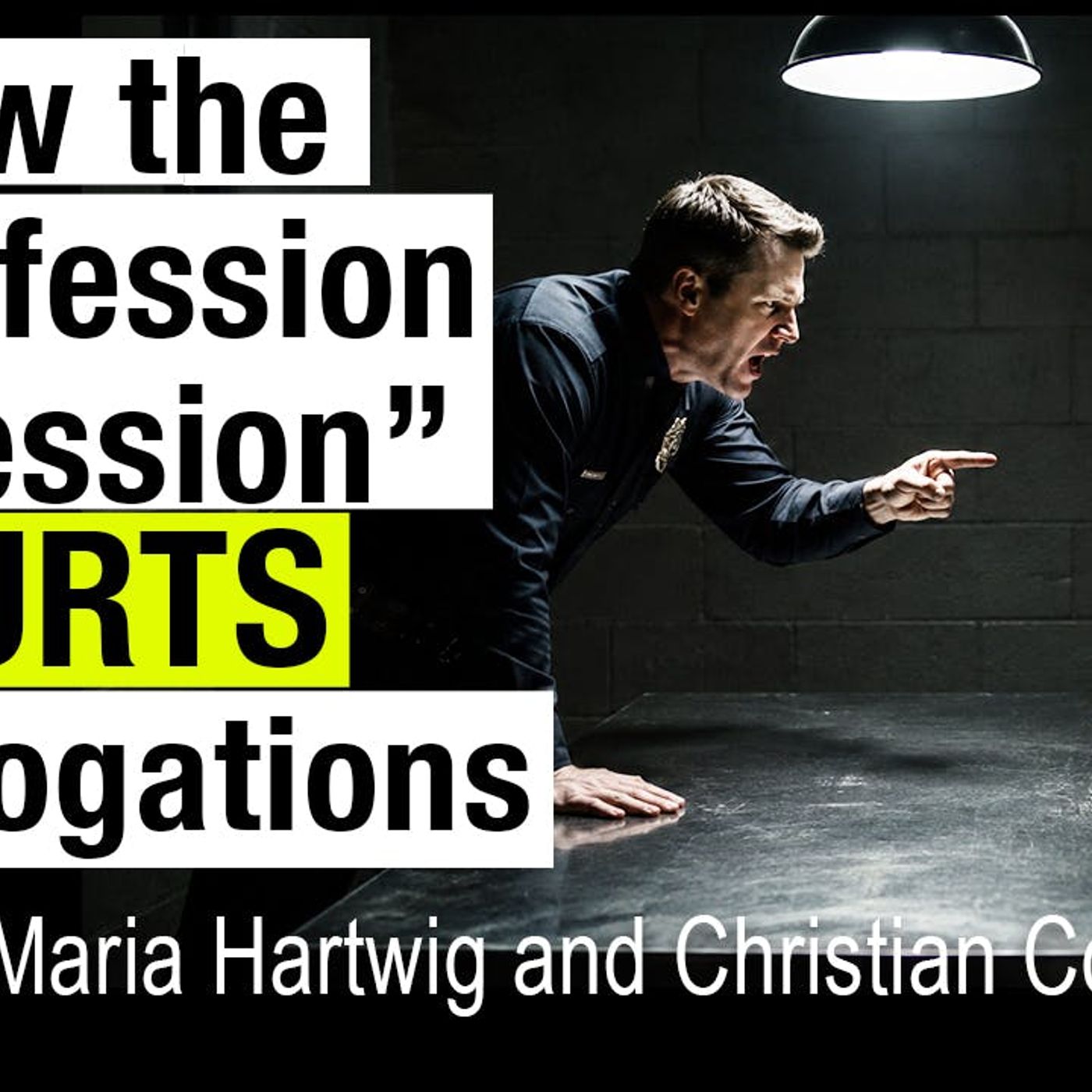
The push for science-based interrogation approaches, with Maria Hartwig and Christian Cory
53m 18s
The conversation with Maria Hartwig and Christian Corey challenges the widespread belief that body language or deceptive tactics can reliably detect lies. They argue that these practices are rooted in pseudoscience, misinformation, and outdated law enforcement training. Instead, they advocate for science-based interviewing techniques that prioritize gathering accurate information over obtaining confessions. A core method, Strategic Use of Evidence (SUE), delays evidence disclosure to allow suspects to reveal inconsistencies in their statements, improving credibility assessments and the quality of investigations. Early evidence disclosure, conversely, creates plausible justifications for both guilty and innocent individuals, undermining truth detection. The duo also critique deceptive practices like false evidence or lying, which risk false confessions and damage rapport. They emphasize that nonverbal cues, including micro-expressions, lack scientific backing and are often misinterpreted due to human biases. Polygraphs are similarly criticized as tools of intimidation. The discussion underscores a broader issue: legacy practices have not been updated in over 50 years, despite abundant new evidence. These outdated methods not only harm investigations by producing false information but also lead to false recantations and erode trust in law enforcement. Project Alithia aims to bridge the gap between research and practice by promoting ethical, evidence-based interviewing techniques. Ultimately, the key to effective investigations lies in focusing on information quality, not in detecting lies through behavioral cues.
it's such a persistent delusion that we can read body language. There's no nonverbal signal
of deception. Cuse to deception are faint at best. You have to be well versed in the scientific literature
to know that so many of these claims are untrue. People are truth biased. I don't think it occurs to
people that a book written by a former law enforcement professional would just be full of shit.
Hi, I'm Zach Elwood, host of the People Who Read People podcast, which you can learn more
about at behavior-podcast.com. You just heard some clips from my talk with Maria Hartwig and Christian
Corey, both of whom work on promoting better techniques in law enforcement related interviews
and interrogations. If you're on LinkedIn, you might like following Maria and Christian there,
as they often share interesting observations about interrogation ideas, deception, nonverbal behavior
and more. Christian and Maria are co-directors of Project Alithia, which is an effort to bridge the
gap between the science and practice of interviewing and interrogation by bringing researchers and
practitioners together. Maria represents the research side of things while Christian as a former
police officer represents the practitioner side. You can sign up to get updates about Project Alithia
on the project site, which is at project-alithia.org. Alithia is spelled A-L-E-T-H-E-I-A.
In TV shows and movies, you've probably many times seen the police interrogation approach,
where police barge in and confront the suspect with other evidence, trying to get them to crack
and give a confession. In this talk, Maria and Christian explain why that doesn't work well,
and why a framework called the strategic use of evidence, or SU SUE, gets much better results.
We also talk about their views on why focusing excessively on getting confessions is counterproductive.
I get their thoughts on the immense amount of pseudoscience and bullshit in the nonverbal
behavior reading space, and we talk about why there is such an enormous demand for that bullshit.
We talk about Paul Ekman's work and Joe Navarro's work, we talk about micro-expressions and what's
the deal with those things, and we touch on quite a few other topics. A little bit more about Maria
Hartwig, she's co-founder and co-director of Project Alithia. She is a professor of psychology
at John J College of Criminal Justice, where she has been on the faculty since 2006.
Her scientific expertise is in the psychology of interrogation and the related topic of the
psychology of deception. She has produced significant amounts of research, partly with the support of
and in collaboration with various government agencies and entities, including law enforcement,
the Department of Defense, and the High Value Detainee interrogation group. A little bit about
Christian Corey, he recently retired after more than 26 years with the Wichita Police Department,
where he served as commander of the crimes against Persons Bureau. Over the course of his career,
he has worked in homicide, sex crimes, and the gang/felony assault unit, and led the department's
crisis negotiation team. He holds a BS in criminology from Kansas State University,
and an MA in forensics psychology from the University of North Dakota.
Today, Corey is the co-director of Project Alithia and a visiting scholar at John J College of
Criminal Justice, where he advocates nationally for ethical, effective, and science-based interview
practices. Okay, here's the talk with Christian and Maria. This might be kind of a broad question to
start with, but what do you see as the biggest areas where practitioners are doing known bad or
counterproductive practices that you're trying to remedy? What comes to top of mind for things you
see as some of the worst and most common practices, would you say? Well, I think we need to start
there with the most most common, because when I came on, there was one way to interview people,
there's one way to interrogate folks, and we have to remember that this is not about malice,
that's the training we were given, and we're again told, hey, this is the best practices do this.
Now, what a lot of practitioners will tell you is, this doesn't feel right. I don't like how this goes,
I don't want to be doing some of these things, I want to interview my way, and I think that just
that intuition there is where a lot of what is science-based, what we put under the umbrella of
science-based interviewing is. And again, I think there's some misnomers from the past about a
confession being the lone hallmark of a case of the lone metric of an interrogation, when in fact,
that's not true at all. And it kind of live at the scope. So when we look at our history,
we have to understand that, and that it is going to be a kind of winning of the hearts and minds,
but also winning it with what the research is showing us, and redefining what it is, and what
success means. Success can't be only a confession, because case after case detectives will tell you,
hey, I didn't get a confession, this guy wasn't going to confess. Okay, so then what do we look at?
So I think we have to go back and redefine what it is just based on the history and just the
amount of poor training that is out there. And that's one of the biggest issues now, as we still
have these trainers coming in and reinforcing these ideas that are just not how people communicate
with each other. Yeah, Maria, I'm curious on that same topic. I mean, if I had to guess, I would say
some of the things, the main things you're trying to correct are, for example, yeah, overly aggressive
approaches, the focus on getting the confession, which seems to be, could be related to the overly
aggressive approaches. And then also the focus on nonverbal behavior, I know is often a topic,
but I'm curious what comes to mind for you for that same question of what the most common and
kind of productive approaches are. I'd say the confession obsession, I'm not saying much,
anything much differently from Christian here, but the notion that the primary goal of an
interrogation is to get a confession and that anything other than a confession outcome
is about one or a failure, that we have to move away from. There's overwhelming evidence that
the science-based techniques that are not actively confession-seeking, they yield as many
confessions as techniques that are designed to elicit confessions. So we tend to put another term
for science-based interviewing, is information gathering, interviews, where the objective
then is information. And if you carry out an interview, interrogation, I'm using those terms
slightly interchangeably, if you conduct an interview in line with science-based practices,
again, your chance of getting a confession, if that is your objective, is equally high.
So you do not lose anything at all by moving from the confession oriented, old school,
pseudo-scientific tactics to the science-based ones.
And am I understanding correctly that it's basically about shifting from seeking confession to
seeking, drawing information out of people, is that a correct synopsis?
Yeah, and information is the chief currency of an investigation. So to maximize the amount of
information, quantity and quality of information is the goal.
I'm curious, I've read a lot, including both of your linked in-posts, that the strategic use of
evidence is a big part of this. Cory, would you care to talk about what the most up-to-date
thinking is about summarizing what the strategy is for the slow release of information?
Again, you have to go back. You look at the history and how you're taught to use evidence.
And this is a big one, because in seminars and speaking across the country, I pull the crowd,
if those conferences allow me to pull people, I do have some numbers, but a lot of people have
never heard about the strategic use of evidence, which is a crime in of itself.
Because when we talk about the confession of session, how do we use evidence in our interviews?
Sometimes we're supposed to use it to overcome objections, but sometimes it's used as a shortcut.
Hey, I want to get right to it. We got this guy dead to rights, whatever my thinking is.
But when we contaminate the statements with the evidence, we're allowing someone that could
could be adaptable to that.
with an explanation where they couldn't before.
And Sue is sometimes reduced to a late disclosure tactic,
which is is not whatsoever.
You're missing bigger investigative points
when it comes down to better questioning,
planning for your interview,
because when we have evidence,
we have to know what that evidence says.
Exactly, if we're gonna challenge points,
and then if we really wanna talk
about credibility assessment,
that's how you really assess credibility,
and you can go testify as who in court versus your eyes
are looking the wrong way here.
Micro-expressions are drifting to the east
or something that day, whatever it is.
That's not stuff, and right now I'm batting 1,000%
over the last two years.
No one is raising their hands and yell,
we're testifying to this stuff in court about credibility,
but everybody testifies to a contradictory statement.
Two things that can't be true at the same time.
I wasn't there, and there's your DNA.
Or there, I wasn't at the quickie mark.
There you are on camera.
And it helps leverage those interviews
for more information.
Just quick anecdotally, we had a large case,
the interviewers went in, did a nice long hour
and a half interview, nothing.
They went in and used the SU technique.
We worked on an evidence disclosure plan
'cause the detective had said,
I've never had luck with SU.
I was like, well, let's try this again.
We went in there, and instead of disclosing
the evidence right away and saying, oh yeah,
well, I've got you here and creating a situation like that.
It was just simply leveraged for more information,
even prior to the actual disclosure of that information.
And that extended the life of that interview
and more information is better
than less information every single time.
- Yeah, I mean, I watch a good amount
of interrogation videos on YouTube.
I'm interested in that.
And ever since I learned about the SU ideas
when I watch these interrogations,
it does stand out to me.
The, some people will just barge in there
and be like, we got this evidence on you, which, yeah.
And now that I've realized this idea,
it's like, yeah, that seems very counterproductive
in multiple ways even because, yeah,
it prevents you from being able to get information
out of them that might conflict
and then make them feel uncomfortable
and more likely to tell you things.
And it also puts them on defense more.
You know, there's like multiple reasons it seems bad.
Would you agree with that synopsis, Maria?
- I would absolutely agree with that synopsis.
And I'm glad that you now have that reaction
because it is one of those things
who wants you to understand why that's not wise,
every damn TV show.
And also it's so often in real life too.
The throwing evidence at people
before they've had a chance to provide an account
is bad for at least two reasons.
The first one is that you're helping
the guilty suspect create a plausible narrative
that accounts for the evidence that,
I suppose now you have to go and investigate
whether that is true or not.
So you're giving guilty people an upper hand.
You had an upper hand in knowing things
that the suspect didn't, but now you don't
because now they know as much as you do.
The second reason, it's not a good idea,
it's unfair to, I would argue,
to innocent suspects to deprive them of the opportunity
to explain the evidence.
When we have conducted experimental studies
on the suit technique, where we know
with 100% certainty that this statement is false,
this one is true, which we rarely do in real life.
The universal pattern when evidence is disclosed early
is that liars and truth tellers
or guilty and innocent suspects.
Both give some sort of plausible explanation
for the evidence and you can't tell them apart.
I think what underlies the impulse
to disclose evidence is kind of, ha, I got you.
Now you're gonna confess except when has that ever happened?
Or like Christian mentioned, it's like a shortcut too.
It's like, we're in a hurry, let's cut to the chase.
- Yes, and evidence disclosure is sometimes done
when the person doesn't know what else to do.
There's a term called evidence stimulation,
which essentially is just, I'm not sure how to get
Zachary to say something, so I'm going to throw
some evidence at him, not thoughtful.
Thank you, Christian, for pointing out
that reducing the suit technique
to just late disclosure is flattening the concept.
It's strategic use of evidence.
It's the questions that you ask
when a suspect is in a state of uncertainty
or ignorance about what information the interviewer has.
- It does seem like, correct me if I'm wrong,
but it does seem like a big part of the way
it can yield confessions is it really,
by having people make their statements
and then they get caught in various contradictions,
it does really ramp up the stress that they're feeling too.
And it seems like I gather that it makes them more likely
to feel like, oh, I've trapped myself
in these various statements
and I just gotta give up now kind of thing.
- Yes, we have not conducted any scientific studies
on the production of confessions
after a sue interview primarily because,
well, I'm confess, I'm not particularly interested
in confessions and I think the attempt to get confessions
might be inherently bordering on the problematic,
but I think you're absolutely right
that there's a likelihood, again, we haven't measured it
but that a person after an interview
where they have trapped themselves
that they will actually confess.
The biggest predictor of whether somebody will confess
or not is the perceived strength of the evidence against them.
So after a sue interview,
the guilty suspect who have told lies,
the contradicted the evidence,
they face not only the evidence,
but also their own statement,
which is conflicting with the evidence.
So yes, I think if you want to get your confession
a sue interview probably prepares pretty well for that.
- And Christian, I'm curious,
would you agree that another benefit
of the strategic use of evidence is that it makes it less likely
that you'll get somebody in a false confession
because you're keeping the evidence that you have
from them longer so they're less likely to say details
about the case that only the guilty person would say,
if I'm getting another, if I'm gathering
that that's another benefit theoretically.
- Well, on a gold standard of the sue technique
would be to have something where you have an uncontaminated statement,
you haven't messed up your statement
by feeding information that you want from the person
and then getting them to reflect it back to you,
but then it's already corroborated with your evidence.
There are stories legitimate.
You have something to test it with
or leverage it for more information.
And it should also be noted that at this time in history,
we've never detectives, investigators
have never had more evidence,
but we're supposed to still treat it like we did 70 years ago.
That doesn't work for me.
You can't tell me there hasn't been an upgrade.
And now they have more opportunities to use the sue technique,
more opportunities to actually test credibility
that they can testify to.
Maria brought it up and you have to remember
lying is information that tells you something.
When you know it's not factual,
if it's contradicted through the evidence
and juries don't like liars either,
we're gonna, if you never confess,
we're gonna show you that video.
They both can't be true.
Here's physical evidence, physical evidence can't lie to us.
So we gotta remember that's gotta be part of your interview
in strategy.
You can't just hear the first lie, call somebody a liar,
it might get redacted in your state anyway,
as being prejudicial, and then power forward
as if you won something.
Take it in as information, make the judgments go back later
and ask them to talk about the contradictions.
Sometimes as physical as statement of statement contradiction,
they may just have to clear something up for you
as the investigator.
Maria, what does the science and research say,
or maybe just your own thoughts also about deceptive approaches
of, you know, saying something or implying something untrue.
to suspects, to get information out of them
or get a confession.
I imagine that goes along with your views
on the overstated importance of confession,
but curious what you would say to that.
- So you can take a pragmatic approach to it.
Does it work?
Well, you have to define what you mean with does it work?
Does it work to tell lies about evidence, for example,
to induce confessions?
Yes, it increases the probability that a statement
will be a confession.
But this is true for both innocent and guilty people.
So the use of false evidence,
ploys decrease the diagnosticity of a confession,
but more simply, it increases the risk for false confessions.
So from again, assuming that we don't want false confessions,
which I don't think we do,
from a practical point of view, it's not a good idea.
I also think that there's an ethical component
where it's unpalatable notion
that the police are allowed to make up stuff.
Again, especially when we know that it has harmful effects.
So they are a big part of the legacy tactic package,
but again, numerous reasons why I think
you really shouldn't do that.
Christian, I'm curious, would you agree with the idea
that another downside of using deception
in those cases is that you risk really harming the rapport.
Like if they know that if you say it's something
that they know as false, that seems like another,
even just a practical bad outcome
of using deceptive information, especially
if you're not sure of it.
- Right, well, you're taking a risk too
because if you're talking to somebody that's guilty
or somebody that knows a scene better than you or something,
they may really, you may verify to them
that you have no idea what you're talking about.
- Exactly, that's what I mean, yeah.
- Yeah, and if you're going to lie to them,
that's you're certainly going to damage your rapport.
They can't trust you, it's a relationship in the interview room,
not like our personal relationships,
but there's certainly a relationship there.
And you're going to destroy that.
The other problem is, is you put yourself in that,
put yourself in that scenario.
Why are you lying about evidence to get a confession
and that goes back to what we were talking about
the confession obsession is that if I have to have a confession
to win the case, right, is it provable another way?
If the answer's yes, then I'm just getting a confession
for what, just for vanity reasons so that they can't
have an appeal, so I don't know what it is.
If we can already win that case, it's risky.
- Yeah, I realized you were mentioning something slightly
different than I mentioned, yeah, it's like the harm
to the rapport, that's one dimension.
And then yeah, you were saying it can actually make them
realize that you don't know what you're talking about
and make them more comfortable that they can keep quiet.
And yeah, so two different, yeah, I realized
that there was two different ideas there.
I just wanted to clarify that.
Would you both agree that the polygraph,
the main use of the polygraph is basically
as a tool of intimidation?
I'm curious what you both think of that.
That's how it occurs to me because I'm like,
we know it's far from 100%, but I'm curious,
would you agree it's mainly used as a cudgel
to get information out of people, Maria?
- I think mainly might be an overstatement
is the polygraph used as part of the confession obsessed
package of techniques?
Yes, and sometimes people are told
that they failed the polygraph when they didn't.
I don't think that's the polygraphs fault.
I think that's again an issue with the systemic issue
with these old school techniques.
Like the more deceptive use I've seen of it
where someone, the polygraph examiner basically says,
like, I know you were lying, you know, like a hundred percent.
It's kind of framing of like, we know based on that alone
that you're lying, that kind of deceptive use.
- Again, it can be used as part of the white set of roses.
The polygraph isn't a monolithic thing as I'm sure you know,
there are multiple kinds of polygraph tests,
different test protocols for different purposes
based on different logics.
So I would possibly take up all of the time
describing the complexities of the polygraph.
It's just very hard to say anything general
about the polygraph test because there's different kinds
of tests that rest on different premises
and use different questions.
So, but do I agree that it is used
to induce confessions?
Absolutely, especially the false feedback that you failed.
- Christian, do you think, I know it's a broad,
as Maria mentioned, it's a broad topic
that we could spend a long time on.
But do you think polygraphs have their place
in science-based interrogation and investigation work?
- Well, I think they have their place in investigations,
but like Maria said, if it's just a roof,
then I would agree with the question that,
yeah, if they're gonna fail this no matter what
and we're gonna drive for confession in this case,
then it's like you said, a cudgel.
- I wanted to pivot to the behavior,
the nonverbal behavior, especially aspect.
As you both know that, I've devoted a good amount of time
on this podcast to talking about some of the bad
and downright, egregiously wrong and distorted information
that people share about using nonverbal behavior.
And I think in my view, it can range all the way
from well-meaning and kind of understandable uses of it
to just straight up charlatan claims about
like what you can do with nonverbal things
in the interrogation room or elsewhere.
But I'm curious, what comes to mind
for what you're combating with the Alitia project
and with your work in general, Maria,
on that use of nonverbal behavior
in law enforcement interrogation settings?
- It's a consistent and chronic beast to grapple with.
And it's a constant fight.
What I mean with fight here is there is,
there are so many training programs,
people booked that claim to be informative
about nonverbal behavior and deception.
So it's a game of whack-a-mole in some sense.
This pseudo-science is highly problematic.
Nonverbal behavior draws attention away
from what's more important,
which is the content of this statement.
I mean, there's so much that could be said about this.
But it's a big, obviously we could spend
many, many days on this, yeah.
- Yes, I think the one point I wanna make,
I'm happy to answer more questions, of course.
But I think one of the reasons why it's such a persistent
delusion that we can read body language
in an inherently pseudo-scientific term,
we want to believe that.
It makes us feel good, I think,
to think that if somebody's lying,
it's going to show and the lies are going to be detectable.
It fits with our notion of the world
as being a fair and just place.
So the idea that somebody can tell you an awful lie
straight to your face and you can't tell.
It's not an idea that we're comfortable with,
even if it's true.
- Yeah, I think the other main distorted thinking
that leads to people wanting to embrace these ideas
is we all know that people in everyday life
can behave in anxious ways so the thinking goes like,
oh, well, maybe we can read these anxious behaviors
and they can tell us something
in these interrogation settings or whatever.
But I think the fundamental flaw there,
and I'm curious if you agree Christian,
the fundamental flaw is that these are already high stakes
tension-producing scenarios.
So there's an assortment of reasons,
whether they're anxious throughout
or whether they get anxious about a specific question.
There's all sorts of reasons why somebody who's innocent
and has nothing to hide or in any case,
may not be the person they're looking for.
have reason to be anxious. I think that's the fundamental flaw because you often hear people
defending these ideas saying, "Well, we're not claiming that we're reading them lying,
we're claiming that we're going to use their anxiety in some way to deduce what they're
thinking, which may include lying." But I think the fundamental flaw is like, there's just so many
reasons somebody can be anxious in these high-stakes settings when I'm curious if you agree with that
Christian. Well, yeah, I remember a time when it came out of the interview room and another
he's approached by somebody else who was watching the interview and said, "You know, she crossed
her arms right when you brought up." And he goes, "Yeah, because it's absolutely freezing in there."
And he just walked off. And we had a couple of other museums that were never comfortable for the
season. But what is it, right? And just kind of a fun fact about me. I don't know if you know this,
but I have the same batting average as many major league hitters when I was growing up.
What's the difference between myself and these really great hitters? Why wasn't I called up to
the majors? Well, the difference is, Major League Baseball kept track of how many times these
guys missed, right? And there's the problem. It's always, "Hey, I got a cue. I found a liar and
found out later." And I was right. But you never talk about the times you miss, right? And that's
one of those things is like, "Are you near perfect?" Well, almost perfect. But what's your
base rate on insert the cue here? Because we're told by these lie wizards that they're near perfect
and then they'll train us how to be near perfect. Or whatever insert your authority there,
I used to be a homicide detective. I was from a three-letter government agency. I was, you know,
you insert whatever appeal from authority you want there. But nobody takes track of their misses.
And nobody has any idea what their batting average is. And that's that's the thing.
I said, "My batting average earlier was a thousand." When I asked people, I said, "Who is
testifying to this stuff in court and nobody raises their hand?" I just don't see it as informative.
And I would ask, you know, my detectives that if you want to go to this training,
are you able to do an evidence disclosure plan? Do you know how to ask illicit free narratives? Do
you know how to ask neutral questions? What are your objectives for this interview? Have you fully
planned? But then you're going to go in there and look for micro expressions or neural linguistic
programming? And lines rarely, yes, no proposition. So yeah, I mean, I think the thing that stands out to me
was recently rereading Joe Navarro's first book, the one that, you know, got-was his main one that he
sold a lot of copies. What is it? What everybody is saying? Everybody's saying? Yeah. And I was, I like
to focus on what are the practical anecdotes that you can pull? What are people saying that you can
actually do, right? And when you look at a lot of these works from people, I just, there's like a
lack of like, where did you actually apply this? Because you would think if it was actually useful,
you would have like a smorgasbord of anecdotes to pull from like very specific examples. But the
fact is you don't really have that. You have like a few like, to me, claims, a few, a handful of
claims about like amazing things that were done. But like when you actually think about those
examples, it's like, there's a number of reasons why you wouldn't use those approaches. And like,
most people wouldn't be good at reading those amazing, you know, examples that they give. So just
to say, yeah, I'm always focused on, yeah, where are the practical anecdotes that you would think
if this was so powerful, they would be all over the place and you just don't see those specific
anecdotes. This is what I think a lot. And I'm curious to get both of your takes on it. I think the
other reason that these things can be hard to talk about and why people can perceive a lot more
stuff in the nonverbal, a lot more importance in the nonverbal area is because I think it's
fundamentally hard for people to separate the nonverbal behavior from the content of what people
are saying. So for example, say you're an interrogator, you're talking to someone, and their story
doesn't add up, you know, getting back to what they say is the most important thing. And so their
story is not adding up. And along with that, you're noticing some nonverbal, exact clues of anxiety,
right? And so I think that leads some people, some practitioners to think like, oh, they were acting
so strange. Like I noticed that they were acting so strange. But I think the thing is, if you
replaced what they said with much more reasonable and non-suspicious content, and you only had
their nonverbal, I don't think those people, the practitioners wouldn't clue into the nonverbal
as much because they'd be thinking like, well, their story makes sense. So, you know, maybe they
were just nervous. And so the fact that, you know, they're basically combining the metal level of
all of these different things, including what they say, which, you know, I think we'd agree,
that's the most important thing. And it's leading them to falsely perceive that, oh, there's
something to this nonverbal stuff because when I do get suspicious of people, I'm noticing these
other things that are in the mix, right? But I'm curious what you think of that Maria as far as
the difficulty that even the practitioners, the law enforcement professionals can, the reasons
why they can think like, oh, there is a lot to this nonverbal stuff. I see it all the time when I see
signs of anxiety. It's not there's, it's very hard to be silent nonverbaly. So there's always
something to interpret. And there's always something to project, something on nonverbal behaviors,
highly ambiguous words as opposed to body language, in ordinary language words have more or less fixed
meaning. If I say car, you know what I mean. If I do that, you don't know what that means.
And if you subscribe to these beliefs, which many, many people do, that nonverbal behavior tells us
the truth, then again, there's an ongoing stream of this behavior that you can interpret to your
heart's content. Related to Christian's point about batting averages and counting misses,
in reality, that there's no ground truth. We do not know in a given case whether that statement
was deceptive or not. I think you're being too kind when you're suggesting that an implausible
or funky story will influence people to think that the body language nonverbal behavior
is also dubious. If anything, I think nonverbal impressions drive perceptions of
the statement. Again, if you're a believer in that human beings can be read. Now,
we read people all the time, try to infer how they feel, what they're thinking, etc, an ongoing
basis in social life. And we're not to completely operating at chance level when it comes to
reading others. But consistently, we vastly overestimate our ability to read nonverbal behavior.
Especially in high stakes, there's a big difference between our social situations,
versus like a high stakes anxiety-producing stress. Yes, there is. The real issue with
deception and nonverbal behavior is that there is no signal of deception. There is nothing there to detect. Cues to deception are faint at best.
When I've gotten in conversations about this, including with law enforcement, professionals say
an interrogator does get, because we all know that everyone's going to make their reads of, you know,
what someone is thinking in practice. They're all going to direct their line of questions in various
ways depending on how the conversation goes. But if we were thinking of like the most you could do
with nonverbal behavior, like if you thought about how if there was a useful use of it, a practical
use of it, it seems to me that the main use, it could occasionally be used for is like,
I asked a question, and somebody suddenly seemed much more nervous, and so you ask you a few more
questions. That seems to me to be like maybe the limit of what you could do with it, but I'm curious,
is that what you would see is like the upper theoretical band on somebody actually using it,
you know, not reaching a firm conclusion about it, but just asking a few more questions.
Quite frankly, that's usually the out a lot of these instructors use when they're teaching.
Well, I just do it to add. Then I ask more questions. It's signaling something. But I would say
that there's a lot. I've had interdiction guys come and talk to me about this while they're
teaching body language here, and I had a guy once that was nervous, and then, or I had a guy in the
interview room, and he was doing XYZ. Think about all the other data points you have. You have
their route of travel, you have that the plates don't match, you have that the story couldn't make
sense with what you knew.
know, but I think we come back to body language and put so much, there's so much
information there that it's got to be true. Yeah, it's like a sexy, it's a sexy
topic that gets all this attention when we know, I mean most people know that
all the information is, or you know, all the useful information is, is elsewhere.
Yeah, and I was, I tell Maria, she's heard me say it a million times, I think it's
more of a lesson in business school than it is in psychology. How does, how does
it sell classes and how to sell? Yeah, because it is a sexy, in-demand topic. I
mean, I think that's, you know, that that's what accounts for so much of it. All
the, I mean, I see all these low quality books on Amazon that have a bunch of
sales and I mean, there's a huge demand for it. I even, what comes to mind is I
was looking at Amazon reviews on Tim Levine's book about, you know, his book on
Deception Detection, which is great, duped. And they, you know, one of the one
star reviews is like somebody angry about the book, they're, you know, they're
like, all these people writing all of these, you know, these law enforcement
people saying there's so much to behavior, they can't be wrong. I'll listen to
the practitioners, you know, doing the, the actual work, which I think it helps
explain why there is so much demand because there is this perception that
somewhere, someone's doing amazing things with this, with this nonverbal
stuff, you know, that even if there are examples of what's happening or few
and far between, but there is this wide perception. And people want to think
that they can get that special skill for whatever, you know, application, you know.
And we're supposed to apply it to situations where we're going to change
somebody's life. We have to get it right. We have to put it in affidavits. I
don't see it going into affidavits. And I, again, like you said, it comes down
to, hey, we want to prescribe more to it. We want to have this skill because
people are always like, oh, you're a cop, you know, to read liars. You just end up
dealing with a lot of liars, I think, but we all do on a daily basis. And I just,
yeah, I just think it's, we'd like the idea of it more than it's actually useful.
Well, too, when I interviewed, I mean, I've interviewed a few law enforcement
people who said basically like they never used, you know, behavior in a way
that made a difference in interrogation and Eric Robinson, retired FBI guy
I interviewed. He, he said, even in the cases, like even in extreme cases where
you very much can get a read that something is going on. It's like, what is the
use of that? Because you still have to get the information, right? He gave an
example of showing a picture to someone in this guy basically like, bowed his head
in an extreme way. And then that's an extreme reaction. And it's like, even if
you were sure that that meant a lot. It's like, what do you do with that? Like, you
already probably had evidence to pursue him as a suspect anyway, right? So it's
like what would it would good does that do? You're not going to put it in court
that he bowed his head or whatever it is. You know, so it's like even in the, even
in those cases where it makes you confident. It's like how often do you not also
have a bunch of evidence pointing in, you know, a good amount of evidence
pointing that direction, you're pursuing that anyway. So that's, that's what
occurs to me. But I don't know if you have anything to respond to that Maria before
you go on. I earlier you said that I totally agree. It's very sexy and everybody
likes it and the notion that if I buy this book, I too can be an expert in this
stuff. And then you said, even though we know that most of it's junk, I think
most of us don't. You have to be quite well versed in the scientific literature
to know that not so many of these claims are untrue. Ironically, people are
truth biased. So and they are inclined, they're
incredulous. And I don't think it occurs to people that a book written by a former
law enforcement professional would just be full of shit. Right. And multiple
books, you know, and multiple YouTube channels, multiple books of so-called
experts, you know, the best behavior experts in the planet on the behavior panel.
You know, yeah, there is this truth bias thing. I mean, I see it all the time in
the comments when I've done my work on behavior panel and chase use related
content. People are like, wait, none of these people can't be, you know, telling us
lies about these things, you know, like there is this very major truth bias
aspect. I wanted to ask you, Maria, because the reason I initially wanted to
talk to you was about your work on micro expressions and your views on
micro expressions. So maybe you could summarize your view. I was, even when I first
learned about them years ago, I was skeptical because they flew in the face of
my own understanding of people's behavior. But I'm curious if you can
summarize your view on micro expressions. And if there is anything there and if
there's any practical use of studying them, I can do that very quickly. There is
nothing there. There has never been an empirical demonstration even of the
existence of micro expressions. There has been no demonstration that their
indicators of deception. Again, because they barely seem to exist. Now I haven't
conducted much research or any research on micro expressions. Others
evaluate Echman's micro expression training tool where participants watched.
They were either received this training or not. And they viewed a variety of
lies and truths. Some of them very high stake. Some of them laboratory derived
no effect. I haven't studied micro expressions because I just did there's no
reason to think that they exist. And again, the little empirical data there is
suggests it's to the extent that they exist extremely low base rate phenomenon.
There was one major study that basically said, yeah, I couldn't find any
significant correlation with anything with the micro expressions. Maybe you're
thinking of Porter and Tenbrink. Yeah, that's the psychological science. Yes. So if I
recall correctly, they analyzed 647 frames and found 14 partial, they found zero
full blown micro expressions out of those 600 something. And 14 partial micro
expressions occurring either in the lower half or the upper half, but none of these
full blown, full fledged expressions that Echman was talking about. And they
occurred with the same frequency when people were displaying it genuinely
what they felt. So to the extent that they even exist, they are not associated
with only with deception. It's meaningless facial twitches that again attract
attention away from what's more important, which is the statement. I'm curious
on that front. I mean, I often, when people ask me because I worked on poker
tells and because I do this podcast, I often get people ask me, what's the best
work on behavior? And I honestly, I was thinking about that recently. I was like,
aside from Tim Levine's book, Doobt, I don't really recommend anything when it
comes to general reading behavior, but I'm kind of books. I just don't, I think
so many of them are bad. They're written by people with incentives to sell you
some distorted and exaggerated information, but I'm curious on, on deducing
learnings that we might get from what people say. Do either of you have
recommendations on resources or books that relate to, you know, reading, trying
to put some deductions together about what people are saying or what they're
not saying. Does anything come to mind in that realm for you? There's a very
good book called Mindwise by Nicholas Eppley that is a popular scientific
overview of a vast literature on reading people. It's very good, very
retired in science because Eppley is a scientist. That's a very, very good
overview of the extent to which we can't read each other. A quick note about
something kind of funny and also kind of irritating to me. I recorded this
talk with Maria and Christian several weeks ago and then just now happened to
look up this book that Maria recommended titled Mindwise. I found out that
that book has the same cover concept that I'd been working on the last few
weeks for my own work in progress book, which will be titled Read People for
Real. The concept involves the old illusion where two face silhouettes are on
the left and the right, facing inward to each other, creating a sort of
face-looking object between them. So that book, Mindwise,
had the same concept. I'd even had the idea to create the face silhouette color to be the same shade
and color as the background on Amazon, so it was to create an interesting effect in that way.
And that book Mineways also did that exact same idea. Anyway, I just wanted to share this publicly in
case people saw my public posts about my book cover the last few weeks and thought that I'd
still win the idea from minewise. I guess the lesson here is that if you're creating a book cover,
you should do a lot of research on what's already been done. I did do that a good amount but maybe
you should have done more of that. And also it probably would have been nice if I had checked out
minewise a few weeks ago when Maria mentioned it, I would have maybe saved myself weeks of thinking
about this idea and paying a bunch of money and design work. There's still a chance I might use the
design but I'm not feeling as good about it. Anyway, back to the talk. Do you have any recommendations on
that front they come to mine? No, I think mine would be more in the realm of interviewing and
getting the statement out there not specifically on nonverbals. I don't even think it should be
in the same literature as like interviewing interrogation but it's been placed there and we've been
how we have to deal with it. Right, so yeah, that would be mine. This has been great. I appreciate both
of you coming on here. It was very interesting. I think people will like this. Do you want any of you
either of you want to say anything else before we wrap up? Join Project Alicia. Yeah, I'll share the
website. Make sure people have that. Share that prominently on the episode. Yeah. One thing we
advocate for is we want to get these science-based interviewing techniques in the hand of practitioners
today because what we're told to believe whether it's about nonverbals or how we interview an
interrogate folks is we have to believe that we can't have enough. We haven't had an upgrade
for well over 50 years and we can't have an upgrade because the old ways are still good and the
final point I'll make is it's not just about false confessions. A lot of these same techniques
and I've written about this are turned on to victims, the credibility assessments. So you're having
false recantations as well whether or not a witness has credibility. So it has effects across
interviewing and I think that's where it's just so problematic in that this is not how we should
be interviewing folks. Christian mentioned false confessions. They're the worst possible outcome
but short of that there's so many problems with these techniques, the legacy techniques generating
false information, just corrupting the quality of the investigation. So it is important. Thank
you for having us. Yeah, thank you both. That was a talk with Maria Hartwig and Christian Corey,
co-directors of Project Alitia and advocates for science-based methods and interviewing and
interrogations. I'm Zach Elwood. This has been the people who read people podcast which you can
and learn more about at Behaviour-Podcast.com.
Podcast Summary
Key Points:
The belief that body language can reveal deception is a persistent delusion with no scientific support; cues to deception are faint or nonexistent.
The focus on obtaining confessions is counterproductive and outdated, as science-based interviewing techniques yield equal or better confession rates without sacrificing investigative quality.
Strategic use of evidence (SUE) improves interviews by delaying evidence disclosure to gather more information, assess credibility, and avoid contaminating statements with prior information.
Early disclosure of evidence creates plausible explanations for both guilty and innocent suspects, reducing the ability to detect deception and undermining credibility assessments.
Deceptive tactics like false evidence or lying to suspects increase the risk of false confessions and damage rapport, making them ethically and practically flawed.
Nonverbal behavior, including micro-expressions, lacks empirical validation and is fundamentally unreliable as a tool for detecting deception.
Polygraphs are often used as intimidation tools and are not reliable or scientifically valid for detecting lies.
The demand for nonverbal deception expertise is driven by truth bias and a desire for "special skills," not scientific evidence, and such practices distort effective interviewing.
Summary:
The conversation with Maria Hartwig and Christian Corey challenges the widespread belief that body language or deceptive tactics can reliably detect lies. They argue that these practices are rooted in pseudoscience, misinformation, and outdated law enforcement training. Instead, they advocate for science-based interviewing techniques that prioritize gathering accurate information over obtaining confessions.
A core method, Strategic Use of Evidence (SUE), delays evidence disclosure to allow suspects to reveal inconsistencies in their statements, improving credibility assessments and the quality of investigations. Early evidence disclosure, conversely, creates plausible justifications for both guilty and innocent individuals, undermining truth detection. The duo also critique deceptive practices like false evidence or lying, which risk false confessions and damage rapport.
They emphasize that nonverbal cues, including micro-expressions, lack scientific backing and are often misinterpreted due to human biases. Polygraphs are similarly criticized as tools of intimidation. The discussion underscores a broader issue: legacy practices have not been updated in over 50 years, despite abundant new evidence.
These outdated methods not only harm investigations by producing false information but also lead to false recantations and erode trust in law enforcement. Project Alithia aims to bridge the gap between research and practice by promoting ethical, evidence-based interviewing techniques. Ultimately, the key to effective investigations lies in focusing on information quality, not in detecting lies through behavioral cues.
FAQs
No, there is no scientific evidence that body language or micro-expressions can reliably indicate deception. Studies have found no significant correlation between such behaviors and lying.
SUE involves disclosing evidence gradually during an interview to prompt suspects to explain inconsistencies in their statements, which enhances information gathering and helps assess credibility without rushing to a confession.
Confessions are not the only measure of a successful investigation. Research shows that science-based interviewing techniques that prioritize information gathering yield just as many confessions as confession-seeking methods, and they improve overall case quality.
Using false evidence increases the risk of false confessions, damages rapport with suspects, and undermines ethical standards. It also reduces the credibility of the investigation and can lead to wrongful outcomes.
By delaying evidence disclosure, interviewers allow suspects to develop explanations for evidence, creating opportunities to identify contradictions and gain more detailed, reliable information.
People are truth-biased and prefer to believe they can detect deception, which makes the idea feel more comfortable and empowering, even though it's not supported by evidence.
Chat with AI
Loading...
Pro features
Go deeper with this episode
Unlock creator-grade tools that turn any transcript into show notes and subtitle files.
 PodcastTranscript AI