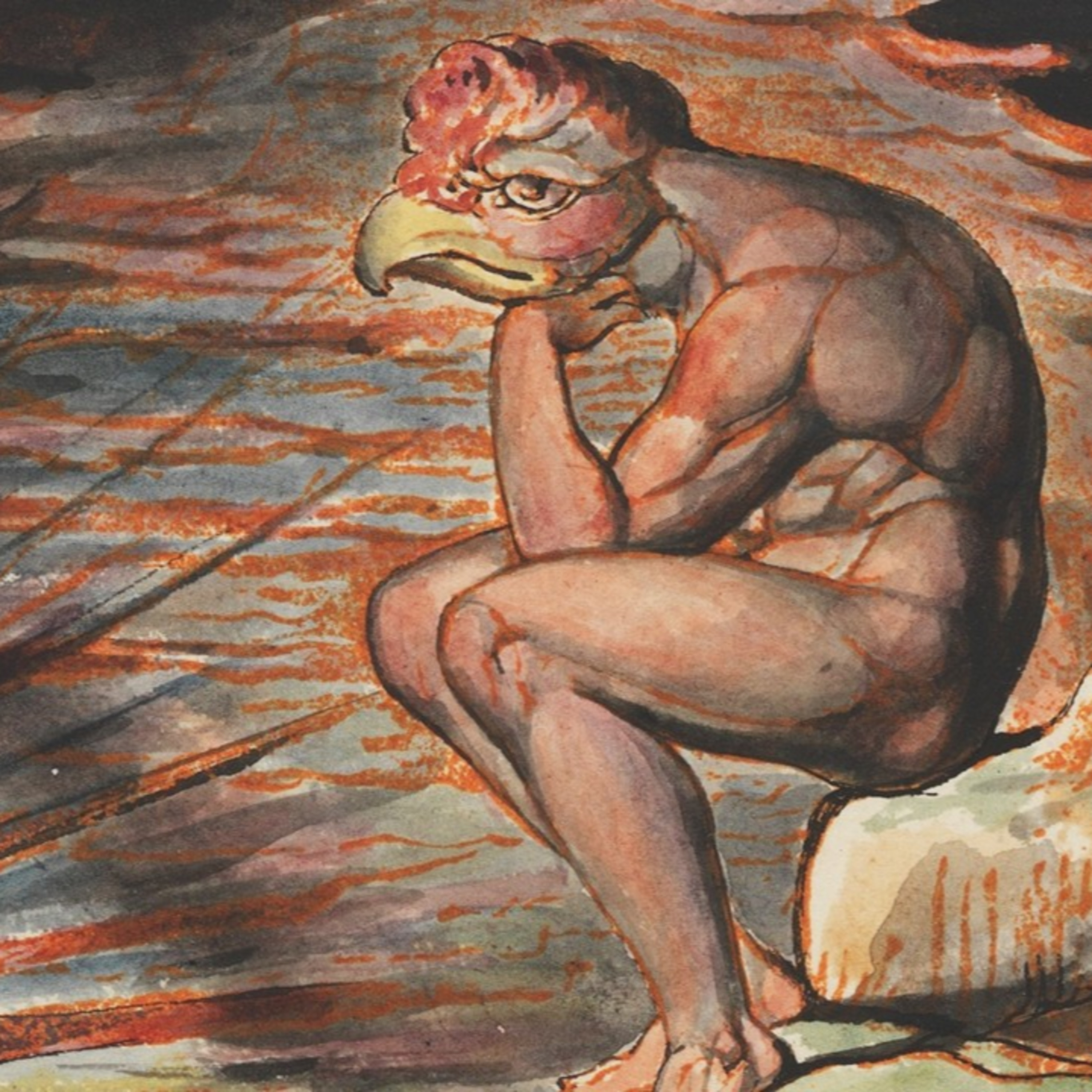
The text explores the wanderer archetype across literature, history, and modern life, beginning with the 10th-century Old English poem "The Wanderer," where an exiled warrior mourns the loss of his lord and the communal warmth of the mead hall. This figure embodies existential loneliness and the search for meaning amid impermanence, ultimately finding solace only in God. The archetype traces back to hunter-gatherer societies, where belonging and shared ritual around fire provided psychological nourishment. Cultural variations include the Japanese ronin (a masterless samurai facing dishonor), the legendary Wandering Jew, and the German concept of "Fernweh" (a melancholic longing for home). In modernity, wanderers appear as digital nomads, internet trolls, or those lost in passive fantasy and distraction, avoiding boredom and inner stillness. This leads to what the text calls the "Grey Life"—a zombie-like state of inner death, where people are mindless, isolated, and endlessly hungry for stimulation without true fulfillment. The zombie archetype reflects a crisis of meaning in the 21st century. The solution lies in confronting inner emptiness through active imagination, meditation, and stillness, rather than endless external movement or distraction. Ultimately, the wanderer's journey is a quest for purpose, but true stability requires turning inward to face one's own desolation.
"After the loan, every first loud of dawn, I've had to speak my sorrows. There's no one living to whom I would dare to reveal clearly my deepest thoughts. The weary mind cannot withstand weird, fate. The troubled heart can offer no help. He who has come to know how cruel a companion is sorrow, to one who has few dear protectors will understand this. The path of exile claims him, not patterned gold, a frost-bound spirit, not solace of earth. He remembers all holders and treasure taking, how in his youth his gold-giving lord accustom him to the feast, that joy all fades. When sorrow and sleep both together often bind up the wretched exile, it seems in his mind that he clasps and kisses his lord of men, and on his knee lays hands and head as he sometimes long ago, in earlier days, enjoyed the gift-throne. But when the friendless man awakens again and sees before him the fellow waves, see births bathing, spreading their feathers, frost falling and snow mingled with hail, then the heart's wounds are that much heavier, pain after pleasure. Where are the horses gone? Where are the riders? Where is the giver of gold? Where are the seats of the feast? Where are the joys of the hall? How the time passed away slipped into nightfall as if it had never been. In the Old English poem The Wanderer composed anonomously in the late 10th century, an exiled warrior mourns the death of his lord and kinsmen. He wanders alone across the cold seas, winter sad and halted, lamenting the destruction of his people and passing of the joyful, and youthful days once spent in the mead hall, a place that offered warmth, community and belonging. The hall that once rang with merriment now lies silent. It is more than just a building. It stances a symbol of the centre of meaning, now left empty. The wanderer treads the path of exile, a man of sorrows acquainted with grief, cut off from his homeland and kin. He reflects that no one can escape weird, fate or more accurately that which comes to pass, which is inaxeable. The archetype of the wanderer appears as a figure of profound loneliness, both outwardly and inwardly. His thoughts dwell on the good old days and the impermanence of worldly life, but he carries his pain silently and despite his melancholy, he stresses the importance of wisdom and patience for endurance in the phase of loss. Ultimately, he concludes that true stability is not found in the fleeting world, but in God, for everything passes, but God does not change. Wondering as a basic pattern of behaviour goes back to our oldest ancestors, but when survival is sufficiently secured for the psyche to turn inward, the wanderer archetype is constellated, bringing something more existential and psychological than mere biological survival. Archetypes do not disappear, their form remains the same, but their content may shift, shaped by new conscious experiences. We evolved within small interdependent groups, in which each person played a vital role in securing food and safety. Days were spent wandering, foraging and hunting. Night was spent around the bonfire. The fire was not just essential for warmth, cooking and protection. It was the gathering place for social and cultural life, the centre of meaning. Here, our ancestors shared food, planned for the coming day, and exchanged stories, dreams and spiritual beliefs beneath the vast night sky, where the Milky Way and stars shown brightly, untouched by artificial light. Human genetic evolution has not kept pace with the rapid transformations of the modern era. Our biology remains fundamentally aligned, with a simpler, more stable rhythms of hunter-gatherer life. Despite its hardships, it carried a profound sense of belonging. As social beings, we are wired to belong to communities where our contributions are recognised and valued. Then that is lost, many sink into meaninglessness. Anthropologists have long known that when a tribe of people lose their feeling that their way of life is worthwhile, they may stop reproducing, or enlarge numbers simply light down and die, besides streams full of fish. Food is not the primary nourishment of man. The word wanderer comes from the Old English "wondrian", which means "to move about aimlessly", such a person drips through life without it fix home or direction, wrestlers in the search for purpose and belonging, often with the urge to pack a bag and simply leave to an unknown destination. In Japan, a samurai became a ronin, a wanderer upon the death of his master. A samurai was expected to commit a Sepulchre after such a loss, or his identity was tied to loyalty to a lord. Ronins who failed to follow the tradition were socially dishonored and marginalised. The ronin drifted from place to place, some became mercenaries or rebels, while others managed to find a new master. In contemporary Japan, Ronin is also used to describe students who have failed university entrance exams, or unemployed individuals, reflecting the societal pressure and expectations surrounding academic and professional success. The term "wonderlast" rooted in German romanticism conveys a light hearted desire to wander. In contemporary German, however, the word "found the far sickness" has become more common, carrying a man-colleged undertone. A deep longing for distant places and the hope of eventually finding a place on earth where one truly feels at home. Such people feel nostalgia for the good old days or the warmth of childhood, and sometimes experience an uncanny sense of deja vu as though certain moments have been lived before or new places already seen. The wanderer longs for home, yet feels at home nowhere, dwelling in a liminal space between past and present, the familiar and the unknown. He is in this world but not of this world, echoing what Lovecraft wrote. "I know always that I am an outsider, a stranger in this century, and among those who are still men." In Scripture, the archetype of the wanderer is reflected in Cain, who, jealous of God's favour towards Abel, commits the first murder and is cursed to be a restless wanderer, exiled to the land of Nard, whose name in Hebrew means to wander. In the 13th century, the legend of the eternally wandering Jew arose, as Christ carried the cross, a man mocked him, telling him to hurry. The unrecognized Saviour turned and said, "I go, but you shall be waiting here for me when I return." If there's one key characteristic of the wanderer, it is restlessness, which appears as a constant need to chase the next thing, whether it be in the outer world, new places, careers or relationships, or in the inner world, memory, streams and reflections. One is tired of living in the country, one moved to the city, one is tired of one's native land, one moves abroad, one is tired of Europe, one goes to America and so on. Finally, one indulges in a dream of endless travel from star to star. All the movement is different, but still in extension, one is tired of dining off Pulsolon, one dimes of silver, one tars of bad, one dimes of gold, one burns half of Rome to get an idea of the Conflugration of Troy. This method defeats itself, it is the bad, infinite, endless progression. Once something is achieved, the wanderer is no longer satisfied and seeks something else, add infinitum. This insatiable desires the cause of much of our suffering. One could say that the wanderer cannot commit to anything, but he certainly committed to wandering. The wanderer is always in search of something, but once he finds it, he quickly sets it aside and continues his restless pursuit. The outer wanderer is caught in a paradox, when he stops moving, he feels imprisoned, when he moves, he feels momentarily free. His condemned to wander for the sake of wandering, yet unable to find rest without feeling trapped. This may lead him to embrace a kind of romantic fatalism, accepting his seemingly inescapable condition. We also wander within our own minds, conjuring imagined scenarios to escape reality, or become trapped in rumination, caught in a loop of negative emotions, past regrets, and perceived failures. In this way, we suffer more in imagination than in reality. The inner wanderer may daydream, watching an endless stream of fantasies unfold like a movie, while ignoring the emotions hidden within these inner images, emerging exhausted, remained and unfulfilled. This is passive fancy, the unconscious figures remain locked up, crying out for freedom, and one is unable to nourish the part of oneself that is starving. As Carl Jung stated, "We have been so busy with the question of what we think, that we entirely forgot to ask what the unconscious psyche thinks about us." contrast to passive fantasy, active imagination allows the
I to fully enter into the unconscious, experiencing it with the same intensity and presence as one would in a physical external situation. Here the ego does not impose its own meaning, but instead surrenders to forces beyond it control, serving as an anchor between the outer and inner realms. Similarly, in meditation one observes emotions with our judgement, acknowledges them and allows them to be integrated into consciousness. In this way, our inner figures are nourished and brought to life. Like a skilled sculptor who envisions the form hidden within a block of marble and carefully chessels away what is superfluous, freeing the figure from its prism. For Kegegor, the unreflectivist theed or pleasure seeker sees boredom as his worst enemy, the root of all evil. Strangely, those who don't bore themselves usually bore others, while those who do bore themselves and use others. The people incapable of boredom are typically those who are busy in the world, but that is precisely why they are the most boring, the most insufferable of all. To wander without end is eventually to arrive at a dead end. The 2014 study just think the challenges of this engaged mind found that people would rather administer electric shocks to themselves than spend 6-15 minutes alone in a room with nothing to do but think. As Milton writes, the mind is its own place and in itself can make a heaven of hell a hell of heaven. And as Pascal famously stated, "Mans on happiness comes from one single thing, not knowing how to stay quietly in a room. We often convince ourselves that boredom is bad, but the opposite is true. You need to be bored. When we are not focused on external tasks or goals and are left alone with our thoughts, the brain's default mode network lights up. And our minds begin to wander. We reflect on ourselves and on life. And begin to feel uneasy or think that something is wrong with us. But if we distract ourselves every time we feel even slightly bored, we make it harder to find meaning and stunt our creativity." Modern life is dominated by an unrelenting cycle of work and financial pressures, often sedentary and confined to a desk. In the few breaks we get, we instinctively reach for online content, numbing ourselves with short term pleasures, at the cost of long term fulfillment. Too many drift into mediocrity, lost in distractions and shallow entertainment, until years pass and one realizes that nothing meaningful has been built. Despite constant connectivity through technology and social media, loneliness has increased. Superficial interactions and the lack of genuine belonging leave many feeling isolated. We compare ourselves to the highlights of others' lives, mistake them for the whole truth, and grow increasingly alienated, creating unrealistic expectations for our ideal self, despite our real self. To fill this in void, some become digital wanderers, creating online personas and seeking attention. In real life they may go unnoticed, but online they can appear as heroes, until they return to daily life, when reality feels dull by comparison. Others become anonymous internet trolls, posting deliberately offensive or provocative messages to elicit strong emotional responses. Like Dostoevsky's underground man, they are alienated, resentful and rebellious, attempting to assert control or influence in a world they feel powerless. Silence and stillness make us uneasy. So we reach for more noise, more stimulation. We feel a constant need to kill time, treating it as an enemy in our pursuit of progress. But this only brings more suffering, more stress, shorter attention spans, poor sleep, at heightened anxiety and depression. Many endure unpleasant states of mind by distracting themselves, even if it means living in misery most of the time. When one steps back and looks at life, it almost seems like a grand, trotic joke, always running, running, running. What are you running for, or better yet, what are you running from? Is it not perhaps yourself? And so one honestly confronts oneself, life as Schopenhauer writes, swings like a pendulum backward and forward, between pain and on we. On we is a deeper, more existential form of boredom, encompassing a profound dissatisfaction and awareness with life. In Tibetan Buddhism, there are six realms into which consciousness can enter, during the battle, the liminal state between death and rebirth. These realms are part of samsara, the cycle of birth, death and rebirth, and reflect the karma and mental patterns we carry through life, shaped by our experiences and attachments. The wondrous, insatiable desire can be compared to the realm of hungry ghosts, where one experiences both poverty and fullness at the same time. Whatever you want, you do not have to look for, but you find yourself possessing it. Yet this makes us more deprived, because we get satisfaction not from possessing alone, but from searching. They say fundamental and insatiable hunger, based on the realization that we already have everything we desire, yet we cannot enjoy it. Once you hold what you desire, the joy of having it fades, yet you cannot bring yourself to let it go. It is as though you are completely full, but you love to eat. And so you begin to have hallucinations of the flavour of food and the pleasure of eating it, tasting it, chewing it, swallowing it, and digesting it. The whole process seems luxurious, and you feel extremely amused of other people who can really be hungry and eat. This is symbolised by the image of a person with a gigantic belly and extremely thin neck and tiny mouth. In Dante's Inferno, after passing the Gate of Hell, which bears the inscription, abandoned all hope, ye who enter, one first encounters the vestibule of hell. Here dwell the neutrals or opportunists, Luke Wompsolves who took no sides in life, neither good nor evil, concerned only with themselves. Guilty of moral indecision, they endure a punishment that mirrors their wasted lives, endlessly pursuing a shifting banner, a restless futility that reflects their spiritual stagnation. By contrast, Limbo, the first circle of hell, is home to the virtues but unredeemed. These souls endure no physical torment, yet wander without hope, in perpetual longing, eternally separated from God. Collocally we say we are in a limbo when we are unsure what to do next, caught in a liminal state which is neither here nor there. Perhaps you have finished a project, but the next step is unclear, or you have lost your job and the future feels uncertain, or you have ended a relationship and you do not know what comes next. It is as if life has paused and you are waiting for something to happen, but it hasn't yet, one experiences simultaneously stagnation but also anxiety about what the future might bring. The wanderer's quest begins with a deep yearning, driven by existential angst and the desire to make sense of one's life, as if one lacks something eternally firm within oneself. Often we do not even have a name for what is missing, but we long for that mysterious something. Fate leads the willing and drags along the reluctant. Each must fulfill the purpose for which one was born, willy-nilly, and that is unique to each individual. What seems meaningless to one may be meaningful to another. There's no recipe for living that suits all cases. Perhaps one longs to discover one's meaning, but cannot, even after years or decades of wandering. The pain may become so great that one convinces oneself that life is meaningless, simply to escape the struggle, but the inner yearning does not disappear. Eventually, the wanderer faces an existential crisis and begins to question the meaning of life. "Where am I? What is this thing called the world? Who is it that has lured me into the world? Who am I? How came I here? Why was I not consulted? Why not made it quaint with its manners and customs instead of throwing me into the ranks as if I had been bought by a kidnapper, a dealer in souls? How did I obtain an interest in this big enterprise they call reality? Why should I have an interest in it? Is it not a voluntary concern? And if I am to be compelled to take part in it, where is the director? I should like to make it remark to him. Is there no director? Will I shall I turn with my complaint?" Even when outward appearances suggest all is well, inwardly one may feel lifeless. This emptiness drains the world of color, making it seem desolate and barren, as within, so without. The external donors mirror as once in a life. How can one perceive the beauty of the world if one is dead inside? In such a state, deserted places feel more like home, reflecting once in a landscape. Lord Byron writes, "There is a pleasure in the pathless woods, there is a rapture in the lonely shore, there is society where non-intruths, by the deep sea and music in its role, I love not man-deless, but nature more." outwardly nothing.
changes, the trees, birds and landscapes remain the same. But one cannot take pleasure in them. This inability to enjoy life, known as an idonia, is often accompanied by depersonalization, a sense of detachment from oneself and reality. In extreme cases, this can resemble Kant Art Syndrome, a rare condition in which a person believes he's already dead, or does not exist. We cannot hope to heal the desolation around us if we do not first confront the desolation within. We worry endlessly about the state of the world, yet neglect to put our own inner lands in order. Not the Black Death, this time the Grey Life. While the Black Death was a sudden and catastrophic plague that caused death, the Grey Life points to a modern affliction that brings inner death, a pervasive dullness, a lifeless and meaningless existence marked by spiritual malaise, young rights. I went into the inner death and saw that outer dying is better than inner death, and I decided to die outside and to live within. For that reason I turned away and sought the place of the inner life. Inner death is exemplified in the archetype of the zombie, which can be seen as a modern reflection of the restless wander archetype. When we use the word "zombie" colloquially, we usually refer to someone whose mindless, exhausted, or going through motions without thinking as if sleep walking through life. The zombie is dull, lifeless and decaying, reflecting the emptiness within. In the book, "Zombies in Western Culture", John Verveiky and colleagues explore the rise of "Zombieism" as emblematic of the 21st century side-guised. The zombie has become an enduring symbol for the crisis in meaning. We are the walking dead. Zombies are a distorted reflection of modern humanity, representing the collapse of what is meaningful to us. They do not speak, they have nothing to say, showing their empty headdness. They move in groups, yet remain utterly alone without any sense of belonging. They have no home and wander absolutely from place to place. Zombies have an insatiable appetite. They eat brains, the seed of intelligibility, but no matter how many they devour, they remain brain dead, demonstrating how one can take in knowledge without true understanding. The endless hunger represents the existential state of being unable to make sense of the world. Zombies are not evil, but driven by an instinctive craving. They act heedlessly, giving north thought to their own survival, in their pursuit of consumption. They will ultimately destroy themselves. If you come into close contact with a zombie, infection inevitably follows, and you become part of the horde, increasing their numbers, symbolising the contagion of mindlessness. Tolkien wrote, "Not all those who wander are lost. You became lost in order to find yourself. The wanderer walks on the path of exile, isolated from others. He is a lone wolf because he feels lonely of being with other people, then with himself. Social interaction does not equal belongingness. I stood among them, but not of them, in a shroud of thought which were not their thoughts." The wanderer may feel terribly lonely, lacking social acceptance, or the temporary comfort of being like by others. However, this acceptance often comes at the cost of once individuality. It is through developing the inner self that one can face loneliness constructively. Jung writes, "If a man knows more than others, he becomes lonely. But loneliness is not necessarily inimical to companionship. For no one is more sensitive to companionship than the lonely man, and companionship thrives only when each individual remembers his individuality, and does not identify himself with others." The wanderer must compensate for his one-sidedness by learning to remain still, to sit in silence, and to observe his thoughts. He must turn towards his neglected emotions and dreams, and write them down or paint them, making the intangible, tangible. Through this practice, the unconscious contents become conscious, allowing for the neglected part of oneself to become integrated. In this way, one gives birth to the true self, moving from fragmentation to wholeness. By first connecting with oneself, one can build meaningful relationships with others. One was not tried to escape from loneliness, but instead accepted as part of oneself. Krishna murty writes, "We will do anything to escape from loneliness to cover it up. Our conscious and unconscious preoccupation seems to be to avoid it or to overcome it. Avoiding and overcoming loneliness are equally futile. Those suppressed or neglected, the pain, the problem is still there. You may lose yourself in a crowd and yet be utterly alone. You may be intensely active, but loneliness silently creeps upon you. Put the book down, and it is there. Emusements and dreams cannot drown loneliness. You may temporarily evade it, but when the laugh turns the effect of alcohol out over, the fear of loneliness returns. The entity who tries to fill or run away from emptiness in completeness, loneliness, is not different from that which he is avoiding. He is it. He cannot run away from himself. All that he can do is to understand himself. He is his loneliness, his emptiness. And as long as he regarded as something separate from himself, he will be an illusion and endless conflict. When he directly experiences that he is his own loneliness, then only can there be freedom from fear." The young prince of Dathukautama was sheltered by his father from all knowledge of suffering. For a profusiyad foretold he would become either a great king or a buddha. Surrounded by a life of luxury and entertainment, he lived a life of pleasure until the age of 29, when he ventured outside the palace. There he encountered an old man, a sick person, a corpse, and finally a monk devoted to understanding suffering. Deeply troubled by the suffering he witnessed, and inspired by the monk's example, Siddhartha renounced his princely life to seek a path that might end human suffering. After years of meditation and the satisism, he attained enlightenment and became the buddha, the awakened one. He told the first noble truth that life is Dukha, arising from insatiable desire and detachment. While often translated as suffering, its meaning is broader. It encompasses physical and psychological pain, Dukha, Dukha, the suffering caused by change, aging, illness and death, the Parinamak Dukha, and the Sattala persistent restlessness that remains even when desires and goals are fulfilled, Sangkara Dukha. While the buddha realized and taught that true change comes from within, many wanderers tragically spend their lives attempting to fill their inner void through external means. In the human rights, I early arrived at the insight that when no answer comes from within to the problems and complexities of life, they ultimately mean very little. Outward circumstances are no substitute for inner experience. After a long period of aimless wandering, one may finally commit to the inner journey and the archetype of the seeker becomes constulated, beginning the search for one soul. My soul, my soul, where are you? Do you hear me? I speak, I call you, are you there? I have returned, I am here again, I have shaken the dust of all the lands from my feet and I have come to you, I am with you. After long years of long wandering, I have come to you again. The one thing I have learned is that one must live this life. Give me your hand, my almost forgotten soul. How warm the joy it's seeing you again. Life has led me back to you. Let us thank the life I've lived for all the happy and all the sad hours. My soul, my journey should continue with you. I will wander with you and ascend to my solitude. I am weary, my soul, my wandering has lasted too long. My search for myself outside of myself. Like a tired wanderer who had sought nothing in the world apart from her, shall I come closer to my soul. I shall learn that my soul finally lies behind everything. And if I cross the world, I am ultimately doing this to find my soul. Yom stated that he had to accept that what he previously called his soul was not a toll his soul, but a dead system. Therefore, he had to speak to his soul as something which did not exist through him, but through whom he existed. The focus of life shifts from external achievements and aimless wandering to the pursuit of self-realization and theosis, union with God. In the grail myths, the seeker appears as the knight in search of the holy grail, a symbol of the self or total personality. Many embark on the quest, but only the pure empires succeed in finding it. The wanderer wanders for the sake of it, while the seeker roams with purpose, guided by a goal. The wanderer may
only reflect on his inner life, whereas the seeker actively does inner work. The wanderer carries an inner void, the seeker builds upon an inner foundation. Throughout life we move between being a wanderer and a seeker, two recurring patterns of behaviours that emerge at different moments. The soul's journey is not static, it's not a one-time thing that can be completed and resolve all difficulties. The greatest problems of life can never be solved, but only outgrown. The journey unfolds through one's daily duties, and there's meaning in every journey that is unknown to us. Suffering is inescapable, but one can suffer meaningfully or not. New roses arises when we flee from the meaningful suffering that comes from knowing oneself. A new roses is an offended guard, or as James Hillman writes in revisioning psychology, our pathologies are calls from the gods. In other words, when we repress a part of ourselves that seeks expression in the world, or prevent nature from fulfilling her role through us, we are in a sense offending the gods. The wanderer suffers neuratically, escaping from himself, while the seeker suffers authentically confronting himself. Few burdens are heavier than blind suffering. If you bring forth what is within you, what you bring forth will save you. If you do not bring forth what is within you, what you do not bring forth will destroy you. The vast majority of problems arise from within. That which we deny ourselves is unconsciously projected onto others. We are always projecting both out good and the bad qualities, so that the world appears filled with the fragmented parts of our personality. Some people seem to hold out in a gold, and we become instantly consumed by them, as if the very meaning of our lives depended on them. Others become hooks for our shadow, evoking anger, fear, or disgust in us. It is essential to recognize these projections, withdraw them and integrate them, for they are simply aspects of ourselves. Only then can we move towards wholeness. We should not depend on others for our self-worth, for the most important relationship we have is with ourselves. We must not ignore ourselves, but learn to value, forgive, and love ourselves just as we do others. By helping oneself, one is better equipped to help others, hence the saying "Love your neighbour, ask yourself". Humility consists in knowing our limitations and getting the help we need. The seeker listens to his conscience, the inner voice that expresses the soul's intent. The ancient Greeks personified the guiding force as the Daimon, which remembers what is in one's image, belongs to one's pattern, and thus carries the essence of one's destiny. A moral and a force of nature, the Daimon guides our actions in ways we may not fully understand. Even when others advise us against a path, we feel an inner conviction that it is the right one to take. Something we cannot fully explain to ourselves, let alone two others. Like the author of Ecclesiastes, the seeker realizes that power, fame, wealth, and pleasure are nothing more than eight chasing after the wind. All these things vanish into thin air, leaving no lasting mark. Only the fruits of our work, the acts of love, wisdom and service endure. As Christ said, by the fruits you shall know them. The fruit serves as a symbol of the culmination of the individuation process, the ultimate goal and completion of existence, the fulfillment of one's soul essence. Consciously lived suffering seems to have a redeeming effect on the past and on the future of humanity's collective consciousness. Jung writes, "The problem of crucifixion is the beginning of individuation. There is the secret meaning of the Christian symbolism, a path of blood and suffering, like any other step forward on the road of the evolution of human consciousness." As seekers, we may come to understand the meaning and purpose of our lives, yet this does not come without restlessness. It is the spiritual journey of the pilgrim, the cross we must carry on our individual journey towards consciousness, walking the path of the eternally alone. But as Jung wrote in a letter, no matter how isolated you are and how lonely you feel, if you do your work truly and conscientiously, unknown friends will come and seek you. Every step forward along the path of individuation is achieved only at the cost of suffering. This is why when we come into conscious contact with the individuation process, we experience it as being painful even deadly. More precisely, however, it is not the ego but the self, which seems at first to be wounded, and it is only when the self is realized in a human being that the person begins to share in the suffering. Individuals are a heroic and often tragic task, the most difficult of all. It involves the suffering of the ego. The ordinary person we once were becomes burdened with the fate of losing himself in a greater dimension and being robbed of his fancied freedom of will. He suffers, so to speak, from the violence done to him by the self. For Jung, the self is a god image, or at least cannot be distinguished from one. The early Christian spirit was not ignorant of this, as the church father, Clamond of Alexandria writes, "Therefore, as it seems, it is the greatest of all disciplines to know oneself. For when a man knows himself, he knows God." The seeker suffers from acedia, a word meaning "without care" in Latin. It is often translated as sloth, but it is more than mere laziness. Early Christian monks described it as a state of spiritual restlessness. In the practicals, Evacrius Pantagos, a desert father, names Acedia one of the aid-tempting thoughts, and calls it the "noonday demon" because it strikes during the day's hardest and most exhausting hours when body and soul are most vulnerable to awareness. It is as if the demon causes the sun to slow down or even stop, so that the day seems endless. It distracts the monk, tempting him to pace the cell, gaze repeatedly out the window, and scan every direction for the other brothers. It fills him with resentment towards his surroundings and the life he has chosen, while making him long for easier places where his needs could be obtained without effort. At the same time, it shows him visions of a long life and the many hardships of the ascetic path, intensifying the test of his spiritual discipline. The demon employs every possible means to make the monk abandon the ascetic life. Evacrius considers this the greatest trial in the monk's daily spiritual struggle. No other demon comes after this one. Once endured, the soul has faced its most intense temptation, and one enters a state of peace and unspeakable joy. One who is constantly seeking meaning may paradoxically fail to find it. The shadow-seeker manifests itself as an obsessive need for spiritual growth and perfection, sacrificing instinct to ideals, health to work, and the earthly to the lofty. Such self-destructive behavior often result in physical and psychological illness, ultimately causing life short and preventing the very goals one hope to achieve. It is important to step back in order to get a bird's eye view. In doing so, one may discover Ariadne's threat and find a way out of the maze of the mind. Who sits in utter idleness shall come much sooner to the goal than he who runeth after God with a sweat of body and of soul. This quote captures the paradox of mystical experience. Spiritual progress is not achieved through frantic effort, but through inner stillness and surrender, and obsession with achieving spiritual goals causes the ego to get in the way of grace. Like watering a plant, growth must happen naturally, it cannot be forced. The shadow-seeker's excessive ambition makes him resemble Lucifer, who attempted to usurp God's throne and was cast down into hell, or Icarus, who ignored his father's warning not to fly too close to the sun and so plunged to his death, both myths stand as warnings against hubris. The shadow-seeker worships the idea of God rather than cultivating a personal relationship with God. Religion becomes a label or cultural identity rather than a lived existential commitment. One prays mechanically without conviction, gives charity to be applauded, wears sacred objects for aesthetic purposes, and treats these outward acts and appearances as the truth itself. When the representations of religion replace the reality of faith, it creates what Bordriard calls "hyper reality". Outward behaviors treated as the essence of faith, even though the underlying relationship with the divine is absent. The shadow-seeker engages with a mere copy of religion, yet believes it to be true. We often search far and wide for treasure, unaware that it lies at home, within ourselves. This is a common mode-tief worldwide. A man dreams of treasure in a distant place. He travels there but finds nothing. He tells another man about his stream, the second man realizes that detretures
actually at the first man's home, the first man returns and finds it buried in a familiar spot. As the alchemists stays at, instead of Guilinis in Venitur, in Filth it will be found. What you need most this often found, where you least want to look. But this is easier said than done. We resist confronting the despised or terrifying aspects of ourselves, and when we neglect or run away from the Filth in ourselves, the unconscious responds accordingly by presenting us with nightmares, grotesque visions, or unknown figures chasing us down. These visions, however, are nothing more than fragments of our own psyche, carrying urgent messages we desperately need. Until we acknowledge them, we remain in misery, no matter how convincingly we pretend that all is well. Young rights. We know the mask of the unconscious is not rigid. It reflects the face we turn towards it. Hostility lancetates threatening aspect. Franglinis suffers his features. The monster you fear becomes the savior you need. The archetype of the savior typically comes from the place where we least expect, and he's frequently despised and rejected by others. It is precisely that which we repress that assumes the role of the savior. This is the principle of psychic compensation. The repressed aspect carries the most energy, or libido, and therefore the greatest potential for growth. When the ego is exhausted, when one's convictions and ideas are depleted, the psyche naturally overturns. Then up comes the other side, which is full of life, that which one has never seen, accepted, or lived, fresh and green as spring. But that is precisely what makes it terrifying and also attractive, since it means a complete reversal of the whole personality. Some seekers choose to dedicate themselves entirely to their inner journey, becoming yogis, hermits, or ascetics, in order to avoid the distractions of the world that hinder the growth of the soul. However, if taken to an extreme, it can become overly one-sided, reflecting another aspect of the shadow-seeker. For Jung, individuation and individualism are mutually exclusive. To isolate oneself in a mountain and meditate alone is to be visited only by one's own ghosts, and that is not individuation. The self does not arise in isolation, but in relationship. It manifests through our deeds, each of which forms a bridge between ourselves and the world around us. The self is therefore fundamentally relatedness. It comes into being through connection with others, and with life itself. Jung writes, "One cannot individuate without being with other human beings. One cannot individuate on top of Mount Everest, or in a cave somewhere, where one doesn't see people for 70 years. One can only individuate with or against something, or somebody. Individuals are only possible with people, through people. You must realise that you are a link in a chain, that you are not an electron suspended somewhere in space, or aimlessly drifting through the cosmos." Indus spoke Zarathustra, after spending 10 years alone in the mountains, Zarathustra grows weary of his wisdom. Wisdom becomes a burden if it is not shared. Thus, like the evening sun that descends to give light to the underworld, Zarathustra begins his downgoing into mankind. The patron saint of Switzerland, Nicholas of Flue, also known as Brother Claus, lived with his wife for 20 years, and together they raised 10 children. At the age of 50, however, he was seized by periods of inner restlessness and depression. In volume 6 of her collected works, Néry Louise von France describes his visions. In one, he saw a four-bride light descending from heaven, revealing the place where a hut and a chapel should be built, and it was carried out according to his vision. His wife and children gave their consent for him to withdraw in this way, and they remained at peace with the decision of to envisaging him at his hermitage. Brother Claus never moved back with him. From that point onward, he undertook a regimen of total fasting, sustained solely by the Eucharist, which he mysteriously maintained until his death, lasting 20 years. Despite his isolation, Brother Claus remained connected to the world. Visitors described him as being in good physical condition, affable and content. He went barefoot and wore a grey robe, stood tall, and spoke with a mildly but charming voice. He often kept his mouth half open, perhaps reflecting an attitude of awe-inspired inner contemplation. We should not liken to Saint to an eccentric who had misanthropically crept away and gone into hiding. Rather, his inner experiences were of more value to him than ordinary human existence. Yume remarked that Brother Claus should be named the patron saint of psychotherapy. On the brink of civil war, it passed her hered to the well-respected hermit for help. Bound by his vow never to leave his cell, he entrusted the pastor with a message for the delegates, effectively averting the conflict. The contents of that message remain in mystery. The shamanic calling often follows a spiritual crisis marked by visions, dreams or trance, and a need for solitude. This illness signals that one has been chosen for a sacred role by descending into the underworld and overcoming trials. The initiate undergoes a symbolic death and rebirth, gains wisdom and ascends to the sky realm, becoming one who has awakened. The real work, however, begins in the return from paradise to society for the shaman's mission is to serve and protect his people. In Buddhism, monks withdraw from society to live an aesthetic and contemplative life, yet they remain connected to the lay community. In the east, the word monk, the rise from the Sanskrit, bixu, meaning one who lives on arms. By receiving food from the layer, monks practice humility while in return offering blessings, guidance and wisdom. This relationship is regarded as a sacred duty. The hero's journey mirrors these patterns. It begins with a call to adventure, leaving the ordinary world behind, separation brings anxiety, and in the special world, the hero faces the dragon, a symbol of one's deepest fears. By defeating the dragon, the hero experiences a symbolic death and rebirth, gaining insight and life experience. The journey continues with a return home, facing further trials, and bringing back the elixir, wisdom, love or knowledge to share with others. Eventually another call to adventure comes, and the cycle begins again. This movement from the ordinary world of consciousness to the special world of the unconscious and back again expresses an ancient truth. That which is below is like that which is above, and that which is above is like that which is below, to accomplish the miracle of one only thing. It ascends from the earth to the heaven, and descends again to the earth, and receives the power of the above and below. Thus you will have the glory of the whole world, therefore all darkness will flee from you. To ascend from earth to heaven alone is to remain too lofty, too one-sided. True homeless requires a return to earth, to fulfill one's duties and share one's insights with fellow suffering beings. Like Kegogor's Night of Faith, such a person participates fully in worldly affairs, yet at every step makes the invisible movement of infinity appreciating the beauty of existence and the simple joys of life. Mystics across the world seek theosis, and they return back to our true home after our temporary exile in this world. They recognize that, despite the apparent differences of our physical forms, we are fundamentally one. To harm another is therefore ultimately to harm ourselves, and the golden rule. Do unto others as you would have them do unto you. A principle found in practically all the world is in existence. The longing for theosis makes the seeker feel consumed by a fire that does not burn, captive in a prison from which there seems no escape, yearning for God, and yet unable to find him. St. Dyrisov Abilur writes, "I live without living in me, and so great a life I hope for, that I die because I do not die. I now live outside myself, to dying of love, because I live in the Lord who chose me for himself. When I gave him my heart, he put this sign on me that I die because I do not die. This divine union and the love with which I live makes my God captive to me and my heart free, and it causes in me such passion to see my God imprisoned that I die because I do not die. Ah, how long this life is, how harsh this exile, this prison and these chains in which the soul is enclosed, only waiting for the release causes me such fierce pain that I die because I do not die. Come to an end, life do not be a burden to me, for by dying what remains but to live and delight in myself, do not cease to console me.
Death, for so I ask you, for I die because I do not die." Like King Solomon, the Seeker knows that with much wisdom comes much sorrow, yet the Seeker sometimes experiences he joy so profound that it surpasses anything the world has to offer. The greatest pain is often accompanied by the greatest bliss. In the Eniads, the Neoplaton is platyneus, reflects on his experiences of mystical union with the One, expressing astonishment at having to return to his human body and everyday reality after such transcendent experiences. The physical world appears heavy, harsh and limiting, while the spiritual world is light, gentle and boundless. The difficulty lies in uniting these opposites harmoniously. This is the great work. How then can these two opposites be reconciled? We might find a hint of this when Lord Jesus, fully God and fully man, suffers in the garden of Gethsemane, falling to the ground and sweating drops of blood in anticipation of the passion that awaits him. He prays, "My Father, if it is possible, may this cup be taken from me. Yet not as I will, but as you will." These words mark one of the most profound moments in Christianity, the struggle to unite human suffering with the Divine Will. This tension reaches its climax on the cross, expressing one of Christ's final words, the opening line of Psalm 22. My God, my God, why have you forsaken me? The seeker is willing to sacrifice the most valued relationships and accomplishments in order to surrender to the Divine Will, shifting the center of life from ego or others to God, who alone quenches all insatiable desire and in whom the weary and burdened heart may find rest. The most powerful prayer, one well-niomed niperton to gain all things and the noblest work of all, is that which proceeds from a quiet mind. The more quiet it is, the more powerful, worthy, useful, praiseworthy and perfect, the prayer and the work. To the quiet mind, all things are possible. What is a quiet mind? A quiet mind is one which nothing weighs on, nothing worries, which, free from ties and from all self-seeking, is wholly merged into the will of God and dead to its own. Amen.
Podcast Summary
Key Points:
The Old English poem "The Wanderer" depicts an exiled warrior mourning lost community, symbolized by the mead hall, and reflecting on fate and impermanence, ultimately finding stability only in God.
The wanderer archetype represents profound loneliness and existential searching, rooted in human evolution from hunter-gatherer life, where belonging and shared meaning were central.
Historical and cultural variations include the Japanese ronin (masterless samurai), the legendary Wandering Jew, and the German concept of "Fernweh" (longing for distant places).
Modern wanderers manifest as digital nomads, internet trolls, or those trapped in passive fantasy and rumination, often using distraction to avoid boredom and inner reflection.
The zombie archetype symbolizes modern inner death (the "Grey Life")—a lifeless, meaningless existence marked by insatiable hunger for stimulation without true fulfillment.
The solution involves confronting inner emptiness through active imagination, meditation, and stillness, rather than endless external movement or distraction.
Summary:
The text explores the wanderer archetype across literature, history, and modern life, beginning with the 10th-century Old English poem "The Wanderer," where an exiled warrior mourns the loss of his lord and the communal warmth of the mead hall. This figure embodies existential loneliness and the search for meaning amid impermanence, ultimately finding solace only in God. The archetype traces back to hunter-gatherer societies, where belonging and shared ritual around fire provided psychological nourishment.
Cultural variations include the Japanese ronin (a masterless samurai facing dishonor), the legendary Wandering Jew, and the German concept of "Fernweh" (a melancholic longing for home). In modernity, wanderers appear as digital nomads, internet trolls, or those lost in passive fantasy and distraction, avoiding boredom and inner stillness. This leads to what the text calls the "Grey Life"—a zombie-like state of inner death, where people are mindless, isolated, and endlessly hungry for stimulation without true fulfillment.
The zombie archetype reflects a crisis of meaning in the 21st century. The solution lies in confronting inner emptiness through active imagination, meditation, and stillness, rather than endless external movement or distraction. Ultimately, the wanderer's journey is a quest for purpose, but true stability requires turning inward to face one's own desolation.
FAQs
The poem explores an exiled warrior mourning his lost lord and kin, lamenting the destruction of his people and the passing of joyful days, emphasizing the impermanence of worldly life and the importance of wisdom and patience.
It appears as restlessness, a constant need to chase new places, careers, or relationships, often leading to dissatisfaction and a sense of being trapped when not moving.
Passive fantasy involves daydreaming without engaging deeply, while active imagination requires fully entering the unconscious, experiencing it with intensity and surrendering the ego to integrate inner figures.
Boredom activates the brain's default mode network, allowing for self-reflection and creativity, whereas constant distraction hinders meaning-making and personal growth.
It symbolizes a state where one possesses everything desired but cannot enjoy it, leading to perpetual hunger and dissatisfaction, mirroring the wanderer's endless search for fulfillment.
Zombies symbolize inner death and meaninglessness, reflecting a crisis of purpose where individuals go through life mindlessly, lacking true understanding or belonging.
Chat with AI
Loading...
Pro features
Go deeper with this episode
Unlock creator-grade tools that turn any transcript into show notes and subtitle files.
 PodcastTranscript AI