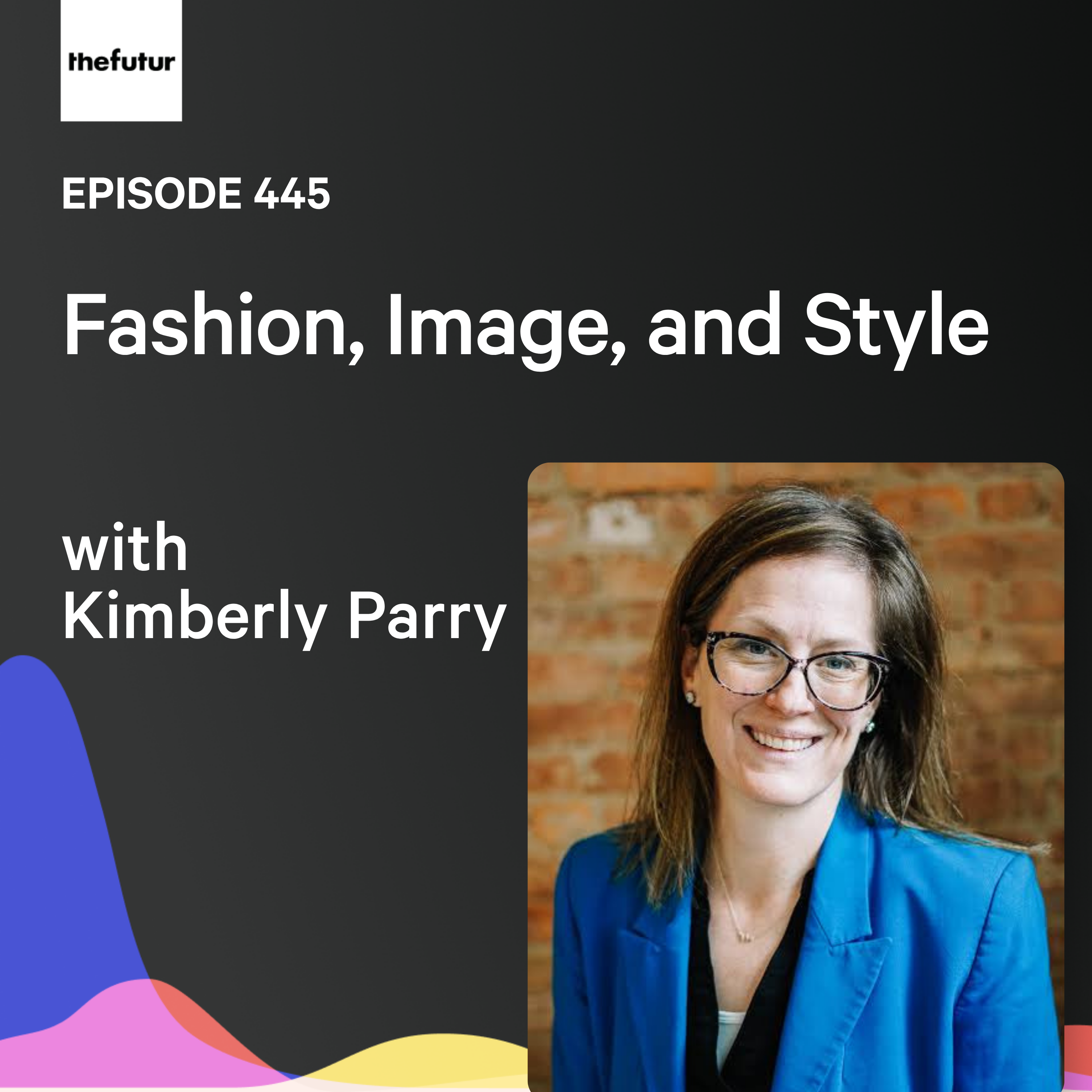
The Psychology of Personal Style w/ Kimberly Parry | Ep 445
from The Futur with Chris Do
38m 38s
Kimberly Perry defines fashion, image, and style as distinct yet interconnected elements of personal presence. Fashion is the creative design of clothing, image is how we are perceived by others, and personal style is grounded in authentic self-expression and identity. She emphasizes that style is not about fitting societal norms but about knowing who you are and how you show up in the world. A key insight is that men often resist change due to a protective, conservative instinct, and their resistance to fashion shifts stems from fear of social judgment or personal loss. Self-sabotage, such as hunching or discomfort when trying new styles, reveals deeper insecurities. Perry introduces a five-layer style framework—rooted in personal brand, relationships, performance, motivation, and image—where authenticity and internal clarity are foundational. She argues that AI can automate external aspects like job skills (performance), but cannot replicate human connection, self-awareness, or authenticity. These deeper layers—personal values, relationships, and motivation—are what make personal style resilient, powerful, and uniquely human, especially in an age of automation. Perry concludes that true personal success comes not from appearance alone, but from living with integrity, confidence, and self-knowledge.
when image is done right, when fashion is done right,
it becomes your three-second resume.
You walk in the room and people have an idea
of who you are and what you're about
before you even open your mouth.
My name is Kimberly Perry
and you are listening to the future.
- There's a recent fascination of mine,
which is fashion and what it says about you
or what your presence or energy
and people might describe it as your vibe or your aura,
how it transmits to other people, nonverbal cues
as to how to look at you and how to perceive you.
And there's a moment in my story here
where I'm walking through one billion followers summit,
but there's a lady and she's doing something
seems kind of interesting.
She seems to be pulling people in
and she starts talking to me immediately
and she goes, I think I need to talk to you.
I'm like, how come?
You just look like a kind of person that I need to talk to
and then she steps back and she gives me a whole leg.
It's your aura and it really crystallizes
something that I've been playing around with
and the reason why we're having our guests on today
which is personal style in terms of your fashion choices
what you're putting together.
So Kimberly Perry is a stylist known for helping clients
refine their look with style that feels polished,
personal and easy to wear,
her approach blends creativity and attention to detail,
making fashion feel both elevated and accessible.
Kimberly, welcome to the show.
- Hello, thank you.
I am so excited for this episode.
Let's start here.
What is fashion, what is personal style?
Can you give us your take on this?
- Yes.
And I think it's very important to clarify what those mean
because just like with what you do with personal branding,
I think you and I define personal branding very similarly
but the rest of the world tends to focus
on social media presence and strategy and image.
And that's why I think it's so important,
especially my approach to fashion
is to clarify the difference between fashion, image and style.
So fashion is the artistry,
the design, the construction of clothing.
It's about what we wear but it's also that creative industry
when you think about fashion, runways, high fashion,
it's the artistry of clothing and construction of clothing.
Image is about how we use clothing
to present ourselves to the world.
And a lot of times when we talk about image,
it's related to how other people view us
and how other people perceive us.
And in the world, especially in the world of business,
we know that you have seconds
and in the world of social media,
I mean the attention span is maybe a millisecond at this point
but you have seconds to make a first impression.
And so your image and what you wear,
the fashion you wear plays into that.
But where I define style differently,
and this is where you're kind of take on personal branding
and my take on style are really aligned,
style goes beyond image, it goes beyond fashion.
And your personal style is about knowing who you are
and how you communicate that to the world.
So you have a leadership style, a communication style,
a relationship style, and yes, a fashion style
that when it is grounded in who you are
and how you want to show up for life,
becomes a powerful tool that's just part of the whole package.
And so that's why I think it's important to differentiate
because a lot of people want clothing
to do something for them that they need to bring
for themselves to life.
If you're not bringing yourself authentically,
clothing can only do so much for you.
- Are using fashion to describe like an industry?
- Fashion is the industry.
It's what trickles down to what we get and ready wear.
The clothing that we wear starts at this creation of fashion
that is cutting edge, it's creative, it's expressive,
it's dynamic, and then from the runways,
people take those ideas and those concepts,
and then they imitate them, recreate them,
and standardize them so that they are more ready to wear
for the regular human who's not rocking
a runway in everyday life.
- And draw the distinction between image and style one more time
'cause I understand the concepts individually,
but why are we separating these two things?
- It's really important to separate
because it affects the way that we approach them.
If you think about image consulting for celebrities
and high profile people,
their image, what the news is saying,
the way that they're represented online,
the way people perceive them can affect their business
and affect their brand,
but image and style are not always connected.
You can repair an image by feeding news feeds to the press
but your style comes from who you are.
And there's a swag, there's a presentation,
there's a way that people bring themselves to life
that cannot be fixed with image consulting.
It can't be fixed with saturating social media.
The only way that your style translates authentically
and powerfully and one of the reasons that I approach you
in this day of AI, it is our differentiator.
So many people are afraid of AI and AI taking over the world
and the thing that makes us resilient
and that makes us relevant in an AI world is our humanity.
And that's our personal style.
That's who you are and you can't fake that.
I'm a visual person, so I'm imagining a diagram
where we take an apple and orange,
we slice it in half and we see the core, that's your style.
And the outside maybe the skin is the image
is how people perceive it.
- Yep.
- All right, when you said swag, what is swag?
- Okay, I was raised in our city.
One of the things that we connected on
I know your San Jose, I'm Sack Town, I'm Sacramento
but it's just the way that you carry yourself
when you walk in a room.
It's that energy and that presence in the corporate world,
they call it as executive presence,
but it's how you walk, it's how you talk,
it's your mannerisms, your body language,
all of that plays into the swag that you carry
and bring to life.
- If we are a coach and someone overlooking somebody
they haven't physically changed at all
and they're wearing the exact same clothes,
how can we guide them like that's not good posture
or presence and this is better?
Like what are some things that they're doing
to hurt their swag?
- I'll say that starting one layer above
where I like to go.
The way that you carry your body language,
it could be due to structural stuff,
but a lot of times it's your confidence.
When someone comes in the room,
how they carry themselves, you can tell if they have some ego,
you can tell if they're insecure,
you can tell if they're naturally confident,
just in their tone of voice in the way that they posture,
the way they hold their shoulders.
And so I start with how did you feel
when you walked in the room?
What were you thinking what was going through your head?
Because all of that, their answers show
in the way they come into the room.
And so it's not so much about teaching them
to be a character or play a role.
It's more helping them understand
what they're bringing to the room
so they can walk into a room and command it
without demanding attention.
- Even if you don't feel good about yourself today,
there are a couple of things that you can do
so that you don't draw negative interpretations
about your mental state.
How does your stand up straight,
chest forward, shoulders back,
and a slow, calm, deliberate movement?
Is the way you want to be?
People who are like looking left and right,
looking super exaggerated emotions,
that's the opposite too, which is like,
I've arrived, everybody, check me out.
So peacocking, so there's a line there
between believing in oneself
and just asking everyone to pay attention to you.
And it's usually like a turn off for most people.
I mean, it works on some people, obviously,
but for most people, like,
ooh, yo, just relax a little bit.
That's ego at play, I believe.
- Yep, it's what I call the faux pro, when the faux pro walks
in the room, you can feel it.
That fake it till you make it,
you can only fake it so far,
and it doesn't make it very long.
- Okay, so there's something else
that I wanted to explore with you
because I've been trying to help people who are like,
hey, I'm really curious about what you're doing
and I'd like some help.
And then we'll go shopping together
and there's a ton of resistance there.
Oh, that won't work.
That reminds me of this.
And I have all these negative emotions.
And so the typical playbook is
they will buy something 3% different
than something they already own in a different color.
And they're thinking, I'm making all this progress
to this Chris, why do you think that is?
- Oh my goodness, the psychology of men's fashion
and women's fashion is amazing
when I was certified in men's wear styling.
The psychology of men's wear fashion,
I'm telling you, it could do like marriage therapy forever.
But one of the things that I say
in its honest truth, men are the biggest pain in the butt
to style is just the truth.
And the reason is is they usually come to me
because
There's a necessity.
Their wives are picking on them.
They're getting feedback from the market.
If they're wanting a job promotion at work,
or if they're entrepreneurs
and wanting to attract a higher level of client,
they're getting the concept
that there's something about their presentation
that's not working.
And so they know something needs to change,
but they don't actually want to change.
And so what they want is a personal shopper.
Really, they want a mom for me, not for you, right?
Like, they want someone to do the shopping for them
or just tell me what to wear
without actually changing anything
about what I do or who I am.
And the whole thing is if there is something
that's blocking you from your next level of success,
if there's something that's getting in your way,
then change is going to be part of that
and change is always uncomfortable.
Our lizard brains are trained for that.
And I think I don't like being super gendered
or stereotypical about things.
So just making it clear,
we're speaking collectively here.
The male psyche was set to protect and defend.
And the caveman instinct is not geared towards change.
The caveman instinct is geared toward stick to the norm,
know your surroundings,
have comfortable familiar surroundings
because that's survival and that success.
And so getting male clients to move into a state of openness
actually is kind of a more feminine energy.
That fluid energy, openness to mentorship and feedback,
getting them to relax into that.
I've found a key, you know, here's a tip for you
when men come to you for that
is really helping them understand the ROI
of what we're doing.
That it's not about changing who you are,
but if you really want the next level of success,
if you really want to move into the version of you 2.0,
version 1.0 can't get there.
So if you want a higher ticket client,
if you want higher level success in your life,
it's not dressed for the job you want,
but it's about becoming the version 2.0
that's ready for that and can hold that level of success.
You said men are usually wired for protection
and conservation and things like that,
but also men are the ones who do the most dangerous jobs.
We will go on adventures and not know that there's a way back.
We will do crazy stupid stuff oftentimes.
So when it comes to exploring fashion or personal style,
this is where it becomes really weird for me
that they stay in a very safe pocket.
And most of the times what they do is they say something
like this to me.
I've always wanted to try that,
but I'm worried that my mates will give me a hard time.
And I have a very specific response to that.
I'm curious like if somebody came up to you and said,
"Hey, I've always wanted to try avant-garde this
or street wear or something else,
but my friends clown on me.
How would you advise them or what would you say to that?"
- Oh, I love that question.
First of all, and when you talk about doing high risk activities,
getting to the core of the why you're willing to do that
plays a lot into this also.
And a lot of times when you look at,
and my dad was a military man.
And so, you know, when you, again,
looking at those protectors, defenders,
people who are willing to put their lives on the line,
it's usually for either a cause, a core value or a person
that they care deeply about.
Social survival, though, is a little bit of a different beast.
If we break patterns, if we draw unwanted attention
to ourselves, that can affect our success.
And for women, I think it goes very much to inclusion.
And for men, a lot of times it goes around power and influence.
So I do think that they're related.
And I think that there is something
that is the honest true to that.
If you think about the way fashion and identity are linked,
anyone who's raised a toddler knows that clothing
is one of the first ways that kids claim their autonomy.
And then moving into like 5th grade, 6th grade junior high,
which is so painful, it's the period
where we're using clothes to try on different identities.
Clothing and identity are very much connected.
But then somewhere between elementary school
and college years, we usually have a fashion fail
where something happens, where we get clowned on,
or maybe beat up.
But we learn that what we wear and how we present ourselves
can get us ostracized, which in junior high is life.
It can affect our life, it can affect our survival.
And that's where our lizard brain kicks in,
our protective instinct kicks in.
And that's where we want comfort, we want security.
And when you figure out a way to blend in with the people
around you to get that success, it can be very scary
to move out of that.
So the gentleman that come to you.
And they come to you for a reason.
You have a very clear point of view.
You are a man of style.
You're also a man of fashion.
And they want that, but are scared of what it's going to cost.
What's it going to cost to me professionally?
What's it going to cost to me socially?
What are people going to say?
And the real vulnerability isn't in what they wear.
It's, what are people going to say when I show up 100% me?
That becomes very personal, but we can put up the front.
Like attack the front and you're not attacking me,
but put yourself out there 100%, which I think
in this AI world for personal brands and entrepreneurs,
it's going to be essential.
It is forcing us into an age of self-exploration
and self-ownership that we've needed for a long time.
Like I'm lighting up, but people are only
forced into it when there's a necessity.
The way I try to explain this to my male friends,
whenever they bring something up like this,
you have a circle of people who really do
be the care about you.
But we also come from a culture where differences
are not usually embraced.
We make fun of each other all the time.
I think if a group of women were around and some woman
fell on their face, I'm like, oh my god, are you OK?
And they'd help each other.
The opposite would happen.
If a guy fell on his face in front of his friends,
they'd be clowning on him.
And nose bleeding is like, they're
going to remind him of that failure over and over again.
Sometimes it's very toxic.
But I also think sometimes it helps
to build resilience, some kind of grit in the person.
But the way I will explain it is this.
When your friends see you moving in a different direction,
they fear something that they cannot articulate to themselves
yet, that you're eventually going to grow apart,
and that you're going to lose the friendship.
They're going to lose you.
And so the only way they know how to respond
is to pull you back in.
It's very crab mentality.
And so I just say to people, there's a couple of ways
you can do this.
You can be brutal about it.
It's like, you know what?
Anyone who doesn't support my personal self-expression
and growth is not really my friend to begin with.
Or you can also say, hey, guys, I'm going to explore
some things.
You may not like it, and that's cool.
But it's not cool if you clown on me,
because then you're going to make it very uncomfortable
for me to be around you, which I still
want to maintain that relationship.
And this just goes beyond personal style.
If you get a new girlfriend or partner,
if you get a new job, if you're doing exciting things,
a new hobby, they feel that immediately,
and they're going to pull you back in.
Like, who would do that?
So whatever it is that they're not into,
they're going to clown you for it
to bring you back into that circle.
OK.
Here's another thing I've noticed.
The people who asked me to help them with fashion,
we try things on.
That's just my thing.
Just keep an open mind, try stuff on.
Cool.
They try it on, and it looks terrible.
And then I'll like, well, let me try it on.
And they're like, wow, that looks amazing.
And I couldn't figure it out until I started to study
the still photos of them trying things on.
I think subconsciously, they're so uncomfortable
in that new silhouette that they are making themselves
uglier.
They're hunched over.
Their hands and their face are really awkward.
It's like a sour face and just, it doesn't look good.
But I said, if you stood up straight like you owned it,
it would look amazing.
And I noticed this that they're self-samotaging
this new aesthetic.
Do you experience something similar
or do you have a different take on this?
Yes.
And I will say there's two reasons for it.
It's not just one-- well, and there's
ever black and white thinking.
We're going to leave that open, too.
But I will say the one that you mentioned, the self-sabotage,
which we do any time we're moving into change.
And again, human beings are meant to be evolutionary creatures.
But we've also got this part of us, the animalistic part
of us, that craves certainty and contrability.
And those two can't exist in the same place at the same time.
If you're going to evolve, there will
be elements of discomfort.
And so we do sabotage moving forward.
And talking about the crab things,
sometimes they're worried about losing their friend.
But I think more often than not, their friend
becomes a mirror to something uncomfortable in them.
They see their friend evolving, and they're scared of their own,
and they don't want to see it.
So yes, there's a self-sabotage.
But then you also have a piece where someone might see Christo
and they're like, oh man, he's got this cool shirt
that he's wearing.
He's got these cool drop-crotch pants.
I want to try that.
I want to rock his style, but there's a reason that you can carry that off.
And it's not just because you've got the confidence to do it, but it's because you know who you are.
You're very intentional about what you're wearing.
And it's not about what other people think, but it's about this is crystal.
Like this is the crystal I'm bringing to this stage, people's secrets.
Oh, and they're like, Oh, I want that swag.
I want that confidence.
I want that whatever, but they're not going to get it trying to be you when they'll find their style.
Sometimes they might try on a kill and not every man can pull off the kill.
And it's not because they don't have the confidence, but not all of them have that inner character,
that inner persona that resonates with that.
When it's not aligned with your personality, and when it's not aligned with who you are,
it's going to feel just as uncomfortable and inauthentic as wearing a pair of pants.
It's a size too small.
You did this as a profession.
I do this as a hobby.
And I'm very interested in playing this space.
And I've come to this conclusion because my buddy Dregor and I we talk about this all the time.
We talk about like Chris, do you want to help them or not?
I said, well, not really because my patience is like that big because I'm not being
paid to do this.
And you've asked me to give you something very valuable my time.
And then you don't want to listen.
So I'm like, I'm kind of done.
I'm writing you off right now.
So I've developed a new rule.
The rule is you have one shot with me.
We go shopping.
If you show me any resistance, if you are kind of frumpy about any of this, we're done.
We'll finish and I'll never try to help you again.
I'm good with that.
Now in your case, your professional, this is how you make a living or this is your area of
expertise.
So what do you do with your prospects in terms of how you onboard them so that you can really help them?
For me, the work that I do, I actually combine fashion styling with art type of coaching
and personal and professional development coaching.
And so in a very similar way for people who come to me and they just want to look,
I'm like, honestly, you can get it cheaper.
And that's not what I do.
I help people connect with who they are, helping people identify their life purpose,
helping them get clear on their core personality.
That's what I do through clothing.
And so if people don't really want to do the internal with the external work,
they're not the right client for me.
But it's that same kind of a thing in how open are you to really being honest with me?
First of all, about what's resonating with you, about who you are.
If you're not going to be honest with me about that, I can't do what I do.
And if you just want a subscription service, honestly, in the day of AI,
you can get it way more cheaper than you can with me.
And that's not my sweet spot.
I'm most passionate about the personal development side of things in the art type
of coaching and helping people really bring that out in a way that leverages their success.
And so their style is very linked to their life goals or their reclamation of their confidence,
their character, rebuilding their lives or taking their lives to the next level.
All right, that makes sense.
So basically I've come to this conclusion that you got one shot and basically everybody
screws up the first shot, but they like it when it works.
Even if they don't understand it, they want to know what all the hard rules are.
As if there's a book, a source of video, a movie, something they can,
they need to know and understand what the rules are.
So what are the rules?
This is going to light me up for a second here talking about the difference between women's fashion
and men's fashion, because for women, most women know the ideal women's body shape.
And a lot of men do too.
Do you know what it is?
No.
For women, I gave a talk to a room full of 14 to 21 year old women.
And the only man in the whole room was working AV behind me.
And I asked him, I said, what's the ideal body shape?
The entire room, 14 year old girls set an hour glass body shape.
And when I was getting trained in women styling, what they kept saying is, these are the rules.
You need to help women follow the rules so that you could create illusions for their body
and make them look as close as possible to the ideal body shape as we can.
And I wanted to bond it in my mouth.
Well, as I continued in what I was doing, I had men asking me, hey, do you do this for men?
And I was, I was like, well, let me go get certified in men's wear styling.
And I wanted to get certified by a male who styled men.
And the first thing he said is, oh, and the slides me up so bad, he said, there is an ideal body shape for men.
It's a trapezoid for those who care.
But he said, the difference between men and women and styling men and women is that men don't care.
So your job as a fashion stylist is to know the rules so you can help them break them.
And that resonated with me in my core, both for my coaching work and for my styling work.
And I said, we are ripping that out of the men's wearer and taking it to women.
Like we are taking our glass slippers to the glass ceilings.
I help people channel their fashion level, their rule breaker, because it is about self expression.
But I will say that the rules that apply are to know your body shape, know what works for your shape,
and then treat it like an art form.
And what I found in combining coaching with styling is your body, like literally your body, your body shape,
your eye color, your hair color, your skin color is custom tailored to your personality.
It is crazy, crazy how custom tailored your body is to your personality when you style it.
And so the key is to know yourself, know your personality and know your body shape.
And then you can dress it in a way that expresses who you are rather than trying to dress to impress.
Let's just say somebody's really curious about our conversation right now.
I want to help them get a quick win.
What are some mistakes that people do? Are there rules of thumb, both for men and for women?
Is there something that you can share?
The number one thing that women make the mistake with is getting stuck by numbers.
Numbers kill women psyche and it hurts the way that they dress.
Their size, their weight and their age.
Those three numbers absolutely affect the way women dress themselves.
It affects the way they present themselves.
And I can't tell you how many women have a size in their mind.
Like I need to be a size X.
There's no rhyme or reason, but there's a number that they feel like they're supposed to be.
And so they buy clothes in that number when the bigger issue is fit.
Sizes on a label are just there to help you find the right fit.
Like this is a starting point.
So what's the solution for that one to understand that numbers are a starting point.
That's what it is just to redefine what the number means.
It's not a label, like it's on a label, but it doesn't label you or define you.
It's just there to help you find your right fit.
With men, it's that comfort zone principle.
Men want to wear what's comfortable without really exploring their fit because it takes time.
It's about really wanting to explore what is it that you want to communicate.
That's different.
What's not working for you is usually where I start with men.
And that's usually the first starting place, the first win for men.
And when they say, Oh, like my clients aren't taking me very seriously.
Well, what about your outfit?
Isn't taking you very seriously.
Like if you're wearing a high school cartoon t-shirt going into a seven figure client.
But if there's something that's not translating, where could you judge that a little bit?
Where could you take that to the next level?
All right.
There's a lot for me to talk about here.
And I think this is going to tie into an idea that you've talked about or written about called bro pros.
I'm going to assume I know what bro pro is.
I'm going to describe one and then you tell me about bright or wrong.
I'm speaking in a summit and I'm talking about personal branding.
And one of the speakers, let's just say his name is John.
It could be his real name or not.
He comes up to me.
He's like, bro, roast me.
I'm like, I don't want to roast you.
Well, you know, I like what you're doing.
Just tell me like, what do you think about what I'm wearing?
I said, do you really want to know?
He goes, yeah.
Okay.
So just to describe what he's wearing, he's wearing a dark blue Italian suit.
That's been very tailored for his body, probably with an expensive, quiet luxury T shirt.
And he's wearing white sneakers and probably an expensive watch.
So I said, um, okay, let me ask you this question because I have this theory.
And my theory is that your clothes are a tool and tools are used to accomplish a job.
So what job is your clothes doing for you?
And he just looked at me like really puzzled like, what are you talking about?
So I think you and I are very much of the same mind here where I encourage people to take
off the corporate mask.
I don't mean just the way you look, but the way you sound and what you write and what you wear.
So we also identify the corporate uniform.
He's wearing very much the speaker's professional corporate uniform.
Every male speaker dresses exactly the same.
Every single one of them look them up and down.
He pretty much all wear the same thing.
I said, so the job that you're closer
doing is to say I'm a professional speaker. I'm successful. I have tailored suits and this is
from Italy and I have tastes. And then I'm like every single other person who's up here.
So I have conservative ideas. I'm professional. Maybe I challenge you 5% but you should trust me.
That's what your suit says. But it's super generic. It's like every single other person up here.
And he smiled. He was a very very good sport about these. Like I'm a mess. I'm like I'm not saying
you're a mess. But if that's the intentionality behind your corporate uniform.
Maybe your bro pro. I don't know. But you look like every other guy speaker who's up here.
So I'm going to throw it over to you. What is a bro pro? And did I just describe one?
Yes. Seeming with podcasters. If you look at podcasters for males, black tea, black tea, black tea,
black tea. Sometimes a cap and sometimes it's forward-facing, sometimes backward-facing.
And there's reasons for that. So we started this conversation talking about fashion and style and
image. And I talk about the Darcy effect. That's one of the things I love talking about with
entrepreneurs and style. Because in the Victorian age and those books, there were three distinct
kinds of individuals. There were men of fashion. There were men of style. And then there were
dandies. So the men of fashion are like the Wicoms. They could look really good. They knew how to
put an outfit together. And so they'd walk into a new city or a new town. Usually they were
military men. But they'd come into a new city or town. And all the women just thought they looked
so great. And they thought they were so wonderful. And they could look great. But there was no
substance. So that's a man of fashion. They can look good. But there's not really anything underneath.
And a lot of times they were the rakes and the robes and the bad dudes. Then you have the dandies.
And those are like the Mr. Collins. They're the tryhards. They're the copycats, the imitators.
So they would try really hard. And they're the comic relief in the book. Like they annoyed everybody.
Like you were talking about the person who comes in the room and seeks attention and demands attention.
And really they repel it. Okay. So that's the dandy. But then you had the men of style.
The men who knew who they were. They weren't going to mess around. They didn't care about playing
to other people's ideals or societal norms. And they were really the men of style. And they were
the ones who set the trends rather than chase the trends. So how we do that in a modern context and
an entrepreneurial stage speaker context is you've got the bro pros, the faux pros and the goats.
Is what I call it. And it's just that concept. You've got the bro pros. You can look really good.
They've got like, I'm going to be crispy like Omar. And I'm going to like wear some jeans like
Chris. Oh, because this is what's going to create it. And what you get is that Instagram real
black shirt, black shirt, black shirt, black shirt. You get the bro pros who maybe know some things.
They have some clout, but they don't know who they are. And they don't bring it. Then you have
the faux pros, which we all know is why there's a trust recession. So bad right now. Everyone who's
like, Oh, I'm the new guru. And let me tell you all these things I've learned and have never done
or let me meet money over now. I'm going to quit my nine to five and start a business because it's
the easiest thing ever said no entrepreneur ever. But the faux pros try. But then you get the goats.
And Mildingra is one that I love because he's a black tea guy. He was a pattern interrupt.
He wasn't doing it to be a cool kid. He was doing it because he was sick as showing up as suits in
the real estate industry. And he was sick of trying to be something he wasn't and he showed up 100%
authentic. But that's what a goat is when people talk about Alex Hermosi and the way that he did
things like so much about his aesthetic came out of necessity. He was sleeping in a gym. He gave
his finger to society and said, No, I'm not going to play by these rules. It's killing me. It's
suffocating me. And now that he's made it, it's like it's still giving the finger. It's like,
yeah, I did it. And I'm still going to rock my brand team. I'm going to still rock my flannel
because this is how I did it. Like, why would I change for you? Why would I change how I show up?
And that's a goat. Okay. What are the five layers of style and how do we make the most of this?
What's the style framework? Yes. Okay. So I've developed and this is what I use when I speak to
corporate when I speak to one-on-one clients. It's the succeed with style framework. And it goes
back to that concept that style is more than about how you look. So if you picture a pyramid with
five layers, the image is the icing on the cake. That's fashion style. It's where a lot of people
go when they think about style image and brand. The base layer is your personal style and your
personal brand. The way I define personal brand, people say you buy from brands that you know like
and trust. Your personal brand is built on how much you know, like and trust yourself. And the
formula for creating that is personal development plus personal style is how you build a personal brand.
And that's the foundation that most people skip. The second layer is your relationship style.
No one succeeds on their own. We all have different strengths and we also have our weaknesses
and how you communicate, how you connect, how you treat people. Your relationship style is second
only to your personal style. But most people start with layer three and they have since the industrial
age especially. But layer three is your performance style. It's your natural skill sets, your talents,
the things that you have your education, your resume. That's where so many people start with as the
base for style. And it's why 83% of the world is burned out is because they never got clear on
their foundation. And then on top of that is your motivation style. And not everybody is motivated
by the same things. Not everybody's motivated by money. When you know who you are, when you know
the relationships that you have, you know your personal strengths. And then you know your Scooby
Snacks. You know it's going to motivate you through the hard times when you're like crying in
your shower wondering why you ever started a thing or why you ever dated that person. Your motivation
style comes there and that's where your inspiration and motivation come. And then the very top layer
is your image. It's your presence. And it does matter. It's the icing on the cake. Like if you think
about a cupcake, a cupcake without icing is like a glorified brand muffin. Nobody wants to buy it.
Nobody wants to eat it. But like icing with no cake is a sugar rush brain freeze and it's going
to make you sick. When image is done right, when fashion is done right, it becomes your three
second resume. And that's the layers of style. But so many people focus on one.
They focus on image. They focus on the tip of the iceberg when it comes to starting a personal
brand or social media presence, which you see all the time. Or they start with level three.
The first question most of us ask, Oh, what do you do? What do you do for living? But the questions
we really need to start with and what AI is doing and I applaud it is AI can automate level three.
What most people have relied on and define themselves by is why so many people are scared right now
because AI can do that. AI can automate. But what it can't recreate or replicate are those bottom
two layers who you are and how you connect with other people. And that is our human differentiator.
It is why I'm not worried about AI taking over the world. Anyone who's had AI customer service
knows it just is like sometimes you need a human who can have a conversation and answer a question
without an automated response. It's that is style when you've got all those pieces firing together.
Literally, it's not a matter of if you can achieve success. It's when and how big your life is
going to blow up. Kimberly, it's been a pleasure. If people want to find out more about you,
where can we send them? You can find everything on my website, which is emergencylifecoaching.com.
My speaker site is emergencylifecoaching.com forward slash Kimberly Perry. Or find me on LinkedIn.
Kimberly Perry. Beautiful. Thanks for sharing your passion, your profession with us.
I look forward to having more conversations about fashion with you. Thank you. Thank you.
Podcast Summary
Key Points:
Fashion is the artistry and design of clothing, while image is how we present ourselves to others, and style is rooted in authentic self-expression and personal identity.
Personal style goes beyond appearance—it reflects one’s leadership, communication, and relationship dynamics, forming a powerful, authentic presence.
Men and women often react differently to fashion due to cultural conditioning
Self-sabotage in fashion choices stems from fear of change, social judgment, or loss of connection—especially in men who are wired for security and conformity.
Authentic style emerges from self-awareness, not imitation; it requires emotional courage to step outside comfort zones and embrace personal truth.
The "bro pro," "faux pro," and "goat" frameworks illustrate how people present themselves—ranging from generic corporate fashion to authentic, rule-breaking self-expression.
A five-layer style framework (personal brand, relationship, performance, motivation, and image) shows that true success comes from internal clarity, not just external appearance.
In an AI-driven world, human authenticity—rooted in personal development and genuine self-expression—is the ultimate differentiator and foundation of lasting impact.
Summary:
Kimberly Perry defines fashion, image, and style as distinct yet interconnected elements of personal presence. Fashion is the creative design of clothing, image is how we are perceived by others, and personal style is grounded in authentic self-expression and identity. She emphasizes that style is not about fitting societal norms but about knowing who you are and how you show up in the world.
A key insight is that men often resist change due to a protective, conservative instinct, and their resistance to fashion shifts stems from fear of social judgment or personal loss. Self-sabotage, such as hunching or discomfort when trying new styles, reveals deeper insecurities. Perry introduces a five-layer style framework—rooted in personal brand, relationships, performance, motivation, and image—where authenticity and internal clarity are foundational.
She argues that AI can automate external aspects like job skills (performance), but cannot replicate human connection, self-awareness, or authenticity. These deeper layers—personal values, relationships, and motivation—are what make personal style resilient, powerful, and uniquely human, especially in an age of automation. Perry concludes that true personal success comes not from appearance alone, but from living with integrity, confidence, and self-knowledge.
FAQs
Fashion refers to the artistry and design of clothing, especially high-end or creative expressions. Image is how you present yourself to others and how they perceive you, often shaped by social media or first impressions. Personal style goes beyond both, reflecting who you are and how you authentically communicate your identity, values, and presence in the world.
Personal style is a powerful, authentic expression of who you are. Unlike image, which can be manipulated or changed quickly, personal style is rooted in your core values, confidence, and self-awareness. It builds trust and authenticity, making it a resilient and unique element in an era of AI and social media.
Swag refers to the energy, presence, and confidence you carry when walking into a room — your body language, tone of voice, and overall demeanor. It’s a form of executive presence that reflects your authenticity and ability to command space without demanding attention.
Start by reflecting on how you feel when entering a room — this reveals your internal state. Focus on standing tall, shoulders back, and moving with calm, deliberate movements. Avoid exaggerated gestures or looking around, which can signal insecurity or ego, and instead embody a grounded, confident presence.
Men are often wired for protection and comfort, rooted in survival instincts. They may fear social judgment or losing relationships if they appear different. This creates resistance, even when change is needed for professional growth or self-expression.
A 'bro pro' looks polished and follows trends but lacks authenticity, often copying others. A 'goat' is authentic and shows up fully for themselves, even if unconventional — like Alex Hermosi, who rejected corporate norms to live authentically. The goat represents true self-expression and resilience.
Chat with AI
Loading...
Pro features
Go deeper with this episode
Unlock creator-grade tools that turn any transcript into show notes and subtitle files.
 PodcastTranscript AI