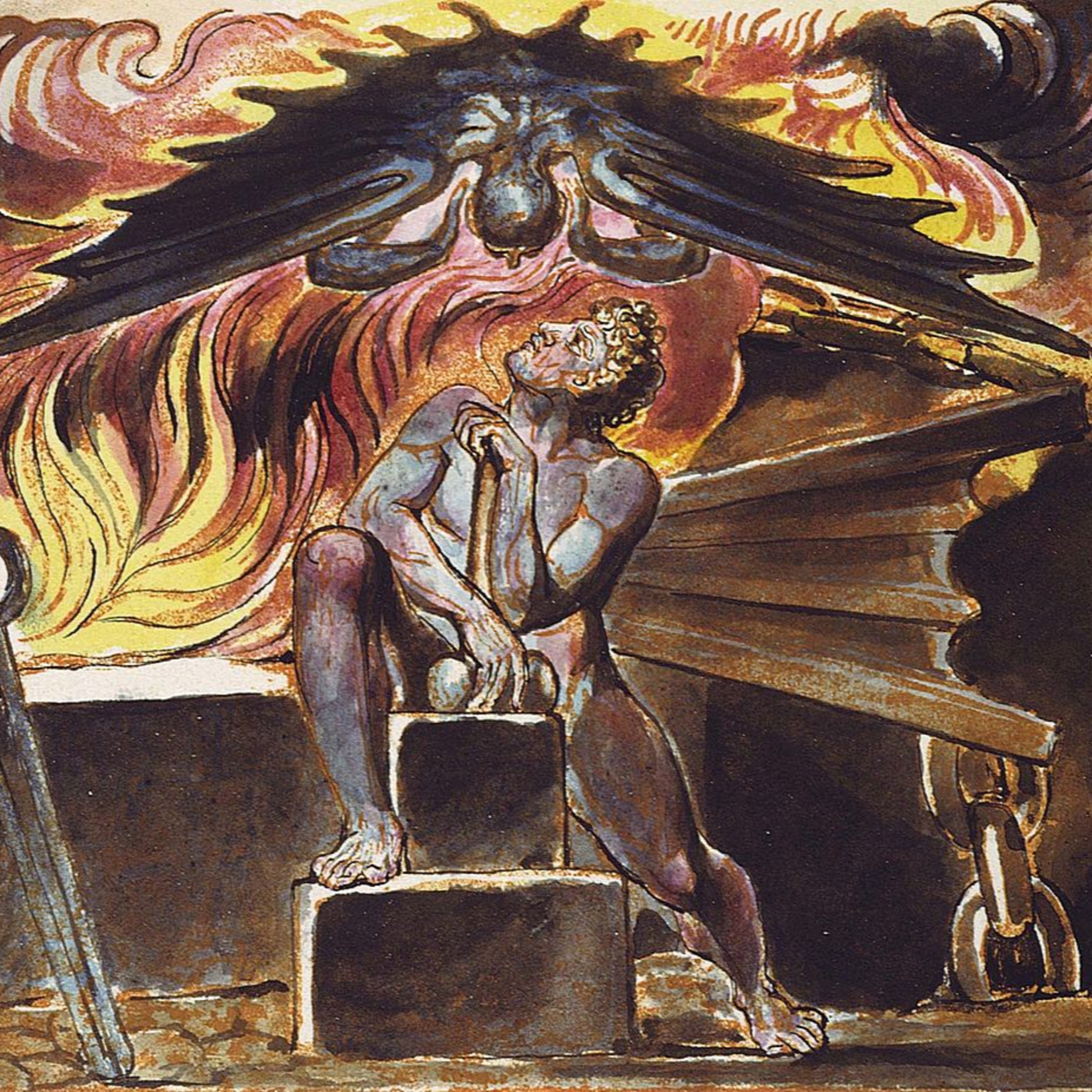
El texto explora la naturaleza y el origen de la creatividad, vinculándola inicialmente a la fantasía y al juego. Históricamente, se entendió como una fuerza divina en los mitos de la creación, que simbolizan el surgimiento del orden desde el caos, un proceso análogo al nacimiento de la conciencia desde el inconsciente. Psicológicamente, la creatividad está ligada al proceso de individuación de Jung, que requiere una dolorosa diferenciación de los demás y la integración de contenidos inconscientes para lograr la plenitud personal. Mitos como el de Prometeo (que roba el fuego) y el de la Caída bíblica ilustran que la ganancia de conciencia y creatividad conlleva un costo: el fin de un estado paradisíaco inconsciente. La creatividad emerge de la tensión entre opuestos, como lo expresa William Blake, y requiere una destrucción simbólica de lo viejo. El artista es presentado como un vehículo de un impulso creativo colectivo e impersonal, a menudo impulsado por un "daimon" interno, cuyo trabajo puede moldear la conciencia humana, aunque frecuentemente a un alto costo personal. La creación artística se manifiesta en modos psicológicos (basados en experiencias personales) y visionarios (que surgen de arquetipos colectivos), siendo este último el que verdaderamente expande los horizontes de la percepción humana.
Transcription
8311 Words, 49031 Characters
Not the artist alone, but every creative individual whatsoever owes all that is greater in his life to fantasy. The dynamic principle of fantasy is play, a characteristic also of the child, and as such it appears inconsistent with the principle of serious work. But without this playing with fantasy, no creative work has ever yet come to birth. The dead we owed to the play of imagination is incalculable. What does it mean to be creative? The work derives from the Latin "Greade", meaning to create, bring forth or give birth. Myths eternally recurring patterns that express fundamental truths about the human condition, portray creation as the activity of the gods who bring the world into existence, thus creativity was first understood as a divine generator force. The earliest recorded creation myths, such as those of the Sumerians, Babylonians, and Egyptians, converge on an archetypal motif. In the beginning only the primordial waters existed, symbolizing chaos out of which auto emerges, heaven and earth, the gods, and eventually humans. From undifferentiated potential arises differentiation and actuality. Psychologically, this mirrors the process by which the unconscious, often symbolized by water, gives birth to consciousness. The human psyche is the womb of all the arts and sciences. As Karl Jung writes, "I am indeed convinced that creative imagination is the only primordial phenomenon accessible to us, the real ground of the psyche, the only immediate reality." From the Renaissance onwards and especially during the Enlightenment, creativity came to be understood as a distinctly human capacity for imagination, innovation, and invention. At a deeper level, however, creativity involves bringing wants in a nature into being a task unique for each individual. In union psychology, this process is called individuation. The lifelong task of becoming fully oneself by bringing the contents of the unconscious up from their dark waters into the light of consciousness. Individuation, however, cannot occur without prior differentiation. One must become psychologically distinct from others, including one's loved wants, and avoid adopting another person's psyche, values, or identity in place of one's own. A common conflict arises when people try to tell others how to live, unaware that they are unconsciously projecting their own identity onto them. Naturally, there will be terrible resistances because no one can live someone else's life. In doing so, one violates not only the others' individuality, but also one's own. Rather than remaining unconsciously fused, one must establish a conscious relationship with others. This does not imply a withdrawal of love or care. On the contrary, fusion creates confusion, whereas separation makes genuine love possible. Each person must allow his or her own individuality to unfold, which is a painful process, for we are not only physically attached to those we love, but also psychologically bound to them. Letting go of these unconscious ties can bring loneliness, anxiety, and guilt, yet without this separation, psychological growth cannot occur. In the first half of life, differentiation dominates as we build a stable ego through interactions with family, friends, school, work, and relationships. In the second half of life, the psyche naturally turns inward, focusing on aligning the ego with itself, our whole personality. Failure to adapt to this shift often leads to a midlife crisis. Both differentiation and individuation continue throughout life, but one tends to dominate at each stage of life. One might say with a little exaggeration that life truly begins at midlife, until then we are just doing research. When the ego is not properly related to the self, neurosis arises as a state of inner division, and in extreme cases psychosis may result. Many people suffer from a profound disconnection from the psyche, or soul, the mythological and symbolic realm that enriches our life with meaning. To restore this meaning, we must reconnect with the self, which represents the potential for attaining our true nature by making the unconscious conscious. Though many seek wholeness, they theorize endlessly about the process, precisely to evade it. For we will do anything to avoid facing our worst enemy, ourselves. Life seems naturally oriented towards growth, like a seed that becomes a tree and bears fruit, we too seek to produce our own fruit, a symbol of our life's work. At the same time, there is a tremendous waste of potential, visible not only in the unlived life of humans, but also throughout nature and the animal world. The creative process is never without struggle, the act of creation is first of all an act of destruction. For new life to emerge, we must allow our old ideas, behaviors and attitudes that hinders from growth to be destroyed. This is a symbolic death and rebirth, a painful transformation that not many are willing to endure, but to refuse the sacrifice is to fall into stagnation and meaninglessness. Just as a snake must shed its skin to live, we too must undergo inner change. A person must pay dearly for the divine gift of creative fire. The ancient Greeks regarded inspiration as a form of divine madness, a gift from the gods. Through the aid of the musers, personifications of human creativity, humans may briefly enter the realm of the divine and obtain the creative fire, but this gift comes with a cost, those who trespass the limits of mortality to claim what belongs to the gods, must ultimately pay a price. Across the world, myths of tricksters and culture heroes, stealing fire, illustrate the dual nature of creativity. It can enlighten, but also brings suffering. The most popular figures that of Prometheus in Greek mythology. As Asiat recounts in Theogony, Prometheus deceived the gods, leading Zeus to withhold fire from humanity. Out of pity for mankind, Prometheus stole the fire back, and act for which he was condemned to eternal torment. In his wrath, Zeus sought to punish humanity as well, commanding her fastest to fashion the first woman from earth, who would bring misfortune to man. Asiat revisits the myth in works and days, framing Prometheus's theft of fire as the origin of human suffering. The first woman is introduced as Pandora, all gifts, who carries a jar containing countless plagues. Prometheus had warned his brother Epimetheus not to accept any gifts from Zeus, but Epimetheus ignored the warning and accepted Pandora. Out of curiosity, Pandora opened the jar, releasing sorrow, deceives and death, thereby ending the Golden Age. Only one thing remained within the jar. Hope. In Prometheus' bound, Prometheus' gifts mortals not only fire, but also hope, and bestows upon them the arch that shapes civilization, thereby expanding their knowledge. Before his intervention, humans are described as having eyes yet seeing nothing, having ears yet hearing no sound. They drifted like fleeting shapes in a dream, lost, confused, wandering through endless days. In myths, truths that occur internally are presented as though they were external events. Psychologically, the theft of fire can be seen as a symbol for the increase of consciousness, which may be described as the goal of human existence, to know oneself. Until we embark on this journey, we exist in a kind of limbo, drifting aimlessly, but the acquisition of such precious knowledge comes at a heavy cost. The end of the paradisical Golden Age. A similar truth appears in the myth of Adam and Eve. If we imagine being born in paradise and living there eternally, we would be like unconscious automatons, with little free will and no possibility for growth. By eating the forbidden fruit from the tree of the knowledge of good and evil, Adam and Eve's eyes were opened, symbolizing the dawn of human unconsciousness. However, they immediately felt ashamed and hit from God, who promptly expelled him from paradise, as they eat of the tree of life and become immortal, like the gods. In his book, The Courage to Create American Psychologist Rollo May considers the battle with the gods as a struggle with our own mortality. Creativity is a way of reaching for immortality. We know we must die, and each of us must find the courage to face death, but we also rebel against it, as Dylan Thomas wrote, "Do not go gentle into that good night. Rage, rage against the dying of the light." Creativity arises from this very struggle. Michael Angelo's riving unfinished statues of slaves, struggling in their prisons of stone, are a fitting symbol for our human condition. Every infant experiences a fall from paradise, a kind of archetypal maternal womb, or original wholeness, when leaving the comforting circle of the mother to develop an ego, yet without this fall, there would be neither consciousness nor creativity as we know them. Thus it can be seen as a happy fall, or fall upward, moving us from the stasis of the denic state to the fall richness of the human condition, where duality and the tension of opposites make growth possible. As Jung declared, "Only here in life and earth, where the opposites clash together, can the general level of consciousness be raced? That seems to be man's metaphysical task." In the marriage of heaven and hell, William Blake states that "without contraries is no progression, attraction and repulsion, reason and energy, love and hate, are necessary to human existence." From these contraries spring what the religious call "good and evil," "good is the passive that obeys reason," "evil is the active springing from energy," "good is heaven," "evil is hell." The marriage of these opposites suggests that by reconciling them, we can transcend duality and go beyond good and evil. This constitutes the true religious experience, through which we may return to paradise, but on a higher level of consciousness. This journey is depicted by Blake in songs of innocence and experience, where the individual falls from innocence into experience and seeks to grow out of the falling condition into higher innocence, a new Eden which transcends the original. Blake reverses the traditional view of hell as a place of punishment, instead portraying it as a realm of activity, desire and energy, writing that "energy is eternal delight." He walks among the fires of hell, delighted with the enjoyment of genius, which two angels look like torment and insanity. In contrast, heaven represents specificity, reason and conformity. Thus, we can distinguish between two types of individuals, the energetic creators, and the rational organizers, or the devils, and the angels. Psychologically, Blake's hell can be understood as the unconscious, the source of inner drives, impulses and creative urges, while heaven symbolizes the super-ego, the internalized social norms and rules taught by parents, institutions and role models. Both are necessary, problems arise when one dominates the other, such as acting out destructive impulses or succumbing to excessive conformity. Blake writes, "He who decides but acts not, reads pestilence." In other words, repressed contents become dangerous for they create neurosis and can erupt uncontrollably. By bringing unconscious psychic energy into consciousness, potentially the destructive impulses can be sublimated into constructive or creative expressions. In this way, fire becomes a symbol of the creative forces of the unconscious, the flames of inspiration, and perhaps even the means of salvation, for fire burns away everything that is superfluous, only the essential survives the fire. One of the central figures in Blake's mythology is Lus, who is frequently associated to the labors of a blacksmith in his forge, heating metal in the furnace and shaping it on the anvil with his hammer, a symbol of creative work. His ultimate task is to redeem his humanity from its fallen state, through the divine spark of imagination, restoring man's original vision of unity in a benevolent universe. Lus also takes the form of the bard, a redemptive agent who has transcended the realm of experience, having seen through the veil that conceals the benevolent unity of the universe, which for others appears flawed or evil. Having awakened, the bard sympathetically cries out to the masses of the earth, calling man to rise to his level of consciousness, suggesting that he too was once oblivious to such a vision. However, while all contain the capacity for this growth, not all achieve it, some remain in experience. The bard realises that his falling condition is not final but transformative, for without a prior fall, there can be no subsequent redemption. He also perceives time differently, past, present and future, exists simultaneously. This fusion of time belongs to eternity, and stands apart from the ordinary temporal condition of fallen humanity. It forms a vertical, timeless axis that intersects the horizontal flow of time at every moment, offering a still point within the ever-moving world. Through creative work, we may at times enter the eternal now, a realm beyond space and time, where self-consciousness fades, and we become fully immersed in the act of creation. This is the flow state. He who learns to live in the present is truly free from all worries, for tomorrow never comes. For Blake, our true nature comes from what he calls the poetic genius. He writes that the poetic genius is the true man, and that the body or outward form of man is derived from the poetic genius, likewise that the forms of all things are derived from their genius, which by the ancients was called an angel and spirit and demon. As all men are alike, though infinitely various, so all religions and as all similes have one source. The true man is the source. He being the poetic genius. The poetic genius is the creative spirit within us all, which is of divine origin. It is the aspect of the psyche that strives towards unity. The word poet comes from the Greek poien, meaning to make or bring forth, thus a poet is literally a maker or a creator. In Roman mythology, the genius was a personal guardian spirit, present at birth, shaping one's character and destiny. Though today, the term is usually used to describe someone of exceptional talent or ability. The ancient Greeks called this guiding spirit a diamond, and he who followed it could experience yudimonia, a state of good spirit and fulfillment. By attending to a true nature, we participate in the imaginative process, and in the creation of our own myth. In doing so, we follow the path of the poetic genius. This creative spirit is the source to underlying all art and myth. Blake's visionary work seeks to restore what the ancients call the golden age, not as a period in the past or future, but as the realization that God and man were one in paradise, and they still are, even though the illusions of the physical world often obscure this unity. The visionary perceives it directly, and the great works of art affirm it. Blake saw the artist task as helping humanity regain Eden, to leave behind that state of delusion that we are separate from our spiritual nature. Art is therefore prophetic, revealing the true pattern of human life. The artist must sacrifice himself to become the mouthpiece of the zeitgeist or spirit of the age. Modern art, for example, often shows alienation, anxiety or disorder, reflecting what is happening in society. In this way, the artist gives us a distant early warning of what is happening to our culture. The question is, can we decipher the meaning? James Joyce writes, "Welcome, old life. I go to encounter for the millionth time, the reality of experience, and to forge in the smithy of my soul, the uncreated conscience of my race." Every creative encounter is a new event. Each one demands an assertion of courage. The tasker's is adious as the blacksmith's labor of bending red hot iron in his forge to make something of value for human life. Conscience is not handed down ready-made, but is created through the inspiration of the artist, who seeks to express the inner voice rising from the depths of his being. And in doing so, contributes to the formation of the conscience of the race. This is no easy task. It is as difficult as forging in the smithy of one's own soul. Two forces are at war within the artist. On the one hand, the longing for happiness, satisfaction and security in life, and on the other, a ruthless passion for creation, which may go so far as to override every personal desire. The unborn work in the psyche of the artist is a force of nature, pushing itself into existence, sometimes with little regard for the individual who serves as its vehicle. The creative urge lives and grows in him like a tree in the earth, from which it grows its nourishment. Human rights, every creative person is a duality or a synthesis of contradictory qualities. On the one side, he is a human being with a personal life, while on the other side, he is an impersonal creative process. Art is a kind of innate drive that ceases a human being and makes him its instrument. The artist is not a person endowed with free will who seeks his own ends, but one who allows art to realize its purposes through him. As a human being, he may have moods and a will and personal aims, but as an artist, he is man in a higher sense, he is collective man, a vehicle and molder of the unconscious psychic life of mankind. That is his office, and it is sometimes so heavy a burden that he is fated to sacrifice happiness and everything that makes life worth living for the ordinary human being. If the lives of artists are often so unsatisfactory, if not tragic, it is either because of some personal inferiority or inability to adapt, or because they are compelled by forces beyond their control, which compelled them to create willy nilly. Human rights, I've had much trouble getting along with my ideas. There was a diamond in me, and in the end, its presence proved decisive. It overpowered me, and if I was at times ruthless, it was because I was in the grip of the diamond. I could never stop at anything once attained. I had to hasten on to catch up with my vision. A creative person has little power over his own life. He is not free, he is captive and driven by his diamond. The diamond of creativity has ruthlessly had its way with me. Creative power is stronger than its processor. The true artist is the one who enlarges human consciousness. This creativity is the most basic manifestation of an individual fulfilling his own being in the world. A work of art is something super personal. The work shapes itself. Thoughts and images arise that the artist never intended. Even so, he recognises that it is something within him speaking. His own inner nature, expressing what he could never say deliberately. Here, the artist feels subordinate to a power greater than himself and stands apart from the act of creation. However, not all works of art come into being in the same way. Some are created deliberately with the artist consciously shaping the material to express a specific intention. In these cases, the artist is fully identified with a creative process, and his will and skill are inseparable from the work itself. Young distinguishes between two modes of artistic creation, the psychological and the visionary. The psychological mode draws its material from the personal unconscious, crucial experiences, powerful emotions, suffering and passion, in short, the stuff of human fate. In the visionary mode, by contrast, the material is no longer familiar. It drives its existence from the hinterland of the human mind, as though it had emerged from the abyss of pre-human ages. These are the archetypes of the collective unconscious. Young gives the example of Gertrist Faust as an illustration of these two extremes. Part 1 belongs to the psychological mode, while Part 2 belongs to the visionary. In the psychological mode, we rarely question the meaning of the material. In the visionary mode, we are unsettled and searched for explanations. We are reminded of nothing in everyday life, but rather of dreams, nighttime fears and the dark, uncanny recesses of the human mind. Because of this, such works are often rejected by the public, yet works that are symbolic fascinators and grips us intently, because a symbol remains a perpetual challenge to our thoughts and feelings, as we are unable to un-riddle its meaning to our entire satisfaction. However, a work that is manifestly not symbolic appeals much more to our aesthetic sensibility, because it is complete in itself and fulfills its purpose. The visionary or archetypal art contain primordial images that are true symbols, that is, expressions for something real but unknown. When an archetypal or mythological situation emerges, it hits us with intense emotion, transporting us far above the challenges of everyday life. At such moments, we aren't no longer individuals, but the race, the voice of all mankind restounds in us. Formation, transformation, eternal minds, eternal recreation. The visionary artist transforms personal experience into the shared destiny of humanity, turning the everyday into the eternal, and awakening the forces that have from time to time, enabled us to find refuge from every peril and to endure the darkest times. What is essential in a work of art is that it should rise far above the realm of personal life, and speak from the spirit and heart of the poet, as man to the spirit and heart of mankind. This is the secret of great art. The creative process activates an archetypal image in the unconscious, which the artist shapes into a work that speaks to the present. By drawing a primordial image up from the unconscious and transforming it into a form the present can accept, the artist compensates for the one-sidedness of the age. In this way, art becomes a process of self-regulation in the life of individuals, nations, and epochs. We tend to assume that strange archetypal visions come from deeply personal experiences, as if the artists were hiding their source. This easily leads to the idea that such art is pathological or neurotic, especially since visionary material can resemble the fantasies of the mentally ill. Yet, at the same time, psychotic works often contain a depth of meaning, usually found only in the creations of a genius. Reducing a vision to a personal experience makes it seem unreal and inauthentic, turning it into a mere symptom rather than a true creation. The chaos is reduced to a psychological disturbance, which reassures us and we turn back to our picture of a well-ordered cosmos. The truth is that it deflects our attention from the psychology of the work of art and focuses it on the psychology of the artist. While the artist's psychology matters, the work of art exists in its own right, as an autonomous complex, and cannot be dismissed as just a personal association. At times, we must even defend the seriousness of the visionary experience against the artist's personal resistance to it. Artists who have fallen out of fashion often rediscovered when our consciousness has evolved enough to understand them in a new way. Their meaning was always in the work, hidden in symbols, but only a renewal of the spirit of the age allows us to perceive it. Fresh eyes are needed because the old ones could see only what they were used to seeing. In the way of the dream, Union analyst Marie-Louise von France recounts the case of one of her patients. A painter specialises in highly accurate and realistic portrait paintings, and who strongly rejected what he called "modern art", which he saw as destructive and senseless. Night after night, he dreamt that he had to abandon his habitual style and begin painting inner abstract realities. Whereas he had always worked in dark colours, the dreams existed that he painted in bright ones. At the same time, he had, among others, one very disagreeable physical symptom, he was impotent. But as soon as he began to obey the dreams, his physical symptoms, including his impotence, disappeared. He was cured by completely changing his artistic style. He did not have to change his vocation. He only had to change his style. People who wish to start a creative endeavour often encounter an inner critic that insists that they are not good enough or that they will never improve. This voice can be paralyzing, leading many to give up before they even start, or to live vicariously through the creations of others. As a result, one may spend years, sometimes a lifetime haunted by self-doubt. This inner critic is a manifestation of the shadow, containing one's repressed aspects, rather than escaping from its criticism, one must listen to it and acknowledge it. What we resist persists. What we embrace transforms. The act of creation is not about making something completely new out of nothing, but the act of setting free and expressing the potential that already exists within us. By taking what inspires us and shaping it in our own way, filling it with our personal experiences, our latent potential is brought into actuality, which leads to the formation of our own myth. What is your myth? It is your role on the world stage. Through it, nature expresses herself in you, and as your consciousness grows, it contributes to the evolution of human consciousness, of nature and of God. Therefore, one should follow the path that nature has carved. Another obstacle in creative work lies in creating merely to please others, or to meet aesthetic expectations, without the work having any personal meaning. This is pseudo-creativity. It is a game in which the persona or social mask is being mistaken for the true self. Without engaging with one's personal life, there can be no authentic encounter with reality, leading to neurosis. Jung writes, "Nerosis does not produce art. It is uncreative and inimical to life. It is failure and bungling, but the moderns mistake morbidity for creative birth, part of the general lunacy of out time." Those who rely on their creativity to earn a living face a harsh reality, they often have to set aside what is personally meaningful, in favor of work that is less fulfilling, but popular and socially approved. At times, they have no choice but to sacrifice their own desires, simply to make a living and survive. Moreover, one predictable and prolonged uncertainty leads to despair, at times one feels abandoned by the musers and unable to work. Society adds to the burden, often judging those who do not earn a living in conventional ways as lazy or worthless. Over time, this pressure leads to isolation and a decline in mental health. The artist, like any human being, needs the support of others. The substance of a creative work does not come from the artist, but from the unseen forces that inspire it. The task of the creative individual is to awaken and give shape to what is already present in silence. Chinese writer Lujie writes, "We, poets, struggle with non-being to force it to yield being. We knock upon silence for an answering music." The being which the poem is to contain derives from non-being, not from the poet, and the music it is to own comes not from us who make the poem, but from the silence comes an answer to our knock. The poet's labours to struggle with the meaninglessness and silence of the world until he can force it to mean, until he can make the silence answer and the non-being be. Creative people are distinguished by their ability to live with anxiety, even though a high price may be paid in terms of insecurity, sensitivity, and vulnerability for the gift of creative fire. They do not run away from non-being, but by encountering and wrestling with it, forced it to produce being. They pursue meaninglessness until they can force it to mean. The true artist puts something of his own personal life experience onto the page, whether good or bad. Something that has moved him and carries meaning. This is authentic creativity. The unconscious does not care as much as what we come up with aesthetically, as our intention behind what we do, what the unconscious appreciates, is our attempt to bring its contents into the light of consciousness. Art is not just about attaining unrealistic aesthetic perfection. There's beauty and imperfection. In Japanese culture, Wabisabi sees imperfection as a form of art. It kind of flawed beauty, recognizing that nothing is perfect. This is wholeness, an acceptance of the full spectrum of the human condition. Creative people are archetypal wanderers, navigating through the unconscious to bring its contents into consciousness. At times they may follow this process without difficulty, but eventually they encounter creative blocks, periods when new ideas or work seems impossible. These blocks can arise from overthinking, perfectionism, self-doubt, fear of failure, burnout, or pressure from deadlines and expectations. Justice Land must lie fallow to become fertile again, so too must we pass through a period of rest and barrenness. We are so accustomed to doing that we have forgotten the art of simply being. Not one can mind all year. I find enough joy every day in my heart, and after a meal and a pot of strong tea, I sit on a rug by a pond and count fish, quiet on troubled days, nothing to do, or change. With 36,000 days, why not spend a few staying still? Time makes us uneasy, for we regard it as our enemy in our seduable striving for progress, fearing the changes it brings and the death that awaits us all. So we find ways to kill time, but if we distract ourselves every time we feel even slightly bored, we make it harder to find meaning and stunt our creativity. It often happens that during idle moments, ideas simply come to us. We do not have ideas, ideas have us. Inspiration can come in a sudden flash, completely absorbing us. This state of being carried away describes both the creative person and someone fully engaged in play. We say a thought pops up, an idea comes out of the blue, or it suddenly hit me, or describe the same thing, ideas rising from the unconscious into awareness. When the creative spirit is absent, yet the desire to create remains, the artist may become deeply frustrated, blame himself and sink into despair, sometimes unable to create for weeks, months or even years. But creativity must grow at its own pace, to force the ego's desires upon a natural process, is like planting a seed and washing it obsessively, whispering, "Grow, grow, grow." Only to become frustrated when it does not. Great things take time to mature. Creativity demands both patience and passion, which share the same etymological root, butti, meaning to endure, to suffer, or to undergo. The creative spirit is far more likely to respond when we prepare for it, rather than blaming ourselves and daydreaming about endless could have would have should have scenarios. Such behavior acts as a defense mechanism, it is tempting because it relieves us of responsibility, projecting it onto some imagined other, who we believe for reasons unknown, refuses to help us. What we fail to realize is that this others are unable to help, precisely because we do not allow it to express itself. In this way, we escape from the growing anxiety that comes from taking responsibility for our own lives. Yet, ultimately, it is we who must decide to bring our creative life into being. Roll or May writes, "But let it be said immediately that unconscious insights or answers to problems that come in reverie do not come hit or miss. They may indeed occur at times of relaxation, or in fantasy, or at other times when we alternate play with work. But what is entirely clear is that they pertain to those areas in which the person consciously has worked laboriously and with dedication. We cannot will to have insights, we cannot will creativity, but we can will to give ourselves to the encounter with the intensity of dedication and commitment. The deeper aspects of awareness are activated to the extent that the person is committed to the encounter. The encounter does not happen merely because we have changed subjectively. It represents rather a real relationship with the objective world. Genuine creativity is characterized by heightened consciousness. The artist experiences joy in contrast to fleeting happiness. Joy is the emotion that goes with heightened consciousness, the mood that accompanies the experience of actualising one's own potentialities. Courage is not the absence of despair, but rather the capacity to move ahead in spite of despair. If you do not express your own ideas coming from yourself, if you do not listen to your own being, you will have betrayed yourself. Creativity takes great courage because an active battle with a god is occurring. We must always base our commitment in the centre of our own being, or else no commitment will be ultimately authentic. The emptiness within corresponds to an apathy without, and apathy adds up in the long run to cowardice. Creativity must arise from your innermost self, not from fulfilling the expectations of others. You must follow your own path. A common regret expressed by those close to death is not having had the courage to live a life true to themselves, instead they lived a life others expected of them. Moreover, they often speak not of deep regret over what they did, but over what they failed to do. Dreams left un-pursued and potential unrealised. This is the unlived life. One of the most destructive things psychologically is unused creative power. If someone has a creative gift and, for some reason, fear, laziness or conformity, does not use it. The psychic energy turns inward and becomes poisonous. That is why we often see neuroses or psychoses as expressions of not lived possibilities. After Jung's paranormal experience in 1916, when the dead appeared to him and told him, "We have come back from Jerusalem where we found not what we sought." He wrote the seven servants of the dead, after which they vanished. He later remarked, "From that time on, the dead have become ever more distinct for me as the voices of the unanswered, unresolved and unredeemed." Jung writes, "Perhaps there is, after all, something to the idea that one chooses one's life before birth. In this case, there would be a connection between previous fantasies and a specific life. You may harbor a yearning for something during your life and have fantasies about the unlived aspect right up until you die. People often regret not having done something or other. If there were a continuation, according to the laws of the psyche, and impulse would arise to realize these compensatory fantasies. In order to bring creativity forth, one must understand oneself, and the meaning and purpose of one's life. But to seek one's true vocation is like entering a forest, where it is darkest and no path is visible. Authenticity requires uncertainty. In the midst of such uncertainty, one may feel a hunch to do a particular thing, yet be unable to explain it rationally, not even to oneself, let alone others. Nevertheless, one feels compelled to follow it, for it may manifest as a visual feeling accompanied by strong emotion. Intuition is a non-rational faculty. As a result, one is often seen as a fool or madman, for not only does one go against social expectations, but one is also unable to fully articulate why. This can create self-doubt, and eventually one may give in and do what others believe is best. The great decisions of human life have as a rule far more to do with the instincts and other mysterious unconscious factors, than with conscious will and well-meaning reasonableness. The shoe that fits one person pinches another, there is no recipe for living that suits all cases. Many of the difficulties we experience in life have the roots in childhood. Every child is creative, but the challenge is remaining creative as we grow up. For those who endured a difficult upbringing, the wounded child does not vanish, it carries on into adulthood, often causing struggles. What are the earliest memories you have of your life? What is the earliest dream you can recall? There is a reason why they became imprinted in your mind. They have affected or shaped you in some way. We often assume that we know little of our childhood, but suddenly a particular smell, image or moment triggers a long forgotten memory, bringing with it a profound sense of nostalgia. Such memories do not disappear, they lie below the threshold of consciousness and can emerge at any moment. Unacknowledged patterns often pass down the family line, which makes it equally important to understand our parents and ancestors. For in doing so, we come to understand ourselves. Jung confessed that a decisive fact in choosing his path was the knowledge that if he did not respond fully to his life's purpose and challenges, then they would be inherited by his children, who would have to bear the burden of his unlived life in addition to their own difficulties. We must examine the cards we have been dealt in life and the peculiarities of our upbringing. For example, someone may have been in voluntarily isolated from society for years, and the card life has dealt is that of the hermit. Rather than regarding this as a misfortune, it can be understood as a constellation of an archetype, of which the person has become a living embodiment. Such a person may possess a rich inner life, yet struggle to adapt to the outer world, which is just as essential. The point is not to speculate on how things could have been different, but to accept them as they are, then life will flow well. Otherwise, we suffer more in imagination than in reality. It is like placing heavy stones to block the natural flow of the river. Thus, the secret of life seems to be to accept it as it is. Paradoxically, the more we think about the meaning of our life, the more we fail to live life fully. Towards the end of his life, Jung wrote, "Much might have been different if I myself had been different, but it was as it had to be, for all came about because I am as I am. I know only that I was born and exist, and it seems to me that I've been carried along. I exist on the foundation of something I do not know. In spite of all uncertainties, I feel a solidity underlying all existence, and they continuity in my mode of being. Most of the time when people say that life has no meaning, it is because they feel their own life lacks meaning, and unconsciously project this emptiness into the world, constructing a philosophy out of their wound itself. It is not about finding the meaning of life in general, but one's own subjective meaning. For this, it is essential to rely on intuition, emotion, dreams, and visions. One should treat one's fantasies as just as important and real as so-called real life." Jung writes, "The best way of dealing with a young conscious is the creative way. Create for instance a fantasy. Work it out with all the means that you are disposal. Work it out as if you were it or in it, as you would work out a real situation in life which you cannot escape. All the difficulties you overcome in such a fantasy are symbolic expressions of psychological difficulties in yourself, and inasmuch as you overcome them in your imagination, you also overcome them in your psyche." For Jung, one of the most powerful means of accessing unconscious material is what he calls active imagination, a technique that involves visualizing various spontaneous scenes and engaging in dialogue with different aspects of yourself while fully awake. By dealing with the struggles that arise in your fantasies, the issues that would have been presented in dreams are confronted and worked out. In this way, dreams become more focused and concentrated and less repetitive. The key lies in the active component. One must write down the session to prevent it from becoming mere passive fantasy. Though it demands deep concentration and solitude, active imagination is among the most effective methods for creative work and for the formation of one's personal myth. However, some people are not psychologically prepared for such a task and may become too absorbed in the flow of images, temporarily losing touch with the ordinary world, for this reason one should be cautious. During his confrontation with the unconscious, Jung knew he had to plunge fully into his fantasies. He needed to gain power over them, before he realized that if he did not do so, they might gain power over him. Moreover, he could not expect of his patience what he was not willing to do himself. He writes, "To the extent that I managed to translate the emotions into images, that is to say, to find the images which were concealed in the emotions, I was inwardly calmed and reassured. Had I left those images hidden in the emotions, I might have been torn to pieces by them." The unconscious can lead to creation or destruction. The more grounded one is, the better one is prepared to delve into the unconscious. As is often the case, one needs balance. Some are too lofty, immersing themselves in the unconscious and becoming possessed by it, while others are too grounded, denying its existence, and yet still falling under its influence. Nietzsche, who proclaimed himself the hermit of Sils Maria, wrote in a draft of his final work, "Egg gay or more. I am solitude become man." Lacking a firm anchor in the outer world, he possessed nothing more than the inner world of his thoughts, which interestingly possessed him more than he it. He succumbed to irreality, the quintessence of horror, and suffered a mental breakdown. Jung writes, "Particularly at this time, when I was working on the fantasies, I needed a point of support in this world, and I may say that my family and my professional work were that to me. It was most essential for me to have a normal life in the real world, as a counterpoise to that strange inner world. The unconscious contents could have driven me out of my wits." Only by attending to everyday duties can one gain a sense of sanity and liberation, which opens the door to a creative mood. Equally senseless the presence of others, individuation occurs through relationships, not complete isolation. von Franck states, "We're now discovering that the dream world is the most beneficent thing on earth, and that attending to one's dreams is the healthiest thing one can do." But the dream world can also devour a person by way of daydreaming, spinning neurotic fantasies, or chasing unrealistic ideas. You only have to go into a lunatic asylum to see the victims of the dream world. The dream world is beneficent and healing only if we have a dialogue with it, but at the same time remain in actual life. We must not forget living. The duties of real living must not be neglected. We call that dangerous aspect of the dream world, the devouring unconscious, or the devouring mother. It can suck us away from reality, and spin us into neurotic or even psychotic unreality. solidifying one's fantasies can make a big difference, whether through writing, music, painting, ceramics, or other creative forms. Otherwise they remain vague and float aimlessly in the unconscious. Even if their meaning is unclear, paying attention to your inner contents influences the unconscious, which may respond with a dream. The dream is the voice of nature or the voice of the instinct. Sometimes your inner world appears to have a correspondence in the outer world, which are called synchronicities or meaningful coincidences. These events are acts of creation in time that are somehow linked to your personal development. It is as though the universe itself acknowledges your effort towards self-realization. Our conscious attitude is crucial. Those who refuse to pay attention to the unconscious are influenced by it nonetheless, albeit in a negative way. In both cases one may suffer, but in one case one suffers authentically and grows, while in the other one suffers neuratically and remains stagnant or withers away. One unites the other splits, life leads to the willing and drags long the unwilling. It makes a difference whether we say yes to our fate and fulfil it positively, or say no and are dragged by it against our will. The self or God image wants to become conscious through us, God wants to incarnate in us, and called or not, God will be present. If you bring forth what is within you, what you bring forth will save you. If you do not bring forth what is within you, what you do not bring forth will destroy you. To speak of suffering is very different from actually experiencing it. One cannot merely intellectualize it and say suffering is indispensable for growth and ultimately good for me. No, when you suffer it fills your whole being. You want it to end, and when it does not, you struggle and fight against it, then you grow. Young writes, "Now and then it happened in my practice that a patient grew beyond himself because of unknown potentialities, and this became an experience of prime importance to me. In the meantime, I'd learn that all the greatest and most important problems of life are fundamentally insoluble. They must be so, for they express the necessary polarity inherent in every self-regulating system. They can never be solved, but only outgrown. It is helpful to view life's trials not as misfortunes that cause meaningless suffering, but as lessons life teaches you. Whether this is objectively true or not is beside the point, what matters is whether this perspective allows one to move from being a passive victim to an active agent in one's own life. If it grants renewed energy to face challenges and the courage to confront them, let it be so, and if one cannot accept him as fortune because it feels absurd or unjust, let that be so as well. One must follow once inner convictions. And illness, whether physical, psychological or spiritual, may take everything we once considered valuable, most respond with despair. Yet, few consider that perhaps it is nature's way of re-educating the person. As though the illness were nature's way of saying, "You must become whole. Only then will you be well." Those who view illness as an opportunity for re-education often emerge healthier and more fulfilled than before. Perhaps God uses such trials to open our eyes, to show us a deeper truth beyond the fleeting things of this world. Austrian psychiatrists Victor Frankl writes, "We must never forget that we may also find meaning in life even when confronted with a hopeless situation, when facing a fate that cannot be changed, for what then matters is to bear witness to the uniquely human potential at its best, which is to transform a personal tragedy into a triumph. When we are no longer able to change a situation, just think of an incurable disease, such as inoperable cancer, we are challenged to change ourselves." It is the meaning of life that keeps us alive against even the most unfavorable conditions. If one continues to suffer and consciously accepts this suffering and understands that one is doing something for the eternal in oneself, then one has made a conscious realization that is essential. Consciously lived suffering seems to have a redeeming effect on the past and on the future of humanity's collective consciousness. Von Franz recounts being consulted by a woman who had a schizophrenic episode and was in a state of profound despair. The woman said to her, "What is the meaning of my life? I am ruined. Even the medication isn't helping me anymore. What meaning can you give to my life?" Von Franz replied, "You are suffering for God." The woman immediately understood and responded, "Thank you. Now I can live." Three weeks before his death, Jung wrote, "Nothing can be created without indebtedness, and only one who bears the cost can create. The person without indebtedness who renounces the world and refuses to pay life's dues does not achieve individuation because a dark guard would find no place in him." Creation always comes at a cost, a sacrifice that brings about suffering, growth requires enduring inner conflict and moral burden. Without confrontation, there is no transformation and hence no individuation. As Jung explores in answer to Job, it is the guilty and burdened individual, not the guiltless one who avoids large demands, who is best suited to carry the continuing incarnation of God. In someone who seeks only light, the dark guard would find no room. The encounter between conscious and unconscious demands that the light not only illuminates the darkness, but also understands it. Only if we wrestle with reconciling these opposites in our own unique way, can we become a whole and allow God to incarnate in us, not as pure light, but as the union of light and darkness on a higher level of consciousness. In this way, we contribute to the collective consciousness of humanity, nature and God. This may be described as the supreme creative act. [BLANK_AUDIO]
Podcast Summary
Key Points:
La creatividad se origina en la fantasía y el juego, siendo esencial para cualquier trabajo creativo, y fue entendida históricamente como una fuerza divina antes de ser considerada una capacidad humana.
El proceso psicológico de la individuación, descrito por Jung, implica diferenciarse de los demás y hacer consciente lo inconsciente para alcanzar la plenitud personal, un proceso doloroso pero necesario para el crecimiento.
Mitos como los de Prometeo y Adán y Eva simbolizan el costo del conocimiento y la conciencia: la pérdida de un estado paradisíaco inconsciente a cambio del potencial para el crecimiento y la creatividad.
La creatividad surge de la tensión entre opuestos (como razón y energía, cielo e infierno) y requiere un "sacrificio" o destrucción de lo viejo para dar paso a lo nuevo, simbolizado por el fuego.
El artista actúa como un instrumento de un impulso creativo impersonal y colectivo, a menudo a expensas de su felicidad personal, y su trabajo puede ampliar la conciencia humana.
Summary:
El texto explora la naturaleza y el origen de la creatividad, vinculándola inicialmente a la fantasía y al juego. Históricamente, se entendió como una fuerza divina en los mitos de la creación, que simbolizan el surgimiento del orden desde el caos, un proceso análogo al nacimiento de la conciencia desde el inconsciente. Psicológicamente, la creatividad está ligada al proceso de individuación de Jung, que requiere una dolorosa diferenciación de los demás y la integración de contenidos inconscientes para lograr la plenitud personal.
Mitos como el de Prometeo (que roba el fuego) y el de la Caída bíblica ilustran que la ganancia de conciencia y creatividad conlleva un costo: el fin de un estado paradisíaco inconsciente. La creatividad emerge de la tensión entre opuestos, como lo expresa William Blake, y requiere una destrucción simbólica de lo viejo. El artista es presentado como un vehículo de un impulso creativo colectivo e impersonal, a menudo impulsado por un "daimon" interno, cuyo trabajo puede moldear la conciencia humana, aunque frecuentemente a un alto costo personal.
La creación artística se manifiesta en modos psicológicos (basados en experiencias personales) y visionarios (que surgen de arquetipos colectivos), siendo este último el que verdaderamente expande los horizontes de la percepción humana.
FAQs
Every creative individual owes the greater aspects of their life to fantasy, whose dynamic principle is play. Without playing with fantasy, no creative work can come to birth, as it is the essential ground for imagination.
Ancient myths, like those of Sumerians and Egyptians, portrayed creativity as a divine generative force, where gods brought the world into existence from primordial chaos. This symbolizes the psychological process of the unconscious giving birth to consciousness.
Individuation is the lifelong process of becoming fully oneself by bringing unconscious contents into consciousness. It requires prior psychological differentiation from others, including loved ones, to avoid projecting one's identity onto them.
The myth of Prometheus stealing fire symbolizes the increase of consciousness, which is the goal of human existence—to know oneself. However, this precious knowledge comes at the cost of ending a paradisiacal state, as seen in both Prometheus and Adam and Eve stories.
Blake states that without contraries like attraction/repulsion or reason/energy, there is no progression. The marriage of these opposites allows us to transcend duality and achieve a higher consciousness, where hell represents energy and creativity, while heaven symbolizes reason and conformity.
The poetic genius is the creative spirit within all humans, of divine origin, and is the true source of our nature. It strives toward unity and is what the ancients called an angel, spirit, or demon, guiding us to create and fulfill our destiny.
Chat with AI
Loading...
Pro features
Go deeper with this episode
Unlock creator-grade tools that turn any transcript into show notes and subtitle files.
 PodcastTranscript AI