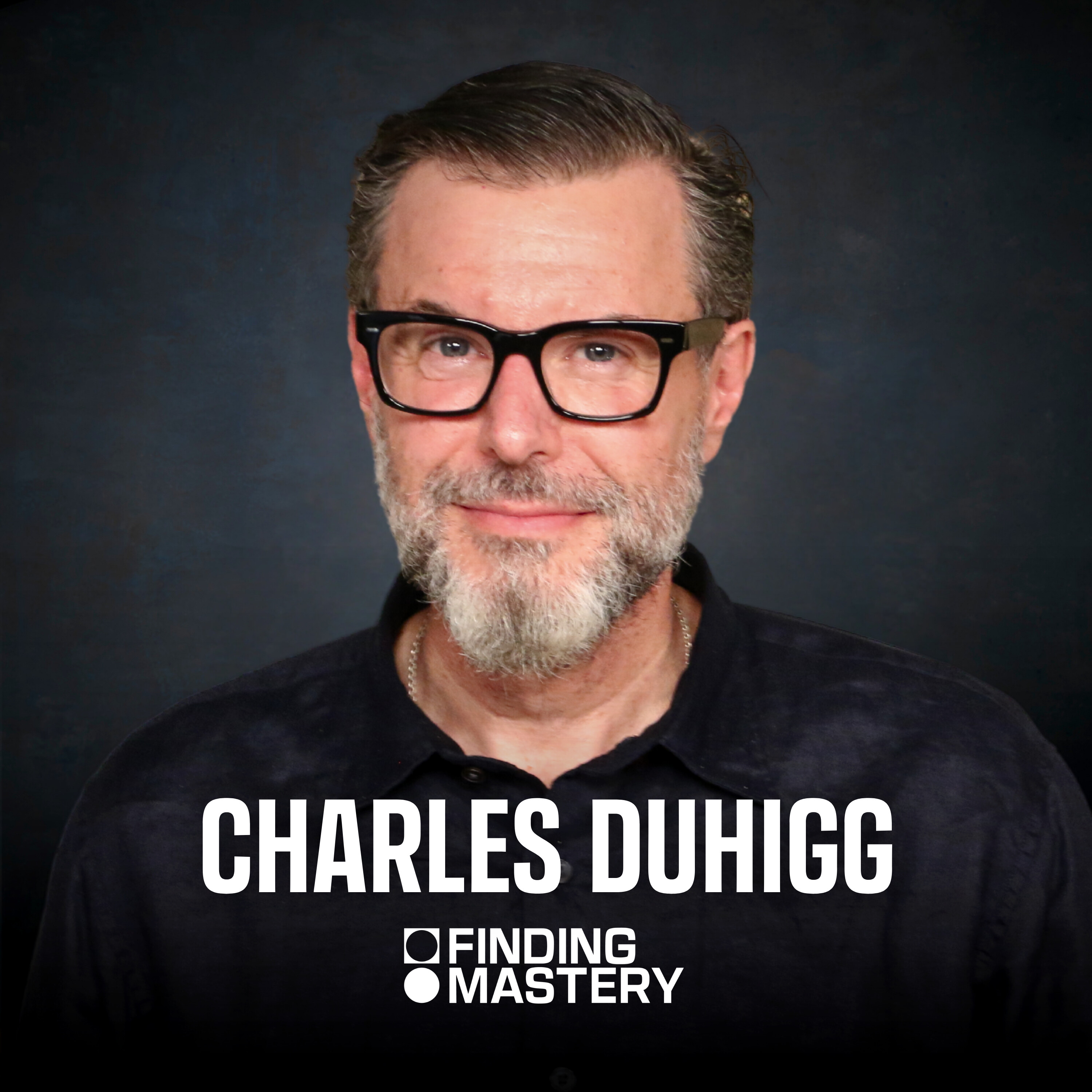
The Psychology of Being a Super Communicator | Charles Duhigg
51m 30s
The core insight from the conversation is that people don’t remember specific details of conversations—they remember how they felt during them. This reveals that emotional connection is far more important than factual information. As AI makes practical communication more polished and efficient, the human ability to detect emotions, show empathy, and respond with genuine presence becomes even more critical. Charles Duhig’s framework identifies three key conversation types: practical (problem-solving), emotional (shared feelings), and social (identity and relationships). True connection occurs when both people are in the same mindset—what he calls the "matching principle." Super communicators aren’t born with a gift; they are trained to listen deeply, ask open-ended questions, and recognize emotional cues like body language or tone. The most powerful questions—such as "Why is this important to you?"—shift conversations from debate to mutual understanding, fostering empathy even in disagreement. This is especially vital in high-stakes settings like politics or family conflict, where people often fail to connect because they’re focused on winning rather than listening. The message is clear: to build lasting relationships, we must prioritize emotional attunement, vulnerability, and active listening—skills that are not only accessible but essential in a world increasingly dominated by automation. These principles apply across personal, professional, and political spheres, proving that connection is the true goal of human communication.
Nobody remembers what you say, they remember how you made them feel.
Why does so many conversations break down, even when both people are trying to connect?
If you look at the research on communication and you ask people,
what did you guys talk about in that hour-long conversation you had?
People on average won't remember anything specific that was said.
But if you ask them, "How did you feel throughout that conversation?"
They'll be able to say, "Oh, at the beginning, I felt like really good."
And then we talked about this one thing, and I started feeling really bad about myself.
Welcome back, or welcome to the Finding Mastery podcast,
where we dive into the minds of the world's greatest thinkers and doers.
I'm your host, Dr. Michael Jervé.
A high-performance psychologist named Michael Jervé.
Who Pete Carroll brought in to work with the Seahawks?
Same as for his work with Felix Baumgartner when he jumped out of space in the Stratoes project.
Olympic athletes depend on something more than just training and talent.
They have to stay mentally tough.
Today's conversation is with Charles Duhig,
Pulitzer Prize-winning journalist and best-selling author of The Power of Habit,
and Supercommunicators. So what's important is to have the same kind of conversation at the same
moment. It's known as the matching principle, that when you and I are in the same mindset,
as long as we are aligned, then we can move from conversation to conversation together,
and we feel connected. This is Charles's third time on the podcast,
because the world has shifted since last we spoke.
We're at the Thanksgiving table.
Politics comes up. I'm going to prove to you that I want to understand how you see the world.
I'm going to say the rise of AI has quietly eroded the signals that we previously use
to read each other. Now every email can be really well written.
And so these soft skills that we have as humans,
the ability to transmit emotions, to be emotionally contagious,
to detect insensarity. Those are becoming even more valuable now because the practicals
got easier. So with that, let's jump into this week's conversation with Charles Duhig.
Charles, this is the third time that we don't have many people that come on three times to
the podcast. And so this is the third time that you're here and the first time that we've met in
person. Yeah. Well, it's a it's a huge honor. I feel like I would rather be on this show three
times than on Saturday and live three times. That's not true. Saturday and live would be a lot of fun.
Well, we've got something to live up to. Exactly. Exactly. Yeah. Cool.
You're exceptional as a storyteller, as a writer. I mean, you've had huge success on those fronts.
The last time you're here, we talked about your book, which I think is still your newest book.
Yeah. Right. So there's no new book that I've missed here.
Right. Super communicators. Super communicators. Yeah.
And when we spoke, I was like, oh, the perfect timing. It's like 2024, super communicators.
Okay, let's be great. Let's understand the science, the application of it. What's changed?
Your experiences. The world has changed. How are you thinking about super communicating differently?
Well, I think one of the things that comes up a lot when I'm talking to people about the book
and about how to use the book is there wasn't a chapter on AI because generative AI really didn't
exist at that point when I was writing it. And now, of course, we live in a in a chat GPT and
in Claude world. But what's interesting is that I was talking to someone actually someone at
Microsoft the other day and she was saying that the drawback of generative AI is that it used to be
when someone sent you an email and it was really well written. That was a signal. It was a signal that
they had thought about it that they had spent some time on it that they're pretty smart.
And as a result, what's happened is that a lot of the
signals, not just in emails, but in all kinds of things around language, a lot of the signals
are no longer functioning as well as they can. Right? We've lost to where a fluency and a polish
meant something because that fluency and that polish can be artificially manufactured now.
Absolutely. I think everyone in our community knows exactly that. Like, emails coming through now,
you can't tell if somebody took a lot of time, a little bit of time. But on that on that point,
it's almost like, let's go back to 2024, 2014, whatever. There's an artificial nature to that
signal. That's exactly right. Okay. So here's the thing that I think it's not so much that it's
changed as much as it become more true, which is in the book, we talk about the practical conversation,
the emotional conversation, the social conversation. Let's come back to that and we open those up.
Yeah. Okay. But the practical AI is really good at the practical conversation, right? AI can give
you instructions on how to do something. But the emotional conversation and the social conversation,
those are as important. If not more important, an AI isn't good at that. You're exactly right. I can
read a beautiful, worded email that actually even has some poetry to it that's written by AI.
But I can tell when it's AI and when it's real person. Okay. So actually, I was doing something
a little differently. Okay. I'm agreeing with you. What I was pointing to is like, let's go back
to 2014 before we knew about AI is that email is a signal of a thoughtful, smart person. But I'm
saying, wait, hold on. Maybe, maybe not because it's not an honest signal. It is a signal. So honest
signals, quote unquote, honest signals. And that's an actual thing is when somebody gives you a
tell that they can't hide. Right. And like people dilation, like a reflexive sweating in an uncomfortable
situation or heart palpitation or hives crawling up the neck. Like there's quote unquote honest
signals, those four people that are exceptionally aware and tuned are incredible bits of information.
But on an email, I don't know how long you took to craft it. I don't know if you asked your,
you know, neighbor, you know, to help you craft it. So there's, there's a proxy in here somewhere.
That's where I was going. Yeah. And I think that's right. I mean, I think what you're getting at
is the different channels of communication have different densities, right? And when we're talking
face to face those honest signals, I can pick up on a lot of them because I have so much information.
I get to see where your eyes are going. I get to hear your tone of voice. I get to see your
expressions on an email. I still have some channels of information available to me, but it's less.
And so as a result, what I think was happening back in 2014 and is happening even more now is
we are starting to lean into the other forms of information in a much more serious way. For example,
for example, if somebody sends me an email and it's just effusive with praise, you wrote the
best book ever. I read it and it changed my life. There's a part of my brain that's saying this
seems like it might be AI generated, right? This seems like it might be something that like is a
form letter that maybe it's not AI generated, but maybe sending that saying that to everyone.
But then if it says something not only unique to me, I liked this about the power of habit
or super communicators, but more importantly, something that seems emotionally true,
something that seems emotionally real, that's the signal I pay attention to now.
And so these soft skills that we have as humans, the ability to transmit emotions,
to be emotionally contagious, to detect insincerity, those are becoming even more valuable now
because the practical has gotten easier. There you go. So you're still supporting your framework,
practical social and emotional. A little bit. Yeah. Okay. Yeah. And just to reiterate the
obvious of what you've said is that AI is exceptionally skilled at practical communication. Yep.
Right? So that mindset of like, let me just hit the kind of thing and it tries with some emotion
bit, but it's not very good at it. Right. Is what your point is. And as humans,
there's three approaches to be great communicators. There's a practical communication style. There's
the emotional and there's the social. And we'll do all three of them. Right. So in a real
conversation like this conversation, we will move from a practical conversation to an emotional
conversation and to a social conversation and then back to a practical conversation together.
And that's the key is that if we're having different kinds of conversations, if you're telling me
about something emotional that happened with you and your family and I say, oh, here's how you
want to solve that. Here's what you want to do. Right. I'm in a practical mindset. You're an
emotional mindset. We're not going to feel like we're connecting with each other and we're definitely
not going to be able to hear each other really well. It's really frustrating. Absolutely. So it's
important is to have the same kind of conversation at the same moment. It's known as the matching principle
that when you and I are in the same mindset, when we're having an emotional conversation together,
when we're having a practical conversation together, as long as we are aligned, then we can move
from conversation to conversation together and we feel connected. So are you saying, okay,
there's just had an idea. Let me see if I'm missing the point here. Is that let me say good communicators,
I'm specifically using the word good. Good communicators are able to discern which type of mindset,
which type of communication path we're on. They pay attention to it. I'm going to say good. Yeah,
okay. Super communicators. Let me do great communicators can actually go good, great, super.
Okay. Great communicators know what path we're on and they can move in and out. They can stay at a
depth of whichever of those three that feels appropriate for the other person and they're good partners
in the conversation and the relationship. Super communicators and I don't think I remember
this part. This is what I would add if like you and I were writing it together. I would say that
the super communicators are able to pick up above and beyond what mere mortals seem to be able to do
all of the honest signals. So I would say yes, except with one caveat. I don't think being a super
communicator is that above and beyond. I actually think every single person can be a super communicator.
It's just a matter of looking for the signals. If you're busy in your head or you're anxious or
you're frustrated or you're run with emotion, right? And I mean, emotions are running the program
as opposed to you being able to work with them. You miss so much of this honestly. Absolutely.
Right. Yeah. So you also to be a super communicator need to be able to work with emotion well.
Absolutely. Well,
and here's what I would say, and I'm curious your thoughts on this, because you obviously communicate
and you teach communication for a living. Not like you, like, I think I just do it. Right? Well,
yeah, and I don't know how to necessarily teach any of this. I think that. So the reason why I'm
saying you don't have to be like a superhuman to do this, that anyone can do this is because if I'm
in my own head and I am anxious and I'm thinking about myself and I'm wondering, hot, is he think
that I'm cool? Does he, like, is my answer impressive? It's hard for me to connect with you, right?
So what's the way that I break myself out of that? I ask you a question. And the thing is,
anyone can ask a question, right? Learning to ask a question is not a hard skill to learn. It's a
habit that anyone can build. And particularly, if I ask you what's known as a deep question,
if I ask you a question that invites you to talk about your values or your beliefs or your experiences,
I'm going to figure out what kind of mindset you're in right now. Like, are you looking for an
emotional conversation? Are you looking for practical conversation? And that can sound kind of
intimidating, but it's as simple as, instead of saying, you know, what team are you working with
right now? Saying, you know, what made you excited about sports? Like, what was it about sports
psychology that really like attracted you? That's second question. That is not an overly intrusive
question. That is not a two-person question. But it invites you to tell me so much about yourself,
right? What you're passionate about, the experiences you've had. Because what that does is now,
if you're a great communicator, and what your job now at this point is, is you've kind of thrown
the ball up in the air as a lob, so to speak, as a metaphor. And depending on how I go get it,
I might say, oh, let me tell you when I was a kid. Like, I was, and I'm going to an emotional
place. Absolutely. Then you're like, oh, okay, I know the mindset that he's in. So let me parallel
path. Yeah, that's exactly right. And you might just as easily say, depending on how you're feeling
at that moment, might say, you know, I just, I really, I heard a lot about saber metrics,
and I think the stats of sports are really compelling to me because we can measure stuff.
Okay, you're using words to tell me you're in a practical mindset right now. That's right. Or,
look, it was, sport was so much fun, and I loved it. And like me, me and my friends and da-da-da.
Then you're like, I'm so sure. You're my dad. Right, exactly. This is how me and my friends
got to know each other. So it's fun, like in my training, which I don't talk about much. You know,
like I think, I wanted to tell you a funny story in a minute, but I don't talk about my training.
And one of the things that I think was this amazing gift that one of my professors just hammered,
this was in graduate training. And he said to me very clearly, he's like, Mike, what are you listening
for? I call him just, I'm really attuning and following the story and just want to make sure I
really understand because you're missing most of the story then. I go, what do you mean? He says
there's two conversations that are happening within a person, which when you're listening to.
I said, well, the story, he goes right, well, the story is emotional. So listen to the words,
but let them fall away as best as you possibly can and work to understand the emotional experience
that's happening that happened or is happening now. Yeah. Right. And so there's the talk track and
there's the emotional track. And if you can get both of those lined up, like you've really got an
understanding, but I was just busy trying to be like clocking. Right. I know all the beats. Right.
And then the other person wants to tell their story over and over and over and over. Now they've
perfected their traumatic story. Yeah. Now we got a different problem that I'm introducing.
But the idea that there's at least two was part of my training. I love that. Yeah. It was really,
it was an important. Well, and I think the best example of that is that if you look at the research
on communication and you ask people, what did you guys talk about in that hour-long conversation
you had? People on average will be able to remember two, maybe two and a half topics and they
won't remember anything specific that was said. But if you ask them, how did you feel throughout
that conversation? They'll be able to say, oh, at the beginning, I felt like really good. And then
we talked about this one thing. I started feeling really bad about myself as my angelouins put it.
Nobody remembers what you say. They remember how you made them feel. That emotional level
is so critical. So let me ask you something, actually, because oftentimes my experience of sports
is that particularly coaches, particularly in the training room, particularly is that that can
become a very practical conversation. How are you going to react? What are you looking for?
But I imagine emotions for those players and for anyone who's performing as an elite,
executive or artists or athlete, those emotions must be a huge part of how they're making decisions.
Yeah. You know what I love about sport is that it's really honest. Yeah. So there's two rooms
I'll talk about in sport and then I'll move it outside of sport. Sport for me is like what I liked
about it is it so concrete. And I am fascinated by the invisible world. Like thoughts are invisible.
We can't see them. We don't know how much they weigh where they come from where they go. We don't
know really what the immaterial world of thought is at this point. And so it's hard to wrestle it
down because you can't get your arms around it in any meaningful way. But we know that thoughts
matter. But the artifact of thoughts are behavior. Okay. So follow me on that and then we can observe
performance is the cauldron if you will when you put some pressure on it to see how behavior
and thoughts work and what's the stitch between our emotions. Yeah. So sport at the highest level
and same with business and same with relationships are for big emotions.
So you ask the question about emotions really. And if the conversation between coach and athlete
or executive and manager or husband, why fill in any relationship where you want
is transactional in nature and it's information sharing. You're missing. I'm missing if I'm in one
of those people so much of the information if it's true that to live an extraordinary life and do
extraordinary things like the Olympics or the Super Bowl or like boardroom pitches that could
change the world or the business. There's a lot of emotion involved in there. And the idea that
we haven't taught our people or children how to work well with emotions has provided a massive
opportunity for me and people like me to say, hey, let me let me show you how thoughts, emotions
and behaviors work together so that you can literally dissolve pressure because you're in control
of the things that you actually can control. And once that starts to open up and the coaches in elite
sport that are not untrained, let's say, but like very sophisticated. They're working at the
emotional level. They must be right. There's so much going on there that I mean every conversation
that we have is colored by emotions. And if I'm talking about the thing I love most right the way
I define myself as I am an athlete, I get on that field and I perform well every single time.
Then of course, there's a huge amount of emotions and social issues and identity issues,
right? All that. I recently went to Indian Wells to see the tennis tournament. Yeah, I haven't
been my hair. It's really fun. It's awesome. It's my first time at a professional tennis tournament
and it was just amazing. Funny Masters brought to you by granola.ai. Some of the most important work we
do happens in conversation. It's in the meeting. It's in the 101 connection. It's the moment someone
shares an idea that could shift the direction of everything. And the greatest gift you can offer in
those moments is your full attention. That's exactly why I love granola. granola is an AI notepad.
You take down the notes that matter to you and granola transcribes the entire conversation
right beside them. So what does that mean for me? It means that I get to be fully present to
listen deeply, to give real attention to the details and the nuances, the thing behind the thing.
Knowing that granola is there, taking notes from me behind the scenes. And the best part,
it works right through your devices audio, which means it integrates seamlessly into your video
conferencing tools that you already use. No big setup, no awkward bots. All I do is let folks know
that granola is transcribing in the background. Happy days. We're off and running. I use it every day.
And what's remarkable is how it helps turn a conversation into something useful. When we're done,
I've got a clear organized recap of what said along with a clean list of action items and clear
next steps. Nothing slips through the cracks. That is the gift of granola. I think you're really
going to like what they're doing. If meetings are eating up your day, granola is a no-brainer.
You can try it totally free. Just head to granola.ai/mastery. That's g-r-a-n-o-l-a.ai granola.ai/mastery
to get your time back. Try it for free at granola.ai/mastery.
Finding masters brought to you by LinkedIn Jobs. If you've ever hired for a small business,
you know the real cost isn't just the salary. It's the time that you lose when the fit is off.
The momentum that stalls when that fit doesn't work. And that's the pressure of having to get it
right while you're still running everything else. That's why I'm paying attention to LinkedIn
Hiring Pro. It's built for the reality of hiring when you're operating lean. You describe the role
in playing language and then Hiring Pro helps you draft the job post, surface the right candidates,
and then narrow to a short list without turning hiring into another full-time job.
And when applications start coming in, it doesn't leave you buried in resumes. It streamlines
screening, including AI-powered interviews for initial conversations. How about that? So that you
can spend less time searching and then more time connecting with the people who match what you need.
With Hiring Pro, you can hire with confidence knowing you're getting the best talent for your business.
In fact, those hiring with LinkedIn are 24% less likely to need to reopen a role within 12 months
when compared to their leading competitor. Join the 2.7 million small businesses using LinkedIn
to hire. Get started by posting your job for free at LinkedIn.com/mastery. Again, that's LinkedIn.com/mastery.
Terms and conditions apply.
But you see, you see those tennis players as a lonely game on Earth, right? You see them on
that court. They just lost a point. They have to get their mind in the right place for the net,
for the next serve. There's nowhere to go. - Where to hide?
- Where to hide, there's no one to talk to
and it's entirely emotional, right?
Whether it's the Yip Sun, a golf course,
whether it's what my team does from me
to do we come together as a team
or are we just individuals
who have to be playing with each other?
And of course, the exact same thing is true
in business and in relationships.
- Yeah, I think that on the surface level,
if you just look at sport, you're like,
oh, it's so transactional.
It's so aggro, it's so whatever.
But when you look at the sophistication
of the best of the world,
it is marrying that or merging that
with the high emotional kind of context
that's taking place.
And here's the thing, 300,000 years ago,
our ancestors passed on this gift when something matters,
your bodies supposed to respond with emotions.
Survival matter.
Our brains are wired to find the threats
and kick on the emotional kind of,
all the kickers that happen.
But you know what, performing well, that matters.
- Yeah.
- So we're dealing with this like a circuitry
that's pretty ancient.
- Absolutely.
And this gets to language.
One of the things that I think is really interesting
about language is that it did not evolve
as a knowledge or information sharing device.
It's a nice secondary benefit that I can tell you,
oh, the code for the lock is 0894, right?
We can use it as an information sharing device.
But the reason why language evolved
was to help us connect with each other.
And if you think about 90% of the conversations
you had yesterday, you weren't really sharing
that much information.
You were talking to your wife and you were saying,
hey, how is your day?
Not because you really want to know exactly
what she did that day, but because you want to connect
with her, right?
Or you're saying to a friend like,
hey, I saw this movie, it was pretty good,
like we should hang out sometime.
When we communicate, and the reason why communication,
which is our superpower,
Homo sapiens superpower is our ability to communicate.
When we communicate, it is not to share information.
It is to feel connected to each other.
Did you just go practical for social and emotional?
What do you mean?
So your mindset is listening to your mindset.
I'm listening to the words,
but also tracking the mindset that you're in, right?
And you're just explaining the utility
for language is to connect.
But you went very practical.
Were you in a practical mindset just now?
Yeah, but for the utility of driving home two points,
which is social and emotional valiance
or value of using words well.
And because we're connected, so you probably know this research.
Within the neuroscience, this is called neural entrainment.
That if we could look at our bodies right now,
we'd see our pupils are dilating at the same rate,
our heart rates are starting to match each other.
More importantly, the activity in our brain
is looking more and more similar.
It's becoming very simultaneous as we share ideas,
as we share emotions.
And so if I get practical, because we're entrained,
because we've matched each other,
you can get practical with me right away.
And then if you say, that reminds me of this conversation
I had with my son that made me feel like just amazing,
then you're emotional.
And I'm going to go emotional right with you.
We don't even have to think about it.
Very cool.
So all right, so let's kind of go backwards
to take maybe a couple of steps forward.
Maybe give a definition if you can about
or just describe the practical one more time,
social, and the emotional,
and how to help people tune to those better,
and then how to help with the entrainment.ps.
So they can become a super community.
Exactly, each of these three kinds of conversations.
And this is what researchers neuroscientists have kind of found
is that we're having multiple different kinds of conversations
every time we have a discussion with someone,
but they tend to fall into one of these three buckets.
And the practical is exactly what it sounds like.
In a practical conversation,
we are usually sharing information,
or we are solving problems together,
or we are coming up with plans together.
We're doing something where there is an outcome
that is not only practical,
but is oftentimes maybe transactional,
but maybe also just like an itinerary.
But then there are times that I tell you
about what I'm feeling, and I don't want you to solve my feelings.
I don't want you to come up with a plan
for me to improve my feelings.
What I want in that case is I want you to empathize with me, right?
I want you to show me that you understand what I'm feeling.
And you might say like, oh, that's a really hard problem.
I don't know if we're going to be able to solve that,
but I'm so sorry that you're going through that.
That sounds so hard.
I'm not looking for you to solve it, right?
All I'm looking for you is to empathize.
And then finally, the social conversation
is when we're talking about how we relate to each other,
how we relate to society, when we're talking about other people,
when we're talking about the identities that are important to us.
And in that conversation, I'm not looking for you to solve anything.
I'm also not looking for you to empathize.
I'm looking for you to acknowledge.
So if I say something like, you know,
as the father of a 17-year-old,
like it's really, really hard to like raise kids right now,
I'm not looking for you to say, oh, I understand what it's like
to be the father of a 17-year-old.
You also have a 17-year-old, so you can empathize.
But simply to say, you know,
that's a really interesting perspective.
Like you have a unique experience there
that's giving you some perspective on this.
Just acknowledging the identity that you just voiced
that's clearly important to you.
That's what we're looking for in that conversation.
So how do people actually do this?
- Okay, so one of my favorite ways of explaining this
is that if you're a teacher,
one of the things you learn in teacher training,
is that if a student comes up
and they have something important that they want to ask you about,
you should start by asking them a question.
And the question you should ask is,
do you want to be helped?
Do you want to be hugged or do you want to be heard?
Which of course is the practical,
the emotional and the social, right?
And what's amazing is that if anyone listening
has young kids at home,
and next time they come up to you with something,
ask them, do you want to be helped to heard?
And they'll know exactly what they want right away.
They'll tell you like, no, no, I don't need you to help me.
I just need you to know that Jimmy's been mean to me, right?
I want to, I need to title on him.
I need you to hear me, right?
Or, I don't need you to fix this problem.
I just need you to give me a hug
and make me feel better about it.
- What about when the response comes back and it's like,
you should know the answer to that.
(laughing)
You've been talking to my wife, don't you?
Don't you know me by now?
Damn it, I need a hug or whatever it is, yeah.
- Well, so one of the things,
I mean, the other place is that in the workplace,
you can't really ask people if they want to be
helped to heard, right?
They're going to call HR.
So in those cases, asking a deep question
is the next best thing we can do.
And sometimes you can just ask a question
about what kind of conversation they want.
When I come home and I start complaining about my day,
my wife will often say, do you want me
to help you solve this problem
or do you just need to get it off your chest?
- Yeah, that hinge between those two ideas
has been really important for my wife and I.
Are we in problem solving mode?
- Right.
- I'm just asking, like, do you want me
to go problem solving with you or is this calibration?
- Yes.
- You know, problem solving or calibration?
And it's like, no, calibrate, like,
I need to talk it through, you know?
Or like, no, I'm looking for a solution, come on,
get with it, oh, I got it, you know, so.
And we can do that in any conversation.
That's why I say, being a super communicator,
it's not really something a super human thing.
It's something that any human can do.
Because at any point, we can ask, you know,
that sounds like a really tough time you're going through.
Do you want me to help you think through some solutions to it?
Is that helpful or do you want to just tell me, sort of,
like, what it's like to be living with this?
- Yeah.
But what you're doing that's, I think, material important.
That's almost kind of the trick in plain sight.
So let me go back to my training one more time is,
when you're going to ask a question,
have a general idea of where it's going to go?
- Yeah.
- And if it zigs when you thought it was going to zag,
no problem, but you have a general idea of where it could lead.
And that's exactly what you're doing.
You're having a general idea,
am I going towards practical?
Am I going towards social?
Am I, so you're giving a pretty innocuous, thoughtful question,
you're lobbying it back to that sport analogy.
And then you're watching where they go.
- Yeah.
And what I love about what you just said is,
if I have a vague hypothesis in my head,
and my hypothesis is, this might be emotional,
like we should probably, I'm going to pay
a lot more attention to your answer.
I'm going to listen a lot better.
- That's exactly it.
- Because I want to see if the hypothesis in my head is true.
So let me ask you a question,
because I have this theory about psychology,
particularly about therapy,
which is that one of the most powerful things that we do
as psychologists, as people who are helping other people,
whether we're trained or untrained,
is that we're helping them recognize the story
they're telling themselves, sometimes without realizing it,
and helping them re-contextualize that story a little bit.
You know, it sounds like you're having a really hard time.
Tell me, what was it like last time you were in this?
What last time is like, in this, it all turned out fine.
So now I'm changing the story in my head.
The story isn't, I'm on the path to doom.
The story is, this is kind of like last time,
and everything worked out okay.
You know, I think we don't really know how this works.
I think we have a good sense that being part of it
was someone else that is not judging or critiquing
or shaming or any of that kind of performative less than stuff
that there's something about just having somebody else
but the positive regard non-judgmentally going, yeah.
Ooh, you know, like, but honestly doing that,
there's a recalibration that takes place there,
and there's something about not letting people
sounds like a little directive, if you will,
not tolerating people to retraumatize themselves
by telling the story again.
- No interesting, I'll tell you how this happened for me.
I was in a tough way, freshman year in college,
and there was a professor, he happened to be
a psychology professor, and there was a tunement
that was happening, like I felt like connected to him
in some kind of way, I didn't know psychology was a thing,
really, but I liked the conversations in the class.
I saw him outside of the building as we were walking
to the building, and I was having a tough time.
I was like, really anxious at this time of my life.
So I came up to him, I was like, hey doc, you got a minute?
He said, yeah, and I go, I just want to talk to you
about something real quick, are you going to class?
So we both knew it was a short conversation.
- Yeah.
- And he goes, yeah, let's walk.
And so he said, what's up?
And I started getting into this thing that was bothering me,
and he interrupted me.
Right in the first third of my entree
into what I was struggling with.
He didn't even get to the struggling piece.
And he said, Mike, when the doorbell rings,
do you have to answer it?
And I looked at him, I'm like, what's that got to do with it?
(laughing)
And my thought was like psychologists or cooks.
And he looked at me and he saw that I was like,
big eyed, like, what are you saying?
And what does this got to do with my trauma?
That I'm not really trauma, micro trauma.
And he peeled off and walked away.
I didn't get it.
It took me another the next week.
I was like, hey, doc, I came back around to him.
I didn't get what happened.
Like, do you have a minute?
I just really want to tell you that he did it again.
He interrupted me about a third of the way through.
It took me years.
He never gave in the answers to what he was doing,
but I know now he interrupted my story.
And in doing that, he didn't allow me to rehydrate it.
Yeah.
He stopped it from blooming.
He created a chaos that was like a gift.
He wasn't going to sit in the presence
of a person re-traumatizing themselves
through telling their story again and again.
I had this story perfected.
Yeah.
Yeah.
So was he a good communicator?
I think he was a super communicator.
Yeah, I think so too.
Yeah.
Well, and what I love about what you just said is
you had this story perfected.
Like, this story was so integral to how you saw yourself.
Right.
How you saw what was happening to you.
It didn't even occur to you.
I'm guessing that there was another story
you could be telling yourself, right?
Or that I don't need to keep telling this story.
Yeah.
Or that this story is in the past
and now we're writing a new story.
That's right.
And I think that sometimes one of the most powerful things
we do as communicators, as humans, as people feel connected,
is simply listening to someone tell their story
and then saying, like, you don't have to answer the doorbell
when the doorbell rings, which just for clarity
means that when the thought arises,
you don't have to entertain them.
Exactly.
Exactly.
Or to say, I'm really starting to going through that,
let me tell you about something similar
that happened to me, right?
Now, what's key here is it's not to steal the spotlight.
Like, oftentimes we'll tell a story
and someone else, or even worse, we go to a party
and someone says, where'd you go on vacation?
And we started answering the question.
We know within 10 seconds.
They don't care where we went on vacation.
They just want to talk about their vacation, right?
They want to tell us about the fancy yacht
that they rented.
So I think when we ask questions of people
when we say, you don't have to answer the doorbell
when we say, it sounds like this is tough for you.
Let me tell you about something I went through
that was similar.
If my goal is to help you instead of stealing
the spotlight away from you, you can feel that.
That's cool, right?
And I think when your professor said,
you don't have to answer the doorbell and you walked away,
what he was actually saying is you're saying,
I'm not stealing the spotlight from you, right?
Like, I'm going to let you sit in the spotlight.
I'm just going to tell you, this is a spotlight,
I don't want to be a part of, right?
You don't have to be a part of.
Are you using the word spotlight from Gillovich's work,
you know, the spotlight effect?
A little bit, yeah, yeah.
So Professor Gillovich did an experiment, right?
Where he identified that people are thinking
about themselves way more than anyone else ever would, right?
And are you purposely using that?
Yeah, exactly, exactly.
Because I think that we feel that generosity of spirit.
We feel when someone actually wants to help us.
And sometimes that help, I mean,
what's amazing to me about the story told
is that you came back to the professor, right?
'Cause it wouldn't really easy to be like,
oh, this professor just blew me off.
Like, I'm not, I'm not going to make a fool of myself again.
Like, I'm going to find someone else to talk to.
Thank you for pointing out.
Yeah, but my inability to recognize this.
But he did it in a way that you knew
he was doing it for your benefit.
You knew that he was trying to help.
I knew he had something that was useful,
that could be useful.
And I went back because I thought I missed kind of the mark.
I just thought it was weird.
I thought he was doing something weird.
But I knew that like, if there was a moment to syncopate,
he could be helpful.
Yeah, yeah, full circle.
Like his name is Dr. Kuzio, Dr. Perkins and Dr. Zanca.
These three professors,
one was a psychologist, theologian,
and the other was a philosopher.
Those three were their best friends,
and materially changed my life.
That's amazing.
Yeah, the world are the invisible.
Yeah, yeah.
So that interaction sounds like it was maybe casual,
but it was actually really important.
Yeah, yeah.
And I'm certain that they thought
about connecting with you.
And for you connecting with them.
That's right.
I mean, these are people you look up to.
These are people you admire.
Like the desire to connect is probably,
you don't even have to think about it.
How are you doing with your connection in life?
We're in LA right now.
I'm here because I'm,
I took my 14-year-old and two of his friends
on their spring break trip down here to LA.
And I think a lot about how to connect to my kids.
I have a 14-year-old and a 17-year-old both boys.
And part of it is that I really want to have a relationship
with them that is they get older,
that we have a genuine relationship.
Friendship is like, I want us to be friends,
but like that's almost too small a word for what I want, right?
But I want to know who they are in the most genuine way.
And I want them to know me.
And so I spend a lot of time thinking
about how to connect with them
because they're not thinking about it.
Right, they're kids, they're teenagers.
They shouldn't have to be thinking about it.
They should be thinking about girls or sports
or, you know, riding scooters,
which is what they love to do in LA.
And so I spend a lot of time thinking about
how do I create moments when we can actually hear each other?
How do you do it?
So a lot of it's in the car, right?
Because with boys and you have a 17-year-old boy,
you know, that's shelter to shoulder conversations.
They're amazing.
They are fantastic.
Finding masters brought to you by Athena.
Time is one of our most valuable resources.
I know you know that.
We can't make more of it.
We can't get it once it's gone.
Once it's gone, it's gone.
But what we can do is be thoughtful about using it wisely,
focusing our attention on what matters most.
That is what the best in the world do.
They are extremely intentional
about where they place their time and their attention.
They pour their focus into what they do best.
And then they build support around everything else.
So that's what brings us to Athena.
They're doing something I think is really special.
They match you with a dedicated full-time remote
executive assistant.
There's a real person who can handle your inbox,
your calendar, your travel,
all the household tasks that seem to quietly fill up your week.
These remote EA's from Athena are vetted from the top 1%
of their applicants.
So they're giving you the best of the crop.
They learn your habits, your routines.
So they get better at supporting you over time.
Athena clients, on average, get back something
like 15 hours a week.
I mean, just think about what you could do
with that kind of time back.
I'm really excited for you to go check out
what Athena is doing.
Go to Athena.com/mastery right now
and get matched with your EA.
Give yourself a few hours back this week.
Go to Athena.com/mastery
and see who they pay you with.
- Finding Master is brought to you by David Protein.
Travel a lot at Finding Mastery.
And sometimes travel makes it tricky to eat well.
Best intentions and then you're at the airport.
And then suddenly the only options around you
are the ones that you'd rarely choose at home.
Something I come back to often is that discipline
isn't really about willpower in the moment.
It's often about choice architecture.
Setting up your environment ahead of time
so that the easy choice and the good choice
are the same one.
That's the role David plays for me on the road.
The gold bar, it's their flagship high protein density,
great texture, flavors that make it easy to stick with.
So when I throw a few in the bag before my trip,
I've already made the decision.
The hard moment later takes care of itself
and the team here at Finding Mastery,
they love the bars as well.
They are ripping through them in the Finding Mastery lab.
Salted peanut butter and fudge brownie
seem to be the fan favorites right now.
They have built something with real rigor in a crowded,
sometimes ambiguous space like nutrition.
That matters when it's something that you reach for again and again.
David bars are now available in major retailers
like Walmart and Target.
And if you'd like to buy them directly
and get a special offer for being a Finding Mastery listener,
head to davidprotein.com/findingmastery
where right now if you buy four packs,
you'll get the fifth one for free.
Again, that's davidprotein.com/findingmastery.
My friends who are raising daughters,
like a lot of it for them is about talking about emotions.
Right, their daughters are having an emotional life
in middle school and high school
that often my male friends didn't have themselves
because as men we tend to mature a little bit slower
than our female counterparts.
And part of it is learning just to say like,
"Tell me how you feel."
And not trying to solve those feelings, right?
But just saying, "Tell me how that made you feel."
Like why did you feel that way?
Like what do you think would make you feel better?
Do you use the word feel?
Oh, all the time.
Yeah, it's cool.
All the time.
I'll sometimes if I want to slide into it a little bit easier,
I'll say, "What was that like for you?"
And then watching.
If he says, "That I was scared,"
or he says, like, "Eh, you know, I don't know.
"Dada-dada-dada."
I'll go, "Oh, he wants to go feelings
"or he wants to stay practical."
Yeah.
I didn't have your framework before I read your book
three years ago, two years ago, now, or whenever it was.
But your framework, it shows up--
It's very intuitive, right?
Yeah, I think it's how many of us communicate.
I think that's exactly right.
Is asking that question, like, you know,
what do you make of that?
Like, again, at the core of these deep questions is why.
You just told me about something.
Why is it important to you?
Right, why are you telling me about this?
What does it mean to you?
As you've been studying super communicators
and the real thing that you're studying,
one more time is about connection.
Yeah. How are we doing?
Just do the US for right now.
Like, how are we doing as communicators?
I'm going to answer that question,
but let me preface it by saying this.
The moments in our nation's history that we are proudest of
are not when everyone agreed with each other.
Right, let's go back to the Constitutional Convention.
To write the Constitution, you get, like,
a couple of dozen men in a room,
many of whom actually hate each other, right?
They were, like, they were physically threatening each other.
And they certainly didn't agree
about what America is supposed to be,
but they managed to write a Constitution.
The moments in our history, whether it's that moment,
whether it's a civil rights movement,
whether it's post-World War II, then most of you.
moments that we're proudest of are not when everyone agreed with each other, it's when
we could disagree and hear each other and still live peacefully alongside each other.
When we felt connected, even though we disagreed with each other.
And so I looked now at the test that I'm going to apply there and say, so if I voted for
someone different than you voted for for president, can we talk about that and still feel connected
to each other?
It's hard.
It's hard.
It's really hard.
It's getting harder.
Yeah.
I'm going to show up at family events because it could go sideways.
Yeah.
Absolutely.
Take us through some things that we can do a little bit better here.
Absolutely.
So what are the components of feeling connected even when we disagree with each other?
A huge part of it is that I need to believe you're actually listening to me because very
often if I'm in a conversation about politics and you're telling me all about why you support
your guy and I'm going to tell you all about why I support my guy.
As you're talking, I'm waiting my turn to speak.
I'm not necessarily listening and you know that, right?
You can feel that in the back of your head.
Is this person actually listening or is he just waiting his turn to speak?
So I have to actually prove to that I'm listening.
I have to say, look, here's what I hear you saying.
You told me that you like your candidate because it feels like he's standing up for the
little guy.
And what I hear you saying is that it feels like the little guy isn't getting the opportunities
that you think America is supposed to provide for them.
Am I getting that right?
Am I hearing you correctly?
At that moment, what I'm doing is I'm proving to you that I'm paying attention.
I'm proving to you that I'm processing what you're saying.
Most importantly, I'm asking you if I got it right.
What do you do in a situation to be a super communicator when you are listening hard,
well, and you are recalibrating that you're aligned.
You just heard, this is what I heard you say.
And you might add a little to it to take it a little bit deeper further or whatever.
And then the person is not as interested in your experience, but wants to keep going
because now they feel seen and heard, right?
Like would you say, fine.
Just let them go.
Look, you don't have to have a conversation with anyone.
There is no obligation to have a conversation with someone, particularly if they don't want
to dialogue with you.
If they just want you.
It's a cool framing post.
That's a cool framing.
I can walk away from it.
Yeah.
Now, sometimes though, I can just remind to the other person that I belong in this conversation.
The classic thing that happens is you go to a party, start talking to someone.
You're asking them question after question.
They never ask you a question back.
Here's what I do in that situation.
They say, oh my gosh.
You know, I've been asked you so many questions.
I'm sure you have some questions to ask me.
Let me take a break and give you a chance to ask me some questions.
And here's the interesting thing.
They do.
They have questions.
That's a nice bit of judo.
It's a nice little bit of judo.
Yeah.
And most importantly, it's not that they didn't have questions.
It's that they're not in the habit of asking questions.
They don't feel comfortable asking questions.
They need my permission.
Why do you want to ask them questions?
I mean, sometimes it's just because you're at a party and you need someone to talk to,
right?
I was wondering if this is for you or for them or for the material understanding.
Yeah.
Okay.
But sometimes, let's go back to family.
Yeah.
But let's say it's my kid, right?
And I'm asking my kid questions after question.
And I often use the young, the fast-friends procedure, which I'm sure you know, the 36 questions
that lead to love.
It's this great experiment.
If anyone looks it up, it's called the fast-friends procedure.
It's these 36 questions that they use in experiments to help people feel closer to each
other.
Well, what is this?
Really?
I missed this.
Yeah, it's wonderful.
It's a wonderful--
It's called yum.
No, the fast-friends procedure.
Oh, what did I hear yum from?
I thought you were saying Dr. Yum.
No, I don't know.
Okay, the fast-friends procedure.
I don't know.
Yes.
Arthur and Elaine Aaron in Rhode Island.
They came up with this.
Okay.
Say the names again.
I missed it.
Arthur and Elaine Aaron.
ARON.
Okay, cool.
Married couple.
Let's find the link and put it in the show.
Yeah.
And it's actually a fun story behind it.
Because what happened was they wanted to come up with a system that could make any two strangers
into friends and they tried all kinds of stuff.
They had people going walks together or do puzzles together or sing songs together.
And basically none of it worked.
Like some people would become friends and others wouldn't.
And so one day they have a big, they have a big graduate lab and their grad students
are like kind of like hippie pot smokers.
And so they're like, "Look, why don't you guys just come up with a bunch of questions
that you ask each other after you've been recreationally relaxing?"
So they write up a bunch of questions and they choose 35 of them.
And it starts pretty easy.
The first question is, if you could have dinner with anyone from history, who would it
be?
That's pretty easy, right?
But question number seven is, how do you think you will die?
Question number 18 is, tell me about your mother.
Question 35, the second and the last question is, when was the last time you cried in front
of another person?
Because one of the things that the errands found is, they would bring people into a room,
sit down, kind of like this, they'd give them the list of questions and they'd tell them
go back and forth.
So I would ask you the first question, you'd answer it and then you'd ask me the first
question, back and forth, back and forth.
And people felt incredibly close to each other.
In fact, so much so that seven weeks later, 70% of the people who had sat in that room had
sought out the other person on campus or in the workplace and just said, "Let's go have
a beer together."
One of them actually got married a year after doing the experiment.
It's very cool.
They do the exact same experiment, but this time instead of having them go back and forth
and give them a list, I ask you all 36 questions, you answer them, then you ask me all 36 questions,
didn't work.
I think what's important, and this gets to what we were saying before about the back and
forth, the why I can't just ask you questions.
You have to ask me questions too, is it is the back and forth.
It is the synchronicity, the building with each other.
That's what makes us feel connected.
So go back to somebody's having a hard time speaking to their brother, to their sister,
to their parent cousin uncle.
So the first thing they're going to do is they're going to prove that they're listening.
Right?
And they're going to indicate I genuinely want to listen to you.
Like, I understand we voted for different people.
I don't want to convince you that my guy is right and your guy is wrong.
I don't want to convince you, I'm smart and you're dumb.
I honestly just want to understand how you see the situation.
And when you tell me, I'm going to prove to you that I'm paying attention.
And what's going to happen is you're going to be more likely to listen to me in return.
Right?
It's just social reciprocity.
We can't help but do it.
But then the second thing I'm going to do is I'm going to try and abstract that conversation
to talk about what underlies it.
And this is where the why question, the deep question becomes so powerful.
Okay.
You voted for your guy.
I voted for my guy.
They see the world really differently.
Instead of asking you why you voted for your guy, I'm going to ask you, why is this important
to you?
Like, if all the things we can be talking about, we can be talking about the Super Bowl
right now, right?
But we're talking about politics.
We seem to care a lot about this candidate.
Why do you care about this candidate?
Why don't you?
I mean, I do.
I care about my candidate, right?
But I'm just wondering like, but you see it, I don't understand how you're seeing it.
You're seeing it so wrong.
You're missing the big point.
So instead of trying to convince you that I'm seeing it wrong, let me just ask you because
I really genuinely want to understand how do you see it?
And you're going to answer that question.
And I'm going to repeat back what's known as looping for understanding, proving that
I'm listening, I'm going to repeat it back.
And because you and I feel like we're actually sharing with each other, we're not going
to change our mind about who we vote for, but we're going to walk away feeling connected
to each other, right?
Because the truth of the matter is that if I'm talking to my neighbor and we vote, we
have different lawn signs on our lawn for different candidates, that takes up like one
percent of my brain, right?
What do you do in that conversation when you're in question mode, listening mode, and you
get an uptick in emotions?
You get triggered.
Somehow it's stepped on a wire and like you're shocked, right?
What do you do with that?
I think at that moment, you say, I want to tell you how I'm feeling.
You actually say like, okay, like we're having kind of a practical conversation.
We're talking about who's increasing the deficit, but I'm going to ask your permission.
I want, can I tell you how I'm feeling?
Can we move together from a practical to an emotional conversation?
You know what's cool about this, because let's say you do that, and then if I say whatever,
now you should probably walk away.
Yeah, right?
Or if I say, yeah, what happened?
And you're like, oh, yeah, so you can go into it.
Yeah, that's cool.
So then you're taking a moment for vulnerability.
Taking a moment for vulnerability?
Yeah.
And it's costless, right?
Because I'm asking you, asking you, can I tell you how do I actually have a feel?
Said anything, yeah.
Right, I haven't said anything.
Right.
I've just asked you if we can go there together.
And the truth of matter is that like, you're definitely not going to say no, you're not
going to say whatever.
I don't care how you feel unless you're a real jerk in which case we're not going to have
a conversation anyways.
But what you're probably going to say is you're going to say, no, what are you feeling?
And then I'm going to talk about myself.
I'm going to talk about what I am an expert on because I am an expert on my own emotions.
I am an expert on my own experiences.
I'm not going to say the reason I get super scared is because your guy just seems mean
and he seems crass and said I'm going to say sometimes when I watch the news, I feel
bad.
I feel like there's something on that news that makes me feel bad about our country and
I don't like feeling that way.
Like I want to feel that.
You're watching the wrong news.
You're watching fake news.
It could be.
It could be.
But I don't need to disagree with you, right?
All I have to do is tell you about what I'm an expert on.
I'm an expert on my experience experience.
And when you're doing that, are you enveloped in yourself because you're like accurately
trying to express your emotions?
When you do that, you almost kind of look within to make sure that you're calibrated.
That's what most people do.
Or are you doing something simultaneously, which is you're looking for signals?
Is it okay for me to keep going?
I think both.
I think we do the second thing almost unconsciously.
But at that moment, my goal is to help you understand how I see the world.
So in a tough conversation, the only goal should be I want to understand how you see
the world.
And I want to speak in such a way that you understand how I see the world.
This seems like a non-sequitur, but it was a high goal.
There's a German philosopher blanking on his name right now that introduced the equivalent
of the word called worldview.
And it's a German word I can't explain.
We'll put this in the show notes too.
It looks like we're in our sensual in my mind,
but of course that's not it.
But it's the first time that the word "world view"
as one word was introduced.
-Interesting. -Do you have a methodology
to help people understand their own worldview
or methodology to help people understand
somebody else's worldview?
So what we know from the research,
and I'm sure you know this also,
is that oftentimes we talk about perspective taking, right?
We say like put yourself in someone else's shoes.
So if I want to explain my worldview to you,
I'm going to invite you to sit in my shoes.
Perspective taking does not work very well.
What works pretty well, because it's just hard to do,
is perspective getting.
That when I ask you questions about your perspective,
oftentimes what I'm doing is I'm nudging you
to actually come up with that worldview.
The truth of the matter is we all walk around
with a worldview and we don't think about it.
That's right, it's not really clear.
-No, it's back to the self. -That's right, yeah.
It's water, the two fish in the water.
One of them says, "How's the water, boys?"
And they go on, and then one of them says,
"What the hell is water?"
-What are we talking about?
-We don't know what our worldview is
until someone asks us about it.
And so it's a gift.
-Okay, our producer just put it up.
It's Veltan Shanung.
-Veltan Shanung, okay.
-I love it.
-It's the first time worldview or world perspective
was introduced as a word.
-So I think that there's what you're doing
is helping people, I think you use the word nudge,
nudge towards understanding their worldview.
-Yeah.
-And maybe it's just thin slice to the political worldview.
-Perhaps.
-But there's probably other stuff in there.
I'm fascinated by people's worldview,
their belief systems, which are very hard to excavate.
-Yeah, they're very difficult.
-But they're so powerful.
-I think part of that is also signaling to you
that I'm actually curious about your worldview.
I'm interested in your worldview.
I'm not just asking you about your worldview
because I want to change it.
I'm asking because I want to understand it.
So get back, we're at the Thanksgiving table.
Politics comes up.
I'm going to prove to you that I'm listening,
that I'm actually taking that in.
And the third thing I'm going to do
is I'm going to share something that I'm an expert on.
And that's probably going to come across
as a little bit of vulnerable, right?
I'm going to say the reason I'm so worried about this election
is that it makes me scared, or it makes me excited,
to let someone like this, to have my kids see
that someone like this can become president.
That is so exciting to me.
You can't disagree with that.
You might not be excited.
-That's right.
-But this is my experience.
I'm telling you what I'm an expert about.
-Very cool.
-Clean, simple.
It's something that I can deploy at the next kind of holiday.
-And it becomes a habit.
That's the nice thing about communication.
Our brains have evolved to be really good at communication.
And one of the things that we do is we create communication
and have it very, very quickly.
-Bonimasters brought to you by Momentus Fiber Plus.
Here's a stat that surprised me when I first came across it.
Nearly 95% of us are not getting enough fiber.
And the thing is, most people think that they are.
That used to be me.
I eat well.
I'm intentional about whole foods.
And I still wasn't hitting it consistently.
And fiber matters.
It's one of those quiet, unglamorous fundamentals
that shapes how the rest of your system runs.
Your gut, your energy, how well you absorb
everything else you're putting in.
So when Jeff Byers and the team at Momentus
reached out about Fiber Plus, I paid attention.
I've been using their products for years.
And the reason I keep coming back to them,
it's pretty simple.
They don't chase trends.
They go deep on the fundamentals
and they build it to a high standard.
And the same holds true for Fiber Plus.
It's clean, no artificial flavors, no unnecessary additives.
The cinnamon flavor uses real cinnamon bark powder.
And it tastes great.
And I don't usually say that about fiber supplements.
I mean, they built this thing right.
Like everything they make.
Fiber Plus is NSF certified for sport,
which is why it's trusted by over 200 professional teams
and athletes.
That's the Momentus standard.
And that's why it's been part of my routine.
If you want to upgrade one of the most overlooked
foundations of your health, head to livemomentus.com/findingmastery
and use the code "findingmastery" for up to 35% off
your first order.
Again, that's livemomentus.com/findingmastery.
The code is "findingmastery" for up to 35% off.
How clear are you that we are social beings?
100%.
Yeah.
And if there was a better way for us to do the social environment
better, would you say it's asking questions?
Yeah, well, I think that's part of it.
I think definitely part of asking questions.
And second of all, it's something you said before
is just transmitting non-judgmentalism, right?
Saying, look, I actually want to understand you.
I don't want to convince you that you're wrong and I'm right.
Yeah.
Carl Rogers, Dr. Rogers, says unconditional positive regard
for the other person.
And if you can hold that, you're going to do
more good this world than not.
I have a friend named Greg Nelson who, like,
you bring him to a party and he's just like,
he can talk to anyone.
And I've studied why he's so good at this.
And the reason why is because when he's in the conversation,
you feel like he is genuinely in the conversation, right?
He's never saying, like, he's never looking over your shoulder.
He's never saying, like, ah,
it seems like a really dumb thing for you to believe in, right?
Yeah, right.
Instead, he's saying, like, tell me more.
And let me tell you about me.
Like, let me tell you how I think about this.
Yeah, right.
That's cool.
So he gets himself in there.
Yeah, he gets himself in there and in that positive regard,
it doesn't cost us anything.
It doesn't mean that you agree with the other person.
It doesn't mean that I'm saying, actually,
you know what, your candidate is the right candidate.
It simply means I want to understand you
and I want you to understand me.
Charles, well done.
(laughing)
Always enjoy our conversation.
Me too.
Quick hits though.
If I knew what you knew, how would I be a better leader?
I think the best leaders are people
who ask a lot of questions.
And what's interesting is if you look at Jamie Dimon,
if you look at leaders from history,
we tend to put these people on a pedestal
and we tend to remember the moment
when Abraham Lincoln gives the Gettysburg address, right?
He's speaking, he's not listening.
And then you read a biography of this guy
or you read his writings.
And he talks about all the questions he's asking.
Very cool.
If I knew what you knew, how would I parent better?
I'll just speak for myself, how I try and parent better.
Is instead of trying to teach my kids so much,
I try and just ask them to teach me.
I want to understand how you see the world.
I want to understand why this seems so important to you.
Like our instinct is to say, "Hi, no so much.
I want to help you avoid these missteps."
But they get that if we say to them,
"Teach me how you see the world."
That's right.
And then lastly, how would I be a better spouse?
If I knew what you knew, how would I be a better spouse?
Again, just speaking from my own experience.
The most important things I've done in my marriage
is to tell my spouse that I want to connect with them.
Like sometimes just saying,
'cause you can get so bogged down by the man you should have life.
Sometimes just saying, like, look,
if it's okay, could we go take like an evening
and just like walk around and talk for two hours?
'Cause I really, I like, I just want to feel close to you.
Did they teach you this at HBS?
They did not teach me this ever business school.
This was not a lesson or ever business school.
- No, you've come a long way, my friend.
- Yeah, well done, yeah, this is not what's taught there.
- Charles, thank you for coming through.
- Thank you for having me, this is so much fun.
- Yeah, let's do a fourth one.
- Absolutely, I love it.
- Do you have a book on the horizon?
- I'm working on, I'm trying to figure out
what it is right now.
So I'm playing with some ideas
and hopefully gonna figure out what the next book is.
- Well, I'm looking forward to it.
- Thank you so much.
- Thank you. - I really appreciate it.
- Next time on Finding Mastery, Dr. Sonya Lubamersky,
joins us to explore a powerful idea
that happiness may depend less on being loved
and more on whether we truly feel loved.
This conversation is full of practical insight
on connection, curiosity,
and the small ways we can create more love
in our everyday relationships.
So join us Wednesday, May 20th at 9 a.m. Pacific,
only on Finding Mastery.
- All right, thank you so much for diving
into another episode of Finding Mastery with us.
Our team loves creating this podcast
and sharing these conversations with you.
We really appreciate you being part of this community.
And if you're enjoying the show,
the easiest, no-cost way to support
is to hit the subscribe or follow button wherever you're listening.
Also, if you haven't already,
please consider dropping us a review on Apple or Spotify.
We are incredibly grateful for the support and feedback.
If you're looking for even more insights,
we have a newsletter we send out every Wednesday,
punch over to findingmastery.com/newsletter to sign up.
The show wouldn't be possible without our sponsors
and we take our recommendations seriously.
And the team is very thoughtful
about making sure we love and endorse
every product you hear on the show.
If you wanna check out any of our sponsor offers
you heard about in this episode,
you can find those deals at findingmastery.com/sponsors.
And remember, no one does it alone.
The door here at Finding Mastery is always open
to those looking to explore the edges
and the reaches of their potential,
so that they can help others do the same.
So join our community, share your favorite episode
with a friend and let us know how we can continue
to show up for you.
Lastly, as a quick reminder,
information in this podcast and from any material
on the Finding Mastery website and social channels
is for information purposes only.
If you're looking for meaningful support,
which we all need, one of the best things you can do
is to talk to a licensed professional.
So seek assistance from your healthcare providers.
Again, a sincere thank you for listening.
Until next episode, be well.
Think well, heat exploring.
Podcast Summary
Key Points:
People don’t remember what is said in conversations, but they remember how they felt, highlighting the emotional foundation of connection.
AI has made practical communication more efficient but weakened emotional and social signals, making human emotional intelligence more valuable than ever.
Effective communication relies on three types of conversations
The "matching principle" emphasizes that connection happens when both parties are in alignment—emotionally, socially, or practically—during a conversation.
Super communicators are not superhuman; they simply listen deeply, ask thoughtful questions, and detect subtle emotional cues to stay attuned to others.
Asking deep questions like “Why is this important to you?” helps shift conversations from debate to understanding, fostering empathy and connection.
In conflict, especially over politics or differences, true connection comes from active listening, validation, and mutual vulnerability, not persuasion.
Emotional presence—such as asking permission to share feelings—creates safety, trust, and deeper human connection in any relationship.
Summary:
The core insight from the conversation is that people don’t remember specific details of conversations—they remember how they felt during them. This reveals that emotional connection is far more important than factual information. As AI makes practical communication more polished and efficient, the human ability to detect emotions, show empathy, and respond with genuine presence becomes even more critical.
Charles Duhig’s framework identifies three key conversation types: practical (problem-solving), emotional (shared feelings), and social (identity and relationships). " Super communicators aren’t born with a gift; they are trained to listen deeply, ask open-ended questions, and recognize emotional cues like body language or tone. "—shift conversations from debate to mutual understanding, fostering empathy even in disagreement.
This is especially vital in high-stakes settings like politics or family conflict, where people often fail to connect because they’re focused on winning rather than listening. The message is clear: to build lasting relationships, we must prioritize emotional attunement, vulnerability, and active listening—skills that are not only accessible but essential in a world increasingly dominated by automation. These principles apply across personal, professional, and political spheres, proving that connection is the true goal of human communication.
FAQs
People don't remember specific details of what was discussed. Instead, they remember the emotional experience, like feelings of connection, comfort, or discomfort, which creates a deeper, more lasting impression.
The three types are practical (sharing information or solving problems), emotional (expressing feelings and seeking empathy), and social (discussing identity, relationships, and shared values).
The matching principle means that for a conversation to be effective and feel connected, both people must be in the same mindset—whether practical, emotional, or social—so they can move together through the conversation.
AI excels at practical communication, like drafting well-written emails, but struggles with emotional authenticity. This makes human emotional and social cues—like tone, body language, and vulnerability—more valuable and essential.
If someone is sharing personal feelings or experiences, it's emotional. If they're discussing plans, facts, or solutions, it's practical. Asking a deep question like 'Why is this important to you?' helps identify the mindset.
Emotional awareness helps people recognize and respond to each other's feelings, building trust, empathy, and connection—especially in high-stakes situations like politics, family dynamics, or team performance.
Chat with AI
Loading...
Pro features
Go deeper with this episode
Unlock creator-grade tools that turn any transcript into show notes and subtitle files.
 PodcastTranscript AI