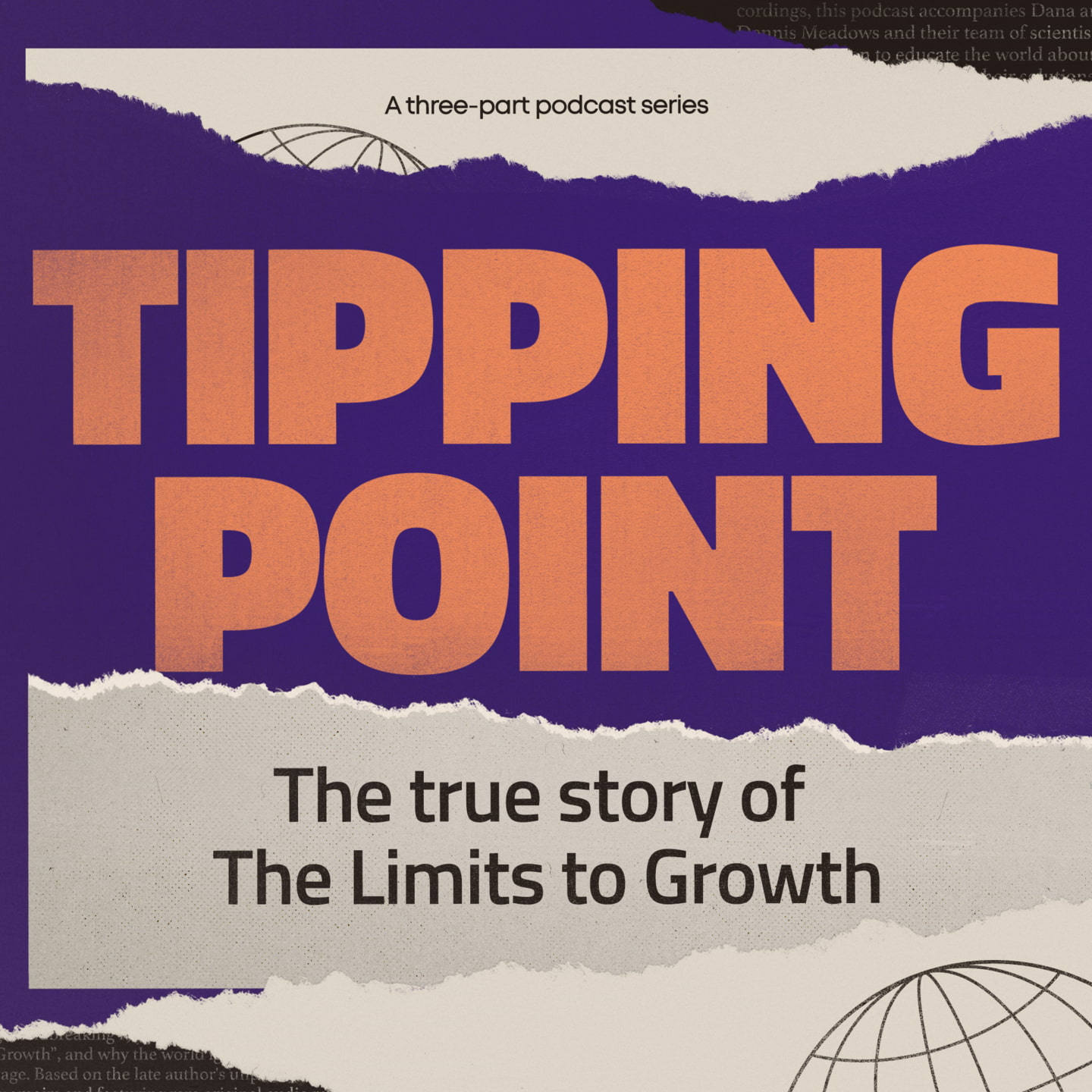
The transcription discusses the legacy and impact of the 1972 book *The Limits to Growth*, a seminal study sponsored by the Club of Rome and conducted by an MIT team led by Dana and Dennis Meadows. The book used systems dynamics modeling to project that continued industrial growth, resource depletion, and pollution would likely cause global societal collapse by the mid-21st century unless humanity adopted a sustainable economic model aligned with Earth’s limits. Despite its rigorous methodology and stark warnings, the study faced intense criticism, especially from economists, and was largely dismissed by mainstream institutions.
The narrative traces the personal journeys of the Meadows, whose travels in Asia exposed them to poverty and environmental degradation, fueling their commitment to the project. It also highlights the role of figures like Aurelio Peccei, founder of the Club of Rome, and Jay Forrester, who pioneered systems modeling. While the book’s predictions were initially controversial, modern scientific consensus acknowledges their accuracy, with current leaders like UN Secretary-General António Guterres echoing its urgent call to address climate change and biodiversity loss. The story underscores the failure to heed early warnings and the ongoing need for systemic change to avoid ecological catastrophe.
"This conference is our chance to stop this orgy of destruction. With our bottomless appetite for unchecked and unequal economic growth, humanity has become a weapon of mass extinction. And ultimately, we are committing suicide by proxy." What was the voice of Secretary-General of the United Nations Antonio Guterres? Speaking in 2022, a scientist warned that thanks to global warming, habitat destruction and pollution, humanity is now on track to make our world unlivable this century. What many people do not know is that 50 years earlier, a group of young scientists predicted almost at exact fate. The study was commissioned by a well-heeled group of intellectuals called The Club of Wrong. You can very well tell by reading this book that it was the product of someone who wrote with clarity and skill and I should like to recognize they in the meadows as the author. "We said two things. One was that if we run into those limits, what will happen will be a collapse of our system, not necessarily the Earth's system, but the industrial system." "That won't take place at the same time around the world. It will be more or less severe in different societies depending on what happens between now and then and on the level of industrialization, but in each case it's likely to be extremely traumatic." "And the second thing we said is we don't have to do that. That there are ways to keep ourselves under those limits and yet to meet all the material needs of the growing world populations." "The Secretary of State GWLE, Richard Simmons. I believe all of us, all of us in the United States, and I think indeed every world citizen are indebted to the Club of Rome. The study is too thoughtful, too thorough, too significant, and the consequences of ignoring its implications to disastrous if we should be wrong in underestimating them." Maurice Strong, a United Nations Under Secretary General, is the director of the upcoming World Conference on the Environment. In the case of the MIT Club of Rome project, they do point out the need for a redirection of many of man's activities, in particular, of the patterns of growth in the high-growth, high-technology, high-pollution societies." "Well, I think that the conclusions of the study are completely wrong. The most hostile group of professionals who have commented on the study have been the economy." "A study which has been announced by almost-opering-funnified analysts of the Western world." "We've got real things to worry about, but the much-foot-lied report of the Club of Rome is not one of them." So why did we ignore the limits to growth? My name is Katie Schultz. I'm a researcher, policy-maker and former economic consultant. I came across the slim little 1972 book The Limits to Growth several years ago when I decided to switch careers to dedicate my time to the unfolding climate and ecological crisis. The book was based on a two-year study sponsored by the Club of Rome, a think tank founded by a renowned Italian industrialist. It was conducted by an interdisciplinary team of young scientists working out of MIT. The team combined the latest scientific research with the very best computing technology of the era to construct a model of the world system and use it to simulate various future pathways for humanity. Their conclusion, the most likely outcome was that our industrial civilization would collapse by around the middle of this, the 21st century, unless that is, we radically altered our economic model from one that focused on endless growth and all the destruction that had entails to one that could allow humanity to thrive and prosper, perhaps indefinitely, and balance with the Earth's natural limits. Stunned by the book's clear prose and profound foresight, I wanted to understand why humanity had failed to heed its warnings. When I learned how it had been the source of much controversy and that it was economists, my alma mater, who had been its greatest critics, I determined to find out why. Together with Vagard Byer, a communication strategist who at the time was researching the origins of the environmental movement, we embarked on an effort to uncover the true story of how the limits of growth came to burst into the public arena half a century ago, only for its young authors to be attacked by the powers that be. As we dug through archives, interviewed former team members and spoke with people close to the story and its many colourful characters, we sought to understand what we can learn from their legacy, now that scientists say we have indeed breached the limits of growth, a must radically chart a new course for humanity if we were to avoid the fate those young scientists foretold. In the course of our research, a particularly fortuitous find was an account of how the limits of growth came to be written by the book's author, Dinella Meadows, or Dana to Friends. A biophysicist from Harvard, Dana was also a lead researcher on the MIT team. Her colleagues describe her at the heart of the project, to its head and Dana's husband, Dennis Meadows. Though rather media shy at the time, Dana went on to become a core figure in the environmental movement. Often referred to as the mother of systems thinking, she was a pioneering educator and writer whose work is now inspiring a new generation of interdisciplinary thinkers striving to build an economic system that can meet the needs of all beings within the means of the planet. Dana intended her account to become a chapter in one of her later books, but it never reached publication. Dana Meadows died unexpectedly on February 20th, 2001, too soon to see her early work vindicated, or to learn just quite what a legacy she would have. This three-part podcast is about the most important book you've probably never read. Cambridge, Massachusetts. It is the summer of 1969 and 28-year-old Dinella Heger, Dana to Friends, is preparing to graduate. A self-professed child of the Sputnik age, Dana was on track for an illustrious career in science. She already held a chemistry degree cum laude from the Esteem's Cardson College and was about to become a doctor in biophysics at Harvard. Not only that, but she'd won one of the Ivy League colleges coveted fellowships, which she intended to take up, just as soon as she returned from her honeymoon. Dana's fiance, college sweetheart, Dana Meadows, was also prepared to graduate that summer. After college, he had gone to DC to work at the Atomic Energy Commission, but the move had made him decide that he didn't want to be a chemist anymore, so he had relocated to Boston to be closer to Dana and found his calling at the Pioneering Computer Science Department, Massachusetts Institute of Technology. That summer, as NASA astronauts read their spacecraft for the moon and artists and musicians prepared to descend upon Woodstock, Dana and Dennis, with two newly minted PhDs, completed their nuptials, sold their car and bought two plain tickets to England. As Dana recalled, "We were out for adventure, we intended to drive to India and back, climbing mountains and kayaking wild rivers along the way." They were setting out for a year-long trek along what was commonly known as the "Hippie Trail," traversing overlands through Europe and on into Western and Southern Asia. They drove and slept in their rusty land over, or camped out in deserts, jungles, mountains and villages. As Dana recalled, "We were often received with hospitality beyond belief, extended dignity and grace by the poorest people we'd ever encountered." Yet her years of academic training could not prepare Dana for what was to be a life-changing experience for this idealistic young couple from the American Midwest. "I started the trip a technological optimist," she later wrote. "I thought science could solve all problems. We didn't have to drive far into East Asia to run into problems that my training couldn't solve. For the first time in our lives, we were faced to face with malnourished children and kids with open sores of smallpox. We saw galloping soil erosion and sewage running in open drains along streets. We began to wonder about the causes and consequences of poverty. As the land overbounds painfully over miles of dusty desert, we tried to make sense of what we were seeing. What they were seeing was already familiar to Adelio Pici. This charismatic, tan, silver-haired Italian industrialist was quite simply on a mission to save the world. The couple had not yet heard of him as they finally made their way onto what we now call Shalanka, but that was about to change." In 1908, the young Adelio was an adventurous polyglot. He had studied in Paris and Russia, and was busy setting up the first fiat motoring factory in China when war brought him back to Italy. He joined the resistance, was captured, imprisoned and endured torture by the Nazis for almost a year before his comrades aided his escape. When the war ended, Adelio helped rebuild Italy as the powerhouse of Europe, going on to head several of its major corporations. But, as Adelio would later write, his time and captivity, living and surviving alongside men with nothing but their own convictions and humanity impacted him profoundly. "It is perhaps from the experiences of that period," he wrote, "that I began to be convinced that late into man is a great force for good, which awaits liberation, and that modern society has yet to discover the way of liberating it." In the following decades, Adelio travelled the world as one of its leading industrialists. He became increasingly concerned about modern societies rising tide of problems, and, despite his earlier hopes, man's seeming inability to tackle them. In 1968, a year before Dana and Dennis Meadows set out on their trip to Asia, he gathered in Rome some of his most distinguished friends, businessman, scientist, political advisors from around the world, to discuss what he called the "problematic." A complex nest of continuous critical problems, such as poverty, inequality, racism, crime, war, pollution and resource depletion. To Adelio, they were symptoms of an increasingly connected, growing and industrialising world economy, and they could not be solved by national governments working in isolation. Today, for the first time in human history, there is one mankind, not scattered civilizations in their own environments, with their own fate, but a vast humankind, which will have to decide altogether where we want to go. Adelio's passion, charisma and deep concern for humanity helped convince the 30-year-old man he had gathered to form a loose think tank, which they named the Club of Rome. After that meeting, they agreed to reconvene within two years, with a plan for tackling the problems. And so, as Dana and Dennis were making their way back to Europe in June 1970, the Club of Rome assembled once again, this time in Berne, Switzerland, to discuss what to do about the problematic. The original members were joined by some of the world's most distinguished scientists and economists, yet after hours of talks, they discovered that not one could deal with the problems in a connected way, except perhaps, for one. Born in Nebraska in 1918, J. Forester showed a genius for invention at a young age. Well, I spent my youth on a cattle ranch. Every winter, the state of Nebraska would send a big wooden box of books to each country school, and they would have ones on electrical experiments, and by the time I was a senior in high school, I built a wind-driven electric generator that was the first electricity that we'd had on the ranch. J. would go on to study at MIT, where he designed feedback control systems for the naval ships used in Pearl Harbor. Later, he developed flight simulators, created the first-ever computer animation, and invented random access memory, which helped usher in an era of powerful modern computing. But it would be for what he did with that computing power that he'll be most remembered for, and what would eventually lead him to become involved with the club of Rome. It was out of discussions with people in industry that I began to look at a different class of problem. In the early 1950s, J. had been working as a consultant to General Electric in its engineering department. When its management team approached him to help solve a different problem, related to its boom and bus performance. We found that if you would take the policies that they were following and do a hand simulation on a notebook page of what would happen week by week, a chewing fact had a highly unstable system. J. used his expertise in building feedback control systems to create a map of all the elements in General Electric's business, such as inventories, workers, overheads and so on, and show how they were all dynamically connected over time so that the company could spot pressure points and prevent them becoming problems. Working in MIT's cutting-edge mainframe computer labs, he then translated his sketches of General Electric's business into computer code, creating a new programming language to help simulate and test different management policies. He called this new branch of science, industrial dynamics. The strategy worked, and soon J. was conducting seminars at MIT Sloan's Management School for the cream of American industry. Later, a chance encounter with the maid of Boston led him to apply this new approach to cities. In the late 1960s, John Collins came to MIT and by chance took an office next to mine. I said to him, wouldn't it be interesting if we would combine the background that we've had in the corporation with the knowledge of people like yourself and cities and see if we could come to any better understanding? Boston, like many cities in the 1960s, was suffering from a rise of poverty and racial inequality. Just as he had done for U.S. corporations, J created a map of all the important elements of the city of Boston, and how they influenced the well-being of its citizens. As in physics, J. liked to say that every action provokes a reaction elsewhere in the system, or to use the engineering term, feedback. Often, policymakers take an action they think will solve a problem, say, building more roads to alleviate traffic. But in so doing, they make the problem worse, by inducing more cars into the city. J. called this the counter-intuitive nature of complex systems. One of J's more counter-intuitive findings for Boston was that creating neighbourhoods of cheap housing would actually serve to entrench its inequality problems further, leading to the development of slums. His resulting book Urban Dynamics came to be used by city planners around the world, and would later inspire the computer game Sim City. Fellow MIT professor Carol Wilson, who happened to be a member of the club of Rome, thought J's pioneering work on modelling complex systems sounded like it could help solve Aralios' problematic, so he invited J to accompany him to bear in that summer. And so on that warm, gin evening in Switzerland, as J listened to the increasingly fraught discussions among the club of Rome members, he took his knowledge of modelling the dynamics of industries and cities, and sketched out the first ever world model right there on a set of Swiss napkins. And I told him they could come to MIT and learn more about this, but they would have to come for two weeks or not at all, because I knew they would take two weeks for them to really understand. And they agreed. They agreed there at midnight that evening, but they would come, they would come three weeks from that day. J touched down in Boston at almost the exact same time as Dana and Dennis were returning from their trip to Asia. For a whole year, the couple had been cut off from events in their home country, living out of the back of a land rover with nothing but a few items of clothing, some cooking utensils, and a teapot for showering. It took some adjusting. We returned that summer to a country that had just bombed Cambodia secretly and shot its own students at Kent State, recalled Dana. We were appalled at the violence and the device of politics, but we went back to visit our middle-class families. We couldn't imagine why the people in our hometowns needed so much stuff. Even though they didn't have smallpox and their babies didn't die from hunger, our families and childhood neighbours seemed to be so manifestly dissatisfied. They were not noticeably happier than the villagers with whom we had spent the last year. We were still reeling from the culture shock when the Club of Rome arrived at MIT. J. Forrester had promised to teach the Club of Rome all about what he called "systems dynamics". Now he needed help from his small department's best computer scientists to demonstrate their work in action. That scientist was, of course, Dana's new husband, Dennis Meadows. Dennis had barely started unpacking when he was hastily recalled to MIT. With a few weeks yet before Harvard would open its doors, Dana decided to accompany him, initially planning on listening to what sounded simply like an intriguing seminar. J. had transcribed the model that he had started on those Swiss napkins in Bern, onto a bedsheet and strung it across an entire wall in the lab. He now proceeded to present to Aurelio and the executive members of the Club of Rome, his model of the world system. It comprised five core elements - population, food, industry, resources and pollution. And a host of others that interacted with these in each other like education, healthcare, investment and technology. By drawing a series of lines and connectors, J. showed how changes on one part of the system might impact the rest. Say, for example, to address hunger, one might use technologies and fertilises to raise food production, but this would also require more energy and create pollution, which could later harm human health. J. put forward that it was only with this complete understanding of the system, the one could hope to solve the problematic. After two packed weeks of seminars, the Club of Rome was finally satisfied. They offered G-2 million Deutschmarks around a quarter of a million dollars, donated by the Volkswagen Foundation. It would be enough to get out an entirely new lab, dedicated to systems dynamics, with the latest and most powerful meanframe computers, and higher over a dozen scientists. But there was a catch. Aurelio, who was now a grandfather, wanted results quickly, within just one year. After that, the Club of Rome intended to set up a permanent think tank in Switzerland, to create policy recommendations for the world's governments and help them to implement them. For reasons that J never made clear, but were lightly influenced by the prospect of the work moving full time to Switzerland, he declined Aurelio's generous offer to lead the project. Dennis had spent a year bearing witness to the problems the Club of Rome wanted to address, and with Dana, many a long-night camped out onto the stars, contemplating what was causing them. He went home that evening and wrote a proposal. He would use J's prototype to show what would happen if current trends continued, and create and test alternative scenarios that could help find solutions to mankind's interconnected problems. As he discussed his ideas with Dana, she too felt a desire to help the people and communities that met in Asia, as well as deal with the mounting problems she was now waking up to at home. She decided there and then to give up her hard-earned Harvard fellowship to help Dennis work on the project. And though her skills were invaluable in ways she could not yet imagine, to avoid any accusation of nepotism, she insisted on joining the project without pay. Although he was just 28 years old at the time, the Club of Rome accepted Dennis' proposal. Now he and Dana found themselves conducting the first major attempt to model the world system. G-Fordister had provided the basic structure, their job was to test it and track down the best numbers to create scenarios. When G-Fordister built his first Arbor Model of Boston, he had insisted on meeting one day per week, every week, with people with knowledge of the different challenges the city faced. Until he was satisfied, he had sufficiently understood the unique complexities and dynamics of the city. The MIT team, under Dennis' leadership, now embarked on a similar endeavor, not for a city, of course, but the entire world. They had to understand how each problem fit within the broader system. Over the following months they met with leading geologists, agronomists, chemists, physicists, ecologists, demographers, economists. They studied soil erosion, ozone layer depletion, chemical pollution, acid rain, infant mortality, poverty, malnutrition. They learned about the eras mineral deposits and fossil fuel reserves and the energy required to extract them. And they studied the prospects for alternative energy sources like hydrogen, nuclear fusion and solar power. They met with various experts from the likes of the United Nations Population Division, the World Bank, the National Academy of Sciences, and the newly formed National Oceanic and Atmospheric Administration, whose scientists presented new and worrying evidence about increasing carbon dioxide emissions, the burning of fossil fuels, and how they might lead to dangerous global warming. Once a visitor from McGill University secretly pilfered a confidential printout of their model, an oversight that would come back to bite them. The team then set about using their data to build their world model. An important feature of the world's system is that it is finite. There is a finite amount of land of mineral deposits and of basic elements like oxygen, which we humans and other species depend on. The Kaibab Plateau in Arizona is one such system. An elevated area bounded by steep cliff drops on all sides, it is almost impossible for land animals to migrate in or out unedited. Until the late 1800s, the Kaibab was a thriving balanced ecosystem consisting of deer and natural predators such as wolves and coyotes. That is, until cattle ranchers moved in, we deemed her drop in native deer numbers. In an attempt to protect the deer, the government allowed hunters to kill the native predators. In system dynamics, as in physics, every action provokes a reaction. J-photester deferred to this as feedback. Negative feedbacks balance or counteract the forces driving a system, while positive ones reinforce them. Here is Dana, using the language of system dynamics to explain what happens when the predators are removed. The predation rate is part of a negative feedback loop. By the time the predator population comes down to zero, the balance between the positive feedback and the negative feedback is destroyed and starts generating an exponentially growing deer population. This the food gets depleted, it takes longer and longer for it to regenerate. What happens is it drags the deer population down with it. In other words, the removed predators instead of protecting the deer had the exact opposite effect. It allowed the deer to multiply to such an extent that they eroded their own habitat. And the deer population finally falls fast enough and far enough to the point where it can be again balanced by the food regeneration rate, both of them at very, very much lower than they had been before. The Kai Bab is an example of what happens when we reach the limits of a finite system. As Dana would later write when grossed its exponential, limits are reached surprisingly quickly. The most common pattern is one of overshoot, beyond the cadding capacity of the environment, followed by collapse. The MIT team's research indicated that in the post-war era and particularly in the United States, various indicators of human activity were also growing exponentially. From a historical perspective, the growth we've witnessed over the last 100 years are absolutely atypical. Global population is doubling every 33 years, resource consumption is doubling every 20 years. The MIT team had realized that in order to determine whether humanity could solve aerial pitches problematic, the nest of problems of hunger, disease, poverty, conflict and so on, it would only be possible if humanity could also stay within the planet's cadding capacity, the physical limits necessary for sustaining human life. But while exponential growth in population and consumption looked to be depleting natural resources at a growing pace, it wasn't clear that those trends alone need cause concern. After all, thanks to the so-called "green revolution" which had created a new generation of synthetic fertilizers and pesticides, agricultural yields were still rising, even as more and more land was being gobbled up to make way for suburbs, shopping malls, roads and factories. And though the population was still growing fast, its rate had started to slow from the heavy heights of the postwar years, but there was another problem to contend with. Pollution. "For this new insect destroyer contains a lot of DDT, not just a little. The most effective weapon man has ever wielded against insects." Biologist Rachel Carson began studying the effects of the powerful pests out DDT when it first came into widespread use in the 1940s. The Nixon administration finally banned the pollutant in 1970. The same year he established the Environmental Protection Agency and the Clean Air Act. The EPA had not arrived from thin air either, but from a growing environmental movement. The first air stay also took place in 1970 and caused the stopped destroy nature and clean up America's air, water and landfills were growing. So if the US by far the world's largest economy in the 1970s was already clamping down on pollution, was there cause for the team to be worried? Well, for one thing, the stocks of even banned pollutants were still rising since many liked DDT accumulate in the environment, often for decades or longer. "In most cases where we have data, pollution is also growing exponentially. Lead has been accumulating in the green with ice caps exponentially, freshwater pollution seems to be going up." Not only that, but has it taken Rachel Carson two decades to prove DDT was harmful to human health and around another decade for Congress to enact a ban, no thanks to lobbying by chemical companies. The thinning nose on layer, acid rain, global warming, there were a host of other pollutants and problems the team was only just discovering and possibly many more going unnoticed. So if bands alone couldn't prevent pollution rising, perhaps technologies could be deployed to clean them up. After all, America had just put a man on the moon. Well, despite what critics me later claim, the team did indeed account for rising technological progress. Here is Dennis Meadows explaining their approach to technology in the world model. "Our project is absolutely not anti-technological. Most of us are in fact rightly to be called technologists. One important question is, will further industrial growth permit us to clean up our environments? Certainly that growth will generate more money for pollution abatement procedures, but will also create more pollution. As agricultural capital increases, food production increases, however industrial output also causes pollution. Pollution decreases food output, it may also have adverse effects on mortality. We can think of technology which abates pollution, but it's likely to be energy and capital intensive, making our resource problems more difficult. Certainly the approaches, the technical approaches to increasing food have exacerbated our environmental situation. In short, the team found that technology could solve some problems, but it may well cause others. As it been the case with the green revolution, and as industry expands, so does the amount of resources used, as well as both the volume and the number of new pollutants. In a growing economy, relying on technology alone was not a surefire way to keep humanity within the planet's limits, and might even push us closer to them. So what were the chances of solving the problematic under the prevailing industrial model of the 1970s? The team was about to find out. It's not some science fantasy effect from 2001. This electronic display emanating from Australia's largest computer is a picture of the condition past, present and future of planet Earth. The programme was developed under the auspices of the Club of Roon by an MIT research team to present a complex model of the world and what we humans are doing to it. Some months after they started their work, they produced what came to be known as the standard run. In that scenario, industry and population continued to grow based on the dynamics of the 1960s and early 70s. For the first few decades, expansion was rapid, and the global economy, and with it pollution, ballooned. From 1980 to the year 2020, pollution really takes off, so the year 2020, the condition of the planet starts to become highly critical. But with limited measures to use resources more judiciously, a rise in consumption combined with exponential growth in pollution started impacting food supplies, and then of course human health. Pollution is going to become so serious that it will start to kill people. So, the population will diminish. And at this stage, round about the year 2042, 2050, civilised life as we know it on this planet will cease to exist. They were not talking about the end of life as we know it, but Estena herself later explained. If we run into those limits, what will happen will be a collapse of our system, not necessarily the Earth system, but the industrial system. Now, you may expect the team to have been alarmed by this finding. After all, it meant a child born in the year 1970 could live to see the breakdown of modern civilisation. But as physicists, Jurgen Randers, just 25, when he worked on the project, explained. I was a very young man and naive in the sense that I thought that once we told the world that the planet is small and that it's a great challenge for humanity to fit a large population and a large economy onto this tiny little planet, I had thought naively that the world would listen and say, "Yes, clearly, this is good advice and we're going to follow this advice." So the team set about figuring out what that advice could look like. Though today's computer processors could no doubt allow infinite simulations of such models. At the time, this was a massive endeavor. The team simulated 10 new scenarios, one with unlimited mineral resources, another with faster rates of technological progress. In a third, a complete switch from fossil fuels to nuclear energy and so on. In most scenarios, humanity flourished initially as the economy expanded, incomes rose and nutrition and health improved. But even where the population eventually stabilized, exponential growth and consumption caused humanity to use up more and more natural resources, to produce more pollution or waste at reach too fast for the earth to absorb them and regenerate. This eventually caused humanity to overshoot their capacity and, like the Kai-Bibed deer, to suddenly collapse. In each scenario, collapse came within 50 to 100 years. Dana later recalled in her memoir how Jay Foddister had once explained to her why this was bound to happen, why humans simply can't keep pushing back all limits, like those on resources or pollution. All at once while still trying to grow the human economy indefinitely on what was essentially a finite planet. Making the system bigger and more complex simply creates new and often more wicked problems, making it impossible to solve the problem I take. It's growth, Dana concluded. The problem is how to control and stabilize growth before the system hits the limits. Our solution, she realized, must be to choose our own limits or let nature choose them for us. So the team tried a final scenario. The investigated how much land resources and income would be needed to afford everyone around the world with sufficient food, water and the sesties for a good life and tested ways to provision this without surpassing the earth's limits. Solutions like renewable energy and efficiency technologies, organic agricultural techniques and regulations to ensure products last longer and could be easily recycled. They also made provisions for investments in education and family planning and changes in how people live, work and travel to help protect nature, reduce land use and curb urban sprawl. This time, they ran a scenario with limits to growth. The solution worked. Still, the team found that it would take some decades to reach its so-called equilibrium society, one in balance with the earth's carrying capacity. Because of the natural delays in making changes to our industrial processes, our policies and laws, our cultures and traditions, the sooner we started on that path, the better our chances of success. This didn't mean that some things couldn't continue to grow, without the problems of economic growth. Dana and the team envisaged that people would be free to focus on more fulfilling activities that did not put too much pressure on the earth, activities like science or sports and culture. It was a marked departure from the American dream of the 1950s, but by the late 60s awareness of mankind's impact on our earth was growing, and a counter-cultural revolution was taking place. Indeed, when Dana was later asked about what gives her hope about this proposal, she said, "I'm very hopeful in this country that the mechanism do exist for this kind of cultural change. In fact, I think it's already happening. I think we're one step, one contribution to a change which is indeed taking place, largely among young people who are trying many experiments, some of which may turn out to be very useful in an equilibrium society. And I think the thing that encourages me, I work in a university with some of these young people, is that they are discovering that the alternate lifestyles that they are trying are not sacrifices, and they're not unpleasant. And in many ways, they're more satisfying, and their lives are more fulfilling than they would have been if they followed the pattern which we have come to regard as the cultural pattern of America. And this, which gives me great hope, I don't think we're calling for a great sacrifice. I only think we're calling for a slightly different way of looking at things, which could, in fact, be too many benefits." Nonetheless, their proposal had profound implications. If the economy were to eventually stop growing, it would mean future income and technologies would need to be redistributed more fairly within and across countries, starting with the richest nation, the United States. Just how that may be achieved, how America and other rich nations can be convinced to follow such a path? That, the team thought, was a job for the club of Rome. It is our conclusion that the overwhelming task for the club of Rome is to identify and implement that set of policies, which will permit us to negotiate an orderly transition to a stable world. It was with these words that Dennis ended his presentation of the MIT team's main findings at the annual gathering of the club of Rome in Montobello, Canada in the spring of 1971. Just weeks before their deadline, he, Dana and the team, had made the journey north to personally deliver their paradigm-changing solution to mankind's predicaments. But the reception wasn't quite what they had hoped for.
Podcast Summary
Key Points:
The 1972 book *The Limits to Growth*, based on an MIT study for the Club of Rome, warned that unchecked industrial growth could lead to global collapse by the mid-21st century unless humanity shifted to a sustainable economic model.
The study faced significant criticism, particularly from economists, and its warnings were largely ignored despite accurate predictions about environmental degradation and resource depletion.
The project was led by young scientists like Dana and Dennis Meadows, whose personal experiences, including travels in Asia, highlighted global inequalities and ecological crises, motivating their work.
The model used systems dynamics to illustrate interconnected global issues—population, food, industry, resources, pollution—and emphasized that solutions require holistic, systemic change rather than isolated fixes.
Despite early controversy, the book’s insights are now seen as prescient, with contemporary calls (e.g., from UN Secretary-General António Guterres) echoing its urgent message for transformative action to avoid ecological collapse.
Summary:
The transcription discusses the legacy and impact of the 1972 book *The Limits to Growth*, a seminal study sponsored by the Club of Rome and conducted by an MIT team led by Dana and Dennis Meadows. The book used systems dynamics modeling to project that continued industrial growth, resource depletion, and pollution would likely cause global societal collapse by the mid-21st century unless humanity adopted a sustainable economic model aligned with Earth’s limits. Despite its rigorous methodology and stark warnings, the study faced intense criticism, especially from economists, and was largely dismissed by mainstream institutions.
The narrative traces the personal journeys of the Meadows, whose travels in Asia exposed them to poverty and environmental degradation, fueling their commitment to the project. It also highlights the role of figures like Aurelio Peccei, founder of the Club of Rome, and Jay Forrester, who pioneered systems modeling. While the book’s predictions were initially controversial, modern scientific consensus acknowledges their accuracy, with current leaders like UN Secretary-General António Guterres echoing its urgent call to address climate change and biodiversity loss. The story underscores the failure to heed early warnings and the ongoing need for systemic change to avoid ecological catastrophe.
FAQs
The book concluded that industrial civilization would likely collapse by the mid-21st century unless humanity shifted from an endless growth economic model to one that respects Earth's natural limits.
The study was sponsored by the Club of Rome, a think tank founded by Italian industrialist Aurelio Peccei, and conducted by an interdisciplinary team at MIT.
Donella 'Dana' Meadows was a biophysicist and lead researcher on the MIT team. She was a key author of 'The Limits to Growth' and became a central figure in systems thinking and the environmental movement.
Systems dynamics, pioneered by Jay Forrester at MIT, models how interconnected elements (like population, resources, pollution) influence each other over time. It was used to simulate future global pathways and identify potential collapse points.
The book faced strong criticism, particularly from economists, who disputed its conclusions about growth limits and the predicted collapse of industrial systems.
The Club of Rome aimed to tackle interconnected global issues—termed the 'problematique'—such as poverty, inequality, pollution, and resource depletion, which they saw as symptoms of an unsustainable global economy.
Chat with AI
Loading...
Pro features
Go deeper with this episode
Unlock creator-grade tools that turn any transcript into show notes and subtitle files.
 PodcastTranscript AI