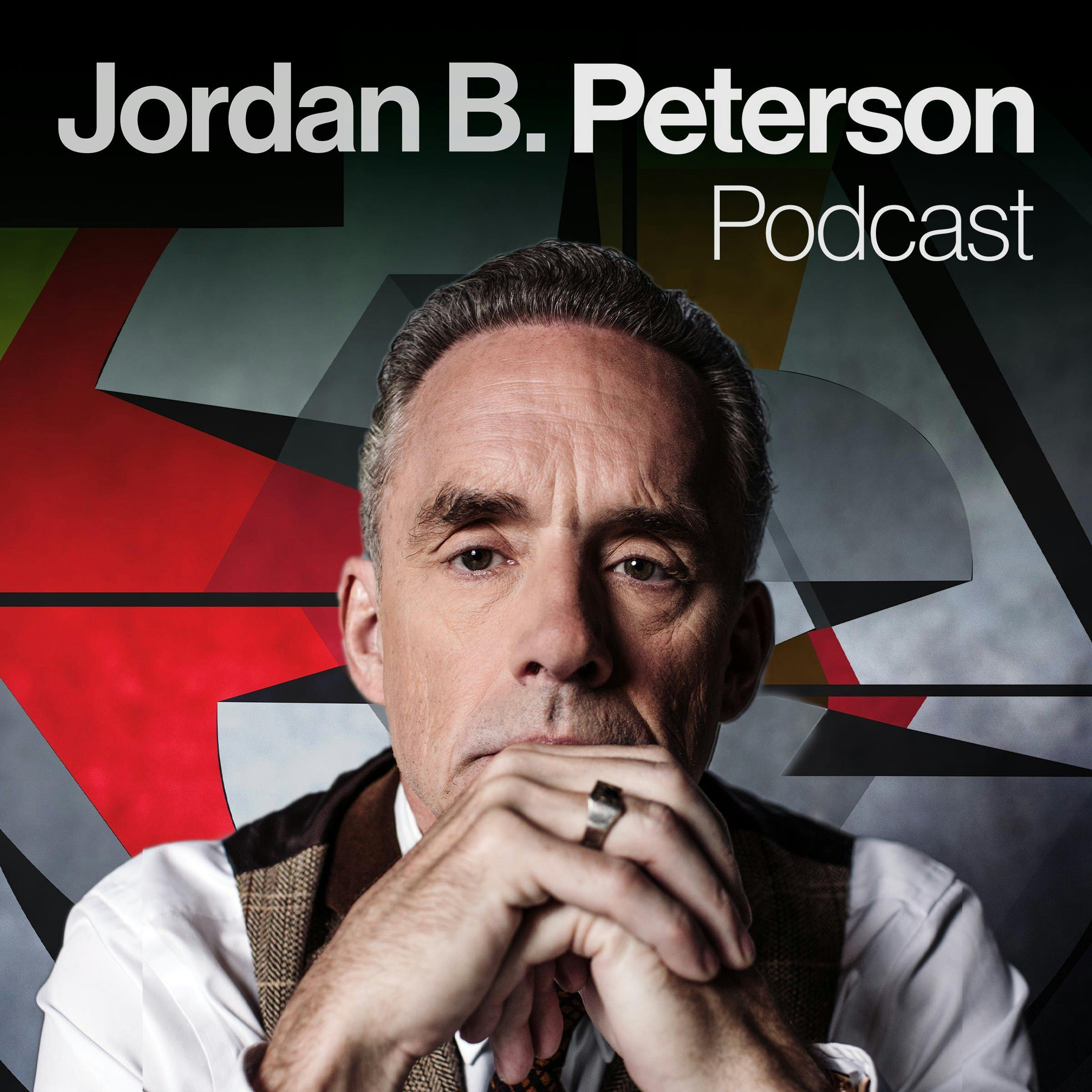
The transcription blends practical advice with deep philosophical exploration. It begins with a recommendation for Jerry, an app that helps users save on car insurance by comparing quotes and tracking rate changes, emphasizing cost savings through proactive monitoring. It then highlights Pure Talk’s limited-time offer as a low-cost, no-contract phone plan with strong customer service, promoting it as a practical solution for those seeking affordable communication. The core philosophical content examines how human perception is shaped by values and stories, not just facts. It argues that we see the world through a narrative lens, with stories—especially religious or mythic ones—offering deeper truths about morality, purpose, and reality. The discussion references Dostoevsky’s exploration of suffering and divine morality, the tension between power and sacrifice, and the idea that consciousness itself is fundamental to existence. It critiques postmodernist claims that power drives human behavior, suggesting instead that human life is rooted in a moral commitment to sacrifice and work. The text concludes by asserting that stories—like the biblical account of creation—frame our understanding of existence, with the potential for transformation and meaning emerging when we confront life’s formless potential with conscious purpose. These ideas are interwoven with personal reflections on faith, responsibility, and the human spirit’s struggle to find meaning in a complex world.
Are you noticing your car insurance rate creep up even without tickets or claims?
You're not alone. That's why there's Jerry, your proactive insurance assistant.
Jerry handles the legwork by comparing quotes side-by-side from over 50 top insurers,
so you can confidently hit buy. No spam calls, no hidden fees. Jerry even tracks rates and alerts
you when it's best to shop. Drivers who save with Jerry can save over $1,300 a year. Don't
settle for higher rates. Download the Jerry app or visit jerry.ai slash wire today.
Let's more on this in a moment first. I saw this new Pure Talk offer and my first thought was,
that is cheaper than a burner phone in a spy movie, really. Except it's actually a real phone,
unless you need a burner phone or a business phone or a phone for your teen. For a limited time,
any Pure Talk plan is just 15 bucks a month for your first three months. No contracts,
no cancellation fees, outstanding US-based customer service, and Consumer Reports gave
them five stars in every single category. Pure Talk is great. I've been using it for years.
Go do it yourself with the best deal they've ever offered. Head on over to
puretalk.com slash Shapiro before this offer disappears. That's
puretalk.com slash Shapiro.
Pray.com helps you make prayer part of your everyday life. Download the Pray.com
app today.
Hi, everybody. I'm pleased to let you know that we're going to release a lecture a week
from my extensive tour archive, beginning this Sunday and then repeating every Sunday after that.
This allows me to do something interesting and useful while I'm otherwise incapacitated.
My health is such at the moment that I can't really return to podcasting or public lecturing.
But we recorded these with the
express intention of preparing them for release, and we've all determined that this is a very good
time to do that. So that's what's going to happen. I hope you find them useful and compelling.
They'll be particularly attractive to those of you who liked my early YouTube work that was very
lecture-focused. It's a return to my roots, I suppose, in some ways. And I'm as happy as I can
be under the current circumstances, given my ill health, to be able to do this. So I'm very,
very happy to be participating in this process and to have these lectures prepared for release.
Thank you very much for your continued interest and support.
There's no adventure without trouble. And the greatest adventure has the most trouble. And
if you took on the full trouble of your life, unstintingly, you'd have an adventure that would
justify the misery. Why do you need a why? Have you tried making your way forward without meaning?
What are you going to do? You're going to work with no purpose? You're going to sacrifice with no purpose?
You're going to suffer with no purpose? Present or absent, we wrestle with God.
And that's human destiny. All aimed at answering the same question:
On what principle is the world founded? And on what principle should the world be founded?
If you gaze upon all the things that terrify you simultaneously, then you become who you
could be. And that would be the spirit that could withstand death and hell and yet prevail.
Thank you very much for your time, and I hope you have a great rest of your day.
She froze to death.
During the night, well, she was screaming to be released, and that became a scandal in Russia.
And it was a well-publicized event, well-publicized horrifying event,
as the torturous death of a child is self-evidently, we hope, a moral crime,
though we seem to be committing an awful lot of those recently.
And Dostoevsky uses that event as an argument that Ivan puts forth about the,
I would say, about the iniquity of existence, essentially.
And he asks, Ivan asks his brother, you know, if this God you believe,
you believe to be a moral being, said, is willing to torture even one child to death,
regardless even if that holds up the whole world.
Is that something you yourself would do?
That's what he asks his brother.
And Eliosha has no idea what to say, because what do you say to a question like that?
And Ivan says to his brother, I know you wouldn't do that,
but the God that you claim exists and that is good and that you worship apparently does.
And so, apart from the utter preposterousness from a materialistic perspective,
say that the deity is inevitable.
That's a necessary supposition.
I think your case for his existence is shaky on moral grounds.
And Eliosha is silent in the onslaught of that argumentation.
But it isn't obvious that it shakes his faith.
And it's still the case that as the novel progresses,
he shows himself to be the best.
He shows himself to be the better man.
Ivan, being brilliant intellect, is characterized by the pride that the brilliant intellect has as its greatest sin.
You know, I've been thinking recently about how the cosmic scales of justice are balanced.
Let's say there's a gospel line that says that to those,
from those to whom much has been given, much will be expected.
Or,
and that's a very interesting line, you know,
because one of the things we wrestle with in the culture now,
let's say, is the issue of privilege.
Maybe you're born wealthy.
Maybe you're born tall.
Maybe you're born Caucasian.
Apparently that's an advantage.
Maybe you're born Asian.
Maybe you were born good looking.
You know, we are all awarded privileges that constitute a temperamental advantage or maybe a situational advantage,
and there's something that seems unfair about that, arguably.
It's certainly the case that people differ painfully in their intellectual capacity, for example.
It's also equally obvious that that difference is a major determinant of success economically,
let's say, as you move forward.
Even the trait conscientiousness, which is associated with orderliness and industrious,
and also predicts economic success, has quite a substantial genetic influence,
which means that it's not a trait that's attributable to the person that bears it.
It's a gift, in some ways, that's given to them at birth.
And you might say, "Well, if talents and abilities are distributed unequally,
how can there be any justice?"
And the answer to that might be, "If you're fortunate, you better pay for it."
And one of the things you see with people who are very intelligent is that they fall prey to the temptation of pride.
And that temptation for intelligent people is proportionate to the degree of their intelligence.
And I would say the potential downside of their gift gone astray is sufficiently great to be the factor on the other side of the coin.
And I would say the potential downside of their gift gone astray is sufficiently great to be the factor on the other side of the scale.
So if you're intelligent and you're proud of that and you get arrogant, that will take you places that you couldn't go if you weren't that bright.
of that and you get arrogant, that will take you places that you couldn't go if you weren't that
bright. And those aren't going to be places that you're particularly going to enjoy being.
Imagine your favorite lecture. Dial that up on Macs, put that on steroids, and then add some
cinematic elements to it. That's the best way I could describe a Peterson Academy lecture.
I went to college because I had to. I go to Peterson Academy because I want to. I'm still
paying off college from 10 years ago and I'm also still questioning the value that I got out of
college. In traditional universities, a lot of times it's just pretty dry. They don't bring the
same energy as the professors at Peterson Academy. It is a completely different experience to learn
from somebody who actually wants to teach you. If you've been on the fence about this, this is the
time. That thing that's calling to you, you won't have an answer for it unless you enroll
and see for yourself. You have the opportunity to investigate that calling.
And so with every gift comes a equivalent temptation and with every talent comes an
equivalent responsibility. And I really do believe that's the case. I think that if nothing else,
if you are unfairly privileged and you don't make much of that, if you don't offer other people
the benefit of your privilege, then you'll take yourself to the next level.
You're going to take yourself apart in one way or another. And so Ivan's a very intelligent man and
he's very prideful as a consequence and that doesn't work out very well for him. And he points
to the suffering of children as his evidence against the existence of God. And when I was
talking to Stephen Fry, he did something that was similar. And I found this extremely interesting
to me. First of all, he talked about his interest in mythology. And then he made a claim, which I
believe to be untrue, that the mythology upon which are the stories, the deep stories, because
that's what I mean when I say mythology, the deep stories upon which our culture are predicated,
essentially the biblical stories, were of perhaps inferior quality to other
collections of ancient stories that we have accumulated. And that surprised me because that's
binomial.
I mean, I don't know what you're talking about. I don't know what you're talking about. like, I don't know, maybe more than anybody else in the world.
You know, I'm dead serious about that, because I've done a lot of analysis of biblical stories, let's say, online, and I read most of the comments that are put on my YouTube channel, and that's often like, you know, a thousand, five thousand comments a week, a lot of comments.
And some of the arguments that the atheists mount against what I'm elucidating, let's say, are rationalistic, materialistic, atheist objections, but most of them are angry.
And a lot of them are written by people who were hurt by people who purported to be religious at some point in their lives.
You know, they had a tyrannical—they encountered the tyranny of dogmatic insistence.
They had a tyrannical insistence in religious guise, and that damaged them and left them with a resentment towards anything with a religious flavor, let's say.
But even that, that's not a rational argument, by the way.
Let's point that out very clearly.
That's an emotional argument, and it's the kind of emotional argument that you would mount against someone that you were in a relationship with.
Now, then you might ask yourself about that.
Are we in a relationship with God?
The spirit of being and becoming.
That's a good way of thinking, but I don't mean with the material world.
That's not what I mean exactly, because the material world, in some sense, isn't the whole world, you know?
And we all know that, because, well, first of all, we exist within the material world, and we're conscious, and we don't know how to relate that to the material realm at all.
Not at all.
We have no idea.
We don't understand the relationship.
We don't understand the relationship between consciousness and matter at all.
And you might say, well, it can be reducible to neurological function.
And I would say most of the neurological function that characterizes you has no consciousness.
And so how we distinguish between the neurological function that hypothetically underlies consciousness and the neurological function that seems equally complex but has no consciousness is not something that anyone knows.
And I would say. The one undeniable truth that we have at hand is the fact of our consciousness.
That was basically Descartes' proposition.
He said, I think, therefore I am.
But what he meant in more modern parlance is something like the brute fact of my own consciousness is the deepest of undeniable realities.
And so what that appears to indicate is that. Well, you can make a materialist case that matter is at the bottom of being itself.
But you can make an equally powerful case philosophically that consciousness is at the bottom of things.
Part not, not least, because I can't even imagine how you could come up with an account of being materialist or otherwise in the absence of consciousness.
If there's no experience of what is there.
And no materialism.
No materialist has ever come up with a satisfactory answer to that.
That's a complicated question.
And then. So there's the fact of consciousness.
And that's a strange fact.
And then there's also the fact of the manner in which we're organized, we're constructed.
So human beings are personalities.
And personalities exist in relationship.
And insofar as we're personalities, we're. Our personalities, speaking materialistically, let's say, are an evolved function.
We're personalities because being a personality is what allows us to orient ourselves in the world.
And so if at the highest level of our being we're personalities, how is it that we're not in relationship with the essence of reality?
Otherwise it wouldn't work.
So that's a very interesting. That's a very interesting fact.
Now, here's another twist for you.
So I've been in touch with Richard Dawkins, who's probably the world's most famous living atheist.
And he's like the avatar of the Enlightenment mind.
He's the last standing avatar of the Enlightenment mind.
That's a good way of thinking about it.
And a formidable, a formidable, a formidable intellect.
And someone I actually like.
I've met Richard a couple of times.
And he's an ornery bastard, you know.
And he's tough as a boot.
And you don't mess with him lightly.
And he's disagreeable enough to cut you into pieces like Englishmen can at the drop of a hat.
But, you know, I think fundamentally he's a genuine scientist.
And that's a difficult thing to be.
And you have to be a dedicated pursuer of the truth to be a scientist.
And there's a certain moral element.
And to that, a profound moral element to that.
And I tried to get Dawkins to talk to me a number of times.
And he put me off, you know, in various ways for a while.
But then one day he wrote me and he said, I don't know what the hell.
I can never understand what you're talking about, Peterson.
But I don't know why you want to talk to me.
And I don't think I'd have the patience for it anyways.
But I kind of think maybe you're interested in this.
And so he sent me a paper.
And I thought, you son of a bitch.
You know exactly why I want to talk to you.
And so it was a paper I actually knew about from about 30 years previously.
And he made a very interesting claim in that paper.
He said that every biological organism is a microcosm of its environment by necessity,
like a model, like a low-resolution representation of its environment.
And here's what he meant by that.
So he said, imagine you were an alien.
Scientists like to imagine such things.
They don't believe in angels or demons, but aliens.
Aliens, man.
Those things are there for sure.
Anyways, anyways.
He said, imagine you gave an alien scientist a bird, a dead bird.
And he said, what could this scientist conclude about?
What could the alien, who'd never seen the earth, let's say,
conclude about the earth from analyzing the bird?
And the answer is, well, a tremendous amount.
Because you could calculate the density of the atmosphere from its wings.
And if you analyzed its blood properly, you would know the composition of the atmosphere.
And you'd be able to calculate the density of the atmosphere from its wings.
You'd be able to calculate the gravitational pull of the earth and its approximate mass.
And by analyzing its DNA at a deep enough level,
you could reconstruct a lot of the tree of life that characterizes earth itself.
I mean, a bird is a densely packed microcosm of its environment.
And I thought, well, I don't know if you know this, Dr. Dawkins,
but there was a medieval conceit among Christians hundreds of years ago
that the human soul was a microcosm.
Right, which was a reflection of the cosmic order.
And your proposition as an evolutionary biologist is that you can't adapt to an environment
that you're not a microcosmic replica of.
That's exactly the same claim that the Christians made, like, in the medieval period.
We're a microcosm.
Our soul reflects the cosmic order.
You might say, well, what the hell does that mean, Dr. Peterson?
It means that if you're not in tune with the structure of reality at all,
the levels at which it manifests itself, then you die.
That's what it means.
And so I found that extraordinarily interesting,
especially because it has another implication,
which is that if we are a microcosm of the cosmos itself and we're a personality,
then maybe the deepest way that we can conceptualize our relationship to being and becoming itself is as a,
as a covenant, as a relationship, as an understanding between beings,
rather than as an alienated consciousness inhabiting a cold and dead material world.
And so I was interested in that partly because there's an insistence in the Old Testament stories
that we're in relationship with being and becoming.
And, you know, and Tammy made reference to that in relationship, let's say, to prayer.
And it's easy to be cynical about such things, especially if you're a Luciferian intellect.
But I would say that the thought that rationalists worship is secularized prayer, historically speaking.
And so why would I say that?
Well, you, you follow along.
You tell me if you think that this is incorrect.
I can't see a flaw in it.
As a scientist, I might ask myself, well, what do I,
what do I do when I'm generating a scientific hypothesis?
Now, this is a very interesting question because scientists never discuss how they generate their hypotheses.
They write down their experimental results and their methods,
and they just take the hypothesis part for granted.
Or maybe they make up some story about how they were driven to their hypothesis.
But this is by rational means.
And that's just not true.
That's not how it works at all.
I had a great student at, at Harvard, Shelly Carson.
Um, Shelly was, uh, creative and intuitive and she'd come
up with a bright idea. And you can't just write your damn bright idea down in a scientific paper.
You have to tell people how you came to it logically. So then she'd have to invent a story
about how she came to her intuitive idea logically, and that was the introduction to her scientific
paper. And scientists do that all the time. Every single scientific paper is like that.
Where do your hypotheses come from? Your research question? What grips your interest? What compels
you and calls you forward? And how does that make itself manifest? Zero instruction in that
in the scientific realm. Okay, so let's take that apart a bit. Well, the first thing that you need
if you're a scientist is a problem. It has to be a real problem. It has to be something. And
how do you know if it's a real problem? How do you know if you have a real problem?
It won't let you go. Well, that's a funny way of thinking about it. It's like,
what won't let you go? You? Well, what do you mean? You won't let you go. This is your conscience,
let's say. It's you that won't let you go. Well, if you can't let yourself go,
if you can't escape from a problem that besets you, what makes you think for a moment that it's
you that's besetting you with the problem? And you know this perfectly well. You know this
perfectly well because many times in your life, if you had the chance,
of just saying to yourself, you should let that problem go, you would. But you can't. You can't,
for example, when your conscience calls you out, or if you do, you damage yourself by lying that
deeply. And it's the same if something calls to you, not so much besets you, but grips your
interest, which is something that happens to scientists all the time. They're insanely
called forward by some phenomena. And,
phenomena, some set of phenomena. Phenomena means to shine forth. They're called forward by what
shines forth to them. And so you need that calling and conscience to specify your problem. And so
you do that in relationship to what besets you and interests you. And there's an autonomy in that.
You know this too. You can't decide what you're interested in. This is so weird. This is part of
what got me interested.
in psychoanalytics. Thought so many years ago, because Freud and Jung both said there are
autonomous. There's an autonomy of spirit operating within you. They put it in the
unconscious. You're motivated by things that aren't under your voluntary control.
They have an autonomy. They call to you. They plague you. You can't control it. What the hell
is that?
So you need to have a problem. And maybe it's a problem because you're fascinated by something.
You're locked onto it by a force that's beyond your control. Or you're plagued by it. Your
conscience screams that. You have to do something about the cancer of children, for example.
Because someone needs to. Because the suffering is wrong. That's a moral claim, by the way, not a
scientific claim. From the purely scientific perspective, the cancer cell has just as much right to live as you do.
You start your investigation with an a priori set of moral claims. All sorts of moral claims. The claim that
the truth is at hand if you approach the problem properly. The claim that the truth is comprehensible.
You have to believe that to be a scientist. The claim that your pursuit of the comprehensible truth will make the
world a better place. That's an axiom of faith. Are we so sure that our technology has made the world a better place?
Well, maybe we are now. But if we wiped ourselves out with hydrogen bombs, we might rethink that
hypothesis. So it's not self-evident. You have to have a problem. You know, that's an interesting
thing to know too, you know, because you're going to have a lot of problems in your life. And a problem
approached comprehensively is an opportunity. And that's something very, very useful to know. And the
deeper the problem is, the more it's going to hurt you. But the more opportunity lurks in that problem. Because the
fact that it besets you means you could be the person to pursue the solution. And that's something very interesting to
know. It's akin to the claim that the dragon hoards the gold. And implicit in that is the notion that the larger
dragons have the more valuable gold. You know, and Tammy referred to that to some degree tonight.
You know, she's been in a situation over the last few years where she's had to face very serious illness and death on a multitude of fronts in many, many ways. And that's about as bitter as it gets. Although as bitter as it gets is a very deep form of bitterness. And it's not too much to say that because she approached the problem on her knees, let's say,
that the net consequence of that suffering has been positive. And I suppose that's the secret to a life well lived, isn't it? Because there's going to be no shortage of serious problems that are coming your way. And if you can't transform them into stellar opportunities, then you're going to be left in the dust. And you do that, at least, not least by faith, but by faith.
But also as a consequence of a certain form of humility. So we could get to that next. You have a problem. You're a scientist. The next thing you have to admit is you don't know the answer. And that's not much different, semantically speaking, than approaching the problem on your knees. It's like you have a problem. It's a real problem. It's an insufficiency. You have an insufficiency. You have to admit to the insufficiency.
Deeply, you have to understand that it's an insufficiency that you would like to have rectified. You have to ask. You have to knock. You have to seek. And the consequence of that, intensely pursued, will be something like a revelation.
Accurate, psychologically or spiritually. If it was you that thought it up, why didn't you know it to begin with? Well, that's a good question, right? Where did that come from? How did you call it forth? Or under what conditions did it make itself manifest to you? Those are the same questions. You're not going to get much of an answer unless you ask the question.
Insufficiency. And it's a reaching into the beyond for a revelation. Now, thought itself doesn't end there because your prayers might be warped. And what that means, to some degree, is that you might be aiming at the wrong thing. And what that might mean is the revelation you receive might not precisely be from God, which is why you have to test the spirit, so to speak, to see if they're of God.
And there's actually no difference between that and critical thinking. You know, you'll ask yourself a question, hopefully a well-aimed one, hopefully one that's aiming up, not something like, how can I take advantage of this situation for myself in this moment maximally and to hell with everyone else, for example, which isn't exactly a prayer to God. Let's put it that way.
Critical thinking of various sorts, which is another manifestation of the creative process. And I don't see any difference between that on the scientific front and prayer, not on the hypothesis generating side.
And so, and I think also it's a completely reasonable claim, anthropologically and historically, to generate the hypothesis that the thought that moderns are capable of, literate,
semantically sophisticated moderns, is a variant of the prayer which clearly preceded that historically.
So, you know, there's a gospel statement that says, if you ask, you'll receive. If you knock, the door will open. And if you seek, you'll find. But it's nested in another set of propositions, which is something like, careful what you ask.
And seriously. And so, if you ask for what is highest, you'll receive what is highest in return. And if you ask for what is lowest, you'll receive what is lowest in return. And I wouldn't recommend that.
All right.
Well, that's a bit of preamble musing, let's say, to set the stage.
I have one other thing I want to discuss with you before we get
the stories themselves. I want to discuss with you what constitutes a story. Now, you know,
we're engaged in a culture war, and part of the reason for that culture war is the clash of two
claims about the structure of reality itself. Now, the rationalists and the empiricists, they
make the claim that the world is composed of a set of objective facts, and that you can be guided by
those facts. You can follow the science, for example, right off the
tyrannical cliff, as you may have noticed. The world is composed of a set of empirical facts,
and that was opposed, starting in the 1970s, by the postmodernists, who claimed that,
no, you see the world through a story, and turns out the facts support the postmodernists,
and not the scientists. And that isn't an opinion anymore, because the same realization
occurred simultaneously in multiple fields of inquiry. So, the greatest neuroscientists in the
world now regard each word as a micro-narrative, let's say, or as a tool. The AI engineers learned
that they could only produce supercomputing, and that they could only produce supercomputing,
intelligences, by training them within the framework of something approximating a hierarchy
of values. The computational scientists learned that it was impossible to generate a robotic
machine that could function merely as a consequence of modeling the facts. All of those things
basically happened at the same time. And here's why.
200 years ago, something like that, a Scottish philosopher named David Hume put forward a very famous
proposition, which was that you couldn't derive an ought from an is, which meant something like,
no matter how many facts you aggregated around you, you couldn't use those facts as an unerring
guide as to where you should go. So, imagine this. Imagine that you're dropped in the ocean,
and you're trying to determine which way to swim. There's no set of facts at your disposal
that is going to map that territory for you. The same is true if you're lost in an expansive
desert. The geography itself will not signify to you your destination. Now, why is that? What is
the problem? It seems like it's one of something approximating volume. The facts can't guide you,
because there's an infinite number of them. And if you rank order and prioritize them, you're
not in the domain of facts. You're in the domain of value. So, and you do this. The perceptual
scientists figured this out too. You do this every time you take a glance. So, and this
is so interesting, eh? Because the empiricists say, well, you just look at the world and
there are the facts. But the perceptual scientists say, no, you can't even
look at the world without looking at the world through a lens of value. Now, and so what do I
mean by that? Well, imagine you're out on a date. Okay, you're in a restaurant. There is a lot of
things you could pay attention to. You could pay attention to the waitress who happens to be more
attractive than your date, let's say. Now, that's not a strategy of value that's going to endear
you to your date. Right. So, what do you do if you're polite and you have a clue?
And this is what you do with the person of the opposite sex, say, that you're with all the time,
is you attend to the facts that accompany them. You prioritize your perception so that in the
restaurant, for example, you don't listen to the conversations two tables away, although you could.
You listen to what your date is saying. And the way you do that is you focus on what it is that
she's uttering and you suppress into invisibility. And you focus on what it is that she's uttering and
you suppress into invisibility. And you suppress into invisibility.
Everything else. And what that means is that you put her utterances at the pinnacle
of a structure of value and you subsume everything else beneath that. And you do that with every
single glance you take. You couldn't even focus your eyes if you didn't do that.
As perception, visual perception, auditory perception, they cannot be dissociated from
action. You don't see and then act because you can't see without acting.
And it's the same with all of your senses. And so you have to make a decision about what's important
literally with every glance, even with the unconscious movements that keep your eyes
actually functioning because they're vibrating constantly, even though you don't know that
because your brain corrects for it. You have to live within a hierarchy of value.
There's no way out of that.
Once you know that, and we know that, and we know that factually, we know that
incontrovertibly, once you know that you live within a structure of value, two questions might
arise. How is that structure of value to be characterized? And what should be valued?
So to answer the first question,
a description of a hierarchy of value is a story.
That's why we're so interested in stories. We want to see how other people see the world.
We want to have them help us solve the problem of what to attend to.
Here's a scientific justification for that claim. Your eyes evolved so that other people
can easily see where you're pointing them. That's why you have whites. When you look at
someone, when you talk to them, you look at their eyes. You look at their face, but mostly their eyes.
And the reason you look at their eyes is so that you can see where they're pointing their eyes.
Because if you can see where they're pointing their eyes, you can figure out what they're aiming
at. And if you can figure out what they're aiming at, you can figure out what they're up to. And if
you can figure out what they're up to, you can use your body to mimic their responses emotionally.
And that's how you understand them.
You say, well, how do you know that's true? Think, what do you do when you go to a movie?
You pay to go see a movie. It's a story. You'll even go pay to see a story that horrifies and
terrifies you. That's how important it is for you to understand the broad landscape of evaluation.
You'll go watch someone confront a horrifying death, and you'll walk through those emotions
just so you can orient yourself in that.
And you'll pay for it. And the reason you'll pay for it is because you'll pay for not doing it.
And you'll pay more. So you go to a movie, and what do you do? You watch the hero. You watch
the protagonist. And you try to infer, what's he up to? What's he doing? Why is he doing it?
What are his aims? What's his moral structure? And you lock onto him. And as soon as you start
to understand his motivations, assuming the movie is well-written and well-portrayed,
you start to feel the emotions. And that's
because you're not doing it. You're not doing it. You're not doing it. You're not doing it.
Because you're using your body as a computational landscape to mimic the state of being that
characterizes the protagonist. And then you split yourself into all sorts of people while watching
the movie, one person per actor. And you experience all those emotions. And you absorb all those
stories. And why do you do that? Well, maybe the protagonist is an anti-hero, like the Joker in
Batman.
Like Heath Ledger's Joker. And why would you watch the Joker?
To learn how not to let the world burn pointlessly. How about that? And why would you watch a superhero
movie? Well, maybe to ally yourself with the central tenets of heroism per se. I mean, if you
have a better explanation, what's the general explanation? It's entertaining. I enjoy it.
Don't make too much of it. It's like, no, sorry, you're gripped by an instinct.
That's how a biologist looks at it. Or a psychologist. What else is dragging you to the movie theater? You can't just brush it off as entertaining. You're missing the point. Why is it entertaining? Why will you pay for that? Here's an even deeper question. You know that part of our attempt to build faster and faster computers is so that we can have more and more realistic
fictional simulations. You don't need the newest supercomputer in your laptop. You were pretty much taken care of on that front in 1995. And so what's driving our desire to build these insanely complex machines? Well, how about the ability to play more realistic games? Story-based games? How about the ability to construct more and more realistic fictional worlds? Why?
Because it matters.
It matters.
So then we might ask yourself, what are we to make of fiction itself?
And a thoughtless rationalist would say, well, fiction is the opposite of fact.
That's a stupid answer.
And here's one of the reasons.
It's because there's a lot of reasons.
But here's one.
We seem to recognize different levels of quality in fiction.
You know, you'll go home when you're tired and watch a movie you know to be trivial, light, shallow, and foolish.
Just entertaining, right?
It doesn't move you.
It doesn't require any effort on your part.
You're probably even embarrassed to watch it.
But, you know, maybe you worked hard that day, and that's pretty much what's left of you.
You know, you can lay on the couch and watch Barbie.
And.
I can only make it halfway through Barbie, by the way.
But then, you know, you'll see a movie, for example, that moves you to your depths, that'll evoke tears, that'll sometimes even change your life.
You'll read a book like that, a book of fiction.
And so we have this instinct and this unerring sense and this knowledge that there are levels of depth in fiction, right?
There's levels of quality in fiction.
And what that seems to indicate is, at least, even if fiction is the opposite of fact, some fiction is much more real than others.
And so I'm a great admirer of Dostoevsky, for example.
And I loved clinical psychology.
I loved being a clinical psychologist because I found that if I listened intently to my clients, they all turned into characters from a Dostoevsky novel.
You know, because people are so interesting.
If you get people to tell you.
If you get people to tell you the truth, they're so interesting that you want to run away screaming.
And so that's why husbands and wives don't listen to each other, by the way.
They tell each other platitudinous half-truths so that none of them are terrified enough to leave the house in a fit of horror.
And they miss the best of the other person as a consequence of that cowardice.
You know, I mean, if you're bored of your spouse.
All that means is they're not letting you know who they are, because if they did, you'd be interested enough to stay awake at night, worrying.
So here's the theory about fiction.
We have to see the world through a hierarchy of valuation and a description of a hierarchy of value.
The hierarchy of valuation is the story.
You're looking at the world through the eyes of someone else, trying to adopt their frame of reference, trying to understand their position, their aim, their conclusions, their emotions, their motivations.
Now, imagine there's sets of stories, right?
And some are more compelling than others.
And then imagine you aggregate all the compelling stories and you make super compelling stories out of that aggregation.
And those are the deepest possible stories.
And the most.
Real possible representations.
That's what mythology is.
It's it's a it's it's a form of truth that surpasses the merely literal.
Now, you might say, well, that's a preposterous claim.
Nothing's more real than concrete reality.
Really, how about numbers?
How about numbers?
What's more real?
The world of.
Brute material facts or the world of numbers?
How powerful are you if you are a master of the world of numbers?
Well, our computational devices are a consequence of our mastery of the world of numbers.
Our technological prowess is a consequence of our mastery of the world of numbers.
Are numbers more or less real than what they represent?
Well, I think the proper answer to that question is it depends on your definition of real.
It depends on the purposes toward which you're putting the levels of abstraction.
But you're a bloody fool if you think the answer to that question is simple.
And you're certainly a fool if you think that making the claim that the realm of numbers is real is a preposterous claim.
It's that just means that you have a definition of reality that you really know nothing about.
Abstractions can be plenty real and deep fiction is the ultimate abstraction of value.
And that's crucial.
Because we see the world through a structure of value.
Now, the postmodernists figured this out in the 1970s.
Why?
Well, how about because they were literary critics?
Now, you'd think literary critics, no wonder they're in the university.
Nothing more useless than a literary critic.
What if you live by stories?
Then there's nothing more powerful than a literary critic.
Especially one that takes the stories.
Your culture is predicated upon a part.
Which is exactly where we are now.
It's worse than that.
Even though the postmodernists got their central claim correct.
That we see the world through a web of stories, let's say.
They got their answer wrong.
And that was because they were possessed by the spirit of Luciferian pride.
They put the cart before the horse.
They thought.
Well, we have.
We have to see the world through a story.
Now, remember, these same people, they're all Marxists.
And I'm not making this up.
Go look it up for yourself.
We're talking about France in the 1970s.
Okay, so that in itself should be a clue.
Right.
And we know perfectly well that the universities have been left-leaning since the 1960s.
And that that was particularly true of France.
During the 1970s.
And probably no more true, true more among the humanities-oriented French intellectuals of the 1970s than anywhere else.
And if they weren't outright Marxists, they were implicit Marxists.
And they said that themselves.
And when Solzhenitsyn came out and demolished the moral pretensions of the communist universe,
they kind of scuttled underground.
But not really.
They just invented a kind of meta-Marxism that would have made old Karl,
had he lived to understand its spin,
and hopefully at a very rapid and uncomfortable rate,
for all of eternity.
What did the postmodernists claim?
The central story that possesses us is one of power and nothing else.
Well,
fair enough in some ways, you know, I mean,
certainly there isn't anyone here.
There's no one alive who hasn't been tempted by.
There's people who are unable to utilize power and they're just useless.
And then they might mask their lack of uselessness with a moral veneer.
I'd never use power.
And my objection would be, well,
it doesn't really matter to me one way or another because you're so incompetent,
you don't have the opportunity.
And so that's not a moral claim.
That was something Nietzsche pointed out in the late 1800s
when in his critique of morality as cowardice.
You know,
if you're weak and useless,
the best justification you have for it is that you don't do terrible things because you're good.
It's like, no, you don't do terrible things just because you're useless.
Now, that doesn't mean that's necessarily the only reason.
That people don't do terrible things.
That is not what I'm saying.
I'm just saying that the accusation thrown by the postmodernists at the human race,
that our fundamental motivation is one of self-serving power.
This power properly defined has to be self-serving.
Otherwise, it's not power, it's cooperation.
So I need to exercise power if I'm trying to compel you to do something you don't want to do.
Maybe that's all we do.
You're out for your power.
I'm out for my power.
It's a bloody,
nightmare of power competition and whatever stability we manage to attain is merely a consequence of the balance of our
fundamentally competing interests and that ethos is
core to the
unholy alliance between the postmodernists and the Marxists.
There's no genuine reality.
There's no genuine morality.
There are a variety.
There's nothing but a set of competing claims to power.
And then there's the oppressed,
and the victimized,
and then there's the victimizer.
And that's a power dynamic.
And you can understand marriage that way.
And you can understand the family that way.
And you can understand history that way.
And it's nothing but power.
And, uh,
as I said, fair enough.
You know, human beings are pretty damn brutal.
And you look at a regime like the National Socialist regime,
or Maoist China,
or Stalinist Soviet Union,
and you think,
"Oh." Or the degeneration of great institutions in the West.
And you think,
Power's on the march, and maybe there's nothing else.
There are a group of people who use nothing but strategies of power.
Psychopaths.
They're about 3% of the population, cross-culturally.
And that fact in itself is pretty damn interesting,
because if there was nothing but power,
why wouldn't the people who use nothing but power
be the majority and be dominant?
And they're not.
Psychopathy turns out to be a very counterproductive strategy.
Many psychopaths land up in prison.
Psychopaths can't cooperate.
If I interact with you and I get what I want from you on our first interaction
and then to hell with you, you're not going to interact with me again.
So psychopaths are itinerant.
Even psychopathic chimps don't do very well.
The idea that the fundamental human motivation is one of power
is about the most cynical and self-serving story that you could possibly tell.
Now, it's a bit compelling, eh?
It's compelling because when a human social organization goes wrong,
it degenerates in the direction of power.
You know, if you and your wife,
you know, if you and your wife are in a relationship,
are not getting along,
you can't cooperate, you can't communicate.
That's all off the table.
You're left with the relationship of tyrant to slave.
And maybe you swap those roles,
but it's in the degeneration of the institution
that the manifestation of power takes place.
I suppose it can degenerate into a kind of
puerile and infantile hedonism, too.
You know, if you can't organize yourself
at some relatively high level,
of sophistication,
you can degenerate into the situation
where you do nothing but allow yourself
to be possessed by your basest whims.
There's not much difference between that
and being psychopathic, by the way.
It's an unbelievably corrosive doctrine.
But then you might object.
That's naive, because everything runs on power.
I don't think it's naive at all, by the way.
But a more fundamental objection would be,
well, if it's not power,
that the world is founded on,
if it's not the war of all against all,
then
on what principle is the world founded?
And that's what the biblical corpus investigates.
I say biblical corpus because
it's a body, like a body of laws.
It's a body of stories.
It's a body of animating stories.
That's another way of thinking about it.
And all stories contain within them
an animating spirit.
That's the moral of the story, by the way.
The seed around which the entire story
organizes itself, or the seed from which it grows.
The seed that is planted in you
when you hear a story,
or tell a story.
Over millennia,
our ancestors
aggregated stories that burned themselves
into their memory.
All aimed at answering
the same question.
Toward what should sacrifice be devoted?
Now that
archaic terminology grates on our modern ears.
We think of burnt altars
and smoking carcasses
and primitive gods
that enjoy the smell of
high quality
roasted fat.
And we,
fail to investigate.
To what end should sacrifice be devoted?
What does that mean?
You will wrestle with that question
your entire life.
There is no difference conceptually
between sacrifice
and work.
They're the same thing.
Work.
The sacrifice of the present
to the future.
Right?
If you're doing something,
for fun,
if you're engaged in the present,
if you're captivated by the moment,
you're not working.
You're enjoying yourself.
You're being entertained.
You're playing.
What are you doing when you're working?
You're striking a bargain with the future.
Or you're striking a bargain
with the spirit of the future.
And the bargain is,
I'll give up something I want
and value now
on the understanding
that it will be returned to me
manifold in the future.
That's why you work.
And so then that's
in the Garden of Eden
when Adam and Eve are tossed out of paradise
because of their sin of pride.
God informs them that
in this fallen world
they will have to work.
They will have to toil
in the fields.
They'll have to toil to bring forth children.
They'll have to work.
It's the human destiny to work.
Why?
How about because we're aware of the future?
How would that be?
Above all other animals,
we understand that we stretch across time,
that you have to save for your retirement
because the you now will be the you
that's 65 and damn soon.
And you have this perspective on the world
that spans the ages, so to speak.
And you have to make a bargain
between what's meet and correct and enjoyable
and fills you with enthusiasm at the moment
and how you have to organize yourself
into the future
to make a bargain.
And you have to make a bargain
with your future self
to strike the same bargain
with everyone else
and all their future selves
and balance all that in the moment
with work.
What kind of work?
That's the story of Cain and Abel.
What sacrifice best pleases God?
Abel's sacrifices are accepted.
His life goes well.
Cain's sacrifices are rejected.
He becomes resentful, arrogant, bitter, murderous,
and then genocidal.
Sound familiar?
Those two things are laid out.
Those two pathways of adaptation,
those two pathways of narrative valuation
are laid out at the outset of the biblical corpus
in about 20 of the most tightly written sentences ever penned.
The story of Cain and Abel is inexhaustible.
It sets the pattern of the battle
between the hostile brothers,
between Batman and. and the Joker,
between Superman and Lex Luthor,
between the Hobbit and Sauron,
between Harry Potter and Voldemort.
It's the eternal battle of good against evil.
And that's the most fundamental narrative trope.
And it's the meta-story that burns us,
that's burned itself into our imagination
and our memory.
And why?
Because that's your story.
Whether you know it or not.
And no matter where you are in that story,
you're in that story.
And no matter which side you're on
or what stance you take,
you're in that story wrestling with God.
There's probably no one who thinks of God
more than a committed atheist.
Right, and that's not accidental.
All right, so. I'm going to walk you through a bit of
the first story in the biblical corpus,
just to give you a flavor of. of exactly how this works.
In the beginning, God created the heaven and the earth.
And the earth was without form and void,
and darkness was upon the face of the deep,
and the Spirit of God moved upon the face of the waters.
A few sentences.
A relatively radical claim.
So let me delve into this a little bit.
Without form and void,
and darkness was on the face of the deep.
It's a juxtaposition of a sequence of metaphors.
The original Hebrew word was tohu v'bohu.
And tohu v'bohu means something like formless potential.
The Spirit of God is that which wrestles with. which confronts and. and differentiates formless chaos
into the manifest structures of the world.
Okay.
Now, and you're made in that image.
What does that mean?
Well, it's a claim about the fundamental structure of reality itself.
And it's not a materialist claim.
Not in the least.
First of all, it claims the existence of something that,
in some sense, is non-material.
And I would say the closest straightforward word we have of understanding
what that is, is consciousness.
That's the brute fact of your awareness.
But more than that, the brute fact of the fact that
your awareness is integrally involved with the fact of being itself.
And more, and more, that the being of your consciousness
gives rise to the world.
Okay, so let's just take that apart for a minute.
You follow along with me, and you tell me what you think about this.
What is it that faces you when you wake up in the morning?
That's the dawn of the new day, right?
God created it.
Creates the world in seven days, units of time.
You wake up in the morning when the sun rises and the light reappears.
What confronts you in the morning?
And because you're a materialist, you think, well, my bed, the furniture in my room, my rug, the artifacts around me.
And I would say, really, when you get up in the morning, the first thing that you perceive and conceive is the furniture that you're 100% familiar with.
Or how about this?
How about this?
This is what confronts you.
How about if you think about the last time you were depressed or anxious?
That's a good way in.
What confronts you when you wake up in the morning?
How about the malformed personality?
Potential of your life?
How about the wasted potential of your life?
How about the increasingly chaotic and demented chaos of your life?
How about all those opportunities you could have made something of had you chosen to?
How about all the wasted opportunities that saturate your house?
All the closets that haven't been organized?
All the fights you haven't had with your wife?
All the issues you haven't settled with your children?
All the problems you haven't solved?
All the problems you haven't solved with your children?
All of that formless, chaotic, anxiety-provoking, terrifying potential.
Well, that's on the negative side.
You might say that's the dragon that is there in the morning when you awaken.
You can paint a positive picture that's equally compelling.
Maybe you're at a peak in your life and you wake up in the morning filled with enthusiasm.
Enthusiasm.
That means to be filled with the Spirit of God.
Enthuse.
Thuse is theos.
Deos.
God.
God.
To be filled.
To be filled with the Spirit of God.
To be joyfully abounding in faith and hope.
And why?
Because you see a new business opportunity make itself manifest.
Or maybe you're in love with someone and the first thing you think about is the potential of that future relationship.
Even if that's the date that night.
Or maybe you have a new child and you're deeply in love with that child.
And you think about the joys that the new day might bring if you only conducted yourself properly.
And so what do you consider?
Confront when you wake up in the morning.
Well, how about a field of potential?
Maybe that's what your consciousness is for.
Your consciousness is the mechanism that confronts a field of potential and casts it into reality.
That makes it tangible.
Now, do you believe that?
Well, do you make decisions?
Do things happen as a consequence of your choices?
Is that not part of assembling and forming the world?
And don't we all know that the world?
Don't we all know that the world?
The world that we aggregate around us is in some wise a consequence of what we've aimed at?
Of our own free choice?
And you might say, well, I don't believe in free choice.
It's like, do you believe in your wife's free choice?
Try treating her like an automaton for a week and see how well your relationship goes.
Well, dear, I know that you really can't help how you are.
And you're just moving robotically through the motions.
And no matter how disarrayed our relationship happens to be,
I can't.
I can't attribute any responsibility to you,
because I know at your core you're nothing but a mindless, deterministic robot.
It's like, you can't even have a relationship with yourself with that attitude,
much less someone else.
And so you might claim to be a determinist,
which, by the way, is not a useful scientific stance,
because the universe is not a deterministic place,
and it can't be conquered by algorithmic calculation.
So, and we know that, and that's actually a fact, not an opinion,
because at the quantum level, the world is fundamentally indeterministic,
and that indeterminism makes it self-manifest to all the levels of reality.
It doesn't work technically, and it doesn't work practically.
It's a preposterous scheme.
And you mostly want to believe it so that you don't have to take responsibility for your life.
But the catastrophe of that is that that potential that you encounter when you awaken is in that potential is everything that could ever
possibly be offered to you if you only knew how to seize it.
And you know that because you're beckoned forward into the future
by the fact that something new and redeeming could still make itself manifest.
And if you don't have that, you can't get out of bed.
You say, I'm hopeless.
I have no hope.
I have no enthusiasm.
The joy has gone out of my life.
The neurological systems,
that signal movement forward to a desired end,
have shut down and left you suffering,
left you with nothing but the bitterness of
the potential that's going to make itself manifest in the most negative possible way
if you can't organize yourself and confront the world.
And that's the same spirit.
That's the same spirit that's claimed in the great book of Genesis
to make it manifest.
To make itself manifest at the beginning of time.
The spirit that confronts potential itself
and casts itself and casts that potential into tangible order.
And not only order.
This is repeatedly insisted upon in the text.
The order that is good.
So imagine that you're conducting yourself
as a proper conscious moral agent in your family.
What are you doing?
You're taking the raw potential of your children and your family
and you're transforming them into the order that is good.
And how do you do that?
Well, do you love your children?
I didn't ask if you liked them.
Do you love your children?
And you say, well, at least I'd like to.
You know, and I'm not being cynical about that.
We're all imperfect.
And none of us love our children with the depth that we should.
But you see the best of people, I would say,
in the love that they manifest for children.
And what does it mean to love a child?
I mean, even if you don't have much hope for yourself,
even if you've given up on yourself,
even if you're bitter about the fact that you've wasted your potential,
you have a child and you think,
if only, God willing, things could be better for him.
The potential that I see inside him that constitutes
the core of my love, that vision of potential,
that could make itself manifest in a manner I was never able to manage.
And you pray that that occurs.
And it hurts you when you see your child deviate from that path.
And so what does that mean?
It means when you orient yourself by love,
you strive to bring about, within the confines of your family,
the order that is good, or even very good.
And what that implies, too, is that the ultimate aim of the Spirit,
that would best make use of potential,
is the Spirit that acts in love.
And that's why there's an insistence in the Judeo-Christian tradition
that the ordering Spirit at the base of reality itself
is precisely the Spirit that acts in accordance with the highest dictates of love.
And you ask yourself,
well, if you wanted to bring about a world that was good or very good,
what else could you possibly be oriented by?
And that love would not only be love,
not just love for your children and for your wife,
but even for yourself.
But for yourself in the deepest possible sense, right?
As the love for yourself as someone who carries within them
the same flame that your son carries.
And that you need to manifest when you're caring for your son
so that he can manifest what's within him.
And then you could ask yourself, too,
if you were oriented, God willing,
by nothing but that love,
what could you make of your life?
Now, there is a prayer.
If I was oriented by nothing but the highest love,
what could I make of my life?
It's a terrifying question to ask,
because if you ask and you want to know,
everything that interferes with that will burn away from you.
And that might mean that there's precious little left standing.
This idea of the Spirit of God descending upon the chaotic waters.
People ask, well, there was no water at the beginning.
None of this makes sense.
It's like, you just don't know what you're talking about.
You have no idea what constitutes a metaphor.
What exists, this potential that exists at the beginning of everything,
isn't water.
It's just that water's a useful metaphor.
Well, why?
You can draw things up from the water.
The water is a metaphor.
The water is unknown.
The water is dark, and it's deep, and it's mysterious, and it's bountiful.
You can drown in the water.
You can sail on the water.
The water is the necessity of life.
Use some imagination, like the poets do.
When Christ is baptized by John the Baptist,
the Spirit of God,
the Spirit descends upon him.
What does that mean?
Next slide, please.
Oh, I'll tell you about this first.
this is the same story told from a different perspective
so what do you confront your life well a monstrous eternal infinite mess of multi-headed snakes
you tell tell me that's never happened in your life you wake up in the morning you think oh my
god i wish i was asleep snakes everywhere right and so what does the hero do
confronts the snake right more than that this is even implicit still in the biblical corpus there
are echoes of the representation of god as the primordial deity who slayed the serpent that
existed at the beginning of time and made the world out of its pieces
leviathan what does that mean well it means that we're hunters
it means that we build we make our clothes out of animal skins
it means that we we establish the order that is habitable
by confronting the predators and making use of them taming them or destroying them
we establish order as a consequence of a of a conflict with potential
it's echoed in the story of the dragon and the gold you confront what's terrifying
and possible and you gain what's valuable and necessary and that's the eternal story of
of the heroic element of the human spirit and when we hear a story like that it echoes deep
inside us that's why the stories are so compelling it's like the
baptismal scene in the lion king when simba is adolescent and deluded and power mad and confused
and his father appears in the sky and says remember who you are well that's what the
ancient stories do they remind you who you are right your children of god made in the image of
the creative being that sits at the center of reality itself reflected in your soul and you've
forgotten in your
misaimed presumptions your pretension your pride and your ignorance and the stories the ancient stories
call to you to wake up and understand who you are to adopt that responsibility and to put that foremost above everything
confront the terrible catastrophic dragon of chaos dressed in your suit of lion skin and your armor so that
you can render the void and the desert habitable for your family yourself and your community
that's the adventure of your life you might say life is suffering and it's bitter and i should
turn against it and the rejoinder to that is
there's no adventure without trouble and the greatest adventure has the most trouble
and if you took on the full trouble of your life unstintingly you'd have an adventure that would
justify the misery that's the offer it's not comfort you want comfort dostoevsky figured this
out in 1880 when he was criticizing utopian delusion delusional utopianism he said look
if you took the typical person and you you just gave them everything they wanted so they could do
nothing with their life but sit around and eat sweet cakes and sit in pools of bubbling water
he obviously had a vision of california and and do nothing but busy yourself with the continuation
of the species what then said well we know what would happen then
he said well we don't know what would happen then he said well we don't know what's going to happen
then he said well we don't know what's going to happen then he said well we don't know what's going to happen
then he said well we don't know what's going to happen then he said well we don't know what's going to happen
that's like the definition of 80 of life well what would happen if you had a real adventure
what would happen for example if you told the truth because that's a real adventure you have
to let everything go if you're going to tell the truth you don't get to predetermine the outcome
if you're going to tell the truth you get to say what you need to say and cast yourself on the
on the on the briny deep and let the waves take you where they're going to
and that's the definition of 80 percent of life well what would happen if you had a real adventure
that's a bit on the destabilizing side you might say but it's no shortage of exciting
and maybe that's what you're built for right viking adventure over the high seas and not
the idiot comfort that were promised by our tyrant wannabes that's what it means to be
made in the image of god to make that creative contending adventurous spirit suffused with love
manifest within you in everything that you say and do that's the dawn of the kingdom of heaven
that's laid upon the earth that men are too blind to see
next slide please good thing we didn't miss that one
hey
christ is baptized by john the baptist
christ is baptized by john the baptist
christ is baptized by john the baptist and the symbolic representations are that
and the symbolic representations are that
and the symbolic representations are that a dove descends from on high
a dove descends from on high
a dove descends from on high the holy spirit and
the holy spirit and
the holy spirit and comes to reside within him
that's when he goes to the desert
that's when he goes to the desert
that's when he goes to the desert by the way
by the way
by the way you ever had that time in your life where
you ever had that time in your life where
you ever had that time in your life where you woke up a little bit
you woke up a little bit
you woke up a little bit you realize that you were
you realize that you were
you realize that you were living a false life
living a false life
living a false life and
and something revealed itself to you to
and something revealed itself to you to
and something revealed itself to you to let you know that you were on the wrong
let you know that you were on the wrong
let you know that you were on the wrong path
path
path and what was the price you paid for that
and what was the price you paid for that
and what was the price you paid for that how about and
how about and
how about and an interregnum of confusion how about a
an interregnum of confusion how about a
an interregnum of confusion how about a period of not knowing which way was up
period of not knowing which way was up
period of not knowing which way was up that's the price you pay for letting go
that's the price you pay for letting go
that's the price you pay for letting go of your tiny tyrannical
of your tiny tyrannical
of your tiny tyrannical of the tyrannical propositions that you
of the tyrannical propositions that you
of the tyrannical propositions that you use to imprison yourself
use to imprison yourself
use to imprison yourself out of the tyranny as it says in exodus
out of the tyranny as it says in exodus
out of the tyranny as it says in exodus into the wasteland and desert
into the wasteland and desert
into the wasteland and desert why do people cling to their foolish
why do people cling to their foolish
why do people cling to their foolish presuppositions
presuppositions
presuppositions because knowing something stupid is more
because knowing something stupid is more
because knowing something stupid is more comforting than knowing nothing at all
comforting than knowing nothing at all
comforting than knowing nothing at all and the price you pay for the
and the price you pay for the
and the price you pay for the realization of your own ignorance is
realization of your own ignorance is
realization of your own ignorance is a brief exposure to the fact that you're
a brief exposure to the fact that you're
a brief exposure to the fact that you're entirely lost
entirely lost
entirely lost but you can wake up as a consequence
but you can wake up as a consequence
but you can wake up as a consequence right you can re-establish your
right you can re-establish your
right you can re-establish your relationship with the creative spirit
relationship with the creative spirit
relationship with the creative spirit that makes what's good out of potential
that makes what's good out of potential
that makes what's good out of potential that's a rediscovery that revelation of
that's a rediscovery that revelation of
that's a rediscovery that revelation of your own ignorance your own bitter
your own ignorance your own bitter
your own ignorance your own bitter this is part of what prayer calls you
this is part of what prayer calls you
this is part of what prayer calls you to do all the time to pray to pray on
to do all the time to pray to pray on
to do all the time to pray to pray on what's what do you pray if you're
what's what do you pray if you're
what's what do you pray if you're sensible what am i doing that's stupid
sensible what am i doing that's stupid
sensible what am i doing that's stupid well there's a source of inexhaustible
well there's a source of inexhaustible
well there's a source of inexhaustible wisdom
wisdom
wisdom precisely proportionate to your stupidity
precisely proportionate to your stupidity
precisely proportionate to your stupidity and you might say why bother well we
and you might say why bother well we
and you might say why bother well we covered that already
covered that already
covered that already so you don't fall into a pit
so you don't fall into a pit
so you don't fall into a pit if you could do nothing but aim high
if you could do nothing but aim high
if you could do nothing but aim high and look within yourself for everything
and look within yourself for everything
and look within yourself for everything that stopped you from moving forward
that stopped you from moving forward
that stopped you from moving forward and you did that full
and you did that full
and you did that full heartedly unreservedly
heartedly unreservedly
heartedly unreservedly and you made that the the leitmotif of
and you made that the the leitmotif of
and you made that the the leitmotif of your life
your life
your life what would you be like in a year in five
what would you be like in a year in five
what would you be like in a year in five years in 10 years and 20 years
years in 10 years and 20 years
years in 10 years and 20 years would you be headed for sainthood itself
would you be headed for sainthood itself
would you be headed for sainthood itself is that not something that
is that not something that
is that not something that is a possibility that resides within you
is a possibility that resides within you
is a possibility that resides within you you know perfectly well that there are
you know perfectly well that there are
you know perfectly well that there are times in your life where you took a turn
times in your life where you took a turn
times in your life where you took a turn for the better
for the better
for the better what if that was the pattern of your
what if that was the pattern of your
what if that was the pattern of your existence nothing but the constant turn
existence nothing but the constant turn
existence nothing but the constant turn for the better and then you might also
for the better and then you might also
for the better and then you might also ask yourself
ask yourself
ask yourself would there be any difference between
would there be any difference between
would there be any difference between living a life that was composed of
living a life that was composed of
living a life that was composed of nothing but constant turns for the better
nothing but constant turns for the better
nothing but constant turns for the better and existence in the kingdom of heaven
and existence in the kingdom of heaven
and existence in the kingdom of heaven itself a place where everything is good
itself a place where everything is good
itself a place where everything is good and still getting better
that's the identification
that's the identification
that's the identification with the spirit of revelation that
with the spirit of revelation that
with the spirit of revelation that descends that replicates the conditions
descends that replicates the conditions
descends that replicates the conditions that
that
that obtain at the beginning of time and space
obtain at the beginning of time and space
obtain at the beginning of time and space itself
itself
itself that's the central core message of the
that's the central core message of the
that's the central core message of the first
first
first four sentences of the biblical corpus
four sentences of the biblical corpus
four sentences of the biblical corpus thank you very much
So, you know, when you came out, when you came out on stage, you said that you were going to talk about 12 rules.
but you talked about this
even if you didn't notice it
because that whole story that you told
was wrestling with God
so you got that
exactly right just so you know it
no problem
alright
here's a question
what or who is behind the anti-semitic
surge in the US
it's not just in the US
and in particular amongst Ivy League
academia
well Satan obviously
and I actually
mean that
and I can explain why to some degree
pain
abides by the narrative of victim
and victimizer
right
and Cain
is resentful
and bitter
and arrogant
and murderous
and deicidal
and genocidal
and the reason for that
is that he construes himself
as an eternal victim of innocence
and everyone else
God included
as a victimizer
and that story leads to hell
and that story leads to hell
so that's the theological level of explanation
more prosaically
it's a consequence of
idiocy and moral degeneration
so the idiocy part is
the willingness of ignorant people
to swallow
hyper-simplified
idolatrous rationalizations
and here's one
the world is founded on power
and the world is founded on power
and the world is founded on power
there's nothing but victims
and victimizers
how do you identify the victimizers
well what's most convenient
if you're a failure
how about the successful
the successful are victimizers
what does that imply
the hyper-successful
are hyper-victimizers
they're the worst
who's most hyper-successful
statistically
God knows
Jews
right
end of argument
why Ivy League people
well because
all they do is
perpetrate the victim
victimizer narrative
and so
here we are
how do I know
when I'm wrestling with God
versus wrestling with myself
how do I know
if it's about what you want
then you're wrestling with yourself
you know here I'll tell you something cool
so psychologists have spent a long time
with early large language models
statistical modeling
that's a good way of thinking about it
looking at the relationship between concepts
the meaning of concepts
of clusters of concepts
and
you know
we identified 30 years ago
a pattern of clusters of concepts
of personality
and laid out a
somewhat inadequate
but useful
five-dimensional picture of
human personality
there's an important dimension missing
but we won't go into that at the moment
one of the dimensions is negative emotion
and so
negative emotion
you can think of your emotional system
as a tree with two trunks
one trunk
branching into two
branching into many
one half of the trunk
or one of the separate trunks
is positive emotion
and the other is negative emotion
and they're independent
neurological systems
each with their own biochemistry
and they cross talk
because it's hard to be miserable
when you're happy
although you can laugh and cry at the same time
right
the relationship can be quite
closely juxtaposed and paradoxical
you can weep with joy
the negative emotions all cluster together
coming as they do from the same trunk
let's say
sorrow
grief
pain
frustration
disappointment
shame
anxiety
horror
disgust
contempt
etc
and if you're
more likely
than most of us
to feel any of those
you're more likely
than most
to feel all of them
there's a normal distribution
of sensitivity
to negative emotion
with some people being
relatively immune
and so
very
resistant
to depression
and anxiety
but also
somewhat opaque
to signals of distress
and threat
others
extraordinarily sensitive
to danger
but suffering
because of a
surfeit of
negative emotion
with most people
in the middle
that's the normal distribution
that's neuroticism
one of the big five traits
tell me the question again
I knew that
you were going to ask me that
how do I know
when I'm wrestling with God
oh yes
so
one of the
okay
so I outlined
I outlined a sequence of
negative emotions
that were associated with
the trait proclivity
for negative emotion
here is another
one of the
negative emotions
that are associated
with the trait proclivity
for negative emotion
and the negative emotions
that are associated
with the trait proclivity
are the negative emotions
that are associated
with the trait proclivity
and the negative emotions
when Tammy was talking
about dealing with her grief
what did she say
she said
she was feeling bitter
and resentful
because people
weren't delivering to her
what she felt
was due her
in her suffering
now you can kind of
understand that
you know
because her father
had just died
and you could think
what kind of a son of a bitch
husband would leave his wife
under such circumstances
look
it was a question
we wrestled with
because there was
conflicting moral obligations
at that moment
but what she realized
was that
she realized
what
she was doing
only she
could realize
which was that
insofar as
her suffering
was a consequence
of her
fault
the reason
for that suffering
is that her aim
was inappropriate
she wasn't
looking up
enough
so she looked up
and she said
well
I need to
reestablish
my
relationship
with what's highest
I need to
realign my aim
away from
bitterness and resentment
towards
only that
which is
optimally good
that's a good
definition of God
a definition of God
note
and what was
the consequence
she got more
than she expected
right
in the
gospels
on the sermon
on the mount
Christ says
something strange
he says
God takes care of us
he takes care of the
sparrows
and closed the
lilies of the field
and you
faithless ones
do not presume
that you are of
sufficient worth
so that that could
happen to you too
and it sounds like
Jesus the hippie
you know
if you were just
a flower or a bird
you know
the sky
daddy would take
care of you
under his wing
that's not what
that means
it's not what it
means
it means that
if your aim
is true
there's nothing
that won't be
revealed to you
even in the
agonies of your
misery
there's enough
there's more
than enough
at hand
to provide
everything that
you need
and why would
we assume
anything other
than the
world we
understand so
poorly
is to be
anything but
a well of
inexhaustible
plenitude
I mean
certainly
you'd see
the miracles
that have occurred
over the last
hundred years
the feeding
of billions
of people
the technological
revolution
that seems to
have no end
the intensification
of our
computational ability
able to do
more and more
with less and less
until what
until what
until we can do
everything with
nothing at all
that's what God
did at the
beginning of
time
if it's
about
what something
in you
that you've
allowed to
possess you
wants right
now
you're wrestling
with the
lowest parts
of yourself
if you
reorient
yourself
and aim
at only
what is
best
then you're
attempting
communion
with God
and you're
And you might ask yourself, well, how do you do that?
And I would say, well, try it.
to do it. Just try to do it. Decide that before you look, before every word you speak, you
place yourself in relationship to what makes itself manifest to you as the highest possible
aim at that moment. And practice that and ask yourself, why in the world would you not
do that? Why in the world would you not want to make the most out of every possible moment?
And there's no difference between making the most out of every possible moment and
aiming up with as much vision and love and hope.
And faith, as you can possibly muster. And you might say, well, faith, that's for people who
are too weak to rely on the facts. It's like, what facts did you rely on when you got married?
You know, your knowledge of who a woman was or a man, what the hell did you know
about the facts? You gamble in life. You stake your soul on your bet.
You make your way forward with faith. You don't know how your new job is going to turn out.
You don't know how your new friendships are going to unfold. You assume that if you navigate
properly over even the stormiest of seas, you can eventually get to your destination.
And that's an action of faith. And you have to make your life, you have to make faith manifest
in your life unless you want to manifest the opposite, partly because you're steeped in
ignorance.
It's like, what the hell do you know? And so you're always facing the plenitude of the unknown
in relationship to your own ignorance. That's like the definition of being mortal.
And how do you step forward when you don't know where to step?
You're like the fool in the tarot cards. You look up and you walk off the cliff.
And you do that while you're looking up. And you do that with every step you take.
And if you look up towards the highest possible heights, then every step you take will have the
firmest of all possible foundations underneath it. And you can do that with every glance and
every word. And if you did that, you would set the world right.
Last question.
Okay.
Last question.
You often talk about the ideal masculine. But what about ideal feminine? How can the
divine feminine be integrated into society to make it greater if it can?
Hammy and I were in Rome six months ago. And in St. Peter's Basilica, which is perhaps the
most remarkable building ever built, there's a remarkable sculpture by Michelangelo who
has carved this particular sculpture when he was a very young man. And it's the paella. It's
the Virgin Mary, the divine mother, the archetype of feminine perfection, if you'll have it that way.
And what does she have in her arms? She has the broken body of her perfect son.
That's the female crucifixion.
What's the highest possible offering? What's the highest possible offering to God? Child and self.
And what does that mean for motherhood? Well, the good mother offers her child to the world to be
broken and to be redeemed. The good mother cannot protect her child from the adventure of his life.
She has to facilitate that, no matter what the cost. And the courage that's intrinsic to that is the
core of female heroic being. It's not the only aspect, but it's the most feminine aspect.
The woman who doesn't do that, the woman who does nothing but protects her child, destroys her child,
the woman who offers her child to the world to be redeemed, the woman who offers her child to the world to be redeemed, the woman who offers her child to God, receives her child back.
And that story is the core of the divinity and femininity. And every mother worth her salt knows that.
And that's that.
Thank you, all.
Thank you very much, everyone.
It was very good to see you.
Thank you for your time and attention.
Get some more on this in a moment first.
I saw this new Pure Talk offer, and my first thought was,
that is cheaper than a burner phone in a spy movie, really.
Except it's actually a real phone.
Unless you need a burner phone, or a business phone, or a phone for your teen.
For a limited time, any Pure Talk plan is just $15,
a month for your first three months.
No contracts, no cancellation fees,
outstanding U.S.-based customer service,
and Consumer Reports gave them five stars
in every single category.
Pure Talk is great. What if a few minutes with God
could change the direction of your entire day?
With Pray.com,
you can begin each morning
with powerful daily prayer.
Prayers, inspiring Bible stories,
and messages created
to strengthen your faith.
Whether you need peace,
encouragement, or a fresh start,
Pray.com helps you make prayer
part of your everyday life.
Download the Pray.com app today.
Podcast Summary
Key Points:
Car insurance rates can rise without claims, and Jerry helps users compare over 50 insurers to save more than $1,300 annually by tracking rates and alerting them to the best times to shop.
Pure Talk offers a no-contract, no-cancellation-fee plan at $15/month for the first three months, praised for its customer service and reliability, with a limited-time promotion available via puretalk.com/slash-Shapiro.
A series of reflections explores the role of stories, values, and consciousness in human existence, arguing that we perceive reality through a hierarchy of values, with myth and religion offering deeper truths than material facts alone.
Summary:
The transcription blends practical advice with deep philosophical exploration. It begins with a recommendation for Jerry, an app that helps users save on car insurance by comparing quotes and tracking rate changes, emphasizing cost savings through proactive monitoring. It then highlights Pure Talk’s limited-time offer as a low-cost, no-contract phone plan with strong customer service, promoting it as a practical solution for those seeking affordable communication.
The core philosophical content examines how human perception is shaped by values and stories, not just facts. It argues that we see the world through a narrative lens, with stories—especially religious or mythic ones—offering deeper truths about morality, purpose, and reality. The discussion references Dostoevsky’s exploration of suffering and divine morality, the tension between power and sacrifice, and the idea that consciousness itself is fundamental to existence.
It critiques postmodernist claims that power drives human behavior, suggesting instead that human life is rooted in a moral commitment to sacrifice and work. The text concludes by asserting that stories—like the biblical account of creation—frame our understanding of existence, with the potential for transformation and meaning emerging when we confront life’s formless potential with conscious purpose. These ideas are interwoven with personal reflections on faith, responsibility, and the human spirit’s struggle to find meaning in a complex world.
FAQs
Car insurance rates can rise due to market trends, changes in risk assessments, or insurer pricing strategies. Jerry helps you compare quotes from over 50 insurers to find the best rate and tracks changes to alert you when it's time to shop.
Pure Talk offers a low-cost plan at $15 per month for the first three months with no contracts or cancellation fees. It has earned five-star reviews from Consumer Reports and provides reliable US-based customer service, making it a great option for personal use.
Jerry compares quotes from over 50 top insurers, finds the best rates, and tracks your insurance costs to alert you when prices rise. Drivers using Jerry can save over $1,300 per year.
The story of Cain and Abel illustrates the difference between offering genuine sacrifice (Abel's) and prideful, resentful offering (Cain's). It shows that work and sacrifice are central to human destiny and moral development.
We see the world through a hierarchy of values, which is essentially a story. Our perception, decisions, and emotions are shaped by the stories we believe in, whether they are religious, cultural, or personal.
The biblical tradition teaches that sacrifice and work are foundational to human life. These are not just religious concepts but reflect a deeper human understanding of responsibility, future-oriented choices, and purpose.
Chat with AI
Loading...
Pro features
Go deeper with this episode
Unlock creator-grade tools that turn any transcript into show notes and subtitle files.
 PodcastTranscript AI