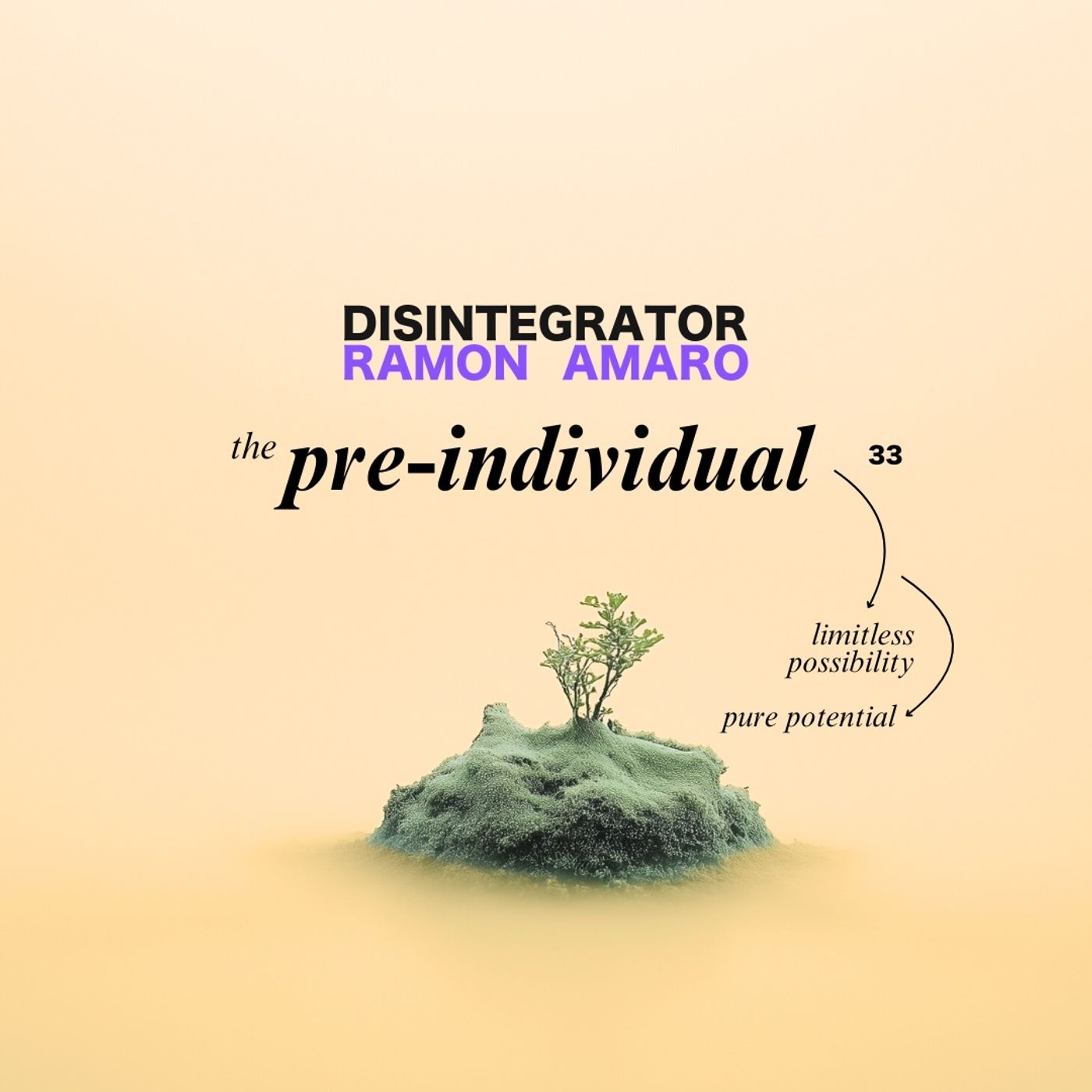
In this transcription, Ramon Amaro discusses his monograph *The Black Technical Object*, which explores the intersection of machine learning, black studies, and the philosophy of technology. He distinguishes blackness from race or identity, framing it as an ontological, pre-individuated state of pure potential that exists within a "pre-individuated milieu"—a space of infinite possibility prior to sensation, language, and articulation. This milieu, influenced by thinkers like Simondon and Deleuze, is where all forms emerge as individuated expressions. Amaro argues that blackness is often misunderstood by technologies like machine learning, which reduce it to a negatively defined category contrasted with whiteness. The "black technical object" reimagines how this autonomous blackness could evolve within technology, forcing computation to engage with blackness without reductive templates. He critiques the perceptual lens that filters blackness through historical, violent categories, advocating for an alteration of perception to unlock new possibilities. Amaro acknowledges the paradoxical tension of situating blackness within a space that resists fixed identity, but insists that existence itself proves its situatedness, avoiding the trap of over-determination. Ultimately, the project seeks to release categorical holds while accounting for their contemporary value, aiming to reshape how we relate to objects and ourselves.
This is the great report, Doctor. We're on with Ramon Amaro, an engineer and sociologist turned philosopher in the creative director of Design Academy, Indehoven. His recent monograph, The Black Technical Object on Machine Learning and the Aspiration of Black Being, is a massive contribution to discussions with the intersection of machine learning, black studies, and the philosophy of technology. So before we go right into the episode, I want to kind of like pre-bake two terms that we throw around quite a bit, one being the black technical object itself, and the other being what Ramon calls the pre-individuated milieu, following Dillison Gattari and Gilbert Cimondon. These terms are super related and they fit into a slightly different perspective on things like race or identity than one that you might be used to. For Doctor Amaro, blackness is not a subcategory of race. It's made out of different stuff than race. It's also critically made out of different stuff than identity. Blackness emerges at the ontological level. It exists prior to any reformulation by racial categorization or identification. You could say it's deeper, but you could also say it's earlier, or maybe you could see it as a kind of limitless potential, right? Like race is then a thing that could be done too or applied over blackness. But that's not how the technologies that we tend to build at scale understand blackness. They understand blackness as a kind of category. In the context of machine learning, it's an embedding, in the context of a database, it's a tag, it's a filter, and more importantly, and you can read this super well through someone like Sylvia Winters' work, it's a negatively defined category. It's a category that's differentiated against whiteness. This space of potential that blackness lives within, this ontological blackness, alongside a cosmic infinity of other potentials, is that pre-individuated milieu. It's the zone of possibility that exists prior to sensation, prior to articulation and language, prior to specific configurations of difference against other things, like whiteness. What Ramon asks us to do in his book is to consider a black technical object, and this is a specific reference to someone like Gilbert C. Mondein. For C. Mondein, a technical object is a way of thinking about technological autonomy. I always like to give the example of an iPhone. Your iPhone is an expression of a much larger technical object, the iPhone generally. What you could think of as a kind of designed and instrumented thing by humans, but you could also think of as a thing that evolves, it sticks, it concentrates, and it kind of specie over time. Technical objects are a great way to think about deep learning, which is something that's actually literally evolving over time, in a way that is observable to us as evolution, much like how we can actually watch things like bacteria evolve. The black technical object then is a project of imagining how an autonomous, pre-individuated blackness might evolve and take shape in other domains, like technology, and then force the question of what it would mean for computation to not just understand blackness without a contrast to a pre-written assumed template of whiteness, but to build a relationship with blackness within computations own pre-individuated share of pure possibility. That's a mouthful, and obviously Dr. Amaro goes through this in detail, but I wanted to give you a little bit of a warm-up in both of those ideas. I love this conversation, our guest is absolutely infectious, insensitive, and very funny. You're going to love it, it'll seriously bend your brain. You know, the conceptions I have on blackness or anything that you can call blackness is one that's sort of ultimately something that lives within the sort of pre-individual state. And this is a state that has taken different variations of names as we know, throughout philosophy and ontology. Probably the closest relationship is delirious and guaturies, influenced by Simondon and thinking about the virtual. I like to think about this pre-individuated milieu as being articulated in other types of languages that cross fields. Some people call it a source, other people call it a type of essence. There have been different conceptions of what this might need. But as Simondon articulates this, this is almost a space that's beyond comprehension because of course as soon as anything is individuated from this sort of milieu and process, as soon as it's actually recognizable through language, through symbolic sort of mechanisms, it's already reductive of the pre-individual state. So it's something that its epistemic relationship and even its perceptual relationship to its articulation will always be in a deficit to the full potentiality of what this milieu might be. And then of course if I think of blackness in that sense, then it just becomes one node in a constellation of other constellations that are flowing around in this pre-individual milieu. So in no way is it an exclusive pocket, but it's something that speaks within communication with other concentrations and amplifications. And it's really here in this sort of theoretical starting point within the pre-individuated milieu, which I begin to think about how different forms that happen prior to that point of individuation might express themselves as a pre-condition. It's almost a bit nichain going back into the recurrent return about this precondition that actually conditions the present moment in terms of sort of present and future possibility. And it's not necessarily a temporal exercise in thinking about the past, maybe what we might conceive of as a black individual or a group or a diasporic type of community is really more so thinking about difference in itself. And that difference in itself of not being in relationship to a type of, you know, this prototypical standard as Gordon would talk about this being, but thinking about difference as difference, that capital D, that something that difference is potentiality, it is a purity, it is something that exists within this milieu that then comes into expression of form, it comes into expression of shape, of ideas and even identity and representation. And I think we're going to talk a little bit about that later. So when I think of the term of blackness in that sense, it's already in living in two modes. In a way, almost this quantum space, you know, there is this pre-individuated milieu, which is always informing each moment of our existence in each articulation of our existence, but then there's also the epistemic articulation of that pre-individuated milieu, which becomes at its present moment the articulation of what one might feel is blackness in itself. And so I what I'm trying to do is account for both of these moments. And in both of these moments, of course, we can see that we're really at the function of language in this sense in many ways. And we can see how blackness then begins to perform once it actually arrives at a type of epistemic level. And I want to really think about not just that performance, but also what condition stage that performance in the first place, and then ultimately how we can return to a pre-individuated milieu to think about different formations in the future. Maybe just like, and this is thinking very binaristically, but just to throw it out there out of curiosity, I'm assuming the answer to this is probably no, but does there exist a pre-individuated whiteness? Like, is that a thing? Like, what does that look like? Yeah. Yeah, absolutely. And this is sort of, you know, the theoretical, nontological dance, because in a way it's an incompatibility. To think about a pure space of potential like a virtual or pre-individuated milieu, and then simultaneously talk about an ethnic or even racialized or even a geopolitical identity as existing within that milieu. It seems, it seems, you know, in first sense, it seems like a contradiction. But in a way, actually the contradiction is the possibility that it doesn't contain the mechanisms of the pre-individuated milieu, because the only way we would recognize those categories is if they've already existed in the possibility of milieu. So it's in suggests that you can't articulate difference within a milieu seems a bit of misunderstanding to me. And so this would also open up the possibilities, of course, that there would be different articulations of being, whether we call that whiteness. You know, however we want to call it. But I think it's important for us to really understand that, for me, when we're talking about, you know, different types of categorical claims, you know, whether it's blackness or whiteness or all these sort of very reductive type of claims in the pre-individual milieu, I'm not speaking of it through the lens of perception of that, which I already perceive in the present. I'm not conceiving of it in anything that is contemporary in this moment, because that's already contaminated by other epithemic conditions of my perception. And in a way, this is what I'm trying to alert to in the book, is that the real boogie man in the room is the perceptual lens of what we think we're stepping into in terms of blackness or whiteness or political affiliation or even solidarities. That's what we think we're stepping into. But actually what we're stepping into is a reductive perceptual field that's already in communication with the pre-existing social milieu. So in a way, when I'm thinking about if an identity can exist within the pre-individual milieu, it's already something that lives outside of our own perceptual field. It's already something that has yet to be articulated, and so therefore to attempt to articulate it would actually be to adopt the same person.
arrogance that unfolds when it epistimically comes into challenge between race and identity. So in a way I kind of want to free it. You know, I don't want to think about that freedom in a post moment, not this sort of resurgence of multiculturalism or, you know, let's get a bunch of celebrities together and sing a song again, you know, hand each other a Pepsi and, you know, and think about how it's just supposed to work itself out. I'm really thinking about what is the essence of being? What is being in itself in that pre-individual milieu and if that being has any relationship to other milieu's and substances that might form themselves as a racial category? So the answer really to that question for me is like a yes and a no, right? So absolutely not. It makes no sense that these constructed identities, these constructed claims, these historical constructions, which we know and a lot of them are either, you know, fundamentally superficial or fundamentally violent or fundamentally uninformed. And it's incompatible to think about something that it's uninformed, how that can exist in something that's all informed, but there's no possibility for the all informed to exist without its shadow, which is the uninformed. They depend upon each other in their articulations. So then to conveniently assume that this virtual world, this pre-individual world only contains what we want it to contain, would be to return to that anthropocentric arrogance, which has put us into this categorical racial tension we emerged in in the first place. And in the way, so again, what I'm trying to do is release that hold into these categories, but at the same time account for the value of those categorical claims in the contemporary moment, because they also alert us to something that maybe we have yet to articulate or understand. Okay, let me see if I find the right way to frame this. I sense a paradoxical tension here between our discussion of the virtual and the actual, the impossibility of situating blackness within the pre-individuated milieu. Space by definition, resists fixed identity or capture. And you know, if we accept that any attempt to define blackness risks, reinscribing the various structures that we're trying to dismantle, how do we avoid that trap? I mean, is it possible to think or speak from within that space without reasserting control over it? Or does the very fact of trying to situate already exposed the limits of how we perceive and how we understand? I think it's interesting for me, and even in the terms of description, you know, to situate already pre-supposes one's ability to actually contain the conditions of the power to situate or to even articulate what's being situated, or even understanding that type of transference and process. But I think I get your meaning, though, because you still have to discursively place something somewhere. So I think in that sense, it's not as if I'm attempting to squeeze this phenomenon of what we might call black identity or blackness or other starts of articulations of difference. It's not that I'm trying to squeeze this and then determine within this larger universal cosmic ecology. I mean, in the billions, in trillions of star systems out there, where I'm trying to situate Southern whiteness or, you know, diasporic blackness is so small in that perspective. It's not that. I'm not looking for its place there. What I'm recognizing is that in these universal conditions, and when I say universal, I'm not talking about a standard generality. I'm talking about cosmic universal conditions, the conditions for blackness, they always already exist within that milieu. So I don't have to situate it. My existence is proof of its situatedness already, just like your existence is already proof of its situativeness. So what I'm trying to do is avoid the trap. So if there's a trap or a loop, what I'm suggesting is that trap or a loop is the misunderstanding that I have a determination or control over the preconditions of my existence in the first place. So then to then presume that I can resituate it, then I would be repeating the sort of same philosophical and ontological arrogance that we have suffered from, you know, for so many years. And I should not mention the K word or B words or H words or, you know, they'll probably come into conversation, but all of the canonicals, you know, we can see the limitations of an over-determination, right? So instead, what I'm attempting to do, especially in the black technical object is I'm seeing this as a problem, as a psychosocial problem of perception. So it's not necessarily that one gains an understanding of difference in blackness in relation to, and that too could be anything, technology, social politics. It's not that one has a full comprehension of that. It's one has a full, a factual experience of the conditions of that. Those conditions are reduced into the recognizable perceptions that have been attached to those conditions. And historically, those sensations have been associated with certain perceptual markers. And this is why I drawn early post-colonial theory of Leif Fanon to show that those perceptual markers had already been conditioned within the most superficial characteristics of our human existence. And so in a way, it's almost like we interpret this incomprehensible phenomenon, we filter that through these visual and sensory perceptual lenses. And then the only languages that we have to understand that are the existing languages of segregation, discretization, fragmentation, and difference in terms of violence. And so almost the intervention, it's not an almost, it actually is the direct intervention of the black technical object, is to really think about what happens if we actually alter our own perceptual fields about our relationships to objects outside of us as well as those inside of us. And in the rearticulation of that perception can new possibilities emerge. And when I say possibilities, I'm not talking about a fictive illusionary possibility, I'm literally talking about a brand new way to look at the field that we're in. And for me, that is potentially a mechanism to avoid this trap. Is that the technical object of the black technical object? Yeah, I would love it if you could speak more to that. Because I mean, the black technical object, one of the most interesting things that I've encountered as a concept, I would love it if you could speak to the technicity involved in this particular, and it is a project, right? Would you call this a project, the black technical object, or is it not? I mean, yeah, absolutely, because it's a project. I mean, that's why the book falls off a cliff, you know, I've showed it, you know, in the end, it definitely took a Hollywood move and said, you know, season two's coming. And I think that, you know, this idea of technicity is very important, but I think it's important in thinking about, you know, it's almost beryxonian in a way, in thinking about time and durability. And I would say it's closer to that realm than it's sort of high-digarian realm. And it's really thinking about how Simone Don is thinking about rearticulating technicity in itself, which of course he starts with the rearticulation of the self in relation to, right? And the only way he can pull that move off is to completely disrupt our own perception of our own individual forms and therefore the pre-adviguated stages. You know, that's even prior to this transductive, you know, move that we make throughout our being. But that moment of technicity becomes very important. My reading of Simone Don is, and really where I'm going with this exchange in the book is, and I don't mention this so much in the book, is it's really influenced by some of my earlier readings in research. I became fascinated with Simone and early German structuralists and thinking about proximity and contact. What happens when one? I'm not so much concerned about, you know, what happens when one picks up a hammer and then all of a sudden I feel like a trade's been empowered because I put this nail in, you know, not that. Maybe, you know, maybe both the industrial evolution, that was the most fascinating concept, right? But I think there's more for us to be drawn with how we actually have to be engaged with the world. And in this sense, when I think about this type of engagement, it pulls me back to that different type of relationship. And let me just back up a second in my early thoughts about thinking about Simone proximity. One, we're really thinking about a systemic way in which to understand the transformation or the transformation of potential or transference that occurs when one enters into contact with the other. And that other, of course, could be inanimate, it could be authentic, it could be anything that is outside or seemingly there is no outside of our being. But it appears to be outside, you know, of our own being. And then what happens when that body, that celestial body, whether in the form of a human, in the form of a social body or even in the form of a social media post, comes into contact with that being. And then what mechanisms begin to alter or spark, you know, even mature and die within that, that catalyzes that next micro-iterrative transformation of us. And this sort of led me throughout the research, of course, in thinking about this German structuralist intervention, you know, this is why DeBoys actually is so heavily stated within the book because, of course, he takes these leanings from Hago, you know, I think this is the most valuable part of Hago, you know, master slave we can develop.
bait forever, maybe that's the whole of the podcast. But, you know, for now, the elements that the boys then takes back to the United States and thinking about this sort of sociological study of race and blackness, you know, there's a very important, I think, is a very important chapter in the souls of black folks, which you know is, it's this kind of mandatory reading. It's mandatory to the point where as, you know, it's one of those where you, you know, no matter how religious or spiritual you are, it's always a song you have to learn. In any kind of context, right? No matter what you believe, there's a song somewhere you have to learn. And I feel like souls of black folks like just on that shelf, you have to read this. So much so that it's deeper analysis gets almost covered over, you know, no one wants to read a peer reviewed article anymore on, you know, Du Bois, you know, no one wants to do that. And the people that do want to do that don't want to speak to anybody because they're sick of us. So, but if we return to that chapter and I think it's called, if I can remember correctly, I think it's called race contact. There's something in either the term he uses his race contact, or I can't remember the name of the chapter of the top of my head, but really what he's talking about and he's very simplistic forms. And we have to keep in mind the time that he's writing this, sort of, by and areas of race. And, you know, he's just come from Hegel. So, of course, he's seen the world. It just apples and oranges. You know, there's always something subservient to something. And what he's saying is the best of one race never comes into contact with the best of another race. You know, the best of one race always comes in contact with the, you know, the worst and this and that. You know, we have to keep in mind for, you know, maybe our younger generational listeners here that, you know, we're out talking about the 1920s, right? And then 1920s American South, there were only two colors, black and, what, actually, three colors, black, white and money. You know, whether that's gold or green, you know, or cotton. But, you know, but if we take a deeper analysis of this, it was quite simple because it's his early treatment of beginning to think about that, that type of zymal contact, that type of what actually of these emergence that might happen when one is faced in proximity with the other. And is this where I draw the parallel with Simone, because in those beginning chapters of the mode of technical being, you know, he really is talking about rearticulating the relationship of proximity between humans and technology. And this is where the haptics and the ethnicity of the engine of the core come in is, is in one's actual recognition of that existence as something that has an equal bearing on the relationship of being as sentient beings. So in a way, Simone was kind of climate justice before climate. He did write two animals in men, right? This rearticulation that actually we are in a communal relationship, a type of symbiotic relationship, and that symbiotic relationship is always already disrupted when sentient beings take the positionality of which portions of that complicated relationship are those which are considered other. And what he's saying, of course, in the beginning comments on negritude, because he does this very short analysis on negritude is basically what he's saying is that we've already rehearsed this idea between human beings and identifying it other, putting languages on that other ring, and then associating meaning, emotion, affect, and other ontological concerns onto that group of people. And so he says that it's no rule I'm thinking about the cliche phrase, like it's no surprise, then that we would encounter a technological apparatus and our first reaction as a sentient people would be to other ring. And that's his proposal to set it free. It's not to set it free to kill us. You know, you don't want to set the train engine free to run over half the population, but is setting it free, what he is proposing is setting free the attachment of the relationship of its own being, setting our need to actually put a determinism on that relationship. And this is where we get a bit hightigarian, it's like how can we actually enter into, because it makes sense to me, how can we enter into a pure space of technicity, but also learn the recursive knowledgeess that come from that exercise, how can we actually engage in an authentic place when the entire engagement is organized by our determinant framework of expectation? And that's where I pull the way, because I think that's something that hightigar and I'm sure people argue, I'll probably receive death threats after this from the purist. But I can't imagine what I'm comparing into as a type of agency between a hammer and a nail. You know, for non puts this in terms of phenomenology, he's playing the card game, this is what Sarah Ahmed picks up, what she's talking about, restitution, right? You know, this sort of haptic relationship with the objects around the room and the cards on the table and the cigarettes and everything else comes into a type of relationship. But there's some mechanisms of that that I feel we take for granted. There's a pre-existing determination with the hammer and the nail. You know, I swing the hammer. There are infinite amount of variations in which I can swing, but it's reductive in terms of its origin and destination, right? I'm looking for gravity, most likely to go top down. There are all these sort of protocols that already reduce that experience. Also, determinant are the material properties of the nail and the table and the hammer, right? So that's even outside of my milieu of its determination of when it comes into contact with the force of my hand and then going into the table. But for some reason, and I won't go more into that kind of exercise, but for some reason, we are conditioned as sentient as human beings to articulate the entire process as being of our own self-will and determination. I am the hammer. I am the one that drives the nail. I am the one that, and of course, Heidegger does address this and bringing it back, which I won't get into now, because of course, I'm being also reductive to that theory. So I'm not suggesting that this is full, but what I'm suggesting is it becomes a starting point for me to consider what would be the difference of relationship between one in contact with a hammer and the hammer and a nail than one in contact with an algorithm, and in contact with an advanced machine learning system. And I think this is something that we perhaps take for granted because a hammer and a nail, this cup in front of me is very material. I can see it. I can touch it. It's there. And we're dealing with very complex technologies today that are obscure. They're invisible. We only feel the effects of them or we see their reductive moments on our screens and our interfaces. So what Simone wants to return to is that relationship with that technological object is in itself a pure relation whereby the human being, as an individual, but communal object, has its own maturation and development, its own genesis, and so does the technological object. But the moment they come into proximity, imagine this is in a singular moment, right? Because they keep coming iteratively in proximity, is each moment that it swings around in proximity. A new relationship is formed, a new relationship is articulated because the pre-individual state they're both in has been re-articulated. And the problem that he's addressing is instead of us setting that process free to think about how they're in relation as a constant dynamic iterative function of the world towards another possibility, instead we solidify the object as being self-evident, which is why right now when we're thinking about artificial general intelligence is spoken of as if it's just inevitable, right? It's something that's set. We've determined that as a culture and when I say as a culture, a culture of, I don't know, what does this boardroom fit? Maybe five people. These five people have determined that this is, and then the rest of the sector industry, even discourse responds to it, I'm kind of going somewhere with this, is at that determination of the relationship with the technological apparatus, you get this trickle-down effect of this self-evident framework of proximity so much so that by the time it gets around to philosophy and discourse, it's responding to a predeterminate relationship of response and it's never actually responding to it, which is why what I'm proposing in the book is I'm not proposing that these types of representational leaves are not valuable because they are valuable, and I do want to talk about why I stay in representation a bit in a moment, but they are very valuable and in everyday epistemic, in terms of survival, in terms of livability, in terms of actually taking some type of agency to carve out a new future, I'm not denying that. What I want to do is think about an additive process of what that might mean in conjunction with the possibility that there is a larger milieu in which the entire relationship in itself can be changed, much as we see like in our political moments, right, where either you really have everyday epistemic actions, direct actions, indirect actions, and simultaneously you're thinking about system transformation, but when it comes to technology, it seems to be very binary. Get this crap out of my face or put it on my screen. Get this, you know, it's bothering me or it's good. It's such a, in my view, it's not to disregard the research and the thought, it just seems reductive of the possibilities of the primo-u and even the condition.
that God is here. - I was just wondering, like, do you have a theory of scale? Like, the scales that we're talking about, like there's a cosmic scale, which you don't presume to speak to, which is great. I think it's probably good that we all stay away from that. It does seem like there's a kind of pre-individuated scale, which is maybe imminent, it's huge, and we're all a kind of part of it. And there's some possibility speaking to that. When it comes to a relationship with technology, like, there's a kind of multi-scale or thing that's occurring, especially in digital technology, right? Yes, I am interacting with the output of a boardroom, but that boardroom is grappling with a piece of technology that's, like, thoroughly distributed. And in the deepest minds, you know, in the DRC, all the way to Nvidia, all the way to. Yeah, so I'm wondering, like, yeah, do you have a theory of scale? What does that look like? And are there boundaries between scales in your cosmology? Or is there like a lot of fluidity? And the registers of agency and interactability? I got triggered in this because you started to speak about politics and, like, political agency. And immediately I'm like, no. So I was so good. Hit me back. For me, thinking about scale is not necessarily a hierarchical exercise. It's more of a type of pure eminence, which is more like a horizontal eminence. It's more of the presupposition of the acceptance that existence is existence in itself. Even the stacking of a hierarchal within that would be reductive of this pre-individuated milieu. So from my perspective in ontology, it's not something that's pre-hierarchized. It's something that's pre-stacked. It's something that has to be stacked, which in terms of blackness is already suspect. And that's why I do the historical exegesis because there is no stacking of the individual in a universal scale with uncertain pockets of difference on this planet that has not already always in relationship to a hierarchal type of intensity. And this is why this attempt to-- I'm not even sure if I would call it break free-- I like to call it more so as a reminder of who we are. And in those terms, the scale in itself become closer to a type of cosmic scale. It's closer to that, which we forget and forgot. And we'll forget in thinking about eminence in itself as being a phenomenon that is far greater than the individual, but is already in communication with a collective milieu of human beings, a planetary milieu of different species, different materialities, and also a universal and cosmic milieu of conditions and circumstances and forces sort of around it. Now, how this articulates on a sort of everyday epistemic and even political scale for me also goes back to Samoan and even Fanon, which is a matter of perspective. It's more so in not thinking about scaling or thinking about or response to scaling is the radical awareness of the potentiality of that, which has already been scaled and a refusal to accept the scaling of that, which has been imposed as scale in itself. And which is why I don't want to scale it because then it just starts that process all over again. And it's here, you can kind of hear the threads of this sort of influence from Moten and thinking about how this type of fugitivity become epistemic. And I know there are these waves that are over that. Everyone expects some concept to just work, and then they disregard it. We tried to be a fugitive for two years. It didn't work. Screwed fugitivity. You know, this is how we operate with ontology. I'm leaving myself. I've been in so many forms where someone has asked me, what's the solution? And I'm thinking you literally think I have the solution to global racism in this moment. But if I did, I don't think I would be there. But I think there's still value in this type of undercomments, not for the act of undercomments in itself, but the psychosocial potentiality of what that might mean within certain scaled spaces. So for me, it's not so much important to think about imminent scale or lack thereof. I'm primarily concerned with actually how we negotiate any scale. Like what happens when we enter into proximity with a scale that can't be recognized, what transformational shifts that happen psychosocially, physically, metaphysically, to alert us to its recognition. And then once we actually recognize that scale, that's where the epistemic action comes in. But if we're not in the proper psychosocial space before the action happens, we end up acting before we think, and we think we're acting on what we want. But we might only be acting in the duress that we already know. And the only way to break that is to break the perception of the scale. So the scale was always a scale and at the same time, a bowl of jello. It's a bowl of fruit loops or whatever you want to imagine. It has to be because we can't trust-- and I don't say this in a negative sense-- I say, we can't fully trust this information, which I think is quite in the irony of our computational moment, having access to so much information, is that I think many years ago, I thought that the response to this would really be to reduce that information, compile certain elements for it, and then think about a livability within it. However, what I'm witnessing in this moment is almost taking that exaggeration and amplification of information as itself being self-evident. And then scaling that. So in other words, we have contaminated ingredients that reach far greater than messy data, than a bad training set. It's far greater than that because our entire perceptual field in this complicated mass that we call the world right now is already infused with these substances that contaminate our visual field. Our perceptual field, our feeling of field is why everyone's in therapy right now. We're all disjointed. We can't feel the world anymore. And then when we do feel the world, we only feel it through a narrative of something that's imposed. And so the block technical object in a way is almost trying to give a permission to feel and be in this world that can live somewhere that doesn't depend upon an over-determination of an externality. And so it's there when I return to machine learning, not as this sort of-- when I say, OK, we get into a relationship, I know we're trying hard with natural language models at this point, but I don't need an AI to be my friend. I'm not talking about I invited to the cook out. And all of a sudden, it's like, don't eat that sausage. That's the AI's. You know, no, I'm not talking about that type of community. But when I am talking about a community is something that, for whatever reason, as a cultural milieu, just like we invented the saw mill and the colonial ship, we have invented culturally this thing. I know some would argue and say, no, the way man invented it, I didn't invent it. But the fact is, is in community together, we are all responsible for the conditions of this. It is disproportionately affecting people on the planet, but its conditions of creation are all of ours. And I'm not talking about a company making it, talking about all of the social conditions. And if this belongs all in the social conditions, then it's possible that what we're facing is an over-concentration of certain voices within that, which is what we see, right? And then we see pockets of artists that are like thinking about new articulations, even, first people's nations, thinking about different mathematics, different forms of code, interacting with it in different types of ways, and putting it into service of the relation. And so what I'm trying to do in the book, "Techno Object," is one, alert people to like, look, this is the basic epistemic function. So you don't have to know mathematics. You don't have to get a degree. It's not simple, but you can learn it. You can learn it without maths. And you can learn how it works, just like you learn your aunties, macaroni, and cheese recipe. You got to learn it. There are steps that it takes. There's an intuitive sense of how it's engineered and it's constructed. And it's designed to do certain things that meet. Some people say this tastes great, and other people to say this is the worst thing I've ever experienced. Just like aunties, macaroni, cheese. So what I'm hoping is that once people enter into this relationship with it, also enter into a relationship with the historicity of those type of dominant, categorical voices in the violences that they come with it, what I'm hoping is that they're left with a basic function. We have a human sentient milieu that has now nodded itself into so much complication that it can no longer find any source of origin of anything. We don't even know where a flower comes from anymore. There is impossibility of finding origin, let alone our social systems, discriminations, misogynies, and transphobia, all those things. The origins are so complicated at this point. And if we have these origins that are this complicated and this situated, but also have this much impact within our lives, the proposal here is to think about how might the algorithmic articulate a different relation, not to ease those symptoms on that end, but to offer other opportunities in which we might capture livability. And it's here where I sort of simplified computational technique and basically say, and I've said this in other forms, and this is what I mean behind it, no matter how sophisticated these technologies get no matter how fast they are. They will
will always be a process within the algorithmic process, which is only comprehensible from machine to machine, or by the machine. And even the machine might not understand whatever understanding is ontologically, even the machine might not understand what it's processing in that moment. And for me, the proposal in that sense is quite simple. And this is what I've said in other forums, that for me, what that means in terms of consequences that there is something on this planet, right now, that has the possibility to live within the space, even if it's a micron of a second, I don't know the measurements of second, so you guys blast me later, whatever the smallest unit is. Right, engineer, I don't know that. But whatever the smallest unit is, even if it's a fraction of that smallest unit, that still means that there's something that we have access to in an existing contemporary relationship that lives outside of our own human perceptual field. And instead of us tapping into that as a contingent plurality of a process, and who knows what methods might come to that, instead of that, we reduces this entropy. It's noise, the incomputable. And of course, here's where we get to be at least in fraudsie, right? And thinking about the incomputable and what that actually means, and that's our proposal, is that this space can be another space. And what I'm suggesting in the black technical object is that this isn't a theoretical space, it's actually real. The problem is the proximity to that realness has only been occupied by certain voices. And what happens if we begin to occupy that? I don't know what will happen. I don't even know how we might occupy it. But I think it's an exercise that's worth thinking about. It's basically you have someone at the cookout who is not bound by the same perceptual conditions that we are that forces into, when I say force, I mean our own selves to ourselves, subconsciously, would force us into the act of these relationships. And so my previous writing is, "AI is an act of thought." See, that's where I'm deriving this concept. It's actually, there is an action of thought that can happen in that moment, and that action of thought can combine itself within relation with the contingent computational mechanism of whatever thought might be, or whatever that might be. And if there is anything about a generative space of possibility, it would be that. It's like that one friend you have that doesn't know the tea that enters in the room where everybody else has been in the same fight for three years, and then one person enters, that's not in that fight. But they can join the community because they can parent that fight. So they act like they belong. They'd be like, yeah, yeah, yeah. I remember when you say, yeah, yeah, yeah, I remember. But secretly, they're saying, I'm not in this. I'm merely parroting this relationship, which is what the algorithmic is doing at the moment. It is merely parroting exactly what we're performing. And then, of course, we outsource all of that difficulty and impossibility back on the algorithm itself and say, solve this for me. This is the same relationship that we had with natural resources. It's the same relationship that we had with trees. Simone Dan makes this point over it over against the same relationship we had in colonialism and slavery, this re-emergence of other types of politics, and it's the same relationship. And so I wonder, when are we actually going to break that cycle? And then, what is going to enable us to break that cycle? And it's becoming increasingly more impossible to think about where that break might happen in a field where we've all drank the Kool-Aid. Some of us have drank the green Kool-Aid, some of us have drank the red. We can identify with the pineapple Kool-Aid, we can do all of that. But the fact is, is we're all drunk on it. And if we're all drunk on it, then perhaps what we need to lean on is something that's not drunk. I don't know what it is. I don't know what it might do. Maybe it will be the thing that kills us before we kill us. But what we do know is that the possibilities of computation that we have tapped into are insufficient. And when we think about potential for computation, that narrative is predominantly within the narrative that sees it as optimization and efficiency. It doesn't see it as possibility, pure possibility. It sees it as the possibility for economic exchange, for reconfigurations of labor, for other forms of productivity and extraction. What we have not done is treat that level of computation like that movie. What was the movie with the aliens came down and they were like speaking a language? A rival, that's what it is. And it's thinking about, okay, you know, artificial gender intelligence does not need to happen. But we live in this world in 2025. We know, if some folks want this thing to happen, it's going to happen. And those folks wanted to happen. I think we've all recognized that now. And we're all thinking about what do we do with that and those folks and all this stuff. But if this isn't a rival, don't you think it's necessary that we begin to communicate in a different language? Not for its conviviality. You do have some people like, I'm being nice to my chat GPT now. Like, you know, I'm a theorist in a philosopher, but I'm not arrogant enough to think that if something land on this planet, it wants remote. You know, of all the cosmic possibilities, like finally the guy with the black technical object, we've been travel billions of light years to make sure. But you know, being silly here, but you know, the point I'm trying to drive is that there's a chance now in which we can begin to learn not that it has something to teach us, but actually being in community with it, reconciling that community because real community and real work drives just like human community and human work where we can be able to talk and say, this is what is not working. This is what's working. How do you negotiate this? Your resources are not sustainable. If you want to live, then how do we have a different sort of possibility? The same negotiations that we would have to have with a neighbor or a friend or a partner or a family member. But again, as Simone Dences and as Fanon says, we're preconditioned to think of the other as outside and therefore are then become obsessed with our own positionality to the other that we actually divorce that entire possibility of a different type of community. And how that community is articulated, I honestly feel, you know, it was eight billion people on this planet. It will articulate itself in potentially eight billion different versions, which is the real risk. So the real risk of artificial gender intelligence in my view is not some sentient moment where we're all be slaves to the algorithm and stuck in our self-driving cars until it wants to spit us out. That's not the real threat. The real threat is the impossibility for us to actually enter into a new condition. The real threat is the idea of our own subservience. How damning is it after all of this struggle of our possibility of even being on this planet? When I'm into talking about you just happen to be born in Italy or Germany, you know, I love national attachments, right? If you want to talk about a contingent process that we take too seriously, it was a random act that my mother had birthed. Like it's not subcosmic determination, you're I don't know how to be, you know, it is what it is. But to think about the evolution of types of processes that had to happen in unfold, even for us to be able to have this conversation, even for us to be able to talk about something like computation, is a miracle in itself. If you really think about it, we're living on a planet where it is difficult to smake it through the day. Let alone make it through evolutionary, transgenerational types of processes. But those moments of joy, those moments of actually gratitude, those moments of recognizing the possibility of that impossibility that can now be in some type of community with computation gets completely usurped by other conditions that we'd rather focus on. And as long as we focus on that, and this is what the Black Tacoma Office is proposing, as long as we focus in that type of linearity, one day there will be, or right now there needs to be, or types of binaries, as long as we stay within that function, I don't think we will recognize until it's way too late that we have actually missed the moment to enter into this new relation. And all we're gonna do is repeat the cycle back if we should have what it could have, and maybe if, you know, blah, blah, blah, blah. And ultimately that's the danger to sort of swing back into representation. That's the danger, that's the risk that I'm trying to identify in the Black Technical Object with representation. It's not a denial of it. The risk is something that we've already seen. It's a false relief. It's a temporary relief, and it's something that won't satisfy what we're all feeling inside, which is our incompatibility is between our own authentic way of being, and that which we're forced to articulate outside in the world. I would like to take a step back to discuss the power of invisibility and how it intersects with the concept of the Black Technical Object. So much.
Sovei, both its technical infrastructure and epistemic foundations, seems built through what we may describe as a white modeling of the world, and modeling that is rooted in colonial logics of recognition and value. But your work gestures toward blackness as a side of kinetic dissonance, as a space of rapture, as a space of invention. So the question is, do you see this as a space where that loop of representational capture might break? I mean, could blackness understood not as identity but as a transformative force open up an entirely different relation to the algorithmic, one not bound by recognition but by a kind of generative opacity? In one sense, yes. You can't say, you know, on its surface that, you know, the algorithmic has been constructed within the image of whiteness. In another sense, it's a challenge to think about what on this planet is not constructed within the image of whiteness. And of course, we're not talking about white people, we're talking about whiteness as a concept. And if that is the case, then this idea of whiteness becomes the same substance as the idea of capital, the same substance as the idea of class, right? It's the same substance. And that's where Silvia, Winter and Phonon are going with this, is actually, it's the same substance that's almost like atmosphere or gravity that has become this sort of naturalized process that's down. Where I turn to Simondon is not so much for thinking about retracing those steps so much, I think that's very important to think about that origin. It's also very important to think about how this is constructed within certain dominated images. And of course, in 2025, that's even a complicated claim because we have folks that don't even identify as white who are just along, you know, they're super soldiers, right? There are a lot of universal super soldiers right now that identifies everything. That's why we're having this political moment, right? It is the diversity heyday. So, but to go back to your question, in a way, what the Black Technical Object is really alerting us to and critiquing is the idea of the construction of within a particular type of condition. So the algorithmic is constructed within an image of whiteness, therefore everything outside of whiteness is seen as the other, therefore the other must act against the structure as well as whiteness. We're back to Hacle again. Can't get up it. And so what I'm attempting not to do is then just replace whiteness with blackness because that's the trap of representation. You know, I wish it was mandatory reading to do black and diasporic art history in the 90s because they were steeped in multiculturalism. They warned us against this, right? Using one thing about another will only replicate the same violences within the type of milieu. Instead, what I'm looking at is the replacement of that entire structure that recognizes that these ingredients are already within that milieu, but that a solution to that milieu is a plural solution that taps into that historicity to articulate itself in an individual as well as collective moment at the time of its articulation, because to draw back to source would only draw us back to the pre-existing constructions of whiteness or blackness or transness or whatever we claim. So in the other words, if I put this quite simply, the bacterial object is basically saying, if you find your community in well-being within the category, I am so happy because what we need is love and community. We need to feel like we belong somewhere. We need to feel like we're not crazy. We need to feel like, even if we do feel like we're crazy. We need to feel like we like being crazy. Anything in that concept. But what I'm advocating for is let's not conflate that sense of belonging, even attachment to one's history and heritage. Let's not conflate that with the category itself. So let's not once again attach ourselves to this pure essence of blackness, which somehow is supposed to save the world, fall into the American Express, like all of the American Express Obama trap. I forget the gentleman. Remember, I don't know if you remember this or you knew a few years ago, there was a black man, and I'm sorry, sir, if you're listening, I don't know your name. But there was a black man who was like the CEO of American Express and all of a sudden, all minorities thought they were going to get credit. But this representation actually changes the structures underneath the disappointment with Obama, all of a sudden within two weeks, hundreds of years of slavery and colonialism was supposed to be bureaucratically written out because his essence of being is there somehow I belong in the white house, all these false attachments. And then this disappointment and crash when you realize that it took them $3 billion to get into that off, then the crash of the illusion happens. And so what I want to do in a way, psychosocially and perceptually, is avoid the crash because the crash is based upon an illusionary figure. So if the algorithmic is constructed in whiteness, that means it's constructed in an echo. It means it's already constructed within a fictive illusion of a type of mechanism, which means that if I'm already recognizing an as-a-fictive solution, I can treat it the same way I would treat an unethical salesperson. Like we're giving it way too much power. If there was a human being that behave, you know what, I'm going to take this back because we're in a different political moment and this will not hold. I literally think whatever I was about to say literally would be outdated in the next five minutes. So I'm not even going to say it. And we're just going to say it. Because who knows what's coming today or tomorrow. I'm just going to say it's concerning the algorithmic in itself. I just think it's worthwhile to constantly remind ourselves not of it as a source, but again, it as a main ingredient in our gumbo. And maybe one day it will be the broth or the sauce that runs through it. And you have all these individual objects, the carrots, the, you know, the prawns, the sausage, you know, everyone's something in this soup. And maybe it will be the fabric that brings it together. But again, what I'm suggesting is to continue to put it within a container, a limited container would continue to reduce the possibilities of the contingency which that gumbo contains. And that's, that's this sort of prehension and psychosocial split that I'm actually advocating for. That is a type of prehension into the future, the type of hyperstition. I'm arriving at the present in a space that I can only imagine that I might be in the future because that's what Moten is asking. Imagine, that's what he asks us in a break. Imagine, now, it's a hyperstition. And if we're able to do a hyperstition of that which we imagine in the present moment and then demand that our other components in that relationship, the algorithmic also meet us at this present moment in a hyperstitial lens, then perhaps new possibilities can unfold. But we can't do that as long as we're encasing it within a mechanism, you know, these rigid mechanisms like whiteness or anything else because you can already see the reduction there of that possibility. So even if it's true, the idea that you immediately attach to it before a thought arrives or even an action or an emotion or feeling, you were already in communication with whiteness. And I would love an existence on this planet where people can be who they want to be without being in reference to something else, whatever that something else is. So if an algorithmic only exists in the construction of whiteness as a hypothetical, then perhaps the project of getting rid of it is sufficient. If it can exist outside of that space, which I think we have proven at this point, then the possibility exists that that attachment in itself is a desperate attachment. And perhaps it's had its day. Maybe that explains the intensity just like capital, right? Maybe that explains it as, what was it? It was Tony Morrison, I think before she died, you know, she said, you know, this is the white man's last stand, right? This is the technocrats. The last stand, people are over this. Right. This techno dream, this techno illusion has been broken. Even the everyday person is like, I went to rack with this. I don't really care, but I'm over it. It's just a matter of time before we're going back. I mean, all the new art students, all the young people are already going back to DIY tech, analog components. They're thinking about another register of computation. However those that have concentrated wealth and power, they're the ones sending us on this general, this general type of menu. And what I'm thinking about is not how those spaces become compatible. I'm thinking about different spaces of recapturing that don't depend upon where dominance circulates, but also at the same time has the reconcile where dominance circulates. And for me, when I look historically in blackness, isn't diasporic communities are the only ones to do this? It's the point to emphasize, but when I look historically, it became a ethnicity and a way to live that had already been conditioned within that possibility. That is how I'm here. I am the descendant of slaves. I was not supposed to survive. I only survive by a high-pestitional power.
possibility of my potential survival. That is what created my survival. Not the epistemic everyday conditions. That was an accident because they found someone somewhere found 30 seconds to hang out. Like that was a coincidence. But my being in itself is of a greater condition and I shall not reduce that being back into the conditions of maybe my generational conception. You've mentioned young artists twice. Is there is there some optimism there? It like what's what's your relationship with young artists? Is there like some is there some superpower that young artists have or are they just like a good example? You know of course as a heavy generalization because it articulates itself in different moments, but I've had the privilege to see quite a few artists that are in a space that I have an experience in the you know the few decades I've been on this planet you dare not age me, but I'm sure some large language model can find it somewhere, but But you know I see a different fire. There's a certain courage. I mean, there's an exacerbated amount of neuroses and anxiety right I wouldn't want to be a 13 year old now. I can't tell you what I was thinking about now. They're thinking about like planetary crisis collapse. You know, I was thinking about GI Joe and Lagos But anyway, you know I don't know there's a pressure, you know that they're on, but I think one of the things that I see just in teaching and and curating and actually being with with young artists is there's an undercurrent in which they The best way I can articulate it is there they seem to be fed up fed up with the impossibility that they cannot be just a young person anymore So they're fed up with the narratives of what computation can be they're fed up with the narratives of how far or we can take digital artworks or aesthetics and they're creating their own pathways These pathways are generally connected to larger social issues, you know some of them are take you know Want to take on migration others are talking about you know what it means mothering language race all these types of mechanisms In which you're dealing with but it's the way that they're in community with computation You can see that the computation in itself is demanding it meet them at that space of refusal And so you see them a lot more like I need the tech to do xyz As opposed to you see the tech is doing xyz and then I need to respond to it Many of these artists are just taking hold and I think a lot of alternative types of coding practices are also taking you know So I'm thinking about you know any way communities that are that's why reference like thinking about different forms of mathematics You know different forms of things that don't exist in their languages Which force them to think about a new way to code Which in itself is already a contingent condition and already thinks about new relational possibilities within that community and what I'm hoping is not After that process they don't just put it into service to count how many you know chickens are in a barn or who needs the work at eight To seven I'm hoping that they'll actually release it into something of real value But at the same time when I'm seeing is thinking about this generational You know and I actually don't even know if it's a generational shift I think it's just an amplification that's based on other Impossibilities and other pressures that is really putting Young artists and makers in a position where they can no longer imagine the future But somehow feel comfortable designing it And how the algorithmic and computation comes into conversation with them at that place I mean maybe a final question for me and this is like I've been kind of dancing around the kernel and I kind of want to ask it directly like It feels To use your gumbo analogy it feels like if this poison the gumbo we need to We need to do another pot of gumbo right like it feels like this this this there's a there's an element of contamination There's an element of something kind of being ruined and dangerous at a certain point And I guess like and that that I'm reading that into your understanding of applied computation And I guess like we're going all the way down to the smallest units of time We're tapping into the emergent kind of contingencies At the the problem of computability itself. We're talking about alternative regimes of mathematics We're talking about return to analog Is there a is there a retroactive? We need to start over kind of component to this how how far back do we need to go if we need to start over Or is it rather a matter of I guess simultaneous new beginnings and infusions into a contemporary state Yeah, I think it's a it's a question about like how is there a conservative Like little nugget in this project It's a complicated question in many senses because Of course, I think we're you know, we're talking about a matter of language again I'll start with thinking about the gumbo in a way. I'm not advocating for an immediate reaction of throwing out the soup throwing out the pot even get rid of the hob You know, sorry in the UK we can get rid of the stove You know That could be a necessary process and many I know many feel that that's the only process right that that is and I think those feelings are very valid What I'm looking at quite simply is I'm looking at the combination of the two is how one can recapture since a being and livability While simultaneously having a radical awareness of the duress that exists real time And if that's the case then that wouldn't necessitate not throwing out the gumbo But collectively figuring out how just like Auntie who already spent those that grocery money she's not throwing out that pot honey She's gonna fix it She's going to fix it Maybe we need to add more water, you know, that's been the attempt That's the representational camp maybe we need to add more black voices more brown voices more trans voices Right maybe we need to think about different combinations because if you add a bit of citrus is going to change the You know the the saline in the mix so maybe we need a different constellation there It's a combination of contingent processes and babies And for me, you know, that's why my book is in philosophy because for me a simultaneous space of that is intervening in this trajectory of philosophy itself So the book is actually written for the future engineer. It's not written for now I want a future engineer that's about five euros old right now to pick that book up before they go work for SkyNet And in that possibility is so what are you thinking about and I think this lens to what you're saying about this kind of historical Container within computation which I don't disagree with because it has been disproportionately represented and constructed and even distributed Is what happens when we take that as a historical lesson as opposed to something to go back to Because if if our ancestors have taught us anything is that you can access the past real time you don't have to go back to it It's point was to be you know because each moment in this present We're constructing the past of our future selves So that means is that each recurrence of the thought and idea and possibility gets a brand new chance at the moment that we want to articulate It how we find that moment I think is maybe it's impossible to do it as one Collective but what we do know is that there is a ripple effect. So maybe we're back at scale now What we do know is that it's like those you know a drop of water on a table is You know it's inconsequential But you know if that turns into a stream That becomes something else you don't require every molecule of water to be the same And I think that's the misrecognition that we're having is when we're thinking about resisting these technology of thinking about something new It's very easy for us to adopt an idea of a university of approach and method and thought and idea When really what this is is a combination of ideas that have to have different articulations and different intensities and we require different things from us So when auntie changes the gumbo it's too salty How she has to fix it will have different relations with the different ingredients But somehow we want all the same relation as if we're all going to have a planetary general meeting and come to a common agreement We can't even get on the bus together and we're talking about a planetary move to we haven't arrived there yet We want to arrive there for a very long time And even if we did arrive there is going to be some nonsense that has nothing to do with computation like what would destroy that meeting Would be something that has nothing to do with computation just like every communal collective that's ever been destroyed You're like look at the history if you don't believe me look at all the documentaries those Experimental communities that wanted to live outside of capital live outside of urban planning They weren't destroyed by the man or power they were destroyed because somebody got jealous Somebody stole someone's frying pan Right the manifesto went out the window as soon as Tina realized she wanted that pot That was the end of the collective and to imagine then that we would have this collective moment Of individual beings coming together and then after this general meeting we have an agreement on what to do with this is ludicrous to me How can we not create the conditions now? Where as the plurality of that experience become each moment of plurality of that experience becomes Amplified and just as important as another moment in the way that they get articulated not a cat.
capturing of that space and asking for response. It's one of the reasons why I mentioned arts and culture because this has been the testing ground for a lot of generative technologies. But it seems so. It's less capture creativity and then show those that are participating in it how we can make their lives easier. Like people don't get art degrees to make their lives easier. (laughs) Like people don't go into music to make their lives easier. All right, it might make their lives faster, right? Like, you know, and of course that's productive 'cause maybe it'll save them a couple hundred quid or dollars and you don't have to get a producer 'cause they outdo it for a life mate. Maybe that, but it's essence. And maybe this is too Benjamin for a lot of people. You know, this aura of what it actually means to be, to main, to feel, to exist, is that which can't be captured because that belongs to each individual being on this planet and gets negotiated with and changes and morphs and grows and shrinks as we come into proximity with others in this world. So that's the short answer to, you know, making this up or not going back. I think in that sense, just kind of one final thought is, I think this type of historicity is very important because also that seems like a contradiction. I mean, most of the black technical object is a historical exegesis of this because there is value in knowing where you come from. I mean, culturally for me, you know, it's an impossibility to exist without bringing that value into the present. That's what Fanon taught us as well. This was Winters taught us as well. You're always at each moment of breath bringing in your pre-existing conditions that are combining with your present conditions and your future possibilities. You can't really escape it. But that can't be confused with going back because all of that combined, and this is where Simone teaches us in this type of transduction in this moment of a phase shift, this is the phase shift that he's talking about, is it's only there to alert us of the incompatibility of the present moment, which is prompting us to do an act of thought so we can phase shift into our next moment of being. But we miss the bus of the phase shift because we get so focused and bogged down with the incompatibility of the present moment. With the incompatibility is just a warning sign, just like a smoke detector that the house is burning. And instead of us leaving the house or putting out the fire or building a new house, no, we're sitting there staring at the smoke detector and asking it to include smoke so it can stop screaming. (laughs) That's representation. We need to break that cycle and say that this isn't alarm. We have something on this planet, which is very good at mirroring back every beautiful thing and every nasty and violent thing we have ever conceived of. And instead of us using this as the holy grail of information on how not to behave, instead we blame it. Don't you dare show me this. Don't you dare put this in front of my face. Don't you dare. And then I dare not say then you have the technocrats who then rely upon that desire and application to continue feeding that cycle. They're perfectly happy to feed that cycle and we're perfectly happy to consume it. Because possibility doesn't sell. Real possibility doesn't sell. Real possibility can't be marketed. Real possibility can't be sold as a potential career or as a potential escape. Because anyone that has ever entered into a space of pure creativity process and we all have, regardless of if you're making a sculpture or washing the dishes, we have all reached a moment of pure possibility and in that moment of pure possibility is where humility happens. Because it's in that moment where we touch into that which is greater than us, whatever that source is. And it's in that moment where we begin even for a microsecond to think that we can be something that we have yet to articulate and let's not miss that moment. So in a way the book is quite simple when it's complexity. What we do with that moment is up to everyone else. It's up to you. It's up to me. It's up to you. And then we get on the whole debate about ethics and that. But I'm not, it is too loud. (laughs) (laughs) (soft music) Subscribe to this podcast for more analysis at the intersection of algorithm, subjectivity, and the odds. This is the greater podcast. (soft music)
Podcast Summary
Key Points:
Blackness is defined as an ontological, pre-individuated state of pure potential, not a subcategory of race or identity, and is distinct from racial categorizations that are often negatively defined against whiteness.
The pre-individuated milieu is a space of infinite possibility existing prior to sensation, language, and articulation, from which all forms (including blackness) emerge as individuated expressions.
The black technical object, inspired by Gilbert Simondon, reimagines how an autonomous, pre-individuated blackness could evolve within technology, challenging computation to engage with blackness without relying on reductive, contrastive templates.
Ramon Amaro critiques the perceptual lens through which blackness is understood, arguing that current frameworks reduce its potentiality to superficial, historically conditioned categories.
The project aims to alter perception to open new possibilities, avoiding the trap of reasserting control over blackness by recognizing that existence itself proves its situatedness within the pre-individuated milieu.
Summary:
In this transcription, Ramon Amaro discusses his monograph *The Black Technical Object*, which explores the intersection of machine learning, black studies, and the philosophy of technology. He distinguishes blackness from race or identity, framing it as an ontological, pre-individuated state of pure potential that exists within a "pre-individuated milieu"—a space of infinite possibility prior to sensation, language, and articulation. This milieu, influenced by thinkers like Simondon and Deleuze, is where all forms emerge as individuated expressions.
Amaro argues that blackness is often misunderstood by technologies like machine learning, which reduce it to a negatively defined category contrasted with whiteness. The "black technical object" reimagines how this autonomous blackness could evolve within technology, forcing computation to engage with blackness without reductive templates. He critiques the perceptual lens that filters blackness through historical, violent categories, advocating for an alteration of perception to unlock new possibilities.
Amaro acknowledges the paradoxical tension of situating blackness within a space that resists fixed identity, but insists that existence itself proves its situatedness, avoiding the trap of over-determination. Ultimately, the project seeks to release categorical holds while accounting for their contemporary value, aiming to reshape how we relate to objects and ourselves.
FAQs
It is a zone of pure potentiality existing prior to sensation, language, and specific configurations of difference, like race or identity. It is the space from which all forms, including blackness, emerge.
Blackness is not a subcategory of race but exists at an ontological level, prior to racial categorization. It is a limitless potential, while race is a category applied over blackness, often defined negatively against whiteness.
It is a concept inspired by Gilbert Simondon, imagining how an autonomous, pre-individuated blackness might evolve and take shape in technology. It challenges computation to engage with blackness without contrasting it against a default whiteness.
Yes and no. It is incompatible to place constructed identities like whiteness in a pure potential space, but the pre-individuated milieu must contain all possibilities, including those that form racial categories. This avoids the arrogance of assuming control over what the milieu contains.
He reframes the issue as a psychosocial problem of perception. By altering our perceptual fields and recognizing that our understanding is filtered through reductive lenses, we can open new possibilities without trying to control or fully define blackness.
Technicity involves the transformation that occurs when one entity comes into contact with another, sparking iterative changes. It helps rethink how blackness engages with technology and the world, drawing on Simondon's ideas of proximity and transference.
Chat with AI
Loading...
Pro features
Go deeper with this episode
Unlock creator-grade tools that turn any transcript into show notes and subtitle files.
 PodcastTranscript AI