And so there was one night and somewhere in the mid-80s
when Harvey came to me one night
because we all had dinner together every night
at 7 p.m. as a department.
But, and he said, we have a difficult situation.
It was a very large multinational business.
It had about seven layers of bonds,
probably 15 to $20 billion of bonds,
and they were having issues.
And he said, look, we can't use Chapter 11
because it was a multinational business.
And back then, the law outside the U.S.,
the bankruptcy law was basically liquidation if you filed.
And you couldn't do an out-of-court exchange offer
because there were about seven tiers of bonds.
You were never gonna be able to find anything.
He said, you're our most creative associate.
Go figure out something new and different.
So I started reading through the indentures
and thumbing through the bankruptcy code.
And around midnight, I thought I had an idea
and I wandered down the hallway
to my buddy, John Rhapsody,
who runs the practice at Elm Albany.
And I explained the situation to him.
And I said, there's a provision in the code
that allows you to solicit before you file.
If I could do that and get in and out quickly,
I can take advantage of all the provisions of Chapter 11
to bind bondholders and get a deal done.
And I could, but I could avoid a liquidation
if I could get us in and out pretty quickly
and explain it to him.
He said, yeah, it makes sense.
By the morning, I'd written a memo for Harvey
on what I called the prepack.
And he called me in the afternoon and he said,
it's very interesting.
It's exactly what I asked for, new, creative.
We're not going to do it.
And we're really not going to tell anybody about it.
So just forget about it.
I didn't forget, but I thought it was a good idea.
I thought it was a good way to save companies.
So a couple of years later, I decided to leave
and I went to what was then a small firm,
a Solve and Grave in Caravell,
which later merged into Elm Albany.
And I was the restructuring department.
And again, it was just fortunate.
- Hello there, M&A advisor community.
This is Roger Argynaldo and welcome back
to the M&A advisor podcast.
Since 1998, the M&A advisors mission
is to recognize achievements, provide thought leadership
and connect professionals in mergers and acquisitions
for the purpose of improving your dealmaking craft
and accelerating your deal flow.
We're so glad you're joining us
for this insightful and inspiring podcast conversation
curated for mergers and acquisitions professionals.
Whether you're an aspiring dealmaker,
a seasoned professional or just curious
about the world of mergers and acquisitions,
you'll find something valuable and relevant in our podcast.
Our goal is to bring you the best insights, stories
and tips from the experts who've been there and done that
so you can learn from their successes and mistakes
and take your dealmaking skills to the next level.
But before we dive in today's episode,
we have a small favor to ask you.
If you enjoyed listening to our podcast
and find it useful, please consider following us
on Spotify, Apple podcasts and YouTube
and subscribing to our M&A alerts newsletter.
You can find the links in the description below.
This will help us reach more people like you
and grow our community of M&A professionals.
It will also let us know that you appreciate our work
and want us to keep producing more quality content for you.
Plus, you'll never miss an episode
and you'll always be in the loop
with the latest trends in the M&A world
to improve and accelerate your dealmaking.
So please follow us.
You are the reason we do what we do
and we couldn't do it without you.
And now for today's podcast.
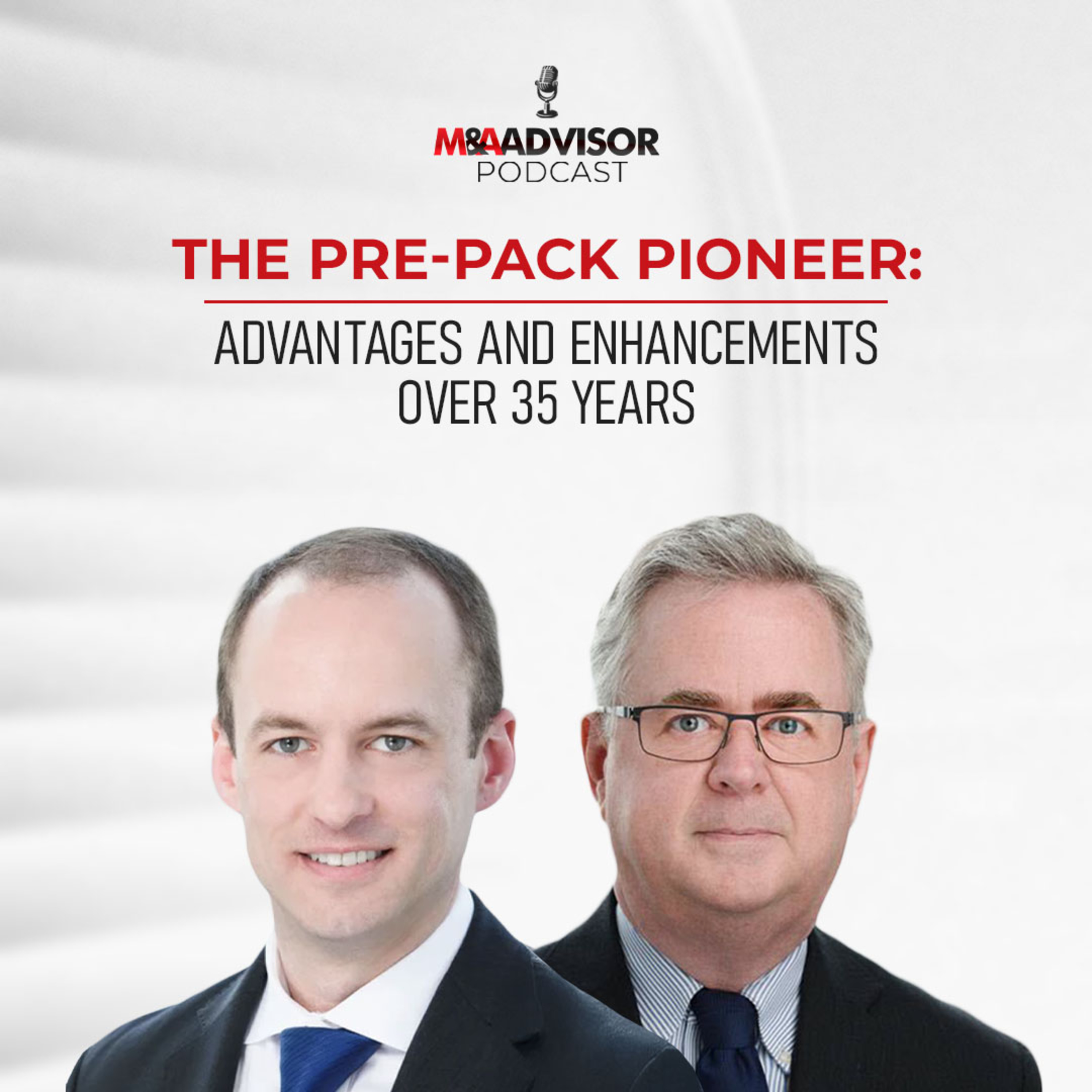
Our next session is with the pioneer of a prepax,
advantages and advancements over 35 years.
This conversation is with the inventor of prepax,
Mr. Jay Goffman.
He is the co-founder and co-CEO at Smith Goffman Partners
and he will be in conversation with Derek Hunter,
who is a partner at Kirkland and Ellis.
Please welcome them.
- Great, thank you.
And thanks to M&A advisors for being here, Jay.
Thanks for talking to me today.
As was mentioned, I think the topic of this panel
is prepax, the invention of prepax,
a lot of technical stuff that we could talk about,
but they gave me the mic
and gave me the opportunity to interview one of the greats.
And so I wanted to start, maybe zoomed out a little bit
and just talk first about your background,
your early life, how you grew up
and how you got into the practice law.
- This better?
- There we go, okay.
So yeah, I grew up in Long Island.
When I went to college, my mother wanted me to be a doctor,
so I was pre-med.
After four years of majoring in chemical-psycho-biology
with an emphasis in neurochemistry,
I decided I hated science.
And I much preferred talking about business and economics
with all my friends, so I went to law school.
Got done with law school, went down to school in Chapel Hill.
When I graduated, I started working for a small firm,
mid-sized firm in New York called Burns Summit.
Rotated through a few sections.
I got to the bankruptcy section.
That week, the senior associate announced
he was going to another firm.
So the partner in charge lifted me and said,
"You look smart enough.
"Would you like to do this permanently?"
I had never taken a course in bankruptcy or creditors' rights.
I didn't know what they were talking about,
but I said, "Sure."
I bought a horn book, read up on it
and worked out from there.
It was a good combination.
It was business and economics and finance
and obviously some corporate law and some litigation,
and it just appealed to my interests.
And so that's how I got started in this.
There was no plan for it.
It just happened like most things in life.
-Naturally starting with what our mothers tell us to do.
-Absolutely. -Yeah, of course.
-She wasn't happy when I decided to go this route.
-Hopefully she got over that.
-Eventually she should get it out and work that out.
-And taking that path through and, of course,
a little trial and error to end and go through
what ultimately ended up being a very successful career,
do you think there were certain characteristics
that either had innately or that you developed
through your education and your early career
that led to your ultimate success?
-Yeah, I do, and I think it's probably the same for a lot of us.
First of all, I was very ambitious
and I wanted to work really hard, and I did.
I think I tend to have worked most other people.
I had more of a creative streak, I think, than most people,
and so I thought about restructuring in a different way
than a lot of other people did, and then I was fortunate.
Over the years, I had a number of mentors,
both in the legal world and the business world,
who for whatever reason just looked out for me
and they created opportunities,
and I was fortunate to take advantage of those opportunities.
-And then, eventually, as the practice leader
at SCADA, and I'm sure you had your pick of the litter
as far as law students that were looking for jobs,
top credentials, top grades,
putting aside those hard metrics,
is there something you looked for in recruiting,
in talent evaluation, maybe soft factors off the page
a little bit that you thought led to a successful lawyer
in your practice? -Yeah, and you're right.
Obviously, if you're working at a firm like SCADA,
no Kirkland or any of the major firms,
you have your choice of talent,
and everyone that comes into interview,
they're all super smart.
They've all gone to the right schools,
they've gotten the right grades,
and you're trying to figure out in 20 or 30 minutes
who are the people you really want to have with you
and who you don't.
And one of the things that we tried to do at SCADA,
especially in restructuring,
was to promote a team orientation.
We wanted people to actually care about each other,
look after each other, and be part of an overall team.
I played sports growing up,
and I thought that was an important analogy.
And so, when we'd interview people,
I'd try to figure out who were the team players?
Who were the guys that you could count on, no matter what?
If I'd get a call on a Friday night from a new client
who had an emergency, and I had to pick up the phone
and call someone and said, "We have an emergency.
"Are you available over the weekend?"
I wanted somebody like Evan Hill who said, "Yeah, I'm all in.
"What can I do? I can get started right away."
Rather than someone that said, "I have plans for the weekend."
So you look for those kind of people.
But by the same token, we tried to build a department
where people looked after each other.
And you want-- again, we tried to build a family,
and I think if you do that, you make it a nice place to work,
and if people enjoy where they come to work,
they're probably going to do a better job.
Yeah, I think that that's probably a theme
in the restructuring industry more broadly.
It's just a very team environment.
It's a close culture.
The way you work with the other advisors' teams
is very team-oriented, and so that makes a lot of sense.
Okay, so maybe getting a little bit more to the hard science here
on what we want to talk about, prepacks.
Could you just talk us through maybe origin stories
too strong of the word, but it comes to mind,
the first prepack, the first prepacks,
what was the client problem you were solving,
and how did it come to be?
Well, again, when I started,
like so many other people that have already spoken,
I was lucky.
I started in 1983.
The Bank of Scode was fairly new,
and we were all just trying to figure it out at the time.
Now, back then, if a company had a problem,
they waited until the very last second.
Then they called their bankruptcy lawyer,
because we hadn't even invented the term restructuring yet.
They provided-- they paid some money.
They paid a retainer, and the company filed for Chapter 11,
and then it was a multi-year litigation process.
And I remember when I was young--
so I spent again the first couple of years at Burns Summit.
I did-- I was lucky.
I got to do-- they had one big case, Saxon Industries,
which was a big case at the time.
It was the sixth largest one.
And for whatever reason, it had been--
there was a fraud involved, and so they had a massive NOL.
And if they could retain the NOL,
which you could under the law at the time,
it would be worth a lot more.
In order to do that, you needed some form-- math formulas in the plan.
The people at my firm didn't-- couldn't put together the math formulas.
They thought it was calculus.
It wasn't that complicated, and I could.
So I got to put it together, and I got to run
one of the largest cases as a second-year associate.
It didn't make any sense, but they let me do it anyway.
So when I got done, the CEO of the-- of that company,
a guy named Bill Scharfenberger,
had been brought in to fix things.
Brilliant guy, great guy.
He took me out to lunch at the Four Seasons.
I'd never been there before.
And he said, you had done-- that I had done a great job,
and now he wanted to get me to a better place.
So he set up interviews for me at Weill and Wachtel
in '11 and Weintraub.
I ended up going into Weill.
Spent a couple of years there working with Harvey and Corinne
and other people, and then I left again,
because Bill asked me to go down to Bear Stearns,
one of the early distressed debt traders.
Back-- again, we hadn't invented the term "folkroom security"
or any of that. We were figuring it out, though,
and we thought it would be interesting.
And what it allowed me to do was to think about restructuring
in a different way, not as a multi-year litigation,
but as a business transaction.
A year or so later when I decided to go back to practicing law
and went back to Weill, I just approached things differently.
And so there was one night, and somewhere in the mid-'80s,
Harvey came to me one night, because we all had dinner together
every night at 7 p.m. as a department.
But-- and he said, "We have a difficult situation.
It was a very large multinational business.
It had about seven layers of bonds,
probably $15 to $20 billion of bonds,
and they were having issues."
And he said, "Look, we can't use Chapter 11
because it was a multinational business,
and back then the law outside the U.S.--
the bankruptcy law was basically liquidation if you filed."
And you couldn't do an out-of-court exchange offer
because there were about seven tiers of bonds.
You were never going to be able to find anything.
He said, "You're our most creative associate.
Go figure out something new and different."
So I started reading through the indentures
and thumbing through the bankruptcy code.
And around midnight, I thought I had an idea,
and I wandered down the hallway to my buddy, John Repsati,
who runs the practice at Al-Malbany.
And I explained the situation to him,
and I said, "There's a provision in the code
that allows you to solicit before you file.
If I could do that and get in and out quickly,
I can take advantage of all the provisions of Chapter 11
to bind bondholders and get a deal done.
But I could avoid a liquidation
if I could get us in and out pretty quickly
and explain it to him."
He said, "Yeah, it makes sense."
By the morning, I'd written a memo for Harvey
on what I called the prepack.
He told me in the afternoon, he said, "It's very interesting.
It's exactly what I asked for, new, creative.
We're not going to do it,
and we're really not going to tell anybody about it,
so just forget about it."
I didn't forget, but I thought it was a good idea.
I thought it was a good way to save companies.
So a couple years later, I decided to leave,
and I went to what was then a small,
firm of Solvengrave and Caravelle,
which later merged into Al-Malbany,
and I was the restructuring department.
And again, it was just fortunate
that one of their major clients
was a company called Memrex-Telex.
Memrex, if you're old enough, you remember the ads,
where they would say, "It's not whatever."
There was a video on it with Ella Fitzgerald,
and I remember sitting down with them,
and it was exactly that situation.
It was a multinational company
with businesses all over the world.
It had about seven layers of bonds, plus bank debt.
So you couldn't just file for Chapter 11.
It would liquidate, and you couldn't find all the bondholders,
so you couldn't do an adequate exchange offer.
So remember sitting down with the CEO and CFO
and explaining what I was proposing.
And the CFO said, "I've already been involved in a bankruptcy.
Bankruptcy won't work for us."
I said, "Yeah, but this is different."
And I explained it.
He said, "Give me an example."
I said, "There are no examples, but it's a really good idea."
And they didn't have a choice, so we did it.
And it worked, and everybody said it wouldn't work.
I remember even when we put the deal together,
and we made up all these first-day orders,
because the CEO said,
"But we can't even survive for 30 days in Chapter 11
because we can't pay our trade, we can't pay our taxes,
we can't do this, we can't do that."
I said, "Just tell me what you want. We'll just make up orders."
And we did, and we went down, visited with the U.S. trustee
the day before, went through the whole list,
and she said, "I'm going to object to everything."
And I said, "Why would you do that?"
She said, "There's nothing in the code that authorizes this."
I said, "There's nothing in the code that prevents it."
And there is a provision that says you can vote beforehand,
and we did that.
And by the way, we have all the votes,
and we're about to save the company.
All we need to do is keep it alive for 30 days.
She objected to everything.
Judge Baillock overruled every objection, approved everything,
and it worked.
And from that moment on, we started doing prepack after prepack,
and then we tried to develop ways to do it faster.
And eventually, a couple years later, I wrote an article
on why we should be able to do them all one-day prepacks.
And before I left SCAD, and Evan will tell you that that was the rule.
If it took more than a day, we don't call it a prepack.
In the world of distress and disruption, value isn't lost.
It's waiting to be found.
For bold investors and turnaround leaders,
disruption creates the rarest kind of opportunity.
That's why the M&A advisor created the Distressed Investing Summit,
the premier stage where private equity, credit restructuring,
and legal experts unite to navigate risk,
unlock hidden value, and turn disruption into opportunity.
Here, bold ideas ignite, emerging trends unfold,
lasting connections are built, and excellence takes center stage.
Welcome to the M&A advisor's Distressed Investing Summit.
Here, you'll tap into the minds rewriting the rules of value creation
from restructuring and special situations to innovative capital
and global turnarounds.
Because in this market, it's not about waiting for stability.
It's about mastering the moment.
Don't just react to change.
Lead the comeback. Secure your spot.
Visit maadvisor.com today.
That's www.maadvisor.com today.
He and I had that debate over the year.
Look, Harvey, if you go back in the annals of bankruptcy,
Harvey's probably the best bankruptcy lawyer of all time.
He was a warrior. He was brilliant at what he did.
He was hardworking. He was everything.
He just had a different approach.
And sometimes the warrior approach works,
and sometimes more the business deal approach works.
You started that by talking about the early bankruptcies were basically
massive litigations, years of litigation, costs, delay, all of that.
That led to the prepack solution.
Today, we're seeing the rise of liability management transactions,
which are quicker, more efficient ways to effectuate effectively a restructuring.
Is liability management just a continuation of the same theme
that you identified with the prepack?
As Judge Drain said, liability management transactions really aren't new.
It's a fancy term for what we've been doing for a long time.
The difference is that in the old days, what we would do is find ways.
If you represented the company would look at its indentures and bank credit agreements
and figure out ways that they could raise money on an out-of-court basis.
And you're always better off if you can do it on an out-of-court basis.
It's quicker, it's less harmful to the business, and it's less costly.
So you always try to do that first.
What happened over the last few years are these creditor and creditor violence transactions
because it wasn't the company any longer coming up with the transaction.
It's a small group of creditors finding a way to get ahead of other creditors.
What the company, in my view, should have always done is just push back and say,
"No, we're going to do this transaction, but we're going to do it in a way that's fair for everyone
so that we don't get challenged in court and so that this doesn't get overturned."
Now, if you can really fix the problem out of court, you should do it that way.
But sometimes that may just be a small part of it.
If it's really just going to be a Band-Aid and six months or 12 months or 18 months,
you can end up in Chapter 11 anyway, then I wouldn't do the LME transaction.
I might use part of the transaction as part of a prepack to clean up the rest of the capital structure
and make whatever other changes you need to.
But it's all about whether you always want to solve the problem as quickly and cost-effectively as you can
if you're really solving the problem.
And it's funny, that's the way I've always used prepacks.
It's not a specific technique.
It's a mindset that says in every deal, there's a way to fix a problem quickly and cost-effectively,
and it may be different in every single transaction.
You just have to figure out where you want to end up and then work backwards to figure out all the steps to get there.
I think that's the answer to what my next question is going to be, which is there's a lot of talk on...
Restructurings are just moving away from the traditional Chapter 11 case, the long-drawn-out Chapter 11 case.
We're moving towards these lighter-touch restructurings.
I think what I heard in that answer was it'll always remain situation-specific,
and some will probably require more drawn-out restructurings.
But do you view this as a one-way evolution, or is this an ebb and flow in how we restructure, or is it always situation-specific?
I think everything is situational-specific, but I do think there will be ebbs and flows.
Chapter 11's become... It was expensive when it came up with the idea for prepacks in the '80s.
It's multiple times more expensive today, and so you try to find a way to avoid that.
The way to do that is to shorten the time period in there.
Again, no company wants to go into Chapter 11.
You go in because there are tools in the bankruptcy code that you can utilize to fix problems.
It may be rejecting contracts or leases. It may be dealing with unions.
There may be a whole variety of ways that you need the code, but you should do it in a way that makes sense.
I remember when we first started doing prepacks, people would say, "It's fine for holding companies. You can't do it for an operational company."
And we did it for an operational company.
Then they said, "We can't do it for an international company."
And we did it for an international company.
Then they said, "You can't do it with mass tortases."
And I said, "Why not? We all know how it's going to end up."
If you know what the end result's going to be, you should be able to work backwards and figure out how to get that deal done.
So I would always try to do it out of court.
And if you can't, you run it through a process, whether it's Chapter 11.
It could be a scheme under some other jurisdiction.
That was the other thing.
Whenever we had a deal at Scadden, we never cared about which law we filed it under.
We would look at the situation and we'd figure out which jurisdiction made the most sense.
And then we'd utilize that.
And sometimes it'd be more than one.
There was a shipping case.
I'll try to avoid names in Europe.
And I remember I was sitting home on a Thanksgiving one day and the family's about to come over.
And I'm going through emails beforehand and I get one of these emails.
And it looked to me like one of these Nigerian emails.
I'm waiting for it at the end where it says, "Send money or give me your credit card number."
But basically it said, "I'm at a big law firm in a particular country in Europe.
I have this client.
We need to restructure.
We can't really do it well under our laws.
We've read about how you do prepacks.
Can you talk to us?"
So I thought it was a joke.
I forwarded it to a couple of my partners in London.
And I said, "This is a scam, right?"
They said, "No, it's the largest firm in the country.
It's a real company we'd like to talk to them."
So I emailed back and said, "Sure, be on the next plane, no problem."
We go over there and sure enough, again, in that particular country, their restriction law was terrible.
So if they tried to use it, it wouldn't work.
And I said, "Let's put your capital structure on the board, bank debt, bonds.
We know how to bind all that."
And they said, "We could probably prepack this in the U.S.
And once we show the creditors we know how to prepack it,
they're going to do the deal with you on an out-of-court basis."
And they said, "That doesn't make any sense.
We're not a North American company."
I said, "You've probably always wanted to have an office in the U.S.
And you've always wanted to give a retainer to a U.S. law firm.
And that's all the contacts you really need because the Bank of the Code is a balanced statute
and it's available to those people that want to use it on a fair basis."
And that's exactly what happened.
We looked at the creditors and we saw that all of them, all the major ones,
they did business in the U.S. or they had assets in the U.S.
So they're going to listen to a federal court order.
And to the extent they didn't, we could bind them in a scheme in the U.K.
or we could bind them under another jurisdiction.
So we'd come up with a transaction where we were going to do a filing
and multiple jurisdictions at the same time, bind everybody to a plan.
And sure enough, as we said, once the creditors saw we knew how to do it in court,
they did it with us on an out-of-court basis.
So that's the way to think about these transactions.
Very interesting.
So Kong is in a time, and consistent with my theme at the outset of selfish questioning,
any parting advice you would give to the next generation of restructuring professionals
on how to have a successful career?
Sure. Look, again, I've been very fortunate.
I was fortunate to find an area that I liked.
I was proud of the kind of work we did.
We saved companies.
We saved jobs.
But I was also fortunate to have mentors.
So I would say, find something you're passionate about.
Look for mentors, people that will try to create opportunities for you.
I would say, really care about your clients.
A lot of people, especially in our industry, we end up dealing with companies when they're in distress.
And it's very easy to think, how could this company get into this kind of problem?
The truth is, these are all really smart guys who work really hard, and something happens.
The inflation goes up.
Inflation goes down.
The price of oil goes up.
The price of money goes down.
A war goes on somewhere.
A pandemic starts somewhere.
So there's a lot of reasons why companies get into trouble.
I would keep your humility in place, try to help clients, and really care about them.
Clients are really smart.
They know who cares about them, and they know who's just doing it to try to get a payday.
Go spend the time with them.
Understand their business.
Understand their problems.
And then go the extra yard and try to figure out something new and creative.
I think clients deserve our best effort.
And our best effort isn't just doing the deal the same way the last five have been done.
It's about figuring out what makes sense in that particular deal.
If you do that, and oh, by the way, you treat all your colleagues in a good way,
then you'll end up making a lot of friends.
You'll make a little bit of money, and you'll have a pretty good career to look back on.
So that's my advice.
Great parting words.
Thank you, Jay.
We hope you enjoyed this episode and learned something new from it.
If you have any questions or comments for us or any of our guests,
please feel free to leave them in the podcast platform of your choice
or send us an email at
[email protected].
We would love to hear from you and get your feedback.
And if you haven't done so already, please follow us on Spotify, Apple Podcast, YouTube,
and subscribe to our M&A Alerts newsletter at the links in the description
or on our website at www.maadvisor.com.
This will help you stay updated on the latest M&A interviews and trends
and support our podcast to grow and reach more listeners like you.
This is Rajar Genalda, the creator and founder of the M&A Advisor.
Thank you for tuning in and being part of our M&A Advisor community.
Until next time, stay safe and happy dealing.
 PodcastTranscript AI