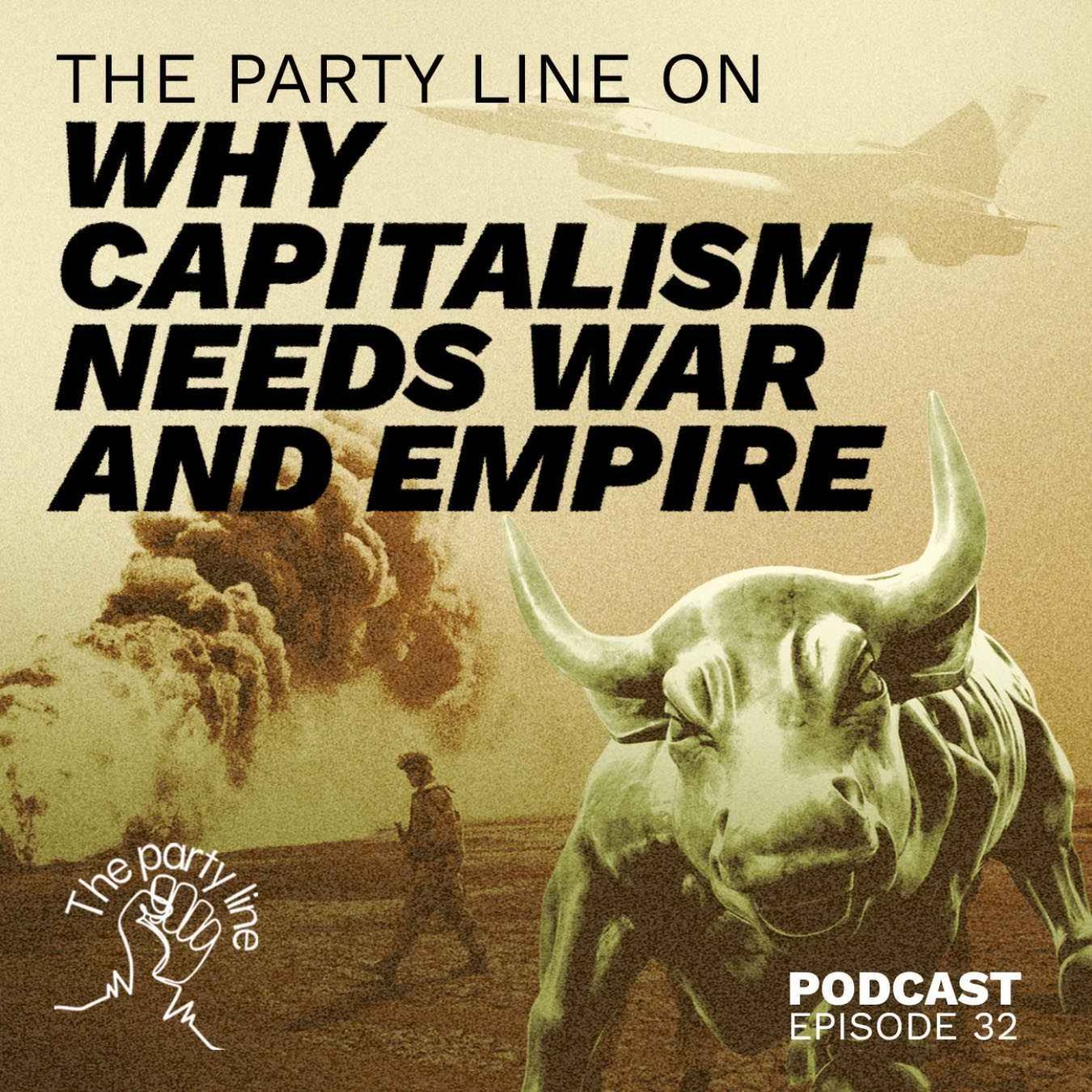
The Party Line on why Capitalism needs War and Empire
69m 9s
This episode of The Party Line podcast begins with a solidarity statement for Indigenous peoples and promotes an upcoming teachers' strike in Melbourne, urging listeners to join. The hosts then engage in casual banter, touching on personal anecdotes like expensive dental costs to critique Australia's healthcare system. They transition to discussing current events, including a right-wing WhatsApp group targeting activists and a Guardian article on the military's use of error-prone AI for target selection in conflicts, highlighting companies like Palantir. The central discussion focuses on the theory of imperialism, arguing that war is not an aberration but a logical outcome of capitalist competition at a global scale. The hosts contend that states and corporations compete militarily and economically for control over critical resources and trade routes, such as the Suez Canal, making conflict a structural feature of the international system rather than merely the result of individual leaders or isolated corporate interests. The episode blends humor with political analysis to explore why capitalism perpetuates constant war.
Hi and welcome to episode 32 of The Party Line. This podcast was recorded on Aboriginal land and we stand in solidarity with our indigenous brothers and sisters in their struggle against racism and capitalism. ♪ Oh my darling, oh my darling, oh my darling party line ♪ ♪ Oh I never will for say thee ♪ ♪ Oh I love this life of mine ♪ Hey guys! Hi, hot low. I've got um, Deja Vu. Yeah, we just fucked up this recording. Although I might you forgot your visual gag. Oh yeah. Oh no. I don't think he's on the visual gag this time. We did like a whole thing. Do you want to do it? I don't do it. Okay. No! I'm just kidding. I'm really excited about this. Yeah, Omar's actually excited because for our audio listeners, Omar's got a like, you know, one of those cutouts where you put your face through and it's about the. Like a Kodak moment? Yeah, Kodak moment. All I've ever heard is that it doesn't know who Kodak is. Yeah, if they listen to Mr. Worldwide. Or just like people know who Kodak is. Okay. Anyways, it says in solidarity with striking school staff, reduced workloads and a 35% pay rise now. The teacher's going on strike. On Tuesday the 24th. And the teachers voted to go on strike with a 98% yes, right? Fuck yeah, it was good. So people are angry and ready to go. Yeah, let's go. Shut it down. So where are we meeting in Melbourne, Omar? Trades Hall. At what time? I think it's a 930. I think the official things start at 10. I reckon get there at 930. Look out for a Victorian socialist, socialist and schools banner and come marching with us. And there'll be like leafletting. Because one of the main arguments is like one day is not coming off, you know. So we're going to be leafletting trying to let people know that yes, if this is great, but we're going to get we're going to need to get serious if we're going to get the government to pay the show out the billions of dollars they have failed to do so far. Yeah. So we weren't sure if we were going to be able to record the podcast this afternoon because I had to go to the dentist. Yes, indeed. And I was like, oh yeah, they're just going to put like a little thing on my tooth or whatever. And then the dentist was like, yes, you're going to need a crown. And it'll and he the way he said it and I was like, how much is that? Like 1950. And it's like, you could hear that. Like $19.50. But actually, it's like the price of a big Mac meal or something. $2000. And then I said to him, like, is there a low income option? And he said, do you have private insurance? Which is, I don't think something that low income people have. It's so out of touch. Access to. But I think it's. Do you guys know what dentists have not been known for historically? To a side. Don't that show them. Wasn't there a whole like measuring brain sizes and skull things like eugenic? I think that was like early psychologists. But dentists are very bad people statistically speaking. No, every dentist, I'm sure there's good ones. Actually, my auntie's a dentist and gave me free dental care the other day. So that was great. Can she fix my thing? I don't know if I can really ask all my friends. But hey, yes, $2000. I think it needs $2000. This is a good reason. I feel like we have done too many pleas for money just for me. Yeah, but like this is real. It's, anyway, it'll be fine. So it's an example of how Australia does not have fucking universal health care. Totally. This is essential health care. Agreed. $2000. Bank, just like that. You're just living your life and then you get told, "I'm winning $2000, please. For essential health care. Luxury bones." So the episode today is going to be all about imperialism. When I was sick, you guys did an episode with Jasmine about the war in Iran. It's pretty good. I had some feedback. Really good job. Yeah. People really like Jasmine. I really like Jasmine. Sorry, sorry. We're facing a pod with the audience. I had some feedback. There could be some shuffling going on. Oh, well, that's fine. If you want to keep it out, you can do all the other. No, maybe I'll do it. Maybe I'll do it. Maybe I'll do it. But yes, we want to talk about the theory behind war. So why does capitalism need war, constant war? So that's what this episode is going to be about. And half the reason we're doing it is we got a jingle. We have a jingle from our friend Joshua Nichols. Yes. And W.A. So thanks, Josh. Shout out to him. And the other half is that we got told many months ago that the way to go viral is to do random theory clips. Random theory clips. So this is our first attempt at a random theory clip. Hopefully we're smart enough for people to want us to go viral. Like, it will be the next contra points. Right? Did you just learn about that today? I learned about that in our first intro. We shouldn't get a corner. So before we get on to that, I actually have some really groundbreaking and important news to share with you guys. I'm excited. Pull it. Just keep it tight. Which is that when you do shit like that, it's impossible to keep it tight actually. So I think that it's really important that people know that there's a shoe problem in Washington. I don't think it's a problem. I think it's quite great. Actually, so Donald Trump is buying like his like Cabal, his codery of, you know, advisors and supporters. He's buying them the same pair of shoes. They're $145 pair of floor shines shoes. Which is great. I've literally never had a pair of shoes even worth half of that. That's okay. We all make it sometime. At one point in our lives. Do it. You'll get there. But the best. That's the capital as me. I think I don't know if we believe in the law. The best thing about shoe gate though is that Trump is either guessing the size of people's shoes or people are too afraid to say what their real shoe size is because otherwise Trump will, you know, lambast them for having small feet because you know what a small foot says about a man. And Trump's got really big hands. So, you know, remember that chant we did? Hands to small camp. Build the wall. Can't build the wall. Hands to small. Unfortunately, he did build the wall. He did build the wall. Yeah. But I just think like, yeah, the picture of Marco Rubio walking around with a pair of shoes to size too big for him is really fantastic. It's comical. And when I was looking at this tweet, it brought to mind a quote from Henna around about why, like, how violence happens, how people come to violence. And she says that it's waning and impotent power that most readily sort of moves to violence. And I think Rubio's feet is. Yeah. As an example of that. Yeah. And check out Annika's brain just like ripping off Hannah Arendt in her free time. Well, it's because I've been preparing for Marxism conference, which is taking place over the Easter weekend. Which is how long away now? I don't want to talk about it very soon. It's too soon. But if people want to grab a ticket, there'll be a lot of interesting smart, engaging talks and then there'll be us. Yeah, talking absolutely nonsense. So we're going to be doing a party line live episode at the Marxism conference. There's also going to be a red flag radio live. Maybe some crossover content. Yeah, maybe we can like do a walk on. Is that what they call it in a like a rap battle? A rap battle. I'm not doing a rap battle. Yeah. A mashup. Okay. So for some serious content, there's some headlines that we wanted to go through. The first ones from our friends at Deepcut News. Yes, which is they've done a story on this, on the original version of this too. But it is a pro-Israel WhatsApp group, Boasts campaign win against Grace Tame. Yeah. So it's like this massive kind of campaign group chat of right wingers attacking Grace Tame. And it's come out that they also have been like behind coordinated campaigns to against people like Francesca Albanese. So she was like doing a speaking engagement at the late university. It's like she is the UN. Yeah. I was shocked when I saw this article because I just, I can't believe Deepcut would run an article targeting this WhatsApp group like this. Just everyday citizens going about their life and then they get exposed by the media. It's just disgusting. Crazy. Yeah, no, it's pretty outrageous. Like, yeah, the last one, what they attacked Clementine for. Yeah. Which of other people, they got a banjo Instagram, right? Yeah, I don't know if that was them. I think that was Instagram just. There were probably a lot of who put in complaints. Ah, probably. Trigger things like that. Yeah, wouldn't surprise me. I just read like there was like 5,000 emails of this WhatsApp group to cancel things. Yeah. And it's just like the ongoing thing about like Grace Tame, they were, we talked about it a couple of episodes ago. They're happy to make Grace Tame. This picture, you know, perfect spokesperson, Jagger out, but as soon as she starts to have political opinion, it's like good political. Don't challenge the empire. Yeah. Yeah. Okay. Well, this one is from the Guardian and it's about the role that AI has played in destroying the world basically. So these aren't AI firms. They're defense contractors. We can't let them hide behind their models. Yeah, it's a good article exploring the role of AI in modern warfare. And part of it is that there's so much data now, you know, it's a kind of cliche of just daily life. But then of course, the military agencies have more data than anyone. So they know where everyone is. They type into everyone's phones, etc. And it's too much to process. So they have, they filter everything through AI and like all the targets in the Gaza war and now in Iran and Lebanon are being developed by AI algorithms filtering through all the information and proposing like here are the targets. We think of the most prominent, most important, most likely to have bad people in them and that's where the decisions are made. And we know we know that AI can't do the most basic maths. They get facts wrong. They invent court cases, you know. Like this is not reliable.
- The one about the court case was all filed like paper, like document after document after document is like fake court case. - So that's probably what's behind like the bombing of the school. I mean, the school used to be a part of the revolutionary guard complex. It was separated off like 10 years ago. And probably AI just fucked it up, like they fuck up everything. - Yeah. - So it's pretty incredible to these companies are profiting and integrated themselves into the military industrial complex when they can't even get basic facts right for Google searches. - Yeah, yeah, 'cause like at the end of the day, they're not profitable companies. They only can make money to like them huge companies, but they're not very profitable. So they get all these contracts with the Department of Defense, the Department of War. They get access to all of that data and then they sell that data. And then they do, yeah, just fucked stuff. And yeah, we have it here as well. We have like, yeah, Palantir is data mining provisions with the Department of Defense in Australia. And it's just getting worse and worse. I guess. - And speaking of Palantir, have people seen this clip from Alex Coup, the Palantir Theor? - Which so far happening in Iran, you see one society just totally dominating. That's our society. Now, you could get into, I would always in fights with my intellectual friends about their like, but wouldn't it be better to have a law-based system where everyone is equal? - Yeah, sure, in theory. But in this world is us or China or Russia. And I don't know how you guys feel about those decisions. - So he goes on to say, I literally, we're doing the work of a higher purpose. - A higher purpose by making sure, and not just for America, but for the whole world, that we are the power that actually has the decisive vote. And there is only one way to do that. And that is with military superiority. - So like Palantir CEO sees the role that this disgusting tech company has played in murdering, you know, 1000 people in Iran as the hand of God. - Well, if it's with like that picture of everyone praying around China, this is the kind of caliber of people who are running America right now. - Yeah. - Yeah. And then it is not even framing it like a Installing Democracy in the Middle East. - No, it's just like this is dumbass. - Yeah, yeah. But hey Alex, he's a friend of the show now. He's been on like every year for the past month. I reckon it's time to like pay it back, you know. Give us some cash all. I will create a new category for you on Patreon. - He's really overtaken Chip La Grande as a decade. - Yeah, the punch bag of the podcast. - You can pay a bargain basement, a million dollars a month and we will mention you on every episode. Free advertising. - That's right. - I mean his output is just high. Maybe he's more productive because of AI. - Well, Chip's writing books that no one's reading. So, you know, he's busy. - I feel like we should do a poll about like who's more fascistic in the tech world. Is it Elon Musk or is it Alex Karl? - It's Alex. - It's gotta be like at least. - Yeah, no actually. - It's because it's hard because-- - Elon Musk is, yeah. He's like created like a network of like fascist young men online. I mean, I guess like the targeting is pro. - Yeah. - It's hard. - I mean, but like-- - I guess saying they like-- - I'm not a star. - I mean, what is it, Elon's just like manufacturing the consent and whatever. So I mean-- - I'm just that. I mean, he's building all the, all the like-- - And like the sky. - Yeah, the styling. - Yeah, yeah, yeah. And whatever. They're just like, they're both the same person. - But speaking of fascists, this continues on our sort of like trend of looking at the fascist content that's posted by American government Twitter pages back to Elon Musk. This one is like a sort of, you know, it looks like a nice travel poster for maybe the 1930s. Says free ticket home, $2,600 exit bonus. And take advantage of the historic home deal we're offering today. A free flight home to your-- So what they're saying is like, we can get out of our country. We'll give you a sign on bonus if you-- it's like, it's horrific. The targeting of migrants in America is just getting out of control. - Yeah, it's disgusting. It's a very bad government. - That's one way of putting it. - That's what I think. It's like on a radical statement that we're known for on this show. - Definitely. ♪ It's very time with the party ♪ ♪ It's very time with the party ♪ - Wow. - It's actually so good. - It's good. - I can laugh. - So thanks so much, Josh for that. So like we said, it's theory time. It's time to talk about what's behind war in capitalism. And I actually think that we could-- - Is it a lizard people? - No, but I think this is actually, this is for me imperialism today. - Where's the sound? - I have to find out yours. I have a funny video to play after this as well. - So this is imperialism today. - Maximum lethality, not tepid legality, violent effect, not politically correct. - I heck said there's been working with Eminem. - Okay, so. - So it's lamp, whole head said. - Oh no, don't have it. There's a bit where, you know how he does the like headlines, like with his hands. War widening, Iran shrinking, going underground. Mid-east war intensifies. Iran increasingly desperate. - Yeah, yeah. - That's what what's his name did, Michael, in the fucking office. It does the same, like the exact same thing. - Getting these cues from pick America, or well, yet the American version. - Here's your headline. - Scranton paper company, Dundermiflin, apologizes to valued client. Some companies still know how business is done. - Terrible. That is another version of imperialism, cultural imperialism. - Sure, it's shocking. The probably the worst aspect of it really. - Okay, but to dig into it. So there's a lot of like questioning about like why does war happen? Is it just the thing about Trump is, you know, mad, like a mad king who's, you know, lost his way and just wants to go crazy. Is it about the personal capacity of someone, you know, is it just things like get pushed too far and then things break out and it all breaks loose and no one can put the genie back into the bottle? - Or just like the oil companies, or the lobby groups. - Yeah, with the military companies. - And so it's not to say that those things aren't a factor, but I think if you just sort of tried to pick and choose one of those things, you'd be lost in a sort of cogmire of what the fuck's going on in the world. But I think it's much better to sort of think about imperialism and war as a key dynamic of capitalism and it's inherently linked to competition as one of the like driving forces of the world system that we live in today. - Yeah, 'cause like the kind of classical theory of capitalism is like, you know, this company is competing over market share and they compete through quality of products, they compete through the price of products and they compete through, you know, keeping costs down by like exploiting workers or finding cheap resources. But then when you zoom out and you get to a global stage, competition isn't just like free and fair kind of competition between capitalist businesses that are just like offering slightly different products or a slightly cheaper product or whatever, but it's actually like these confrontations between entire blocks of big capital backed up by governments. You know, and so imperialism, therefore, there's just like capitalist competition at a global scale using governments as the vehicles and armies as the vehicles, not just marketing departments and, you know, HR departments and stuff like that. One easy way of looking at it, I guess. - Yeah, and like sanctions and whatever. Because yeah, like if you think about the logical conclusion of competition, it's just monopoly. And then, you know, once you've monopolized everything, you can't just sit down and be happy with that. You've got to still make your profit. So yeah, the logical conclusion is intervening in other states, which are just again, monopolies of profit. - Yeah, totally. So I think the thing about competition, yeah, it, you can't stop competing. 'Cause there's always gonna be rivals. And that's true on a business level and it's true on a state level. And I think one of the things about sort of capitalism, the way that it developed, is very quickly, as capitalism nestled itself all across the globe. The question of internal economies and nation states became to be very much interlinked. And so I think on an international scale, competition between countries has to be displayed. It has to be sort of seen through the lens of war. And then there's a question of like, what are they competing over? Because it's pretty clear in an economy, you're competing over market share, you're competing over who's gonna have the most factories, who's gonna innovate the quickest, et cetera. But then what are states competing over, well, a multitude of things, one being trade routes as a pretty recent example. Like we've seen through the question of the state of Hamus, like,
that trade route is central to the global economy. Who controls that? Actually, you can have a lot of power. - Yeah, totally. And one of the other main ones is off the coast of China, right, the South China state. Yeah, I forget what it's called. - Just that. - Yeah. No, but there's a strike. Anyway, to get out of it, I think it's between the Philippines and another country. And that, like, it's from China, obviously. So it's like an enormous proportion of world trade. So these are real choke points. - The other one being the Panama Canal. - Yeah, that's right. - And this is a quote, like one of the, yeah, the Suez Canal, exactly, these canals that America recently has been sort of saying they want to have more dominance over, you know, we gave it to them too cheap. We need to get it back. - Exactly. - Or Greenland as another example. (laughing) - Not really a trade route, but like-- - We'll become one when the ice caps are on. - That's true, yeah. - That's true. But so that's the thing. Like, these things can be invisible when things are functioning normally. And so, every day people, we don't think about it that much. But like, the job of imperialist strategist is to think, okay, well, when shit hits the fan, like it is now, where are the places that matter and how do we make sure we control them? And this is, it runs kind of counter strategy to America is by like disrupting this thing. So it's very embarrassing for America. It was a fundamental thing that you have to be able to do to fight Iran is to keep this channel open. Similarly with the China, the Chinese canals in the Eastern Pacific and so on. So, yeah, these are very important things to control because they're like the veins of the whole global market. I think another thing that states are competing over is resources and markets. And I think, you know, they can go together and also be separate. A whole bunch of sort of the like early imperialists sort of neocolonialism was about getting access to things like rare earth metals, access to water supplies. So a whole bunch of China's sort of Belt and Road project has been about access to water. It's quite an important question. - Oh, I'm very early stages like access to labor as well. - Yeah, absolutely. And then the other thing is just markets. Like if you're a commodity producing nation, you need to have somewhere where you can send out all of the commodities that you've produced so that you don't flood your internal market as well. - Yeah, so like America's done this historically by saying, well, you can't sell cars in America unless you produce expersentage of the media, Europe does the same thing. So it's about protecting your own market and then forcing others to open theirs up to your product as well, yeah. - But then a big part of it, 'cause, you know, I think resources is like a very important question. But sometimes countries that have a lot of one resource still have to compete with their rivals over that very same resource. So the prime example is oil right now. This is like a dominating question in the news right now because the oil prices just shut up. America is a big producer of oil. - The biggest. - So then I think this relates to what's the other thing they're competing over it's power and dominance in their own region and then also globally. - Yeah, yeah, that's right. And sometimes even if you have more than you need of a resource, like China has way more rates than they need. But by developing a monopoly over it, you can control the whole world economy in a specific way, it gives you leverage. And so America's vision, well, it's whole practice really for the whole 20th century was control the Middle East, dominate Saudi Arabia, we'll not dominate. Work with Saudi Arabia, develop the Gulf States, they run under the shell like we talked about last week. Because if you control the oil, you control the whole economy. And so that's not to say that America wants the oil. And that's not to say that the oil is the only thing that governs some American foreign policy 'cause so often was a reduced to like single resources or whatever. But it's a major factor because oil and fossil fuels generally are still the engine of the world economy. One of the things that could be changing as a result of this you would think. But still for now, are absolutely a vital part of anything that goes on in most places. - Yeah, and like you can have a complete monopoly over one particular thing. Like Australia does when it comes to uranium, for example. Like that's where this is where uranium lives. But then you know, we still intervene in our Pacific neighbors about like over oil, like bugging meeting rooms and whatever and doing all that kind of stuff. And yeah, we do that ourselves. - Like Australia literally re-drew the like maritime borders of Australia to yeah, and as East Teemore to make sure that they controlled the shell gas, shell oil anyways. - Yeah, offshore gas fuel. - Yeah, yeah, yeah. - In the ocean. - So we get half of the profits, even though we're not at all. - Yes, there's a bunch of hours. - Or not we, like the strain government here. - Totally. So nations are competing all the time. And so sometimes it happens through like the kind of process of like they call it soft power, generally not super soft. - No. - So like the free trade agreements that are you know, designed by powerful wealthy countries to force, you know, smaller countries to like I must have before open their markets, give up resources, etc. And then other times it's through violence writ large on a massive scale. And so I think what we sort of talked about gone through like the different things they're competing over the relationship between companies and markets and states and militaries. It shows us that imperialism isn't just like a set of policies. It's not just like America or like white papers that get white to defense papers, whatever they get put out sort of talk about. What's the approach? Even if they didn't put out those sets of approaches, policies, papers. I think we have to see that it's imperialism, imperialism is the inherent logic of like the international political capitalist world system. - Yeah, and it's also why like, you know, there's a lot of countries that are accused of being or accused, labeled as being like anti-imperialist. - Yeah. - But we see them doing the exact same things, like competing, I mean like the logical conclusion of competition by, you know, doing their own, whether it be not exactly sanctions, but like, you know, the targeting of other countries or all your companies and all that kind of stuff. - Yeah, totally. - Yeah, and so like, it's not just America, even though America is the kind of dominant global power and the most aggressive as a result of that, they have the most capacity and they've done the most terrible things. But it's like, everybody would like to be America, you know? It's like, it's not like Germany or France that is thinking, oh, we really love the fact that we're like medium-sized powers. - Yeah. - No, they wish they could be big. China, obviously, wishes it could be the top dog. Vladimir Putin definitely wishes it was the top dog. Like, it's just the sort of logic of the thing that the more dominant you are, the more money you can make for your capital, like with the big sea, your country, your country's rich, the more you can dominate over international institutions. So it's just an inherent logic that flows from the competition. And so, you know, China is the other, like America's the dominant one. China's sort of the rising one. It's still coming from a long way back, compared to America. Like, America has like 800 foreign bases. China has, I think, three if you squint. But, you know, they're rising. And that's sort of dynamic is shaping a lot of what's happening globally. - Yeah. - Yeah. And they might not have as many like military bases, but they've got, you know, ownership of, you know, a lot of African economies and-- - Ports. - Yeah, ports in Australia, no less. And-- - Not for long, I'd say. (laughing) - We'll find out soon. - If the capitalists have their way. - Yeah, but yeah, they're intervening in an imperialist manner, no different to America, except of the bombs and stuff. I guess also, but, you know, they're a supplier of weapons to countries that are doing their bombs. - Like Russia, yeah, and Ukraine. - So it is the logic of capitalism, and it's not just a policy, and they can be quite like sort of illogical from the standpoint of the human experience, reasons to go to war, but logical from the standpoint of, you know, competition and people, states fighting to be big players. But I think it is worth saying that even if they are in an inherent and eternal logic to something, wars don't often always go the way that the countries are planned on them going. So here's an example from 2003. - Major combat operations in Iraq have ended. In the Battle of Iraq, the United States and our allies have prevailed. Because of you, the tyrant has fallen and Iraq is free. - So after 2003, how much longer did the war go for? - 18 years. - A couple of days. - 18 years. - I think it's 18 years. - Well, they say, - No, I went to war. - 2011 was the official withdrawal of troops from Iraq, but. - Did it Trump and that war? - They still go on. Iraq has the biggest American, like base in the region, I think like it's fucking massive. I was watching the Dick Cheney movie, or the movie about Dick Cheney Vice, Christian Bale Stars, the one where he thanked Satan for the inspiration for playing the character. But I mean, that is an exact, it's a really good movie. I reckon if you want to get a bit of a sense of like, what does it look like when America decides to go to war? And it's like a bunch of these evil, evil men concocting, you know,
Basically different reasons for why they're allowed to go into war and In the fallout is the deaths of probably a million civilians Probably more if you count the people who have continued to suffer You know problems or whatever from the experience at the war the destruction of economies etc But I guess one of the things about it is it feels like a distant time that you could sort of think of like oh It's interesting when they did that you know They had to get approval from the you end to do that. They don't need to do that anymore. Yeah Well, I mean yeah the other the other thing is like so that's the globe that's America America can sort of do that sure Um, and and that's why they're sort of a global, you know unique global power Then there's China that's like rising. There's a whole other category of countries that I think People tend to only understand in it's kind of simplistic way like France Germany the UK Australia like in terms of their relationship to another Yeah, Japan South Korea like often these countries are called kind of part of the US axis whatever and they are But they also have independent agendas and we talked about Australia's kind of last week or any to do that again But basically the thing about imperialism is not that like one country just tells everyone else what to do But it's just that it's everything's a balance of force is kind of thing and how much what can you get out of it? What are you gonna lose? So Australia benefits from being part of the US axis Sometimes we're not all in like the current Iran war thing like we're we're sort of getting drawn in but like clearly Elbanese doesn't want to be fully drawn in Other times we're just like now. It's fucking bombs and Iraqis and occupy their country for 10 years and whatever So it's a it's a judgment call, but they have their own agendas and those agendas line up. Yeah, so where America can just sort of get away with doing whatever the fuck it wants in the entire world So whether that's kidnapping Nicholas Maduro from Venezuela or you know sending in bombers into Iran and destroying You know the country there Regional powers can also get away with stuff in their own spaces. So Jody raised the example of the Australian government, you know, spying on foreign leaders, but also participating in the put downs of rebellions and uprising sending the AFP troops to train You know government police forces Vietnam. Yeah, exactly. But then obviously there's another regional power which is Russia which is basically gotten away with an invasion of Ukraine And then there's China which is obviously its own sort of regional power as well. So We have it's you know, is it a multipolar world Kind of in that sense like America isn't just able to um Impact everything about global politics and war and the global economy. Yeah, I mean there's because you know We mentioned kind of traditional powers, but then there's like newer ones like Brazil Yeah, South Korea Iran itself Saudi Arabia the UAE which are traditionally not like major players traditionally. They were you know I mean, there were very oppress nations till till the kind of middle of last century But they've developed and never risen and in uneven ways and it's still like a lot of people in those countries are very poor But the state itself has that has got enough sort of wealth and capacity that it can now throw its way around at regional level And so um, you know like Iran and Saudi Arabia and Israel obviously is in this category as well Like they do a lot at a regional level to shape the Middle East South Africa, you know, is a very powerful player in the politics of southern a southern Africa More broadly or India as a major player. Yeah, yeah, and Brazil in Latin America So so these are kind of mid-level players. They can't shape the whole world dynamic as you said But they can have a really impact on what goes on locally um, and so then their relationship to to the bigger players becomes very kind of pragmatic So you see them play both sides trying to work out who's going to benefit the more Um, that they go out off the chain of little and they kind of pull back So again, it's a very complicated picture And when people just reduce things to like, oh, they're someone's proxy or they're whatever It doesn't work like that. Everyone's got their own agendas Yeah, and you can see them sometimes form their own regional blocks like the EU or BRICS or whatever To protect, you know profit like their own profit competing with profit elsewhere Um, but that's just Like competition is the underlying thing. So it's just always gonna fail Um, there's that really good Mussolini quote Really good Benilli is article um, where is it? Mussolini Um, what's it the league is very well when sparrow shout but no good when all eagles fall out. Yeah. Yeah. So at certain points The attempts to maintain sort of peace through economic cooperation International law And we're seeing that today all of this just uh falls apart because We come back to that thing about competition being the sort of internal like the the main dynamic I mean uh in the early stages of the like 20th century or the end of the 19 uh, there was you know debates in uh sort of Left Sears about oh is competition actually and like profit making gonna mean that countries don't want to go to war with Chumler anymore Because oh well if you go to war then you're not going to be able to sell your products etc I mean then well were one happened Yeah, well then one more two then But then harder negrary reprise that theory. Oh yeah, yeah, yeah In the in the 90s and early 2000s they they they wrote a book called Empire which argued that basically Capital was too important and well trade was too entrenched that they could never be serious wars again Yeah, and this got popularized by other people. I don't think this was them Like they said that no two countries with the McDonald's had ever gone to war but then the Iraq war I didn't have enough on it So that was a very good theory there's global powers and there's regional powers um, but then you know There's other smaller nations which they don't have big economies. They don't have big armies And they're less able to impact the politics um of their regions But that doesn't mean that the sort of ruling class and the capitalist class um that are internal to that country Don't have imperialist sort of sites or aims for the country that they run Um, and so then can ally themselves to different regional players in order to maximize um their profits and their power Yeah, so like The way that a lot of the left has developed their understanding of world politics is that there's like powerful countries and their bad and there's weak countries and they're good Um, but but I think the point that you just made well anico is like we countries Uh exploit their own working classes They destroy their own local environments for profit etc all the usual things that every capitalist do and then they're also like depending on their size Trying to find an issue within the world system which gives them some influence, you know and um just how can I best serve the bigger powers and how can I play a role So they're always looking to that um and I think in that sense like you know It's not that every country is imperialist but there's no good countries. Yeah, that's the that's the point of this is that yeah There's no country. There's no capitalist class anywhere that runs a country that is looking out for its people or or international peace or anything like that They're all just in it for themselves and they're rich mate. Yeah, just because you're a bit shitter at something doesn't make you inherently good Anti that yeah, they're just they're late developing. Yeah, they don't have the resources or they've been like they've been victims of Which means that they haven't been able to build up their economies um in the way that obviously they would have liked But I think one of the points. It's quite important in terms of how do these countries begin to develop and create riches For the ruling class will usually it relies on extreme oppression of the internal population So the destruction of union rights the jailing of leftists and activists and this is important as well because I think because that a lot of Because the fact that a lot of these countries were victims of colonialism Means that they had anti colonial movements and so they were infused with a sort of quasi sort of socialist Stalinist Third worldest kind of political worldview Which people today can see as well. That's a socialist country. Yeah And so I think you know where critical of that perspective not because we think um You know These countries should be oppressed or something like that But because it's important that politics matters and you know socialism is not oppressive nation. It's working class people actually liberating themselves Yeah, yeah, and not in the interests of like some just a national ruling class I would have like look at yeah even like most recently became a far so like you know getting rid of their French Influence and whatever and then immediately like criminalizing homosexuality Um, yeah, yeah Yeah, and then there's like a table or even that which it is like broken countries that are because we've broken as long as capitalism exists You know like These team or Lebanon El Salvador Honduras like these these parts of the world that just for whatever reason how they've been structured how they were set up How they've been oppressed um you just can't imagine this situation Under capitalism where they're ever going to go forward um and so like that's just a reality of capitalism and its development That there's just some parts of the world that it is cast aside and like a lot of Africa is in this category actually like a lot of African nations Um, they were just ravaged by slavery by colonialism um The resource extraction that goes on there is so kind of unequal and extractive That it's it's just like impossible to see kind of Nations developing in the normal world
that has occurred in the countries that were earlier developing and not not colonized, you know. So that's just another argument to be a revolutionary socialist because there's no moderate, there's no moderate way of fixing these structural inequalities. They're just kind of built in to the way the world works. Yeah. Oh, I was going to say you can see kind of maybe India becoming that like developing and whatever, but that's kind of an exception to all the other countries. Yeah, and I think all part of the thing about India is that one, it's a massive mass, huge population. And like the British suppressed their like industry, but then also their internal sort of like bourgeoisie inside India were able to develop at the same time. And so, you know, India has a huge amount of poverty, but it also has quite a big sort of research and development sort of part of the economy. It's a nuclear power. So it's, and it's like an imperial power in its own. Like it's got all these, if you go east from India towards Nepal and stuff, there's like all these oppressed nations that are built in and then there's Kashmir. That's right. And then there's there's probably other groups like I'm not an expert on Indian politics, but there's numerous national groupings in India that are oppressed. And it was set up that way when the Indian won liberation from the British. They deliberately expanded beyond what was like kind of sort of legit territory. And then also so did their capitalists like look at Adani South Africa with the Gupta's and everything like it's a, it's a, they're doing great. And it's an important point like some of the stuff that, you know, thinking through the role of India in its region and the like, because I think another kind of common conception of imperialism is that it's like decisions made by fat old white guys in suits in boardrooms, but actually there's a global sort of imperial, like well, there's a global ruling class, which means that there are imperialists, people who engage in, you know, the impression, the impression of the Kurds or the Kashmiris or etc. Who are not just white guys in suits, they're, you know, brown guys in suits. That's right. I'm glad you said that. And they're competing. Yeah, that's right. So Marxist theory has been, you know, has grappled with this question of war and confrontation from the get-go. So early on, Marx developed the sort of understanding of capitalist competition and also the sort of understanding that capitalism as a system had to become global in order for it to its exceed because it is an expansionist and accumulatory, if you can say that word, system. It has to keep pushing out, pushing out, pushing out. And then, as I said, sort of in the 19th and 20th century, because the global economy was properly sort of just taken over by capitalism, it pushed out, feudalism, it pushed out sort of the old sort of forms of organizing its society, whatever. Then we get onto the question of, okay, so now these states have to compete with one another. And one of the early sort of Marxists that grappled with the question of, you know, this new imperialism was Buchanan, who was a member of the Bolshevik Party in Russia. And some of the stuff that he wrote was really useful and helped develop Lenin's theory of imperialism where he sort of basically just, you know, he popularised it. Yeah, yeah, yeah, got the spark, nice. But it's worth saying, I just remember from this from a long time ago, like in Capital, Marx has like a big section on it. I just want to read it because I think it really disproves the idea that Marxism is sort of Eurocentric and sort of about this stuff. Marx wrote, "The discovery of golden silver in America, the exturpancy in slavement and entombment in minds of the Aboriginal people, the beginning of the conquest and looting of the East Indies, the turning of Africa into a war in for the commercial hunting of black skins, signaled the rosy dawn of the era of capitalist production." These idyllic proceedings are the chief moments of primitive accumulation. So this is Marx, you know, at his savage anti-imperialist best. And this is in like what's often presented in universities as a sort of dry academic analysis of the economy. It's actually a strong anti-capitalist, anti-imperial statement all the way through. Absolutely. So then capitalism required basically large firms inside a one country to be able to be backed up and supported by a state, a nation state. So the nation state is really like the major development or capitalism becoming this global system. And so early on, large firms they engaged in different things. Like, you know, they had secret, like not secret like mafia style sort of beating up, you know, your car tell like. Yeah. So you beat up the workers or you go engage in industrial espionage or you just steal resources. But eventually it's like you can't just have sort of company-based militias. You need states to be able to do that. Yeah, I mean like a lot of sorry the UK's colonial enterprises were and the Netherlands as well. That's Dutch, right? Yes. They always get them confused. Anyway, the companies were actually some of the main ones like on the front lines of those struggles. Like they would go out, look for things, you know, buy people out there. Exactly. And in some ways they were like bigger than the government, you know, like in the colonies. But then yeah, like the more that other companies, sorry other countries and companies rose, you would then have skirmishes between these different companies like who's going to run this this very lucrative part of America or India or Indonesia or whatever. And then suddenly the power of the militaries behind these companies become decisive. Because like we know contracts are not worth the paper. They're written on unless they're backed up by a force that can enforce them. And you know, in the wild west from the capitalist point of view of the Asian area and the Africa colonies like basically might makes a right. And so the states develop in order to back up their growing kind of colonial endeavors. Yeah. Yeah. And like I think those companies doing their corporate espionage stuff, like they still do that. Like every day, like Woolie's literally buys massive blocks of land where you know, calls might be able to pop up a shop and just like hold that land. Or like on like a global scale, like there's black black rock. Yeah. Yeah. Or like these companies, these mercenary groups that go into African countries and take control over the gold production. But I mean, even these kind of organizations and institutions are tied to states. So you know, Russia has come in and sort of pushed out or French or whatever. Exactly. Or it works the other way around where like the government goes in and does a deal with like China with the belt and road. We'll lend you $500 billion to build a port in somewhere. But in the meantime, and in the process, we're going to employ Chinese capitalist to do all the work. Chinese workers are going to come to all the work. You know, Chinese providers are going to provide. So like this is not going to do any positive impact on your economy whatsoever. Basically, the diplomacy is about subsidizing Chinese capitalists in an area of work they wouldn't have had otherwise. And no one used to do this back when it was more generous with the Marshall plan. Venezuela. That's right. Yeah. That's right. But like the Marshall plan, you know, like they basically rebuilt Europe, which was all for the benefit of America because they knew we're producing all this stuff. Yeah. And we got nowhere to sell it. So we need we need the economy. We need the economies of Europe to buy it back. I mean, the other sort of example and done in a really brutal fashion going back to Dick Cheney in the Iraq war was American corporations were given contracts, defense contracts, both in terms of the production of weaponry, but then also the thing about going in and, you know, increasing production in like, you know, doing the contracts to rebuild in quotation marks Iraq. And so one of the big examples is Halley Burton, which Dick Cheney was the CEO of before he became George W's VP running mate. They were given $39.5 billion in Iraq related contracts. And there was no bidding. So it is the best companies of the job. They were good. They're a really efficient company. And I think one of the points that's important as well is that like, you know, in the sort of 2000s and late 90s, you sort of refer to it before, about I was these new theories about what's going to happen now that we live in a globalized nation world. And, you know, there's not just like companies in one country. There's there's multinational trends, multinational, multinational corporate. But and so people thought the role of the state was going to diminish in some fashion companies would run the world companies and NGOs. That was the theory I was taught. But no, no major corporation can be unmoored from its sort of nation state. Yeah. You know, we know about, you know, American steel or, you know, Japanese cars or Australian iron ore or whatever. Like, yeah. Tops are under.
all that. These companies, as much as they operate on a multinational scale, they still have really, really important connections to their countries. And most of the time, the multinational aspect of it is so that they don't have to pay taxes in their homes. Yes, they're all based in Ireland now, I think. Yeah, all even the American ones. So back to Buchanan, I think this quote is a bit of a useful summation of sort of what we've been talking about. It says, when competition has finally reached its highest stage, then the use of state power and the possibilities connected with it begin to play a very large part. War and capitalist societies are only one of the methods of capitalist competition. When the latter extends to the sphere of world, the world economy, this is why war is an imminent law of a society producing goods under the pressure of the blind, blind laws of a spontaneously developing world market. And I think that connects to the thing about capitalism is actually in an arctic, crazy fucking system. Everyone's just producing so they can make money, make money, make money. Well, that means that anarchy of the market is going to explode in different fashions. And that fashion is inevitably going to be war. Yeah. And we say domestically, like the state develops all this brutality towards unions and to crush striking workers. That's not the free market. Ron Drake and Mr. Free Market at the same time, destroying trade unions in America. There's always been a contradiction at the heart of competition. They say it's purely economic, all choice related, like no force. But then in reality, there's always been force at a local level from police, from whatever our military at extreme times. But then at a global level, it's the same. So you know, you have free trade, whatever. But then everyone's always trying to subsidize their own companies behind the scenes. When that's not working, maybe then you start putting tariffs on other countries. When that's not working, maybe you sanction them. When that's not working, maybe you do a cartel. When that doesn't work, maybe you go to war. You know, like these are all on a spectrum of possibilities. But there's never been pure economic competition. It's just an absolute myth. It's a libertarian kind of fantasy. And then I think in terms of those different possibilities, the spectrum of possibilities, I think it is important really to talk about war in its like most human terms, because you can say competition, like capital war is just competition on a global scale. It's like, yeah. So what does that mean for ordinary human beings? Well, it means like in Tehran, when they bomb the oil refinery, whatever, people are all the school. Yeah. Like people are there's acid rain falling down on people that's going to cause cancers for decades and decades. There's the genocide in Gaza. There's the million civilians killed in the war on Iraq. There's the Holocaust. There's, you know, there goes on and on. The elimination of wegas in China. It's like the occupation of Ukraine that goes on after five years now. Like every country is trying to do it. Like the destruction of Georgia, you know, a few years ago by Russia. Like it's it's just the world is a chessboard. And we are like invisible dust on the chessboard to get point of view. Yeah, we don't even pause. Yeah. We're not the ones. Yeah. Country is a pawns. We're just like the human dust. That's right. And then there's like, you know, there's everything leading towards, I mean, World War three is gonna fucking happen. Like, you know, there's going to be a point where China and America both managed to build up their munitions capabilities beyond the point of just they've only got enough bullets to fight for 30 days or whatever. And, you know, this competition is going to have to express itself on a global scale at some point. And so what's going to happen to ordinary people in the midst of that? Well, you're going to be bombed or you're going to be a soldier that's forced to go fight in that war. Yeah. Yeah. Yeah. When you think about it at that scale, it becomes like extremely urgent, you know, and like Lenin's writings like Bucharest wrote a really good book about this. Lenin also wrote one about imperialism around the same time a bit more for like a public audience. And his argument was basically like the only way to stop war is to stop capitalism. Like there are there are there are wars you can stop short of stopping capitalism. Like the Vietnam War, whatever. Like there are some kind of peripheral wars or wars that are they're always brutal, but they're not necessarily like at the core of what the system needs to survive. Even if they're not totally like second like wars of choice, like maybe the Iran one is. But like when you have major countries fighting it out, that's because the contradiction that has been building for too long just couldn't no longer sustain. Like the thing about the colonial era is there were so many parts of the world that hadn't been colonized. So everyone could just colonize. And okay, this part's been taken by Britain. We'll just go next door and we'll just colonize that part. And that can be ours. Oh, your friends, you're a bit later. Okay, you can go over there Germany, you go over there, Italy go over there. Everyone can have a bit, you know, like the world's so big, everyone can have a slice. Yeah. And then it gets to a certain point where hold on, everyone's taken everything. Yeah. So the rising power, how do they move forward? Well, they have to yeah, they have to break it up. They have to shake things up and shaking things up means the war. Yeah. And so alternatively, you can go take the little bit that another country already took like Greenland or whatever. Or yeah. But then if you don't, but then the other side doesn't accept that. Exactly. Yeah. So like you have to redevide what's already been divided. And the world today is that America runs all of it politically, but then China runs so much of it economically. And China's the new player. And so they can go up, they can rise to a certain point. But we're seeing all the ways that America is trying to use to stop them. Well, if you're China, okay, maybe you play along for a while, but at a certain point that contradiction is going to explode. And that's the kind of terrifying possibilities that we face. And world war, yeah, the deaths in world wars are not in the thousands, they're not in the tens of thousands. They're in the tens of millions. And a future world war, God knows like how that would be. Exactly. New now like Jesus and AI. Yeah. What will Alex, what will I come up with? Yeah. Don't want to think about it. But the reality is that war is not just something that people have accepted blindly or just not been able to resist and fight back against it. Actually, war is one of the things that has most often resulted in like rebellion and uprising. Some of the most important movements for the working class historically has been opposition to war. So the Russian revolution happened because the contradictions of world war one, ie the death and destruction of ordinary human life just got so bad that people could not deal with it anymore. Yeah, they were fighting without shoes. They were fighting with our bullets. They could be everyone who is someone who was dying before. So they have to fight back or yeah. And it was just a rejection of that logic. Yeah. And then like the big, you know, most recent example of like global working class resistance or, you know, actually the 2011, like anyways. But a recent one, the movements of the 60s kicked off because of the Vietnam war. And the just the fact that America was able to get away with dropping napalm on innocent people in the countryside. And you know, this kicked off an uprising in France, you know, big movement in America, in Britain, in Germany, in Australia, etc. Italy. Yeah. And the kind of the connections are began to be drawn. Like we're fighting the class struggle here. Our working class kids are being sent to die over there. What have they done to us? Like, you know, like the famous Muhammad Ali thing, like no V.A. Kong ever called me, whatever. And in America, like you've got all these black because the American army's always been disproportionately black and brown because of economic conscription. It's such a poor country. It's one of the only reliable jobs. So it's it's disproportionately black and brown. But they're living in the Jim Crow era. They don't have equal rights. And yet they're going and fighting in another country for freedom in America. Like yeah. So that contradiction exploded. So yeah, like the both the experience of fighting and dying and the horrors of the economic privations, like we're about to see a kind of small glimpse of that with the inflation. This, you know, that's going to be generated from this appalling war that Trump and Israel have just concocted out of nowhere. People are going to suffer and get impoverished as a result. Well, when you have big, big and long-lasting imperial conflicts, you know, people suffer a lot more. So like in Germany, during World War One, there was like a whole year where like the only vegetable and fruit available was turnips, you know, and they were making coffee out of it. They were eating it. That I don't understand how you get coffee at the time. Maybe you brew it for a long time. Anyway, it was like an extreme kind of crisis. And you know, England always just has cabbage and potatoes and stuff. So yeah, that's a normal food. Yeah. So you know, when you break the trade routes and you, and you prioritize in military conflict, like people really suffer. And it leads to rebellion. And sometimes resistance happens in unconventional ways. Yeah, that's the really good bit. But then there's also a little bit. So take this tweet, for example, anyone who attacks the UAE and not one reason at all is a mortal enemy to the MacGregor's. That's great. That's pretty much is that. Yeah, I think that's kind of what we mean. This is kind of a great. Is that a chega, about our image of the 21st century? Okay, I'm joking. Obviously, kind of MacGregor is not a resistance to imperialism. But the one that I actually wanted to show was this the most beautiful clip I think from the 2000s. Agreement lays out a framework for the withdrawal of American forces in Iraq. It would draw that as possible because of the success of the surge. [Speaking in Arabic] [Speaking in Arabic] [Speaking in Arabic] [Laughter] So for people who couldn't see the visual, this is um,
Iraqi journalist, an activist. Can you say for me? So throwing his shoes at George W. Bush. We got both of them off. So I think those are kind of some of the examples of resistance to imperialism, which bring you special joy. That's after George Bush tried to say thank you very much. By the way, that's also in 2008, which is like five years after he declared a triumphant victory. Still announcing those withdrawals. And the war went on for many years after that, yeah. But yeah, so I think people always find ways to fight back and bringing it back to sort of like, you know, the role of socialists because I think that socialists, it's, there can be different types of resistance to imperialism, you know, sometimes it's people throwing things at shoes at presidents. Sometimes it's like you know, journalists writing articles about, you know, the horrors of, you know, what's going on and exposing some of the just criminal aspects of what's taking place. But it's sometimes it's soldiers shooting their generals. Totally. But I mean, that's an example of one that can actually have an impact, you know, you can write as many fucking op-eds that you want. But it's only going to be working-class resistance. It's going to be the thing that can actually stop wars from taking place or in an ideal scenario, turning an imperialist war into a war of the working class against the ruling class and destroying the capitalist system that creates wars. Yeah, that's important because obviously we support resistance to empire whenever it takes place and imperialism. But there's, there's like the reality is that some resist, not all resistances are equal. And so there was a whole wave of anti-colonial movements that took place in the middle of last century. And the left supported them absolutely. And you know, revolution is definitely dead and socialist and so on. But like what we've actually been seeing in the last 10 years or so is like revolutions in those countries against those same leaderships. Like the Arab Spring was primarily targeted at the early anti-colonial leaderships which still existed the same people in some cases, the same institutions and others. The protest movement in Bangladesh, like the other, year was targeting a party that had been in power, you know, basically since the formation of Bangladesh. Like so, you know, the problem with supporting capitalist forces who are fighting against imperialism at times is that their fight is only temporary and inconsistent. Because what they're fighting for is a place in the world market. You know, they want a space where they can run a country, exploit a population, what make decisions, you know, which we support. Like people should have the right to do that, you know, collectively as a people free from imperial occupation. But if you just satisfy yourself by creating a country, well, if that's a capitalist country, then you're going to still suffer from many, many problems. And in fact, what most of these new countries did was sell their populations to the world market by exploiting them hard and repressing them and so on. So countries like Vietnam have got enriched by having a police state, you know, treatment of workers while, you know, offering a good condition for investment for our and capital. Like this is not the kind of liberation that we're talking about when we're talking about anti-imperialism and independence and all that kind of stuff. Yeah. So I think that there's a lot of really important, like arguments and lessons for us today. So you can't ever trust a government or a country. Yeah, or a capitalist. Because these people are only acting in their own interest. There's no, like there isn't. And so I've been talking about how important the nation state is to capitalism. But the nation state is not important to the working class. Like the nation state is. Well, yeah, is a is an. The the the the institution that oppresses working class people. And so capitalist nations are always acting in their own self interest. And that means that for us, we're always opposed to wars that are carried out by one country against another. Yeah, imperialist wars are not to be supported by any means. The other lesson is like Australia's role in all this as a as a mid-range power is something that we have to be critical of. We're not just like being dragged behind other wars in a sort of reluctant manner. But as a middle power, it's a whole strategy and like other other middle powers like, you know, European powers, etc. It's our government hitching itself to another power which actually magnifies its own power. And so in that sense, like the European Union, which is sometimes positive as an alternative to America historically, is not an alternative. Australia definitely is not an alternative. But neither is Russia or China or Iran or anything like that. Like every country, even including the mid-range powers, they're in it for themselves and their interests are totally counterposed to working class people. And I have a little video to sort of show the way that Australia has hitched itself to America. I love Hegsir. I don't. Creating infrastructure on air bases in Queensland and the Northern Territory that allows for additional US bomber rotations. That's exciting. We're upgrading logistics and infrastructure in Darwin. So war US Marines can do rotational deployments. Right. Positioning MV-22 Ospreys. Disestablishes new and resilient logistics networks across Australia. That is so uplifting. Yeah, I feel really inspired by that. But yeah, it's like this. Throw like a storage ground for American killing machines. I mean, they haven't they already started to do the nuclear powered subs in Australian ports. Yeah, in W.A. Yeah. So yeah, and even like New Zealand was like absolutely not. Well, yeah, I mean, that's what broke up the ends as thing, wasn't it? Because New Zealand was like. Is that over? Like that element of it. That's not why that's why they're not being focused. I could be in progress. Yeah, okay. Yeah, that's yeah. How would you do that? How all cousins is? That's probably why it's to be honest. Yeah. The HR department. The PR department. I'm sorry. Sorry, it's coming around. Yeah, so I think like Hegsir sort of reeling off the different ways that the American military is going to be president Australia shows you that this relationship is deep. It's tight and it's not going anywhere. Yeah, that's right. Anyways, to wrap us off, the lesson from all of this is to only trust a power of workers, students and a poor because. Because I mean, like it's just clear that it's like you can't sort of expect a capitalist nation to do anything in the interest of the working class in the press. It's only the working class in the press that can fight back against war against the destruction of the planet against just the sort of runaway capitalism that we're in at the moment. Yeah, and the experience of the post-colonial struggles of last century is that even like just capitalist force is leading legitimate liberation struggles when they come to power. They don't achieve what people are fighting for. And so just having a few more capitalist nations in the world is not going to ease the oppression of the Palestinians or the Kurds or the myriad other groups around the world who are yet to even achieve the first step in this whole thing of having your own country. What actually needs to exist is a federation of socialist nations which do not give a shit about race, ethnicity, religion, anything like that, but are promised on the collaboration of workers as equals globally. And fighting for nothing short of that I think is the best way to ensure an end to war and oppression. Well, thanks so much for listening to the party line. Let us know if you liked our theory. It was a bit dense to me. But we want to keep on making podcasts for you. And if you like the podcast, please like and subscribe, share with your friends and join the socials party. Yeah, and ask us if you want to like another theory topic. Or if you don't want them at all. Yeah, or if you really fucking hate it, this shit, or you want the socialist position on conscription and all that jazz against, no, like against conscription. But like if we were conscripted. Oh, yeah, I'd started newspaper. Yeah. Like a soldier newspaper. Yeah. I'd maybe like dunk my face and I start like, what do they do? They do like mewing. Yeah, yeah, maybe I do that. And they do get that they have a hammer and should imagine if they gave you a gun and training, like you specifically, not me or Omar or anything like you specifically. What does that mean? Like what you guys fuck shit up? No way. You'd be an effective operator. Yeah, totally. Oh, an effective operator. You'd be like the guerrilla fire. Yeah. I've always followed you to do anything. Well, okay, well, when World War Three happens, join my regiment.
Podcast Summary
Key Points:
The podcast opens with a land acknowledgment and solidarity with Indigenous struggles, followed by announcements about an upcoming teachers' strike in Melbourne.
The hosts discuss personal and political issues, including the high cost of dental care as an example of inadequate universal healthcare in Australia, and share news headlines about coordinated online smear campaigns and the dangerous use of AI in modern warfare.
The core topic of the episode is imperialism, analyzing war as an inherent feature of capitalist competition between states and corporations over resources, trade routes, and global dominance.
Summary:
This episode of The Party Line podcast begins with a solidarity statement for Indigenous peoples and promotes an upcoming teachers' strike in Melbourne, urging listeners to join. The hosts then engage in casual banter, touching on personal anecdotes like expensive dental costs to critique Australia's healthcare system. They transition to discussing current events, including a right-wing WhatsApp group targeting activists and a Guardian article on the military's use of error-prone AI for target selection in conflicts, highlighting companies like Palantir.
The central discussion focuses on the theory of imperialism, arguing that war is not an aberration but a logical outcome of capitalist competition at a global scale. The hosts contend that states and corporations compete militarily and economically for control over critical resources and trade routes, such as the Suez Canal, making conflict a structural feature of the international system rather than merely the result of individual leaders or isolated corporate interests. The episode blends humor with political analysis to explore why capitalism perpetuates constant war.
FAQs
The podcast acknowledges being recorded on Aboriginal land and expresses solidarity with indigenous communities in their struggle against racism and capitalism.
The teachers' strike is on Tuesday the 24th, with a meeting at Trades Hall in Melbourne starting around 9:30 AM, and official events at 10 AM.
It highlights the lack of universal healthcare in Australia, using a $2000 dental crown as an example of essential healthcare being unaffordable for many.
The episode focuses on imperialism, exploring why capitalism leads to constant war and the theory behind it.
AI algorithms are used by military agencies to process vast data and propose targets in conflicts, despite concerns about their reliability and accuracy.
It criticizes companies like Palantir for profiting from military contracts and contributing to violence, with CEOs framing it as a 'higher purpose' for global dominance.
Chat with AI
Loading...
Pro features
Go deeper with this episode
Unlock creator-grade tools that turn any transcript into show notes and subtitle files.
 PodcastTranscript AI